Friday, September 6, 2013

Towards the future of minesweeping: an introduction


Deploying today’s minesweepers and keeping them in action for long periods of time out at sea is not easy. The current vessels have glass-reinforced plastic hulls, excellent not to detonate magnetic mines but not so good for ocean travel. They aren’t fast vessels, and they are very small, with a logistical endurance that ranges on the 14 days mark. Minesweepers also happen to be complex warships, very expensive to build and maintain: in proportion to its size, the Hunt-class minesweeper is the most expensive ship in the Royal Navy’s arsenal. It is a very capable minesweeper, but has serious limitations, and although formally all minesweepers have a secondary “patrol vessel” capability, this is very marginal, considering their limited endurance, low speed, lack of helicopter facilities etcetera.

The RN minesweepers can be deployed over long distances, of course: it takes time, but both Hunt and Sandown vessels regularly make their way to the Gulf to replace their sister ships involved in Operation Kipion. Once every three years, there is a ship rotation. The force based in the Gulf (newly grouped under the badge of 9th MCM Squadron) is normally composed by two Hunt and two Sandown, so that the complementary capabilities of the two boats are both readily available in the area (the Hunts are fitted with the hull-mounted sonar Type 2193, while the Sandowns have the variable-depth Type 2093). To counter the weakness of the minesweepers, the RN keeps a Bay-class ship as mother vessel in the area: she carries communications, weapons for the defence of the force, an hangar for a Lynx helicopter flight, a command and control staff, Diver teams, aerial and underwater unmanned vehicle teams and stores and fuel that she can pass on to the minesweepers to extend their endurance. 

Operation Kipion is the constant presence in the Gulf of powerful RN assets, centered on the MCM force of four minesweepers.

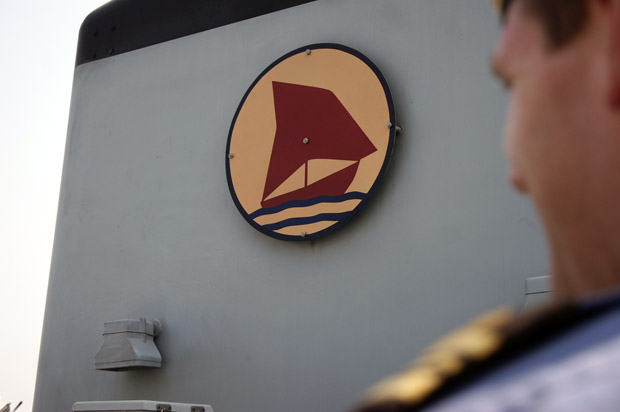
The expanded MCM force in the Gulf has now been given the collective identity of 9th MCM Squadron. The badge has already been worn by MCM forces of the Royal Navy in the Gulf in the past

The US Navy does more or less the same using the USS Ponce, an old LPD that instead of being withdrawn from service was refitted and transformed into a capable Afloat Forward Staging Base. The US Navy, which has had to deploy its minesweepers over a greater distance, all the way across the Atlantic, used Float On, Float Off vessels to carry the warships to the Gulf, in a demonstration of how difficult it can be to deploy the current generation of minehunting vessels over long distances. The minesweepers on their own would have needed at least 60 days to reach Bahrain, against 40 days of travel on the back of the FLO-FLO vessels Blue Marlin or Tern (both ships used for the super-transport), and on their arrival they would have needed a drydocking period to have the wear and tear of the travel fixed and remedied to.  

MCM global deployment, US Navy style
 
This is part of the reason why all major western Navies are trying to develop a working, stand-off suite of unmanned boats, underwater and air vehicles that can sweep a wide area of sea to remove enemy mines, without requiring the mothership to actually get close to the minefield. This would allow the removal of the single-purpose, wooden or glass reinforced plastic hulled minesweepers from the fleet, making space for larger, steel-built, ocean-capable vessels which would offer far greater deployability and flexibility.
It is the concept behind the american LCS with its MCM module. France has its SLAM-F project, the UK has the MHPC programme and Italy is planning to eventually replace the minesweepers of the Lerici and Gaeta classes with a OPV/mothership carrying an equal modular suite of unmanned vehicles. In this brief introductory piece to what I hope will be a series of posts I’ll be writing over time, I want to recall a major case of wartime difficulties with minesweeping, going back to the Royal Navy’s experience in the Falklands war. This also gives me the chance to talk about an act of bravery that does not really get recognized enough, and that I’m sure many do ignore completely.

In the task force that sailed south to retake the Falklands in 1982, there initially were no minesweepers, although it was fully expected that sweeping of mines, underwater EOD and other tasks were likely to be required, and a small MCM team sailed aboard the LPD HMS Fearless.
The absence of minesweepers was due to the elderly Ton class’s incapacity to safety face the long transfer from the UK and the heavy seas expected in the South Atlantic. The Hunt class was at the time yet to come, with the first two vessels yet to be delivered, and anyway it would have been a tough call for the newer hulls as well.

Unfortunately, the Argies were soon observed planting mines at sea. Admiral Woodward writes in his memories (“One hundred days”, book written with the help of Patrick Robinson):


One of our submarines had already watched the Args laying mines to the east of Port Stanley harbor entrance (called Port William, incidentally), which was after all the most obvious place for us to land. So we knew well enough that they were perfectly capable of laying mines across the northern end of Falklands Sound as well. For that matter they might even go for the Southern end too, depending on how many they had, how much time they had and whether they thought it necessary. And since it now seemed fairly certain that our General Directive would change in a way that which would render Carlos Water our automatic choice for the landings, I wanted to do my best to ensure that we did not lose half a dozen ships and a couple of thousand men four miles short of the landing area.


[…]


If I had been an Argentinian and had suspected even for one moment that the british were coming in to land in Carlos Bay, I would have laid as many mines in the north and south entrances to Falkland Sound as I could. That would have eliminated all worry about the Brits landing anywhere along either side of the Sound. It would have been a considerable weight off my mind. We did not, of course, know whether they had done just that… or something very like it.  

For my part, however, mine-sweepers and their special equipment I did not have, which meant that I would have to use something else – and the hull of a ship was the only suitable hardware available. The only steel which would go deep enough. Now, plainly I could not use the two indispensable Type 22 frigates Broadsword or Brilliant with their close-range Sea Wolf systems. I also clearly could not send in my remaining Type 42s Coventry and Glasgow with their invaluable long-range Sea Dart systems. And equally surely, it really wasn’t on to send a merchant ship or RFA. It had to be a ship though – and it would have to be a Royal Navy warship. But it would also have to be something cheap and cheerful which I could replace, like a 3000-ton Type 21 frigate. Like Alacrity. Like expendable Alacrity.

Now, I did not particularly relish the prospect of ringing up Commander Christophere Craig and saying, “Tonight I would like you to go and see if you can get yourself sunk by a mine in the Falkland Sound. By the way, I will put Arrow up at the northern end to observe events and in case she’s needed to pick up survivors.” Nor, when it came to sending the amphibians in, could I possibly follow the instincts of the fabled American Civil War admiral, David Farragut, who roared at the entrance to Mobile Bay in 1869, “Damn the torpedoes. Full speed ahead!”

I did neither. Instead I phoned Commander Craig on the voice-encrypted network and said, “Er,… Christopher, I would like you to do a circumnavigation of East Falkland tonight, all the way around to the south, then north up Falkland Sound and out past Fanning Head to rendezvous with Arrow.” I also told him to come up the Sound very noisily, exploding a few star-shells and generally frightening the life out of the Args. I added, “If you see anything move, sink it, but be out of there and home by dawn, so you are clear of the land before they can fly.”
He was silent for a few moments and then he said, “Umm, I expect you would like me to go in and out of the north entrance a few times, Admiral. Do a bit of zig-zagging.”
“Oh,” I said, feigning surprise and feeling about two inches high. “Why do you ask that?”
“I expect you would like me to find out whether there are any mines there,” he said quietly.
I cannot remember what I said. But I remember how I felt. I think I just mentioned that I thought that would be quite useful.
He replied, with immense dignity, “Very well, Sir.” Then he went off to prepare for the possible loss of his ship and people the best way he could. I shall remember him as one of the bravest men I ever met. This was Victoria Cross material but, strangely, only if it went wrong.

I personally felt awful not to have had the guts to be honest with him and wondered what the devil he was going to tell his ship’s company about their task tonight and about my pitiful performance, which, for a sea-going admiral to one of his commanders, beggared description.


Fortunately, there were no mines. Alacrity did her dangerous job that night, taking to occasion to sink the argentine tanker Isla de Los Estados, caught in the Sound in the light of a star-shell and pounded with the 4.5 inch gun.


Thus ended quietly, and no doubt gratefully so, an extraordinary story of courage, which will go, I’m afraid, largely unnoticed in the annals of maritime history. COMAW (Commodore, Amphibious Warfare, Michael Clapp) certainly was completely unimpressed by Alacrity’s efforts. But had it ended in tragedy it would have joined the sagas of Jervis Bay or Glowworm being presented to young naval officers of the future as a supreme example of selflessness and devotion to duty. If they had hit a mine, Commander Craig would have been most strongly recommended for the award of a VC – but, thank goodness, he didn’t.


Commander Craig lived on and continued his career with distinction. No VC for him, but he became Commodore and was the frontline commander of the british task force in the Gulf War, the conflict in which, showing that many lessons from the Falklands had been learned, a much improved Type 42, HMS Gloucester, with much improved Sea Dart missiles, shot down an iraqi Silkworm anti-ship missile in a worldwide first that has yet to be repeated.  

On 12 May, Carlos Bay became the definite objective for the beach head. Alacrity had done her job and allowed the campaign to proceed. On May 21st, the troops landed on the beaches of San Carlos bay.

It was only on May 26 that the 11th Mine Counter-Measure Squadron, a formation purposefully stood up for the South Atlantic campaign, reached South Georgia. The Squadron was formed requisitioning five deep sea trawlers from Hull and fitting them with rudimentary MCM equipment. The crews for the five ships came from the Ton-class minesweepers based in Rosyth.
The vessels so obtained (HMS FARNELLA, HMS CORDELLA, HMS JUNELLA, HMS NORTHELLA and HMS PICT) initially worked to transfer stores across the task force and towards the beach heads, before serving in their intended role, finally clearing Port William waters between 23 June and July 4. It was only in early July that two new Hunt-class minesweepers could arrive in the area to complete the job.
I strongly encourage everyone who reads this piece to go read this brief but detailed account of the activities of the “forgotten few of the Falklands”: the men of the Minewarfare, Diving and Explosive Ordnance Disposal units.

Waiting so long to have minesweepers, even rudimentary, was a non-starter, during the Falklands campaign, which was dramatically constrained and absolutely had to be closed in short time, before the ships were worn out and the winter could set in.
It is worth remembering that the Falklands Campaign was planned with the awareness that the task group would, in Woodward’s effective words “fall apart” by mid to late june, due to the ships receiving no adequate maintenance and spending all their time out in the hostile South Atlantic. The arrival of winter would have made pretty much impossible to sustain the tempo of the operation, and the ships would have had to turn back and head to a port.
Already in the planning phases it was evident that the land battle had to be won by the end of June at the latest, and preferably a good two weeks before that. As a consequence, to make sure that land forces would have a reasonable time to reach Port Stanley, the soldiers had to go ashore by about May 25, not later. To sustain the campaign, the sky and sea had to be sufficiently clear to allow operations and, crucially, to enable the transfer of stores, men, vehicles, fuel and ammunition from the ships to the shore, by both boat and helicopter.
The margins were incredibly tight, also considering that the LPD HMS Intrepid had been destored in March and put in reserve as part of the disastetrous cuts of the John Nott’s defence review, and she had to be re-stored and brought back to operational status before she could sail south.
Weather and strategic considerations, plus the availability of HMS Intrepid constrained the definition of the “window” of time in which the amphibious landing could take place: it had to happen between 16 April (earlier date at which HMS Intrepid could be available) and 25 May.

It is a good thing that the Args did not have the capability to establish larger minefields. They would have posed a tremendous challenge, and potentially derailed the whole campaign, in consideration of the unavailability of proper minesweeping equipment and, crucially, the pathologic lack of available time. 
Time is always a crucial factor, in any war. But the Falklands campaign is probably the one war that has been shaped the most by choices of timing. It is worth reminding, and admiral Woodward himself never made a mystery of it, that had the Args waited six months more, the islands would now be called Malvinas for real. Six months would have seen the Argies in a stronger position (with the Etendards carrier-qualified, so able to deploy their Exocet missiles far further out at sea) while the cuts mandated by the John Nott's defence review would have had removed Britain's capability to react by removing from the ORBAT the carriers and the LPDs. 

On Sunday 13 June, the Task Group was, as was to be expected, effectively falling apart. Only three vessels in the force had no major OPDEF (Operational Defect) to report, and these were Hermes, Yarmouth and Exeter.
Fortunately, the war was over, with the surrender of the argentine garrison in Port Stanley on Monday 14, in the times that had been anticipated. HMS Invincible, that had had to deal with big trouble almost immediately after setting sail, dealing with a gearbox which wouldn’t work, had now to sail well clear to the north, escorted by the frigate Andromeda, to undergo an engine change.
As expected, by then the weather was changing, and the ships had to endure a monstrous tempest with force 10 gale winds, confirming that, for very good reasons, there was no time to waste.


Conclusions
There are many examples of how much of an impact mines can have on impeding operations. They are very effective at slowing down the pace of the opposition’s ops, and this at times can, in itself, bring to victory. Unfortunately, the current minesweeping vessels are slow, not genuinely globally deployable and limited in terms of usefulness outside of their very specific role. They are as incredibly precious, in other words, as they are frustrating.  

I’m firmly convinced that the times are now mature for motherships much less specialized and much more multirole and flexible, equipped with modular mission payloads. The emerging unmanned stand-off MCM capabilities have the potential to make sure that the unfortunate HMS Alacrity of the future will be able to reconnoiter a waterway not with their own hull, but with the help of unmanned boats and sensors they will be able to deploy from cargo decks. We can think, specifically, to the future Type 26 frigates, with their mission deck capable to take 11 containers of equipment and/or boats, manned or unmanned.

The modular payloads will extend the capabilities of warships in many roles, not just in the MCM field. Unmanned vehicles will most likely grow more and more important in ASW missions as well, for example. And while the minesweeper as we currently intend it will possibly disappear, there will be a new, exciting chance to build multirole vessels with far greater logistical endurance and deployability and with utility across a much wider range of roles.

In the coming posts, it is my intention to talk about the ongoing development programs, from MHPC to SLAM-F to the LCS, tracing a story of this important turning point in the history of naval warfare. 

Thursday, August 29, 2013

Thinking about MARS Solid Support Ship


A post by Solomon up at SNAFU has pushed me towards a return to the subject of the crucially important and very interesting MARS Solid Support Ship requirement. I want to briefly explain why, in the Royal Navy that is taking shape in these years, the MARS SSS is crucially important and why giving it RoRo and amphibious capabilities would be an excellent investment.

The discussion is inspired by some early concept images of the MARS SSS ship which have made it out of MOD circles, reaching the public. These images show large, ambitious supply ships with three Heavy RAS stations, two large cranes supporting a couple of LCVP MK5 landing crafts, a RoRo deck with ramp and, apparently, an enclosed well dock, in addition to a large two-spot flight deck and hangar arrangements for three Merlin helicopters, folded.

The objection moved is that MARS SSS looks like a ship that is trying to do too much. In part, it is a correct observation, because MARS SSS comes from the merging of two different requirements. In origin, the Military Afloat Reach and Sustainability (MARS) program was due to deliver six fleet tankers, two Solid Stores replenishment ships and three Joint Sea Based Logistics vessels.
Years of budget cuts have had a dramatic impact on MARS, with its separation in separate workstreams and with a tough reduction in the number of hulls. The MARS FT (Fleet Tanker) workstream, after many long delays, settled for the delivery of four 37.000 tons tankers, with hulls built in South Korea to british design.  The Joint Sea Based Logistic requirement has been killed by the insufficiency of funding, leading to a merging with the Solid Stores replenishment requirement. From an initially envisaged 5 vessels of two types, we are down to aspirations for three vessels of the same design.

With MARS, the Royal Navy had hoped to return to a clean separation of roles between Auxiliaries, taking a step away from the concept of “one stop” replenishment vessels such as Fort Victoria and Fort George, which have been built to be able to provide both fuel and solid stores during a single RAS contact with supported warships.
Following the cuts, while the neat distinction between Tanker and Solid Support vessel will be reinstated, some degree of fusion between requirements is expected to be part of the Solid Support Ship, as the alternative is abandoning every ambition of providing better afloat logistics support to ground troops ashore. The JSBL vessels was to be able to provide stores and support, including maintenance workshops for helicopters and land vehicles, for a up to a complete medium weight brigade engaged on operations even well inland. We’ve never quite gotten to explore the design of such a vessel, since the requirement has been killed before we could reach the stage of the first designs, however extensive Forward Aviation Support (FAS) capabilities, plus a RoRo cargo deck and some means for the transfer of large loads and vehicles to and from landing crafts for delivery ashore were all key points of the ship’s concept.

The MARS SSS will thus need to harmonize the requirements of a Stores replenishment ship, optimized for the support of aircraft carrier operations, with the requirements connected with the support of ground forces in action ashore.

This merging of requirements fits into a wider picture which sees the Royal Navy condemned to do a lot more with a lot less. With the effective, silent death of any program for the replacement of the LPH capability offered by HMS Ocean and by HMS Illustrious, the Royal Navy is reduced to hoping that both of the Queen Elizabeth (CVF) class carriers can make it into active service not as pure strike carriers, but as multirole Landing, Helicopter, Aviation vessels (LHA). This need has been recognized publicly and openly for the first time in the SDSR 2010, with the unveiling of the Carrier Enabled Power Projection plan. The QE-class ships will routinely only carry a single squadron of F35B, but will complement it with elements of a Royal Marines battlegroup, with support helicopters including Chinooks, Merlin and Apache gunships.

As a consequence, the Solid Support Ship will be required to support a carrier which is also an amphibious assault platform, at the centre of the Response Force Task Group of the Royal Navy, an integrated force which replaces the earlier, separated Amphibious Ready Group and CVS battlegroup.

MARS SSS should enter service “around the middle of the next decade”. In fact, during planning round 2011, the Ministry of Defence decided to extend by two years the service life of the current replenishment vessels, Fort Austin (which had been mothballed in 2009 but was brought back in service with an SDSR 2010 decision and a big refit) and Fort Rosalie, so that they are now due to retire in 2023 and 2024. I’ve not been able to find an official, up to date indication of OSD for Fort Victoria, which is younger but has the problem of being an Auxiliary Oiler Replenisher carrying fuel in an outdated single-hull structure. My guess is that she could bow out in 2025.
Fort Austin and Fort Rosalie have a full load displacement of over 23.800 tons, and can carry up to 3500 tons of solid stores in four holds with a total capacity of some 12.200 cubic meters. They have a single spot flight deck and a large hangar, the top of which can be used as an emergency landing platform. Up to four helicopters can be embarked.
Fort Austin has been fitted with two Phalanx CIWS guns, on the two wings of the bridge, prior to sailing with the Cougar 13 task force. You can see them in the photos by Cherbourg Escale


The concept art released for MARS SSS clearly shows a Ro-Ro ramp access (closed), a couple of LCVP MK5s with cranes, a triple hangar for Merlin helicopters and a large, two-spot flight deck. The stern view shows what seems to be a well dock, open for boat operations. Two H-RAS masts are present on the port side, while only one is provided starboard. The RAS masts on the port side are positioned to be able to link up to aircraft lifts openings in the hull of the Queen Elizabeth class aircraft carriers.

Fort Victoria is newer and larger. Designed as a single-stop support vessel capable to provide both fuels and dry stores, she can carry some 70.000 barrels of fuels and oils along with 6234 cubic meters of dry stores. She displaces more than 32.000 tons. She can operate with up to five helicopters and is fitted with a couple of Phalanx CIWS guns for self defence but is no longer compliant to law as she is a single hulled oiler. 

Her sister, Fort George, was decommissioned in the SDSR 2010.


Roles for MARS SSS
The MARS SSS depicted by the concept art is a large, ambitious vessel, but far less compromised and overtasked than other proposed or realized European “Joint Support Ships”, as the JSS normally combines tanker, solid stores and RO/RO amphibious role all in one.
MARS SSS would at least be relieved of the tanker role, and the vast cargo holds needed for solid stores, including ordnance, are relatively compatible with the need for a RoRo deck, with ramp, and even with a well dock. The well dock would be the best way to ensure that the vessel can send stores and vehicles to the forces ashore, in mostly every sea condition, thanks to the controlled environment of the enclosed dock.

The well dock would also enable MARS SSS to embark some landing crafts or the future Force Protection Craft when deploying as part of the Response Force Task Group. This capability, along with the Ro-Ro cargo deck, is important because it would make up for the future loss of the four LCVP MK5s that HMS Ocean currently brings to the party. Ocean also has a (relatively small) space for vehicles and stores, which can be driven onto landing crafts thanks to a ramp leading down to a “steel beach” in the stern, which during operations is expanded with the use of a pontoon that the ship carries, folded, on her flight deck.

The new carriers don’t have a reserved space for the embarkation of vehicles, have no ramp and no steel beach. If vehicles for the amphibious force are to be carried, they have to be craned onto the flight deck and moved into the hangar with the aircraft lifts. During an amphibious assault, such stores and vehicles would only reach the shore if they were Chinook or Merlin portable, as under slung delivery would be the only realistic option. It is not clear yet if the boat bays of CVF are compatible with LCVP MK5s. The carriers have a boat boarding area in the stern, which can be reached by soldiers and sailors thanks to stairs. Marines could use this, weather permitting, to climb aboard landing crafts coming from the LPD and LSDs in the task force, but an additional well dock and more landing craft capacity would no doubt be welcome during operations.  


HMS Ocean's ramp and steel beach. The poonton in the water is carried, folded, on deck, and deployed by crane. HMS Ocean has a relatively small vehicle deck and carries four LCVP MK5. The aircraft carriers that will have to replace her due to the impossibility of funding a dedicate replacement do not match these particular capabilities. MARS SSS could step in and remedy to this.
 
Concept Art showing the hangar of the CVF carriers


The boat boarding area

MARS SSS is shown carrying two LCVP MK5s on davits, which could be replaced by Force Protection Crafts were the boats to be more adequate to the missions, but a single-bay well dock capable to take a LCU or support operations of the LCVPs and FPCs once they are lowered in the water would be a major enhancement.

The well dock would also be particularly useful in the Gulf. For what I can see now, I can only guess that the Royal Navy will be busy in Operation Kipton (the enduring presence in the Gulf of minesweepers and support assets) for many more years. And according to MOD data, the current minesweepers will not begin to be replaced by new vessels before 2028, which means that well into the 2030s they will need intimate support of a mothership whenever they go. The Hunt and Sandown are excellent ships, perfect for their job, but aren’t really deployable and only have a logistic endurance out at sea of around 14 days.

That has forced the Royal Navy to constantly support the four ships in the Gulf with a larger support vessel capable to pass on fuel and stores. With the risk of hostilities in the area always being so high, a flight deck for helicopters is also badly needed, being helicopters excellent to detect and fight back fast attack crafts that could, in theory, swarm out of Iran very quickly were things to get hot. UAVs and force protection boats are also constantly in action to keep the force secure, and all the requirements of these supporting elements have made large, capable support vessels simply indispensable.
The US Navy converted an old LPD, the USS Ponce, into a capable Afloat Forward Staging Base, and this vessel provides command, control, communications, a large flying deck for helicopters and a well dock for boat operations.
The Royal Navy cannot afford such a top class solution, and is consequently forced to constantly commit one third of its LDSs to the “Seabase” role in the Gulf: one of the Bay class LSDs is always serving in the Gulf, looking after the minesweepers, and this has a very evident knockout effect on the amphibious capabilities of the UK. The madness of withdrawing Largs Bay from service, selling it to Australia, only made things worse. 

USS Ponce and Cardigan Bay together in the Gulf, followed by the minesweepers that they support and protect. Cardigan bay shows the hangar she has finally been fitted with, and the Marinised Land Phalanx Weapon System installation on the cargo deck.
 
The Bays have been steadily increasing their capabilities in these years: from very simple, lightly-equipped LSDs, they have been evolving into capable seabases. They are being fitted with Data Link 16 and complete communications suites removed from the retired Type 22 Batch 3 frigates. They are getting remotely-controlled 30mm gun turrets as the combat vessels in the fleet, and Cardigan Bay, the ship currently in the Gulf, finally also sports a prefabricated hangar structure on deck, which finally gives adequate protection to embarked helicopters and UAVs and their ground crew as maintenance is carried out. Possibly, the other two vessels will also get hangars of their own in the next future: Mounts Bay has been used as an auxiliary aviation ship while RFA Argus was undergoing her latest refit, and she had to resort to walls formed on deck with empty containers to provide some shelter to the helos. A solution not unlikely the emergency fitting of Atlantic Conveyor for the Falklands War!
Cardigan Bay has been serving as a base for US UAV teams, and is almost certainly going to be the first Royal Navy ship to get the newly ordered, much awaited Scan Eagle drones the MOD finally funded. Cardigan Bay will, at least for the next future, only have a contractor-owned, contractor-operated Scan Eagle task-line, with a second task-line to be made available for embarkation on Type 23 frigates afterwards. Hopefully, it is only the first step towards a greater availability of UAVs for the Royal Navy.
A couple of Diving Teams and reconnaissance parties with REMUS unmanned underwater vehicles also operate from the Bay, which can provide an excellent base to all boats with her rafting system and well dock. Finally, the ship also embarks a Role 2 Medical Team: a tri-service, deployable surgical field hospital.

The Bays are also getting fitted with Phalanx CIWS Block 1B, eventually uplifted to Baseline 2 standard, the latest and most capable. initially the Bays deploying to the Gulf have been fitted with “Marinised Land-Based Phalanx Weapon System" (MLPWS), which are, put simply, the Centurion C-RAM guns that the British Army deployed to Basra during operations in Iraq. Removed from the trailers and bolted to the cargo deck of the Bays, the MLPWS have been the solution so far, but Lyme Bay now shows, first of the three sisters, properly integrated Phalanx guns installed in the intended positions on the superstructure, over the bow and overlooking the stern. It is hoped that the other two ships will be eventually fitted out to the same standard.  

This close up better shows the temporary solution represented by the MLPWS Phalanx fit


RFA Lyme Bay, deployed on Cougar 13 right now, shows, for the first time, a properly integrated fit of Phalanx CIWS guns, placed in the intended, originally Fitted For But Not With positions.


The Bays could have been fitted with Goalkeeper mounts, but the Royal Navy is standardizing on Phalanx and will withdraw from service all Goalkeeper mounts by 2015. The positions evidenced in the photos above have now been used for Phalanx, at least on Lyme Bay. It is hoped that all three ships will be similarly outfitted. A careful look at the photos will also show that Cardigan Bay and Lyme Bay show new radomes, probably part of the Data Link 16 and communications fit coming from the withdrawn Type 22 frigates.


The hangar fitted to Cardigan Bay is built by Rubb Buildings Ltd. Australia acquired one of these hangars and had it fitted on the ex-Largs Bay, now HMAS Choules, in the photo.
 
Improved weapons fit: this photo shows Cardigan Bay fitted with 30mm guns an M134 miniguns

The Royal Navy also maintains in the Gulf and Indian Ocean a variety of other support vessels, including a tanker, the forward repair ship RFA Diligence (working hard in support of the SSN presence constantly maintained “East of Suez”) and the Auxiliary Oiler Replenisher (AOR) Fort Victoria.
MARS SSS, if fitted with a well dock, could tick all the boxes and provide a perfect seabase for the UK to maintain in the Gulf Area. Instead of maintaining a tanker, an LSD and an AOR in the area, the Royal Navy would possibly be able to cover both the AOR and minesweeper support roles with the same ship, releasing the LSD back to its main role as amphibious vessel.
The vast hangar, the large flight deck, the unmatched capacity for stores and the well dock would make MARS SSS perfect to sustain the minesweepers and the other vessels working in the Gulf. Hopefully, the Riverine Command Boats employed by the Americans from Cardigan Bay’s well dock would in time be replaced by british Force Protection Crafts, increasing the security of the force in the area. 

Boats in the well dock 
 
American Riverine Command Boats (CB90s) operating from a british Bay vessel in the Gulf. The CB90 has been evaluated by the Royal Marines as a possible base for the Force Protection Craft.

The requirement for extensive, excellent Forward Aviation Support capability is nothing new for this kind of unit in the Royal Navy. The current Fort-class vessels themselves have very extensive capability in this field, with up to 5 or 6 Merlin helicopters able to work from the ships’s deck and facilities. The ability to support a large number of helicopters from the new vessels (the concept art suggests hangar bays for three Merlin, with a big, Chinook-capable, two-spot flight deck) would maximize their capability to operate, even alone, on complex constabulary tasks during peacetime. During high-intensity ops, the ability to embark ASW helicopters would relieve the carrier’s flight deck from some of the pressure, and this is crucially important following the cuts the Royal Navy has suffered: with the carriers now condemned to be replacements for the LPHs as well, they will be required to carry a lot of machines and stores and men. Even as big as they are, in a major operation requiring both a high number of jets and capable amphibious forces with their helicopters they will be filled to capacity quite quickly. If there’s one certainty about aircraft carriers, simply put, is that they are never quite big enough.

Three MARS SSS ships could be tasked to provide one vessel “on station” in the Gulf, and another to assign to the RN Task Group. If MARS SSS was built to the specifications suggested by the concept art, the new vessel would be able to act as a major force multiplier in both roles.
Speaking about Type 26, Cmdr. Ken Houlberg, Royal Navy who, until August 2012 , was the Capability Manager for Above Water Surface Combatants at the MOD, said:

“There will be no more destroyers or frigates. There will be combat ships.”

Similarly, it looks like the RN hopes to build more than simple replenishment ships. Seabases would be a better description.


Cutting costs and complexity with a steel beach?
The usefulness of the well dock is pretty much unquestionable. But in an age of budget difficulties, its cost and the complexity that it adds to the design of the vessel is what caused the most perplexity. It is possible that cost cutting would remove the dock and replace it with a simpler “steel beach”, with a ramp leading down to the water from the RoRo deck. It would be a serious reduction in the capability to support boat and landing craft operations in hostile weather and sea conditions, but it would take less space, less money and it would be much simpler to add in the design.

A good example of support vessel sporting a RoRo deck complete with steel beach is the new multipurpose dutch Joint Support Ship, the Karel Doorman. This 205 meters long, 28.000 tons vessel is an immensely impressive beast, even if it is the result of many compromises. It can support ships at sea thanks to two RAS masts and a 40 tons crane. It can carry 730 cubic meters of ammunition pallets for some 400 tons of ordnance and 1000 cubic meters of dry stores. She carries 8000 cubic meters of fuel for warships, 1000 cubic meters of aviation fuel and 450 cubic meters of potable water.
In addition to all this, she has 2350 lane meters of Ro-Ro deck, complete with ramp of access and steel beach in the stern for cargo transfer onto landing crafts.
She sports a two-bay operating theatre as part of her medical facilities. She carries a couple of LCVP landing crafts as well as other boats, and she is equipped with an integrated I-Mast with a sensor fit comparable to that of combat vessels. For self defence, she is fitted with two Goalkeeper CIWS, two Oto Melara MARLIN turrets with 30mm guns, four Oto Melara HITROLE remote weapon stations with 12.7 mm machine guns and four SRBOC decoy launchers.
Finally, she has a huge hangar for six NH90 medium helicopters (folded) or two Chinooks unfolded, which can make good use of the huge 80 x 30 meters flight deck. 

The dutch JSS shows the stern "steel beach", right near the opening of the RoRo access ramp

Design detail of the steel beach

An image of the hull of the JSS during her building. The large steel beach is very evident


Her max payload is 10.600 tons, of which up to 5000 tons can be made up by armored vehicles and/or Ro-Ro deck stores. Her crew numbers between 150 and 175 men, with accommodations for 300 people on board. Her max speed is 18 knots, with an endurance of 10.000 nautical miles at 15 knots cruise speed.

The vessel is incredibly impressive and can prove its worth in many different operation scenarios and roles. Its Ro-Ro deck and steel beach provide a visual example of what could be put on MARS SSS, even if, for the reasons covered earlier, a full well dock is desirable.


A capable replenishment ship 
That is not to say that MARS SSS is not primarily thought to be an excellent replenishment vessel, optimized to support the new aircraft carriers, even in high intensity operations. In this that is their primary role, the new ships will be aided by the new Rolls Royce Heavy Replenishment At Sea (H-RAS) equipment, which will increase the current transfer capability of some 2 tons to larger, bulky pallets of five tons each. 
A working H-RAS system has been built on land at the HMS Raleigh base, which is being used to validate and trial the new system. The facility will then be used to train RFA and Royal Navy sailors in RAS procedures. 

RAS operations today with Fort vessels.
 
H-RAS will shape the new vessels, since their design and internal configuration will be largely determined by the need to move around such bulky loads, sustaining the far higher pace of RAS operations that the more than doubled payload transfer capability will make possible. Receiving such large, heavy loads in one go will be challenging for the supported ships, as well. It is likely that frigates and destroyers will mostly continue to receive the smaller pallets, unless Type 26’s design is optimized for the new system.
The larger payload capability will be crucial mostly for the new aircraft carriers. Currently, the standard RAS pallet is a 1000 x 1200 mm NATO base, with a loaded weight of around 1,8 ton. Resupplying an aircraft carrier during high intensity operations is a challenging task, as right now the transfer rate would be about a couple of 1000 lbs bombs with each pallet, for example.
H-RAS is meant to allow the transfer of 25 loads, each of 5 tons, per hour, while the ships travel at around 10 knots, with a gap from hull to hull of 50 or 55 meters. The improvement is dramatic. It is fair to assume that, if MARS SSS was replenishing HMS Queen Elizabeth during a major operation, some of the weapons could be passed to the carrier already strapped to Highly Mechanized Weapon Handling System-compatible skid pallets, which would then be lowered into the carrier’s deep holds and would be readily available to be picked up by the moles of the HMWHS system.

The 5 tons payload capability will also be crucial to enable the transfer of the F35B’s spare engines, enclosed in their transport containers. The current RAS systems are unable to move the heavy, bulky containers, and this would complicate the life for the embarked air group, requiring a greater number of spare engines to be immediately available on the ship.
The increased capacity of the H-RAS system will also be of great help in moving other heavy, bulky loads, such as Storm Shadow cruise missiles, which should be part of the future arsenal of the british F35Bs: enclosed in its shipping container, a single Storm Shadow weights 2150 kg and is well over 5 meters long. 

Storm Shadow missile being pulled out of its shipping container
 
The Queen Elizabeth class aircraft carriers will not have big problems in dealing with the new, bulky loads coming in, since they will adopt the same technique used by the US Navy, receiving the stores directly in the hangar, via the openings of the aircraft lifts. You can see a video and some photos of this evolution, as done by the US Navy. The main difference being that they call it Underway Replenishment (UNREP). 


US Navy UNREP operations aboard supercarriers


Both MARS Fleet Tanker and MARS Solid Support Ships are obviously configured to optimally support the new carriers. MARS FT, for example, has two RAS masts on the starboard side, so that it can easily link up to the two RAS fuel receiving stations on the port side of the QE-class carriers.
The MARS SSS vessel, instead, has two H-RAS masts on the port side, spaced out to coincide with the openings of the aircraft lifts on CVF’s starboard side.
CVF also seem to have another RAS fuel receiving station, under the forward island, on starboard side. 

Model trials of MARS Fleet Tanker and QE-class carrier, showing the RAS Masts and the two receiving bays on the carrier.

This curious image shows the french PA2, once planned to be built on the same design as the british CVF, receiving fuel at the RAS station under the forward wing while also receiving pallets of dry stores through the forward aircraft lift opening. The supply ship seems to be an AEGIR AOR design. None of the depicted vessels will enter french navy service, but the image is interesting as it depicts what will happen with CVF.

Another old image, courtesy of http://navy-matters.beedall.com/, showing H-RAS at work delivering containerized stores into the hangar of a CVF carrier.

This graphic, once released by the MOD as part of the bidding call for MARS FT, has been preserved by http://navy-matters.beedall.com/. The small arrows indicate the RAS stations. On CVF we can see the two fuel-receiving stations on port side. Two arrows clearly indicate the aircraft lifts openings as well, for H-RAS, while a fifth arrow signals another fuel receiving station.

Conclusions  
MARS SSS can and should be more than just a "solid replenisher" ship. In a navy hit so savagely by cuts, each ship must be able to cover multiple requirements whenever this is possible and efficient. It would of course be better to have more ships, and a neat separation of roles. But this is financially impossible in the current climate. And anyway, the british armed forces have sustained cuts so savage that realizing the once planned combination of two large replenishment vessels and three "seabases" would be realistically excessive. There wouldn't be amphibious forces nor aircraft carrier strike wings large enough to fully justify them. It is a sad truth. 
Freeing the Bay LSDs from the duties of Operation Kipton, on the other hand, would be a major achievement that would reinstate higher capabilities for the UK's amphibious force.

MARS SSS is a key component of a navy which is shrinking in size but not in ambition. So long as the UK aims to remain a globally engaged country, it needs expeditionary forces. And MARS SSS is a fundamental component of them. In "seabase" configuration, its usefulness is maximized in all roles.