I am fully
aware of the hate I will attract with this post as I write it, but I think it
is necessary to throw out a few punches and set out precise questions which I
would be delighted to see answered. It wasn’t my intention to write this, at
least until a few days ago, until I was teased into the argument by comments
that I personally judge ill-informed, about possibly obtaining savings by
removing “sacred cows” identified in the Fleet Air Arm and Army Air Corps.
I very much
think that the one big sacred cow in the room, however, is the independent air
force in general. I’m not the one who came up with the “100 years experiment”
definition for the independent air force, but I will admit that I am inclined
to agree with the arguments of those who did. Especially because proponents of
air forces so far have failed to present good arguments as a counter. Before I
discuss, with a particular focus on the UK, the reasons that make me think the
independent air force is too willing to preserve its very few elements of
uniqueness at the expense of those elements of airpower which are more closely
related to the other two services, I will formulate the base question:
What is the compelling logic behind drawing dividing lines between air power and the military tasks to which it contributes?
Whether you
believe it or not (and i'm sure many won't believe to it), I’m not an air force “hater”, nor a navy “obsessed”. I’m
“obsessed” with capability on land, on and under the sea and in the air, and
with the preservation of it. So I’m not by principle opposed to alternative
arrangements. If there are factual evidences and good arguments in support of a
single air warfare command which will ensure the Navy’s and Army’s needs are
not neglected, I will be glad to hear them. But to be clear from the start,
capability-wise, I will always consider a naval-capable squadron, able to serve
ashore and shipboard, more useful than a one dimensional, land-constrained
squadron. And that's exactly because i'm a great believer in airpower, and want all ranges of airpower applications to be available. Because capability means strategic options, reach and flexibility. If
it could be made to work, I’d even unify all three services into one, if it
meant making the UK forces a flexible, all-environment instrument. Something which would have, most likely, many points of contact with the USMC. So, if you could avoid the usual accuses of being anti-air force, I
would appreciate it a lot. Although I’ve off course known all along, while
writing this, that that will be the tone of many of the responses.
Please also
note that, while of course having the RAF and FAA and AAC at the centre of the
specific discussion, I’m posing questions not about the existence of the RAF,
but in general about the need for the independence of air forces. Worldwide.
Because it seems that the issue is indeed worldwide; cue many intestine battles
between services, recently including also the spat between Indian Air Force and
Indian Army about which service should own the new Apache attack helicopters.
I think it
is time to ask questions, and get answers.
That even
experienced military officers believe the air force should not exist as an
independent bureaucratic entity, is no mystery. Most recently, in the UK, before
and after the publication of the SDSR 2010 there was some rather serious talk
of removing duplication and reducing overhead by abolishing the Royal Air Force
as an independent service. Most of the suggestions, while coming from high rank
officers, where outside the closed doors beyond which the destiny of the
british armed services was decided. But even while going on mostly outside the
room, the discussion got loud enough that it eventually prompted the then
defence secretary Liam Fox to publicly announce that the review of alternatives for
the restructuring of the forces would stop short of service merging, and Joint
Forces Command instead came out in the end. JFC is, however, in good part another
mouse born by the mountain, yet another command added on top of the others,
like the earlier “smart” creation of the Joint Helicopter Command, a 2-star HQ
to give the Army control over support helicopters which it really should own,
but that for some reason are in the RAF. One of the tasks of Joint Forces
Command is to preserve ISTAR capabilities, many of which are delivered through
air assets, from single-service thinking and ensure that capability, rather
than single service ownership, guide the planning.
JFC’s birth
however has not been able to avoid the gapping of vital Maritime Patrol
Aircraft capability, and it couldn’t even prevent the SDSR from containing the
horribly misguided decision of achieving savings by withdrawing Sentinel R1 and
Shadow R1 aircraft from service as soon as operations in Afghanistan were to
end.
Thankfully,
on this front, a victory has been achieved in more recent times by securing (at
least until the next SDSR brings to more havoc and infighting) the future of
these platforms at least out to 2018. One of several U-turns, some simply
massive, which authorize any and everyone to, simply, say that the SDSR as
published in October 2010 was as good as toilette paper. The complete failure
of that document, evident at first reading to any informed observed, became
glaringly obvious for all others already in July 2011, when the promised army
of 94.000 regulars was revised all the way down to 82.400, not even ten full
months after publishing.
JFC recently
obtained another victory by helping the Navy to secure funding for bridging, as
much as possible, the gap that was about to open in the capability of obtaining
Airborne Early Warning (AEW) surveillance for ships out at sea. AEW is
absolutely fundamental to protect ships from over the horizon missile attacks,
due to the physical, unavoidable limitations that a surface-mounted radar (such
as that of a warship) has in identifying low-flying threats at useful range.
Lack of AEW in 1982 was among the biggest weak points in the task force’s capability:
warships have been lost due to the difficulties of countering sea-skimming
Exocet missiles due to the lack of aircraft / helicopter-borne radars. Despite
this awareness, AEW was about to be gapped for four or more years until last
year, when funding was won over to life extend the Sea King MK7 and its AEW
system out to 2018, while speeding up the replacement programme, CROWSNEST,
which will put an AEW radar payload on Merlin HM2 helicopters hopefully in time
to almost completely close the gap (even though Initial Operational Capability
is still planned in 2020, the first radar sets should be available earlier,
hopefully in 2018).
Brutal
budget cuts are at the root of the ill informed decisions of the SDSR 2010, of
course, but there is more than that about them. Single-service thinking has had
an evident part in deciding where to direct the axe. The independent air force
has worked to protect its independent core capability as much as possible,
while directing the pain on those capabilities more joint in nature. The Nimrod
was RAF owned and RAF manned, but its main mission was of crucial importance to
the Navy, more than to the air force itself: MPAs are essential in protecting
movements of SSBNs and in assisting warships in the difficult job of locating
and attacking enemy submarines. It was once said that, due to the range and
speed of the Nimrod, it was worth a dozen frigates in terms of area
surveillance. Now MPAs are gone, and frigate numbers have definitely not gone
up either.
Sentinel R1
is a long range flying radar meant to detect and track fixed and moving targets
on the ground. It is a system most useful to the Army, and born out of a
British Army requirement dating all the way back to the 70s, indeed, not by a
RAF one. The Sentinel R1 squadron is jointly manned, and actually includes
hundreds of army personnel. Shadow R1 is another ground surveillance and
intelligence asset, a key support for the army, less keenly needed by the RAF. It
took the operations in Libya in 2011, which had Sentinel R1 used prominently to
track ground targets to the benefit of the air force attack aircraft, to
significantly increase support for Sentinel in the RAF top brass.
A whole
book would then have to be written about the history of the Harrier, and on how
suspicious years of RAF mandated cuts to its numbers look, up to the final, early demise in 2011, which
of course hurt the RAF, but hurt the FAA way worse, leaving it without fixed
wing aircraft and leaving the nation without the ability to deploy airpower at
sea for almost a decade. The Harrier force was subject to constant funding and
manpower squeezes even while covering the Afghanistan deployment: it was never
built up to the four frontline squadrons planned. Already in 2006, the three
squadrons were instead cut down in size, from 12 to 9 aircraft each. By 2009,
reductions had constrained the output so much that the comparison with the
Tornado GR4 fleet, still numbering 7 frontline squadrons, was extremely
unfavorable, and in early 2010 things got even worse as the frontline force
reduced from 3 to 2 squadrons, as one had to re-role as training unit when the
existing OCU squadron was disbanded.
In October,
it indeed looked right to cut Harrier instead of Tornado due to the massive
output difference. However, it soon became evident that the benefit of being a
much larger force was partly overrated, as the Harrier fleet was already too
small even for achieving the savings needed by withdrawing it from service. The
Tornado force had to finally shrink to 5, and then further down to 3 frontline
squadrons. It would now be about to drop to just 2, wasn’t for operations in
Iraq and for the Typhoon’s enduring insufficient air to ground capability
making Tornado the last remaining suitable strike platform. Anyway, there are
now 102 Tornado GR4, around half of which parked in the sustainment fleet,
sustaining a Force Element at Readiness capability of 18 aircraft. They are
almost down to the FEAR of 10 aircraft the Harrier force had at the time of the
SDSR.
Had the Tornado
fleet shared the pain between 2006 and 2010, instead of being protected at the
expense of the Harrier, and had the number of frontline squadrons thus remained
more closely comparable between the two fleets, the SDSR would have almost
certainly cut Tornado, not Harrier. First Sea Lord Jonathon Band had seen it coming, but too late. He was only able to
delay the final blow by a little.
The RAF is
not the only service making decisions that cause trouble for another, of
course. Again in the SDSR 2010, Navy HQ and Army HQ had a bit of a fight over
the intention of the army to disband much of the army capability (artillery and
engineers) which support the amphibious Royal Marines brigade. But with the air
force, problems seem to be especially frequent and serious.
Although
not the happiest of solutions, doing away with the independent air force has
merits that go beyond doing the reverse. Absorbing the FAA into the RAF would
have marginal manpower impacts unless it meant losing capabilities altogether:
after losing MPA and carrier air capability (at least temporarily) I don’t want
to think what a merger would bring about. There isn't that much overhead in a
force of 5000 in total which i believe has actually quite an excellent track
record of efficiency. The Army Air Corps is also quite small, and there isn't
going to be much that can be chopped off, unless absorbing it is another way to
say erase much of its fleet and output, sacrificing combat helicopters to pay
for more fast jets.
Training is
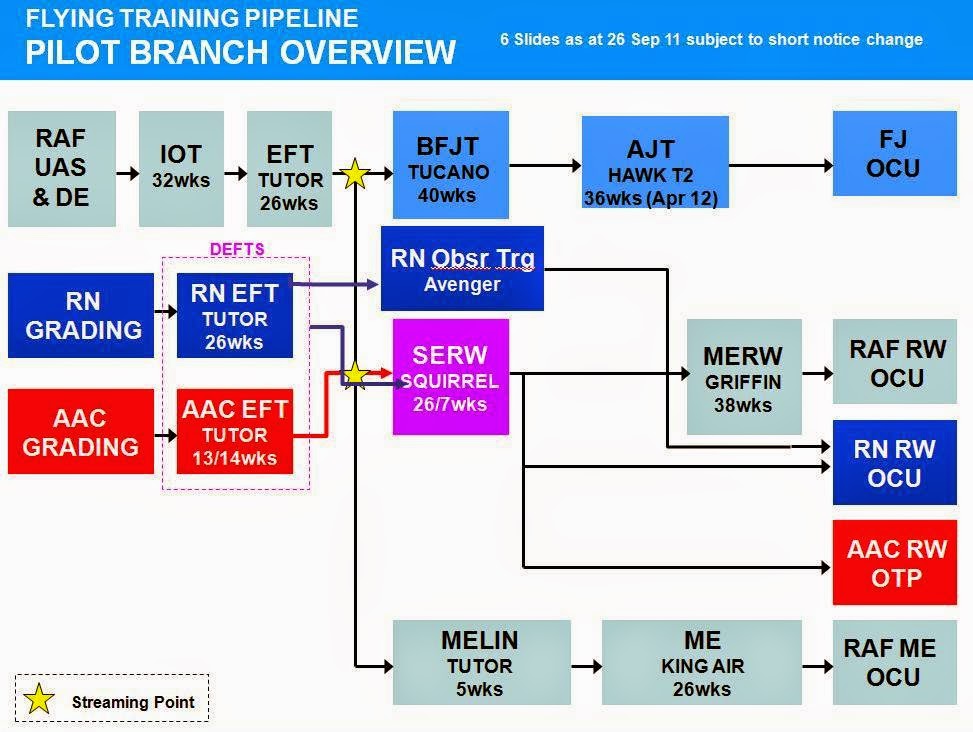
already largely joint, so there is not much efficiency to obtain there, either.
A merge that puts key naval and army airpower requirements completely in the
hands of a separate service? Gods, no. I can see nothing good coming from it.
Besides, even if you did put RAF and FAA together, there would still need to be a separation. The "habitat" shapes the force: the "naval" part of the service would still have its very own shape, and there is no real way around this fact. Unless you do away with much of the naval requirements when transitioning to an air forces only structure, you end up making the light blue darker to fit what you need it to do. Naval aviation and air forces are separated by a big fact that is as glaringly obvious as it is often overlooked: naval aviators live and operate routinely on land and on ships. Air forces only routinely know land ops. You can readily put a naval aviator ashore, and he will do all you expected him to do. You can’t take an air force pilot and put him on a ship with the same ease. There’s a need for additional competencies and training, and the ship-capable aircraft have different requirements, shape, and equipment fit. You can build an air force on land with aircraft built for naval work and crews trained for naval work. But you can’t do the opposite.
There are also issues in how manpower is employed and how much it is expected to be deployed away from home. Even after the recent changes (april 2014) to Harmony Guidelines, the RAF personnel is still supposed to be away from home a maximum of 468 days in 36 months, against 498 for the Army and 660 for the Navy. Previous guidelines were more restrictive and awkward to use because not all of them related to the same 36 months period, and the RAF's ones called for a rather rigid mechanism of deployments and break periods which wasn't really suitable.
Joint
Helicopter Command and Joint Force Harrier have both been built based primarily on the Harmony
Guidelines of the Royal Air Force, which contemplated shorter tours, more frequent, to a 1 in 5 measure of deployed personnel (like Army guidelines) but with less total time spent deployed.
In order to
synchronize deployments of aircraft and helicopters with the warships, though
(which can be at sea for up to 9 months), guidelines have to shift towards Navy
values. Please note that the 660 days for the navy are not necessarily indicative of a combat tour, but tipically refer to total time spent away from home base, which normally include a significant number of
days spent in foreign ports, getting some rest ashore. Away from home, but not locked in
combat. Still, the differences build up to significant numbers, and Sea King HC4s and MK7s have been operating in Afghanistan for a long time looking to meet 660 days targets, due to the respective forces being too small to do differently. Navy personnel has been deployed on long tours with little percentual breaks of service harmony guidelines due to the 660 days figure; RAF personnel, in many areas, has served longer than mandated tours, and this has been reported as a significant breach of harmony guidelines for lots of personnel, due to the target days away being much lower.
In 2009 the Army was also missing harmony figures for the Apache fleet due to the still insufficient number of crews to sustain a 1 in 5 rule (the Apache fleet was basically built up during the conflict, deploying pretty much immediately after achieving entry in service), doing instead a 1 in 4, while Sea King personnel did a 1 in 3-some.
Doing it “navy
style”, compatibly with the aircraft’s need for maintenance periods and with
the crew’s need for rest and relaxation, offers the chance to do more with less
manpower, although 660 days deployed into an enduring conflict would be too much, and would ideally require an adjustement in itself, due to a combat deployment not including days ashore in friendly ports.
On the army front, if you give the Army the support helicopters, you no longer need a JHC either. That's another saving. One that other nations have discovered long ago, by the way. With all due respect to those who serve in JHC and that over the years have indeed managed to make it useful and effective in assuring ground forces access to rotary wing air mobility, JHC remains a duplication created to remedy to another duplication. The army is the user of the support helicopters. Why is the RAF still clinging to them, requiring a purple (read: joint) 2-star headquarters which ensures the army controls how the helicopters are employed, without owning them. Wouldn’t it be simpler if the Army owned the helicopters? Of course it would be.
The RAF
refusing to let the Army control the helicopters it needs to move its soldiers
on the battlefield is an oddity. I can think of a similar oddity (but even
here, less pronounced) in Germany, where the Luftwaffe controls the huge CH-53
helicopters. But this is partially justified by describing them as a
“strategic” capability and a complement to the cargo aircraft due to its huge
payload and the ability to act as a tactical airlifter from airports to Forward
Operating Bases. The army support helicopters (NH-90), however, are all being
given to the army aviation. Why? Because that is where they should be, as the
army is the user. JHC is an admission of this truth, which just fell short of
forcing the RAF to transfer ownership of the resource, and related budget.
Of course,
after 2001 other matters have kept the forces busy to the extreme, and thinking
of acting such a massive transfer of personnel and machines was unthinkable
while being deployed in Iraq and Afghanistan. But with Afghanistan over and
budgets being squeezed more and more, it is time to actually solve the problem
instead of trying to dress it up nicely in purple robes.
Cargo
aircraft also primarily serve the army’s needs. They transport, of course,
supplies to deployed air force elements, but they are there to transport heavy
material for the ground forces, vehicles and soldiers. The tactical cargo
aircraft have as primary mission the launch of the army’s parachute troops.
There is no real reason why Army Aviation can’t take over the cargo fleet,
other than the fact that air forces, in the UK and elsewhere, have sought to
limit the size and weight and role of fixed-wing aircraft employed directly by
the army. In the US, for example, there is a formal “contract”, known as Key
West agreement that limits the role of the Army Aviation and reserves roles for
the USAF after it obtained independence from the army in 1947.
I have yet to hear actually convincing explanations of why it would be beneficial to put the key capabilities of FAA and AAC into the RAF, instead. This debate has been going on for a long time, not just in the UK, and normally the argument in favor of air forces is that they "understand" and "champion" air power. If we ever get to a real serious debate on the matter, i feel there will be a compelling need to do better than this. Airpower was born and developed in large part before independent air forces came to life. Even strategic bombing started before the RAF. The UK built and employed its first bomber aircraft for initiative of the Admiralty, through what was then the Royal Naval Air Service. The RAF was the first independent air force in the world, and only formed on April 1st, 1918. The Royal Flying Corps for the Army, and the Royal Naval Air Service for the Navy, had developed squadrons, aircraft, tactics, ideas, and fought most of the 1st World War before an unified command took shape.
The USAF
had an additional A during the Second World War. It is true that during the
conflict it had already obtained a large degree of autonomy, but it was army's
territory: US Army Air Force. It didn't hamper the development of airpower
effects and application, and it took up to 1947 for the USAF to win
independence, and it was in no small part due to nuclear weapons.
Until
nuclear weapons were only air delivered, and the bombers were the principal
mean of delivering them, it made a reasonable amount of sense to have an
independent air force to procure, manage and employ them. But even then, I find
the rationale became weak pretty quickly with the nuclear bombs finding their
way on interdiction aircraft and even bombers (these especially in the US Navy,
of course) launched by aircraft carriers.
There are a
few examples in the world of joined up armed services where the air force is
the owner of the maritime and army support air elements. One example is Israel,
but the naval aviation component is composed literally by a handful of simple
helicopters and 3 light aircraft.
Another
example is the Netherlands, and another is Canada, the one nation which goes
closer to the UK’s force and capability levels, while still not getting close:
no amphibious force, no carrier air. It has maritime air wings, aligned to the
Atlantic and Pacific fleets, comprising maritime patrol aircraft and ship
flights, the latter in very serious troubles due to the catastrophic Cyclone
procurement mess. The dutch embarked elements also are in their own maritime
group, and also have difficulties of their own due to the endless problems of
the NH-90 helicopter.
Even by
joining up the elements of air warfare, there is still no escaping the fact
that the naval and army support elements have their specific nature and are
closely connected to the relative services. I’m not opposed in principle to a
single air warfare service, but I’m absolutely not convinced it serves the best
interests of the armed forces, nor am I convinced there are compelling
arguments in favor of a third service for the air elements. Moreover, putting
all air elements in one separate basket requires a joint mentality and a responsibility
towards the needs of the other services that I’m just not seeing in the way the
RAF has behaved over the years. Regardless of those who think I’m all about the
navy, I’m actually obsessed only by one factor: capability. I want to see the
widest and most complete range of capabilities protected, and putting the RAF
in charge of all air elements simply does not look like it will do the trick.
No airpower
element has been or is a genuine prerogative of the sole independent air
forces. Naval aviation, or the naval services in general, deal routinely with
ISTAR and AEW, satellite communications and surveillance, air defence, air
traffic control, ballistic missile defence, deep strike, nuclear strike. Naval
aviation shares the sky with the air force, shares weapons and tactics, and at
times even shares the same aircraft. What it does not share is the crucial,
special ability of embarking on ships and operate from them, and not just from
airbases ashore. Operating in the air is not an air force uniqueness, and it is
consequently not a valid reason for advocating an air-only service. If we were
to separate the services strictly due to the uniqueness of their operating
environment, the third service would not be the air force, but the Submarine
Service, as there is no environment with the characteristics, dangers and
uniqueness of the ocean’s depths.
If we look
at the Royal Navy in particular, we see it handles the most delicate and
complex of satellite communications, those with submarines out at sea. It
handles on a matter of exclusivity the delivery of nuclear weapons with the use
of the most complex weapons in service in the UK. It delivers part of the
training pipeline for rotary and fixed wing personnel, which is largely already
joined up. With the Type 45 destroyer it is the only branch of the british
armed forces which is actively looking at possibly building up a kinetic
anti-ballistic capability, having tracked satellites and ballistic missile
threats during HMS Daring’s 9-month cruise in the Pacific ocean in 2013 and
early 2014. Before being dismantled almost entirely in the late 70s, the Fleet
Air Arm routinely dealt with air to air refueling and had the ability to fly
limited amounts of cargo all the way onto aircraft carriers. The Fleet Air Arm
of today has experience only as receiver of fuel, not as giver, as it does not
operate any kit of tanker or tanker kit. However, since in the event of any
merge the tankers and much of the crew related to them would actually still be
the same, this is not as big an issue as it could appear. The naval service is
also very much adept to deep strike, being the owner of the Tomahawk missile
which so great a role has had in recent conflicts.
In short:
there is no shortage of understanding of the merits and possibilities of
airpower in the Naval Service. Until HMS Ark Royal (the fourth, the last
big-deck carrier of the RN) left service, the Fleet Air Arm actually did most
of the high end combat the UK forces have experienced after the second world
war. From Korea to the Falklands, moving through Aden, Suez, Borneo. No Royal
Air Force aircraft has been in the position to shoot down an enemy aircraft
since 1948. RAF pilots have, but only by serving in American and Fleet Air Arm
aircraft. While this is not a decisive fact in itself, it is worth reminding.
The almost
complete dismantling of the Fleet Air Arm fixed wing element in the late 70s,
which almost cost the UK the Falklands, was reasonable (and even then, not
entirely) in a defence posture which saw the UK focused on central Europe and
self defence. A UK which was very much retreating from much of the world and
going towards extreme specialization within NATO: it was all about the Rhine,
and anti submarine warfare. Here, aircraft based ashore were, for the most
part, sufficient. The Invincible class ships, which after the Falklands war
have been called aircraft carriers, weren’t real aircraft carriers: they were
born as anti-submarine through deck cruisers meant to carry a large number of
ASW helicopters and just enough Sea Harriers (around 6) to hopefully fight away
the URSS’s reconnaissance aircraft which would come forwards to locate the NATO
warships before giving way to Tu-22 bombers firing large volleys of enormous,
supersonic anti-ship missiles from well outside the range of ship-mounted
missiles. It was too little air defence capability even for that task, and
definitely too little to ever think about effectively fight back large scale
air attacks, but the concept at least made some sense. They Invincibles had to
be re-invented as aircraft carriers because getting rid of naval aviation was
soon proved to be a big mistake, and they did all they could. But they have
never overcome their intrinsic limitations.
When the
focus has widened again well beyond Europe, the role of carrier air has
returned all the more important. A factor which was partially understood and
addressed by ordering the Queen Elizabeth class aircraft carriers. But after
launching the programme, budget difficulties have caused a lot of hesitation
and messing around with the rebirth of naval aviation, leading to a series of
compromises that badly limit what could and should be.
There is
off course a reason why not all nations have a naval aviation: naval operations
have a cost. Aircraft meant to operate on ships are more expensive, also due to
the greater training needs for the air and ground crew both. Shipborne aircraft
also are normally somewhat limited in their kinetic performance by the unique
requirements they have to embody to be able to take off and land in 200 meters
instead of 3000. Plus, of course, the need for adequate ships on which to
serve.
However,
naval aviation gives the full range of strategic options. Air forces are tied
to air bases ashore, while naval aviation moves around the world with its own
mobile airfield, the aircraft carrier. Often, aircraft carriers won’t be the
only game in town during an operation abroad, as airbases will be available
within reasonable distance of the targets.
But in
other occasions, and the Falklands are an example, land-based air forces just
won’t do. The 2001 operations against the Taliban also were heavily dependent
on carrier air, which for the initial phase of ops accounted for up to 75% of
the sorties. When sand storms blocked land-based aircraft on the runways during
Desert Storm, carrier air was there to fill the gap. During the Suez campaign,
naval aircraft carried out the most of the air campaign thanks to their ability
to deploy closer to the targets. And so along.
The UK, as
long as it will remain a nation dependent on sea trade and globally engaged,
will need to be able to apply airpower at sea and from the sea. When a task
force puts to sea, it must have its own umbrella of aircraft for protection and
support, and the only way to achieve this result properly is by having a
carrier and naval aviation on it, trained to operate day and night in the ship
environment.
Being able
to operate on ships shapes the force like no other requirement. It determines
how the aircraft is built and it determines how personnel is trained and
deployed. You can unify the HQ level, but the truth is that you will be turning
the air force (or at least part of it) into naval aviation. Or you will simply be
losing naval capability.
Doing it
all from within the air force is something that was already tried in the UK:
the Fleet Air Arm formed in 1924 as a “naval” part of the RAF, but experience
made it evident that that wasn’t the right place for it, and in May 1939 it was
finally separated from the RAF and re-assigned to the Navy. Too late to correct
years of neglect before the conflict started, but in time to ensure the Navy
had its organic, vital airpower capability, which during the conflict proved
absolutely decisive and was quickly rebuilt, adapting air force aircraft and
purchasing US ones, into a formidable force.
Naval
aviation, at least the fixed wing part, has actually already been re-absorbed
into the RAF in the early 2000s, and in my opinion it was the repeat of a
mistake. By 2006, the Sea Harrier was gone, sacrificed, along with the air
defence capability it assured to the fleet, to fund the RAF Harrier GR7 upgrade
and, in smaller measure, yet new fixes and improvements for the ever troubled
Tornado F3. The result was the excellent GR9, a great machine for Close Air
Support and strike against land targets, but with little to no capability to
protect the fleet from air threats due to lack of radar and medium range
anti-air missiles. The Royal Navy reluctantly re-directed the Sea Harrier
upgrade studies, and even the new, more powerful engine towards the land
Harrier, “buying in” into the larger land fleet with the hope of securing at
least partial airpower at sea for the long term.
Meanwhile the
Tornado F3 was finally given the full AMRAAM missile integration the Sea
Harrier already had, but its numbers fell rather quickly afterwards, losing one
squadron to cuts (from 4 to 3) in 2003, then going down to just 1 squadrons in
2009, and finally leaving service in 2011. Ironically, the Sea Harrier was
denied funding in 2002 because it needed upgrades which were not worth the
expense, due to the OSD being “near”. The OSD had then been planned for 2012,
when it was still way too optimistically planned that the F-35B would enter
service. The upgrade plan was cancelled in favor of adopting the new engine on
the GR9, and the Sea Harrier OSD was moved ahead to early 2006.
The Sea
Harrier, even without the new engine could have brought its full AMRAAM
capability in help of the Tornado F3, while still being available to protect
the fleet in case of need. Instead, yet another questionable decision was
taken, preserving the land-only Tornado F3, at the cost of opening a capability
gap at sea which, even in the best case, was going to last longer than any
perceived reduction of capability ashore. Of course, the Sea Harrier FA2 were
less numerous (although a significant number of aircraft was actually parked in
reserve and could have boosted the operational fleet), had less speed and range
and had serious limitations to their ability to land with unexpended weapons on
an Invincible class carrier in Middle Eastern summer heat (the reason at the
base of the big upgrade plan with new, more powerful engines, which eventually
was shelved). But with Typhoon on the way and the days of the Tornado F3
counting down rather quickly, and with the likelihood of having to shoot down enemy bombers on the
North Sea very, very low, a compromise solution would have worked better, and
prevented the opening of such a massive and long-lasting gap in the ability to
bring airpower out to sea. Tell me, with a straight face, that the dragging
forwards of Tornado F3 at all costs wasn’t due, at least in part, to the RAF
not wanting to let the small Dark Blue Sea Harrier FA2 serve in QRA, even while
controlling them as a part of Joint Force Harrier.
But worse
still, as we saw, the Sea Harrier sacrifice was made twice as painful by the
fact that even the Harrier GR9 itself ended up having a very short, although
glorious, service history. The RAF directed the budget cuts onto the Harrier
fleet, again and again, and in just about 4 years from when the Sea Harrier
bowed out, it was all over for the whole force. Yes, Tornado GR4 was busy in
Iraq while Harrier was busy in Afghanistan: but even so, why cut one fleet and
never the other? To sustain an enduring deployment while allowing the crews to
have acceptable breaks between a tour and another, you need a minimum of four
squadrons. Why was the Harrier fleet constantly cut back and prevented from
achieving four squadrons consistency, while keeping all seven Tornado GR4
squadrons untouched until there just wasn’t anything else to sacrifice?
I judge
this a failure, because a better balanced outcome was possible, but was not
pursued. If RAF control translates into losing every capability that isn’t
purely air force branded, then it is the worst possible option.
Now it is
planned that the F-35B for the new carriers will be again operated jointly,
under RAF command and ownership of the budget line, base and aircraft. Around
40% of the force’s personnel will come from the Navy. Already, there are
worries about the future, and about empty aircraft carrier decks. A routinely
embarked air wing of 12 aircraft is promised, but the Navy has already leaked
fears that the RAF will only release around 6 aircraft on average for at sea
duty, and it is no mystery that the RN hopes to have the USMC involved with the
new carriers, so that the deck is filled up. If I have to guess what the Sea
Lord is thinking, I’ll say that he wants USMC aircraft on board to put pressure
on the RAF to ensure that british aircraft are available for embarkation
instead. Failing to generate a decent airgroup would be a deeply embarrassing
and damaging failure. I will point my finger to France, which is heading for a fleet
of 40 Rafale M for shipboard use, owned by the naval aviation. This is not far
from than the 48 F-35B the UK currently plans to purchase (with the hope of
buying more in the longer term). France is equipping three squadrons of 12
aircraft each, and intends to have two squadrons on board their aircraft
carrier every time she deploys, so around 20 aircraft embarked on average. Moreover,
the squadron that stays back on the base is routinely employed in providing a Quick Reaction Alert
service, taking
turns with air force jets to protect French skies. The Marine Nationale is
advantaged by the fact that the Rafale B employed by the air force is similar
in most ways to the M variant, so only a few M airframes are used in the joint
Rafale training squadron. But even so, they remain a good example. It also
shows, if it was ever necessary, that providing QRA is not in itself a task
that requires an independent air force. It is a relatively routine mission:
naval pilots will often be asked to provide QRA-like readiness to take off on
the deck of an aircraft carrier, and there’s no real reason why they can’t do
so ashore, too.
The pressure
will be all on the Joint Force Lightning to match those output levels.
Especially because the French aircraft are catapult launched and cable
arrested, like US Navy aircraft. The Royal Navy is getting less capable Short
Take Off and Vertical Landing aircraft in no small part due to the RAF
involvement, as STOVL ship training is cheaper and shorter than the qualification process for catapult
and wires pilots. The need for catapult training would rule out the employment
“part time” of land crews on ships, effectively ruling in favor of a Fleet Air
Arm again owner of the carrier aircraft, a reversion to pre-2000 arrangements.
It would be
very bad if the French output at sea couldn’t be matched, because it would call
the bluff of years of ill thought compromises. And it would definitively
confirm the fact that naval aviation can’t be an afterthought. With Joint Force
Harrier, there was the constant commitment to Afghanistan hiding the problem
away. But in the future, the RAF can obviously expect to be watched very
carefully. They have obtained control de facto over naval fixed wing resources
by over a decade. Now they are largely responsible for success or failure. Good
of the First Sea Lord to use everything he can, from the French to the USMC, to
put pressure on the RAF to deliver.
The Army
and the Royal Navy have clear requirements, and do not need to be told how
important airpower, including the ability to manoeuvre troops by air, is. They
need to be able to more directly manage their requirements and respond to them
with the most adequate equipment programmes, without having to coax a third,
independent service into providing what they need. Airpower is essential to any
military operation, but the same isn’t true of the air force. Indeed, the
independent air force, in the UK in particular but elsewhere as well, has ended
up sacrificing elements of airpower of key importance for the ground and naval
forces, in order to protect its main focus: land based fast jets. And this is
only fine until luck lasts and the lacking capability isn’t exposed by dangers to which there is
suddenly no adequate answer.
In
conclusion, I definitely do not support the view that the RAF should own
everything that flies. I believe there are actually good reasons to believe
that removing the RAF as an independent bureaucratic entity would help the
retention and development of relevant airpower capability, by ensuring that the
users of much of that capability, the army and the navy, have direct
decision-making authority. I’m plenty sure that admirals and generals fully
understand the merits of fighter cover protecting them from enemy offence, and
I fully believe there is no element of modern air warfare which is beyond their
understanding.
The
explanation that Navy and Army “don’t understand airpower” is exceptionally
weak (in my opinion, actually entirely false) and does not seem to have any
factual base. Less than ever it could be used today, with the Army coming out
of years of constant operations in close cooperation with airpower. The army
has probably never had a better grasp of air ISTAR, air support and helicopter
manoeuvre than it has right now.
And there
is actually historical evidence that Air forces themselves have, in the years,
actually been the pulled brake to airpower developments in several occasions. I
will make only one monumental example here: the USAF battle against the US Army
which almost prevented the army air mobility and attack helicopters from coming
into play; a disconcerting case of air force not understanding airpower at all.
 |
| This page, put online by Sobchak Security (sobchak.wordpress.com), is taken from the book "The 25-Year War: America’s Military Role in Vietnam", written by Generale Bruce Palmer, Jr US Army; it details one of the lowest points in the history of airpower and is a testament to how wrong the US Air Force was at the time, and how much infighting complicates the job of the forces |
What I will
recognize is that having a separate service in charge of much of the airpower
capability has some advantages in the sense that it comes with its own budget and with its own ethos and fascination over recruits. It is focused just
on air programmes, and has to fight its corners only for them.
If the air
force budget and personnel is re-assigned to the Army and Navy, suddenly air
equipment programmes are more vulnerable because the division between ships,
submarines, tanks, guns and aircraft almost vanishes, and competition between
so many different requirements within the two services becomes more direct than
ever before. This does present some risk, especially in the assumption of ever
tighter budgets, which are the very reason why I’m talking of removing one
service from the count. But at least the army and navy will be able to set their
priorities and act on them without having to try and get them accepted by a
third party.
Recruitment
and retention of personnel could also experience some difficulties, at least at
first. Not to mention that the transition of existing capabilities and
equipment would take time and would be a very delicate process. I wouldn’t
suggest a solution as extreme as the removal of the air force as independent service
if the forces weren’t dealing with the dramatic budget issues that we all know.
Despite the
difficulties, that most certainly exist, I don’t see why it shouldn’t be
feasible. The expansion of the Fleet Air Arm and Army Air Corps following such
a shift would be, in part, a solution in themselves, as they would give a whole
different weight to officers of the air branches at the budget table.
The Royal Navy today finally has a First Sea Lord coming from the Fleet Air Arm, and this is an excellent development in itself, which would become more common if the FAA was to gain weight and importance by expanding in such a way.
The Royal Navy today finally has a First Sea Lord coming from the Fleet Air Arm, and this is an excellent development in itself, which would become more common if the FAA was to gain weight and importance by expanding in such a way.
I honestly
believe it would be refreshing for airpower to be back in the hands of the main
users, because budget constraints generate monsters if the users are forced to
live with someone else’s decisions, and the SDSR 2010 was a punch in the face
of jointery and of military capability. The RAF clinged to Tornado and Typhoon
to the very end. Only after everything else had been written off or was planned
to be written off did they allow cuts to hit the Tornado line. And I don’t
think it was the right course of action for the nation. Tornado is a great capability, and the Tornado
force has been the mainstay of the operations in the Middle East ever since the
90s. I love Tornado, I’ve been a fanboy of it in forever, whether you believe
to it or not. And I have the greatest respect for the hard work of the Tornado
force over the years. But even so, even with all the respect everyone in the
Tornado force deserves, in the first decade of the 2000s the Tornado has been
disproportionately protected at the expense of other capabilities that never
should have ended on the chopping block. Thankfully, in the last two years,
some sense has returned and some of the announced, but not yet enacted cuts
have been stopped. But with another SDSR on the horizon, the sky is filling
with dark clouds.
Since
budget cuts are going to stay in play, and more complex decisions are likely
ahead, I feel that decisions should be in the hands of the actual end users, to
ensure coherent results and an actually balanced range of capabilities.
Airpower can act somewhat independently of ground and sea forces in some
circumstances, yes. But not in a way that justifies an independent service, and
less than ever in a way that puts capabilities on the chopping block to
preserve strike jets at all costs. Most of the airpower output, especially for
a middle weight airforce like the RAF, which has no strategic bombers, is
directly connected to the needs of naval and ground forces. So the decisions
must revolve around those needs, first of all. While the number of strike
aircraft going down is a concern, it is a greater concern how important
elements of wider airpower are being lost. It is in my opinion of little use to
have the RAF able to support deployment of a handful more jets on an airfield
abroad if the cost is losing the strategic options of being able to deploy jets
at sea as well. Losing MPAs and putting Sentinel R1 at risk and failing to keep
the Sentry updated is a worse concern than the dropping number of Tornado jets,
especially as Typhoon, a decade of service and budget-draining on, finally
begins to turn into something useful in air to ground as well. If asked to find new, large savings next year, even with the huge pain it gives to say so, i'm under no doubt that the first thing to go should be Tornado, with a partial offset coming by launching UOR crash programs to get Brimstone and perhaps RAPTOR at least partially integrated on Typhoon ASAP. Any other cut would have far worse, long-lasting consequences.
Many
shortcomings and problems have emerged over the years which are very much the
result of senseless border lines which dictate what only the air force might
control. This is especially evident in the US as well: if the US Navy wasn’t
essentially barred from having air tankers of its own to support the carrier
strike groups (it has been trying to get them at least since the 80s, but of
course the USAF will never let it happen), its capabilities would be pretty
much limitless. Instead, it can only have buddy-buddy tanking pods for the sole
irreducible purpose of topping up fuel tanks of embarked aircraft so they don’t
crash into the sea for lack of fuel if they miss the arresting cable at the
first try; depend on the USAF and allies for the rest; and buy hours out of the
three old, civilian-owned air tankers of Omega Services. It has been a point of
friction between the two services for decades.
It is
definitely not a matter of the Navy and Army not understanding certain
requirements: it is a matter of being denied the permission to act about them,
because the USAF has to be in charge of certain assets (and of the budget lines
relating to them). The sorry saga of the Joint Cargo Aircraft is another
example, as well as the never ending story about the A-10 (although on the A-10
I will specify that I do not quite share the obsession over it. Good as it is,
it isn’t indispensable nor decisive on its own. Even in a decade of COIN wars
it has had an all in all limited role, and in a high intensity war against a
peer enemy I wouldn’t bet on it having a good experience). The situation of the joint expeditionary EW squadrons of the US Navy are another example of how unnecessarily awkward it gets at times: Growler squadrons by any other name, closely related to the embarked ones in the carrier air wings, to operate on land they need to embed USAF personnel and get the USAF's "blessing". To which i ask, really...?
I finally return to
the title: why air forces? Is there an actually unique contribution they make
that is not due to the other services being barred from taking care of business
on their own? What actual difference would it make if the army controlled cargo
aircraft and support helicopters and the Navy controlled air tankers, naval and
amphibious support helicopters and fast jets ashore as well as on the aircraft
carriers?
Airpower is
one thing, an Air Force another. Airpower was born well before the independent Air
Force, and it is not at all a private domain of air forces. Actually, most of
the great revolutions of airpower use in war have little to do with independent
air forces. Nobody needs to be convinced about the crucial importance of airpower in any aspect of warfare, but there is plenty to explain about the merits of an independent service structure and overhad for it.
So, what is today’s rationale for independent air forces, since the
original one, the belief that strategic bombing could fight and win wars on its
own, has been proven false multiple times? What is the irreplaceable
contribution made to airpower by the separation of the air command from the
users? I honestly can’t see it. Less than ever after the SDSR 2010. But as I
said, I will listen to counter arguments, if they go beyond “the air force is
large, and efficiency is only possible absorbing the small” and “the air force’s
job is flying, so it should do it all”.
Actual
arguments, please.




.jpg)


