HMS
Queen Elizabeth will be in port for a few more weeks before heading out for
another round of trials. There is still plenty to do: the ship has not yet
received its weapons (Phalanx CIWS mounts and DS30M 30mm guns), for example.
While she is in port she is getting further elements of the deck visual aids
installed, and there will be no doubt further touch-ups on the list. Judging
from CGIs and from the metallic frame well visible, the forward island should
get a large display which is still missing. When she goes out to sea again,
she’ll be more complete.
Testing the Firefighting Foam Spray system
Testing the pre-wetting system for CBRN washdown
There
is still plenty to be tested, too. So far, Queen Elizabeth has not used her
Mission System. Only navigation radars have been in use, while Artisan and LRR
have been kept motionless. The next phase of trials will almost certainly focus
on this area, to get to the point when the Royal Navy can commission her. That
should happen by the end of the year or in early 2018. As of now, the Queen
Elizabeth is still contractor owned and does not fly the White Ensign.
A
further period of defect rectification and capability insertion is planned for
next year. That’s when the F-35 related kit, beginning with the ALIS computers
and ending, probably, with the planned complement of mission simulators to be
carried onboard at all times.
The
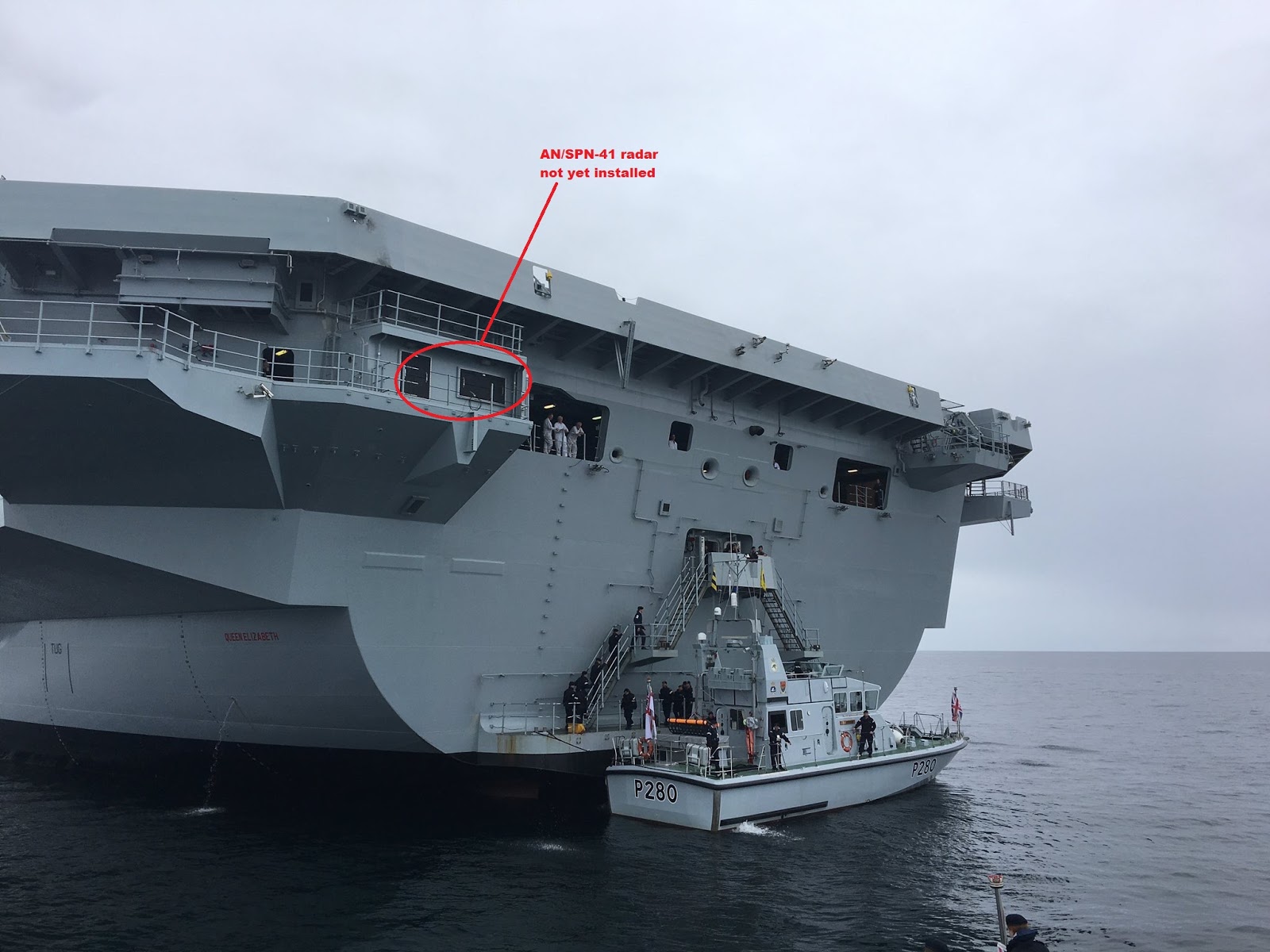
Instrument Carrier Landing System (ICLS) AN/SPN-41/41A, which provides all
weather instrument approach guidance from the ship to the aircraft, might also
only appear onboard during this period of works. Currently, the space reserved
for the AN/SPN-41 Azimuth aerial is still empty.
The
AN/SPN-41 is found on all American aircraft carriers, LHDs and LHA, as well as
on the Italian carrier Cavour. It has a large, flat antenna installed on the
stern of the carrier, for the provision of Azimuth data, and a second element,
for elevation, found normally on the back of the island.
The
particularly powerful and hot downwash of an F-35B coming in for a vertical
landing has however introduced the necessity for appropriate shielding of the Azimuth
component. The three vessels that the US Navy has so far refitted for F-35B
operations (USS Wasp, USS America and USS Essex) are a good example: their
stern area has been re-arranged, moving some equipment around (Phalanx CIWS
mounts, most notably) and building a protective box around other pieces,
including the 41’s antenna.
On
HMS Queen Elizabeth, the 41 Azimuth component is contained within a specially
designed sponson which was rapidly worked into the design and into the building
process after the MOD requested it in November 2013, when the F-35 had
completed two periods of Development Trials at sea on USS Wasp (DT-1 in October
2011 and DT-2 in august 2013.
The AN/SPN-41 is among the systems that still have to be installed
Other equipment yet to be filled includes the Height Indicator Hover Aid Thermometer (HIHAT) which will appear on the forward island. A good view of the main Landing Aid lights and tools is available in the brochure by AGI, which produces them and is working right now on QE in Portsmouth.
Meanwhile,
on September 8, the second ship in class will be named with a ceremony in Rosyth
which will see the Royal Lancers, affiliated to the ship, proving a spear
Guard.
The USS America as commissioned (top) and following F-35B modifications applied in 2015 (bottom). The shielding of the AN/SPN-41 is evident. Phalanx has moved, with RAM replacing it. This might indicate that RAM is less vulnerable to hot downwash.
Ship
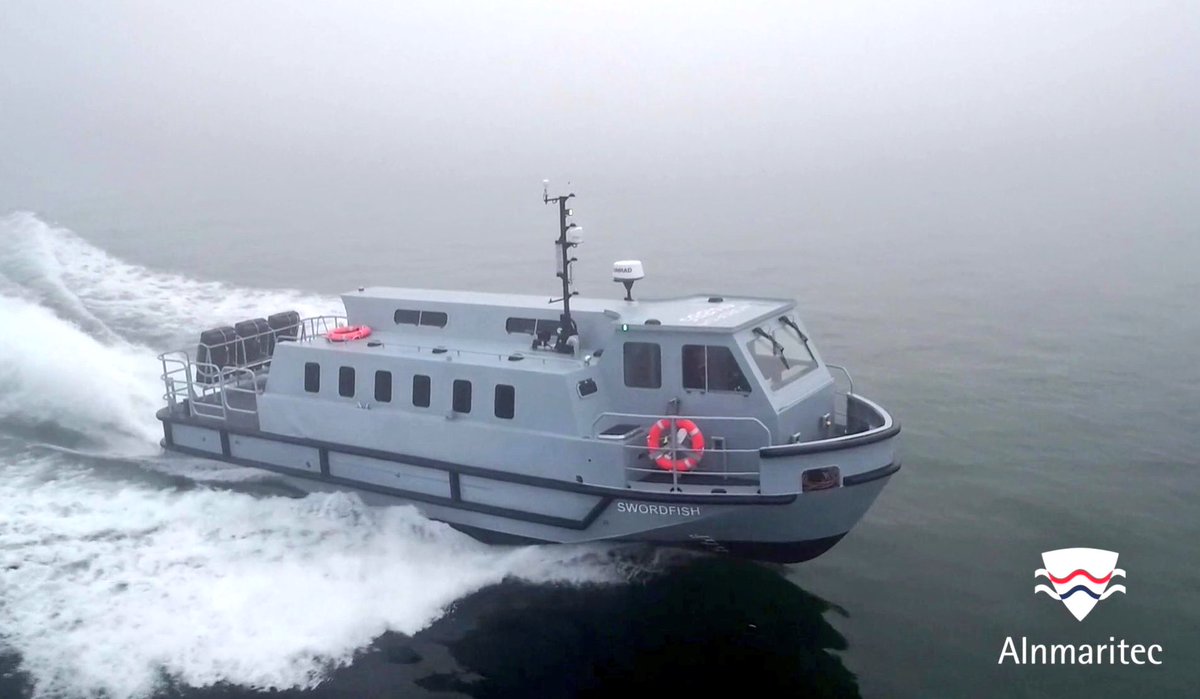
boats for both carriers are in delivery or on order. Four purpose-built boats
have been ordered for Queen Elizabeth, and two (named Swordfish and Buccaneer)
have already been delivered.
Queen Elizabeth's boat
Ship boats and RHIBs are carried in fully enclosed bays in the sponsons
Prince
of Wales, instead, will receive three boats from the recent contract for “up to
38” workboats of the SEA class. The workboat contracts includes 33 firm orders
and 5 options. Included in the firm order are three boats for Prince of Wales,
while the options include 3 more boats of the same kind.
For
general interest, the SEA class will include 10 workboats (for delivery in Fiscal
Year 2018 (5), 2019 (3) and 2020 (2)), 3 passenger transfer boats plus 3
options, 7 Dive Support Boats (3 in 2019, 3 in 2020), 6 officer training boats
plus 2 options, for delivery in 2020 and 2021; 3 survey motor boats (Medium)
and 3 Survey motor boats (Small).
SEA class workboats are modular and come in 11, 13, 15 and 18 meters lenght.
SafeHaven
Marine will deliver the largest boat, a 18-meter WILDCAT60 derivative which
will be delivered in May 2018 and will replace the current HMS Gleaner, which
is soon to leave service after carrying out key survey work to chart the course
out of Rosyth and into Portsmouth for the carriers.
At 18 meters, the replacement will be a big bigger than the current HMS Gleaner
Capability build up
Things
will get more interesting next year. HMS Queen Elizabeth is expected to put to
sea between January and March 2018 for Rotary Wing trials and first embarkation
of a Special Purpose Task Group of Royal Marines. The aim is to land Merlin
HC4, Apache, Chinook and Wildcat on the ship and validate the employment of a
rotary wing air group and of an embarked component of Marines up to
Company-group size.
By
August 2018, HMS Queen Elizabeth should achieve IOC as LPH. It is the Royal
Navy’s intention to always embark a Royal Marines SPTG of anything between 50
and 300 marines supported by at least a “unit of action” of up to 4 Merlin HC4
from 845 NAS. The SPTG provides the carrier with a response force that can
quickly move ashore for raids, evacuations of british personnel and, crucially,
for recovery of downed pilots and recovery or destruction of valuable equipment
lost in enemy territory. The F-35 is highly valuable technology and cannot be
allowed to fall into enemy hands other than in very small pieces. Development of
a Joint Personnel Recovery Capability within 3 Commando Brigade is well
underway, and the RAF Regiment is working on JPR training of its own.
This
period of early LPH trials and experimentation will be followed by the already
mentioned period in port for technology insertion, which is meant to prepare
the ship for First of Class Flying Trials. Queen Elizabeth will set sail for
the US East Coast in the autumn. HMS Montrose is currently expected to escort
her there.
The
Royal Navy anticipates to send QE loaded with a Royal Marines force including a
composite rotary wing air component. This will move inland for exercises
alongside the US Marine Corps, while QE will embark 2 instrumented F-35Bs and 4
pilots for 8 weeks of tests and evaluation. Highlight of the trials will be the
experimentation of the Short Rolling Vertical Landing technique, which is of
routine use ashore but that, for the shipboard side, represents an innovation
and something that has so far been trialed only in simulation.
In
March 2018, 617 Squadron will formally stand up in Beaufort, in the US, in time
to celebrate the 75th anniversary of the Dambusters.
In
June 2018 the Sqn will begin its extraction from Beaufort, with a first group
of 4 aircraft flying to Marham, followed by other waves by August. By December,
617 Sqn should achieve Land IOC with 9 aircraft in Marham.
5
more aircraft and around 50 personnel will remain in Beaufort until the summer
of 2019 to repay the USMC of the collaboration and literally provide back
training flying hours. They’ll then move to RAF Marham in time for the stand-up
of 207 Sqn, the OCU for the Lightning fleet, in July 2019.
3
Instrumented aircraft (BK-1, BK-2 and BK-4) will remain in Edwards AFB with
17(R) Sqn for test, development and evaluation purpose.
By
the summer of 2019, work should be complete on the new Integrated Training
Centre being built in Marham. It will have 4 networked full mission simulators,
and the hope is to hook them up as soon as possible with Typhoon simulators in
Coningsby and Lossiemouth as well as with USAF F-35A simulators at Lakenheath
and elsewhere, to enable large-scale collaborative operations within the training
simulation.
By
then, Marham will also have 3 vertical landing pads; a hangar for deep
maintenance, a facility for maintenance and monitoring of the health of the
stealth coating and a new National Operating Centre hosting the UK ALIS
infrastructure as well as the Lightning Force HQ, offices and other key
supports. Drive-through sun shelters will be installed in the area destined to
617 and 207 Sqns operations, and existing Hardened Aircraft Shelters upgraded
for F-35 compatibility.
The
runways (one of 9500 and one of 6500 feet) will be resurfaced and the shorter
one will have an area specifically configured as STOVL strip.
The Hardened Aircraft Shelters for 617 Sqn, to the left, and the 207 Sqn OCU area, including the Integrated Training Centre, to the right
The OCU facilities are entirely new builds, developed on brown land
The ITC
Maintenance facility, being built in place of the old No3 hangar. Another engineering facility replaces the old No1 as well.
From the journal of RAF Marham, the progress in the build
Project ANVIL is a massive infrastructure improvement
In
the summer / autumn of 2019, the intention is to embark 617 Sqn and sail in UK
waters for squadron-level trials and certifications.
In
2020 this will be followed by a larger exercise combining 617 Sqn with the
other elements of the air wing (Merlin from 820 NAS; CROWSNEST from 849 NAS and
so along) and of the surface task group, in order to reach IOC Carrier.
Finally,
in 2021, Queen Elizabeth and her task group are expected to set sail for the
first major operational deployment away from home.
The
UK has received 11 F-35B so far, and by the end of the year they will be 14. 3
more aircraft will be delivered next year (BK-15, 16, 17), while BK-18 will
follow in 2019, alone, as the MOD ordered a single aircraft within LRIP 11.
3
will follow within LRIP 13, for delivery in 2020. 6 more in 2021, 8 in 2022 and
7 in 2023. By the end of 2023 the UK will have 42 F-35B, of which 24 will be in
frontline units as 809 NAS stands-up.
6
more aircraft will follow in 2024, so that by January 2025 the UK will have
taken delivery of 48 F-35B.
The
number of aircraft effectively embarked will depend on the Routine Operating
Model that will be written down.
The
profile of orders beyond Lot 16 (deliveries in 2024) is not yet known. The
latest Major Projects Report released by the MOD has the F-35 programme end
date as 31 March 2035. To receive all of the promised total of 138 aircraft by
then, the MOD should place the last order in 2033, as two years pass between
order and delivery.
Beginning
in 2023 and ending in 2033, the MOD would have to order 8 - 9 aircraft per
year. Not a particularly ambitious target, yet a non insignificant one for a
ministry in perennial budget crisis.
The
greatest threat for the future of embarked fixed wing aviation is the Split Buy
idea that continues to float around as very real threat. More on the split buy
danger here.
Within
the Joint Force, the manpower split is currently expected to hover at around 58
to 42% in favor of the RAF, but with the Squadron’s commanders alternating by
Service.
There
is every intention to have a permanent exchange programme in place with the
USMC, as used to happen with the Harrier, with one UK instructor in Beaufort
within the USMC OCU, and a USMC instructor in the UK within 207(R) Sqn.
For
expeditionary operations, the UK has the same kind of ambitions as the USMC.
AM-2 matting stocks are expected to be rebuilt, and Royal Engineers should
already be involved in USMC expeditionary airfield training at 29 Palms as this
is being written. Next year, a landing strip and pad should appear in Kinloss,
home of the Air Support engineers.
Training
of deck handlers is carried out at the School of Flight Deck Operations at
Culdrose, on the “HMS Siskin”, the dummy carrier deck modified for the new QEC
age. 4 training mock-ups of the F-35B have been procured, and thanks to water
tanks inside their structure they can replicate the various weights of
different load-outs. They are also equipped with cockpits suitable for training
of emergency extraction of injured pilots. Old Sea Harriers, which do not fly
but which have working engines, are used to prepare personnel to the noise and
hazards typical of flight deck operations. The School includes a special
simulator, an enclosed space where personnel can train safely for fire
emergencies.
4 Ground Training Aids, Sea Harriers and real helicopters are used for deck training
Since
late 2015 the School also includes a new Flight Deck Training Simulator which allows
flight deck crews to simulate every aspect of deck operations. Fire fighting
& engineering emergencies, aircraft refuelling, marshalling and multi-spot
landings can be simulated as well as changing sea states and day and night
conditions.
In
terms of capability of the F-35B, the UK is looking ahead to Block IV software
and hardware updates, for integration in four successive incremenets (4.1 to
4.4) between 2021 and 2025/26. The full list of upgrades and additions is still
being finalized by the Pentagon, but for the UK Block IV is defined by integration
of the latest mark of ASRAAM (New Build, or Block 6 if you prefer); of the
bunker-buster warhead variant for Paveway IV; of Meteor and SPEAR 3.
Block
IV should give the F-35 full video downlink capability as well as swap the
current EOTS targeting / FLIR assembly with the Advanced EOTS which offer a
greater resolution, a new TV camera, an IR pointer and a lead-in laser for
improved moving target engagement capability with laser-guided bombs.
A
new processor (Technology Refresh 3, TR3, as opposed to current in-production
aircraft which use the TR2, which supplanted the earlier TR1) a new cockpit
display by Elbit are expected in Block 4.2.
Significant
improvements to the engine, which would make it more powerful and reduce consumption
of fuel by a good 5%, have been proposed but it is not yet known if there will
be room to actually take such mods aboard in the Block IV programme, which is
already quite extensive especially due to the long list of weapons to be added.
The
IOC will be attained with Block 3F instead, which will begin to roll out in the
coming months, and which brings integration of 2 ASRAAM for external carriage
as well as up to 6 Paveway IV (2 internal, 4 external), plus of course 2
internal AMRAAM (or 4 if no bombs are carried internally).
The
UK chose to wait out on the gun pods and only bring them aboard with Block IV,
even though they will be cleared with 3F.
Phase 2 Ski Jump trials are underway at Patuxent River. Here a F-35B launches with a heavy ASRAAM and Paveway IV external load for the first time. Asymmetric loads and high wind launches are also being validated.
On
the amphibious side of things, the Royal Navy is working to embody some
unspecified modifications and enhancements on Prince of Wales with the aim of
getting it to a “LPH FOC” status in 2023.
This
is a larger scale capability than the SPTG embarked on QE. Prince of Wales will
embark two company groups of Royal Marines with stores and some vehicles /
light guns as well as a large composite wing of helicopters for their insertion
and support. It will be the de-facto replacement of HMS Ocean (which bows out
early next year) and will be at the heart of the amphibious task group. With
Prince of Wales, 1 LPD and at least 2 of the Bay-class LSDs the Navy intends to
deliver the same 1800-strong Lead Commando Battlegroup envisaged today, with a
greater rotary wing support.
The
Lead Commando Battlegroup is meant to insert simultaneously a Company group by
air assault and a mechanized company group mounted on Viking vehicles by
landing craft from the LPD and LSDs.
The
other companies and supporting elements would follow in subsequent waves.
Prince
of Wales will be able to simultaneously launch 10 to 14 helicopters per wave
thanks to her vast deck.
The
modifications introduced on Prince of Wales should then be applied to Queen
Elizabeth during her first refit around 2026.
The
Navy intends to hold the aircraft carrier at Very High Readiness (5 days notice
to move) with the “LPH” at High Readiness (20 to 30 days notice to move). For
major deployments / operations, the two carriers would deploy together.
There
will be, however, periods in which only one ship is available as the other
enters refit. During those periods it will be more frequent to see mixed air
wings including a smaller number of F-35Bs and a greater number of Marines and
helicopters.
In conclusion
The
current plan is good. There is a lot of work to do, but the project looks solid
and it is particularly reassuring to see the planned development of the
amphibious capability, since the loss of HMS Ocean would otherwise have
catastrophic consequences for the UK’s capabilities in this area. Now we have
to hope that no new budget cuts come to knock pieces off this plan, and that
the split buy idea is killed off, at least until after 4 squadrons of F-35B
have been formed. 4 squadrons plus OCU are the current long-term plan and
already it represents arguably a bare minimum target for a capable, sustainable
fleet which must be able to generate a substantial deployable force. A split
buy would greatly harm the entire project and dramatically reduce the UK’s
ability to actually put jets on the deck.
An important element coming up is the MARS Solid Support Ship which must replace the old Fort Austin, Fort Rosalie and Fort Victoria around the middle of the 2020s.
Next month might provide some clues about this programme as well as Type 31 since the Shipbuilding strategy should (finally!) be released. The MOD plans to brief industry about Type 31 at DSEI, on September 7.
Contract award for MARS Solid Support is expected in 2020. These large ships, fitted with Heavy Replenishment At Sea rigs, will carry the stores, ammunition and spare parts needed to keep the carrier group going. Their role in support of amphibious operations will also be important, so details of their design and of the acquisition schedule are eagerly awaited.
There is
not too terribly much that can be said on sir Parker’s review of the UK
shipbuilding situation, at the moment. His is merely a list of suggestions, an
independent report which might or might not generate policy changes. To know
whether his recommendations have changed anything, we’ll have to wait for the
actual Shipbuilding Strategy which the government has promised to publish
sometime in “spring 2017”.
That
document is the one we want to read, and the one from which answers should
come. We can only hope that something serious comes out of the whole exercise,
but skepticism is more than justified.
The single
most important recommendation formulated by sir Parker, in my opinion, is this:
The MOD Sponsor should establish a transparent Master Plan for naval
shipbuilding that lays out Defence’s procurement plans for each series of naval
ships over the next 30 years. This should be backed by “set and assured”
capital budgets for each new series of ships. The Master Plan should be
reviewed at each SDSR.
The
importance of an overarching, long term vision cannot possibly be overstated.
What sir Parker denounces in his report is that the Royal Navy’s future is
dependent on a series of programmes that almost come out of the blue. There is
no master plan, there is no long term vision guiding the succession of studies,
assessments and attempts to launch a new shipbuilding programme of any kind.
The result
of the short-termism is evident in today’s frankly desperate situation, in
which the Royal Navy, at very short notice, has been saddled with 5 OPVs that
it didn’t really want nor yet need (the current ones could easily last another
decade, as was planned until recently); while at the same time seeing its main
frigate programme not only delayed, but broken into two halves, the second of
which has no defined shape, role, budget. RFA Diligence is gone without
replacement, RFA Argus is very much at risk of ending the same way within the
next 4 years, and the future of everything else is still vague and indefinite,
subject to the shifting fortunes of yearly budget negotiations.
Ultimately, the current process involves many
people and too many ‘hand-offs’. Too many think they have a vote, or even a
veto, in the process. Current governance is not sufficiently clear. There is no
assured “Capital budget” for a RN project which means programmes are subject to
arbitrary intervention and delays adding to cost. Senior Responsible Owners’
objectives and accountability are not always properly aligned. There is a clear
system of financial approvals via the Investment Approvals Committee, but the
system is not always applied intelligently to ensure that good quality
information and early engagement with decision makers results in well evidenced
and timely decisions. The result is a lack of empowered project grip.
Sir Parker
talks of “set and assured” capital budgets for the 30 year plan, and this would
clearly be helpful, but it is also evidently very complicated. Even just a more
flexible commitment would help, however, as it would help the Royal Navy’s
struggle to preserve what’s left of the fleet.
The navy
itself needs to plan that far ahead, not so much in terms of what the singular
ship will look like that far away in time, but in terms of how to retain and
possibly enhance a capability. There are, in my opinion, two critical cases in
which long term planning is long overdue: one has to do with the role of the
MCM, Hydrographic Capability (MHC) mothership expected to eventually replace
current Hunt, Sandown and Echo classes, beginning in 2028. The MHC mothership
plans have taken, this far, a very far back seat, with all MHC attention going
to the payload development and test.
There are
certainly good reasons for focusing on the new unmanned vehicles and the new
kind and breadth of stand-off mine clearing they enable. It is a great
innovation, with all the risks that innovation entails, and until the system is
proven the Royal Navy cannot take a final decision on whether the future
mothership will be a steel-hulled, multi-role vessel or a novel edition of the
super-specialized GRP hulls in use today.
The Royal
Navy, however, needs to take a decision quickly because as Type 31 drops down
the capability ladder to become a “light frigate”, or a General Purpose vessel,
the fields of usefulness of Type 31 and of the potential MHC Mothership begin
to overlap.
Without a
plan, there is a very real risk that the Royal Navy, within a decade, goes from
having no “second line” flotilla to having three classes of second rank ships:
Type 31, River Batch 2, MHC. It would be an incredibly bad use of money,
because it would leave the high end fleet of escorts short of numbers and
capability, while overcrowding the lower segment.
Sir Parker
mentions that containerized MCM kit could one day be deployed from Type 31, and
while this might well be, the point that needs to be made, very quickly, is
what overlap exists between Type 31 and MHC – Mothership. Can they become the
same programme? If not, how can the RN make sure that the Type 31, while being
“light” is an escort oriented towards the high end of warfare, with MHC
covering the low end, rather than duplicating a same set of limited
capabilities?
This is how
wasteful procurement is born: lack of clarity, lack of long term vision.
The Type 26
itself is already suffering from severe lack of long term vision. The Royal
Navy arrived to the Type 26 programme after close to two decades of desperate
attempts to get a new frigate programme on the move. Countless efforts began
and died without ever generating a single ship, and the last of the big studies
had eventually come up with a fleet-wide plan for 10 “C1” high-end ASW
combatants supported by 8 “C2”, simpler “general purpose” frigates, with a
third class, the “C3” for OPV roles and MHC mothershipping.
Type 26
came out of the killing blow dealt to that tentative long term plan: C1 and C2 were
merged into Type 26 and their cumulative total was reduced to 13, with any C3
equivalent deferred to a vague future.
Then, just
a few years into the Type 26 programme, the Royal Navy has been effectively
kicked back to a C1 and C2 situation, where 8 Type 26 are supposed to be the C1
element and the Type 31 the C2.
This is an
example of catastrophic long term planning failure, and the Type 26 now
arguably suffers of design imbalances caused by having to be the “one and only”.
The Type 26 has been designed with extremely long logistic endurance, a vast
defensive armament spread in two different areas of the ship, a very large
mission bay and a Chinook-capable flight deck, and thanks to the MK41 it has
the potential to be very well armed as well (overlooking for a moment the fact
that right now she is far more likely to have empty cells than filled cells,
again for lack of clarity on the future and cash shortage). Was all this
necessary in an ASW-roled escort which, by virtue of its role, would spend most
of its time in task group? They are all very helpful attributes, but being in
task group means having relatively easy access to extra firepower from the
other vessels; access to fuel and stores replenishment; aviation support.
Currently,
the RN is facing the prospect of having a large, multi-role ASW vessel inside
the task group and a cheap, light frigate doing solo deployments. One is left
to wonder if it wouldn’t make more sense to have built a somewhat simpler ASW
escort, more rationally thought out for Task Group roles, and a capable “global
combat ship” as supporting element, designed to be a capable “solo player”.
Imbalances
caused by lack of long term clarity, again.
Another
area that needs long-term clarity is the amphibious capability, left in
disarray by the loss of HMS Ocean without replacement, which damages very badly
the UK’s capability in the sector and imposes a hybrid use of the new aircraft
carriers, under the acronym CEPP, for Carrier Enabled Power Projection.
The long
term solution, if a realistic amphibious capability is to be retained, is to
replace the current LPDs with LHDs, combining aviation spaces with well dock
and large landing crafts. But this will be extremely complex unless a coherent
plan is worked out well beforehand and the government endorses the requirement.
As of now, would you be willing to bet any money on the LPDs being replaced at
all…? I would be very torn.
The lack of
a long term plan inexorably makes it almost impossible to sustain the
shipbuilding sector. How can a serious industrial and infrastructural project
be put together if there is not a realistic idea of what it is that the Navy
will buy, how it will do so and when? Who could ever seriously invest in shipbuilding
if the only thing somewhat assured is that a few frigates will, indeed, one day
be built again, while everything else might simply be replaced by vessels built
abroad, if not by nothing at all?
A long term
plan is desperately necessary. Everything depends on such a plan, and on
decisions to be made. If we look ahead, we see that a shipbuilding plan for the
surface fleet includes:
-3
large Solid Support Ships, probably close to 40.000 tons each, to be built
between 2020 and 2025
-8
Type 26, between 2017 (hopefully) and the 2030s
-N
Type 31 between X and the 2030s
-N
MHC ships, to be defined, from the late 2020s onwards
The LPDs
should enter “replacement age” around 2030 – 2032. Now that they alternate in
and out of service in 5 year intervals their useful life might be effectively
stretched out, but their lack of aviation facilities and overall insufficient
troops and vehicles capacity, in light of the loss of Ocean, suggests that a
replacement is needed sooner rather than later, so the carriers can eventually
concentrate on being carriers, rather than LHAs. Depending on the choices that
will be made, building the LHDs would also help sustain the whole shipbuilding
sector.
By 2039,
the Type 45 will all have gone out of service too, unless their 25-years life
is extended. The Royal Navy is currently planning to have them gone by 2039,
taking the last MK8 Mod 1 guns with them (there is currently no money for ever
retrofitting the 127mm gun on Type 45).
Depending
on how the government wanted / was financially able to proceed, there is no
real shortage of work: these programmes often overlap, suggesting that for many
years there could be a relative abundance of orders. Assuming all programmes
eventually start and that ships are not procured abroad. And this is what the
strategy needs to say.
In the
early 2020s, the RFA Argus question will resurface as well, and a successor to
RFA Diligence is highly desirable, so there is in theory a need for a couple of
large civilian ship conversions or new builds, if the government is willing to
endorse the requirement.
The Venator 110 is sir Parker's idea of what a Type 31 base design could be. Hard not to agree with him, especially since the two BAE alternatives seen so far, the Avenger and Cutlass, have little good to offer, particularly the former.
The Royal Navy desperately needs a long term plan for weapons, too. VL or canister? Type 23/45 would need the latter, Type 26 the former, Type 31? Land attack? Anti-ship? Currently, only confusion is apparent.
All
decisions about the future of the shipyards can only be taken if there is a
long term master plan upon which assumptions and plans can be built.
If the
three MARS SSS ships were built in the UK, in Blocks and Super Blocks, even
Rosyth could have a future as the yard of assembly. As of now, Rosyth does not
have much of a post-carriers future, with the Goliath crane already expected to
be sold once the work on the flagships is over and all that remains is nuclear
submarine dismantling and, maybe, the carrier refits over their service life.
A decision
to have the SSS built in the UK could change the situation entirely, and the
LPD replacement could slot on the back of the three ships (with a bit of a gap
in the middle, admittedly, but probably manageable).
The
recommendation to assemble the Type 31 away from the Clyde is a political hot
potato. In some ways it is highly desirable, in others it is a problem. The SNP
will be given something to moan about if the Clyde does not assembly the new
frigate. On the other hand, if a yard down south does the job, the SNP can be
told, much more credibly, that if they play their independence stunt, the flow
of work for the yards will dry up and construction will move south.
It is also
evident that trying to built two different frigate types at the same time in
the same yard could cause all sorts of problems, including the transmission of
delays from one programme to the other whenever something does not work as
intended. It might be reasonable to assume that BAE systems will attempt to
craft out a plan to use Govan and Scotstoun differently, perhaps assigning a
frigate type to each site. What will happen with the Type 31 is, at this moment
in time, anyone’s guess.
The
exportability bit is the one that leaves me shaking my head. It is hard to
imagine that Type 31 will turn out a great export success. The market is
already quite saturated with “cheap” warships which come with extremely good
capability and a very heavy load of weaponry. If the Royal Navy insists on its
usual trend of trying to contain cost by shredding sensors and weapons rather
than adjusting building standards and other areas, the Type 31 will never sell.
Look at the ships that are being sold, or seriously considered by this nation
or that: they are capable vessels. They have probably cut corners somewhere,
otherwise they would cost more, but they carry sensors, they tipically have an
ASW capability, perhaps not always exploited by the customer, but present. They
are heavily armed. The MEKOs sold to Algeria, for example. Or the Aster-armed
ships recently sold in the Gulf.
Extremely
well armed and cheap vessels from Russia and China are an increasingly
attractive proposition.
And there
is now a strong political pressure on the US Navy calling for the design of a
new “small” surface combatant to build in place of the LCS-derived Fast
Frigates in the 2020s. If such a ship was to emerge, it could deal the killing
blow to any Type 31 export hope before Type 31 even becomes a thing.
For a
variety of good reasons, it is very hard to imagine the Type 31 actually
selling, especially if it is built as something which is little more than an
OPV.
The Royal
Navy needs to get a Type 31 which is actually useful at escorting. It also
needs, possibly, to reconsider exactly how Type 26 and Type 31 will be used to
cover future requirements. Perhaps it makes more sense to have Type 31s with
variable depth towed sonars doing Task Group escort work and Type 26 in solo
deployments.
The Royal
Navy needs escorts that are credible and that respond to the two greatest
dangers out there: air and sub-surface attacks. Type 31 must focus first of all
on this simple truth, like the French FTI “intermediate” frigate is doing. The
lower end constabulary tasks should not be a design driver, nor, arguably,
should they be the Type 31’s concern. What kind of role will the MHC mothership
be able to play in that area? Knowing it in good time is fundamental.
The Marine Nationale has been clear all along about what it wanted out of FTI: a ship with capable AAW defences and a good ASW capability, at a lower cost than that of a FREMM. The Type 31 should follow the same path rather than venture in "General Purpose" non-ASW land which will never deliver what the navy effectively needs from its escorts.
Two other
recommendations stand out to my eyes: that the MOD and Navy should be more
intelligent buyers of ships; and that a marine design centre of excellence is missing
from the picture.
There is a
bond between the two things, I feel: the Royal Navy needs to be part of such a
design centre of excellence, and it must probably have its own design office
inside the organization. Much, if not all, of the Royal Navy’s internal know
how and capability in designing warships was lost years ago, leaving the
service more or less completely in the hands of industry. This was supposed to
save money, but it has probably generated more trouble than benefit.
A Navy able
to design its own solutions is a more capable and intelligent customer by
default. It will not need to buy the solution to every problem: it can design
it and then have it realized. The Italian navy is currently kicking off a major
shipbuilding programme building 7 PPA, “light frigates” that will complement
the FREMMs and replace everything from two of the old Destroyers down to the
current OPVs. The programme also includes a massive and very capable LHD and a
supply ship. The cost of the entire programme is lower than the Type 26 alone
is expected to cost, and this is extraordinary.
Only 2 of the 7 PPA will be fully equipped with sensors and weaponry, at least initially (torpedoes, towed sonar, Aster missiles, Teseo SSM, 127mm, 76mm CIWS), with a few more having an intermediate fit including 76mm CIWS on top of the hangar, 127mm gun and Aster missiles and the remaining having lighter sensors fit and only the guns, with no Aster. But all come with significant innovations in their design, from the bow to their high speed, from the mission spaces under the flight deck and amidship to the new fixed-face radars to the impressive two-man "cockpit".
One of the “secrets”
of the current Italian shipbuilding programme is that the new ships have
largely come out of the work of the Navy’s own design office. Industry is
involved, of course, but in a very good way: the new ships introduce a large
number of new systems (a new CIWS 76mm turret, new IRST, new radars, new towed
sonar, a modular and multi-mission design, an innovative wave piercing bow for
very high speeds (PPA is meant for 35 knots speeds) and others) designed by the
nation’s industries. Why the UK can’t put together something as ambitious? Why
has the Type 31 to be affordable only through being a depressingly low
capability hull?
The
long-term shipbuilding strategy for the UK must include a real centre of
excellence in shipbuilding design, and the Royal Navy probably needs to have
its own office inside. Shoulder to shoulder with industry, but with doors that
can be locked when the moment calls for it.
Note: this article has been mostly ready for days. I'been waiting to
post it because i wanted to add the latest information about the At Sea
Demonstration 2015 in the Hebrides, and its implications on Type 45 Ballistic
Missile Defence potential. Unfortunately, news are scarce. The article will be
updated as necessary when information finally arrives.
The following is an analysis of the main issues that the Royal Navy
brings to the SDSR table.
Manpower
Manpower is the first issue the Royal Navy will bring to the table at
the SDSR. There is a recognized shortage in this area, which extends just as
severely to the RFA. Despite half-denials and adjusted truth answers to
repeated questions in Parliament, it appears pretty evident that the 400 posts
the RFA lost in the SDSR 2010 have exacerbated a situation which was already
far from optimal, leading to ships which quite literally have no crew. The RFA
has got to the point in which there were worries, not long ago, about not being
able to crew Tidespring in her travel home from South Korea; Mounts Bay has
been tied up in port for a looong time and so forth.
The regular Royal Navy is also short of men, and this will be only be
felt even more as the F-35B enters service and the carriers need crewing. The
Royal Navy will partially cover the manpower requirement for HMS Prince of
Wales by losing HMS Ocean without a dedicate replacement, but Ocean’s crew is
quite literally just a third of what it takes for a QE carrier, even though
these are exceptionally lean manned for their size.
There have been press reports that the Royal Navy is due to receive a
boost equating to 2500 posts. More recent press reports have suggested a need
for up to 4000, which would mean almost a return to pre-SDSR 10 levels. 4000
looks somewhat excessive (several ships have gone), although not unrealistic.
However, it is very hard to imagine that such a boost could be funded, and it
might take a real long time to boost recruitment figures anyway. The addition
of 2500 men, however, would be vital, and a few hundred of those posts should
be allocated to the RFA to hopefully solve its own issues, which appear even
worse than those of the navy proper.
Unfortunately, the Times reports that the Navy will grow by just 300
men, and that, while better than a cut, would not solve the problems.
At this stage, nothing is certain anyway.
Carrier Enabled Power Projection
Right after manpower, the priority is obviously getting the carriers right.
For starters, we now have an official promise that both carriers will enter
service, but we have no real idea of how to read this. The devil is in the
detail: how will they be employed, and crewed, and resourced? HMS Albion and
HMS Bulwark are both “in service” too, but only one sails, and the other is in
mothball. Will this be the case for the carriers as well? Will the second be on
extended readiness, but not quite in mothball? Will both sail at once, and if
so, will one work as “Commando carrier” and one as “Fleet / Strike carrier”?
I probably don’t need to be saying this again, but forget about having
two fixed wing airwings to use both simultaneously as carriers, obviously:
there are no resources for that.
Obviously, this is a massively important point to clear up.
The other main worry is connected with the loss without replacement of
HMS Ocean. CEPP is about filling that hole using the carrier. Normally, the
ship can be expected to embark a mixed force including at least one reinforced
company of Royal Marines with their helicopters and a squadron of F-35Bs. This
can be adjusted by increasing or decreasing the components, going up to a full
“strike” air wing centered on F-35s and Merlin helicopters for AEW and ASW, or
down to a force of sole helicopters and Royal Marines.
In order for CEPP to work and avoid a dramatic, further downsizing in
the UK’s amphibious assault capability, a number of things have to happen:
- The design of
the carrier’s deck has to be adjusted to respond to the needs of a mixed air
wing. An increased number of spots for air operations, some 10, was being
considered. There are actually 12 areas on deck which are serviced to support
air operations, but 10 spots were seen as a realistic number for those which could
actually be used simultaneously. The study, however, needs to progress into a
plan, and be applied when the time to coat and paint the flight deck of Queen
Elizabeth comes.
- Queen Elizabeth
will be able to embark a 250-strong Royal Marines element at entry in service.
However, in order to properly replace HMS Ocean it is necessary to do a lot
more: there is the need for a workable plan for transporting and deploying the
Royal Marines’ equipment and ammunition, and more spaces are necessary to increase
the force that the ship can project. The figures which have circulated so far
are definitely conservative, considering that this is a vast, 65.000+ tons
ship. There is no real reason why the currently immense projected gap between
the force an America LHA can project and what will be embarked on QE. There is
a “plan”, who knows how substantial at this stage, to use some of the currently
abundant non-allocated spaces to increase the Embarked Military Force capacity.
For QE, this will not happen before the first major refit and docking, though.
For Prince of Wales, it is highly desirable to incorporate all the changes
possible while the ship is in assembly. Currently, PoW is 4 months ahead of
schedule. Quick decision-making could lead to a more capable vessel at entry in
service.
For a detailed analysis of the “Ocean problem” and the role of the QE
carriers in solving it, see this earlier article.
MARS Fleet Solid Support
Among the programmes waiting in the shadow, MARS FSS is, in my opinion,
the most important. With the renewal of the Fuel support element now on the way
with the four Tide class tankers (with Tidespring named on 7 October and
expected to sail to the UK by year end), it is important to progress with the
Solid Stores part.
Currently, the capability in this area is provided by the old RFA Fort
Rosalie and RFA Fort Austin, plus RFA Fort Victoria, which is an AOR, combining
solid stores capacity with a relevant fuel capacity. The fuel bit, however,
will become more and more problematic to keep in use as the ship is
single-hulled, and thus no longer complies with the law.
The new Solid Support vessels are expected to introduce the Heavy RAS
capability, which doubles the weight that can be transferred at sea between
supply ship and warship, also dramatically expanding the size of each shipment.
Its near-container sized, 5+ tons capability enable a much faster transfer rate
of stores, including aviation ammunition and spare parts. Crucially, the Heavy
RAS rig will enable the transfer of the bulky, heavy F-135 engine in its
shipping container.
The Solid Support ship will also be able to transfer weaponry for the
air wing by sending across pallets which, once arrived in the carrier’s hangar,
will just need to be moved to the nearer elevator of the Highly Mechanized
Weapon Handling System to be struck down into the deep magazines.
Another key capability the MARS FSS ship could and should deliver is
amphibious support. Earlier in the story of MARS, there were going to be two
different types of ships for the two roles, one delivering Fleet Solid Support
to the fleet and the Joint Sea Based Logistics providing support for the amphibious
element and for ground forces ashore. Of course, MARS as originally planned
collapsed long ago, and now the JSBL is no longer planned, with the two classes
tentatively merged into one, hopefully counting 3 ships. The early designs the
MOD and the industries of the Naval Design Partnership have put together for
MARS FSS include the carrying of a couple of LCVPs and a RoRo deck with steel
beach or even a well deck, giving some very real capability to carry and deploy
ashore stores and even vehicles.
The design put forwards by the Naval Design Partnership, a consortium of UK MOD and industry, led by the MOD Directorate of Ships
Confirming this kind of capability into the design and finally
progressing with the procurement to put the new vessels in service by around
the middle of the next decade would help in making up for the loss of HMS
Ocean. I’ve written in detail about MARS FSS here.
Building three would perhaps enable maintaining one in the Gulf while
having two rotating into readiness to accompany the Response Force Task Group.
The one in the gulf, with the RoRo deck, well deck and RoRo space plus vast
aviation capabilities, could in itself benefit the amphibious force, by
releasing the Bay class LSD which has to be used as mothership for the MCM
force.
Type 26
The Type 26 remains a cause of concern, because it is an absolutely key
priority, for obvious reasons, and unfortunately has not been rich of good news
as of late. For one, every hope to agree a purchase of 13 ships seem to be
gone. Even the original plan of ordering all 8 the ASW ones in a first, large
batch has been trashed, and currently the assumption is that the 13 vessels
will be ordered in three batches of 3, 5 and 5.
I don’t need to write what everyone’s fear is, especially with the Type
45 no 7 and no 8 still quite fresh in the memory.
After the publishing of the SDSR, the final negotiations for the order
for the first 3 ships will hopefully progress quickly. Much of their value is
already under contract as part of an 859 million “Demonstration Phase” which
includes tens of long lead items purchases covering gas turbines, diesels,
gearboxes, steering gear, stabilizers, communications, integrated bridge and
many more. Included in the contract are shorte-based test facilities including:
-
The Electrical Integration Test Facility, which will be established at GE Power
Conversion's Whetstone site, will contain an integrated half ship-set of the
Type 26’s electrical power generation and propulsion system, allowing extensive
testing.
-
Another test facility will be set up at David Brown Gear Systems' facility in
Huddersfield, and will be used to demonstrate the new cross-connect gearbox.
Bad news, albeit still poor in details and thus hard to fully evaluate,
is the estimate programme cost figure given by Rear Adm Alex Burton, the
Assistant Chief of Naval Staff, which indicated in “around 12 billion pounds” the expected amount. When asked about this extraordinary amount, the
MOD apparently did not deny, but said that it is more likely in the 11.5
billion range. It remains an extraordinary and worrying figure. However, we do
not know what this figure actually includes beyond development and procurement
of the 13 ships, plus a “safety margin”, no doubt amounting to hundreds of
millions, which is now routinely included in MOD programme cost allocations.
The MOD is being asked to increasingly plan for “whole life costs”, so
it is likely that the 11.5 billion include some degree of post-delivery costs
for N years.
On the other hand, the Type 26 is a deliberately conservative design,
and it introduces very few things which are new, and even less things which are
developmental:
The Sea Ceptor missile system is largely not part of the Type 26
programme, as CAMM development costs come under the Complex Weapons budget, and
the missiles, canisters and data links and electronics will have been purchased
for the Type 23 CSP, being then transferred onto the Type 26 later.
Same goes for the Artisan 3D / Type 997 radar; the sonar 2087; decoys
including the Sea Sentor anti-torpedo system, light guns, probably navigation
radars, and the EO/IR Situational Awareness system, which is now due to be
developed for use initially on the Type 23.
The major innovations brought by the Type 26 are the 127mm gun, which is
new to the Royal Navy but non developmental in nature, and indeed will come in
the form of refurbished, used MK45 Mod 2 guns from the US Navy stocks, uplifted
to the latest Mod 4 standard and accompanied by a new, developmental Fully
Automated Ammunition Handling system holding 196 rounds. The purchase of the
guns, the magazines and the ammunition will be part of the Type 26 price. About
the guns, there is also a question to be asked about the really low number of
shells reported. One hypothesis is that only half the magazine is automated,
with perhaps as many rounds stored in a manually-operated depot, from which the
shells could be transferred to the automated system during a long fire support
mission. At the moment, there are no certainties other than 196 rounds are
extraordinarily few compared to any other warship, which carry normally well
more than 300 per gun. The 196 figure was given by a BAE spokesman at DSEI
during an interview with Navy Recognition (from minute
7:39).
Similarly, the Type 26 will be fitted with the “new” (to the Royal Navy)
MK41 VLS, with 3 modules installed on each ship. And here comes the big
question: will the Type 26 programme include the purchase of something to put
into the MK41? Because today the RN has nothing in its arsenal which is
MK41-launched. It only uses the torpedo-tube, encapsulated variant of the
Tomahawk, and does not use any other MK41 weapon.
However, the Type 26 will need a good land attack capability; a novel
anti-ship capability and a novel ASW capability. The latter is especially
relevant since ASW remains the key design driver of the Type 26, and yet the
ship seems set to have no torpedo tubes. It has to be said, in any case, that
324mm torpedoes are little more than a snap-defence weapon: if the frigate has
to launch her own torpedoes, given their reach, it is pretty likely that the
enemy submarine will have already fired its own torpedoes.
The requirement for a longer range, ship-based weapon is pretty clear.
Moreover, the Type 26 is meant to carry a single Merlin helicopter (a second
can only ride inside the mission bay for “short periods”) or up to two Wildcat.
Two Wildcat ensure better around-the-clock coverage, but unfortunately the
Wildcat will not have a dipping sonar nor sonobuoys. It will be able to drop
torpedoes, but only if guided by the frigate itself, or by a Merlin, an MPA or
an allied ASW platform with the appropriate sensors.
Without an helicopter in the air and without torpedo tubes, the Type 26
can’t do anything about a submarine. An ASROC-like solution would greatly help.
It would also introduce the precious ability of reacting really quickly to a
fleeting sonar contact.
Similarly, the Royal Navy’s old Harpoon missiles, still of the ancient
Block 1C type, will need replacement as early as 2018. There is a good
probability that the OSD will be pushed to the right for lack of a realistic
alternative (other than losing the anti-ship missile altogether). Purchasing
another tube-launched missile would be pretty easy, but expensive and without a
clear future: there is no apparent space reservation in the Type 26 for
mounting an above-deck, tube-launch ASM. Conversely, the Type 23 cannot adopt a
Vertical Launch solution, and the Type 45 only has the potential to if the
reserved space is employed to install two MK41 modules. Possible, but highly
unlikely.
The “fitted for, but not with” nature of Type 45, supposedly the chief
escort in Royal Navy service, suggests that a whole lot of nothing is sadly a
very likely outcome, no matter how absurd and embarrassing the mere thought of
it is.
That leads us back to the questions “will the RN purchase anything to
put in the MK41?” and “how the hell can the Type 26 programme cost so much?”.
The optimist in me would like to think that missiles will be procured to solve
at least a couple of the three problems. The pessimist (or realistic?) part of
me fears that the MK41 will, at least initially, come empty, and so missiles
are not part of the explanation for the shock 11.5 billion figure.
Moving on, some differences can be observed in the latest CGIs and the
3d visualization video shown by BAE. The design has been refined and modified
slightly from the recent past. The funnel mast appears higher, the main mast is
also more robust and taller, the ESM installation on it is different. The SeaSentor anti-torpedo decoy
launchers have appeared, installed on the roof of the hangar. The Sea Gnat
chaff and flare decoy launchers are still located ahead of the Phalanx, where
they used to be already from 2013. Earlier still, Sea Sentor was shown there,
then it seems to have vanished for a while, as it wasn’t visible in the 2013
model. Now it has reappeared, thankfully.
The Sea Sentor system includes a towed array and two 8-round launchers for Expendable Acoustic Decoys (in the photo)
By the way, it is worth mentioning
once more how exceptionally (and disappointingly) conservative the design is:
the decoy launchers are still fixed banks of tubes, less flexible and responsive
than trainable launchers which are already commonly seen in use on warships
built elsewhere.
The Centurion trainable, stealthy decoy launcher complex. It can also fire missiles such as Griffin and Javelin to protect the ship from fast attack crafts
Type 26 models and images still show fixed banks of tubes. Yesterday's solution, well into the future...?
And it is not like UK industry
wouldn’t be able to supply a more capable system, having developed and
demonstrated the Centurion system, a particularly advanced trainable launcher
which has been proven even with lightweight missiles, not just with
decoys.
This recent 3D visualization shows the new disposition of the CAMM cells and decoys. The "Flexible Strike Silo" seems sized for 3 MK41 modules, equating to the expected 24 cells. The 3 separate shapes of the modules can be guessed in the image.
This latest CGI released by BAE shows a number of design adjustements and changes. Decoy placement near the VLS is not consistant with the 3D visualization, and reflects the earlier arrangement, dating back to 2013 or earlier
The Type 26 model shown at DSEI 2013. The different disposition of the CAMM cells is evident.
The CAMM launchers
have been re-arranged in a different way, at least in the bow silo. The number
of cells is unchanged, but they are disposed in a different way.
The Outfit DLF decoy
tubes have a new disposition in the 3D visualization.
The Irving GQ DLF-3 passive radar decoy. The photo above shows the launch tube. The bottom image shows the decoy inflated and in operation. It is meant to passively seduce missiles away from the real ship.
I’ve already made clear more than once that the choice of a CODLOG
arrangement for the propulsion is a long term concern in my book, as it will
make very difficult, to produce more power for future ship systems and for
obtaining higher speeds. In terms of speed, the figures given for the Type 26
go from a 26+ knots to a 28+ knots. Obviously, even assuming an undeclared
extra performance margin (both Type 23 and Type 45 have demonstrated
significantly higher than declared speeds), a sprint in the region of the 26
knots would be disappointing.
The Type 26 design is excellent under many points of view, but very
evidently the result of an infinite series of compromises made on cost grounds,
exemplified by the sheer amount of systems which will pretty much merely change
hull, moving from the Type 23 to the 26. By the Royal Navy’s own admission, the
Type 26 is a “20% new, 80% legacy” design, the polar opposite of the Type 45.
This is not necessarily a bad thing, when the systems planned to move
across are good. But the result of the compromise should be a low price, making
the ship affordable and exportable. Depending on what the 11.5 billion
programme cost includes, affordability and exportability might have been
utterly missed. And if this is the case, it is a signal, perhaps the ultimate
one, that british shipbuilding is unsustainable, because there is nothing in
the design seen so far which can justify such a high cost. Unless a big chunk
of it relates to missiles and post-delivery support, the figure is completely
out of reality, and ignoring this fact by continuing with the current british
shipbuilding arrangement will lead first to the vanishing of the Royal Navy and
then to the closure of the shipyards. The yards will still close, it’ll just
take more time and more pain. Because let me say it again: that price is absurd
unless it includes a lot of non-strictly ship procurement voices.
Connected with the Type 26 is the 100 million plan for refurbishment of
the shipyard facilities in Govan and Scotstoun, after the more expensive plan
for a single-site, more modern shipyard was shelved.
There is every reason to suspect that the decision to keep the building
of the Type 26 spread on two sites was taken for political reasons, as closing
Govan is currently an off limits proposition that would damage the Union’s
image in Scotland.
BAE and the MOD are now working to determine exactly what kind of
refurbishment each site will receive, and how the building of Type 26 will be
spread over the two yards.
River Batch 2
I continue to make the case for their entry in service in addition to
the Batch 1s, not as their early replacement. The Batch 2 is costing a
formidable amount of money for the ships it will deliver: make at least sure
that they count and bring actual effect.
In short, my suggestion remains the same: forward base one in the West
Indies to take care of the standing task there, removing it from the list of
concerns for the frigates and, as much as possible, for the RFA vessels as
well. An OPV won’t obviously be able to deliver the kind of disaster-relief
effect that Lyme Bay has recently offered, but is more than adequate for all
other roles normally associated with the Atlantic Patrol (North) task.
A second ship should be forward based to Gibraltar, both to provide it
with much needed assurance and confidence boost in the face of constant Spanish
provocation and increasing frustration at the complete failure of FCO’s
“concern” and calls to Madrid’s ambassador. From Gibraltar, the OPV could help
the Royal Navy express a more constant presence in the Mediterranean and down
the west coast of Africa, without having to necessarily tie down a frigate all
the time.
The third ship could be held in UK waters and still find plenty of use.
Forward basing in the gulf is also an option to consider, as it might well be
worth the cost.
2016 should see some progress for the novel, unmanned mine
countermeasure system. The UK is currently sustaining not one but two
sub-programmes: one is the joint prototyping effort with France, while the
other is the latest evolution of work which has been ongoing since at least
2007, targeted at delivering a novel combined sweep solution to replace the
long lost capability of the Hunt ships in this area. Because of this, the UK is
funding the production of two different Unmanned Surface Vehicles with similar
shape, role and general characteristics, one designed by ASV within the joint
project with France, and one by Atlas Elektronik with the sweep programme.
The Combined Sweep programme is the latest chapter of a story which has
been with us since 2007 or earlier. Originally we had FAST, the Flexible Agile
Sweeping Technology, a technology demonstrator produced by Atlas Elektronik,
aimed at replacing the combined influence sweep equipment that, until the end
of 2005, had been employed by the Hunt minesweepers.
The idea was to refit a number of Hunt vessels, possibly four, modifying
their stern to enable the carriage of a couple of unmanned surface vehicles
towing a new combined influence sweep equipment. The Hunt would no longer go
directly into the minefield, with all the risks that this entails, but would
act as mothership, directing the operations of the USV from a safe distance.
FAST, however, never progressed to that stage. It has instead been used
for experimentation and for demonstrating a whole series of technologies and
approaches, including the carriage, launch and recovery of Seafox search and
disposal UUVs on board of an unmanned, remotely operated boat.
Extremely useful, and no doubt it has delivered much invaluable
information to the Royal Navy… but in the meanwhile, the sweep gap, from the
about 4 years once envisaged, has extended to a good decade, and a workable
system is still far from being in service.
Atlas Elektronik has received a new contract on 6 march this year, with
12.6 million pounds of funding for the first of three phases of what is
envisaged being a 3-year programme.
This Block 1 contract covers the designing and building of a prototype
sweep system, with USV and towed payload.
Block 2, not funded as of today, would entail the modification of a
first Hunt minesweepers to enable the integration of the sweep system and its
full demonstration.
Block 3, finally, would see 3 more Hunt ships modified with the launch
and recovery system for the USV, plus the Reconnaissance Unmanned Underwater
Vehicle Hangar (RUUVH) meant to house the underwater elements of the system.
In general terms, it is FAST all over again. The final objectives are
the same.
Atlas Elektronik’s USV is expected to be an improved version of its
ARCIMS boat, which the Royal Navy already knows and already uses, albeit in
manned form, as motorboat “Hazard” for the experimentation of UUVs and related
technology as part of MHC studies.
ASV, teamed with Ultra and Thales UK, placed a bid for the Sweep
programme, but was rejected.
The sweep system will be remotely operated from ships and, potentially, from the shore as well.
However, ASV was
subsequently selected to provide the Unmanned Surface Vehicle for the twin
prototype MHC systems (one for France and one for the UK) that will be produced
under the Maritime Mine Counter Measures (MMCM) contract awarded on 27 march
2015 to Thales, in collaboration with BAE Systems, ECA, Wood & Douglas and
SAAB. Atlas Elektronik in this case was the losing bidder.
The MMCM programme is
another incremental programme. The 2015 contract covers only the Stage 1, which
means the Design phase.
Stage 2, if funded,
would be a 24 months manufacture and demonstration phase.
Stage 3, if funded,
would be a 24 months test campaign.
The MMCM system
comprises:
-
One unmanned surface vehicle, the ASV Halcyon MK2, a development of the Halcyon
which ASV demonstrated to the UK MOD in 2014 and which was rejected for the
sweep programme. The USV will have an autonomous navigation system and an
obstacle detection and avoidance sonar. The USV should deploy the ROV for the
neutralization of the mines, while the unmanned underwater vehicles for the
“search” phase could be deployed directly from the mothership. A towed sonar
will be available for use with the USV during the search phase.
-
A threat identification and neutralization capability based on Remotely
Operated Vehicles. SAAB has been chosen to deliver its multi-shot mine
neutralization ROV, which will provide a reusable system to replace the Royal
Navy’s one-shot Seafox, while enabling the destruction of multiple mines in the
same underwater sortie.
-
Autonomous Underwater Vehicles are planned for the “search” phase, to scout the
depths and locate the mines. The French company ECA should deliver the AUVs,
which Thales will equip with its SAMDIS synthetic aperture sonar. There will
probably be two AUvs, one thought for the greater depths and a smaller one for
Very Shallow Waters.
-
A towed synthetic aperture sonar for the USV
Wood & Douglas
will provide the communications element of the system; Thales will deliver the
integrated Portable Operations Centre (POC) solution, which will incorporate
command & control by Thales and BAE Systems.
BAE Systems’s role is
to provide the Mission Management System.
A graphic showing the indicative structure of the MHC system. The UK weep module, coming from outside the bi-national programme, is evidenced.
The Royal Navy plans
to use the USV for towing the Combined Influence Sweep equipment too, at some
point in the longer term future. Which leads me to wondering if prototyping two
different USVs is beneficial or wasteful. Can the equipment developed in the
two different programmes be easily “migrated” to the USV produced by the other
project?
We must hope the
answer is yet, and that having two prototypes will allow a better choice,
instead of complicating later phases.
It does remain pretty
curious that the two programmes are separated. Especially since the Hunt class
can be expected to be the mothership for the MMCM system as well as the sweep
system, since modifying the Sandown’s stern is a much more complex, if
practicable at all, exercise.
The USV are likely to
have similar size (around 11 to 12 meters in length) and it is to be hoped that
the Royal Navy will seek modifications for the Hunt which are compatible with
the elements of both systems. That’s where the programme separation becomes
again a concern: it would be pretty ridiculous to end up having to modify the
Hunt class twice because the A frame and hangar developed the first time are
not adequate for the actual, final system.
From the outside, it
looks as if there is some confusion in planning here. The hope is that the
Royal Navy is working the issue out in an holistic manner.
In the meanwhile,
France has, right in the last few days, confirmed its the intention of
progressing to MMCM stage 2 by ordering its prototype system in 2016. The UK,
hopefully, will do the same.
A Royal Navy graphic showing the baseline concept and reinforcing the absolute importance of getting the USV right. It is also evidenced that the MHC equipment must be able to be transported by air, by land, and deployed and operate directly from the shore, not just from a mothership. Initially, the Hunt minesweepers will be the MHC motherships: in the future, new vessels are envisaged.
When the SDSR 2010
was published, the plan was to have the first elements of the MHC capability on
selected Hunt minesweepers beginning in 2018. Given the timeframes currently
expected, the only system with a chance to make it, is that Combined Influence
Sweep system which the Royal Navy has been pursuing at least since 2007, and
which ideally should have entered service swiftly after the 2005 demise of the
sweep capability of the Hunt class.
The “P” of “Patrol”,
which used to be in the acronym, giving MHPC, has been dropped (at least for
the moment) after the 3 River Batch 2 were ordered.
It is to be hoped,
however, that this will not hamper the attempt of the Royal Navy to squeeze
wider utility from the future platforms, beyond the MCM and Hydrographic role.
With an ever insufficient number of major escorts (and auxiliaries) any new
hull which enters the water must deliver the widest possible range of
usefulness. The new MHC mothership should come with greater endurance and
seakeeping than the MCM vessels of today, as well as with aviation facilities,
enabling them to be usefully employed for constabulary tasks.
The work on new
motherships, vessels intended to replace the current Hunt and Sandown classes,
has very much slowed down, anyway, to a full stop or close to it. The first
replacement ship is not expected before 2028 at the earliest, so that the Hunt
class will be working as motherships for quite a while, if the direction of
travel stays the same.
Both Hunt and Sandown
can thus be expected to be the face of the Royal Navy’s MCM force out to 2030
and beyond. This adds a whole new level of importance to the ongoing work to
sustain and improve their capability: the Hunt class is being refitted with new
engines and machinery, with new Caterpillar C32 diesel engines replacing the
old Napier Deltics. The Sandowns are undergoing refits of their own,
introducing significant changes and
life-extension treatment which include the
the Sandown Volvo Generator Programme
(SVGP) which replaces the ageing Perkins CV8
diesel generators with more environment-friendly and efficient Volvo Penta D13
Marine diesel generators. All Hunt and Sandown should receive the modifications
by the end of 2016.
The Sandowns will
have their Type 2093 multifrequency variable depth sonars improved by
introduction of wideband capability under the 2093 CSP programme, from 2018 and over some 60 months.
Wideband pulse
compression technology allows for long-range detection and classification of
low target echo strength mines by optimising performance against reverberation
and noise simultaneously, and has already been embodied in the sonar 2193 used
by the Hunt class.
The two sonars are
key to the different, complimentary specializations of Hunt and Sandown
vessels: the Hunt class, with the T2193 sonar, are extremely good at detecting
mines in shallow waters, down to 80 meters. The Sandown, with the variable
depth T2093, can hunt mines down to 200 meters depth.
At least six between
Hunt and Sandown vessels have received a SATCOM communications fit, and the Royal Navy hopes to fit this upgrade to all vessels, eventually.
The constant deployments to the Gulf for Operation Kipion have also meant the
introduction a slew of other changes and upgrades, including the addition of
miniguns for improved self defence, armor and improved gun ammunition.
The Royal Navy
employs a number of Unmanned Underwater Vehicles for MCM work: the REMUS 600 is
employed in deep waters, while the REMUS 100 searches Very Shallow Waters. 2
REMUS 600 systems, each comprising 2 drones, were originally purchased in 2007,
and another two systems have possibly been added later.
10 REMUS 100 are
available, and in 2012 they have been upgraded to improve their capability to detect mines.
The Seafox UUV is
used for neutralizing the mines once they have been located. A training system,
the Seafox T, was introduced during 2011, and the original Sexfox C, which was
a sacrificial system which would explode together with the mine has now been improved
with the COBRA system, a “mask” worn on the front of the UUV and which carries a detachable
disposal charge which is connected to the mine. The Seafox vehicle itself then
sails away and lives to do it again, with considerable savings.
The Royal Navy has
also just purchased 4 sea glider drones, which have an extremely long endurance
stretching up to 4 months. These are very useful for basic survey work which is
key to both MCM and Hydrographic work.
3 Iver 3 UUVs have been ordered as part of a contract let to SeeByte for an autonomy
demonstration.
Merlin
HM2
One lasting concern
is the size of the Merlin HM2 fleet, in light of the wide range of tasks that
the type will have to cover, particularly in a few years time, when the AEW
role will be added to the list.
With just 30
machines, some 8 of which are expected to be eventually fitted for the AEW
mission at all times, there really is not much of a margin.
Unfortunately,
despite remarkable optimism at the end of 2014, silence has settled over the
idea of extending the upgrade programme to some more of the old Merlin HM1s.
There are at least 8 machines which could, with reasonable expense, be uplifted
to the latest standard, while 4 more have been in storage and cannibalization
for so long that they probably are not as attractive for reactivation.
In late 2014, rumor was
that the addition of “2 to 8” more Merlin was almost a done thing, but the
silence is rarely, if ever, a good sign in these cases. Like the 9th
C-17, these additional Merlins might have died in the dark and in the silence.
However, the Royal
Navy should still try and bring the 8 Merlin HM1 to the table of the SDSR,
asking for their upgrade to HM2. The upgrade should not include the ASW part,
so to save money: the 8 machines could be directly and permanently assigned to
the AEW role. This would reduce or eliminate the need for mods to the remaining
30 helicopters to enable the role-fitting of the CROWSNEST AEW suite.
Obviously, the Royal
Navy should try and have these additional Merlin funded through the CROWSNEST
programme itself, as it is the best and maybe only chance to obtain success.
The Merlin HM2 fleet
continues to be handicapped by lack of an integrated EO/IR turret on all
helicopters. A small number of MX-15 turrets is available, and these can be
installed on any of the HM2, but a permanent fit would of course be desirable.
The HM2 fleet is also
not fitted with a DAS for self-protection. There are only about 16 DAS sets
which are assigned to the helicopters deployed in areas assessed as dangerous.
Initially, 4 sets were procured as UOR to be employed on Merlin helicopters
assigned to Maritime Security duties in the Gulf, but 12 more DAS kits have
been added later.
It is highly probable
that the Merlin serving in AEW role with the CROWSNEST fit would also be fitted
with DAS, as their role brings them up-threat, both on the sea and on land,
while those employed for pure ASW are not assessed as being as much exposed.
The lack of
anti-surface missiles on the Merlin is puzzling, but admittedly not as urgent
to solve. However, since the Royal Navy ships only ever carry Merlin OR Lynx /
Wildcat, each ship ends up missing a capability or the other: Wildcat brings
anti-surface attack capability but no sonar and sonobuoys; Merlin is the exact
opposite. Clearly, it is not an ideal situation.
Wildcat
The Wildcat fleet
goes to the SDSR for trying to secure funding for the installation of the
tactical data link. This is a major urgency, since it is frankly absurd and a
major operational handicap to lack a data link on the helicopter which will be
the primary ISTAR and surface-attack platform for the Fleet Air Arm’s future.
Indeed, the Royal
Navy as a whole has been working for a while to progress with the adoption of
the Data Link 22, and this is likely to be a priority with a pretty high place
on the list.
There is also the
problem of the incoming gap in attack capability: Sea Venom (FASGW-H) and
Martlet (FASGW-L, also known as Thales LMM) are not expected to be operational
before 2020, while the Lynx HM8 and the Sea Skua missile will be gone by 2017 /
18.
There does not seem
much of a path around the obstacle: we are staring at another capability gap in
the making. There is not enough money to waste it on an interim solution with
no long-term value. If, on the other hand, a Brimstone integration could be
brought forwards together with the Army Air Corps, that would be a whole
different story.
Commando Helicopter Force
The Royal Navy has begun to receive from AgustaWestland a total of 7 "Interim" HC3 Merlins equipped with minimum naval features (folding rotor, lashing points, fast rope, modified undercarriage) that will have to bridge a helicopter gap that will keep the Royal Marines short of rotary wing support for a long while.
The last few remaining Sea King HC4 will be gone by 1 April 2016, and that date will see the 7 "Interims" as the only real "naval" helicopters the RM will have for ship to shore operations.
The 7 Interim helicopters make up the Phase 1 of the wider project, which will eventually re-deliver 25 Merlin, fully navalized (with with folding tail) and upgraded with a new cockpit
and avionics package building on the Navy's HM2, so that training will be eased by the commonality.
Phase 2 of the project sees a first batch of 9 Merlin going back to AgustaWestland for transformation into HC4 and 4A machines.
This of course means that in the meanwhile the Royal Marines will have access to a total of 16 helicopters, of which 9 will mostly be good only for training over land, since lack of
folding rotor and lashing points greatly hampers any attempt to work
from a ship's deck. The Commando Helicopter Force will have to be somewhat creative to make the best possible use of the HC3 and of the Interims, to squeeze maximum effect out of the two mini-fleets.
The first HC4 should be re-delivered in September 2017, and IOC with up to 7 HC4s could be obtained sometime in 2018. FOC with all 9 is expected by February 2020.
Phase 3 will follow, with the remaining 16 helicopters (including the 7 Interim machines) going back to factory for the full navalization and upgrade.
Deliveries will only be completed in March 2022, meaning that the complex transition from Sea King to the ex-RAF Merlin will last quite a few years, putting the Commando Helicopter Force in a tough position.
Further complications come from the limited scope of the Interim navalization: without folding tail, the Merlin HC3 is not going to fit HMS Ocean's lifts, which means having to park the Merlins on the deck.
It is one of the Merlin's issues: it is a very big helicopter, with a footprint that rivals the Chinook's, bringing the same kind of carrying capability to the party.
Unfortunately, the navalization also adds weight, well over an additional ton for the HC4 over the original HC3's weight.
In other words: the Merlin will bring a capability boost compared to the Sea King in some areas, but not without challenges and shortcomings.
Trials on RFA Lyme Bay back in March
The final objective is a force of 25 amphibious support helicopters and 37 trained crews in two squadrons (846 and 845 NAS).
The first Interim has just been delivered
From 2017, new training simulators will be installed in Yeovilton to allow on-site and HC4-specific training to take place.
The new HC4 training simulators will be installed within existing buildings. Until then, training will probably continue in RAF Benson with the HC3 simulator
There will be two Flight Training Devices, a Flight Navigation
Procedures Trainer and a Rear Crew Trainer. It is also expected that the simulators will be linked to the Wildcat training facility, also in Yeovilton, to enable cooperative synthetic training.
847 NAS, which uses the same Wildcat AH1 employed by the Army, is almost ready after a long build-up phase. It is meant to have 6 helicopters and 8 crews, supporting 4 Force Elements at Readiness.
The small AH1 fleet of 34 machines, however, will be effectively centrally pooled, and both 847 NAS and the Army squadrons of 1st Army Air Corps Regiment will draw machines from the same pool.
847 NAS will closely cooperate with 1st AAC Regiment when at the base, but it maintains its own core of naval specialists for shipborne operations.
847 NAS personnel brings special abilities to 3rd Commando Brigade, including Forward Air Controllers (Airborne) and direction of Naval Gunfire Support.
To this day, the Wildcat AH1's only planned armament is a GPMG or HM3 heavy machine gun at the door. Adding at least the LMM, which is due to be integrated anyway on the naval variant, would bring a significant firepower boost, and open up whole new possibilities.
UAVs
Under first sea lord
admiral Zambellas, the Royal Navy is publicly announcing its increasing
interest in unmanned vehicles for a wide variety of tasks. We’ve seen what is
already in use and what is coming on and beneath the waves for MCM and
hydrographic work, but where the Royal Navy still lags is in the air. The
acquisition of a Scan Eagle capability, contractor-provided and
contractor-operated albeit with RN personnel involved, is a first step (which
the navy unsuccessfully tried to move already years ago, between 2005 and 2007,
trialing the system but not being able to afford it after the successful
demonstrations at sea) but still quite a modest one. The Royal Navy initially
tasked Boeing UK with delivering 300 hours of Scan Eagle coverage per month, on
the Bay class LSD used as MCM mothership in the Gulf (currently RFA Cardigan
Bay) and on a frigate, also in the Gulf area. For now, the contract for the
provision of Scan Eagle support to the Royal Navy has been extended out to 30
June 2017.
The Royal Navy
initially put the Scan Eagles within 831 Flight, but eventually this evolved
into the current 700X Naval Air Squadron, which has 3 Scan Eagle flights. Each
flight includes 4 Boeing UK personnel who fly the system, plus a RN Flight
Commander and a Senior Maintenance Rating, of petty officer rank.
700X is still a very
small squadron. Its responsibility expands beyond Scan Eagle, however, as it is
the unit responsible for trialing and evaluating other UAVs the Royal Navy
might be interested in.
For example, the
Royal Navy aspires to acquire, going towards 2020, a large Rotary Wing unmanned
air system, and as part of early concept work for this, the navy ran a test
campaign using the SW-4 Solo optionally-manned helicopter provided by
AgustaWestland. It had been hoped that the tests would include live trials on a
Type 23 at sea, but this had to be replaced with flight-deck simulation done
with a platform mounted on a truck’s trailer.
The Capability
Concept Demonstration with the SW-4 has produced 27 hours of flight and 22
automated simulated deck landings at Llanbedr Airfield in Wales.
The trials involved
Atlas Elektronik and tried to show the usefulness of an unmanned helicopter for
the mine countermeasure (MCM) operations. BAE Systems was involved to
help with demonstrating integration with ship management systems and with the
Type 23’s DNA2 command system. Concepts of operation regarding hydrographic
surveying were also explored, although little to no detail has been released.
Further trials should follow sometime in the future.
The advantage of an
optionally piloted helicopter like the SOLO is that it can still be piloted by
humans to cross civilian airspace and it retains the cabin for transport of
passengers. This adds flexibility to the system, especially on a small ship
which would not be able to embark a UAV this large and a manned helicopter too.
The RN rotary wing
UAS is mainly targeted at a future made up by Type 45 (which have an hangar for
2 Lynx / Wildcat helicopters and could thus embark one Wildcat and one RWUAS in
the future) and the Type 26m with its ample hangar and with the adjacent
mission bay offering plenty of space.
Manned – Unmanned
teaming at this scale is likely not practicable on the Type 23 for lack of
hangar and flight deck space. And this is unfortunate, since the Type 23 is
planned to be in service well into the 2030s.
Also, the incoming
River Batch 2 OPVs have no hangar and could never embark two helicopters at
once, so if the RWUAS was an optionally manned product, it would help in
achieving the maximum flexibility from a single embarked machine.
After the successful
demonstration of a 3D printed small UAV launched at sea
by HMS Mersey, the Royal Navy has provided further
funding for experimentation and development of a cheap, simple drone which
could be printed directly aboard the ship.
Next year, during
Joint Warrior 16-2, a special event, called “Unmanned Warrior”, will see the
experimental operations of a variety of unmanned vehicles. This should help the
Navy in deciding on how to use the limited budget available.
In the (relatively)
short term, the Royal Navy would like to take full control of its Scan Eagle
systems from the contractor. There is also interest in adding a UAV control
capability on board of helicopters, such as Merlin HM2, so that an helicopter
in flight can take command of the UAV and allow it to flight a much greater
distance away from the ship.
This is normally not
possible because the UAV would otherwise lose the signal and get out of
control.
Going ahead, a
capable RWUAS could be a real force-multiplier in a wide variety of roles. The
UK is investing in opening up ASW capabilities for unmanned air vehicles,
funding development of a lightweight generation of sonobuoys. Industry is also
increasingly interested: Bear Systems Research (BBSR) has shown at DSEI 2015 an
automated system for the deployment of the buoys; while Thales is already working on a
small, lightweight variant of the FLASH dipping sonar that would be suitable
for installation on a RWUAS.
The US Navy leads the
way with the MQ-8B and C Fire Scout helicopters, onto which it is integrating
increasingly more capable radars; laser-guided rockets and even the AN/DVS-1
Coastal Battlefield Reconnaissance and Analysis (COBRA), a pod-mounted sensor
for detection and localization of minefields and obstacles in the surf zone and
beach zone.
Repeated promises
about the Queen Elizabeth class carriers embarking “unmanned aircraft” have
been met with curiosity and frustration, as, as many have again and again
pointed out, the lack of catapults and arrestor wires is likely to
significantly limit future UAV and, even more so, UCAV options.
It will be
interesting to see what, if anything, will move in this particular area.
The Royal Marines, on
their part, now regularly employ the Black Hornet nano UAV scouting, and they
have worked to include a Desert Hawk III capability within the brigade.
Specifically, since at least 2013 the Air Defence troop has a double role, as
it also trains to operate the DHIII mini-UAV.
Perhaps with the
awareness that this double-hatting can work only until the two capabilities are
not required at the same time, a Reserve commando UAV troop has been formed within
104 Regiment RA, as 289 Commando Troop, again with the DHIII.
In the next future,
the Royal Navy and Royal Marines should work closely to ensure maximum
collaboration in the UAV sector. The Response Force Task Group should gain its
own Scan Eagle flight, instead of keeping the UAVs tied to the lone Operation
Kipion in the Gulf. The Royal Marines might want to consider Scan Eagle for use
ashore, too, as an early-entry capability, far more deployable than the Army’s
Watchkeeper and far more capable, in range and endurance, than Desert Hawk III.
The future Rotary
Wing UAS, similarly, should not be a Royal Navy-only affair. It could be
incredibly useful to the Royal Marines as well, particularly so if it also
ended up having a non-insignificant under slung load carrying capability, which
could help with logistics both ship to shore and ashore.
700X should grow, and
should involve the Royal Marines as well. The Marines cannot be left to try and
have the same men doing air defence and UAV operations.
Royal
Marines
Speaking of Marines,
another huge worry of mine, that I have exposed in detail again and again, has
been addressed. 24 Commando Engineer Regiment now has 3 field squadrons,
although one is made of reserves.
54 Sqn is no longer
an HQ and Support Sqn, as these capabilities have instead been spread across
both 54 and 59. These squadrons can now alternate in the high readiness role,
with the support of 131 Commando Reserve Squadron, which formally became part
of the regiment just days ago.
It is a step in the
right direction, at least, although a third regular sqn would of course help.
The Royals approach
the SDSR with a list of requirements which have been kicked to the right in
earlier occasions. The list includes replacement of the LCU MK10 (in 2020) and
the dreamed Force Protection Craft, which would also replace, at least
partially, the LCVP MK5 fleet. After the PACSCAT trials for the first
requirement, and the CB90 trials for the second, nothing happened. Lack of
money forced the postponing of both programmes. And there do not seem to be too
many hopes going into the new SDSR, either.
A third unsatisfied
requirement is for the replacement of the fleet of
BV206 all terrain, unprotected vehicles. Again, this is not a new requirement:
the Marines attempted to launch procurement of a new vehicle already in 2008.
It did not progress, obviously.
The requirement is
for some 232 vehicles, with armour protection, coming in troop-carrying,
mortar, ambulance, command, repair and logistic flatbed variants. The solution
is seen in a new vehicle having exactly the same general concept and
configuration as BV206 and Viking. The new BAE Beowulf is seen as a strong
contender.
The new vehicle would
take the place of the BV206 and would support the fleet of 99 refurbished
Viking vehicles for front line combat use.
Personally, I think
that replacing the LCU MK10 is very urgent. The MK10 is slow. Too slow. And
being a traditional LCU, it greatly limits the number of beaches which have an
acceptable gradient to allow a landing taking place. Taken together, these two
limitations represent a huge handicap.
A new, more modern
landing craft offering better performances in those two areas would open up a
whole new world of possibilities. The LCU MK10, still relatively young, could
go to the Royal Logistic Corps to replace the outgoing Ramped Crafts Logistics
which otherwise will progressively vanish without any replacement.
The PACSCAT made 19 knots when loaded with a Challenger 2. The LCU MK10 won't make 19 knots when unladen. At 40 knots unladen, the PACSCAT makes four times the LCU MK10's speed. PACSCAT was also trialed with the Hippo beach recovery vehicle and with a load of 5 Vikings.
I’m tempted to say
that a new LCU is a more urgent requirement than a BV206 replacement.
Indeed, I personally
question the enduring validity of having the entire commando brigade mounted on
such lightly protected, although highly mobile vehicles.
In an ideal world,
the Royal Marines capability should evolve with the frontline combat role taken
up by a wheeled, amphibious 8x8 vehicle with greater protection and firepower
and the Viking moving to be the supporting vehicle. Of course, money is the
problem, as always, and this is highly unlikely to happen.
I would not be
surprised to see the BV206 replacement itself being kicked further out to the
right.
The Royal Marines are receiving 99 regenerated (after heavy use and abuse in Afghanistan) and better protected Vikings, some of which will return with new roles. The upgrade will in fact deliver 9 Mortar Carriers and 19 Crew Served Weapon carriers. The exact configuration of the CSW as delivered to the Royal Marines is not yet known: BAE systems showcased a very heavily equipped prototype with a Remote Weapon Station with .50 HMG on the front car, a protected ring mount on top of the rear car, Boomerang III acoustical shooter detection system and retractable, mast-mounted EO/IR sensor payload, but there's no telling yet if the RM are getting all of it. The mortar carrier has the 81mm L16 mortar on a turntable in the back, and carries 140 rounds.
The regenerated Vikings come with several MK2 features including a shallow V-hull for blast protection, on both the front and rear cars, plus a steel body offering full protection against 7.62 AP and 152 mm fragmentation (at 10 meters). Unfortunately, the budget did not cover the upgrade of the engine from MK1 to MK2: the difference is significant, from a 5.9 litre to a 6.7 litre which offers increased power output as well. The vehicles are wired to accept the bigger engine, and the RM hope to buy in at a later moment. The refurbished Vikings are fully amphibious in their base protection. An add-on armor kit is available to uplift protection to 2a / 2b NATO standard against mines and IEDs once ashore.
In Afghanistan, a number of Vikings were converted into Ambulances. The fate of these vehicles is unknown; they apparently aren't being refurbished.
Crew Served Weapon variant as showcased by BAE
Mortar Carrier
An experiment saw Vikings launched directly from the LPD to test their ability to swim autonomously to the beach and back. Possible, but slowly and over short distances.
The Viking fleet comes in Troop Carrier, Command and Recovery variants. The addition of 9 mortar carriers and the CSW variant signal the intention to equip the Lead Commando Battlegroup with the more capable and protected Viking even in the supporting roles. The other two Commandos use the unprotected BV206 as mortar carrier.
It has never been cleared what the fate of the at least 24 Viking MK2 that were procured for use in Afghanistan is. Do they add to the 99 refurbished? Are they counted in the 99 total? Sweden should also have re-delivered 12 front cars uplifted to MK2 standard as payment for the urgent loan of 12 up-armored rear cars for use in Afghanistan.
21 Vikings MK2 are used by the British Army as carriers for the Tac Parties for the Watchkeeper UAV batteries.
Type 45
and ballistic missile defence
The Type 45 fleet has
been plagued by serious issues affecting the propulsion system, and it is not
clear how reliable the compartment is, even after years in service. HMS Diamond
has only days ago gone back at sea after a “Capability Upgrade Period (CUP)”
which has kept it out of action for 15 long months. The ship now is the second
Type 45 armed with Harpoon (after HMS Duncan) and other work has included
“upgrades to communications and IT equipment, a new gas turbine and stabilisers
plus upgraded high-pressure salt water and air systems”. It would be nice to
have more details and a greater understanding of what exactly this was all
about: the rumor is that a lot of defects rectification had to be implemented
to (hopefully) solve long-standing reliability issues. There is,
understandably, reluctance in talking about the difficulties with the Type 45,
but it is clear that if reliability concerns continue, the first priority about
them will be having them undergo the same kind of defect rectification that HMS
Diamond faced.
Right now, the
picture is that of a busy fleet:
Diamond should deploy
next year.
Defender has just
left the UK for a new 9 months tour in the Gulf. It will replace HMS Duncan,
currently in the area.
Dragon returned from
deployment back in May. In September she made a first-ever visit to Dublin, and
now is undergoing maintenance in Portsmouth.
Daring is out at sea
and recently visited the Channel Islands. It is due to train ahead of a new
deployment next year.
Dauntless was up
north to take part in Joint Warrior and, at least so was planned, in the At Sea
Demonstration 2015, the first live-fire Ballistic Missile Defence event ever
held in Europe. It sadly now appears that, for unknown reasons, she did not
actually managed to take part.
On October 20, in the
Hebrides missile range, the USS Ross (DDG-71) has successfully intercepted a
ballistic target with an SM-3 missile, fired for the very first time in
European waters. USS Ross is one of four BMD-capable Arleigh Burke destroyers
the US Navy bases in Rota, Spain, as part of the NATO Missile Defence
programme. The USS The Sullivans (DDG-68) fired, again for the first time ever
in the Hebrides, an SM-2 to take down an air-breathing missile.
The ASD15 event,
sponsored by the Maritime Theater Missile Defense (MTMD), saw the firing of
some 26 targets and missiles, as the scenario specifically sought to put the
multinational task force in simultaneous danger from anti-ship and cruise
missiles and ballistic missiles.
The Netherlands’ navy
De Zeven Provincen ship used its SMART L radar to track the ballistic target
and provided BMD track cues to the USS Ross via data link, in another first.
The Spanish ship Almirante Juan de Borbón’ (F-102) also transmitted BMD cues
via data link.
Ships and delegations
from nine MTMD countries (UK, US, Canada, Germany, Italy, France, Netherlands,
Norway, Spain) took part, and observers from Denmark and Japan also attended.
Type 45 participation
in the At Sea Demonstration 2015 was intended to follow the 10 September 2013
involvement of HMS Daring in Flight Test Operational-01 (FTO-01),
a US live-fire ballistic missile defence event in the Pacific ocean. Back then,
Daring was fitted with a first software load which allowed the SAMPSON radar to
lock onto the two ballistic missile targets. The 2013 software, however, required
Daring to focus entirely on the ballistic threat, abdicating temporarily to the
conventional air defence role.
The good results of
the test prompted the funding of a more complex and ambitious software load
allowing simultaneous air defence and ballistic defence.
HMS Dauntless was
planned to station near the USS Ross and simultaneously track air and ballistic
threats. She is however not visible in the photos of the task force, and it is
not clear if she was effectively present in the end. As of now, it seems that
she was not present, bringing us back to the questions about reliability of
these ships and their temperamental propulsion system.
It remains quite
unlikely that the Type 45 will be given anti-ballistic capability in the short
term, because it would require a sizeable investment: the ship would have to be
equipped with the 16 additional cells it has space reserved for; the cells
would have to be MK41 Strike length and would then be used to host SM-3
missiles. In October 2014 the MOD funded a pre-feasibility contract to study
the requirements connected to the physical integration of the MK41 modules and
with the Raytheon SM-3 interceptor. Raytheon, on its own, has been working for
a while on offering a dual band datalink allowing European X-band radars to
communicate with the SM-3. Specifically, the radar that Raytheon has in mind is
the LRR, Thales Netherlands SMART-L. This radar, known in the UK as S-1850M, is
installed on the Type 45s, on the Horizon destroyers of France and Italy, on
the german Sachsen class, on the De Zeven Provincien class, on Iver Huitfeldt
class etcetera. This makes it the obvious pick for the European BMD
capability.
Eventually, four ships should be fitted with Harpoon. Wiring and systems for their employment should be fitted to all six, but only four sets of actual launchers are available, coming from the decommissioned Type 22 Batch 3 frigates. However, moving the launchers and tubes around would not be a big problem, if the back-end was fitted on all hulls. The post Harpoon future is a big question mark.
The MOD, however, has
been working so far to use the SAMPSON S-band radar as main sensor in BMD. The
SAMPSON is supposedly able to work both with the Aster missiles (as it is
already doing), but also with the American Standard missile family. This, in
theory, should actually ease an eventual SM-3 integration on the Type 45.
A much more modest
anti-ballistic capability could come via the next evolution of the Aster 30
missile itself, which will offer increased anti-ballistic capability in
addition to enhancements in its main role. France and Italy have been talking
for a while about launching development of the Aster 30 Block 1 New Technology
(NT). This would build on the Block 1 employed in the land-based SAMP-T missile
batteries, which has demonstrated BMD capabilities with a first interception of
a ballistic target at the DGA missile launch test centre (CELM) in Biscarosse
back in October 2010. The capability is pretty limited, against ballistic
missiles with a range of about 600 km, so with low trajectories. The UK’s
participation in this next phase of the Aster programme is still uncertain.
An Aster 30 Block 2,
sometimes also called the Aster “45”, has been mentioned more than once, but
who knows if it will ever actually progress.
It is worth pointing
out that adding MK41 on the Type 45 would also open up a potential Tomahawk
capability (although this would also require adding the TLAM combat system
element) as well as giving options for the post-Harpoon future of anti-ship
missiles in the Royal Navy. Having MK41, like the Type 26 has, would allow both
ships to access Vertical Launch ASuW weapons.
I don’t think the
money for MK41 and SM-3 will be available at this point in time. I’m not
holding my breath for major developments in this area. But it will be extremely
important to continue the operations of the Missile Defence Centre, which
coordinates BMD activities and keeps in touch with US developments. If right
now the ballistic defence capability is not an absolute urgency, it could
become one relatively soon, especially if ballistic anti-ship missiles become
more common. The SAMPSON BMD mode and the Type 45s tests so far have been a
low-cost success story, and it will be important to continue building up in
this fashion.
Increasing
reliability of the ship’s critical systems remains key.
Cyprus
In the morning of October
21, the british base at Akrotiri was temporarily put under lockdown after two
boats full of migrants landed on the beach near the base. Thankfully, nothing
serious seems to have happened, but this arguably underscores a vulnerability
which is pretty evident and that we must be thankful no terrorist commando has
exploited yet. It is not clear if the base knew they were incoming, or if it
was completely in the dark until the last moment. For sure, there are currently
little means to react out at sea to a threat coming towards the base.
The british sovereign
area in Cyprus, for several years after the 2003 operations in Iraq, was given
enhanced protection in the form of a Royal Navy squadron with two armed P2000
patrol boats. Unfortunately, a very questionable decision was taken in 2010: to
close down the squadron and bring its assets back to the UK.
Since then, the
Mediterranean area has fallen into the chaotic situation that everyone knows.
Akrotiri is the key base for the RAF involvement in the fight against ISIS, and
it is absurd that the waterside is not adequately protected with the kind of
flexible response capability that only naval presence can ensure.
I’d say it is very
much time to have the Cyprus Sqn back, with a couple of P2000s refitted for the
role and sent there, urgently. While nothing serious has happened yet.
Successor
The Royal Navy
chapter cannot be concluded without a word on Successor, since the new SSBN
will represent a massively challenging and expensive programme.
However, there is not
much to say about it at this point. Assuming that the vote in Parliament next
year is passed without any nasty surprise, the only thing we have to hope for
is that the manufacture phase proceeds smoothly and according to schedule and
cost estimates.
A 3.3 billion
assessment phase is reaching its conclusion, and will be followed by the Main
Gate sometime next year, assuming that the vote in Parliament goes well.
59 million went to
General Dynamics Electric Boat at the end of 2014 for the production of the 12
Trident II tubes destined to equip the first Successor boat. The first tube is
expected to be completed in November 2016, and the first 4-tube block should be
built between August 2016 and April 2018. 3 such blocks will make up the Common
Missile Compartment for the british SSBN. The new US SSBN will have four such
blocks.
Apart from the new
PWR3 reactor and associated machinery, and for the Common Missile Compartment,
the Successor is expected to offer very high commonality with Astute. The same
sonar suite, conventional armament and combat system, allowing crewmen to move
from one to the other without issues. Dimensionally, it will not be much
different from the current Vanguard, in order to reduce to the minimum the need
for infrastructure adjustments.
Significant amounts
of long lead items have been and are being procured: the PWR3 propulsion
system; the weapons handling and launch system; gearbox components and
associated equipment; material to support the manufacture of missile tubes;
material to support the manufacture of integrated tube and hull fixtures; main
lubrication oil pumps; main feed flexible couplings; main shaft bearing; hull
fittings; pressure plate and stiffeners; turbo generators; main engines and
condensers; electrical distribution components and fibre optic components.
In general, the long
lead purchases cover 3 boats, as confirmation for the fourth was only expected
at Main Gate. David Cameron has now said they will be four, ahead of the formal decision point that remains scheduled for next
year.
£206M of the Assessment Phase have been invested in new facilities in
the Central Yard at Barrow to improve outfitting, finishing and logistics as
well as early implementation steel work in the New Assembly Shop. Groundwork has now begun on the site of the
future Central Yard Complex.
The proposed sizes of this new building are 170m x 90m x 45m high, at
the roof apex. Maximum staff numbers are anticipated to be 570, and its
facilities will include a large Assembly Hall, Workshop, Store & Offices.
This is where Pressure Hull Units and Submarine Equipment Modules will be
integrated, tested and commissioned.
Map of the redevelopment project
The Devonshire Dock Hall is planned to be extended with two new
buildings (number 2, the structures evidenced in Green) for manufacturing of
submarine units. A new off-site 28.000 square meters logistic store has also
been authorized (evidenced in red in the picture) and work on it has been
kicked off back in august. In the picture, shaded in dark green, the new
Dockside Test Facility is also shown. Light blue shading identifies the
existing buildings which will be refurbished.
All work should be
completed by 2021.
I will just add a
suggestion for the names: an I class wouldn’t be bad, in my opinion.
Indefatigable is a great name for an SSBN, and there are plenty of other great
and historic names, such as Invincible, Illustrious, Implacable and others to
choose from.
Recommendations for the SDSR
Last time there was a breakdown of the famous “headroom” money in the 10
Years Equipment Programme, it was suggested that the Royal Navy would get
around 1 billion to allocate to new projects. Unfortunately, with MARS FSS
being on the whiteboard of non-funded priorities, it looks highly likely that
much of the money will be needed for this very requirement, leaving little to
nothing for the rest, unless further money can be secured.
It should also be noted that the Navy has another two big question marks
floating in the non so distant future: the replacement of RFA Argus and RFA
Diligence. Both these ships were once expected to have gone out of service well
before 2020, but now Argus has a 2024 OSD date, while Diligence’s OSD is not
known, but also likely planned for sometime in the 2020s. Both ships are old,
but they are real gold: their usefulness has been proven again and again, and
securing a replacement should sit quite high on the Navy’s priority list, if
not now then in 2020.
For the current review, the list of urgencies I would put forward is
composed of:
- Manpower. The key issue a
serious SDSR should tackle. If the Times has got its report right, and the boost
will be of a mere 300 men, it is not going to cut it. Way too few to solve the
problems. 300 will, at most, help deliver the promise of putting the second
carrier in service (but not at sea at the same time as the other). Such a small
growth is also likely to be a tombstone on the hope of using the River Batch 2
ships in addition, and not as replacement, for the current Rivers. It could
also suffocate many of the other attempts to get increased capability across
the Navy, and it could mean continuing to see RFA vessels tied up in port for
pure lack of crews. Because let’s be honest: however much the government denies
it, the number of RFA vessels languishing in port lately is very much suspect.
- As we speak, the
Royal Navy is facing exercise Trident Juncture with the smallest and saddest
task group in all its history: HMS Bulwark, HMS Ocean, MV Hartland Point. Not a
Bay, not a tanker, not a replenisher, not an escort. I thought Cougar 14 was
rock bottom: I was wrong. Cougar 15 is officially worse.
- Fully define the
amphibious role of the new carriers, by adopting the deck design, methods and
modifications required to achieve the maximum capability.
- MARS FSS is the
next big priority. Securing the progress of the programme is fundamental, and
the amphibious support capability should be kept in the design. The loss of HMS
Ocean will make it even more important. 3 ships for entry in service in 2023.
2024, 2025 is what the Navy would need, to replace Fort Rosalie, Fort Austin, Fort
Victoria.
- Continue with
MHC. Are two USV a wise way to spend money? Make at least sure the two
programmes are compatible and run them on coherently! If you modify the Hunt
for one, make sure the modification is good for the other too.
- UAVs are force
multipliers. The Response Force Task Group should have its own Scan Eagle
coverage, and synergies can certainly be found with the Royal Marines’ own
needs.
- Type 26: drive
cost down in every possible way, and then stick with the plan. It is crucial
not to have it ending like Type 45 ended.
- Securing MK41
for the Type 26 is good, but what next? ASW, ASuW and Land Attack need sorting
out, and the MK41 is only the launcher. What about the munitions?
- Data Link for
Wildcat. It is absurd that it isn’t in the programme yet.
- Merlin HM2
numbers: if there is any money, boost the number with more airframes to use
permanently in AEW&C role.
- Royal Marines
need a new, faster, more capable LCU. It can change and expand their capability
in such a dramatic way that it deserves higher priority.
- Those three
River Batch 2s are costing a lot of money. They can be very useful in two or
three specific roles and places. Do exploit them to max effect, and keep the
River Batch 1 in Fishery Protection Duty. The River Batch 2 is the only
financially feasible way to increase the Royal Navy’s reach and enable greater
availability of high-end escorts by removing some tasks from their long list. I
can’t stress this enough: OPVs are very limited, but there are a number of ways
in which these three ships can deliver a lot of help. It would be very, very
smart to make good use of the astonishing 348 millions these vessels are
costing, plus the 39 million expended recently to purchase the River Batch 1s
outright (they used to be on a lease).
- It is highly
unlikely that money will allow procurement of MK41 and SM-3 for Type 45 at this
stage. But the BMD studies and technology development should continue, because
this capability is likely to become crucial sometime in the not far future.
Crucially, the long standing reliability issues of the Type 45 must be
brought under control.
- Restore a naval
presence in Cyprus. It is astonishing that this hasn’t already been done,
considering both the migrants crisis and ISIS-connected risks.