Showing posts with label Defence Engagement Battalions. Show all posts

Monday, November 28, 2016

Strike Brigades, the short version


"You know the tank, that we invented and we just finished to celebrate? We are going to cut a third of them so we can use Ajax out of role instead, converting a tank regiment into a "medium armour" thingy."

"We're going to leave the armoured brigades without recce cavalry so we can pretend Ajax is a medium tank and put it in an otherwise wheeled brigade, because we don't have the money to put the 40mm gun on MIV itself. We used to plan a Medium Armour variant of Ajax armed with a 105 or 120 mm gun, but we cancelled that and there is no money to resurrect it now. Instead we have ordered 245 Ajax in recce configuration and sub-variants, plus supporting variants. No problem: we build Ajax to be the reconnaissance element of armoured brigades, but we can just squeeze it into another role instead. But don't worry, we won't use it as a tank. Well, yes, we will, but only if there is no enemy MBT around, i guess. If there is, surely the air force can think about it, or Javelin, perhaps...?
Our Medium Weight force will be half tracked and with a firepower deficit, but these are details.

Direct Fire / Medium Armour variant: one of the Ajax variants that did not make it into the contract. 
Ajax Medium Armour might still see the light, but it will be on the other side of the Atlantic. The Griffin, based on the Ajax hull and armed with a 120mm smoothbore, is GD's entry for the US Army Lightweight Protected Firepower requirement. If the British Army could change the Ajax order to include a number of these, the Strike Brigade would make at least a bit more sense. 

Maybe, just maybe, we will do something for the Royal Artillery. Something very innovative. So innovative that the Royal Artillery has tried to do the same things for more than a decade, without ever getting the money for them.
In the meanwhile, we are probably going to cut a regiment's worth of AS90 self-propelled howitzers.


General Sir Nicholas Carter: Yes. The strike idea is designed to meet two outputs. The first output is what I described earlier: being able to project land power in a self-deployable fashion over greater distances, up to, say, 2,000 km.The second thing that strike is designed to do is to be able to dominate a battle space that is increasingly larger and perhaps has more population on it, that is more complex and is also able to concentrate and disperse rapidly within that battle space. The capability is being built on a vehicle piece of equipment—

 Phil Wilson: Is that the AJAX?

General Sir Nicholas Carter: Yes, it is. It is being constructed in south Wales. They start to roll off the production line, not in south Wales, but initially in Europe, come next year. We are building the capability in a methodical and deliberate fashion over time, as this equipment rolls off the production line. Rather like we did in the 1930s, the idea is to test it to destruction and to experiment with it, in the same way we did with the mechanisation of force in the 1930s, so that we get the doctrine and the concept right at the forefront and so that we understand what the structure should look like. We test it and we veer and haul from it, so that, come 2021, we have an initial operating capability. I know that may sound a long way away, but that is the rate at which these vehicles are rolling off the production line.                

Phil Wilson: How many vehicles in total will you be looking for in the end?

General Sir Nicholas Carter: Well, a regiment equipped with AJAX will have around 50 to 60 AJAX vehicles within it. Each of these brigades will have two AJAX regiments and probably two mechanised infantry battalions as well.
[...] 

General Sir Nicholas Carter: Well, it (AJAX) is a completely different capability. We initially felt that we needed to buy it to replace what is called CVR(T)CVR(T) had the Scimitar, and the Spartan series of vehicles, which was a tracked reconnaissance vehicle. Of course, what we have now discovered, because technology has advanced significantly, is that it is a much more capable platform than just simply a recce platform and therefore what we are now looking for is something that can fill a capability gap at the medium weight. Although weight is a bad way of describing things, it puts it into perspective for you.

"Then we are going to do stuff with these new half tracked and half wheeled and lightly armed brigades. I have no real idea what, but we'll call it "joint land strike", because i like the sound of that and it makes us sound like the air force."

Video of Nick Carter talking of the Strike Brigade to the Defence Committee, June 2016. 14:52:00 onwards.

"Cutting a tank regiment and stripping of heavy armour all supporting units as we downgrade an armoured brigade is not going to save enough money and manpower on its own, but i really want the MIV. We have too many small and unusable infantry battalions, but government doesn't want to get bashed about the loss of capbadges so we can't disband any.
So we are going to turn 5 infantry battalions into "Defence Engagement" units of just about 300 to 350 men each, and put them in Aldershot, so we can move some men out of them and into the Strike Brigades.
Mechanized Infantry battalions are 709 strong, and we have 3 of them right now. We need to reinforce another battalion for the same role, and make adjustements elsewhere too, in some supporting elements. New Gurkha sub-units worth more than 600 men are already planned; Gurkhas are handy because you are pretty much guarranteed to meet any recruitment target you set."


General Sir Nicholas Carter: Putting that smartly to one side, what it actually means goes back to when I talked about specialised infantry battalions in answer to the very first question. These creatures, which will only be about 300 strong, allow me—because they will be built from battalions that are 550 strong—to be able to reinvest over time the 250 saving which you make into the other infantry battalions around them to make them more resilient.


Mrs Moon: They are very small though.


General Sir Nicholas Carter: But I want them to be small; I want 300-man battalions, because I want them to conduct these very specialised tasks. I want them to have more non-commissioned officers and officers. I want them to be linguists. I want them to have cultural expertise. I want them to have very professional skills, so that they are able to perform a number of outputs. I want them, for example, to be able to go into the heart of Nigeria and be able to train a Nigerian division to go into the fight against Boko Haram. I want them to be able to train the Kurds to go and fight against Daesh in Iraq. I want them to be able to train the Ukrainian armed forces to be able to provide an effective deterrent to Russia. I want them to do tasks that are at the higher end of risk, and to be able to really do something that is quite specialised. I won’t be able to create that many. I don’t want them any larger than they actually are. Oddly enough, they look very similar to some of the things that other nations have and I think that is probably a case in point.

[The above quote was the origin of the press stories a while back that described these "specialized battalions" as the british answer to the US's Green Berets. Whether they will actually be that ambitious, considering the costs of such a venture and the recruitment difficulties that come with specialists, is anybody's guess] 
General Carter oral evidence to the Defence Committee


"But that won't be enough either, so we are going to dismantle 102 Logistic Brigade. Forget about a 2-division ambition, we'll be perfectly fine with a one-shot, six-month best effort structure of a single division. The "Adaptable Force" will continue to contain a whole bunch of orphaned infantry and light cavalry formations that we aren't really able to use because we are lacking in support elements for them. We'll just say that it is a wonderful example of "golf bag approach", and that they can be "pieced together" as needed. Yes, that sounds good."


General Sir Nicholas Carter: Yes, by 2025 I want to be able to field two manoeuvre brigades—armoured infantry brigades, as we call them—and, ideally, a strike brigade. I would like to have some manoeuvre support—as you know far better than I, basic infantry to be able to protect things and guard prisoners—and, of course, all the combat service support necessary to represent the full orchestra.


Bob Stewart: Which brings in the sustainment thing. You used the term “one-off” there, so we deploy up to three brigades in a war-fighting division for a one-off campaign of probably six months, but we cannot replen, as it were, or we might be able to cobble together a brigade but we would not be able to put together a division to back it up. We could not replace it.

General Sir Nicholas Carter: No. You would not be able to replace the full division. You would probably be able to find a replacement divisional headquarters at readiness and you would probably be able to have a brigade there on an enduring basis, but if you had to go larger than that, it would be challenging.
General Carter oral evidence to the Defence Committee


"We need a gucci name for this whole thing. We'll call it "Integrated Action". Yes, that will do."

"All our doctrinal studies since 2010 have said that we need deployable Division HQ for strategic handling and we have again and again concluded that mixing tracks and wheels is bad. But we will ignore our own findings again, because i really want the MIV."


And Army 2020 Refine, or Army 2025 if you prefer, is born.

I hope it dies soon, because the cost of those MIVs is going to be a great burden on the rest of the army. Fast forward to a new chief of staff and a new SDSR, please. There are better ways to use the money.


Wednesday, September 7, 2016

Light Mechanised Infantry and Light Cavalry: the next orphans?


The British Army seems to have dropped the unwieldy "Light Protected Mobility Infantry" definition for the more immediate Light Mechanised Infantry title. But this is the minor of the changes that affect the 6 infantry battalions mounted on Foxhound.
A much greater change of plans regards the structure of these dramatically undersized units: they now have only two Rifle Companies each. The army apparently calls these "Strike Companies", but i'm not really ready to care for general Carter's questionable obsessions.

Notoriously, Army 2020 got around the political imperative of not cutting more than 5 infantry battalions by making all other Light Role and Light Mechanised battalions a lot smaller. The establishment of these units, all  ranks - all trades, is 561 and 581.
A big part of the cut comes from eliminating three rifle platoons: initially, the structure was on three companies of two platoons plus a GPMG Section, but in more recent times the Army has chosen instead to keep the GPMGs grouped up into a traditional Machine Gun platoon and put all 6 remaining rifle platoons in two companies.

The current structure of a Light Mechanised Infantry unit is as follows, exemplified here by 3 SCOTS, The Black Watch:


Alpha (Grenadier) Coy     
1, 2, 3 rifle platoons

Bravo Coy
4, 5, 6 rifle platoons

Charlie Coy (Manoeuvre Support Coy)
Mortar platoon
Machine Gun Platoon
Assault Pioneers / Pipes and Drums

Delta (Light) Coy – Intelligence Surveillance Reconnaissance (ISR)
Recce Platoon / Sniper Platoon (when combined, they make up the "Patrols" platoon)
Anti-Tank Platoon 
Intelligence Section

Signals Platoon 


As can be observed, the other bit of novelty is the conversion of the third Rifle Coy into an ISR Company grouping signals, the intelligence cell, snipers, recce and Javelin missiles. 
The Javelin has probably been included in the ISR company because of the value its aiming unit has when used as a battlefield surveillance sensor. 


The Husky recovery is the current interim solution


The Foxhound Logistics and WMIK variants would have an obvious role to play within the Light Mechanised Infantry

The recce platoons in Army 2020 have been slimmed down, to 24 men. The number of sniper pairs should still be 8. There was the ambition to train all recce infantrymen on the L129A1 to add long range precision firepower, but it is hard to say if this is being done for real or not. 
The reconnaissance patrols are usually composed of a 6-man team from Recce platoon plus a Sniper Pair, and four such patrols are generated. 
The Anti-Tank platoon has four detachments, led by corporals. 


Vehicles 

In terms of vehicles, the battalion is currently a mix of many different platforms: the Rifle Companies are mounted in Foxhound vehicles, while Anti-Tank, Machine Gun and Recce ride in RWIMIK +. 
The battalion probably employs some Panther too, meaning that, from a logistic point of view, the whole formation is a bit of a mess. 
The Mortar Platoon uses the Husky, which is also employed by the REME Light Aid Detachment. 
It has to be assumed that the REME are still using the few Husky Recovery vehicles that they created when still deployed in Afghanistan: the army has a requirement for an actual Light Mechanised Recovery Vehicle but so far hasn't yet selected the platform. 
Supacat is showcasing at DVD 2016 a Recovery vehicle developed on the Coyote 6x6 chassis, which could be a good solution for the needs of PARA, Marines, Light Cavalry and Light Mechanised Infantry. 
Other offers have been made, one of which based on a DURO chassis. 

Supacat's offer for the Lightweight Protected Recovery Vehicle requirement. 

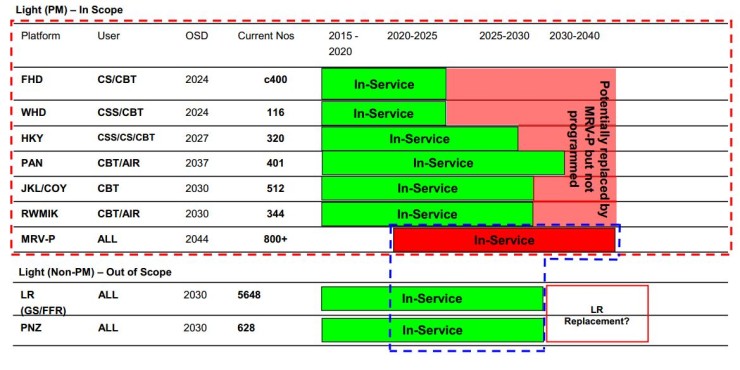
The Army has a Multi Role Vehicle - Protected requirement that should move on in the near future to deliver a few hundred general purpose, protected vehicles and a new protected battlefield ambulance, and this could end up adding yet another vehicle to the roster. According to recent news reports, the Army has been seriously considering the opportunity of selecting the american Joint Light Tactical Vehicle, which, being due for a massive production run of well over 50.000, might be the only contender with a chance to fit the small budget. 
I remain personally concerned by the way the MRV-P programme seems to lack a true long-term plan, and clarity about how MRV-P fits within the other fleets and how the number of different vehicles can be cut down to achieve logistic simplification over the coming years. If MRV-P is to be successful, the Army must be prepared to build up its numbers with regular purchases over the years, and make it part of a coherent programme for replacement of old platforms. 
The first MRV-P purchases seem destined to replace shares of unprotected support vehicles (Land Rover, Pinzgauer, DURO) in a number of roles and positions across the army, but this must only be a beginning, not a one-off. The army has already started and then abandoned too many programmes, ending up with an endless list of different vehicle types. This time, it must do things differently. 

The planning gap: the Army quite clearly does not know what it wants going ahead. The confusion is made even more evident by Foxhound OSD being given as 2024: frankly, an absurd proposition. 

MRV-P variants duplicate, in a way or another, a variety of vehicles including Panther, Foxhound and Husky. It is imperative to formulate an actual long term plan to move from multiple vehicle types down to one or two. Foxhound's uniqueness is given by its high protection level, which is two NATO STANAG levels higher than what is requested out of MRV-P. The level of protection requested should determine which proportion of the fleet needs to be made up of Foxhound variants and which can be covered with MRV-P. 

From a Light Mechanised Infantry point of view, the priorities beyond proper, protected Recovery vehicles and ambulance should arguably be the replacement of the RWIMIK +. It is hard to accept that the firepower of the battalion should ride into battle in a platform offering less protection and, probably, somewhat inferior mobility than that of the troop carrier within the rifle companies. 
The Foxhound WMIK variant should be brought in to solve the problem, and General Dynamics has been offering other variants of the base Foxhound: this year it is showcasing a SF variant and a C2 command and communications variant that could be a perfect long-term replacement for Panther and beyond. 
The Army needs to formulate a plan which, i suggest, would need to capitalize on Foxhound on one side and on MRV-P on the other. The main differences between the two will be protection and cost, with the Foxhound being much better armoured and much more expensive. Over the coming years, the Foxhound, in all its variants, should equip the light units closer to the line of fire, with MRV-P in its variants covering the rest of the requirement, leaving completely unprotected vehicles to the non-frontline jobs. 


Light Cavalry 

Light Cavalry regiments, currently 3, are 404 strong and are mounted on Jackal and Coyote. They currently suffer the lack of an adequate light recovery vehicle able to follow the formation and support it right up to the line of fire. Apart from a few Husky "Recovery" created directly by the REME in Afghanistan, they currently have nothing but the gigantic MAN wrecker trucks. 
This problem should, however, be solved relatetively soon. 

Another problem facing the Light Cavalry is a serious firepower deficit. Javelin aside, the Light Cavalry does not field anything more than Grenade Machine guns (in theory, one in each Troop of four vehicles) and .50 HMGs (on the other three vehicles in the Troop). 
This firepower is insufficient to stand up to the threats likely to be encountered, and i'm not talking necessarily about russian reconnaissance formations here, but even of the ubiquitous toyota pick-ups loaded up with heavy weaponry by terrorists and insurgents all around the world. 
As the french discovered in Mali, the .50 is at a disadvantage against enemies often armed with the russian 14.5mm gun, not to mention against pick ups armed with the ZSU-23-2 anti-aircraft gun. 

Accuracy is questionable, but this kind of combination would put a Jackal with a .50 HMG at a disadvantage in terms of range and lethality. 
The Light Cavalry needs a greater reach and greater lethality in order to be credible. The French in Mali had the Sagaie and AMX-10 to fall back on, and where these were not available they have resurrected old 20mm guns and installed them on the back of trucks, to fight fire with fire. 
The US Army, facing much the same considerations, intends to equip its lightweight recce formations with a JLTV variant armed with a 30mm gun derived from the Apache's one. 
The russian army is working on an impressive unmanned, enclosed turret with a 30mm gun, installed on top of the Tigr 4x4 protected vehicle. 

Tigr with 30mm gun turret
The M230LF trialed on top of an M-ATV of the US Army. 

The Jackal needs to follow the same path if the Light Cavalry is to be credible, otherwise it will be badly outgunned in each and every scenario. 


An orphaned capability? 

There is a big question mark floating over the british army light forces, however, due to the new Army 2025 plan. At the moment, there is little to no information available about the kind of structure that the six Infantry Brigades will assume. Moreover, there are no details regarding how these brigades will be employed and what kind of capability they will be able to generate. 
Light Mechanised Infantry and Light Cavalry were key components of Army 2020, as two "Adaptable" brigades formed around these units were part of the 5-formations cycle needed to support an enduring operation: 

Armoured Infantry Brigade x3 
Adaptable Brigade x2    (the 7 Adaptable Brigades would be used to generate two deployable force packages, to cover two successive tours in theatre) 

Under Army 2025, however, there will be a "greater focus" on one-shot, short duration, Division-level warfighting, and the SDSR 2015 document and successive (few) words offered by general Carter accurately fail to detail whether the army will still be able to support a 5-brigade cycle, making a future enduring operation possible. 
When listed: 

Armoured Brigades x2
Strike Brigades x2
Infantry Brigades x6 

the elements of Army 2025 seem impressive and more than capable to support a future enduring operation. However, this is actually far from certain, as the Army intends to keep two rather than one brigade at readiness each year (1 armoured and 1 strike). 
In addition, 5 infantry battalions will be further maimed to create "Defence Engagement" formations numbering a mere 350 men each. The re-organization of the cavalry regiments might also take away one or two Light Cavalry regiments, depending on the decisions that will be made (four rather than 3 Ajax regiments are envisaged now, and a Cavalry unit might be ordered to change role to CBRN reconnaissance as the capability is given back to the Army). 

Husky in Mortar carrier role 
The insufficient number and consistence of supporting regiments (Signal, Logistic, Artillery, Engineer) makes it unthinkable that more than 5 brigades can be adequately resourced for deployment, which means having, at best, one deployable Infantry Brigade out of the six planned. Maybe not even that. 
This risks turning the Light Cavalry and Light Mechanised Infantry into orphaned capabilities, lost somewhere within a force structure that makes little sense and that seems unable to properly, fully exploit the resources already paid for. 

Tuesday, June 14, 2016

Few revelations, lots of questions


The chief of the general staff, general Nick Carter, has spoken today to the Defence Committee within the frame of the Army 2025 inquiry. Unsurprisingly, very few solid answers have come out of the long session, and the few which did arouse even more questions and worries:

- The general has confirmed what was clear all along: the "Defence Engagement Battalions" will be tiny and the manpower recouped from their downsizing is what will be available to beef up the units needed for the Strike Brigades. N battalions (2 to 5) will go down to "around 300" personnel, from the current 560 (Army 2020 Light Role battalion establishment, all-ranks, all-trades). The DEBs are tiny, but don't you go thinking it is yet another fudge to avoid disbanding unsustainable battalions! No, they are just going to be "very specialized", with more officers and NCOs, linguists etcetera, according to the general. We'll see. 

- The Strike Brigades are apparently going to have a very questionable structure: Carter talked of 2 regiments on Ajax and "probably" 2 mechanized infantry battalions for each brigade. 
This suggests a very modest uplift of one battalion compared to earlier plans for 3 mechanized / heavy protected mobility units. What cost will be paid by heavy armoured infantry and tank units, we do not yet know. 
With 4 regiments of "50 to 60" Ajax vehicles planned as key parts of the Strike Brigades, we are most likely looking at armoured brigades without a heavy cavalry formation: 4 regiments is already one more than earlier planned, and with no extra vehicles on the horizon it is hard to imagine any more regiments using the type, unless all recce troops within armoured infantry and tank regiments are sacrificed to scrape up enough Ajax to build up some kind of recce formation. 
The Ajax will be the "medium armour" element of the Strike Brigade, and this is incredibly annoying because FRES SV did include an actual Medium Armour segment, which envisaged a medium tank with a 105 or even 120 mm smoothbore gun, but it was cancelled and it is not coming back.
Ajax was then designed and built for reconnaissance, and now will be squeezed into a medium armour construct, with reconnaissance a distant second and with the heavy armour formations apparently cut out.
The whole Strike Brigade concept appears to be built upon the french army operations in Mali, which have evidently fascinated Carter to no end. Supposedly, the Strike Brigade will be a self-contained, self-deployable formation able to move "up to 2000 km" on its own, covering a large battlespace, "dispersing and regrouping" as necessary.
This is what the french did in Mali with their mechanized, highly mobile battlegroups, but whether that experience is in any way indicative of future scenarios and needs is up for debate.
The french in Mali have enjoyed the firepower of 105mm guns on AMX-10 and 90 mm guns on Sagaie. In the future, they will have the EBRC Jaguar with the 40mm CTA plus 2x anti-tank missiles, so they won't have the same kind of direct fire punch. They might very well feel the loss.

Ajax comes with no anti-tank missiles, as of current plans, so it'll have even more of a firepower deficit. That Medium Armour element would be very handy now, if this is the plan the british army thinks it needs to follow.

Also, it is worth noticing that the french medium brigades will have 2 cavalry regiments, but more than 2 infantry units. In addition, french infantry regiments are much, much larger than british ones.
The Strike Brigade seems an imitation made by the poor cousin.
Again, the french have taken the "self-deployable", "highly mobile" part of the concept very seriously by introducing combat squadrons in the logistic regiments to ensure that supply convoys have a permanent, organic escort.
Again, the french can count on mobile, mechanized artillery in the form of CAESAR, while the British Army is most likely going to count on towed L-118.

Having to rely on Ajax for the Medium Armour capability also goes against another of the British Army's own recommendations from the Agile Warrior experiments: do not mix track and wheel in combat formations.

Many, many doubts remain. The price that the heavy armour will pay to allow this to (try to) become reality will be the measure of the wisdom of this plan. If the cost is contained, it'll be somewhat acceptable. Otherwise, it'll be a disaster under a fancy label.

- Force generation cycle. According to the written evidence submitted to the Committee, the army will adopt a new 4-year cycle, with 2 armoured and 2 strike brigades, alternating in such a way to ensure that one of each type is always at readiness. 
How it is supposed to work, i sincerely can't quite imagine. There are only so many ways you can try and keep at readiness 2 out of 4 brigades, year after year. 

- Reserves. The Army has suddenly awakened to one fact: it is not realistic to expect that reservists will be available in sufficient numbers to routinely complete understrength, mutilated regular units.
The Reserve will still be "integrated", but it'll return to a "warfighter reinforcement" model, as well as continue to be a supplier of specialists (for example, 80% of the medical capability, as already happens).

I'm not paid by the Army or MOD, nor am i inside their secrets, but if you read this same blog in November last year, you were faced by the prophecy about the true nature of the Defence Engagement Battalion and by the problem of force generation cycle and all other adjustements needed for this 4 brigade approach.
Had the defence committee read my post, they would have had today's answers with greater detail and background, several months early.
And this should be a reason for concern all by itself, because the MOD and Army top brass are supposed to do a little bit better than me on my own in my spare time... 

The little we learned today, in practice, is enough to confirm that we are heading into a new questionable castle of fragile compromises, as was easily predictable. And we still do not have a measure of the other stealthy cuts that will be involved in this exercise of make believe. What will be the two armoured brigades look like? Will the number of MBTs fall further? What about reconnaissance in the heavy formations?
And what will be the capability of the 6 remaining infantry brigades? What will their role be in the force generation cycle, and will the UK retain the ability to sustain an enduring brigade-sized deployment?


Meanwhile, from Eurosatory we hear that the expected date for the first MOD choices regarding the Multi Role Vehicle - Protected has come and gone in the silence, with no decisions evident. 

The Royal Artillery is expected to put out an Invite To Tender early next year for two precision artillery solutions for the 155mm calibre: one requirement is for "Near Precision", and will be most likely fullfilled (assuming it receives funding one day) with course-correction fuzes that can reduce the CEP of standard, unguided shells. 
The "Extreme Precision" requirement would be met by a guided shell, which could be Excalibur, or Vulcano, or the Standard Guided Projectile, or any of the other contenders on the market. Even if the ITT goes out early next year as now apparently planned, it'll be 2019 before a choice is made. Don't hold your breath. The Royal Artillery has been trying to get this programme to progress for so many years that it isn't even funny anymore. 

Industry is forming teams that will compete for the Challenger 2 LEP programme, but, again, it'll be a while before anything happens and for now, apart from the pricetag, there is nothing particularly exciting in this obsolescence-removal programme of desperation. 

ABSV, as always, tends not to make any news, ever.