Showing posts with label Sea King MK7. Show all posts

Tuesday, December 9, 2014

Merlin progress - UPDATE with AEW squadron plan


Merlin for the Royal Marines

846 NAS is training with the Merlin HC3 with the aim of going out to sea soon. According to ADS Advance, the plan is to have them having their first sortie at sea before Christmas, presumably on board of HMS Ocean, due to RFA Argus being deployed to Sierra Leone in support of Operation Gritrock, the british intervention against ebola.
There is not much time left, if the plan is still in place, so their debut at sea might be truly imminent.

846 NAS has re-formed in September in RAF Benson, with 10 helicopters and 14 crews, for a total of 28 pilots. Over 300 aircrew and engineers from the Royal Navy have been training in Benson from 2012 to reach this moment. 846 NAS will remain in Benson for a while still, working alongside the remaining RAF Merlin squadron, 28(AC) Sqn. The squadron is expected to relocate to Yeovilton by Easter 2015, and next year 845 NAS should also gradually take Merlin in, with 28(AC) disbanding. 845 NAS should reform in August 2015, operating at least for a few months with a mix of Merlin and Sea King.

The Merlin is handed over from RAF to RN; september 2014


25 Merlin HC3 (the HC3 is the original RAF variant, known by Agusta Westland as AW101-411; 22 were originally purchased) and 3A (built for Denmark with an enhanced mission fit including a nose modified to take a LOAM low flying collision avoidance sensor; known as AW101-512, they have been purchased by the MOD for a UOR and used for training in the UK to increase the number of deployable HC3s available) are transfering from the RAF to the Fleet Air Arm, and they are all due to be life-extended, upgraded and navalized under a GBP455 million contract.
In order to maintain a core of operational capability constantly available, this process and the withdrawal of Sea King HC4 are organized in phases.

One of the first few Merlin HC3 in Royal Navy markings, by P_H_images

Phase 1 began in October 2014, and includes the partial navalization of 7 helicopters. These will receive a manual folding rotor head, lashing down points, upgraded undercarriage and fast rope harnesses, to be suitable, at least partially, for use on ships and in support of Royal Marines operations. All 7 helicopters, to be known as HC3i (Interim) should be operational by April 2016, when the last Sea King HC4 (no more than 11 remain in service, used by 845 NAS) will be withdrawn from service.

Phase 2 will involve the full navalization and upgrade of a first batch of 9 helicopters, to be uplifted to HC4/4A standard. The HC4 adds an electrically folding tail boom and a cockpit upgraded at HM2 standard as well as a new Tactical Mission System by General Dynamics UK, partially common with the one of the Wildcat. These 9 helicopters should be fully operational by February 2020, and there have been earlier indications of HC4 deliveries beginning in September 2017. Following trials, HC4 IOC with up to 7 helicopters could be achieved during 2018.

HM2's shiny new glass cockpit


Phase 3 will uplift all remaining helicopters to HC4/4A standard, including the 7 HC3i. Deliveries are to be completed by March 2022.
The Commando Helicopter Force will have a total of 37 crews for the 25 Merlin by the end of the transition from Sea King.

A number of Merlin HC3 deployed to Albania this year to work with the Royal Navy and Royal Marines during Albanian Lion 2014. Hopefully we'll see the HC3 on ships soon.

It will be quite a long transition period, which will keep the Royal Marines short of fully ship-compatible helicopters for a long period.


HM2

The HM2 Merlins have achieved operational capability early, and have been through months of very intense training, culminating in exercise Deep Blue, which saw, for the first time in many years, a full ASW squadron of 9 helicopters embarked on HMS Illustrious to fend off the attacks of british and french SSNs and of Dutch diesel submarines.


The Merlin HM2 squadron of exercise Deep Blue

Deep Blue was also a chance to test the Merlin HM2 night capabilities, with the NVG available (finally) to the crew. Here is HMS Richmond seen at night.

The Royal Navy now plans for a fleet of 30 HM2 which will try to sustain a forward available fleet of 25 at any one time, with the other 5 in maintenance.
Of these 30, up to 14 will be embarking at once on the aircraft carrier when deployed, so that the task group can line both a 9-strong ASW squadron and a 4 to 5 strong AEW component (see CROWSNEST further down in the article).
In addition, the Merlin fleet will also be required to sustain at least 5 Small Ship Flights for operations on frigates and destroyers.

HM2 have been carrying on Stingray drops in Falmouth bay as well
The Royal Navy is consequently still hoping to be able to fund the HM2 upgrade for a further 2 to 8 Merlin. The HM1 fleet numbers 38 operational machines and 4 airframes in storage / cannibalised for spares.
30 helicopters are being upgraded to HM2, but the option for 8 more was at one point dropped. However, the Royal Navy now hopes to be able to obtain 2 to 8 more HM2 machines, and a decision might be taken before the year ends.

A busy HMS Illustrious in ex Deep Blue
 
By February 2015, all squadrons (824, 820, 814 and 829) will have converted to the HM2. 


CROWSNEST  

The important AEW capability for the fleet will be a Merlin HM2 task as well, once Sea King is retired. IOC for CROWSNEST is expected in 2019, while the last Sea King ASaC Mk 7 will be withdrawn by September 30, 2018.
The Sea King ASaC force will be downsized quickly in the coming months, and probably it will soon be down to the sole 849 NAS. The number of operational helicopters will be further reduced from 11 to 7 in the forward fleet, and one in reserve. However, this beats by far the earlier plan of having the ASaC going out of service in 2016, with an AEW coverage gap for 3 to 4 years.

CROWSNEST is a programme lead by Lockheed Martin as Main Contractor due to its role in delivering the upgraded mission system used by the Merlin HM2.
Lockheed Martin is also a contender for the requirement: teaming with Elta, they are offering the VIGILANCE radar pods. The pod contains a Elta AESA radar complete with power and cooling system, IFF interrogator and ESM: The pod is carried in place of the torpedo pylons, and only needs a single point power and data connection to the helicopter: the mission system is already compatible with the HM2 software and consoles.

A Thales team is offering a new upgrade of the CERBERUS system used on the Sea King Mk 7, with the Searchwater radar carried inside the well known inflatable "bag" radome. Up to DSEI 2013, the Thales offer involved installing the radar, upgraded to deliver greater detection capabilities, on rails added on the starboard middle fuselage of the Merlin HM2s. After take off, when the undercarriage is folded away, the bag would slide down the rails so that the radar hangs below the helicopter, from where it has unobstructed 360° field of view.
In 2014 the design seems to have been tweaked doing away with the rails and adopting instead an hinge which swings the radar beneath the fuselage. The hinge assembly would go on the weapon pylon station, and from the CGI it appears a cleaner installation. The inflatable radome used on the Sea King MK7 might also be replaced with a solid radome.


Both systems are already being test flown from Boscombe Down, and the two rival bids are expected to be filed in by the end of January 2015. A selection of the winning bid is due in the first quarter of 2015. Operations should begin in 2018 and reach IOC during 2019. Thales has repeatedly said they believe they can deliver operational capability quicker than that, while LM has not been as talkative so far about the progress of the VIGILANCE trials.

The 2014 Thales offer as shown in a CGI by flightglobal.com.

A model showing the Thales solution and the rails on the fuselage, as shown at DSEI 2013

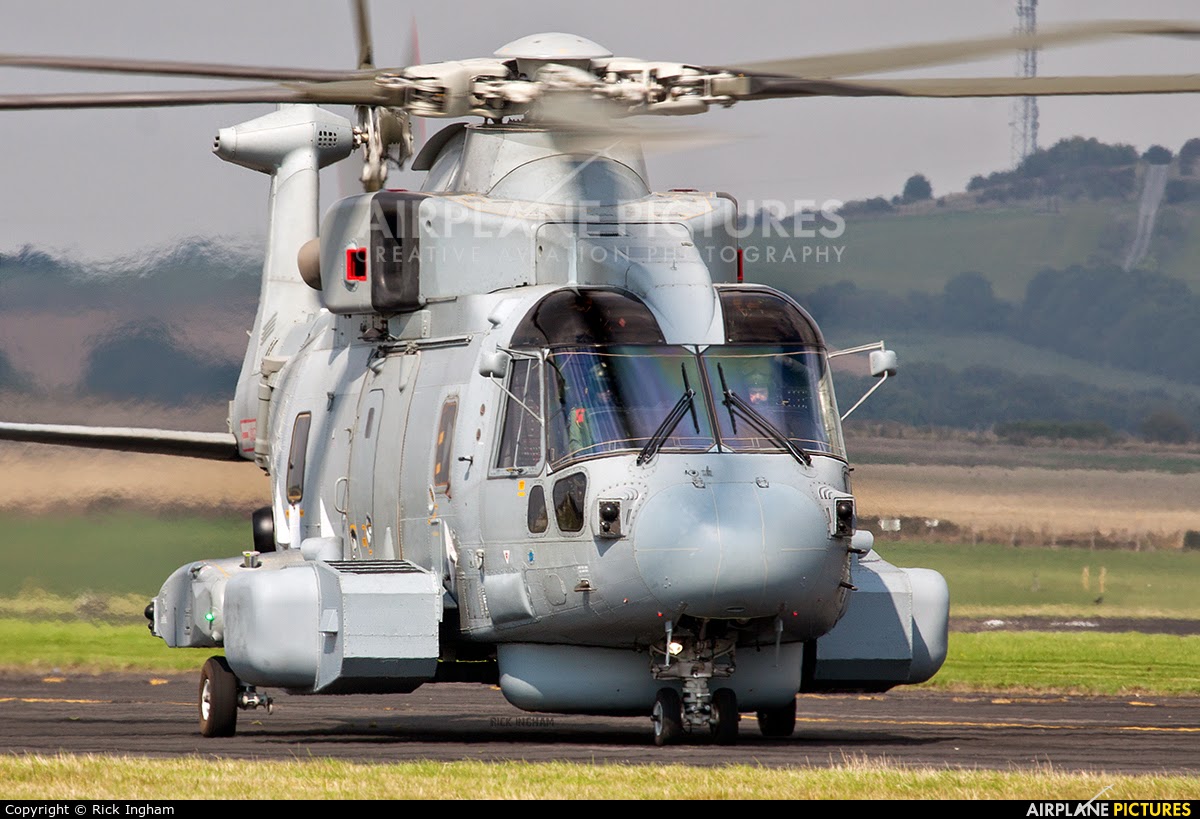
Merlin HM2 with Thales CROWSNEST payload seen in the sky over Wiltshire in november 2014

Rick Ingham shot this great photo of Merlin HM2 ZH831 fitted with two VIGILANCE pods for CROWSNEST trials. Photo from airplane-pictures.net; @ Rick Ingham

So far, the plan has been described as including the purchase of 10 AEW mission fits and the modification of all 30 Merlin HM2 to enable quick installation and removal of the system. Any helicopter in the fleet could thus move from ASW to AEW role in hours.

The new consoles of the HM2, with the large Barco displays, is suitable for displaying AEW data when CROWSNEST is in use

The concept seems brilliant, but i'm very much of the opinion that the Royal Navy, if it manages to fund the upgrade of 8 more helicopters, would better be served by removing the ASW kit from them and fitting them out to serve as AEW platforms full time, in a separate squadron.
My suspect is that the vast and precious range of capabilities and competencies of the very different arts of ASW and AEW cannot be mixed in the same crew. Perhaps the helicopters can be made capable to take the kit as quickly as promised, but the AEW and ASW specialists will, i believe, stay as two separate families.
Modifying a smaller number of helicopters for CROWSNEST transport and having them in their own squadron continues to look to me as the best solution.

UPDATE: there will indeed be an AEW squadron. The Royal Navy today announced that 849 NAS, as well as going ahead solo with the Sea King MK7 up to March 2018, will then continue as a Merlin HM2 squadron operating CROWSNEST.

854 NAS is being re-absorbed into 849 NAS as "Normandy Flight", and 857 NAS will revert to Flight identity, taking the name "Palembang Flight", with formal decommissioning in the new year.
849 NAS will carry on as a frontline squadron with 3 Flights, one presumably with training function and two operational flights. The third flight is expected to be called "Okinawa" after one of 849's battle honours.


A sensible organization, which reflects my expectations. Now, if it was possible to go ahead with the last 8 Merlin to upgrade them and use them in the AEW squadron, that would be a very good development.


Monday, August 13, 2012

Giving eyes to the aircraft carriers


I will start this article by making it clear that I deem extremely unlikely (unfortunately) the scenario that sees the UK buying the V22 Osprey, fascinating and militarily attractive as this solution arguably is. I don’t think the MOD has the money, the will and perhaps not even an impelling enough necessity for doing it. It is a lot more believable, instead, to talk about the US Navy exercising its option for the buy of 48 Ospreys, to use mainly for Carrier On-board Delivery (COD) and, eventually, Search and Rescue (SAR) and Air to Air Refuelling (AAR). And, perhaps, at some point the US Marines will want an Aerial Early Warning platform capable to operate from the flat-deck amphibious vessels, who knows.

With the return to the F35B and, as a consequence, to a STOVL-configured CVF, rumors have been prone to come up every few minutes about the UK possibly buying a number of Ospreys for AEW and COD and AAR roles. Not without a reason, since the V22 AEW was a contender in MASC (Maritime Airborne Surveillance and Control) for the replacement of the Sea King ASaC Mk7 AEW, with some interesting collaboration going on between the UK and the US Marines, who showed quite a bit of interest in fitting the british Cerberus AEW suite to the Osprey. In addition, the Royal Navy was pretty eager to demonstrate that it would be able to operate with an airplane as large and complex as the V22, even on a deck as “small” as that of an Invincible-class carrier.

A lot of things have changed, however, and not for the best. MASC has become Crowsnest, and it is now pretty much certain that the new AEW solution will be Merlin HM2-based, with the helicopter being fitted with the Cerberus system, migrating from the Sea Kings, or with the new Lockheed Martin Vigilance podded radar system. A marked backwards step from the earlier Navy hopes of procuring around 10 dedicate AEW platforms: under the new scenario, the already hard-worked fleet of Merlin helicopters, while going down from 42 (4 in storage) to 30, would be loaded with yet another role, in addition to ASW and Maritime Security in the Gulf.
Even worse, there is a very real risk of having to face and AEW gap of several years, with the Sea King Mk7 bowing out in 2016, with the replacement only available possibly as far away as 2021 or 2022.

From this scenario to a buy of V22s for specific navy use… well, I think it is evident why I find it real hard to consider the Osprey option anything other than a nice dream. However, it is a subject worth treating, and, who knows, perhaps I’ll be proven wrong.
I’d love it.


AEW, AAR, COD  

The core role that needs to be met, urgently and categorically, is the Airborne Early Warning one. The Falklands have well shown what happens when the surface ships are left on their own, trying to react timely to airstrikes that their mast-mounted radars can only detect at short distances. Highly deployable airborne radars capable to provide the commanders with a complete picture of what’s happening in the air and on the surface have proven relevant and indispensable in many, many more occasions: name a recent conflict the UK has been a part of, and the Sea King MK7 was there.
It was there in 2003 to provide 3rd Commando Brigade with the necessary airborne surveillance capability. It was there in Libya, it was there to protect the Olympic games and it is used to great effect in Afghanistan.

Crucial to the Sea King MK7’s success is the Cerberus system, with the Searchwater 2000 radar. This system, delivered from 2002, turned the Sea King MK2 (a pure AEW platform) into a multimission surveillance and control system: the Searchwater 2000 is a very capable radar that can track targets on the surface and in the air, processing three radar modes at once.
The two observers flying into the Sea King MK7 can share the battlefield picture obtained thanks to the radar with the commanders on ships / on the ground, via Data Link 16 and an extensive Secure Communications equipment.
In any moment, the Observers can be asked to re-task, and look over a particular area. For the almost totality of a typical 3.5 hours sortie, the Sea King MK7 is an all-seeing eye over the battlefield.
There is no exaggerating the impact of this kind of capability.   

The radar, multimission by nature, makes the Sea King better, under certain aspects, than an immensely more expensive, much bigger E3D Sentry: the AWACS has very little use as a ground-target tracking platform.
In addition, the small sizes of the Sea King, and its ability to take off vertically have been important, making its deployment a lot easier when compared to the use of huge E3D Sentry and/or Sentinel R1.
On the other hand, the Sea King’s typical sortie lasts a fraction of that of a Sentry or Sentinel, and the helicopter can only fly at a much, much lower altitude. And there’s a price to pay for this: the radar has to be placed as high as possible, as altitude means increased range, and increased range means detecting the enemy earlier, and having more time to react. And time is never enough in certain situations. Every additional second counts.

Delivering 24 hours coverage with the Sea King is not easy. The MK7 will often fly two missions a day, but even so, you need no less than 4 airframes to ensure constant coverage. And there is no remedy to the altitude issue.
These two being the reasons that make the V22 attractive.

The V22 is fully compatible to a STOVL carrier, and is almost as deployable as Sea King: it does not need big runways to operate. On the other hand, it is much, much larger than Sea King, so deployment on small ships such as frigates and destroyers is a no.
On the other hand, the V22 offers greater mission endurance and flies at a much higher altitude, with a service ceiling of 24700 feet. A Merlin-based solution would fly at 15.000 feet at most.

The MV22 is also much faster, at between 250 and 262 knots maximum sustainable cruising speed against Merlin’s cruise speed at 150 knots. Even in “economic” cruise speed, the MV22 would undoubtedly lead by a great margin.
The MV22 has at least 4 hours endurance with a load of 24 combat-ready troops, but its mission normally is not described much in terms of endurance, but in terms of range and speed: it can carry the 24 Marines out to 325 naval miles and return to the ship in record time.
The Special Forces CV22 has additional fuel tanks, and its mission is to carry a 18-man team out to 500 naval miles.

In March 2008 Boeing was already proposing a V22 ASaC solution which would incorporate the CV22 additional fuel tanks, improved power connectors, secure communications and a Link 16 antenna. A rigid radome would contain the Searchwater 2000 radar. As of 2012, the proposed V22-Cerberus is still mooted, as Totally Organic Sensor System (TOSS).  

The US V22 plan calls for the acquisition of 458 V22s, of which 360 for the Marines (MV22 variant), 50 for the US Special Forces Command, via USAF (CV22) and 48 for the US Navy (HV22). As of 2010, 216 Osprey aircrafts had been procured, 185 for USMC and 31 for USAF. The 48 Navy Ospreys haven’t yet been ordered.
Recent buys have been conducted under the terms of a 10.4 USD billion contract signed on March 28, 2008, valid out to FY2012 and covering procurement of 141 MV22 and 26 CV22, giving an average cost per unit of roughly 62,3 million dollars for the multiyear contract. When the over 10 billion dollars of Development costs are added, the unitary cost is 109 million each over the planned 458-strong fleet.
The V22 is not a cheap airplane. However, it is worth remembering that the UK is paying for 14 new Chinooks a billion pounds (including 5 years of support), and that means north of 100 USD million per airframe.

In terms of capabilities offered, a MV22 AEW would mean a big leap forwards, thanks to greater speed, altitude and endurance. Besides, the Osprey can refuel in flight, and while the Merlin (the HC3 variant, at least) can also be air refueled, the UK currently is unable / unwilling to exploit this particular characteristic.  
The TOSS envisaged 3 workstations on board, adding one compared to Sea King MK7, and better accommodating teamwork with UAVs, that the UK has been experimenting as part of MASC since 2005. Namely, the Sea King MK7 was back then trialed working in team with the Scan Eagle drone, which the future AEW platform could send ahead to visually observe a target acquired on the radar, for example.
This year the Scan Eagle will again be trialed by the Royal Navy from a Type 23 frigate, but this time it’ll be an operational trial, since the drone will be used in the Gulf, during a routine deployment.
An April 2012 image of a possible V22 ASaC shows two workstations, but probably there is quite a lot of flexibility in how the AEW equipment can be arranged on board.

The AEW Osprey is shown equipped with a palletized Cerberus, rather similar to what was proposed in 2010 by Thales and AgustaWestland for adoption on the Merlin HC3. The radome containing the Searchwater radar is lowered out from the rear ramp, while a pallet fitted with the electronics and workstations

As a Carrier On-board Delivery platform, the V22 offers respectable performances: it has an internal cargo bay volume of 739 cubic feet, and can carry a 20.000 pounds load, with the floor rated for a pressure of 300 pounds per square foot.
The length of cargo space available is 20.8 feet, which means a load of, for example, four 48x48 Warehouse pallets, or two 463L pallets. The cargo space can take containers as large as 68 inches wide, 66.23 inches high, and 250 inches long as long as they can achieve the necessary restraint criteria.
For external loads, there are two cargo hooks, either of which can support a 4358 kg load (10.000 lbs). Alternatively, both hooks can be used together, to stably lift a 15.000 lbs load.
There is also a rescue hoist on a removable boom. Good for SAR work, it is rated for 600 pounds. Fastrope equipment can be fitted under the tail, allowing men to rope down from the rear ramp with the Osprey hovering.

As an Air to Air Refueler, the V22 is fitted with a palletized 660 lbs kit with a single drogue unit, deployed centrally from the rear ramp. Two auxiliary fuel tanks are installed in the cargo bay, each for 430 gallons, for a combined 5590 lbs of weight.
The installation of this kit takes around 1 and a half hours. Max speed is 230 knots in this configuration, enough to safely refuel fixed-wing jets, F35 included. The central position of the drogue keeps the plane that is being refueled safe from the vortexes of the two massive rotors of the V22.
Internally, the MV22 carries 1720 gallons (117000 lbs), with the CV22 carrying 2040 gallons, so that, with the auxiliary tanks installed, there’s at least 17290 lbs of fuel on board, much of which is transferable.
It is not much, when you consider that a F35B carries more than 13.000 lbs of internal fuel, but for sure it is enough to provide an helpful top-up to several F35s in a single sortie, extending their range and endurance considerably. 

The ISR-C2 variant shown seems to be equipped with the TOSS system based on the Cerberus and Searchwater radar. The trademark "bag" of the radar is well visible.

The deck footprint of a V22 is quite huge: 84,6 feet in width and 57,3 feet in length. When folded for storage, however, the width reduces to just 18,11 feet [5.8 meters], while the length increases to 63 feet. The V22 can be brought down into the CVF’s hangar without being folded, as the lift and hangars are big enough to take the airplane. The hangar is also high enough, at least for part of its length, to take the unfolded V22, which is 6,7 meters high, reducing to 5,5 meters when folded down.

If the UK ever got around to buying the Osprey, there would also be an opportunity for collaboration and joint maintenance in the UK, as the US are deploying a squadron of CV22 Special Ops Ospreys to the airbase in Mildenhall.

There is no doubt that the V22 would make available some very interesting capabilities to the Royal Navy, but at a quite high cost. I don’t think the Navy will ever be able to justify said costs. To the scrutiny of the MOD and Treasury, the Merlin helicopter is probably going to result perfectly adequate for the AEW role, and COD and AAR roles are not immediate requirements, much as they would of course add a lot to a carrier task force’s capability. 

Data from: 

http://www.scribd.com/doc/89698817/v22-brief#download - thanks to SNAFU - Solomon for putting this online 

http://www.marines.mil/unit/mcbjapan/Pages/Around/MV22GB.pdf

Arnie Easterly (January 2004) "Navy V22 Concept of Employment, US Naval War College" 


Crowsnest: the Merlin AEW

Indeed, as said also in the Royal Navy 2012 handbook, the Crowsnest is by now set on using the Merlin HM2 platform as base for the AEW role.
The HM2 is the soon to be in service upgraded variant of the Merlin HM1 sub-hunting helicopter. Originally, 44 Merlin HM1 were purchased, but in the years 2 have been lost to accidents and 4 have been mothballed. Of the remaining 38, 30 are being updated, while an option for modernizing the other 8 seem set not to be exercised.

The Merlin HM2 fleet will routinely be asked to provide 6 or 8 Small Ship Flights for the Type 23 and then 26 frigates, with more potentially earmarked for Type 45. A requirement also exists for providing larger (4 to 6 helicopters) flights to big ships such as RFA Argus (it has become a common solution for Somalia anti-piracy deployments) or the Fort class replenishers, and of course to the Aircraft Carrier in future. Then there are additional security tasks, training needs and other requirements to be met.
If we consider that all ship flights ideally should be triple (one training, one deployed, one recovering after deployment), we can immediately appreciate the full dimensions of the problem, and of the work that the already stretched Merlin family does. Meet all calls from a fleet of 30 aircrafts will be a real problem.

As I said, I deem it highly unlikely that we get an Osprey solution. My greatest hope is to see Crowsnest adjusted to involve the upgrade and use of the 8 – 12 HM1 airframes not currently part of the HM2 upgrade. This upgrade could do away with everything relating to the dipping sonar and sonobuoys, and focus on delivering the core software and hardware modifications of the HM2, to remove obsolescence and make the fleet logistically common to the main one. This way, the two AEW Squadrons could be retained as a separate force, like now, and the requirements could better be met.  
If we were to obtain this, it would already be something worth cheering for.

There are two different industrial teams putting forwards two modular AEW solutions for adoption on the Merlin HM2. One team is composed by AgustaWestland and Thales, and includes a palletized Cerberus solution, “migrated” from the Sea Kings.
Lockheed Martin and Northrop Grumman are putting forwards their Vigilance podded radar/ESM solution, developed specifically on the HM2 software and systems, which are a Lockheed product to start with.
In some more detail:

Thales and AgustaWestland proposal

The initial proposal by Thales and Westland was made in the summer of 2010, and aimed at HC3 type Merlins equipped with a rear ramp. The choice of airframe was rather weird, as there is no overabundance of Utility helicopters, quite the opposite!
The possibility of modifying the surplus HM1 airframes to cut a ramp opening into their back was, as far as I’m aware, never confirmed, and anyway such an approach would require quite a lot of work and expense. Westland at the time was planning on the hope that the MOD would acquire around 10 new helicopters specifically to meet AEW needs. 


The original Thales - AgustaWestland proposal, targeted at the Merlin HC3 (or better still at new build "HC3+" with folding rotors and navalization)

In this first proposal, a pallets with two workstations and the electronic equipment would be rolled into the fuselage, followed by another pallet mounted on the edge of the ramp, holding up the Searchwater 2000 radome, which would be lowered once in flight to have unobstructed 360° coverage.

In 2011 the Thales/Westland proposal evolved as it became clear that HM2 airframes would likely to be mandated for the job. The new proposal removes the need for a rear ramp and for pallets, by utilizing modified HM2 workstations (2 of them, no additions) and by fitting a modified Searchwater radome over rails fitted to the side of the fuselage.
The radar pod would slide up and down the rails: up to clear the way for landing, and down to obtain unobstructed view once in the air. 

The revised Thales proposal, with rail-mounted radome. The "bag" slids upwards prior to landing.

This new proposal involves minimum modifications to the base helicopter, and would enable quick re-roling of the Merlin if most or all of the HM2 fleet was fitted with the rails and software mods.   


Lockheed Martin and Northrop Grumman proposal

The Lochkeed Martin/Northropp Grumman Vigilance AEW radarpod is a 280 to 300 kg pod, entirely self-contained, which houses a powerful Northrop Grumman AESA radar, said to be related to the AN/APG80 and AN/APG81 radars of the same company. The AN/APG81, in particular, is the “super radar” of the F35.
Said AESA radar is said to offer quite unbeatable performances, with SAR and ground targeting capability, and powerful air to air AEW mode.

The Vigilance pod also contains the processor and power system, an IFF interrogator, GPS/INS, ESM sensors and its own cooling system. Two of these pods, mounted on the torpedo hardpoints of the Merlin HM2, can give 360° degrees of AEW and land surveillance capability. They only need a single power source connection, and can work with the software and tactical workstations (2) of the Merlin HM2, even if two more stations could be added for improved performance in the various roles made possible by the multimission nature of the radar. 

The Vigilance radar pod fitted to a Merlin HM2 for tests
The Vigilance pod contains IFF, AESA radar and integrated cooling system

Again, this solution requires minimum modifications to the helicopter (very possibly even less than required by the Thales solution) and would be quickly adoptable on potentially all of the HM2s.

The Vigilance pods could almost certainly be fitted to the V22 as well, leaving more space in the cargo bay to install auxiliary fuel tanks and expand endurance. The pods are indeed offered for adoption on a huge variety of rotary and fixed wing platforms. Validated on the Merlin HM2, the Vigilance is offered for platforms all the way up to the C130.


The odd and fascinating one

News of Royal Navy interest in hybrid airships surfaced on the press some time ago and generated immediately quite some interest.

The Bedfordshire-based Hybrid Air Vehicles is producing its HAV304 airship platform for the Northrop Grumman’s Long Endurance Multi-Intelligence Vehicle (LEMV), an airship that will offer the US Army a 21 days loiter time at 20.000 feet (plus possibly the equivalent of 2 days loiter in range of deployment), with a wide range of sensors and cameras installed as part of a 1800 lbs payload.
With a crew of men onboard, loiter time reduces to 5 days at 16.000 feet.
The hybrid airship can loiter at 30 knots speed and cruise at a max speed of 80 knots.

The LEMV has made its first flight in the last few days, some 16 months behind schedule: it had to be in Afghanistan by the end of 2011, and it won’t be there before 2013.

The Royal Navy interest was apparently for the HAV314 variant, however, a larger heavy lift airship with a payload of 50 tons. Now known as AIRLANDER 50, this hybrid airship can land on water or on any reasonably flat ground surface. It does not need a runway, but it does require around 4 times its length in open space to safely land and take off.
Range is 2600 nautical miles (at full payload of 50 tons?), and the body of the airship is fitted with a cockpit for a 2-man crew. The cargo area is separated in two zones: the first area, just behind the cockpit, has a raised floor and offers 2.8 meters (9 feet) in height and 10 meters (33 feet) in length, with a minimum width of 5,64 meters. The second cargo section offers 3.93 meters (13 feet) in height and 20 meters (66 feet) in length and can take 6 standard containers in two rows of 3. In the rear, a vertical crane assembly is provided, which can lift 20 tons, and pull up or lower a container on a truck or on the ground.
Landing and take off speed is 40 knots, and cruise speed is around 80 knots or higher. 


With 200 passengers, it can cross the Atlantic in around 36 hours. According to the Telegraph report, the Royal Navy was even considering the Airship as an assault vessel, carrying up to 150 Royal Marines and a number of RHIBs that could be lowered into the water via crane, or deployed after landing the airship on the water. Fascinating, even if I wonder what the range and endurance would be, what kind of accommodations the Royal Marines would have on board and what exactly would be the mission of such platform.

As an AEW/ISTAR platform, an airship is both attractive and problematic: how would it deploy? Self-Deploying at range over a naval task force in open sea might be a real issue, and the airship definitely can’t land on the carrier’s deck, even less on a smaller vessel.
Would it be possible to refill, maintain, refuel and support the airship by landing it on the water, or would an airship-support vessel be required?
With an airship costing 60 million pounds, reportedly, the solution is already far from cheap, at least in initial procurement (the savings come over the service life of the platform, which requires a lot less support and a lot less fuel than helicopters and airplanes), without needing to buy a (huge) support vessel capable to embark at least a couple of airships, the number needed to ensure continuous coverage.
Even assuming that a Cerberus-like payload can be integrated, and then operated remotely from on board the carrier to maximize the time the airship can spend in the air, and at maximum altitude, the problem of deploying the airship over the task force and keep it flying needs a solution.

As air-tanker, the Airship has no chances, as it is way too slow to enable fast jets to refuel from it.
As a COD platform, with a 20 ton crane capable to lower standard TEU containers on the deck of CVF, and with the capability to carry 50 tons or 200 passengers, the airship is quite unmatched.

But the only way I can see an airship used in the Royal Navy is as an additional capability, not as a Crowsnest solution. A small number of airships, fitted with a payload of sensors and surveillance cameras and with a remaining significant payload margin for transport and COD missions would certainly be useful.
But would they be useful enough to justify their cost in a crowded and always tight budget?

The airship might not be the right solution for the present.
It might, however, be the solution for the future, paradoxically. Enter the Lockheed Martin’s ISIS (Integrated Sensor Is Structure) airship, a gigantic high altitude platform meant to fly at 70.000 feet for up to 10 years per sortie, while carrying a massive integral air search radar capable to detect air targets at a range of 373 naval miles in all directions, while simultaneously carrying a monstrous ground surveillance radar system capable to track multiple static and moving surface targets out to 186 naval miles. The airship would be able to relocate globally in a 10 days time thanks to a sustained speed of at least 60 knots and sprints to 100 knots, and operate without in-theatre support. The control element would be CONUS-based (CONtinental United States).  
This capability would replace at once the E3D Sentry AWACS, the Sentinel R1 and the carrier-borne AEW platforms, offering much increased performances over all of them. The US has been working on the ISIS for years, with the LM contract awarded in 2009. A demonstrator might fly next year.

This airship program, if successful, would no doubt represent a true revolution.  


Wednesday, November 23, 2011

Buy a plane, get an air force


Truly multirole

The US Marines saw many times the SOCOM, US Air Force-flown AC130 gunships in action. In particular, they have seen their effect in 2001, during operations in Afghanistan, and the USMC has always had a wish for that kind of enduring, highly accurate and devastating fire support from the air. But an AC130 costs a lot: at least 3 times as much as a latest generation KC130J, the multirole tanker variant that the USMC uses.
The Marines couldn’t afford that cost, nor a single-use fleet of warplanes like those assigned to the special forces. But they realized that, perhaps, they could exploit planes they already had, and turn out a genuinely multirole solution, at a very advantageous cost.

Enter the Harvest Hawk (Hercules Airborne Weapons Kit) programme, one of the most interesting plans ever, and moreover, one that works and delivers.


The KC130J

The KC130J is the Multirole Tanker/Transport plane used by the USMC. Its main role is to refuel USMC planes and helicopters, as it did in 2001, toppling up the fuel tanks of the CH53 and CH46 helicopters carrying the Marines from the USS Peleliu assault ship, in the Indian Ocean, all the way to the small airstrip south of Kandahar that would become Forward Operating Base RHINO after that historical 400 miles vertical amphibious assault. 

The KC130J is without a doubt the best Tactical Tanker currently out there on operations. It only takes a 1000 feet runway to take off and land, can fly low, is fully night-vision compatible and has an extensive self-protection kit of electronic countermeasures and radar warning receiver.

The KC-130J carries its fuel mainly in the Wing tanks and in two underwing external long-range tanks, which means that in most missions the cargo bay remains available for carrying personnel and kit. With the wingload of fuel, the KC130J can distribute 57,500 pound of fuel to other helicopters and planes, with a 500 nautical mile operating radius. Refueling is carried out thanks to two standard probe and drogue pods mounted under the wings. The KC130J is thus capable to refuel all USMC, US Navy and most NATO airplanes, but not USAF ones, since the USAF continues to favor the Boom AAR method.
When more offload fuel is required, the cargo bay can be fitted with a fuselage tank capable of  an additional 24,392 pounds of fuel.  

The KC130J can refuel planes and helicopters (the second capability is very important to Special Forces and Marines), while a jet-based AAR asset such as Voyager is not really suited for refueling helicopters due to speed and altitude differences. 
But the KC130J is a complete Tactical Tanker, as it can land on rough terrain, potentially very close to the front or even inside enemy territory, and constitute a ready-to-deliver Forward Refueling Point on the ground. It can pump fuel into fuel caches such as the common “Pillow Tanks”, inside vehicles and helicopters even “rotor turning”, and do so at a rate of 4018 pounds of fuel per minute. With the cargo bay clear, it could also carry ground support teams and armed security teams for the functioning of the FRP, and then just take off at the end of the operation, to return to base. To make this possible, the KC130J’s propellers have been given a feathering feature (known as “hotel mode”) which stops the props but keeps the turbines going to pump fuel. This eliminates the otherwise powerful blast behind the KC-130J, allowing ground forces to operate in relative calm all around it. 


Tanker, Transport and gunship

The ability of the KC130J to refuel other planes and carry cargo at the same time became immediately attractive for the USMC officers as they evaluated their options for introducing a Gunship for their Corp. The KC130J is found hovering high above the operation areas, so it is well placed to carry out enduring battlefield surveillance and strikes, even while continuing to offload fuel to other assets when necessary. 

RoRo pallet with Harvest Hawk tactical workstation.

A modular kit that could be embarked in the cargo bay was an ideal solution, and the USMC worked to obtain just that with Harvest Hawk. The modular kit includes:

-          One roll-on/roll-off set of surveillance displays and fire control electronics that are rolled into the cargo bay. This is coupled with a modular surveillance and targeting unit that takes up the rear portion of the inboard left external fuel tank, or may simply be mounted below that tank as a surveillance turret. Lockheed Martin’s AN/AAQ-30 TSS was selected as sensor, a choice made with some wisdom, since the TSS is already in use as the main sensor of the U.S. Marine Corps AH-1Z Cobra attack helicopter, simplifying logistics and offering commonality. The TSS makes the KC130J capable to detect, follow, and track multiple targets, and laser-designate them for its own weapons, or for third-party attacks. The TSS installation reduces the amount of fuel carried in the affected external fuel tanks, obviously, but it is a very fair trade off seen the capabilities offered. 

The TSS, mounted at the back of one of the big external long range fuel tanks

 -          A four-rails M299 missile rack (identical to those used on Apache) for 4 AGM-114P Hellfires and/or up to 16 DAGR laser-guided 70mm rockets to the left wing, in place of the left-hand aerial refueling pod. This reduces the KC130J’s refueling points to One instead of Two, but adds a lot of firepower.

-          A cargo-ramp mounted, 10-cells launcher is mounted in the back, and contains 10 Griffin missiles, each weighting just 15.6 kg (34.5 pound), with a 5.9 kg (13 pound) warhead which is larger, in proportion to its size, than the one carried by the larger Hellfire missile. The Griffin is a 42-inch-long, 5.5 inches wide tube-launched missile with a semi-active laser seeker. It is a low cost weapon that Raytheon self-funded and developed from existing technology, aiming at drones. It is proving a real success.
Griffin has pop-out wings, allowing it to glide, and thus has a 15 kilometers range, longer than that of Hellfire. The Griffin is proving popular for most kind of engagements in Afghanistan, and the M299 racks will be, in future, made capable to eventually employ Griffin in place of Hellfires, offering 3 times as many weapons on the same rack. The Hellfire of course remains more suited for engaging “hard” targets such as heavy armor, but in many cases, heavy armor is just not around, and an Hellfire/Brimstone makes for an expensive overkill when the target is a lone sniper firing out of a “killing hole”. 

The 10-cells Griffin missile launcher mounted on the rear cargo ramp.

 -          Currently considered “optional”, is the Bushmaster MK44 30 mm gun, which can be installed to fire out of the rear left Paratroops door of the KC130J, with 160 rounds available and a rate of fire of 200 to 400 rounds per minute. The selection of the MK44 caused some concerns: while the Mk 44 Bushmaster II [30×173mm] and M230 Chain Gun [30×113mm] are both nominally 30mm, their cartridges are very different in size, power, and range. The MK44 is a big, powerful gun, presenting some real challenges in terms of mounting and stabilization for an application aboard flying gunships. The MK44 is used on armoured vehicles and ships, with great satisfaction, but when the US Air Force decided to use it to replace the 25 mm Gatling gun and the ancient 40 mm Bofors gun on its own AC130 gunships, the programme ended up being a big, burning failure: the stabilization of the mount proved ineffective, and the accuracy of the gun was affected. Of course, a weapon that “fires somewhere over there” is not acceptable, and not just for the risk of collateral damages to civilians, but for the very real risks in terms of friendly fire, as Gunship often operate supporting troops on the ground and firing quite damn close to them. The USAF eventually gave in, and “retrograded” the modified AC130s to re-embark their original weapons, despite the enduring disappointment for the performances of the 25 mm gun and the support problems of the ancient, immortal 40 mm Bofors.
The US Marines believe they have found the solution, and that the MK44 will work excellently on their KC130J.

Images from a recent Lochkeed Martin brief showing the modular MK44 gun mount and the concept for the tube-launcher modular mount, which would employ light guided weapons.

This is a lot of firepower, and the plane still remains capable to refuel other planes as well. Rolling down even just the Griffin launcher and palletized consoles, the cargo bay is again available for tactical transport missions, making the KC130J probably the most multirole airplane out there. MK44 excluded, the KC130J kit costs some 10 million dollars, plus some additional training for crews. Awesomely cost effective, and excellent for delivering enduring fire support, with missions typically lasting 7 or 8 hours, but with one Harvest HAWK having flown for 10 hours and fired its entire compliment of Hellfire missiles during combat operations in Afghanistan on March 14.
The kit can be removed in less than a day’s work.   

The USMC aims to have 3 Harvest Hawk kits available in each of the 3 Squadrons (they will be four in 2012 as the last Sqn stands up) of KC130Js.

And it is not over yet: for the KC130J spiral development there are plans and suggestions coming out of everywhere. The Viper Strike weapon, another ultra-small precision guided ammunition, has been selected by the US Special Forces for use on the traditional single-role gunships, and last year and this August orders was placed for integrating the weapon on the Harvest Hawk as well. The JDAM bombs, deployed probably from the cargo ramp, have also been proposed, turning the KC130J potentially into a tactical medium bomber! Again, LM offers a different solution for the rear paratroop door, which could replace the gun module with a quadruple tube-launcher assembly for guided weapons. 

The KC130J Harvest Hawk

The Special Operations Command (SOCOM) and the USAF themselves are noticing the value and success of the Harvest Hawk approach, and the SOCOM now plans an Harvest Hawk-like drop-in modular package for precision strike for its fleet of MC130W Combat Spear Special Forces transport planes. Similar kits could also be fielded for SOCOM’s most recent HC-130J Combat King II (fixed-wing Combat SAR platform, derived from the KC130J and capable to refuel helicopters and planes in flight) and MC-130J Combat Shadow IIs (again, a Tactical Airlifter/Air Tanker based on the KC130J), and they may even spread beyond that. Meanwhile, SOCOM remains a user of dedicate, single-role gunships, and is expanding its existing AC-130 gunship fleet to 33, with the acquisition of 16 new AC-130J models. As of now, 13 AC-130U Gunships are flown by the 4th Special Operations Squadron (SOS) and 8 AC-130H Gunships are flown by the 16th SOS. The 8 aging AC130H would be retired and replaced by the first 8 AC130Js, with another 8 coming to expand the fleet.


Vigilant Watch and Vigilant Hawk

The Harvest Hawk programme of the US Marines is a spin-off of the Vigilant Hawk – Armed ISR mission kit conceived by Lochkeed Martin for the rapid re-roling of C130 tactical transports for covering other impelling operational needs, namely the request, at an absolute all times high, for ISR.
Said need generated Vigilant Watch, a RoRo pallet installation comprising multispectral sensors and consoles that can transform any C130E/H/J into a capable ISR platform with minimum work: installation takes as little as 24 hours.

Vigilant Watch uses 7 different sensors, installed in two modified external long range fuel tanks. A “Vigilant Hawk lite” configuration comprises one SAR radar, one EO/IR sensor ball and 1 digital camera mounted in a modified long range fuel tank, with a RoRo pallet installation with one or two operator consoles and communications on Line of Sight and Beyond Line of Sight (LOS and BLOS).

Vigilant Hawk followed. Like it happened earlier with Predator drones, the awareness that ISR platforms often identify time critical targets but cannot independently prosecute them spurred development of a time-critical, on-board engagement capability. This concept, adopted by the US Marines, became the Harvest Hawk.  

Vigilant Watch was presented on the international market this year, and Vigilant Hawk concept is also available for export, under the LM slogan “buy a C130, get an air force”. 
Lochkeed Martin is working to expand the range of fuel-tank mounted sensors that can be integrated onto the C130: some proposals are very impressive.
Currently, Harvest Hawk flies with a modified Fuel Tank, filled with 7000 lbs of fuel, and fitted with a EO/IR sensor ball, but LM is offering to put a ISAR radar into the front of the fuel tank to give dual targeting and ground target surveillance capability. Another configuration, which leaves no fuel at all into the tank, uses also the middle section of said tank to fit a long-range side-looking recce camera, potentially like the one used by the RAPTOR recce pod, giving a triple sensor: imagery, SAR radar, EO/IR.
Another configuration offered replaces the long range camera in the middle of the fuel tank for tube launchers for small guided ammunitions, and there’s even a Marittime Patrol fit, with maritime ISAR radar, EO/IR ball and middle section containing Sonobuoys dispensers.

The possibilities are quite impressive. 


Is this of some interest for the UK?

The Harvest Hawk is a very successful programme, delivering great effect at very low cost. But the UK does not operate an equivalent mark of C130, and anyway, after the SDSR, we now expect to see even the relatively young (but hard worked) C130Js vanish by 2022, leaving a fleet of sole A400 and C17.
The RAF does not have KC130Js onto which Harvest Hawk kit could be rolled into. The RAF’s C130 also have only two underwing pilons, available for Long Range external fuel tanks, against the four pylons of the KC130.


The Voyager

However, it is the concept that is interesting, not just the kit. For the UK, the platform on which new roles could be introduced would be the Airbus A400 Atlas, even though there’s been official suggestions from the RAF itself that the Voyager Air Tanker could have a future ISTAR role.
It is not, in principle, a bad idea, but I have many doubts on its viability. There are only two underwing pods, and those are necessary for AAR. Sacrificing one for a pod might not be acceptable most of the time. Adding more pylons might be a nightmare: if the Boeing 767 experience with the nightmarish integration of the underwing refueling pods that cost 4 years of delay to the Italian order for the tanker is any example of what might happen, holy hell do not do it.

I also wonder how close to the target area the Voyager will ever get: it is a strategic asset, one which will spend its time as far as possible from the trouble, and thus also, most of the time, from the areas and targets it is supposed to observe in an ISTAR role.
Again, installing consoles inside the fuselage won’t be as easy as with the KC130J, where there’s a big rear cargo ramp to pass pallets through when and how you want.

However, the Voyager idea continues to turn around: after being proposed by the RAF marshal, it was caressed by the French air force in these last few days: French air force chief Gen. Jean-Paul Palomeros announced on Saturday 19 that the French air force plans to acquire a first five to seven A330 MRTT tanker aircrafts in 2013 for speedy delivery, due to the urgency of replacing the KC135 fleet, which is ancient and performed unsatisfactorily during operations over Libya. A second batch, purchased later on to reach the total of 14, also would have the role of replacing France's A340 and A310 VIP and transport fleet.
France is set to acquire, differently from the RAF, the A330-200F, the cargo variant, with cargo door and reconfigurable top deck, so for them it’ll be much easier to roll modules in and reconfigure the plane to cover different roles. The RAF would have to squeeze each component through passenger doors, and while it is possible to remove seating to fit stretchers for MEDEVAC role, it is to be questioned the effective possibility of extensive rerolling including fitting of consoles and other kit.

France continues to seek an agreement (and a fair economic deal) for using spare capacity on the UK Royal Air Force’s fleet of 14 Voyagers, as part of the Anglo-French Defence Agreement, and the French general said that the French fleet, once it enters service, will be pooled with the RAF one, in what could be a major win for both countries, if the appropriate deals are made. The AirTanker consortium will have to be part of the negotiations, though, and this might complicate things that would otherwise be pretty easy. Palomeros also said that there would be discussions with the RAF over the addition of command-and-control capabilities to the joint fleet.

Again, like for the RAF’s own suggestion of adding ISTAR role and capacity to FSTA, I say: welcome concept, but I have my doubts. As always, only time will tell what comes effectively out of it, and at what cost.
The easier way to put the needed sensors on the Voyager is to swap one of the underwing refueling pods for a combined sensors pod, such as those proposed by LM for the C130, but the extent of the rewiring necessary, and the already mentioned issues with even just bringing consoles inside the fuselage make me hesitate some.
It would certainly be interesting to see proposals fleshed out in some detail, to see what would the planes do, and how they would operate. A strategic asset such as a tanker the size and value of Voyager is normally kept as far as possible from the action, differently from KC130Js of the Marines that regularly fly above “hot” zones.
Would this operating concept change? If the plane remains at great distance, its sensors have any meaningful effect and capability to spy the enemy? These are some of the questions that need an answer.


The C130J Marittime Patrol Aircraft

In terms of C130 conversions, Marshall offered to the UK MOD, post SDSR, the possibility of converting some of the Js into Marittime Patrol Aircrafts as cost-effective replacement for the binned Nimrod MRA4.
The proposal was received well, but does not seem to be a favorite MOD solution in the assessment of possible solutions to the gap in patrol capability. The reasons are probably multiple: the nightmare of the “cost-effective” upgrade to Nimrod airframes is still a fresh and painful memory, and the fear of ending up in another disaster must be high.
Again, the A400 is late, and the C130K retirement is in perfect time, which means that the C130Js are being worked real hard. Unite this consideration with the well known problem of faster-than-expected aging and stressing of the C130J wing (a report on the conditions of the fleet is expected in 2013) and with the cost that the correction of this issue would imply (at least 3 million pounds per each plane, from 2008 NAO figures relating to the older C130K), and you have another cause of hesitation.
The issue of wings fatigue, with the necessary programme of wing replacement and strengthening, figured as part of the decision-making in the SDSR: to avoid the expense, it was decided to retire the C130J fleet by 2022, instead of operating it in addition to the A400 one, with OSD 2030, as was earlier planned.
The C130J maritime patrol would be attractive only if genuinely cost-effective, but the certainty of it being cheap and merry does not appear to be there. 

Graphic of the proposed C130 MPA conversion. The radar fit indicated, using the Searchwater in the AEW version (that of Sea King MK7, to be clear) is most evidently an error. The Searchwater 2000MR, which was mandated for Nimrod MRA4 would be the actual fit. 

On the side of advantages, the Marshall offer would use airframes already in the RAF inventory, with training and logistics already well established and very effective. It would use an airplane which costs just around 12.000 pounds per flying hour, remarkably cost-effective. And it would tap into a global logistics and support system destined to last for many more years.

The Marshall proposal uses pallets that are rolled into the cargo bay and wired in, with five tactical workstations and other role-specific kit. ESM pods are fitted in the tail and at the extremity of the wings, and a EO/IR turret, presumably the same once planned for Nimrod, mounted under the nose of the plane. The biggest modification comes in the form of a new rear cargo ramp, which is changed entirely to accommodate an installation for the Searchwater 2000 radar that was destined to the Nimrod MRA4, plus two sonobouys launcher systems. A graphic I’ve found actually shows the C130J fitted with the Searchwater 2000AEW, weird choice since that is the Sea King MK7 radar, not adequate for the MPA role.

Thanks to LM’s own proposals, this concept could be improved. For example, there is no evident provision for carriage and employment of weapons in the Marshal proposal, and the extent of modification required appears quite significant.
It would be probably more effective and easier to adopt some of LM’s kit and ideas: for example, the EO/IR turret and search radar integrated in the fuel tank under the left wing (eventually with a second radar-only kit in the fuel tank on the right wing, if necessary to provide 360° coverage) would allow the rear ramp to be maintained, and reduce significantly the rebuilding necessary.
The rear-ramp could then be fitted with a weapons rack, on the style of that employed by the Harvest Hawk for Griffin missiles, loaded however with Stingray torpedoes and sonobuoys.
Ideally, a further two wing pylons would be added to the airframe, to enable the carriage of Anti-Ship missiles as well, since the Nimrod was the only remaining plane in inventory with this capability, and anti-shipping attack is now part of the huge bleeding gap. However, the addition of two pylons would be subject to strict evaluation of its cost and complexity.

Such an arrangement, with the Tactical Workstations being mounted on RoRo pallet, and the weapons rack being mobile, would allow rapid rerolling of the retained C130Js to Tactical Transport, and/or, with the addition of Harvest Hawk modules, the transformation into gunships, at very low cost.

Worth at least thinking a little bit about it, no? The cost of buying 5 to 6 Poseidon P8 MPAs hovers at around 1 billion pounds of cost, so there’s a margin of maneuver: if the conversion of 9 or 12 C130Js could be done with a similar cost, it would become advantageous, also due to the logistics, training and support being already available. The cost per flying hour of the C130 will also be considerably lower than that of P8.


The Merlin helicopter
  
I’m serious.
Apparently, the Lochkeed Martin/Northropp Grumman Vigilance AEW radarpod is a spin-off of the Vigilant Watch concept, sized down to be suitable for use on helicopters like the Merlin HM2. Indeed, Vigilance pod is offered for use on the C130 as well, and probably is in relation with the proposed radar installations in the modified fuel tanks of which we discussed earlier in this article.  

The Vigilance is a 280 to 300 kg pod, entirely self-contained, which houses a powerful Northrop Grumman AESA radar, said to be related to the AN/APG80 and AN/APG81 radars of the same company. The AN/APG81, in particular, is the “super radar” of the F35.
Said AESA radar is said to offer quite unbeatable performances, with SAR and ground targeting capability, and powerful air to air AEW mode. The pod also contains the processor and power system, an IFF interrogator, GPS/INS, ESM sensors and its own cooling system. Two of these pods, mounted on the torpedo hardpoints of the Merlin HM2, can give 360° degrees of AEW and land surveillance capability. They only need a single power source connection, and can work with the software and tactical workstations (2) of the Merlin HM2, even if two more stations could be added for improved performance in the various roles made possible by the multimission nature of the radar. 

The Vigilance pod mounted on a Merlin HM2


LM and Northrop have anyway confirmed that each eventual export will be covered on a case-by-case method, so the AESA radar into the pod could come from different suppliers, eventually. The Vigilance pod has already been ground-tested at Northrop Grumman’s Baltimore facility, and flight tests will take place in the UK early next year on a helicopter, perhaps already a Merlin HM2 as it flies its own planned test and trials before returning to active service.

Lockheed Martin is self-funding the Vigilance initiative, which derives directly from a 2009-10 study of how the Merlin helicopter could be adapted to replace the Royal Navy’s aging Sea King MK7 airborne surveillance and control helicopters. And indeed, as covered in this blog, in 2010 the LM and Northrop team made a proposal based on AESA “body-mounted” radars for the Crow’s Nest requirement, ex MASC, for the provision to the Royal Navy of a new airborne early warning system to cope with the retirement of the MK7 Sea King, planned by 2016.

Crow’s Nest is, at the moment, motionless. But the LM and Northrop Grumman proposal is shaping up, and it appears to be even more risk free and less complex than trying to migrate the Searchwater 2000AEW and Cerberus suite from the Sea King MK7 to the Merlin HM2, as proposed by Thales and AgustaWestland.
I covered the latest information available about the two proposals in my article on this year DSEI show, here and here.

The Thales-Westland proposal for Merlin AEW would use rails mounted on the side of the fuselage, over which the "bag" of the Searchwater AEW radar would slide up and down: up prior to landing, down once in the air, to have unobstructed 360° view. It is a somewhat more awkward solution, but its big issue is actually the internal consoles: can the Cerberus suite be "migrated" onto the HM2 computers and existing two workstations? If not, integration might be a real issue. LM is advantaged, since it is the company delivering the HM2 upgrade, and knows exactly how to ensure that Vigilance works seamlessly with the HM2 systems.

The LM/Northrop proposal represents the most likely and “immediate” influence of the Vigilant Hawk concept rooting in the UK in a serious way.  


The A400 Atlas

The ideal platform for a UK multi-role plane would be, undoubtedly, the A400 Atlas. The large tactical cargo aircraft will soon start its Air Tanker trials, fitted with two underwing pods, the Cobham 908E, which will turn the Atlas in an excellent tactical AAR, particularly precious for its ability of refueling helicopters comfortably, something that the UK so far has never really done, other than experimentally: the Merlin HC3 can be fitted with AAR probe, and was certified for AAR using a C130 tanker supplied by the Italian air force. That, however, was pretty much the end of it.
As already said, the UK helicopters only refuel by landing on FARPs established on the ground, potentially in hot areas.

It is an area of deficiency that would be good to fill. The Chinook is another helicopter than can be fitted with AAR probes, and the Americans do it regularly. It could prove very useful for the UK as well.
Furthermore, the acquisition of at least a number of AAR kits for the Atlas would allow the UK to avoid basing one of the precious Voyagers in the Falklands, as the local flight could cover both transport and AAR role with the Atlas and the proper kit.

But, just like the Harvest Hawk, the Atlas could do much more than that.
The plane normally is operated as Air Tanker without fitting additional fuel reserves in the cargo bay, so cargo space is still available.

One potential use for the Atlas is that of “Long Range Non Penetrator” strike aircraft. This concept, which has been around at least since 2003 and was considered as part of FOAS (the defunct study for defining a Tornado GR4 replacement), involves a cargo plane (C17, C130 and Atlas are all capable to take on this role) carrying a consistent number of cruise missiles, which are extracted in flight via rear cargo door, and launched towards their targets.
EADS is said to have offered, itself, an Atlas strike package, which could involve 12 or more Storm Shadow missiles carried and deployed from an A400 ramp.  
This would be a very cost-effective and efficient mean to conserve (and indeed enhance) the UK’s capability of striking targets at very long range, with a reaction time measurable in hours. If a modular rack carrying Storm Shadow missiles was developed, and made available for fitting inside the cargo bay of Atlas based in Brize Norton, a single Atlas could do, literally, the work of 6 Tornado GR4 plus supporting air tankers. 

Future Offensive Air System, FOAS. In this concept art, a RAF C17 is shown deploying pallets carrying each a couple of Conventional Air Launched Cruise Missiles (CALCM), in this case apparently a modified Tomahawk. 

We have still fresh memory of the Marham-launched Storm Shadow raids against Libya, with multiple AARs needed by each Tornado GR4 involved in the 8-hours mission. At 35.000 pounds per flying hour, 6 Tornado GR4 virtually cost 210.000 pounds per each such sortie, and that’s without considering the cost of the four air refueling and of the air tankers involved.
Conversely, an Atlas cargo could deploy 12 Storm Shadow (payload of, let’s assume, 20 tons including the launch system) flying unrefueled for the whole mission. Indeed, it could strike targets further away than Libya is. 

Another FOAS related concept art, showing a C130 used as Long Range Non Penetrator strike platform, launching a new, stealth Conventional Air Launched Cruise Missiles (CALCM).

Such a long range strike capability would provide a Time-Critical reaction capability, more effective, and at lower cost than that of any manned fighter bomber available or in development. It would be complimentary to the Carrier Air Wing / Land based expeditionary wing, which would deploy, in a matter of days, to the area of operations, to prosecute effectively the mission from close by.

It would also be very worth consideration the hypothesis of buying a few adapted Harvest Hawk kit, to make available to the Atlas fleet, starting from the squadron (currently 47 RAF, tomorrow perhaps another one) of cargo aircrafts assigned to Special Forces support role.
The US Marines are paying only 10 million dollars or so for a kit that’s proving very effective and very much appreciated on the ground. It is a remarkably low cost to pay for a capability that provides 8 or even 10 hours of Recce, communications and fire support to the troops on the ground with each sortie flown. Perhaps while carrying a AAR Cobham 908E pod under the other wing.

Definitely worth thinking about it.