Showing posts with label Bay. Show all posts

Sunday, July 5, 2020

The sad farcical pre-Integrated Review: amphibious without ships


One area of massive concern ahead of the Integrated Review is the UK’s amphibious capability. Despite the attempts to put up smiles and talk of “exciting” times ahead for the “Future Commando Force”, it is impossible not to notice the horrendous persistence of a question mark on the fate of the amphibious ships that give the Royal Marines their meaning. Worse still, there are some very, very goofy attempts constantly going on at laying justifications for the loss of amphibious ships, mainly the LPDs of the ALBION class, using wildly inaccurate comparisons with the “USMC giving up its MBTs” or even statements as absurd as “the days of storming a beach are over".

Let me be absolutely clear from the very beginning: “the days of storming a beach are over" is another one of those typical british nonsensical claims generated purely by fear that budget cuts in an incoming SDSR are going to strip the capability to do so away. It is simply not in any way true and it is ludicrous to see people arguing otherwise.

It shouldn’t be necessary to say this, but sadly it appears many need to hear it:
Nobody “storms the beach” because it is a pleasant or easy thing to do. It is done because it is sometimes beneficial and sometimes simply non discretionary to cross a significant body of water to access strategically relevant territory.
Amphibious maneuver might simply be indispensable to dislodge an enemy from a position; in order to access a theatre of operations; in order to force the enemy to spread out its forces along its coast, weakening its defences in other areas as a result; or even to turn the flank of an enemy front too solid to be dealt purely with through “frontal” assault on land.
Seas, islands and shores are not going anywhere and so isn’t the need to be able to move significant force over water, onto the shore and beyond. There will be occasions in which littoral maneuver is simply non discretionary because geography, both physical and political, dictates it.

And why beaches? Simple: because the enemy is not stupid enough to directly give up a port. If getting directly into a port is an option, obviously everyone is very happy to go for the port as unloading ships in port is countless times faster and safer and easier. But the enemy will make sure the ports are well guarded and / or timely sabotaged. Having the ability to land substantial force over an undeveloped beach and maneuver from there enormously complicates the enemy’s defensive needs and plans.

There are legitimate concerns about the ability to assault “defended beaches”, but first of all we should better define what a "defended beach" is. Many seem to automatically revert to images out of Omaha beach and imagine infantry charging in shallow waters at Atlantic Wall bunkers.
But nobody today would be able to defend in that way. Not even China has enough army to do that, and if you forced them to do it, it would be a victory in itself with how many troops and resources it ties down along countless kilometers of shore. Not to mention that precision weaponry of today means that the fortifications of a new Atlantic Wall would quickly turn into large graves.

A defended beach today is more likely to be a stretch of coast which can only be approached from directions which are covered by reconnaissance assets, perhaps with ground-launched anti-ship missiles in range and with the threat of enemy air assets as well as ground-based air defence such as long range Surface to Air Missiles. Enemy ground forces over and in the immediate vicinity of the beach are unlikely to be substantial, but mechanized units will be ready to move along the coast to timely meet an invasion force. For example, Italy during the Cold War developed the 8x8 tank-destroyer CENTAURO specifically to create wheeled, medium-weight formations which could race along the coastal roads to contain a soviet amphibious force landing (presumably) on the Adriatic coast. Now the TYPE 16 tank-destroyer being fielded by Japan is a continuation of that general idea.

These overlapping layers of defence are commonly identified as Anti Access; Area Denial (A2AD) “bubbles”, although this arguably tries to attribute to these threats a degree of novelty which they do not really have. A major feature of war has always been the need to prevent the enemy from accessing / taking over an area. What was a fort, a coastal battery, is not A2AD of its time?

What is “new” to A2AD is that, potentially, offensive weapons are currently seen as having better chances than the defences. In the endless struggle between “sword” and “shield”, we currently feel that the “sword” has the advantage. In other words, in the West, we no longer trust our warships to be able to cope with enemy missile and air attacks. We fear that modern technology has made it so much easier to detect, track and attack ships out at sea that getting past the “coastal batteries” might no longer be possible.

As I’ve written already while talking of the other commonly heard trope that “aircraft carriers are obsolete”, it is not the carrier that has grown more vulnerable than it was in the past, but it is our escort ships and embarked air wing that we no longer trust. If we feel we can’t operate the carrier / amphibious ships safely, the actual implication is that we do not expect the escort ships and embarked fighter jets to be able to defend them.

The answer to this fear cannot be “let’s do without carriers and amphibs”, because that would weaken the fleet even further (no air wing to fight the air battle with) and remove much of the purpose of the whole fleet. If the carrier cannot be defended, what can we defend? If warships cannot defend each other in a group, they won’t be able to prevent the enemy from cutting off the sea lanes either.
Basically it would mean we have lost not just control of the sea, but the ability to make any use of it, tactically and strategically. If we believe this, very urgent action is required to improve the “shield”.

But in truth, much of the argument against carriers and amphibs is born more out of interservice rivalry over insufficient budgets than by actual strategic and tactical thinking. If the latter was driving the policy, we would be talking of how to improve escort ships and their missiles as well as the capabilities of the embarked air wing. To be fair, it must be noted that some in the US are actually calling for an Air Wing rethink, but unfortunately they are an exception in a discourse which is otherwise a completely partisan battle for the budget, not for the sea.


But the USMC…

In this sad debate, largely devoid of actual technical content, many will happily mention the USMC reforms and their offer of their MBTs in sacrifice to free up funds for other capabilities as a sign that “storming the beach” is a thing of the past.

Some claim that the future is “raiding” to be conducted with small boats, stealthy infiltrations of small groups of Marines and helicopters for the rest, with little to no space for surface maneuver. They want this to be the future of the Royal Marines and they even claim this is what the USMC is doing.

Thing is, the USMC is definitely not giving up on surface maneuver. The moment an amphibious force does that, it ceases to exist, or at least it ceases to matter.

Using raids, stealthy infiltration of small and agile combat elements and carrying out “Commando” work, sabotage, reconnaissance and target acquisition in favor of the fleet is of course important and it is right to pour more effort into improving tactics and equipment for achieving greater effect. It is also rational to reduce the vulnerability of the force by coming in smaller groups from multiple directions at once: dispersion is an effective way to reduce vulnerability to the mass of long range fires some enemies are able to deploy.

Ultimately, however, raids and long range insertions of small bodies of troops to push the enemy back from the shore are pre-landing force work. The multiple pinpricks they directly deliver, and the much greater damage they can cause by calling upon and coordinating Joint Fires are meant to weaken the enemy defences and ideally drive them back from the shore to allow the fleet more freedom of movement, eventually all the way up to the landing of a mechanized force. All these activities (call them Commando work, if you must) are not new, and while we might evolve them and make them deadlier, they cannot, in isolation, in any way be the future of amphibious capability.

If you can raid but not land, you are essentially arguing to become a master of foreplay but with no actual capability to continue with the main act.

The USMC is definitely not giving up on its ability to go ashore with a significant force. It is not giving up on beaches and it is not aiming for “helicopters and boats”. If you actually read the papers about the USMC restructuring you will see that they actually intend to sacrifice several helicopter and even some tilt-rotor squadrons in order to free up funds. Specifically, Heavy Lift helicopter squadrons are due to drop from 8 to 5; attack helicopter squadrons from 7 to 5 or less; Tilt Rotor squadrons from 17 to 14.

Some of the funds will go towards one of the greatest priorities so far identified, which is the purchase of 30 more amphibious ships. Much smaller, simpler and “attritable” than current large amphibs, but, interestingly, actually able to beach themselves like the LSTs of old, and thus able to disgorge a significant load of vehicles or stores, all the way up to MBT size.  

Why would they want that?
Because their new concept of operation definitely still requires the landing over the beach of significant amounts of heavy equipment. While they recognize they must put the enemy in front of a much greater number of individually less attractive targets (30 ships means almost doubling the current amphibious fleet) to begin to change the dynamics, they know they can’t do that by turning amphibious capability into 8 or 12 Marines in an Offshore Raiding Craft with little or nothing behind them.

While the exact shape of the new amphibious ships for the USMC's future concepts has yet to be decided, the concepts make clear that landing heavy stuff on a beach is far from a dead requirement. 

The USMC wants to create multiple dispersed forward operating bases ashore, some of which equipped as forward arming and refueling points for aircraft up to F-35B or even F-35C (the latter is more complex, for obvious reasons, but the USMC has the capability to lay longer AM-2 strips and install deployable arresting wire sets). The Forward Bases will effectively become their own A2AD bubbles, armed with long range rockets and missiles, including anti-ship weapons. Indeed, the USMC plans to greatly reduce its holding of howitzers (from 21 to 5 batteries) but to treble the number of HIMARS rocket launchers and missile batteries equipped with even smaller launchers (from 7 to 21). Notably, the USMC is investing in an unmanned vehicle, the ROGUE, which is a JLTV without crew and topped by a launcher for GMLRS rockets or other munitions, including the Naval Strike Missile anti-ship weapon. The ROGUE is smaller and more easily deployable than even HIMARS and, obviously, is more remorselessly sacrificed. The USMC has also requested in the 2021 budget a first purchase of 48 TOMAHAWK missiles for launch from the ground, with the expectation that they will go for the new TLAM MK 5A Maritime Strike variant, aka the one fitted with an active seeker for use against warships at sea as well as moving targets on land. While it might be feasible to move ROGUE by helicopter (the USMC will have the massive CH-53K King Stallion heavy lift machines, after all), it is clear that in order to actually beef up and sustain the forward bases there will be an enduring need for surface manoeuvre. Only landing craft, or the new beaching amphibious vessel, will be able to deliver the quantity of stores, ammunition and combat vehicles required.

Test firings of a NSM anti-ship missile from a ROGUE prototype are expected soon. This new launcher has the firepower of a HIMARS in a smaller, attritable package. 

The new USMC Marine Littoral Regiment is still experimenting to find its final shape, but it is centered on a slightly smaller but “more powerful” infantry battalion mixed with long-range Fires, including anti-ship missiles. The Regiment obviously has its own dedicated logistic battalion. And, very significantly, there is a Littoral Anti-Air Battalion, which will be absolutely central to the success of the plan. Let the full implication sink in: a battalion of infantry, a battalion of air defence assets. That’s one special ratio of infantry to air defences.

For now there has been very little discussion about what exactly a Littoral Anti-Air Battalion will end up looking like, but personally I expect the USMC will move to field ground based anti-air capabilities with ranges and lethality going far beyond the remit of the current Low-Altitude Air Defense (LAAD) Battalions. Investment currently is focused on providing a modernized SHORAD and Counter-UAV capability with weapons and sensors on JLTV vehicle bases, but it is reasonable to expect that much longer ranged SAMs will follow. It is only logical: the USMC “A2AD” bubbles will need to not only threaten ships but to help the fleet at sea in the fight against enemy long range missile and air attacks. The USMC is already working to ensure its ground-based radars can seamlessly share tracking and targeting data with the Navy’s and with the Army’s own air defence networks, but they will need to be able to put ashore their own long range SAMs, so I fully expect substantial investment in this direction.

The USMC forward bases, some of which will be decoys and some of which will be used rotationally, with frequent moves from one to another, are clearly meant to be “sponges” for enemy long range fires. Imagine forward airfields that can enhance the striking range of F-35Bs as well as fire Naval Strike Missiles, TOMAHAWK and other long range guided weapons: they constitute a threat that no enemy can ignore. Dispersion, movement in and out of bases and use of small and expendable weapon systems such as ROGUE, with a great number of small, cheap vessels shuttling the force around mean that suddenly, the target is much harder to eradicate and it starts absorbing more and more long range fires and more missiles. Especially so if it comes with its own anti-missile defences and can shoot down some of the incoming weapons, as well as “taking the others on the chin” without becoming combat-ineffective.
Imagine a few of these deployable A2AD bubbles forming a loose chain around a stretch of shore. Suddenly, the defender is the one struggling to get troops into the area to hold it against a force coming ashore.
You can see how the new USMC approach starts to change the picture.

The USMC having no MBTs of its own is more detail than substance when you realize that they will have the same, or indeed a much greater ability to put MBTs ashore if they so need. The USMC commander, General David Berger, has been very clear about what his thinking actually is: “We need an Army with lots of tanks. We don't need a Marine Corps with tanks.”

That phrase, alone, is enough to shoot down any wildly inaccurate claim that the USMC thinks the tank is obsolete, or that “storming the beach” is no longer a thing. It makes sense for the USMC to accept some sacrifices and a greater dependence on the Army’s own formations, if it can lead to a better overall result by enabling investment elsewhere. Not to mention that this is the United States of America that we are talking about: Congress might still decide to provide additional money and prevent some of the proposed cuts from even happening.

Even if all cuts do take place, please note that the USMC will no longer have tanks but it will have a very significant number of 8x8 vehicles, both for reconnaissance and screening (a LAV-25 replacement is in prototype phase) and for the infantry fighting.
The new Amphibious Combat Vehicle (ACV) destined to replace the AAV-7 will have far better on-land combat value than its predecessor, and the USMC is acquiring not just the APC variant but an IFV / Combat variant with turret and 30 mm cannon. This is an enormous capability uplift from the .50 HMG plus 40 mm Grenade Launcher in the tiny turret of the gigantic and vulnerable AAV-7.


While it is notionally planned that the number of Amphibious Assault Companies will drop from 6 to 4, this still means the USMC will have the ability to move 4 full battalions of infantry on 8x8s (note: each Amphibian Company of AAV-7s, and in the future of ACVs, is able to lift a whole battalion of Marines. The Amphibian companies are grouped in 2 battalions), maybe more considering that the individual battalion strength is expected to go down around 200 elements from the current 850. Overall, the number of infantry battalions itself is expected to go down from 24 to 21, so the reduction in vehicles is proportional to the overall force restructuring. 

The Reconnaissance Companies (currently mounted on the lightweight LAV-25 8x8) are at the moment penciled for an increase from 9 to 12, meaning that significant “cavalry” support will also be available.

In short: the USMC is certainly not giving up its ability to land a substantial force and maneuver aggressively inland. They will sacrifice their remaining 7 companies of MBTs, yes, but they will gain more capability elsewhere and will still be more than able to put ashore tanks. They will be army tanks, but that is secondary.

The Royal Marines have given up way too early on trying to secure an amphibious 8x8 future for themselves. The UK could use that kind of capability in many ways and scenarios, including on the continent. The complete absence of any amphibious armour in the UK's inventory (beyond the modest VIKING) is twice as surprising considering how much experience the British Army has collected in the Second World War on the usefulness of amphibious armour in getting acrosss rivers, littorals and flooded areas. 


The Future Commando Force

It is very worrying instead to observe the Future Commando Force work through a series of botched interviews and news releases and endless rumors which all reinforce the unpleasant feeling that we are staring at nothing more than a capability cut.

It is widely speculated that the ALBION-class LPDs will be lost at the Review table, and probably without any kind of replacement.
Not even the infamous Littoral Strike Ships.

In the last article on the Telegraph, the Littoral Strike Groups (one in the North Atlantic / Arctic area and one East of Suez) are described as nothing more than a Company-group held afloat on a single BAY-class LSD each. The possibility of the LPDs going and the LSS never happening is spelled out without much hesitation, and yet the annoyingly false pretense of “evolution” is pushed forth in what would be, with those premises, nothing but an insult to any thinking brain. 

Single company groups deployments on lone BAY class LSDs, but also on the LPD at times, have been happening for years under the heading “Special Purpose Task Group”. A SPTG based on HMS Albion operated into the Pacific in 2018, for example, while one on Lyme Bay operated in the Mediterranean. Eventually, the groups reconnected for an operation at more meaningful scale during SAIF SAREEA 3 in Oman.

Reorganize the Company-group all you like, add some UAVs and cameras on the helmets and a new uniform and C8 rifles in exchange for L85A3s, but what are you actually going to achieve?
Not much, frankly. It will still be an SPTG, in the end. With the same limitations due to operating from the very same ship it has been using for years. 


What would be new if the loss of the LPDs was confirmed would be the inability to do anything more than SPTGs. No ability anymore to do something at battlegroup scale. No ability to put ashore a mechanized force of any relevance.
That is not an “exciting future force”. That is a disastrous death for the UK’s amphibious capability.

“Dealing with new threats” has clearly nothing to do with the structure of such a force. A BAY is in no way more survivable than the LPD. In fact it is built to more relaxed standards, which make it even less of a hit-taker, in pure survivability terms.
It is not any better armed than the LPD. It does not come with new generation ship to shore connectors that enable the Royal Marines to get ashore faster, from further away, or just more stealthily. A forward deployed, one-ship Littoral Strike Group, or Littoral Response Group, depending on who you listen to, is in no way more useable or useful, than what could be done with the current amphibious ships.

I can trust the Royal Marines’ judgement on what they are trying to do with tactics for 12-man groups operating more dispersed, more “Special Forces-like” once ashore. But, dramatically, I see little to no attention paid to how to put troops ashore in the first place. Going back to what I wrote at the beginning of the article, it feels like we are debating all sorts of details about pre-landing force work, but completely ignoring the landing bit.

What we really need to see is ships, ship to shore connectors and vehicles talk. It’s impossible to take seriously the hype about “future force” without the actual fundamentals being secured. Until there is such a huge question mark over the fate of the ships and craft needed to lift and insert and sustain the force, everything else is secondary at best.

In all seriousness, if an amphibious force isn't even sure it will be able to hang on to its defining capability for lack of shipping, throwing money at new uniforms and C8 rifles is more infuriating than exciting. Is this expenditure truly necessary, considering that the amphibious capability as a whole is hanging by a weak thread…?


What if the LPDs go but Littoral Strike Ships come in?

Much would depend on what capability the Littoral Strike Ships would come with. However, for what we have seen and heard so far, the LSS was definitely heading into MV Ocean Trader territory. That is, pretty much, a POINT-class RoRo with a flight deck and hangar bolted on top, as well as an enlarged accommodation block added to the superstructure.
If this is the LSS, losing the LPDs to purchase them would be madness.

Let us be clear on one thing, once and for all: the LSS concept was born as a (very) poor man's LPH replacement because the current amphibious fleet's greatest weakness is the lack of aviation facilities.
The combination of ALBION and BAY classes was originally conceived with the expectation that there would be 2 LPH covering the aviation side. Of course, 2 LPH quickly became 1 (HMS Ocean) and then 0 today.
In absence of the QE-class carrier at readiness, the LSS was (is?) going to provide a forward deployed group with some hangar space, a big flight deck and extra lift to compensate, again, the loss of the substantial capacity that Ocean ensured.  
You might remember that the Commando Helicopter Force was thinking in terms of “Units of Action”, aka modular sub-squadron groupings of helicopters, indicatively described as 4 MERLIN plus some WILDCAT for the reconnaissance, escort and light attack roles. An air group similar to the one we can observe on RFA Argus right now in the Caribbean.


The PREVAIL concept is the best visualization we have been given of what an LSS could be. It would be a fantastic low cost floating base for forward presence, but makes very little sense as LPD replacement. 

A Littoral Strike Group of “2-3 ships”, centered on an LSS and comprising a BAY and eventually an LPD, would have been a significant forward-deployed force, especially with an helicopter “unit of action” on the LSS.
When the idea was proposed in these terms, it all made sense.

But if you start to picture the LSS as an LPD replacement, you are much better served by doing nothing and keeping the LPDs you have.
The LSS as imagined so far has nothing particularly magic about it and while it might carry several boats / Offshore Raiding Crafts it is highly unlikely to have any real ability to land heavy stores and vehicles unless she can use a port or go real close to shore to make do with Mexeflotes. It is no better than a normal POINT sealift vessel, in this particular regard. 
Which means that, whatever kind of fantastic insertion concept you want to imagine with RHIBs, "boats and helicopters", the only thing the LSS has that other ships in the amphibious flotilla don’t, is the hangar for maintenance on the helicopters.

Even if there was anything truly smart to "using boats and helicopters only” and withdrawing the LCU MK10 from service losing your heavy lift capability in the process, and there is not, you could do that extremely well from the existing LPD. You can fit plenty of boats in the well dock and vehicle deck; the davits have already been tested with CB90 combat boats in place of LCVPs, the flight deck can operate 2 CHINOOKs at once.

Which also means, again, that the LPD can do better than the BAYs as well. Whatever you can imagine doing from a BAY with "boats and helicopters", you can do better from the LPD. More boats and more helicopters, literally.

Capability-wise there is exactly ZERO reasons to lose those ships early, whatever concept of operation you want to fantasize about.
If the LSS is to be a replacement and not an addition, again there is ZERO reason to bother.

Beyond small boats, what defines amphibious capability is the possibility of inserting ashore a mechanized force with meaningful combat power. A force almost as agile as an airborne one in terms of deployability at range, but at the same time one which comes with armor, with mobility, firepower and sustainability that air insertion cannot give you.

For this fantastic, unique attribute to be true, however, you need LIFT. You need the right ships to carry that force, and the right Ship to Shore connectors to send that force ashore. Lose the LPDs and you've lost much of the LIFT (especially so if you get nothing at all in exchange, obviously) and the very vast majority of ship to shore capability. A single LPD operates 4 LCU MK10 and 4 LCVPs. The smaller well dock on a BAY can handle a single LCU MK10. The whole fleet of 3 BAYs combined is still one LCU short of what a single LPD gives you.
It's really simple math.

And since the carries thankfully exist, i'd rather take the lack of aviation facilities in the forward deployed element, knowing the carrier can at least be used when really needed, than go for the lack of ship to shore, which nothing else in the fleet gives you.

Talk money, if you have to. But whoever thinks the LPDs are a problem capability-wise is clearly not in touch with reality. Don't even try to spin it in capability terms, it destroys your credibility. 
Whoever thinks that using the BAYs alone has anything to do with “new scenarios” and “A2AD making it impossible to storm the beach like before” is equally living in fantasy.


What is the aim, at the end of the day?
What is the actual aim of the Future Commando Force work carried out by the Royal Marines? What is the desired end state, the actual thinking for the future?

Obviously the Royal Marines are not in the financial position for pursuing their own anti-air formations and follow the USMC lead, but what is being done, or at least thought of, to improve the capability at least a bit?

What does all the talk about “working more closely with the Navy” actually entail? For what we are reading right now, not much. Beyond the role change of 42 Commando, which has already happened, I don’t see much. The forward presence through BAY ships is more of a Navy realignment with the Royal Marines than the opposite, simply because the BAY class has been increasingly called away from the amphibious role in order to cover all sorts of other requirements, from disaster relief in the Caribbean to the enduring requirement for a mothership in support of the MCM force in the Gulf.

With 3 BAY ships in total, one of which tied down in support of the MCM force, keeping up a constant routine of forward deployments in the High North and East of Suez would exhaust the entire fleet. It is a concept of operations which will entail unavoidable presence gaps for lack of shipping whenever a BAY hits refit time.

The loss of amphibious shipping will also mutilate the role of 3 Commando Brigade in Norway and the High North, just after the UK has committed itself to a 10 year plan of support to its ally. Without the ships to lift a sizeable force and insert and move it with agility along the Norwegian coast, 3 Commando brigade is just another Light Infantry brigade with a problem of how to get to Norway in the first place and how to move quickly around the country once there. Its actual usefulness in the area drops down to minimum terms.

I hope there is a bit more to this Future Commando Force than cosmetics, but so far it looks like shuffling of chairs on the deck of a sinking ship. None of the work we’ve heard about is tackling any real requirement connected to actual amphibious work. The last time there was an attempt at something genuinely helpful was almost 10 years ago when the PACSCAT fast landing craft and the CB90 combat boats were extensively tested. Those could have been engines of change. Adding this or that UAV is helpful, and changing uniform might make a lot of difference to the individual soldier's comfort, but none of these small bits does a future force make.

Ultimately, is there is going to be no actual amphibious lift and capability left, the logical consequence must be the immediate disbandment of 3 Commando brigade, with the transfer of 29 Royal Artillery, 24 Royal Engineers and the Logistic Regiment and the VIKINGs to an army brigade in 1st Division, so that at least one brigade can be rescued from the current state of insignificance. If there is no capability to insert it from the sea, there is no reason for it continuing and being a drain on the Navy’s budget. Thanks to the VIKINGs, an Army brigade can take up the mountain / arctic role (if at least that is to be retained in some form, at this point there is no telling what the UK is even trying to do anymore), while 40 and 45 Commando should just be disbanded. They would be reduced to the status of infantry as expensive as Special Forces but not equally free of political caveats on their employment.

42 Cdo would remain to cover the “actual” maritime roles, as it already does; 43 Cdo will stay as long as the nuclear deterrent stays, in order to ensure its security; and 47 Cdo might still become something useful if, out of the massacre, they can at least buy actual combat boats for littoral / riverine support to the Navy.

Imagine what an actual maritime force multiplier a battalion more similar to the Swedish amphibious force, or the US Navy riverine squadrons, could be: if 47 Commando was equipped with well armed combat boats with decent range, something like CB90 or larger, it could actually complement other warships.
Imagine a BAY used as mothership for a substantial number of combat boats, deployed to somewhere like the Gulf, in a scenario of protection to commercial shipping, like we saw very recently. Fast, highly mobile combat boats cannot beat back a major Iranian offensive on their own, but they can virtually “multiply” HMS Montrose. In the vast majority of realistic scenarios, the presence of a suitable Royal Marines combat boat would be enough to dissuade attempts to seize the merchant vessel, even if the nearest frigate was a long distance away.

An expensive hollow force without a clear role is not needed: the British Army already maintains a whole Division of loosely put together infantry without supports, always on the lookout for a reason to continue existing. 3 Commando brigade should not join the count of the “fake” brigades.

But if it does because the disastrous decision to cut the amphibious ships is made, then I’m left to hope that there is the dignity and courage to at least be honest about the implications and follow through with reductions which can at least generate some actual savings in terms of manpower and money to devote to other priorities. 
The worst possible outcome is to mutilate amphibious capability to save the few dozen millions spent yearly for the LPDs, but continue sinking money on a brigade no longer able to carry out its mission.

If you really need to save money, at least do that decently. If you kill a capability to save pennies and gain no real personnel / budget headroom to do anything else anyway, you are shafting yourself twice.

Ultimately, the UK needs to decide what it wants to be. This is the one decision that constantly gets skirted around.

If the worst case scenario for the Integrated Review, which has been leaked to the Times today, ever comes to pass, the UK must be honest with itself and spell out the consequence: it is finished as a military power of any relevance. Not global, not even regional. It will be a small player with some absurdly good capabilities still in the arsenal merely because they are the ruins of what existed before. The whole structure, however, is losing so much coherence and stability that the comparison with other countries is increasingly humiliating. 

What we absolutely not need is the UK pretending to still be relevant and capable while mutilating itself.

Exactly like we don’t need the Royal Marines pretending to be an amphibious force for the future while amphibious capability actually vanishes.

Sort out what you want to be, with honesty.

Thursday, May 29, 2014

State of the Royal Navy: a roundup - Part 2


Part 1


Merlin HM2

The passage from HM1 to HM2 is progressing, with two squadrons converted to the upgraded machine: 824 NAS, the OCU, and 820 NAS, one of the "carrier squadrons" (the other being 814 NAS). 829 NAS, which supplies six small ship flights for the Type 23 frigates, should have begun its transition in November 2013 and should be fully converted to the HM2 by the end of June. The last squadron to convert will be 814 NAS,as they are locked in operations in the Gulf area and will only be able to start converting in October, with the process to be completed in early 2015.
Subsequent releases of software are complicating the readiness cycle, as the first HM2 helicopters have to be parked again to receive the latest software standard, including the Night Vision Google capability, which should hit IOC in time for the big June 2014 deployment of 820 NAS on HMS Illustrious (more on this later).
The Full Operating Capability won't be achieved before March 2015, as the last four helicopters to be converted will include additional work done to carry forwards the UOR fit added to 4 HM1 for maritime security operations in the Gulf.
This includes fitting DAS self protection, a ballistic protection package, full motion video capability and EO/IR turret.

As part of the HM2 upgrade, i believe that all 30 helicopters were made compatible with the MX-15 EO/IR turret, but unfortunately this continues to be a role fit for a few machines, rather than a stable addition to the Merlin's capability.
This is depressing, as the lack of EO/IR and of anti-surface attack capability (beyond the M3M machine gun) is a recognized handicap of the british Merlin which was exposed from the very beginning. Unbelievably, after all these years the problem still hasn't been solved. Lack of money and the wish to protect the requirement for Lynx and Wildcat in the eyes of the Treasury seem to be the reason, because the Merlin definitely can receive an integrated EO/IR and launch missiles: ask the italian navy.
This situation leaves the Royal Navy in the awkward situation of having an helicopter good mostly just for ASW (Merlin), and one just for surface attack (Wildcat). With the latter actually facing potentially years of no attack capability at all as FASGW fails to deliver the new missiles in time.
In other words: a Royal Navy ship, to have a full capability set, would need to embark a Merlin and a Wildcat at the same time, otherwise half of the sky is always missing.

The UOR nature of the MX-15 and of the DAS system is evident from their installation. The EO/IR turret conflicts with the possibility to carry weapons on the side on which it is installed, and it also seems to have a limited field of view.
The CSP sadly couldn't include a proper EO/IR fit and the integration of anti-surface capability. Both have been a Fleet Air Arm requirement ever since the Merlin entered service.

Will the Fleet Air Arm ever be able to get this?

The avionics and mission system improvements are massive, and the flexibility of the helicopter is much improved, thanks to the mission consoles that can split and make space for other missions. The HM2 can carry up to 12 stretchers for MEDEVAC, or transport 16 troops in a maritime security configuration, and can also lift 10.000 lbs (a good 4500 kg) under slung. We all hope not to see anymore precious HM Merlins lifting L118 Light Guns around, though.


The first few upgraded helicopters have been getting into the action, with the first deployment made as part of exercise Dynamic Mongoose, a 11-days ASW chase in the waters of Norway held last february. The exercise saw the deployment of three Merlin flights, two of which equipped with the HM2, working from a norwegian air base alongside an HM1 from 05 Flight, 829 NAS, which flew from HMS Kent.

The Merlin force is in for a much more notable challenge as a full ASW complement of 9 helicopters deploys on HMS Illustrious for a oceanic chase for the first time in many years. This June, HMS Illustrious will set sail for the Atlantic ocean embarking 9 Merlin HM2 and 1 HM1, for their biggest test yet as part of the exercise Deep Blue. The exercise will see, from the first time since the end of the Cold War, a full 24 hours / 7 days ASW scenario in which three helicopters are in the air all the time.

The Merlin fleet is high in demand. Four helicopters with DAS and EO/IR turret are always high on the list of the needs of the Royal Navy force in the Gulf; a number of helicopters must take up the job that once was of the Nimrod to protect the movements of SSBNs in and out of Faslane; flights are needed for the Type 23s; and in the future deployments "en masse" on the model of Deep Blue will have to become far more common with the new carriers.
And to all this, the Royal Navy is forced to add the AEW role with CROWSNEST. A small fleet worked very, very hard. 


Unmanned Air Vehicles 

The Royal Navy, after trying for years (since 2005, when it first trialed it) has finally managed to obtain a couple of Scan Eagle systems, employed in the Gulf, one on the Bay LSD acting as mothership in the area, and one on the deployed Type 23 frigate. 
The two UAV systems are contractor owned and contractor operated, but under mission control of the Royal Navy. The senior service hopes to build on from this first achievement, and hopefully obtain full control of its UAVs. 
A first development, however, could be linking the Scan Eagle to the ship's helicopter, so that the UAVs can be sent patroling further away from the frigate: for the moment, security and safety concerns comport the limitation of flying the UAVs within the direct control of the frigate, including radar contact. 


Later this year, the Royal Navy will trial its first rotorcraft UAV onboard a Type 23 frigate. The test aircraft will be an optionally manned SW-4 SOLO helicopter provided by AgustaWestland under a 2.3 million contract. The SOLO will be fitted with a Selex ES PicoSar radar, a VigilX imaging system and a DRS Technologies EO/IR turret. 

VigilX is a Selex ES product that brings together feeds from multiple cameras situated around an aircraft to create a single integrated panoramic image that is displayed to the crew. It provides the aircrew with an all-direction view of the outside environment, allowing them to ‘see through the hull’ of the aircraft. The system improves flight safety and, via a combination of camera types supplemented by 3D conformal symbology, allows platforms to operate at any time 24/7, even in degraded visual environments caused by darkness, sand, dust, heavy rain and sea spray.
This will help the SOLO demonstrate operations up to Sea State 6, as required. 

 
The possibility to have a pilot on board ensures no problems with civilian airspace regulations when in transit. 

The helicopter will serve only as a test and concept development machine, for now. The Royal Navy has called in other contractors to provide other systems to trial, in order to explore the possible uses of a rotary wing UAV for ISTAR and even Mine Counter Measure operations. Atlas and Thales will be involved to demonstrate subsystems for the MCM role. 
The Royal Navy plans to eventually acquire an operational RWUAS in the early 2020s, built on the lessons learned with this experimentation program. 


FASGW


The Future Air to Surface Guided Weapon program is due to replace the venerable Sea Skua missile with two different weapons: FASGW Light, is the Thales Light Multirole Missile, while the Heavy round is a new missile to be jointly developed with France by MBDA.

Unfortunately, both programs have suffered delays and won't be ready to deliver by 2015 to equip the Wildcat, causing a new gap in capability that will get progressively worse as the Lynx MK8 and Sea Skua are withdrawn from service, without their replacement being ready.

The MOD and Thales signed a contract in 2011 for the development and delivery of some 1000 LMM missiles. This was possible by modifying the existing contract for the supply of Starstreak VSHORAD missiles. The deliveries have started, but the integration contract to get the missile onto the Wildcat helicopter is still missing.
To make things worse, it has emerged that Roxel has been unable to hand over satisfyingly performing rocket motors for the LMM, and Thales has decided to ask Nammo to step in. Roxel is not going through a good period: it also had significant problems in getting the Vulcan rocket motor for Brimstone 2 to perform, causing a delay to that program. But while that problem was solved with Roxel staying in, a different decision has been made in this case.

The Wildcat should eventually be able to carry up to 4 FASGW Heavy, or 20 LMM, or 2 FASGW Heavy and up to 10 LMM.


A mock up of FASGW Heavy (for the french it is instead ANL, light anti-ship missile) Image by ArmyRecognition.com

The go ahead for the development of FASGW Heavy has instead been slowed down by budgetary problems. France had to go through its defence white paper, and getting them to sign for this program while they had greater priorities elsewhere proved to be a struggle. The contract was finally signed in april this year, but the delay means that we are looking at a late 2020 entry in service. It is not yet clear if the gap caused by this delay will be somehow mitigated, and how.

FASGW (Heavy) will have a 30 kg warhead, good for targets in the 50 to 500 or 1000 tons range. The range will be at least double that of the current Sea Skua, it is expected. Weight will be between 110 and 150 kg, and guidance will be passive, imaging infra red. The missile can also be employed against static land targets.
FASGW (Heavy) will be compatible, with minimum adjustements, with the support tooling and even the containers used for Sea Skua. 

The LMM is a derivative of the Starstreak missile, and is compatible with the Starstreak launchers, including the man-portable, LML and vehicle mounted system. It is much slower (Mach 1.5, reportedly, versus well over mach 3) and it employs a 3 kg unitary multi-effect warhead instead of the three darts of Starstreak. Range is roughly 8 kilometers. It can be used as air-to-air, air to ground and ground to air weapon.
The air launched Starstreak (ATASK)
Initially the missile will be produced in laser beam riding variant, but development of a Semi Active Laser variant is ongoing, as well as studies on different warhead options and new forms of employment. LMM is offered as an additional weapon for the SIGMA naval gun mount, for enhanced anti-FIAC and anti-air capability; and it has also been tested in a free-fall, gliding ultra-light munition for use from aircraft, primarily unmanned.

Future growth potential
A free-fall extremely low collateral damage weapon derived from LMM was tested from a Lynx helicopter simulating a UAV. A gliding munition would give UAVs a cheap, long-range mini munition.
The addition of LMM cluster to naval gun mounts brings long-range precision firepower. This arrangement was trialed at the Eskmeals range and has the eye of the Royal Navy as a potential answer to swarming attacks at sea.


Tide class tankers

The much needed new tankers to be delivered under MARS FT will represent a massive boost in capability from the current old and tired fleet of diverse tankers, made up by the big Orangeleaf and by Black Rover and Gold Rover.

The small Rovers are military vessels with a flight deck plus capacity for 340 tons of solid stores, 7460 cubic meters of diesel fuel, 600 tons of AVCAT, 70 tons of lubricating oils and 362 cubic meters of fresh water. Orangeleaf instead began her career as a civilian tanker, so has no aviation facilities at all, but carries 22.000 cubic meters of diesel and 3800 cubic meters of aviation fuel.
These old vessels are all single-hulled, old and hard worked, and they badly need replacement. MARS FT took a long time before starting, and the delivery of the new vessels will greatly improve the capability available to the navy.

The new 37.000 tons tankers - Tidespring, Tiderace, Tidesurge, Tideforce - have a 19.000 cubic meters capacity for ship and aviation fuel. They are designed to be military vessels, and include a vast flight deck (suitable for Chinook operations), an hangar - workshop for a Merlin-sized helicopter and spaces for aviation stores to support the operation of a permanently embarked flight. There are also a dedicated admin office and an aircrew briefing room separated from the ship's own.

The fuels and oils are carried in tanks arranged three abreast, with the centreline tanks designed as issue tanks. Surrounding these will be ballast water tanks providing the double hull mandated by international law.

The abeam RAS system selected for the new tankers is of conventional design, but comes with several improvements over ships in service: all winches and drives are installed below deck to protect them from the elements and make maintenance easier while leaving more clear space on the upper deck. The system has a lower power consumption, and the RAS masts are boxed in to reduce their exposition and radar signature. The whole vessel has a clean line, with the ship boats recessed into the superstructure, again with benefic effect on radar cross section.
Each abeam rig carries up to to 7'' hoses and one 2.5'' hose. The larger hoses are meant to cut down the time required to resupply the aircraft carriers with fuel and fresh water. The tankers have two RAS masts on the starboard side, corresponding to the Queen Elizabeth class's two receiving stations on port side.
On the port side, the MARS tankers have a single RAS mast, meant for the resupply of escort vessels.
On deck, eight 20' containers can be carried, containing solid stores, including refrigerated.


The ship has provision for refueling astern and for receiving a line over the bow.

The ship has hybrid diesel-electric propulsion on two shafts with controllable pitch 6.5 meters propellers.
The ship has accommodation for 108, accounting for a crew of 63 plus 45 additional berths for RFA training margin, embarked flight and embarked military force.

The ships have a communications fit allowing them to operate seamlessly with the fleet, and can receive weapons including two 30mm light guns and two Phalanx CIWS mounts.

The first ship is to be delivered to the MOD on 15 October 2015, followed by the others at six months intervals, with the last delivery planned for 15 April 2017.
The building of the first vessel, Tidespring, is planned to begin in South Korea this June, with the building of each vessel taking 10 months.


MARS Fleet Solid Support

Decisions for MARS FSS are due in the next SDSR, with the program having been included into the Carrier Enabled Power Projection capability. These new vessels will have to replace the Forts and deliver solid stores, including huge amounts of weapons for the aircraft carrier air wing.
There are little news about this project for the moment. The only new thing is that the MOD has apparently moved back to Fleet Solid Support as project name, after a period in which the acronym was Solid Support Ships.

The key innovation of these vessels will be the high capacity Heavy RAS system by Rolls Royce, able to move oversize loads weighting up to 5 tons, twice as much as the current. For details, see this earlier article.


Self protection weapons fit


The Royal Navy has 36 Phalanx CIWS mounts, and five more on order. All of the existing 36 should be brought to Block 1B Baseline 2 over time. Several already have been upgraded under two separate contracts that cover at least 20 turrets, and there's a years-old Foreign Military Sales authrorization from the US that covers all 36 upgrade kits needed. It just seems that, due to their significant costs, the kits are actually being acquired in small successive batches.

The Royal Navy is refurbishing the Phalanx mounts that it supplied to the army for conversion into Centurion land-based Counter Artillery Rocket Mortar (C-RAM systems). An unspecified number of Centurion systems, needed in Iraq, was obtained using leased trailers, which have been since handed back to the US, and Phalanx guns which were taken out of the 36 available to the Royal Navy.
At the end of the operations in Iraq, these Centurion-Phalanx guns have been removed from the trailers, quickly re-navalized and urgently installed on the cargo deck of Bay LSDs deploying to the Gulf. They are being now re-converted to fully naval Phalanx mounts and upgraded. 
Cardigan Bay is in the gulf right now with two re-navalized Centurion systems, formally "Marinised Land-Based Phalanx Weapon System" MLPWS, which will later be refurbished. 
MLPWS on Cardigan Bay

RFA Lyme Bay has already received a permanent fit of fully naval, upgraded Phalanx guns on the intended CIWS positions (originally tought for Goalkeeper, by the way, but Goalkeeper is going out of service by the end of next year) and i believe the other Bays will get their own sets at the next maintenance periods.
Phalanx is part of a series of upgrades to the Bays that include communication systems coming from the Type 22s, and 30mm light gun turrets. 
Lyme Bay during Cougar 2013, showing her Phalanx fit and the new radomes of the enhanced communications suite coming from the old Type 22 frigates
30mm guns are also being fitted.

Phalanx is present on the Type 45s (2 on each destroyer), on HMS Ocean (3x), on RFA Fort Victoria (2x), on RFA Fort Austin (2x) on Wave Ruler and Wave Knight (2 on each), on Lyme Bay (2x) and Cardigan Bay (2x MLPWS). That means that some 27 are currently installed, if i'm not missing some.

Mounts Bay didn't have Phalanx during Cougar last year and still did not have them in Joint Warrior, but should get them eventually, i believe. Fort Rosalie also seems to still be missing them.

When Goalkeeper goes out of service next year, we can expect the LPDs HMS Albion and HMS Bulwark to receive a Phalanx fit as replacement.


Strategic sealift 

Contrary to esplicit promise made in the SDSR, the government has, over the course of 2011, dropped two of the six Point-class RoRo transport vessels.

Only four such ships remain available to the MOD.


Mr Dunne: The movement of cargo by sea is primarily provided through the private finance initiative (PFI) strategic sealift service. The review of the Ministry of Defence's (MOD) strategic sealift requirement, in autumn 2011, concluded that better value for money would be achieved if the number of vessels contracted as part of this PFI was reduced from six to four. This reduction became effective on 27 April 2012 following detailed discussions between MOD officials and representatives of Foreland Shipping.
All six vessels are owned by Foreland Shipping under the PFI agreement. They were not purchased or maintained by the MOD.


Any remuneration between the MOD and Foreland Shipping as a result of the change made to the PFI agreement has yet to be determined. This is dependent, in part, on the sale of the two redundant vessels. The MOD will receive a percentage of the sale receipts from Foreland Shipping.


Overall the MOD is expected to accrue significant savings over the remaining period of the PFI agreement as a result of the decision to reduce the number of contracted vessels.


The two ships no longer part of the PFI used to be available on call. While the other four are in the immediate tasking availability of the MOD, these two vessels were used on the civilian shipping market but available on 20 and 30 days notice to move respectively.


P2000 inshore patrol boats

The P2000 boats are getting a new breath of life in a refit program aiming for a 15-years life extension. The boats are receiving new CAT C18 ACERT engines.

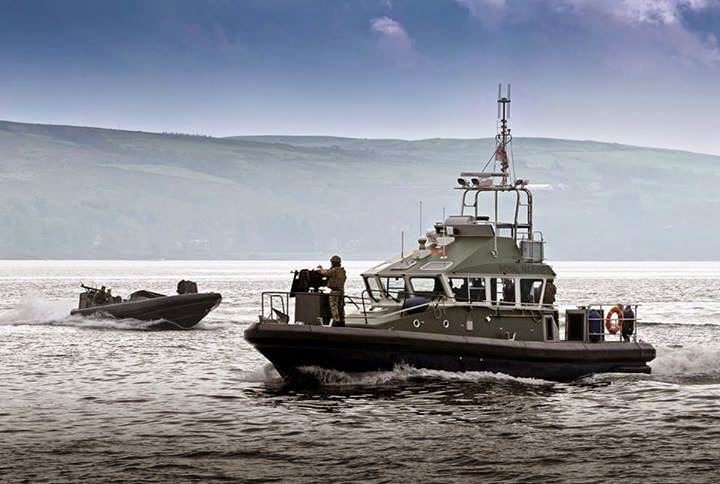
HMS Tracker and HMS Raider have been given kevlar armor and other upgrades, and have been assigned to the force protection role in the Faslane patrol boat squadron.
The Royal Marines of 43 Commando have two patrol boats of their own, Mull and Rona (Island class), obtained by upgrading and refurbishing ex MOD Police boats.

One of the two Island-class patrol boats of 43 Commando 
HMS Raider with the new kevlar armor fit

Mine countermeasures

The Royal Navy's precious minesweepers will have to work hard for many more years, so they are receiving an extensive refurbishment. The Hunt class is receiving new engines, gearboxes, bow thruster systems, propellers and machinery control systems under a six-year contract with BAE Systems. HMS Chiddingfold was the first vessel to re-enter service after the full change of engines and machinery, and after a program of upgrades and obsolescence removal.

The Sandown minehunters also receive substantial touch ups during their refits.

In addition, for their enduring presence in the Gulf the mine countermeasures vessels of both classes are receiving communications upgrades, including the addition of X band SATCOM. The four deployed ships have received their equipment fit, and Airbus is under contract for fitting out a further two vessels. The MOD hopes to be able to finance the installation of the system on the whole fleet.

As MCM ships rotate to the Gulf, they all progressively get "tropicalized" to better perform in the harsh climate of the gulf, and all forward deployed ships receive "significant" upgrades in force protection measures, including fitting miniguns, using enhanced ammunition and adding ballistic protection.

Looking out to the future, this could be a decisive year for the evolution of MCM technology, thanks to Hazard, an optionally manned - and later fully unmanned - surface craft that shall be able to venture into minefields to launch and recover unmanned underwater vehicles to search, locate and dispose of mines.
Hazard will also be used to tow combined influence sweep gear, re-instating a capability that was lost in late 2005 when the Hunt vessels finally disembarked their own kit.
A requirement has existed ever since, to procure and put in service an unmanned surface vehicle with sweep equipment, capable to be deployed from a Hunt ship.
Despite successful experimentation with systems such as FAST, no system was actually brought into service, instead being used to refine the concept and experiment the delivery of greater and more diverse capability.

Hazard, if she will prove herself capable of living up to all the promises, will be a key component of the Mine Counter Measures and Hydrographic Capability (MHPC) programme. The remotely operated boat will be able to deploy from a Hunt ship, move at high speed to the danger area, release UUVs for underwater search (such as the in-service REMUS 100 for swallow waters and the larger REMUS 600 for deep waters) and later sweep the area with towed equipment, or proceed to disposal of the mines in the deep with an unmanned system such as the in-service SeaFox or, better still, with a reusable ROV armed with multi-shot stand off disposal capability. 

In the future, such an unmanned boat will also be able to conduct hydrographic survey, deploying from any suitable mothership, or even from the coast. This will eliminate the need for extremely expensive specialized vessels with glass reinforced plastic hulls such as the Hunt and Sandown, which are, per meter, the most expensive vessels in the navy. The system of unmanned vehicles, potentially to include air vehicles as well, will be effectively decoupled from the mothership. The system will be able to deploy forward quickly by air or with land transport, and move onto a suitable vessel to reach a safe stan-off area. Only the unmanned vehicles will move into the minefield itself. 

The replacement vessels for the current Hunt and Minesweepers, in fact, are expected to be much larger, built of steel, with greater seakeeping and deployable capability. 3000 tons is the expected weight range for these new ships that, from 2028, should begin replacing not just the MCM ships, but the multi-role hydrographic vessels HMS Echo and HMS Enterprise as well, plus the tiny inshore survey boat HMS Gleaner. 
The same common hull could replace, in good time, the River OPVs. Unless, as we saw in part 1 of this report, they get replaced much earlier by the new ships to be built to keep the shipyards busy.


For now, Hazard has been working with a small team on board. The boat can easily touch 30 knots speed.

A re-usable ROV armed with a stand-off multi shot disposal weapon is a desirable upgrade from the SeaFox, which is a "suicide" vehicle which is sacrificed to dispose of the mines.

The REMUS 100 is meant to locate mines in waters from very shallow to 100 meters deep


Hazard is being tested around Portsmouth by the men of the Maritime Autonomous System Trials Team (MASTT). Before the year is over, though, the boat will have been experimented and demonstrated also in Brest (the french are partners in the development of future MCM solutions) and in La Spezia, Italy. 
The first interim package of MHPC modular minesweeping capability should be delivered in the 2018-19 timeframe as of current planning, and to achieve that the Royal Navy plans to conduct a full scale demonstration of the concept by modifying one Hunt minesweeper sometime within the next two years. The modified Hunt would have its stern modified and fitted with an A frame for the launch and recovery of one or two USVs like Hazard, and the ship would need to be modified to provide suitable command spaces, communications to the unmanned vehicles and storage space for their transport. 

A very old graphic showing how the Hunt minesweeper will be modified to launch and recover USVs. Hopefully we'll see the first ship modified within two years.
 
Sweeping minefields with helicopters is standard practice in USA and Japan. In particular, Japan uses the Merlin as the helicopter for this hard, risky job, and the Royal Navy has shown some interest in the possibilities. It is more likely, however, that the air component of the MHPC capability will be centered on an unmanned helicopter with sensors for the discovery of minefields.

Visions of the future? The french navy has its own program, SLAM-F, which follows the very same concept. Uk and France are collaborating in the definition of the future MCM system. This concept show a possible mothership replacement for the current french minesweepers. Image by meretmarine.com

Hazard is an ATLAS Elektronik ATLAS Remote Combined Influence Minesweeping System (ARCIMS) boat modified according to Royal Navy requirements. Thales offers a very similar product, Halcyon. The video below shows Halcyon in action, and is very much representative of what Hazard is meant to do.


Successor SSBN 

The future SSBN project is progressing on both sides of the Atlantic. The less known but most interesting ongoing activity emerges from US documents that show that a prototype section of the Common Missile Compartment is being built, with activities having begun in early 2013 and with the schedule of the program fixed in June 2013.
By 2018, the first quad-pack module, with four Trident tubes, will have been built.
The US Navy has formalized its choice of going with an X stern control surface design, which also appears to be the Royal Navy's target. The US submarine will have 16 tubes, the UK's one probably 12. Earlier suggestion of having super-large tubesof 97 inches diameter as future-proofing measure was abandoned on cost grounds, and tube diameter is now set at 87 inches.

The US SSBN will largely draw from the Virginia design, and the Royal Navy similarly plans to draw all it can from the Astute, to keep costs down.
The new SSBN will adopt the PWR 3 nuclear reactor, derived from american expertise and seen as offering greater safety.

The existing class of SSBNs will have to keep working into the 2030s, with Vanguard not replaced before 2028. The PWR 2 Core H installed on HMS Vanguard is to be precautionally refueled to ensure she can get that far, after the test core reactor on land developed faults.


Viking refurbishment


I think the total british orders over time for Viking are north of 160, but apparently a lot less than that will remain in use. 108 were originally purchased for the Marines, but several more were added when the army asked the RM to leave Viking in Afghanistan as it proved so useful in theatre. The Afghanistan orders came in several batches: 14 in 2008 (9 recovery, 1 command, 4 troop carriers), 9 in early 2009, and then in September 2008 a further 24 Viking, in the MK2 variant (22 Troop carriers, 2 command). Under Army 2020 i believe all remaining Vikings are going to the Royal Marines with one single exception: 21 Viking vehicles have been ordered by the army as carriers for the Watchkeeper tactical parties. Assuming all orders went ahead to delivery, the MOD should have received a total of 176 Viking vehicles.

99 Vikings are being refurbished and uplifted to MK2 (amphibious) protection level, are heading for long term service with the Marines, and 21 more will serve as part of the Watchkeeper system in the Army.
That leaves as many as 56 out of the picture, unless the MK2s are still workable and in service without needing to be included in the refurbishment. At least 27 vehicles have been written off due to Afghan damage, maybe more than that.
It must also be noted that the UK loaned 12 rear cabs with full TES armor kit to Sweden to fill their UOR for use on operations (front cars were given by the dutch), and Sweden is due to return an equal number of rear cabs in full MK2 specification. Not sure how these fit in into the future fleet either, as the MOD hasn't been very detailed in its news releases. 

BAE systems stated, at the time of the 99-vehicle refurbishment award:


All but the existing Mk2 Vikings will be rebuilt around completely new front and rear car hulls featuring the latest mine-protected v-shaped underbodies of the Mk2”


How should we read it, though? Some of the 99 vehicles were already MK2 and only got partial touch-ups, or there are MK2 vehicles in use in addition to the 99 that did not need refurbishment at all to remain operative...? Not sure at all. BAE says it has refurbished some MK2s returning from Afghanistan in the Phase 1 (the quickest and easier) of the refurbishment programme, so i'm afraid it is 99 and not one more. 


The MK2 Viking is fitted with a shallow V-shaped shield in both cars (with the exception of the Recovery and Mortar variants, which have no V-shield on the rear car as no one sits inside when on the move), and has a steel body fully protected against 7.62 armor piercing rounds and 152 mm artillery slivers at 10 meters of range. The MK2 has greater engine power and electrical power output increased to 260 amperes. It is also equipped with blast-protected seats, hung on rails, and comes with four-point seat belts.
It also has weight growth margin to take additional armor to gain 2a/2b NATO STANAG resistance against mines and IEDs, and can be fitted with a cage armor to resist to RPGs, but with these additions it is no longer amphibious. The refurbishment program financed by the MOD includes the delivery of these additional armor kits, which will be available for use on deployment.

The 99 vehicles being refurbished will see 9 emerging as mortar carriers, and 19 as Crew Served Weapon Carriers. The numbers of these two "special" variants appear just enough to replace the unarmored BV-206 carriers in the single RM battalion held at High Readiness.


The Viking mortar gives protected mobility to an 81mm mortar and over one hundred shells.
It is not sure if the Royal Marines are getting the "full optional" Crew Served Weapon variant, which comes with a RWS with .50 machine gun on the front car, manned turret on the rear car and ROTAS mast-mounted EO/IR turret.

It must unfortunately also be noted that the refurbished MK1 Vikings are not entirely common with the MK2, as the budget didn't go up enough to enable replacement of the 5.9 litre engine with the 6.7 of the MK2. With an engine with so much less power for the same base weight, it is easy to imagine that the old Vikings will feel somewhat "tired" when driving around, at least compared to the newer ones.
The wiring is in place to hopefully replace the engines later, hoping it does not mean "in the next century". 
Will the Royal Marines have long-term access to the Viking ambulance variant?

A Viking ambulance variant was used in Afghanistan, but it is not clear if it'll stay around in the long term, nor do we know how many vehicles have been converted, if any past the "prototype" that was prepared in theatre. It sure would be helpful to the RM to have an armored ambulance with this mobility, but there's no mention of it being in the refurbishment contract.


Force Protection Craft and Fast Landing Craft 

The Royal Marines will have to wait at least until 2020 before trying again to have a quicker landing craft brought into service as replacement for the sluggish MK10. 

The fate of the Force Protection Craft, instead, is not clear. The Royal Marines have a requirement for a dozen fast armed crafts, to serve as replacement for some of the LCVP MK5s, while delivering a long range combat platform meant to protect larger vessels and amphibious forces from enemy FIACs. The craft would also need to be able to beach to put ashore a recce party at least 8-strong. 


The Royal Marines have loaned a couple of CB90 combat boats from Sweden, trialing them extensively for a year to put down a definitive list of requirements.  


FPC is a high speed craft capable of defending a boat lane, in which the Fast Landing Craft will operate, against hostile Fast Incoming Attack Craft and land based threats. It also has a secondary role to transport eight Royal Marines and their personal equipment as part of the Pre-Landing Force. To satisfy this requirement the FPC will be capable of 40 knots in calm water whilst its hull form will be optimised for offshore operations in Sea State 4. Significantly, the design of the FPC will have to meet constraints imposed by current davits. A total of twelve craft are planned with the first anticipated to enter service in 2016.


[...] The pair was modified to be davit compatible, with trial serials including a limited davit interoperability assessment with the UK LPD HMS Albion.


The CB90 trialed later became four. The report of the Royal Marines was largely positive, although they evidenced some areas in need of changes and improvements. But since the loan concluded, news have been very sparse, and it is not clear if the program is still alive or if it has fallen victim of the budget axe. 

The Force Protection Crafts were meant to be delivered from 2016, but it is not clear if this is still true.


24 Commando Engineer stays, P Squadron goes

I reported last year about the ongoing fight that Navy HQ and the Royal Marines were fighting to ensure the survival of 24 Commando Engineer Regiment. The news available in the open were few and sparse, but the delay in disbanding the formation was evident, and by november 2013 there was some optimism.


For once, this optimism has been rewarded, as a bit of common sense has won the day for once. Yesterday, the Minister for the Armed Forces, Mr Mark Francois, made a statement in Parliament that confirms that this battle is won: the regiment will not disband.


On 5 July 2012, Official Report, column 1085, the Defence Secretary made a statement to the House on the outcome of the Army 2020 review and laid out the future structure of the British Army. The announcement explained the need to restructure the Army to face an increasingly uncertain world and to create the agile and adaptable armed forces as set out in the 2010 strategic defence and security review. Included in the statement was the withdrawal of 24 Commando Engineer Regiment.

At the time of the Army 2020 announcement, the Army acknowledged that engagement with the Royal Navy was still ongoing, and this would refine the allocation of Army manpower available to support Royal Navy tasks. This process is now complete and it has been decided that 24 Commando Engineer Regiment will be retained although the regiment will be reduced in size. This change will be achieved by rebalancing Army manpower within 3 Commando Brigade and allows for the best use of available resources to deliver the strategic defence and security review and Army 2020 capability.
We envisage that these structural changes will be implemented by no later than July 2015. 24 Commando Engineer Regiment will remain in Royal Marines Barracks, Chivenor (Barnstaple).

The regiment won't disappear, and this is a major step forwards. But it is still shrinking, and considering that it never even gained the second regular field squadron that was once planned and that remains very much needed, this is no good. It is a step in the right direction, but this regiment should actually be growing in size to better respond to the busy schedule of the high-readiness amphibious force.
There is also some worry behind the meaning of "rebalancing army manpower" within the brigade, which knowing politician language could hide unpleasant news, perhaps to hit 29 Commando Royal Artillery (which already had to win its own fight earlier, to ensure the survival of 148 Meiktila Bty).

But at least, it is a step in the right direction. Let's take away some joy and hope from it.


P Squadron, 43 Commando, has instead disbanded in December 2013. The squadron stood up in 2010, manned not by Marines but by RN personnel, to provide force protection teams to "second line" ships deploying: RFA, Point RoRo, minesweepers and survey ships. Escorts have their own Green (Royal Marines) team and normally a Blue team formed by members of the ship's crew.
A Royal Navy sorely in need of manpower has had to close down this squadron, and its contribution to providing teams to all vessels has to be replaced by men coming out of the Commando battalion in its "Other Tasks" year; aka the year of rest and operational reset that follows the year spent at very high readiness.