For the first post in literally years, I'm sharing the submission I've filed in the public consultation for the SDSR. The format of the consultation involved a long list of fixed questions that could be answered with up to 500 words each.
This has, of course, determined the format of my entries.
Describe the strategic context for UK
Defence

Strategic context begins with geography. Always remember that the world actually looks like this, and the UK's front in any Russia scenario is to the North.
While the Russian invasion of Ukraine is the main factor polarizing attention, the threats to UK interests go well beyond Russia. It is in the Red Sea and Middle East that UK assets have actually needed to open fire to protect allied installations and critical shipping routes, and it is towards Asia that the economic and political center of the world is shifting. While Russia represents the most obvious threat, it is not in a position to start a direct land conflict against NATO and it would be a mistake to allow Russia to tether UK foreign and Defence policy to a narrow European focus.
The priority for UK defence remains maintaining a capable, useful mix of capabilities measured against high end, state on state warfare scenarios, that can be projected where needed, across Europe and beyond.
Geography dictate that any threat against the UK originates quite some distance away, and that any operation mounted by UK forces will be expeditionary by nature and will imply thousands of kilometres of distance to be negotiated. UK forces must be able to project over those distances and be credible once in theatre. While the UK won’t be able to achieve Mass on its own, it should maintain armed forces which are as much as possible capable of “independent” action within an alliance framework. In other words, the UK force should be able to deploy with its own means (SEA-lift, AIR-lift, LAND mobility) and, as much as possible, able to take responsibility for a section of a front / part of an operation without Allies having to fill critical capability gaps. The UK contingent should come with adequate Enablers and be able to serve as core for Allies to attach to (for example in a Joint Expeditionary Force context).This would enable the UK to retain a leading role in any scenario and in any theatre. UK forces could act as an aggregator that smaller partners can join forces with, helping to generate mass, enabled by UK strategic capabilities they might otherwise not have access to. When working with greater partners with more mass and resources, UK forces should still be able to provide a complete, reliable military component that can look as autonomously as possible over a sector of the front / portion of the operation.
There can be little doubt that UK forces which best compare on the world stage with that of other nations are Navy and Air Force.The Army does not compare as well, nor is likely to be able to catch up anytime soon. While the Army conditions must be improved, this must not come to the detriment of the other Services, especially since, even in a “narrow” European scenario, the front of most immediate interest to the UK is the Scandinavian peninsula – North and Arctic Sea and Iceland area (in Cold War parlance, the GIUK gap). This is the only front where Russia and UK are virtually in direct contact, through Sea and Air.
In general, UK is fortunate in that forces which are well attuned to their NATO role will generally be valid elsewhere too.
Propose, in order of priority, the
roles UK Defence must be capable of fulfilling 2024-2040.
If the UK will maintain its ability to secure the North Sea / High North by forward deploying in NATO context a powerful Air Force component while also putting to sea a capable fleet centered on SSNs and the Carrier Strike Group, plus the Littoral Response Groups, it will meet its vital, direct defence interest.

On Land, the UK should maintain its High North commitment through the Littoral Response Group North and, ideally, a greater Army component aligned to the task (at least initially it would come from within 1st Division) while working to deliver the full promise to NATO of a Strategic Reserve Corps of "2 Divisions with 6 brigades" under the ARRC. Obviously it will be a relatively small Corps, made of relatively small brigades, but there is no reason why it shouldn't be capable.
The need to be rapidly deployable wherever SACEUR needs them across Europe will in turn ensure the British Divisions maintain capabilities and logistical readiness that will ensure the British Army can be relevant outside of Europe too when necessary.
To achieve this result, the British Army structures will need to evolve and, in absence of a net growth to the overall manpower ceiling, some infantry battalions will need to go, not because they are unneeded, but because forming the necessary Artillery, Air Defence, Drone, Logistics and Engineering units will be far more critical. The current structure is dramatically short of these key enablers and this will need fixing.
 |
| The wider context of a major NATO clash with Russia has not changed much. |
In Europe, the UK's priority is dictated by geography and will always come down to reinforcing the Northern flank of NATO, working in close cooperation with the Joint Expeditionary Force partners and bringing naval and air elements"up threat"in Iceland, Scandinavia and at Sea to contain Russian navaland air elements which are a direct threat to the UK mainland. Through the JEF, and the Littoral Response Group (North), which also hinges on the long standing cooperation with the Netherlands' own Marines, the UK is also committed to reinforcing the Allies ashore.
The UK is also committed to putting a British Corps (ARRC) of eventually 2Divisions at the call of SACEUR as a strategic reserve that can be rapidly deployed "along the entire NATO front in Europe".
This will require a well stocked, well trained force that can move quickly and that has the necessary strategic lift in place to get where SACEUR needs it.
UK reach and commitments to the Northern NATO flank require amphibious capability to be sustained and ideally enhanced.
The need to protect key infrastructure at sea and the Deterrent requite dedicate Deep Sea Data Gathering and thus put urgency on the need to procure the planned and very much necessary purpose-designed vessel for this (planned as the second Multi-Role Ocean Surveillance hull).
The Reserve should be reorganized to provide a more realistic seedcorn for expansion in time of crisis. Probably the Army Reserve would benefit from being organized in a couple of "shadow brigades", one dedicate to supporting the Heavy armour (and thus 3rd Division) and one (or more) dedicate to lighter,more easily regenerated light role / light mechanized capability in support of 1st Division.
Describe how existing UK Defence capability
and the current 10-year programme match the demands of the roles and
capabilities identified for 2024-2040, highlighting and prioritising critical
gaps.
Existing equipment plans are mostly coherent with UK tasks in Europe and beyond. Some areas that require additional attention include:
Suppression of Enemy Air Defence: the introduction of SPEAR 3, SPEAR EW and ECRS2 radar with jamming capability (this on Typhoon Tranche 3) are helpful, but the absence of an anti-radar missile since the withdrawal of ALARM in 2013 is a concern. Adoption of the AARGM ER missile for both F-35 and Typhoon (Germany and Italy are already planning to adopt and integrate it) would greatly increase capability. Retrofitting the ECR Mk2 radar to Typhoon Tranche 2 should also be a priority.
Air to Air refuelling: the "nordic air force" (Sweden, Norway, Finland, Denmark) is THE obvious and critical partner for the RAF in an European fight, while US and Australia are other obvious main partners the UK will collaborate with. All these partners, and others (Germany, Italy, Netherlands, Japan etc) will use F-35As that can only be refuelled through the Boom method. The VOYAGER tankers of the RAF at present are not fitted with boom and cannot contribute in any way (and can also NOT refuel the RAF's own C-17, P-8, E-7 and Rivet Joint fleets). Fitting Boom to at least a portion of the fleet would enable the RAF to offer invaluable support to Nordic partners in Europe, and to Allies everywhere.
Ground based air defence must be enhanced at a brisker pace and with greater ambition. Existing SKY SABRE batteries can be quickly enhanced adopting the Extended Range variant of the CAMM missile, while development of the even longer ranged CAMM MR with Poland should be properly supported.
Additional SKY SABRE batteries are needed, and the Army's air defence regiments should probably be reorganized into hybrid regiments that, a bit like the PILICA+ batteries in Poland, combine CAMM with SHORAD. Adding a gun in anti-drone function should be a priority, with the PALADIN system having already been tested providing a good, UK-made candidate for rapid adoption. Directed energy weapons such as laser and RF (projects DRAGONFIRE, SWINTON, EALING) promise great capability which however might not be fully reliable for quite some time, making a gun-based solution a precious complement and stopgap.
Additional SHORAD Batteries should become an organic part of manoeuvre brigades: in other countries, a SHORAD battery is commonly found within the Brigade's artillery regiment, for example.
BOXER vehicles fitted with SKYRANGER gun turrets and missiles represent a good, readily available solution to succeed to STORMER and bring(thanks to the 30/35mmgun) increased anti-drone capability.
The Navy's Type45s should be equipped with new-production ASTER 30 Block1 NT missiles as soon as practicable. Low-volume production of these new and improved missiles would help realize the much needed "always on" model for key weapons production in the UK.
Logistic lift is known to be insufficient. The number of MAN SV EPLS trucks capable of carrying containers, for example, even if recently uplifted, remains more than 700 short of the endorsed Land requirement. This should be addressed, including by standing up new regiments to fill known gaps (for the support of 1 DRS BCT and 4 Light BCT, for example).
Propose how UK Defence's contribution
to NATO should be enhanced as a driving requirement of capability and activity,
including through prioritising defence export potential.
The UK contribution to NATO should be centred on the two Key roles:
- The protection of the Northern Flank, with a focus on Carrier Strike Group operations, ASW, maritime urveillance, air defence and amphibious reinforcement of Scandinavia (Littoral Response Group North, in cooperation with the Netherlands's own amphibious force)
- The provision of a credible British Corps to SACEUR for the Strategic Reserve role.
It might seem counter-intuitive and politically unpalatable, but to improve its contribution to NATO the British Army needs to offload the commitment to Estonia to other partners. The British Army is simply not large enough to deliver, at the same time, an armour-centric Battlegroup in the Forward Land Force (with commitment to uplift to a full brigade in time of crisis) and the Strategic Reserve role.
This is not debatable but rather fact: 3rd Division is the only heavy division the UK has, and only comprises 2 armoured brigades. If one of them is committed to Estonia, it cannot at the same time be available as a strategic reserve for SACEUR. Double-hatting is not serious and is not workable.
Partners should be approached in a mature way and the Forward Land Force role in Estonia should fall on another Army within the new NATO Force Model. Other countries are due to take Regional defence roles, and this should include replacing the british element in Estonia so the British Army can, in turn, ensure SACEUR's critical reserve is truly available and ready to deploy when and where needed.
2 Army programs in particular stand out for export potential in a NATO context and possibly beyond: the Technology Demonstrator 5 project to integrated advanced lethal and ISR payloads into GMLRS rockets and PrSM missiles would result in a massive capability growth and most likely in substantial export orders.
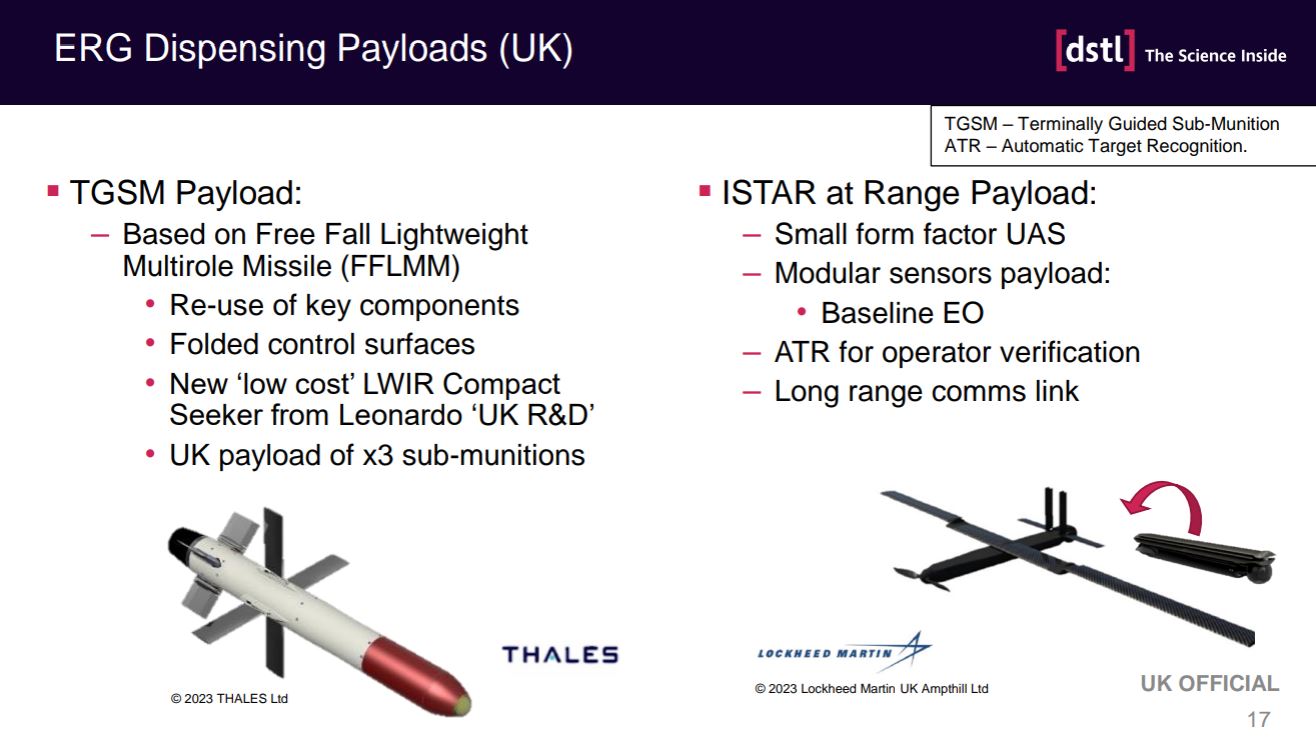

The other project with great potential is the Mounted Close Combat Overwatch project centered on ground-launched Brimstone for long-range anti-armour capability. This has in some ways already obtained an export win of sorts with Poland having selected Brimstone for its own long range ATGW need.
There is obvious potential in several of the UK's drone projects as well: uncrewed adjunct aircraft, the HYDRA armed drone, one-way strike solutions and the PROTEUS uncrewed helicopter for the Navy could all prove successful in securing export deals.
DSTL’s work on an uncrewed, highly mobile ultra-lightweight 127mm gun on the LAMP mobility platform should also continue as it would answer the need of Marine, Para/Airmobile and Mountain troops in particular and could secure interest in multiple countries.
Describe how the current support to
Ukraine is integrated into UK Defence programmes and activities and propose
measures in priority order to sustain and enhance this support to at least
2027.
The UK could provide aid to Ukraine while improving its own defences in multiple ways, as the decision to restart manufacture of large calibre barrels in the UK proves.
With GMLRS rockets being a key asset for the British Army as well as one of the most successful weapons employed by Ukraine, the UK should look at establishing production at home. Lockheed Martin reportedly was willing to bring GMLRS work to Ampthill and this should be a priority.
Again on GMLRS, the already mentioned Techical Demonstrator 5 could be a game changer: Ukraine could probably benefit from early access to some prototype systems, which in turn would support spiral development for the UK's own needs.
There is great scope for even more cooperation on drones, lethal and not, and on electronic warfare, including C-UAS jammers.
Ukraine is also continuously in need of anti-air missiles. France and Italy have supplied SAMP-T batteries firing Aster 30 B1 missiles, and MBDA UK will soon be remanufacturing existing Aster 30 missiles of the Royal Navy into B1s. There might be potential to increase production capability in the UK and help keep Ukraine's batteries armed.
Similarly, CAMM/CAMM ER, much needed to increase the British Army's GBAD capability, could be key to help meet Ukraine's needs as well.
The recent work to increase the ability to produce ammunition in the UK and manufacture artillery barrels is welcome, but one critical weakness remains unaddressed: the production within the UK of energetics and propellants. A core capability in country would be fundamental for resilience in times of crisis when supply from abroad might dry up.
Describe and recommend how the UK
Defence homebase is made secure and resilient in confrontation, crisis and
conflict, including in enabling full mobilisation and campaign endurance when
needed.
Ther esilience of the UK realistically depends on factors other than military. Increased capacity to produce energy domestically, reduced reliance on imports would be the most decisive factors.
The military specifically, and the UK’s ability to mobilise for a major war are afflicted by excessive centralisation as a result of decades of efficiencies. A successful long-range missile strike that managed to hit a few critical installations (for example Lossiemouth, critical to QRA, maritime patrol aircraft and AEW), Waddington, Ashchurch (most of the Army’s vehicle fleet is to be found stored there), Donnington (general stores) and Kineton (ammunition) would be enough to have an absolutely crippling effect on the ability to properly mobilise in the first place.
Strengthening Ground based air defence can help, but there are not enough resources to attempt a complete coverage. For sure, a resident SKY SABRE battery at least in Lossiemouth and other key locations on the eastern coast would not be a bad investment. Longer range air defences would help, but would require massive investment.
Project LEWIS for a new anti-ballistic radar would provide early warning to the UK and to the benefit of the whole of NATO, assuming the Government remains committed to it.
 |
| Project LEWIS has seen the UK secure US authorization for the procurement a Long Range Discrimination Radar (LRDR) (for construction on the island that gives the project its name...?), but it is one of those background programs no one ever talks much about. It's also a promise to NATO formulated years ago. |
The best defence against such an attack, which at present can come only from Russia, will always be to deploy the Armed Forces, particularly the Navy and Air Force, “up threat” to intercept Russian ships, submarines and long range aviation over Scandinavia and the North Sea. Forward deployment of the carrier strike group and of RAF jets to Iceland and Norway would no doubt be an early measure taken at the first sign of serious crisis.
In general, the worst threats to the UK will manifest not so much directly against the UK mainland but abroad. The Red Sea shipping crisis is an eloquent example. Even in a “Russia” scenario, the UK will be defended first of all at range up in the High North, not so much directly from its shores. Geography dictates this.
As a consequence, it is non-discretionary to maintain military force that is expeditionary and has the logistic “legs” to deploy where needed.
Propose measures in priority order
that establish how UK Defence transitions to the optimum balance of regular,
reserve, civil servant, and industry people across all standing tasks and
commitments and on mobilisation. Recommend the recruitment, education, training
and retention measures required to achieve this.
The topic of Reserves for the UK is complex, again because of the geo-political truth that dictates that state threats to the UK will manifest away from the homeland. The frequent mention of Finland’s reserves, or Poland’s territorial units is of limited relevance to the UK: light infantry formations for local defence have little to no relevance for the UK, unlike for those countries who would be fighting on and for the very home turf. Units equal to Poland’s territorials could be formed, but in any war scenario they would have to be lifted across Europe to the point of need, unlike Poland’s own.
The old Territorial Army used to have a demonstrable ability to deploy to the Continent in support of regulars during the Cold War, but it’s undoubtedly harder to do that now, and it is proving difficult to deploy formed bodies of Reservists during “peacetime”. There are a few cases, but all pretty small scale and relatively sparse over the years.
The matter of Reserves is tricky and not easily solved. It’s true reserve infantry battalions cost a lot less than regular ones, but that is of little relevance if their output is not only much smaller but also relatively unpredictable due to uncertain availability of people. Any expansion of their combat role, in addition, would require equipment and vehicle fleets that at the moment simply do not exist.
A serious assessment is needed to determine what the Reserve can actually do in “peacetime”(it would be fairer to say in times of competition/confrontation short of all out war) and what they can be expected to do during major mobilisation.
If all-out war ever happened, there is every reason to believe the Reserve would show up in decent force, but at present it is at best questionable whether it could be equipped and actually employed as anything other than individual / small sub-units replacements and some degree of augmentation. There is an obvious shortage of combat vehicle fleets, for example. Formed reserve units would only be of the lightest kind.
There will probably need to be a more neatly “separated” plan for those Reserve individuals and units which are available, willing and indeed needed in “peacetime” and those formed bodies which would only realistically come together for occasional major exercise and ultimately in case of a real major crisis.
The latter formations, which should probably be organized as coherent brigades for best effect, would need to have a well defined, realistic role attuned with what equipment will be actually available in the depots or in a realistic emergency procurement/production plan to outfit them.
It would probably be beneficial to organize a “shadow” heavy brigade of Reservists, recognizing however that as things stand the armour to make them deployable as a formed unit simply does not exist in the inventory. They would deploy essentially as augmentees / casualty replacements.
Light brigades could be organized to be “deployable” in a specific format which will not be equal to that of regular formations and should thus develop its own Concepts, much like Poland’s territorial formations but with the difference, again, that UK Reserves would be deployed to fight far away from home.
It might yet prove to be the case that a larger Reserve is not in fact the right answer if larger doesn’t work out to more available/capable. More capable will require dedicate vehicle fleets and equipment holdings which will rapidly make the Reserve far less financially attractive overall.
Roles and expectations must be defined first.
Propose how the maritime (including
littoral) domain is developed to contribute to an Integrated Force,
recommending measures that accelerate modernisation and transformation and
identifying existing capabilities and programmes that do not support this.
The development of uncrewed assets such as PROTEUS (rotary wing), VIXEN (fixed wing) and SEA PROTECTOR (MQ-9B modified with the wing-king for short take off and landing on the carriers) would massively enhance the carrier strike group's ability to deploy and fight up-threat. SEA PROTECTOR could be ready within a few years and, equipped with suitable podded radars and sonobuoy launchers, could bring extremely long endurance airborne early warning cover against missile attacks and long range, persistent anti-submarine patrol.
PROTEUS will help make up for the insufficient numbers of manned MERLIN helicopters.
Carrierborne F-35B (the expansion of the fleet to atleast 74 jets in 3– ideally at least4 – Squadrons should remain an absolute priority) and drones ensure the UK can confidently deploy far from home with the indispensable air cover.
The Littoral Response Groups give the UK a persistent forward deployed force around which larger operations can take shape. In a NATO context, the Littoral Response Group North represent the continuation of cooperation with the Netherlands and assistance for the Nordic Allies. The future Multi Role Support Ship will need to be more survivable than current amphibious ships while preserving the ability to lift and send ashore even the heaviest Army vehicles. The new vessels will need to combine both aviation capability and heavy surface lift capability, with a well dock sized for LCUs and mexeflotes operations. Room for containers, including on the weather deck, will give flexibility to embark modular weapons (a modular CAMM missile system should be a priority) and capabilities (Role 2+ and 3 medical facilities) for deployment.
Frigates, destroyers and submarines with land strike weapons will contribute to the suppression of enemy air defence and will strike high value targets. They have a great deterrent value as well. General purpose frigates and pureOPVs are no longer particularly useful in a new context of state on state warfare risks: the new generation vessels should have space and services reserved for embarking drones and modular mission payloads / containerized weapon systems that make them more useful combat platforms by expanding their base fit.
The MCM component is currently based on small ships which are not very deployable nor very useful beyond their specialized role, but the transition is already underway. Drone-based systems for MCM are more capable and more flexible but the necessary motherships to project those drones at range have not yet been built. If they were, the transition could be accelerated further. Swift procurement of a first mothership would allow the return of the currently employed BAY-class vessel in the Gulf to the amphibious role.
Modular capability, such as CAMM missiles in containers (NavyPODs) and portable lasers can help ensure the new Multi Role Support Ships and MCM motherships can deploy with the necessary defences on board, while saving on build costs. Such modular capability could also follow the Marines ashore, delivering further effect very efficiently.
The Littoral Response Group will need long range strike weapons that can be inserted from the sea and then used from land, against the land and against the sea. GMLRS and PrSM missiles, common with the Army, would achieve this but would ideally require a lighter, more deployable launcher like the defunct LIMAWS(R) on Supacat platform, or the uncrewed ROGUE of the US Marines.
If the Marines can go ashore with GMLRS and CAMM, they can create safe havens for the fleet and prove a real strategic concern to the enemy.
Propose how the land domain is developed
to contribute to an Integrated Force, recommending measures that accelerate
modernisation and transformation and identifying existing capabilities and
programmes that do not support this.
Land will contribute through growt of Long Range Fires, primarily through the Land Deep Fires programme to grow the number of M270 launchers and their ammunition.
- GMLRS ER, which should include Alternative Warhead to restore area-attack capability, 150 km reach
- PrSM missile 500+ km
- Land Precision Strike will deliver extended overwatch
- Technology Demonstrator 5, a UK effort, to integrate advanced payloads into GMLRS and perhaps PrSM, including reconnaissance drones and intelligent sub-munitions, mines, ISR sensors, EW devices and jammers. If realized, these capabilities would be transformational and are sure to gain export orders.
Further long range strike options will come through drones. Lethal drones are needed at all tactical levels:
small ones such as D40 would restore infantry’s ability to deliver HE on indirect trajectory.
Fires have to make up for lack of mass. The PHALANX model for Platoons and Companies, which pushes JAVELIN and 81 mm mortar down to Coy level, should be adopted.
At battlegroup level, adoption of 120 mm mortars and Mounted Close Combat Overwatch is key.
A battery of M270 should become organic to each Heavy brigade, alongside RCH155, primarily for Land Precision Strike overwatch. This seems the correct tactical level where to employ this new capability.

GMLRS ER and PrSM would primarily be used by the GMLRS Regiments held within Deep Recce Strike BCT if not even aligned directly to Corps level.
Another GMLRS regiment should be added, equipped with a lightweight launcher (like USMC’s ROGUE or resurrected LIMAWS-R) to ensure 16 Air Assault and 3 Commando Brigades have access to this strategic system and can more easily move it (including under slung by CHINOOK).
GBAD will need to grow. CAMM ER should be added to SKY SABRE urgently; more batteries should be formed.
Each Brigade should grow an organic, mobile SHORAD battery, on BOXER Skyranger in the Heavy formations. 30 / 35 mm gun adds cost-effective counter-drone capability.
Directed energy weapons work should continue towards a useable capability to be fielded as soon as practicable.
12 and 16 RA regiments probably need to evolve mixing SKY SABRE with SHORAD, both for their own survivability and for improved effect. Guns (such as PALADIN from British company MSI, which has already been tested) would add resilience against drones.
In order to deliver the “British Corps”, 4 Brigade will need to be rebuilt, with Combat Support and Combat Service Support regiments it currently lacks.
4 and 7 Brigades should both be made medium mechanized with FOXHOUND and a circa-20 tons Troop Carrier as planned within the Land Mobility Programme.
Ideally, 1st Division should have its own lightweight Deep Recce Strike formation. Resources are highly unlikely to be sufficient, so 16 Air Assault Brigade could be adapted to deliver this role where applicable while preserving its more unique deployability aspects.
3rd Division’s armoured brigades would benefit from putting a remotely operated turret on ARES and adapting the internal fit of these new vehicles to restore a degree of IFV capability.
BOXER would then deliver supporting roles by adapting the current plan for Mission Modules. A 120 mm turreted mortar and SHORAD should be priorities.
Ideally, 12 and 20 brigades should be “square” and composed of Combined Arms Regiments of CR3 and ARES. At an absolute minimum, the current 3 regular MBT regiments should be preserved by cancelling plans to convert King’s Royal Hussars from MBT to Armoured Recce.
Security Force Assistance Brigade should be sacrificed to free resources. In general, rebuilding needed CS and CSS formations is priority and in absence of manpower growth, accessory missions should be scaled back to recoup posts for more urgent priorities.
Propose how the air and space domains
are developed to contribute to an Integrated Force, recommending measures that
accelerate modernisation and transformation and identifying existing
capabilities and programmes that do not support this.
The Air Force contribution to the Integrated Force is fundamental, but its ability to intervene in the face of powerful enemy anti-air defences must be increased if this is to continue to be the case even in high intensity warfare. EW, uncrewed aircraft companion for crewed jets, SPEAR 3 and SPEAR EW are going to be fundamental, and it would be extremely important to retrofit the ECR Mk2 radar with jamming capability on the Tranche 2 Typhoons too, since they make up most of the RAF’s numbers.
The procurement of AARGM ER anti-radar missiles, as already pursued by allies, should be the next step.
MQ-9B PROTECTOR’s potential overland is threatened by its vulnerability to enemy action. As it stands, PROTECTOR is virtually helpless against any enemy attack: procurement of a Self Defence pod should be a priority.
PROTECTOR should then be developed with suitable radar and podded sonobuoy dispensers to become an adjunct maritime patrol solution supporting P-8 Poseidon, especially in the High North.
PROTECTOR should also be equipped with the Short Take Off and Landing wing-kit to enable it to deploy directly on the aircraft carriers. The addition of suitable radars in pods would enable SEA PROTECTOR to deliver high altitude, long endurance Airborne Early Warning; in Maritime Patrol configuration it would deliver long duration anti-submarine patrols. In both cases, this would ease the burden on the insufficient number of MERLIN HM2 helicopters, which could then go back to focusing on ASW. In AEW, PROTECTOR would deliver greater capability than CROWSNEST and could in part supplement the insufficient number of E-7 WEDGETAIL too.
It would be highly beneficial to pursue a capability similar to the USAF’s RAPID DRAGON: pallets that can be air-dropped from cargo aircraft to launch multiple cruise missiles. A single A400 could be made to launch as many Storm Shadows as 4 or perhaps even 8 Typhoon, at far greater ranges from the UK, with next to no need for air to air refuelling. For a modest investment, this would bring quasi-strategic bomber capability back to the RAF’s roster.
Probably the most transformational capability that can be pursued, however, is the ISTARI multi-ISR constellation of Low Earth Orbit satellites. The OBERON-type satellites, with their radar sensor, will be particularly important to gather intelligence and targeting in all weathers. The use of laser to securely transmit huge amounts of data (TITANIA demonstrator) could also be game-changing.
In general, while LEO satellites are small and individually less capable than larger satellites so far favoured by most nations, they present advantages:
- The UK industry is one of the main LEO small satellites producers worldwide
- The use of multiple small satellites makes the constellation more survivable
- It is conceivable that additional LEO sats could be “rapidly” deployed into orbit in time of need
- The maturation of launch options directly from UK soil open up an opportunity to have UK satellites, launched from the UK, delivering sovereign intelligence capability

It would be highly beneficial to procure a number of air to air refuelling pods for A400M, to open up the ability to refuel MERLIN HC4 (Littoral Response Group) and CHINOOK (Army, Special Forces) in flight as well as have extra AAR capability for jets in times of need.
As mentioned elsewhere, adding Boom to at least some VOYAGER tankers would be a massive force multiplier by opening up options to extend E-7, P-8, RIVET JOINT and even C-17 in Flight, as well as making the RAF capable of supporting its main partners, including the F-35A of the “Nordic Air Force” in Scandinavia.
Propose how UK Special Forces are developed
as part of an Integrated Force and in support of UK National Security and
resilience.
In a high intensity warfare context, the role of Special Forces is likely to primarily revolve around deep reconnaissance and target acquisition in favour of the integrated force. The Army Special Operations Brigade, in particular, should have this as a key role for its Rangers, which should thus be organized and equipped with the necessary mobility, sensors and communications to scout deep beyond the Forward Edge of Battle Area.
Special Forces will of course retain their shock action and direct assault capability as well.
Propose how to improve financial
management and administration across Defence, meeting HMG standards of
accountability and identifying how more rapid adoption of digital technology
will modernise culture, organisation and ways of working.
The one reform that would have the greatest effect on the handling of Defence budget would be one that favoured flexibility over rigid annuality parameters and that created a planning mechanism more akin to the Defence Planning Law in France. Government and Opposition alike need to have more visibility and more say on how long-term defence plans are set out and should vote regularly on those plans to ensure neither side can offer big promises while in Opposition only to deliver the opposite if Elected.
A more credible, long-term commitment to capabilities, programs and structures would give the Services and Industry the confidence needed to approach programs in annual increments. Currently, UK defence spends years and years trying to plan every financial detail of enormous, decade-long programs, generating famine periods followed by gigantic monolithic contracts which later invariably encounter problems due to inflation, unforeseen events, changed requirements and the delays that end up regularly being inflicted upon programmes to fit within annuality requirements. Enormous amounts of equipment are purchased in big contracts because Industry doesn't trust the government to come back if a project is split in tranches, and the Services are terrified of losing their chance (and budget) is they don't commit it. This needs to change. Industry and Services alike must be put in a situation in which they are more comfortable ordering 100 or so vehicles a year within a framework, rather than order 523 BOXERs in one go, to make an example. This would make it easier to control expenditure year on year on big projects without the need for shock cancellations.
Requirements must be set, endorsed, voted upon by both sides of the House, and then delivered incrementally year on year with industry and armed forces reasonably confident that the entire thing won't collapse the moment there is a new General Election and yet another SDSR looking for cuts.
Propose how UK Defence can build
relationships with allies, partners and alliances as a strategic strength for
the UK
AUKUS is the most impressive example of mutually beneficial relationship, and GCAP will do much in turn to keep Japan and Italy close to the UK.
There is obvious scope for more cooperation. BOXER with Germany, Australia and the Netherlands, for example. With Germany, synergies have been found in the TRITON program to jointly procure a replacement for the M3 rig; in the joint development of ammunition for Challenger 3; in the RCH155 artillery program, in FOST naval training, and hopefully in the future this can continue through the UK procuring the Skyranger turret for BOXER, like Germany already is doing, to enhance anti-air and anti-drone defence.
Type 26, if selected by Norway, could represent a formidable area of cooperation in the context of ASW on the Northern flank of NATO. There is potential for cooperation over P-8 POSEIDON too, and on MQ-9B PROTECTOR, particularly once it is fitted to also deliver maritime patrol / ASW. Norway has a known interest. Both countries employ the Sting Ray torpedo and this might continue in the future should Norway decide to follow the Mod 2 development now started in the UK.
Poland ties are strong thanks to CAMM / SKY SABRE and the joint development of the new CAMM MR munition. Poland has also acquired BRIMSTONE. Further synergies can be built upon these capabilities. Poland is about to become the second user of APACHE helicopters worldwide and the British Army Air Corps could do much to assist them along the way. The two nations would benefit from joint armament purchases for the APACHE fleets and from joint development of conceps and capabilities relating to the AH-64E.
Poland has also acquired AW-149s which the UK is considering as New Medium Helicopter solution.
I again stress the importance of TD5 and the advanced payloads for GMLRS rockets: this project could be a real winner in the field and on the market, and more GMLRS users should be involved as soon as possible to help build momentum.
These are some of the main examples. Those equipment points of contact bring mutual advantages, ease interoperability and create a wider user community to share the costs of modernisation with, while deepening mutual understanding and favouring common solutions.
The UK should consider more direct purchases from partners in return for defence sales. For example, cooperation with Norway on the VANGUARD concept for large motherships would deliver a good solution for the Royal Navy requirement while probably representing a welcome return for Norway's eventual selection of the Type 26 as its new frigate.


