Showing posts with label CVR(T). Show all posts

Tuesday, September 23, 2014

FRES SV has a contract


After years of hesitations, rethinking, changing of minds, messing of requirements, wasting of money, starts and stops, FRES SV is finally “the thing” after the signing of a production contract worth 3.5 billion pounds and covering the delivery of 589 vehicles in various configurations.

The history of FRES and of the programs that came before is a messy, sorry novel which has cost hundreds of millions and delivered nothing for it, but I want to focus on the good side of the news for this once. FRES SV has undergone the last major changes (to date) behind the scenes following the release of the SDSR 2010 (October 2010) and, moreover, with the three-months additional cutting exercise of 2011, which shredded several pages of the SDSR and generated the Army cuts known as Army 2020.

Prior to the Army cuts, FRES SV was a program meant to develop across three “RECCE” production Blocks plus a “Medium Armour” and “Manoeuvre Support” blocks totaling up to a maximum of 1238 vehicles, 10.000 jobs and with production in the UK. After the cuts of summer 2011, FRES SV has shrunk massively: the Medium Armour and Manoeuvre Support blocks were lost practically right away, and the Block 2 and Block 3 have looked increasingly unlikely, up to the point of being effectively reabsorbed into the sole Block 1. And production in the UK is, at best, highly unlikely, as the reduced quantities to be purchased mean General Dynamics will almost certainly want to keep work in its plants in Spain, or ask for quite a lot of additional money to step up an assembly line in the UK. Jobs realistically sustained in the UK will be no more than 1300 unless an assembly line is indeed started up. 

FRES SV as once envisaged. Quantities and number of variants were much higher.

The good news is that in the last few years the program has remained stable and has worked to reabsorb the main army needs into the sole Block 1, and the result, as it stands today, is reassuring in the sense that the numbers outlined appear perfect for Army 2020, with its three armoured infantry brigades. The variants announced also cover most of the needs, even if a few questions remain, in particular regarding what can be done to replace the Samaritan CVR(T) and the FV430 ambulances.

In fact, the contract calls for the production of:

245 “turreted” vehicles, with the CTA40 mm gun. 245 gun turrets were reportedly ordered months before the contract.
Of these:
-          198 Cavalry vehicles Scout
-          23 Joint Fires Control variant
-          24 Ground Based Surveillance variant

A further 256 vehicles are variants of the turretless Protected Mobility base vehicle, of which:
-          112 Command and Control C2
-          59 Protected Mobility Reconnaissance Support troop carriers
-          34 Formation Reconnaissance Overwatch vehicles
-          51 Engineer Reconnaissance vehicles

The final 88 vehicles are for recovery and repair, specifically:
-          38 Recovery
-          50 Repair

Most of these variants haven’t been properly demonstrated yet, as the Block 1 production run was once expected to include 589 vehicles, yet, but coming only in Cavalry Scout, Protected Mobility Reconnaissance Support, Repair and Recovery variants. The other variants have all been pulled forwards from later production blocks, and there have been only some basic feasibility demonstrations done over the course of 2013 to ensure that the Common Base Vehicle Hull could be adapted for the various roles.
Such demonstrations have been made for the ambulance variant as well, but an ambulance variant has not been included in the contract. 

The Scout in the latest CGI
 
There is consequently serious enduring uncertainty about how these variants will be configured. Very early graphics and information dating up to 2011 suggested, for example, that the Ground Based Surveillance and Joint Fires Control variants would be based on the turretless hull, but this has now changed entirely. I’m particularly impressed by the change of heart regarding the Joint Fires Control variant, since up to at least 2011 the Royal Artillery was planning to have this vehicle able not just to designate targets for artillery and air attacks from under armour, but also to carry a full 6-man dismountable Joint Fires Support Team. The use of the turreted variant appears to me to suggest that this second requirement has been dropped, because for what has been seen so far, despite deriving from an IFV, the Scout vehicle won’t be able to carry that many, if any, dismounts (early prototypes showcased only had a couple of seats in the back).  

The work done by the Royal Artillery to shape a way forwards for the FV514 variant of the Warrior will no doubt feed into the design of the FRES Joint Fires Control variant. One question waiting for an answer is also how many FV514s will be upgraded for Joint Fires Control for use in Armoured Infantry Formations. Will these vehicles also be permanently attached to AS90 artillery regiments, like once happened? And when will the RA be able to launch a formal upgrade program for the FV514? The Warrior CSP will only deliver mechanical, electric and protection upgrades to these Warriors, but the complex mission equipment will have to be selected and fitted separately under RA responsibility. Originally, FRES Joint Fires would come from the Block 2 production lot and would replace all Spartan vehicles used for Fire Control tasks: current situation is unclear.

The Ground Surveillance vehicle was also shown as a turretless vehicle variant with a very evident mast-mounted radar and, possibly and desirably, an electro-optic sight head as well. Currently, the news releases say that the GBS variant will have a “man-portable radar”. One would hope that, like it was for the Warrior artillery observation post with the MSTAR radar, this vehicle will offer the possibility to rise the radar antenna on a mast for use from stationary vehicle, with the possibility to dismount the radar and a number of operators. Again, the relatively small space available observed in the Scout prototype showcased so far suggests that in no way more than four, and more likely just two, dismounts can fit in the back, even without thinking of how to possibly store a man-portable radar set inside the vehicle.
The prototype seen in earlier shows, while not fully representative of the final Scout, is likely indicative of what kind of space is available, and it only had two blast-protected seats on the left side, with the right side occupied by a white box presumably containing some of the electronics.
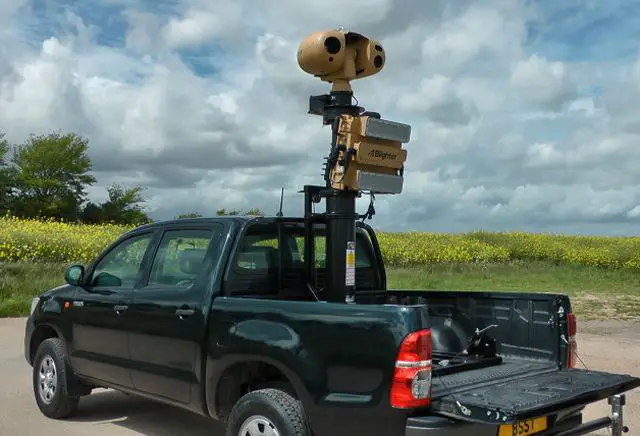
 
Mast-mounted sensor heads combining radar and EO/IR are becoming increasingly common. One would hope that the future primary ISTAR platform of the British Army, at least in its Ground Surveillance variant, will be equipped with something resembling this combination offered by Blighter

Another variant which can only attract curiosity is the Overwatch variant for the Guided Weapon Troops within Armoured Cavalry regiments. Heirs of the GW Troops armed with the Striker vehicle, CVR(T) family, armed with Swingfire anti-tank missiles capable of 4000 meters engagements, the Guided Weapon Troops (3 in each Army 2020 Armoured Cavalry Regiment) are now making do with Javelin teams capable of 2500 meters engagements, moving around on simple APCs.
It will be very interesting to see if the Overwatch FRES SV variant is just a Protected Mobility vehicle with Javelin racks and slightly different seats arrangement, or if it finally restore a longer-range, vehicle-launch precision strike capability. In years past, particularly with the TRACER program, which came before FRES but was ultimately cancelled, the Overwatch variant had to have a turret with .machine gun and boxes of ready-to-fire Brimstone missiles (at least 4), giving it quite a formidable reach and punch. In more recent times, the MOD funded a 2-year study and demonstration for a lightweight multipurpose missile turret capable to employ both anti-tank and anti-air missiles, the Multi Mission System Technical Demonstrator Programme (MMS TDP), which might come handy for the Overwatch variant. Some experience in dual-role missile turrets comes through the 2011 capability sustainment programme of the Stormer HVM vehicles, which received integration of the LMM missile as well as the latest variant of Starstreak, and a sensors and thermal imaging upgrade to enable surveillance and engagement of ground targets as well as of airborne targets.
The LMM, while not a main battle tank killing missile, could have lots of uses against lighter armored vehicles and other targets. The anti-tank capability proper could come from Brimstone (but it is perhaps unlikely due to cost) or from Javelin, which has been demonstrated as a vehicle launched weapon and also proved to an extended range of 4700 meters.  

MBDA's Multi Purpose Combat Vehicle turret could be indicative of a possible solution for a vehicle-mounted launcher for the Overwatch variant. Here in "french" sauce, the MPCV is shown being used with MMP anti-tank missiles or with Mistral surface to air rounds. 

Worth of mention is also the high number of C2 vehicles to be acquired. 112 is a big number, and seem to confirm my expectation that, due to the high complexity of wiring the electronic and comms of a modern command post, new-build FRES SV platforms have been preferred over the rebuilding of Warriors or other as yet unspecified solutions within Armoured Battlegroup Support Vehicle programme, which should take a step forwards over the end of this year and early in 2015. Thanks to its greater capacity, the FRES Command vehicle should do more than just replace Sultan, also considering that some Sultan roles have actually already been taken up by Panther. The FRES Command post variant will be seen well beyond the confines of the Cavalry regiments: it can be expected to feature in tank, armoured infantry and armoured engineer formations as well, and perhaps in armoured REME units too, replacing Sultan and also, I would guess, at least a part of the FV432s and 436. 

The most recent CGI of the C2 variant.
 
Conversely, the absence of a FRES Ambulance variant suggest that there might be greater confidence in turning out a suitable vehicle from the ABSV programme, most likely by rebuilding surplus Warriors into new variants. The MOD, however, retains the option of purchasing a second block of FRES SV vehicles if it was to become necessary, and ambulances might enter the frame in this (very unlikely) case.

It will also be interesting to see how Engineer formations will reorganize if the Engineer Recce vehicle variant really carries no dismounts. I’m quite surprised by this, honestly, since the recce troop has always had dismounted teams moving around in Spartan or other armoured vehicles. I don’t see why the Engineer Recce would be unable to carry dismounts, being a derivative of the APC hull. What is the “specialist equipment” to be carried? At the moment, I honestly have no idea.
I’m left to wonder if the deletion of the counter mobility variant carrying Remote Delivery Mine System for the replacement of Shielder (which was silently withdrawn from service without replacement as part of SDSR cuts) has something to do with it. If not, it would be nice to understand if and how the army plans to recover a counter-mobility capability, which seems to me to be very important. 

Engineer reconnaissance variant. Reportedly, it will not carry any dismount: what will be carried in their place?

There is also an enduring need for medium-weight bridgelayers to support the independent manoeuvre of the new recce cavalry regiments. The british army is set to retain the 10 to 12 sets of truck-mounted Rapidly Emplaced Bridge Systems (REBS) purchased as UOR for Afghanistan, but this solution seems no more than a stopgap, besides with some serious limitations.
It is licit to wonder if the proposed Warrior Bridgelayer vehicle could find a place in the ABSV budget, and come to the rescue.


Warrior CSP and ABSV

As I’ve written several times in the past, with the way the armour programs of the british army have evolved, FRES SV can’t be considered in isolation from ABSV, as this second programme is needed to hopefully complete the replacement of FV430 in addition to CVR(T). Controversial reports have emerged in the public domain about the number of vehicles to be upgraded, and further confusion is generated by the recent decision to formally separate Warrior CSP and ABSV.
The NAO Major Projects report 2013 reported that the affordable fleet of Warrior vehicles numbers 565 machines, with 445 planned to undergo CSP, including 65 to be upgraded to ABSV. This was prior to the division of the two programs, and anyway always made little sense: 65 ABSV are far too few to respond to the ABSV requirement.
Press reports in more recent times have suggested that the MOD is looking at upgrading a minimum of 381 vehicles, of which 250 would be IFVs, with the turret and 40 mm gun.
Again, the numbers don’t quite add up, in my opinion: 131 recovery, repair and artillery observation post (the FV514 variant has the turret, but the gun is a dummy) appear too many, and yet too few to assume ABSV variants are counted in.
Originally, 788 Warrior vehicles entered service. An Armoured Infantry Battalion of the old ORBAT needed some 63 Warrior vehicles of which 7 between recovery and repair variants and 56 “turreted” ones, with gun. Even assuming a reduced allocation of vehicles to the Anti-Tank platoon, it is fair to assume that over 50 turreted Warriors are still needed for each battalion, and this makes it instantly clear that 250 such vehicles would totally insufficient for the 6 armoured infantry battalions that are supposed to be the hard core of Army 2020. At 56 turreted vehicles for battalion, and excluding reserve and training fleet needs, 336 turreted Warriors are required.
Compare the numbers with FRES Scout, where the 198 Cavalry vehicles slot in quite nicely with the requirement (estimate requirement 3 squadrons of 12 in each Cavalry regiment, plus one recce troop of 8 in each Tank and armoured infantry battalion = 180 versus 198 ordered, not including Radar and Joint Fires subvariants).
I would not want to invest in having all the recce vehicles I need, if then the main core of my brigades is insufficient and I can only scrub together 4 out of 6 battalions at maximum effort.  I would expect the Warrior CSP to deliver numbers more closely matching the requirement. 


Note that 380 + 65 gives 445: I’ve long suspected that the NAO and the press have been reporting their numbers and types the wrong way. 380 turreted Warriors and 65 between recovery and repair vehicles would much more closely match the requirement, and would still leave some 120 surplus Warriors available for conversion under ABSV. More, potentially, since the fleet is supposed to still include at least 643 vehicles, the original number planned for CSP upgrades.
120 vehicles could potentially suffice (albeit barely) to replace the around 20 FV430 vehicles in ambulance, APC, mortar carrier and command variants found in each armoured infantry battalion. The new ABSV programme is expected to generate an invitation to tender before this year ends, with Initial Gate hopefully to come next year, and entry in service desired starting in 2019 to keep the pace with Warrior CSP. An APC, C2, Ambulance and Mortar variant are envisaged, with the Army keeping open the door for the option of a vehicle-mounted anti-tank guided weapon system. If an ATGW vehicle was included in ABSV, the number of Warrior IFVs to be upgraded with the new turret and gun could decrease due to the vanishing need to provide a battle wagon for the Javelin teams.
Another way to reduce the number of turreted Warrior vehicles to be acquired would be to build sections including turretless APC vehicles coming out of ABSV: this could have some merit due to the fact that the number of dismounts on Warrior is to drop from 7 to 6 as part of the CSP upgrade. Replacing one or two of the four IFV in the Platoon with a simpler APC would restore the dismounted strength of the platoon, while potentially also saving money. It might be an option with enough merit to be considered.  
The clear implication is that the requirements are closely connected, and a change in one area can have impacts elsewhere.
Now that there is a signed FRES SV contract, it is fundamental to arrive to a final decision on the number of Warrior to be upgraded, and on the way forwards for ABSV: the use of surplus Warrior hulls is no longer described as the automatic way forward for the programme, but I continue to believe that it remains the most likely and most promising option. 


The Warrior Mortar Carrier demonstrator was shown with L16 81mm mortar, ENFORCER lightweight RWS and full suite of 360° situational awareness cameras

BAE systems seem to think the same, as it showed a notional Warrior mortar carrier variant at DVD earlier this year.


Considerations on FRES SV

There has been criticism in some areas about the weight and size of the FRES SV, which supposedly make it a vehicle unsuited for its role. I personally disagree. FRES Scout is a big vehicle, but this is only fair in view of its role, which is scouting for armoured brigades made of Challenger 2s, Warriors, Mastiff and heavy trucks and artillery. While there is some merit to equipping the reconnaissance unit with a small, nimble vehicle which can move on very soft ground and in very tight places, it must also be noted that this kind of mobility is not excessively beneficial in broad terms. The current Scimitar is an excellent, agile and easily deployable light scout which can move on bridges and routes that heavier vehicles won’t be able to use. But the question is: how much of a gain actually comes from this? The Scimitar is scouting ahead of a brigade made of Warriors and Challenger 2s, and these are the vehicles that determine where the brigade can and cannot go, in the end.
It is their weight and size that dictates how long the brigade takes to deploy, and how it moves on the battlefield. The Scimitars might get some benefit from being able to use alternative routes and gain positions precluded to heavier vehicles, but the benefit will be limited, as in the end the action will need Challenger 2 routes.

The FRES SV comes with excellent soft ground mobility thanks to large tracks and to the additional road wheel, giving it a ground pressure not distant from that of the latest Scimitar MK2: this despite being 38 tons in combat weight, versus 12. Tactical mobility will still be pretty good, even if tight routes and bridges that would be perfectly good for Scimitar won’t be acceptable for the Scout.

On the other hand, the Scout comes with much greater protection, much better sensors and communications, much improved armament and with a whole different level of comfort for the crew. All these are crucial factors in modern operations, as the Scimitar MK2, with its rebuilt hull, testimonies.
Despite the upgrades they received, the CVR(T) are well past their time as primary armour reconnaissance platforms of the british army. It is definitely time to see them replaced: an APC for four dismounts which struggles to actually fit two with how much kit soldiers carry today, and a recce vehicle at the end of its evolutionary path are not going to meet the long term army requirements.

There would be, however, still use for an armoured, tracked vehicle with excellent tactical mobility and the incredible ease of deployment of CVR(T). Something that can be loaded on a cargo plane with a full load of weapons and consumables, and roll out on the runway during Air Landing assaults. Something that can be airlifted by helicopters and that can go over almost any terrain. There would very much still be uses for it, even if the gun is the old RARDEN with all its limits. I do see this usefulness more as a niche role, however: an option to keep alive on a small scale, as a complement to heavier capabilities and as a support to air manoeuvre and special forces operations. 

The Scimitar MK2 offers increased protection and more decent spaces for the crew thanks to the use of remanufactured Spartan APC hulls mated to Scimitar turrets. Weight grows to over 12 tons from the original 8, though.

Under Army 2020, the Household Cavalry saw its connection to 16 Air Assault Brigade severed. The brigade no longer has a direct affiliation to a squadron of light armour, and despite the entrance into the brigade of other kind of capabilities as replacement (namely one STA battery from 5 Regiment RA, and one UAV battery from 47 Regiment RA) the truth is that some armour protection capable to go in from the air would very much still be needed. 

 
Air Landing assault: an A400 can carry a combat ready Scimitar, a WMIK with trailer and 60 troops onto a tactical landing zone. The Scout appears likely to only be A400 capable if in air transport configuration, requiring filling up for combat after landing.
That’s where CVR(T) could and should still have a role. In an ideal world, 16 Air Assault brigade would have a reconnaissance squadron riding the CVR(T) Mk 2 vehicles coming back from Afghanistan, and ideally, in the future, a more modern platform with similar perks. 


Sunday, September 18, 2011

DSEI 2011

I'm putting together all articles about DSEI, along with a final, fast word.
Technologically, there have several interesting novelties shown in this edition of DSEI, but nothing revolutionary. In terms of contracts signed, by the MOD especially, we really are at an all-times low: the budget crisis and the difficult state of economies worldwide truly is having a very evident impact. Despite much expectations, for example for the signing of the Warrior CSP contract, almost everything is delayed to, as a parliamentary answer puts it, to "later this autumn". The 10-years Equipment Procurement plan is not yet complete, as the Forces are struggling to fit within the budget: in particular, the Army appears to be in serious difficulty, as it is probably the service which needs the most new kit, and has several serious urgencies, (FRES SV and Warrior upgrade above all) which all need addressing but all are expensive and heavy on the budget and planning.

The equipment report, promised for September, is in my opinion likely to be released only in October, if not later, as it appears very hard, as of 18 September, to imagine publishing a report before the end of the month if the Army is still unable to fit its two top-priorities in it.
We'll have to wait some more for the report, and in the meanwhile, we all have to hope it is detailed, clear and well thought... and especially, we must pray that it does not bring too many bad news along.

The links below will bring you to the articles i made for the various days of the DSEI show.

DSEI - Day 1
DSEI - Day 2
DSEI - Day 3
DSEI - Day 4

Think Defence also collected in a page of his blog a big list of useful links to articles from various sources and publications about DSEI and the products showcased there.

Thursday, September 15, 2011

DSEI - Day 3

FRES Scout at risk?
The key British Army requirement for a new scout armored vehicle contract is in danger of being canceled due to continuing defense financial constraints, according to General Dynamics UK boss Sandy Wilson.

Speaking to reporters at a briefing on the sidelines of the Defence System Equipment International exhibition here, Wilson said that while a delay to the program was the most likely outcome, cancellation remains a possibility.

General Dynamics UK signed a 500 million pound ($791.4 million) deal in July 2010 with the government to design and demonstrate a family of medium weight specialist vehicles based on its ASCOD platform for the Army. The design and development phase is working to prepare 7 prototypes (3 Scout, 1 Recovery, 1 Repair, 1 Protected Mobility and 1 Common Base Platform) for a campaign of tests and for demonstrating the solutions prior to begin of production.

Under the government's original agreement, it was due to make a decision to enter a production phase in 2013 with first deliveries starting in 2016. Earlier, 2015 had been the planned date. A damning NAO report on Armoured Vehicles Procurement, published a few months ago, had contained hints about the FRES SV sliding to the right to 2017, and now it seems that they might well have been right.
Or perhaps even too optimistic.

The specialist vehicle requirement is the British Army's top vehicle program along with a project to update the Warrior infantry fighting vehicle. Lockheed Martin is negotiating with the Ministry of Defence to secure that deal.

Timing and numbers are being discussed, but the Army is trying to alter the spending profile to be able to afford both key programs.

This however seems to indicate that the Warrior upgrade contract won’t be signed during DSEI, as had been widely expected. It also calls in question the famous report on the 10-years equipment plan that is to be released this month. With two weeks left, it is in my opinion hard to imagine a release in the timeframe planned, if the Army is still struggling to find a way to signal the go-ahead for its two main programmes.


CVR(T) MK2: yes, the hull is new.
BAE Systems Global Combat Systems is upgrading a batch of Combat Vehicle Reconnaissance (Tracked) to an enhanced standard, the first of which have recently been flown to Afghanistan and are now deployed. Most of these are in the Scimitar Mk 2 reconnaissance vehicle configuration, for around 30 - 35 vehicles.
The most significant change is the new aluminium hull, built at BAE Systems’ Wolverhampton facility. This offers a higher level of protection, improves maintainability and lowers support costs. It is based on the hull of the Spartan troop carrier and provides greater internal volume than the original Scimitar hull, as well as raising the driver’s position for improved safety. The vehicle also incorporates the previous upgrades under the Life Extension and Environmental Mitigation programmes, which were deployed to Afghanistan several years ago.

Survivability requirements play a significant part of the Mk 2 design, with a new hull based on the Spartan troop carrier providing improved mine blast protection. The new aluminium alloy, which is fabricated at the company's Wolverhampton site, has greater resistance to corrosion while keeping the weight down.

The extra headroom has allowed the fitting of blast attenuating seating ‘in every position in every variant'.

In addition, redesigned and repositioned driver foot controls aim to reduce lower limb mine blast injuries while improved appliquƩ armour has been added to improve blast and ballistic protection.

According to company literature ‘a new power distribution system, including a new rotary base junction, provides improved power management between chassis and turret and will enable further systems upgrades in the future'.

Additional improvements include a redesigned fuel system and a larger fuel tank, an environmental control system that provides air-conditioning for the complete vehicle, a new power distribution system, new crew seats and upgraded suspension.

The turret is the old standard Scimitar’s armed with the ancient 30mm RARDEN cannon and 7.62mm coaxial machine gun, and remains the big weak spot of the combination due to lack of stabilization and awkwardness of gun loading.

In addition to the Scimitar reconnaissance vehicle, over 20 new hulls have been built for four other members of the CVR(T) family, including the Spartan, the Sultan command post vehicle, the Samson recovery and the Samaritan ambulance. These are mainly minor changes, such as a heavier-duty winch on the Samson variant.

This £30 million upgrade, also referred to as Project Transformer, is being carried out under urgent operational requirements funding and is due to be completed early in 2012 with the delivery of 58 vehicles.

The Scimitar MK2 is already online in Afghanistan, as proudly announced today by the MOD who also released the following pics: 


Interesting cruise missiles from Turkey fits the F35’s weapons bays.
Tübitak-SAGE, the defence industries research and development institute of Turkey’s scientific and technological research council, has unveiled the Stand-Off Missile (SOM) on its stand at DSEi (N7-168). Last month, this major weapon programme successfully conducted its first guided flight.
SOM has been in development by Tübitak- SAGE since 2006, and following extensive wind tunnel and systems tests – followed by captive-carry and release trials – made its first guided flight on 9 August. Flying over the Black Sea, the SOM covered more than 100 nautical miles using GPS/ INS guidance. A campaign of about 30 test flights is to be conducted to assess aspects of the missile’s design.

SOM is a 1,300 lb stealthy cruise missile offering a variety of programmable ingress and attack profiles. Midcourse guidance is accomplished by GPS/ INS, with terrain reference updates.
Furthermore, the missile’s imaging infrared seeker can also be used to provide image-based midcourse navigation by taking snapshots of waypoints and comparing them against predicted position to update the navigation system. Infrared and terrain updates allow the missile to navigate without GPS if that capability is denied or degraded.

The IR seeker provides terminal guidance using target auto-tracking, and the weapon can be programmed to attack at various angles to match the required effects.

The warhead weighs 500 lb. SOM has a two-way datalink that allows in-flight retasking, and it is networkenabled. With the exception of the French Microturbo engine, the major elements of SOM are of Turkish design, including the high-resolution imaging infrared seeker.
Tübitak-SAGE has also developed a mission planning system for the SOM. This is common with that required for the HGK, a GPS/INSguided bomb kit for Mk 84 bombs that the institute has also developed and tested for the Turkish air force. Both HGK and SOM are compatible with NATO’s universal armaments interface.

Initial development work on SOM is being undertaken using the F-4E 2020 upgraded Phantom operated by the Turkish Air Force, but around the turn of the year work will begin on integrating the weapon onto the F-16, which is Turkey’s most numerous fighter.

SOM would also likely be included in any indigenous Turkish fighter development, but perhaps the big prize is the F-35 JSF that Turkey will operate. Tübitak-SAGE has sized the SOM to the internal bays of the Joint Strike Fighter, although the four rear fins will have to fold to fit the missile into the bay.
As befits its role as a design institute, Tübitak- SAGE produces only prototypes and development items, and does not have the capacity for mass production.

Turkey has not yet finalised production plans for the SOM, although an announcement is expected next year.


New Viking variants.
BAE Systems Global Combat Systems is showing two new versions of its combat proven BvS 10 Mk II all-terrain tracked all-armoured vehicle at DSEi for the first time. The first is a crew-served weapon platform, fitted with a Selex Enforcer remote weapon station (RWS) armed with a stabilised .50 M2 HB machine gun on the front unit, which is aimed using a flat-panel display from under full armour protection. Also mounted on the front unit is a Boomerang acoustic sniper detection system, coupled to the RWS.


These images show the BsV10 Viking MK2 Crew Served Weapon carrier. The Enforcer RWS on the front car is very evident, as is the installation of the Boomerang acoustical fire source detection device, the rear (manned, shielded) weapon turret and the Mast-Mounted Sensors for battlefield surveillance.
A complete Selex sensor suite is installed. It includes DNVS 4 night driver’s vision system, local situational awareness system and retractable mast-mounted sensor pod. The latter features high-performance day/night sensors and a laser rangefinder for surveillance and target acquisition. The rear unit also has a roof-mounted protected weapon station for increased firepower.

Second BvS 10 Mk II has a rear unit modified to carry a turntable-mounted 81mm mortar and about 140 rounds of ready-use ammunition.

The BsV10 Viking MK2 Mortar Carrier, with its 81 mm mortar in firing mode.

A key feature of these new versions of BvS 10 is that they both retain their full amphibious capability, making them very, very attractive for the 3rd Commando Brigade, which would need such firepower enhancements greatly. Although not optimal in terms of commonality, the Viking mortar carrier could also be a solution for replacing the FV432 MC in Armoured and Mechanized Infantry Battalions, since (very worrisome detail) the British Army seems to be oblivious to the need to provide a replacement to the protected mobility of mortal sections.

The first customer for the BvS 10 was the UK Royal Marines, which deployed it on combat operations to Afghanistan, followed by the British Army. A total 190 units have been delivered to the UK, including battlefield replacement vehicles.


Foxhound is in production
First Foxhound vehicles will be delivered late this year for training. Around 35 of the 200 vehicles are expected to be used for training purposes. Deliveries of all vehicles are due to be completed by mid-2012 to replace the Snatch Land Rover, which has proved highly vulnerable.

Ocelot was selected following extensive competitive trials carried out last year. Since then the vehicle has been further refined and by September this year more than 50 physical blast trials had been carried out.

Final assembly of the Ocelot is carried out at the Ricardo facility in Shoreham, with the support of other key subcontractors including the Defence Support Group, Formaplex, Sula, Thales and QinetiQ.

Export marketing is already underway and two vehicles – one in the standard configuration and one in the two-door configuration with a flat bed at the rear – were delivered to Australia to take part in the Australian Land 121 Phase 4 requirement.


A trackway for UAVs.
Faun Trackway, the defence division of North Wales-based Faun Zoeller, has introduced a landing mat specifically designed for unmanned aerial vehicles (UAV). It is the latest addition to Faun’s suite of temporary runway solutions. The lightweight aluminium mat will be capable of clearly marking permissible landing areas and will provide a smooth landing, regardless of terrain, for any size or weight of UAV.

Faun’s UAV mat is being developed for rapid deployment by hand and will prevent foreign object damage to help protect valuable UAV assets when in the field. To enable the UAV to rapidly decelerate when landing, the mats can also be fitted with arrestor gear usually found on aircraft carriers.

Alternative ancillary equipment will also be available, including lighting systems, painted markings, generators, heat-protective gloves and electric hammer drills. Faun plans to launch the product in 2012, and the British Army could be interested due to the need of Watchkeeper for runways, even if semi-prepared airstrips and grass surfaces can do. Watchkeeper could also be adapted for catapult launch, but the Army did not express interest nor did formulate a requirement for this aspect.


The Warrior bridgelayer is shown to the public.
Pearson Engineering has completed development of its Bridge Launch Mechanism (BLM), which is being shown for the first time in the Vehicle Park (South Hall) integrated onto a BAE Systems Warrior manoeuvre support vehicle.

The BLM is a special to role attachment that can be fitted to a wide range of chassis, tracked and wheeled, which allows for the launch and recovery of a bridge from under armour in less than two minutes.

At DSEi it is being shown for use with the BAE Systems No 12 bridge, which is currently deployed by the British Army from the Titan bridge layer. The BLM has also been tested on a Leopard 1 tank chassis.

Four versions are being marketed: Heavy, Medium, Light, and one for use on vehicles fitted with a palletised loading system, which, typically, is based on an 8x8 cross-country truck chassis. BLM has three operating positions: transport without the bridge fitted; transport with the bridge fitted; and a deployed position with the bridge laid in position over the front of the chassis.

Hydraulic power is provided to a BLM directly from the vehicle or from an onboard hydraulic system, which can be supplied as part of a Pearson Engineering common interface system (CIS). Installation of the CIS allows the vehicle to be rapidly re-rolled according to mission requirements, such as installation of a dozer blade or mine-clearing devices of the roller or plough type. The CIS makes the vehicle more than just a bridgelayer, and the name (Warrior Maneuver Support Vehicle) is a clear allusion to this, other than a proof that this development is aimed at giving the MOD a cost-effective path for fulfilling the FRES Maneuver Support Vehicle requirement, which has a slot for some 35 bridgelayers and support vehicles, alongside 60 Terriers already on order. 

This ridiculously tiny picture is all i can find so far for a vision of the Warrior Maneuver Support Vehicle. I doubt the Challenger II development was as secretive and less publicized, sincerely. A pity, because as always i'd love to know more.
Other options for fitting the CIS and meeting the requirement are the ASCOD SV Common Base Platform or the Terrier hull. Both are inexorably going to cost more than using Warrior hulls made available by the reduction in Armoured Infantry requirements.


The UK and the F35C progresses.
Rear Admiral Amjad Hussain, the Ministry of Defence’s Director of Precision Attack, earlier this year visited Naval Air Station Patuxent River in Maryland, where he was briefed on the F-35C programme progress and witnessed flight test operations.

Three F-35C test aircraft are now operating from the Patuxent River test facility to support integration testing with the US Navy’s Nimitz class aircraft carriers. CF-1, at Patuxent River since last November, was joined earlier in 2011 by CF-2 and CF-3; the latter is the primary catapult launch and arrestor recovery test aircraft and is also a fully mission systems capable platform.
Jet blast deflector tests were recently completed at Lakehurst, New Jersey.

Carrier suitability testing is scheduled throughout this year, including ongoing catapult testing and the start of arrestment testing in preparation for initial ship trials in 2013. While the Royal Navy’s new Queen Elizabeth class ships are smaller than the Nimitz class, there will still be considerable read across from the US test and integration campaign.

In a separate but associated development, the UK and US governments are close to finalising a JSF ‘swap’ deal that would see the UK exchange one of its three F-35B short takeoff and landing (STOVL) initial operational test and evaluation (IOT&E) aircraft for an F-35C CV variant.
A deal has been agreed in principle by the national armaments directors of both countries. Final approvals are expected by the end of 2011.

The mock-up F35 exposed at DSEI is shown accompanied by a Meteor missile, indication of the MBDA’s firmness in adapting the design to the JSF’s weapon bays constraints and pursue export orders associated with the plane. 


MASC, Crow's Nest... Give the carrier a flying eye: the RN has a requirement for an airborne early warning platform embarkable on ships, mainly the Strike Carrier. This capability will have to replace the Sea King MK7 ASaC, which is working in both Afghanistan and Libya (flying from HMS Ocean) as we speak, but that is planned for retirement by 2016, along with all other Sea King variants. 

The MASC requirement could be filled by 3 to 6 Hawkeyes (in terms of performances, unbeatable, but also very expensive to acquire) or by around 10 Merlin helicopters. However, funding will be so constrained that the RN is clearly anticipating to have no chance of buying new airframes for the role. Perhaps, if the Senior Service is really lucky, the 8 non-upgraded Merlin HM1 will be recovered for the role, but in case this was not economically feasible, the 30 Merlin HM2s will be given yet another role, making them even busier. 


Thales and AgustaWestland presented in 2010 a solution with a palletized Cerberus radar suite that could be installed easily on the Merlin HC3, which is planned to be navalized and given to the navy by 2016/18. 

The original Thales - Westland proposal, rolled out in 2010, showed the Cerberus radar bag mounted on a pallet in the back. This required the Rear Loading Ramp, and thus either a new buy Merlin, an HC3, or a heavier rebuild process on HM1/2 at time of navalization. The Merlin in HM2 configuration has a two-men crew console in the back, but for ASW sensors. It is not clear if this same console could be expanded (mainly software-wise) to work with the Cerberus suite and in the AEW role as well, or if some kind of AEW-specific console will be provided, sized to be embarked through the side sliding door.

However, the 25 Merlin HC4 will be too precious and in demand providing vertical mobility to troops to be used for the AEW role as well, and Thales is showing at DSEI a revised fast-installation option. 


The Cerberus suite already used in the Sea King is, again, retained as core of the system. The Searchwater 2000 radar (the black bag that gives the Sea King MK7 its "Bagger" surname) would now be installed on the Merlin and deployed using elevator rails attached to the aircraft's fuselage, and not using a pallet approach, removing the need for the rear loading ramp, and thus making the solution perfectly compatible, potentially, with ALL Merlin variants. Roughly one-third of the HM2 fleet could be equipped with airborne early-warning sensors at any one time, with all capable of carrying it if and when necessary.
The two-men radar console for the Radar Crew would probably sized and designed in order to enter the Merlin by the side sliding door.

Lockheed Martin, which in 2010 announced a plan to adapt fuselage-mounted AESA radar arrays to the Merlin for fullfilling the same role, is now presenting its plan: essentially, two small pods mounted on the helicopter's pylons, each containing a radar array and IFF, to give the 360° coverage required by the RN.

The pods would feature synthetic aperture radar and ground moving-target indication modes and be suitable for tasks such as fighter control and maritime and battlefield surveillance, tracking targets in the air and on land.

The LM proposal: one radar pod can be seen, attached to the sling points were the pylon for Stingray torpedoes is normally found. Again, no details are currently available about the crew radar workstations.


Also incorporating a gimballed radar and electronic support measures and identification friend-or-foe equipment, each pylon-mounted pod would weigh roughly 280kg (617lb).

Lockheed says the design represents "a role-fit solution which can be mounted on any fixed-wing transport/surveillance aircraft or medium-sized helicopter".

Concerns definitely remain. The Merlin HM2 fleet will routinely be asked to provide 6 or 8 Small Ship Flights for the Type 23 and then 26 frigates, with more potentially earmarked for Type 45. A requirement also exists for providing larger (6-helicopters) flights to big ships such as RFA Argus (it has become a common solution for Somalia anti-piracy deployments) or the Fort class replenishers, and of course on the Aircraft Carrier in future.
If we consider that all ship flights ideally should be triple (one training, one deployed, one recovering after deployment), we can immediately appreciate the full dimensions of the problem, and of the work that the already stretched Merlin family does.

It really is to be hoped that the 8 HM1 airframes (12, actually, considering 4 stored ones) can be recovered for this job.


Puma HC2 silently but steadily progresses:
The project to inject new life into the RAF's fleet of Puma support helicopters is making good progress, according to Eurocopter. Since the maiden flight of the first modified aircraft in June, Eurocopter test pilots have completed nearly 30 hours of manufacturer's test flying. That work is due to be complete by the end of the year when the aircraft will be transferred to Boscombe Down in Wiltshire for military certificate and acceptance testing by QinetiQ.

Under the £300 million Puma Life Extension Programme which was launched in September 2009, 28 (NOTE: 24 is the number that was presented post SDSR, so i highly doubt there's been a return to the 28 figure, which anyway always was, even in times of lesser economic despair, expressed in terms of "up to 28") of the RAF's Pumas are being given a new avionics suite, similar to that fitted to the EC725, new Turbomeca Makila engines and a modified gearbox to cope with the extra power.

The aircraft is being totally re-wired and given a new fuel tank which will further extend the range of the aircraft, potentially making it more attractive for special forces use. The type is understood to be the preferred mount of UK SF personnel.

Airframes selected for the update are delivered to Eurocopter UK at Kidlington in Oxford. There the aircraft are dismantled and components not required, such as the engines, are delivered back to the RAF.
The aircraft is then trucked to Eurocopter Romania's facility in Brasov where the work is being undertaken. Fourteen aircraft are now going through the upgrade process. Four of the 20-some will be completed at Eurocopter's plant at Marignane near Marseille.

As well as the new Pumas, the training simulator at RAF Benson will be modified into a Mk2 cockpit configuration, but early training of instructors will be carried out on a simulator in France.