There can be no discussion of an
alternative to Future Soldier without first spending a few words on AJAX, and
how the plan as published has faced some issues, or ignored them.
Even after the recent oral statement and the publication of the report into the
vibration and noise disaster, we still do not know if AJAX will ever be
able to get into service. Proposals for a number of fixes have been formulated
but will now have to be trialed, evaluated and costed, and who knows what the
result will be, and how long it will take.
Future Soldier (for now) assumes AJAX will
eventually deliver, but there are very good reasons to fear it won’t. It is
also increasingly out of place in an Army that has lost its IFVs and does not
have a budget that would enable the launch of a second major acquisition
programme to replace it. The British Army seems to have well and truly crashed
into its “French moment”, and I don’t know if there will ever again be a
tracked IFV in service.
At this point, my personal opinion is that AJAX shouldnot survive. The money yet not sunk on AJAX would be redirected
primarily towards more BOXERs (because that is the only thing that can be
purchased quickly, and expanding the order is cheaper than trying to launch a
separate procurement for something else) and towards a modest expansion of the
CHALLENGER 3 project. However, given the current situation and the fact that
the Army is clearly afraid that, if it lets go of this deal for 589 AFVS, it
will not be able to get them replaced, it is indispensable to consider the scenario
in which AJAX does survive.
We can only guess, at this stage, how the
Army thinks it will fight in the future. The Future Soldier plan deliberately
avoids venturing into the shape of the “warfighting division” on deployment,
unlike Army 2020 Refine, the previous plan.
Under Army 2020 Refine, 3rd
Division was going to have 2 armoured infantry brigades and 2 STRIKE brigades,
but the planning assumption was that, on deployment, only one of the STRIKE
formations would go. The equipment allocations went hand in hand with that
assumption, because at no point of
the STRIKE odyssey there was a funded, well-timed plan to get to both brigades
being fully resourced.
Now 3rd Division is down to 2
armoured infantry “Brigade Combat Teams” and a “Deep Recce & Strike Brigade
Combat Team” which will see the current 1st Armoured Infantry
Brigade merge with 1st Artillery Brigade in Summer 2022.
I’m guessing
that the whole package is expected to deploy in the field, but the document
does not exactly gives us confirmations or any detail about the timeframes and
other accompanying conditions and assumptions.
Assuming the whole package is now expected
to deploy, the principal changes are the greater number of BOXER battalions and
AJAX regiments that would deploy.
Future Soldier lists 5 BOXER-mounted
infantry battalions, up from 4 in the Army 2020 Refine plan (2 per each STRIKE
brigade). If the whole package is to be deployable, this is an increase from 2
to 5 “deployable” BOXER units.
Of course, it does not compensate the fact
that, under Army 2020 Refine, there were going to be 4 WARRIOR-mounted
battalions in addition to the ones on BOXER.
The number of AJAX regiments is the same
(4, with the fourth to be obtained by having King’s Royal Hussars regiment
losing MBTs to convert to AJAX instead), but their distribution has changed:
instead of being assigned in pairs to each STRIKE brigade (so with the
assumption that only 2 out of 4 would simultaneously deploy) they are now
assigned as follows:
1x in each Armoured Infantry BCT
2x in the Deep Recce Strike BCT
If the whole package is going to be
deployable, the assumption is that AJAX units will be held at higher readiness
to deploy and will have an even more important role to play.
We can also speculate on the Why.
In a STRIKE brigade, one AJAX regiment
would be in “Armoured Cavalry” configuration, and would have reconnaissance and
screening as its main role. The other, controversially, was going to be known
as “Medium Armour” and would have had the exact same AJAX vehicles, organized
differently, more akin to a Tank regiment, with the mission of supplying the
very lightly armed BOXERs with intimate fire support.
In practice, once in the field the STRIKE
brigade was going to possibly parcel out “Cavalry” squadrons to cover the
reconnaissance needs, while organizing the rest of its resources in combined
arms battlegroups that, by default, would have included:
1x Medium Armour Squadron (14 AJAX in 4
Sabre Troops and 2 more in the HQ, plus a section of 4 ARES carrying JAVELIN
teams)
2x Mechanized Infantry Companies on BOXER
(12 Infantry Carrier Vehicles in 3 Rifle Platoons, 1 Ambulance, 3 more for the
OC, 2IC and CSM respectively)
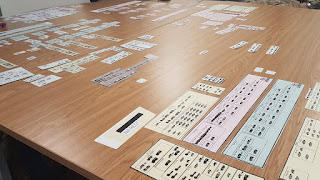
Internal Wargaming of the STRIKE brigade. A battlegroup with the standard Medium Armour Sqn is visible nearest to the camera.
BOXER, being lightly armed and, unlike
WARRIOR, unable to drive the infantry onto the target and deliver supporting
fire on the spot, was (and is) expected to dismount the infantry a “safe”
distance away from the target. The dismounts would have gotten their intimate
fire support not by their APCs, but by AJAX.
In the Armoured Infantry Brigade, of
course, the WARRIOR covers both bases (at the cost of carrying 2 dismounts
less) and works alongside the CHALLENGER tanks.
That was the previous plan. What happens
now?
Despite much talk of attempts to improve
the armament of at least some of the BOXERs, they remain wheeled APCs which the
Army continues to see as unsuited for driving onto the target. The Army has been very clear and consistent in
saying that BOXER is not and won’t be a WARRIOR replacement, because it does
not have that kind of capability.
Unfortunately, however, the BOXER is
physically replacing WARRIOR anyway. It will take its place into the infantry
battalions that would have had WARRIOR, and will take over the garages and
bases in Salisbury plain. It will sit within the Armoured Infantry Brigades,
since the STRIKE brigades are no more.
It will replace WARRIOR... while being in
no way adequate to replace WARRIOR. Wonders of British Army planning!
This situation means that the firepower gap
that AJAX was meant to fill in the STRIKE battlegroups not only is unchanged
and undiminished, it is literally 100% worse since WARRIOR will be withdrawn
from service.
Future Soldier no longer lists any of the
AJAX regiments as “Medium Armour”, but i suspect this is just a cosmetic
change.
As we have seen, when STRIKE was a thing
and the 2 Armoured Brigades had no Cavalry of their own at all, they were
supposed to be supported for their reconnaissance and screening needs by elements
coming from the single STRIKE brigade, aka from 2 AJAX regiments.
Under the new plan, the 2 armoured BCTs
each have an AJAX regiment, and 2 more sit into the Deep Recce Strike BCT. This
means 4 AJAX regiments potentially in the field at once. All of them, if we
look at the names on paper, to cover Cavalry tasks.
Do we believe to that? Until yesterday, 2
AJAX regts were supposed to be enough to deliver recce, screening and fire
support organic to the STRIKE Battlegroups proper, with the Armoured Brigades
having no cavalry on their own, and now the Cavalry requirement is virtually
doubled...?
I don’t think so. It seems clear to me
that, while the Army is (rightly so) too embarrassed to call AJAX “medium
armour” anymore, the requirement for it to support the infantry is more acute
than ever before. With WARRIOR gone, there
is nothing else that can deliver the supporting fire of a high-elevation,
quick firing gun to suppress infantry, light armour and enemy ATGW teams.
Logic suggest that the Deep Recce &
Strike BCT with its 2 AJAX regiment will do the cavalry job... and the AJAX
regiments in the Armoured BCTs will, regardless of names and titles, end up
playing that “medium armour” role.
I’ll be controversial about it and say
that, by accident and inability to set sensible priorities, the British Army is
on the path to (poorly and remotely) emulate the Russian “TERMINATOR” vehicle
concept by having AJAX, a non-tank, non-IFV, provide intimate support to tanks
and infantry.
If AJAX is to stay, I can only hope there
is a decent technical solution to its vibration and noise problems. What is not
going away is fact that AJAX and BOXER are 2 unfinished projects thrown
together in despair to create something that is workable, but way too expensive
and awkward for what it does.
I honestly don't think there are
alternatives for a wheeled, under-armed APC and a
vehicle-with-firepower-of-upgraded-Warrior-but-unable-to-carry-dismounts. All
you can do is have APC sitting back, disgorging dismounts some distance away
while AJAX “plays Warrior” accompanying them.
I’ll also have to try and guess how the
Army now expects to kit out 5 infantry battalions with BOXER without new
vehicles being purchased. In this case i must assume they have done what i’ve long
been saying would be unavoidable, and changed the mix of variants in the order.
For example, I think the 60 engineer
section vehiclescould probably have
been switched to Infantry carriers: remember that Future Soldier downgrades the
previous plan from 4 brigades to 2, effectively, and there is already an
engineer variant of AJAX, the ARGUS, on order.
Until recently, we can assume ARGUS would
have equipped the Armoured Infantry Brigade’s engineer regiments, while the
BOXERs would have gone to the engineer regiments of the STRIKE brigades. Now,
there are only the former left to equip.
The order for 61 ambulances could also have
been cut back sharply, as well as the (absolutely out of balance) 123 between
Command Posts and Command Post – Utility vehicles.
Finally, a comment on another case of
British Army contradictory decisions: it appears likely that the Mobile Fires
Platform project, for the replacement of the AS90 with a new 155/52 gun, has
seen its requirement slashed significantly. Possibly by half, despite the
Army’s narrative being a greater focus on the Deep battle and long range Fires.
The requirement previously fluctuated
between 98 and 116 guns, but with one firm assumption: 4 regiments would get
the new gun. 2 regiments for the armoured infantry brigades (19 RA and 1 RHA)
and 2 for the STRIKE brigades (3 RHA and 4 RA).
But under future soldier, 3 RHA is
converting to GMLRS, and its place in support of 4 “Light BCT” is taken by 103
Royal Artillery Regiment (Reserve). Very big doubts hang over the deployability
of 4th Light BCT as its Combat Support and Combat Service Support are all dependent on Reservists showing up when needed. Moreover, it is now going
to be an extremely light brigade, and this makes it very difficult to imagine
103 RA being outfitted with MFP.
4 RA will support 7th Light
Mechanised BCT and might still get
MFP, eventually.
Instinctively, i say that the MFP requirement has just stealthily been cut by 25 to 50%.
An
alternative Future Soldier
In my alternative proposal, Infantry
battalions take (kind of) even more of a hit, in favour of building up the
range of supports needed to ensure there are more Combined Arms Formations that
can be formed and put into the field. The Army Special Operations Brigade and
the Ranger regiment remain, but the parallel Security Force Assistance Brigade
is removed in favour of manpower going to other roles.
The main design drivers of my alternative
proposal are:
-North and South focus. The UK’s
national strategy has, now more than ever, a two-pronged (3 if we include
Central / Eastern Europe) shape with the conclusion of key agreements with
“High North” countries (Canada, Norway and the rest of the Joint Expeditionary
Force partners) and other important deals concluded with partners in the Middle
East, with India and in Asia.
The Future Commando Force
is reflecting this double focus by forming two Littoral Response Groups but it
is clear to me that the Army must add its weight to ensure each region benefits
from a more capable and credible UK forward presence.
-Finding and Striking is going
to be key in the future. This is an assumption we hear all the time, and which
the previous Chief of Defence Staff constantly repeated, but there is little to
no evidence of any real action being taken to ensure British forces can Find
and Acquire targets quickly and hit them at long range. The upgrade to M270B1
launchers and the acquisition of longer range GMLRS rockets and new payload
options is an excellent start but is not sufficient.
Key to my proposal is the
repurposing of multiple infantry battalions into composite units which, taking
example from 30 Commando IX in 3 Commando Brigade, will assume a long-range “Recce-Strike”
and Brigade HQ support role. These units will also become responsible for Mini
UAVs and suitable Uncrewed Ground Vehicles once these will become available, in
particular combat UGVs compatible with Conceptual Force 2035’s aim of using
autonomous vehicles to “push reconnaissance forth to the point of destruction”
in order to increase op tempo.
With mini-UAVs being
distributed out directly to the infantry, 32 Royal Artillery regiment will
instead convert to lightweight GMLRS launchers.
The official Future
Soldier plan assigns 1 Royal Irish to 16 Air Assault brigade in such a role,
although detail is still scarce and my proposal might still be significantly
different. Each brigade will get such a battalion under my plan.
-The British Armed Forces
already possess most of the expensive “ingredients” needed to build up a
powerful Air Mobile force. Future Soldier seems to (finally) have noticed and
has started exploiting them with plans for the “Global Response Force”, but i’m
urging an even greater focus on this area.
-My alternative plan keeps the
Army Special Operations Brigade and the Rangers, but sacrifices the Security
Force Assistance Brigade in favour of resourcing the manoeuvre brigades. I
think the Rangers, being meant from the start as a capable fighting force that
will accompany local allies and
carry out SOF raids, can carve a useful role for themselves even though the
Joint Force would be hard pressed to supply the wide panoply of supports that
would be needed for the concept to truly work. I’m far less convinced by the
usefulness of the SFAB, because I simply don’t think courses in basic
soldiering skills are what partners need.
-I hope the Reserve can provide
more formed units and more capabilities in the future, but i’m not prepared to
make one of already way too few brigades dependent on Reservists showing up
when and as required. The core BCTs must be manned by regulars and provided
with sufficient CS and CSS support.
1st Division
In my Army proposal, 1st
Division is devoted to Forward Presence and Rapid Reaction. Forward Presence
being a major, national strategy and involving the Future Commando Force and
the indispensable support of Navy and Royal Navy units, the Division becomes a
joint unit, effectively absorbing Joint Task Force HQ and integrating 3rd
Commando Brigade in its mechanism of force generation to cover the North and
South tasks.
1st Division will take command
of 1st Aviation BCT, 16 Air Assault BCT, 3 Commando and 7th
Mechanized BCT.
1st Division will become a High
Readiness, highly active deployable HQ, integrating in itself Joint Task Force
HQ functions (and resources). It will be strengthened to account for the fact
that it will be expected to oversee permanently forward deployed forces and
command quick reaction operations.
30 Signal Regiment has the single Aviation
Support comms Sqn, but sits in 1st Signal Brigade and under ARRC. Why has
everything got to be this convoluted? Why can't the British Army just put
things where they are needed, and cut down some of the intricacy?
30 Signal Regiment, which is primarily
tasked with JTFHQ and JHC support already, will consequently become an organic
element of the Division’s Information Maneouvre Component, alongside 2 Signal
Regiment and an Intelligence battalion integrating joint force elements. 244
Aviation Support Signal Sqn will go directly to the Aviation Brigade.
A Recce and Fires Group will be formed
around 32 Regiment Royal Artillery as it re-equips with a lightweight, rapidly
deployable new missile launcher, either LIMAWS(R) resurrected or the USMC’s
ROGUE/NMESIS. These lightweight launchers, which will be able to deploy by air,
move long distances by road and being carried under slung by CHINOOK, would add
that “strategic” dimension to both the air mobile and future commando force
that is currently missing. Compatibility with GMLRS ammunition, up to the
Precision Strike Missile to come (with ranges of 500 Km or more) and even to
Naval Strike Missile (the NMESIS solution) would massively expand the
usefulness of the light raiding forces, and make them lethal.
One note i will add here is that plans to
acquire and develop new warhead and payload options for GMLRS rockets are the
one truly good news of Future Soldier and i hope the Army will truly prioritize
this. The acquisition of the Alternative Warhead for Convention-compliant area
attack is crucial to restore the M270’s destructive ability, and the intention
to add “explosive and non-explosive barriers to constrain vehicle movement; missile-deployed
sensors; and radio frequency effects” are to be welcomed. Russia leads NATO by
a mile in this kind of advanced artillery capability, and if the UK manages to
develop effective payloads it could not only improve the Army’s position but
potentially secure huge export wins across NATO.
The Recce and Fires Group will also include
one Electronic Warfare regiment: Future Soldier already plans to convert 21
Royal Signal in a second EW formation. In my plan 14 Regt would focus on 1st
Division (it already includes the LEWTs for 16 Air Assault) and would maintain
an EW Sqn for each brigade (3 Commando already provides its own EW) plus a
Divisional Sqn.
Unlike the Deep Recce & Strike Group at
present, which is a mammoth formation of 2 heavy cav, 2 light cav, 2 GMLRS
regiments, 2 AS90 regiments and a STA regiment absurdly without any organic RLC
unit to carry the immense amount of ammunition and supplies required, the Recce
and Fires Group will absolutely need to have at least one organic, regular logistic
regiment, plus a Reserve transport regiment specifically focused on ammunition
and in particular GMLRS pods.
With each Division having equal “dignity”
even if not equal weight, Air Defence needs will be equal as well. In my plan,
12 and 16 Regiments will be assigned one per Division and will become mixed
regiments comprising SHORAD and MRAD batteries. Being based on the very same
installation and very much working side by side, there shouldn’t be excessive
issues in adopting a mix that, in the field, would be inevitable anyway.
An additional Surveillance and Target
Acquisition regiment will need to be formed, so each Division has access to
indispensable sensors including counter-battery radars.
The Recce and Fires Group for 1st
Division will have 2 scout battlegroups formed around Light Cavalry, initially
with Jackals and, one day, with an enclosed light vehicle better suited to
operations including in extreme cold.
1st
Aviation Brigade Combat Team changes
1st Aviation BCT will expand and
rationalize its organisation. Elements of one infantry battalion, plus 244
Signal Squadron (from 30 Signal Regiment) and Landing Zone reconnaissance and
communication parties from the current Joint Helicopter Support Squadron will
be used to create a Command and Support Battalion that will deliver deployable
HQs, communications, ground reconnaissance and force protection.
The RAF Chinook Squadrons will formally
come under the BCT’s command, organized into a Heavy Regiment through the
formation of appropriate ground life support teams for operations in the field,
on the model of existing AAC regiments. At the moment, the RAF Support Force is
more tied to established airbases and does not come with the kind of organic
life support found in AAC Regts.
The same would happen with the new Medium
helicopters, to be organized in a Medium Regiment which will have 2 of its
Squadrons forward based by default (84 Sqn in Cyprus, 667 Sqn in Brunei).
The RAF Tactical Supply Wing will merge with
132 RLC Sqn and elements of the current JHSS to form a single, integrated
Aviation Sustainment Battalion.
7 REME will lose command of 132 RLC Sqn and
carry on focusing only on Aviation Maintenance.
158 Aviation Support Battalion RLC
(Reserve) will become organic to the BCT it is meant to support.
47 Royal Artillery with its WATCHKEEPER
batteries would be part of the Aviation Brigade due to the sizeable ground
footprint required by the drone.
16
Air Assault Brigade Combat Team changes
Largely the same changes already planned in
Future Soldier: a third logistic squadron and artillery battery to be formed so
that each battlegroup (2 PARA, 3 PARA, 1/2 GURKHA) is supported.
1 R IRISH joining the brigade as a Recce
and Strike Formation. Keeping pace with my conception of this unit, which
should in no small part reproduce what 30 Commando successfully does for 3
Commando, this battalion will effectively also absorb 216 Signal Sqn and the
Brigade’s deployable HQ, to ensure its force protection and life support.
R IRISH will also supply patrols / a
mounted Brigade Reconnaissance and Surveillance Sqn, effectively integrating
the Pathfinders into what will really be a composite unit, no longer a “true”
infantry formation.
An EW battery and a Light Air Defence
Battery will complete this battlegroup, on permanent alignment from 14 Royal
Signal Regiment and 12 Royal Artillery Regiment respectively, much as already
happens today.
The priority for the brigade would be the
acquisition of CHINOOK-portable light vehicles to increase its mobility on the
ground. The new Battlegroup Organic Anti-Armour solution should obviously
include a scaled-down launcher option compatible with these light vehicles; the
current trailer-mounted EXACTOR can be the stopgap on the way there.
7th
Brigade Combat Team
In my plan, this brigade becomes “joined at
the hip” with the Future Commando Force’s Littoral Response Groups, forming a
North group, with focus on Norway and the Arctic, and a South group focused on
Middle East and beyond.
The brigade will still be “light
mechanized”, but it would receive the VIKING as its primary fighting vehicle,
because it is amphibious and proven both in Arctic scenarios and in hot, sandy
and muddy ground.
The brigade will technically be quaternary,
but its 4 battalions will be split into two groups, one for forward deployment
in Oman, and the other focused on Norway deployments. Each group having 2
battalions enables a yearly rotation to spread out the pressure.
In combination with the afloat LRG provided
by the Royal Marines, these heavier, mechanized battlegroups ensure the UK has
a more credible force at readiness in both regions. Obviously the Artillery
regiment would have 4 batteries to ensure proper battlegrouping, and the Close
Support Logistic regiment should ideally receive, over time, at least a basic
fleet of all-terrain, Arctic-compatible heavy duty cargo carriers able to
ensure appropriate intimate support even in the most demanding terrain.
4 Artillery Regiment would receive the
Mobile Fires Platform in the 2030s, replacing the L118.
The brigade will have, as per my
introduction, a “Recce-Strike” battlegroup delivering brigade reconnaissance in
deep, screening, communications and force protection for the HQ in the field.
The unit will integrate the deployable brigade HQ and its Signal Sqn.
32 Royal Engineers will provide close
support engineering, and a Close Support RLC regiment will, over time, acquire
at least a basic fleet of heavy duty logistic platforms compatible with snow
and the atrocious terrain of the high north. Budget restrictions mean this will
have to be a gradual transformation, but if priorities were steady, progressive
improvements would be possible.
3
Commando Brigade changes
The Commando brigade would undergo some
level of change by continuing its already ongoing split into two Groups, North
and South. Specifically, i’m advocating 42 and 47 Commando to mix their
respective capabilities. Right now, 42 Commando concentrates all of the ship
boarding and ship force protection teams, as well as Mentoring tasks and a Sqn
assigned to Joint Personnel Recovery role; 47 Commando groups the Landing Craft
Sqns and the boat raiding Sqn.
I think it would be beneficial to split the
capabilities across the two units and have them assigned to the two geographic
focus points. Each “maritime Commando” will deliver:
-Boarding Teams and Force
Protection with the adequate force and equipment mix for the relative areas. In
general, most boarding happens in the LRG (South) area, normally.
-Boat / Raiding Sqn, to be
equipped with more capable combat boats as soon as practicable
-Landing Craft Sqn
-Joint Personnel Recovery
LRG
(North) would be delivered by 45 and 47 Commando plus supports; (South) would
be the remit of 40 and 42 Commando.
3rd Division
The Iron Division will continue to be the
Heavy division (or “warfighting” if you like the Americanism) and will have 3
manoeuvre brigades: 12 and 20 armoured BCTs and 4th Light BCT. The
inclusion of the Light BCT can appear counter-intuitive, but it was always
planned that 3rd Division, on deployment, would call on the services
of the Vanguard Light Brigade for rear area security, prisoners management and
all sort of other supporting tasks. In my proposal, 4th BCT would
also be Light Mechanized, anyway, by inheriting the Foxhound (and Mastiff /
Ridgback) from 7th BCT as the latter gets VIKINGs.
The divisional enablers will include of
course a Recce and Fires Group centered on 26 RA (and 101 RA of the Reserve)
with M270B1 GMLRS. 5 RA delivering STA, 16 RA delivering SHORAD and MRAD, 21
Royal Signal delivering EW.
The one difference from 1st
Division’s Group would be the 2 Recce-Strike battlegroups which, in this case,
would be square Combined Arms Regiments comprising a cavalry “battalion” with 2
AJAX Sabre Sqns plus supports and an infantry “battalion” of two rifles
companies on BOXER, plus a regimental support company with mortars, long range
ATGWs (to be acquired under the Battlegroup Organic Anti-Armour project).
Armoured
BCTs
This model of Combined Arms Regiment would
be the core of the Armoured BCTs as well, for the reasons explained at length in
the introduction. You’ve heard me talk of the Combined Arms Regiment in a
multitude of articles in the past, so i won’t repeat it all here.
I will just note that, due to the
“particular” situation of today’s British Army, needing to combine AJAX and
BOXER to, effectively, replace effects normally associated to the IFV alone,
i’m keeping the tank regiments separated.
Instead of a single Type 58 regiment, each
brigade would have 2 smaller tank regiments (ideally Type 44, with a slight
increase to the total number of CHALLENGER 3 to be acquired over time), to go
along with 2 Combined Arms Regiments.
The Armoured BCTs would need to be,
virtually, at the same level of readiness for the deployment of both to be
feasible in a Division-level operation, but in truth we’ll have to assume a
more graduated cycle of readiness and engagement.
One brigade at “higher” readiness could be
committed to central-eastern Europe, with elements of one Combined Arms
Regiment plus tanks and supports in Estonia for operation CABRIT and the other
Combined Arms Regiment and tank regiment in Germany.
The other brigade could, in the same year,
rotate its battlegroups through Oman’s training area to deliver the heavier
element of Forward Presence in the (South) sector and to exploit greater
training spaces and maintain experience of operations in arid climates.
The Close Support Artillery regiments with
AS90 (and then MFP) would be organic to the BCTs in my plan, as well as Close
Support Logistic.
The Armoured BCTs would have their own
Recce-Strike formation to support the HQ, deliver reconnaissance in deep and
UAV support and organic tactical intelligence.
If Future Soldier is to truly deliver BCTs
that are more capable of independent action, this is simply indispensable.
4th
Light Mechanized BCT
That 4th Light Brigade Combat Team as
envisioned in the current Future Soldier is not a (reliably) deployable brigade
is evident by the fact that the totality of its Combat Support and Combat
Service Support roles are to be covered by the Reserve.
With all due respect for the Reserve and
with all possible optimism in the expansion of their role and ability to field
formed units, it appears to me that this arrangement will too often not work
satisfactorily.
That 4th BCT is yet another
brigade becoming an undeployable paper tiger due to the Army’s obsession to
cling on to more infantry battalions than it can possibly support is further
evidence by the fact that 1st Division has a single Signal regiment. 3rd
Division has 1 divisional regt and 2 "brigade" regts. The current
ORBAT is just NOT built around what is needed to deploy force in the field.
We KNOW that a Bde needs, at a MINIMUM, a
Signal Sqn for its HQ and Comms. Army currently assigns a whole regt to its
(few) decent bdes, with 1 Sqn delivering Armoured HQ (where applicable) and 1
delivering Network, plus Sp Sqn. A Bde is nothing if it can't command &
communicate.
"We need X battalions of infantry
because there is the Cyprus and Publid Duty rotation, you know" is
technically true, but the Army cannot continue to use this shield to defend a
constant erosion of the CS and CSS elements that make a Brigade a meaningful
combined arms formation.
21 Signal Regt becomes EW, and that's
fantastic. More EW is needed. But can price of some more EW really be leaving
4th Brigade without Signal support? 3 RHA becomes a GMLRS regiment, and again
that's good, but the price can't be leaving 4th Bde depending wholly on the
Reserve.
My solution to all of these problems is the
Recce-Strike combined arms formation at brigade level, as it combines a combat
role suited to infantry and cavalry with indispensable current capabilities
including a Signal Sqn for the brigade’s C2 needs and a tactical UAV unit.
The remaining Signal resources, grouped in
regiments assigned to the Divisions, can deliver theatre-wide network support
while the Signals organic to the brigades deliver the BCT’s intimate needs.
With 32 RA no longer being the lone
custodian of mini UAVs, it can convert to Light GMLRs as said earlier, and 3
RHA can continue in the close support artillery role.
4th Brigade will be based around
4 Light Mechanized battalions on deployment, but will have more battalions at
its command to account for the needs of Cyprus.
Cyprus absorbs 2 battalions, one of which
is a garrison force while the other, from several years already, is a Theatre
Reserve Battalion, effectively forward based on the island for rapid insertion
in the Mediterranean and Middle East area. This would make it one of the 4
primary manoeuvre units of the brigade.
The brigade would also control the garrison
battalion, but that would be additional to the manoeuvre strength, not
considered part of it proper. The Cyprus-task would continue to be rotated
through the brigade’s battalions.
3 RHA would still be aiming for the Mobile
Fires Platform, in my plan.
The
Reserve
Future Soldier is a bit contradictory on
how best to organize the Reserve to ensure it can force-generate for
deployment. Several Reserve units are organic to Regular BCTs, while many more
are assigned to 19th Brigade, which will resurrect in 2022 to take
care of the reserve force generation cycle.
Personally, i’m going to recommend going
with specific brigading of the Reserve, outside but alongside Regular BCTs.
As i’ve said from the beginning, 11th
Brigade will not take a Security
Force Assistance role in my plan. Instead, it will become a Reserve brigade
(Heavy), assigned to 3rd Division to support primarily the armoured
BCTs.
It will take ownership of units that Future
Soldier currently assigns directly to the Armd BCTs, from 104 Royal Artillery
to the Royal Wessex Yeomanry, moving through the Reserve battalion counterparts
to the BOXER-mounted regulars.
19th Brigade will be the Reserve
brigade for 1st Division, taking command of 103 Royal Artillery and
the reserve infantry battalions as well as the reserve CS and CSS units
currently assigned to 4th BCT.
Public
Duty
Future Soldier has started a welcome
revolution in how Public Duties are provided, reducing the requirement from 2
regular battalions to 1, thanks to the creation of “Public Duties Teams”,
presumably based on the current Incremental Guards Companies. There will be 8
teams, apparently, with up to 3 on duty at any one time.
Support will be provided by the reserves of
the LONDON regiment, which is receiving the Guards title.
In
conclusion
My plan would impact the Infantry quite
severely. Many battalions would need to become “hybrid” formations less about
traditional infanteering and more about UAVs, patrols, surveillance and target
acquisition. I believe this is in the interest of the Army’s capability,
however, and an inevitable consequence of having to accommodate the largest
number of capable Combined Arms Formations into a constrictive ceiling of
73.000 regulars.
Emphasis is put on ensuring regular CS and
CSS support, as well as Surveillance and Target Acquisition, are available more
widely and assuredly across the formations.
Note that these are all things that the
Army and Secretary of State for Defence say are needed; the problem is that
Future Soldier as currently published does not follow those directions.
NOTE: this article was originally meant to appear
also on uklandpower.com, since it was initially conceived specifically as a
reply to one of their articles. This intention had to be abandoned since the
editor and the army voices on that portal feel that this article is too long
and the point it raises have already been “discussed ad infinitum”. I felt I could
simply not work along the lines that were asked of me.
My
criticism of STRIKE has gained me the irritation of several Army figures, so
I’m now known as an Army hater as well as an RAF hater. Facts of life, I guess.
I actually care deeply for both, and want only the best for them. My critique
is purely due to the firm belief that in some areas the Services insist on
taking the wrong paths.
There can
be no doubt that the “STRIKE prophet” who has written a new pro-STRIKE article on
UKLandPower.com is speaking primarily, if not only, to me. I am the one who
challenged “STRIKE prophets” to provide answers, after all.
I will now
have to answer, and to once more clarify the exact nature of my critiques and
concerns, which again and again are reduced to the absurd rather than faced
head on. My critique is a bit more complex than “BOXER has no cannon and so is
useless”.
I will
quote several passages of the article in question, and refer to its author as
“the Author”, but of course you should first of all go and read what he has to say about the STRIKEconcept. As you can
tell I continue to have many reservations, but it is a more useful article than
most seen so far.
I also need
to point out a fact which should be obvious, but evidently is not: the STRIKE
supporters that periodically try to prove me wrong have an easy time coming at
me from their individual background and push forward their own idea and
interpretation of STRIKE.
I’m locked
in discussions with multiple people, however, and that means I am exposed to
multiple interpretations of STRIKE, including those who insist that the Armoured
Brigades should be sacrificed in order to go “full STRIKE” for the future. I
have to answer to everyone, not just to one person, so this will require some
extra space, and if it feels like I’m addressing things you haven’t said, it is
because someone else has. It is also a factor in my hostility to the concept: the
more STRIKE is presented as the One and Only Future for the Army, the more I
tend to disagree.
The
Author’s main point, in this case, is that:
In the simplest possible terms, [STRIKE] means
giving a UK Division and/or Allied Corps a Screening and Exploitation
Force. This has been publicly stated by the Army.
It has, and
it has never been in doubt. Screening and reconnaissance have always been part
of the STRIKE concept, and in truth, since building STRIKE means taking the Armoured
Cavalry element out of the Armoured Infantry Brigades, it can only be so. One
of the first sacrifices STRIKE has required has been the shifting of AJAX to
the “new” role and new formation, and the Armoured Brigades no longer will have
a recce cavalry element of their own, other than the Close Recce troops part of
the constituent Battalions and Tank regiment. Clearly, the requirement has not
gone away; just the vehicles have.
Screening,
reconnaissance and exploitation are extremely important in high intensity
warfare, and we are witnessing increasing interest in powerful formations for
this role also in the USA, where more and more often the old and extremely
powerful Armored Cavalry Regiment of Gulf War fame is mentioned as a kind of
formation that needs to return and might in fact provide a base for the future
structures.
The premise
is something I don’t disagree on.
The Strike mission requires highly dispersed
operations enabled by low signature, highly redundant C2 which can concentrate
effects in both time and space in ways far more detrimental to the enemy’s
scheme of manoeuvre than might otherwise be the case if conventional methods
were used.
Strike is looking to add as much friction and
uncertainty to the enemy formation as possible by enabling Fires, Aviation, Air
and a whole range of joint effects to destroy, defeat, and inflict attrition on
enemy formations within a Division’s or Corps’ battlespace. Ultimately, this
allows Armoured Infantry Brigades and/or coalition Armoured formations to
conduct counterattacks and counter strokes under considerably better conditions
than if Strike Brigades were not present.
The Author
is right. This is part of the concept and is an effect that the British Army
hopes to obtain through dispersion. From the RUSI Land Warfare Conference 2019
we have learned that the STRIKE Brigade is looking at covering “a front width
of 80 to 100 km, with a depth of up to 100 km, advancing on as many as 12 axis
at the same time”.
Brigadier James Martin speaks from around minute
28:40. This is recommended viewing.
The
Author’s mention of “uncertainty” for the enemy can actually be further
developed. STRIKE is clearly the primary attempt of the British Army to fit
into the new Multi Domain concept pushed by the US Army. To understand what I
mean, I recommend reading this report (of course coming from the American
side. Unfortunately the British Army is terrible at this kind of communication
and rarely produces something which is both accessible and worth reading) from
WARFIGHTER Exercise 19-04. This massive wargame / simulation exercise held in
the US had 3rd (UK) Division involved and the article does an
excellent job at explaining just what this concept of “creating dilemmas for
the enemy” is all about.
“A single penetration, though conservative and
often effective, would not achieve the commander’s intent. The penetration
presents the enemy with one problem—a problem that other units have presented
repeatedly. Dilemmas are not the same as problems. A problem is a situation
regarded as unwelcome or harmful that must be dealt with and overcome. A
dilemma, by contrast, is a situation in which a difficult choice has to be made
between two or more alternatives, especially equally undesirable ones. To
present the enemy with multiple dilemmas across multiple domains and in
multiple locations, the Division combined penetrations with audacious turning
movements and tactical deceptions, complemented and reinforced with nonlethal
effects.”
“Conducted simultaneously, the penetrations,
turning movements, and tactical deceptions enabled the Division to achieve a
degree of irreversible momentum against the enemy. The armor penetrations kept
the enemy’s sensors engaged. The turning movements avoided the enemy’s
principle defensive positions and seized objectives behind the enemy’s current
positions causing the enemy to both dislocate from its positions and to divert
forces to meet the threat. The tactical deceptions, in particular feints, kept
the enemy fixed on sizable threats, which influenced the enemy’s decision to
prematurely unmask forces in sanctuary inside its underground facilities.
Additionally, the combat aviation Brigade was employed as an independent
maneuver organization focused on destroying enemy high-payoff targets—in
particular long-range artillery. Synchronizing all of these actions in time,
space, and purpose became a tremendously complex task and the primary focus for
the Division main command post.”
It is
pretty clear where the STRIKE concept fits in, and also the kind of
considerations that have driven the (incredibly welcome) development of the
British Army finally forming a coherent aviation Brigade for Division-level ops.
It is also
pretty clear, however, how different the US and British approaches are. The
British Army believes that this kind of warfare can be founded upon a wheeled
(in part…) Brigade, with the consequent reduced sustainment needs, while the US
Army has in no way identified a particular advantage for wheels or tracks. The
US Army has actually not yet wedded itself to a new Brigade Combat Team
structure for this kind of distributed warfare; but has actually started from
evolving its FIRES, and the sensors and communications needed to employ them to
strike out to 1,000 miles and beyond. The absolutely central role of FIRES is
something that the American article once again makes clear, reaffirming how
artillery is at the same time the main problem and the most promising solution.
The US is
especially not betting that they can somehow practice dispersion by using a Brigade
consisting of just 2 infantry Battalions to split across up to 12 axis of
advance on a front of 100x100 km. They do consider a level of dispersion and
wider fronts, but in much more realistic terms. Now, obviously the British Army
is in no condition to throw as many combined arms Battalions at a front as the
US Army can, but the worst possible thing to do is to pretend once again that
“less is more” and aim for stars that can’t be reached.
It is no
mystery that I think the US Army approach is the more realistic one. And it is
no mystery that the main thing that remains mysterious is how the British
approach to dispersion is supposed to successfully work. It is more than
legitimate to have doubts.
I will once
again reference one of the most interesting proposals for future army
formations in a Multi Domain Operations setting, which is the Reconnaissance and Strike Group put forward by US Army Colonel
(retd) Douglas MacGregor, of battle of 73 Easting fame. His RSG has obvious
points of contact with both the ACR of his days and with STRIKE. The formation
he proposes is meant to cover a very wide front of 60 to 80 kilometers, with a
depth of attack of 80 to 100 depending mostly on terrain.
The Reconnaissance Strike Group is built around
its FIRES element.
It differs
from STRIKE in many ways, however: it is founded upon a powerful FIRES
formation literally at its center, and puts 4 extremely powerful and tracked
Recce-Strike combined arms battalions all around it. It is a mobile fortress
which fights on a very vast area, finding and striking targets. Its Battalions,
in the proposal, are clearly meant to achieve infiltration by force, and lots
of it. MacGregor wants something lighter than an MBT, but with firepower at
least equal, and in fact superior: he urges the US Army to adopt a new
standardized tracked Armoured vehicle coming in IFV variant with 30mm and
Direct Fire variant with 120mm, if not with the new Rheinmetall 130 mm cannon. Moreover,
he also wants the Battalions to have numerous organic AMOS 120mm turreted
mortars on the same base hull.
Again, the
US Army clearly can afford to purchase more and better kit than the British
Army could ever afford, so a direct comparison of kit is not the point of this.
What I truly want people to reflect on is that the extremely powerful RSG is
meant to operate, with twice the mass and several times over the firepower, on
an area which is smaller than the one
STRIKE is supposedly meant to cover, against the same opponent.
How can
this ever be realistic? If you can’t afford the equipment, you can’t cover the
area. If you can’t infiltrate by means of force and are extremely unlikely to
do it by means of stealth, what is left? This is my chief worry about STRIKE.
It is not about the “30 mm on BOXER” in isolation, it is the fact that I do not
see any real effort to make dispersion viable. STRIKE takes vehicles and
armaments of a Brigade that used to count on MBTs for the striking power, and
tells them, literally, to operate over a far greater area. How can spreading
insufficient resources on an even wider area be considered a solution is
mysterious.
In TANK,
the Royal Tank Regiment journal, issue 2017, Lieutenant J. Benn writes after
involvement in STRIKE simulations and mentions, among other things, that “in
CATT, the AJAX Troop was spread up to 8 km apart, with commanders being able to
make decisions for themselves about Limits of Exploitation and what risks they
could take. Exploitation was the principle aim and if the threat picture became
too great we simply dissolved into the ether in order to concentrate
elsewhere”.
This might
appear extremely bold and innovative to some, but it appears exceptionally
fragile in a multitude of ways, and I seriously struggle to imagine much room
for actual exploitation against a peer enemy with even the most basic of
competence in using its own sensors and weapons. It literally seems like a
desperate attempt to avoid annihilation via artillery by spreading out too
widely to present a good target, but without a real answer about how to preserve
a meaningful offensive potential.
When people pontificate that “strike cannot
survive against a peer competitor,” they seem to do so from a standpoint which
does not reflect an understanding of Formation-, Division- or Corps-level
warfighting. So some people clearly think Strike is an alternative to an Armoured
infantry Brigade, which given the announcement made in December 2016, that the
Field Army would reorganise as two Strike Brigades and two Armoured Infantry Brigades
is hard to understand, as the intended role of the Strike Brigades, if not
immediately articulated, was obviously both different from and complimentary
to, the Armoured Infantry Brigades. Even the most casual observer should have
concluded that a Strike Brigade does not fight or operate like an Armoured
Infantry Brigade and has a totally different mission. If 50% of the formation
is reconnaissance vehicles, then logic would strongly suggest the role it
currently has is far from being as “vague and unclear” as some suggest.
We have
established in what contest STRIKE fits in. And while I can’t speak for others,
I have always had in mind the fact that 3rd Division is meant to
deploy as 2 Armoured Brigades and 1 STRIKE. But that does not in itself ease
the concerns about STRIKE being unsuited for the kind of fights it imagines.
Also, please
note that the British Army itself says that of the 2 AJAX-mounted regiments in
each STRIKE Brigade, only one is expected to be truly recce roled, with the
other called Medium Armour. The Army
has made extremely clear that AJAX is there to act as a medium tank of sort in
support of the infantry carried by MIV, and that the coupling of the two
vehicles is indispensable because, as we know, MIV is extremely lightly armed.
It is in fact an APC, and in other times this means it would have kept pretty
much out of the fight; in STRIKE this is not quite possible and MIV will be in
the very vanguard despite not being truly equipped for it.
I would
avoid making the point that 50% of the vehicles are “recce” because it is not
quite as meaningful as the Author implies. While in the future the aspiration seems
to be that the line between “recce” and “striking” battlegroups will be
increasingly blurred, if not cancelled, to claim that the presence of AJAX
means everything is clear cut is not realistic. AJAX is there primarily because
it is what the Army has. It is the most expensive contract the army has entered
into for decades. There is no easy way out of it (if at all), and STRIKE needed
something with Direct Fire capability and good “eyes”. There never was a choice;
it was AJAX or nothing at that point in time.
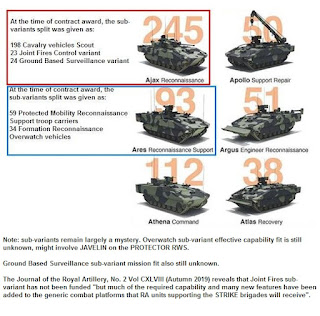
The AJAX family: variants, sub-variants and
procurement quantities. The Joint Fires sub-variant appears to be effectively
dead, while the status of Overwatch and Ground Based Surveillance is not known.
STRIKE will
not operate as a traditional Armoured Brigade and no one has tried to imply
otherwise. Or at least, I haven’t. But it is a fact of life that at the lower
levels, the cooperation between AJAX and MIV will still have to very closely
imitate the relationship between an MBT and an APC in a Mechanized formation.
AJAX being the armour, MIV being the APC which, unlike in a traditional scenario,
will have to do more than stay well back and drop its infantry some distance
away from the actual target. It is fair to say that at Brigade level the
concept is very different from that of “normal” Mechanized Infantry Brigades,
but deep down at platoon level the difference is far less.
Again J.
Benn mentions: “in CATT, AJAX and MIV pairs worked alongside one another, with
the AJAX commanders under the direction of the Platoon Commander”.
He goes on
to make a series of reasonable points about how this will have to be taken into
consideration in training both MIV and Platoon Commanders, which will have to
be particularly prepared in both fields. Intimate collaboration at all training
levels is also extremely relevant, but of course the STRIKE battlegroups only
form up in the field, and otherwise are well separated entities with the AJAX
half living in Tidworth and the MIV half in Catterick. Finding a way to create
permanent STRIKE BGs was too innovative for this innovative project. Capbadge
bunfights will have been in the way too, I bet.
Simulation
of course helps, but the cost and intricacies of training are going to be
massive if this has to work and it is another reason why I utterly despise the
argument that STRIKE is a cheaper alternative to legacy Mechanized Brigades. They
really aren’t, at no level, assuming you are serious about doing it right.
The Author
suggests elsewhere in his text that the renewed concept of screening began with
AJAX itself, and it is probably true, in a way. When it was still known as FRES
SV, there were going to be several other variants in a number of successive
production batches, with more vehicles ordered to cover more roles. Crucially,
there used to be an actual Medium Armour variant which was meant to be procured
to ensure the Scout variant would have intimate support of 120mm guns. You
might remember that a lot of happy noise was produced back then because AJAX came
with the large turret ring capability, ready to accept the turret and cannon
needed to create the Medium Armour variant.
FRES SV clearly had plans that extended well
beyond what AJAX now delivers. Medium Armour was already planned back then. The
difference is that the previous plan had the firepower, not just the name.
General
Dynamics has benefitted from that as it gave them a developed base to work on
to mature their proposal for the US Army’s Mobile Protected Firepower medium
armour programme (although armed with a 105mm rather than a 120, at least for
now). The British Army, short of money, is stuck to saying that half of the
AJAXs will be “Medium Armour” even though they are the exact same vehicle with
the exact same armament. It is this kind of “magic” that I really can’t
support. At one point in this story, the dramatic loss of firepower that
intervened since the true Medium Armour and Overwatch (long range ATGW launcher
vehicle) variants that had to be part of FRES SV have both vanished, has been
brushed under the carpet. The firepower is no longer there, but the role is,
and the area to cover is still the same. Or indeed much larger.
The latest image of General Dynamics’ offering
for the US Army Mobile Protected Firepower. These are intended to equip a
Squadron within each infantry brigade. The Stryker brigades have concentrated
their wheeled 105mm Mobile Gun Systems at Squadron level within their cavalry
element as well, while a Squadron of MBTs has been moved into the recce element
of Armored Brigade Combat Teams.
Italy assigns a similar number of CENTAURO to
the Cavalry regiment of each of its brigades. The challenges of urban warfare
and the recognized need for a stronger screening are part of the reason for
this firepower increase across various countries and brigade structures.
What I
firmly believe was not planned before 2015 at the earliest was the eventual
split of the same Brigade between tracks and wheels.
I don’t
think anyone can deny that there was a rather dramatic split in ideas between
the era of CGS Sir Peter Wall, which ended with tracks being the absolute
priority and the signing of the AJAX contract in its very last days, and the
era of CGS Sir Nicholas Carter which followed with the dawn of STRIKE. The
equipment programme shows the damage that the about turn from tracks to wheels
has caused, leaving the Army stranded in the middle with insufficient money to
do both and, moreover, to fund everything else in the contour.
I believe there
can be little doubt that, had AJAX not been already on order, in the context of
STRIKE it would not have been pursued in its current form.
We are
where we are at this point, but let’s not turn a blind eye to reality.
This brings us to a key point about Strike,
which again some seem not understand. Strike is not a platform-centric idea.
Yes, Strike may have started with Ajax, but that was pure logic, based on the
fact that covering forces were in the formation recce business, as in CVR(T)
regiments. Ajax is the CVR(T) replacement. This means that criticism of Strike
is based on shallow technical analysis of Ajax and Boxer. The most simplistic
observations seem to focus on direct fire weapons and mobility.
High lethality is required, and any vehicle can
increase its capacity to offend by adding a weapon, but that comes with large
cost implications attached, and so the often heard comment that “Boxer needs a
30mm cannon” assumes the absolute need for such a weapon, or else Strike will
be a “hollow force.” For Strike, what gives the 30mm weapon its real value is
the sighting and detection system inherent to it. Thus, lots of people talk
about the 40mm cannon on Ajax. Almost no one talks about the Thermal Imager,
which is actually the key capability. The strike concept of operation clearly
puts primacy on sensors and communications. To paraphrase Wavell: “Amateurs
talk 30mm cannons. Professionals talk communications and sensors”.
As previously stated, lethality is clearly both
important and required, but as the current Strike Brigade Commander has pointed
out, what experience has shown is that for Strike to succeed it merely needs to
be competitive with the enemy, as opposed to superior to the enemy. You just
need to win the fight rather than the whole battle. Consequently, the plan has
always been to resource Strike units with both mounted and dismounted
ATGM and anti-armour weapons, which are obviously high pay-off in terms of cost
versus effect/ flexibility.
To some
measure it is true that final capability is not purely due to platforms. But
you cannot pretend platforms are not key. The idea might well be kind of
platform agnostic, but its realization cannot be. MIV was always going to be
wheeled, because it is felt that only wheeled armour has the kind of low
sustainment burden needed for dispersion to have a chance. Moreover, the British
Army selected the absolutely most
expensive 8x8 on the market. Why, if platform attributes are not that
important? Why has it insisted on having numerous ambulances and command posts
on this very expensive vehicle base rather than be “innovative” and offload
those to something less expensive, like MRV-P, in a fashion already seen in
other countries?[1]
Because, I
am told, you need the exact same protection and mobility level for those
elements for STRIKE to work, because everyone has to work dispersed and,
indeed, probably surrounded by enemies. There is no rear echelon anymore, is
the argument, which if pushed to the extreme introduces all sorts of
implications for the wider Logistic element too. I’ve seen people seriously
debating the opportunity of carrying supplies in BOXERs, but I hope no one is
seriously thinking about replacing MAN SV trucks with it. Some heavily
protected load carriers have been seen before, of course, but it’s unclear
quite how far the Army thinks it needs to go.
For sure, it
is serious enough in its belief that BOXER is the only base vehicle that will
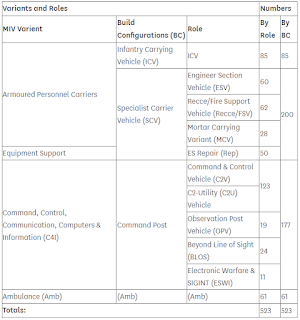
suffice, to bet its available budget on the current order. An order which is the largest ever made so far worldwide for BOXER vehicles. And yet, even though more than 520 BOXERs are incoming, at most 4 infantry battalions will convert to it. Or possibly just 2 plus a training margin, since some say that the first BOXER order is only sufficient for the first STRIKE Brigade, not also for the second. The exact details are not known yet.
In another European army such an order could have equipped about twice as many Infantry
Battalions, since other countries would have focused their attention on the combat variants.
And yet, at the same time, key elements of combat capability
such as the mortars have received no equal attention, which is another aspect
that I find frankly incomprehensible.
The Author
writes “This concept [STRIKE] then
allowed the British Army to buy BOXER. So, no Strike, no BOXER.” I’d argue
that it is more factually accurate to say that the British Army has actually
decided “no BOXER, no STRIKE”: its procurement choices make clear that the one
thing the Army absolutely wants to have in order to declare STRIKE operational
is a large amount of wheeled APCs, “specialist” carriers, ambulances and
command posts. It has put the available budget into buying BOXER, not in
Satcom-on-the-move-enabled tactical headquarters, not on speeding up LeTacCis
to move beyond BOWMAN, not on curing the recognized, immense gap in FIRES and
not even on continuing the slow process of modernization of its Armoured Brigades,
putting their very future into jeopardy. The Army has chosen its overriding
priority in BOXER, and has accepted all sorts of limitations, both on the
equipment fit of the vehicles itself and in other areas of its capability, in
order to buy it. This is undeniable. Regardless of what the Author claims, the
Army has decided that it could not use MASTIFF, or FV432 for the first part of
the life of its new creature. It demands to have BOXER to declare IOC. So long
for not being platform and wheels centric! You can’t deny that this has been
the choice. The only question left to be answered is whether this was wise. If
you ask me, it wasn’t.
And yes, we
have all been told about the wonder that the Thales ORION sight is, and how
AJAX will be an excellent target finder. But I’m afraid I am a little less
prone to believing in hype, and I don’t think the enemy’s own thermal cameras
will be that much worse to tip the balance. And that’s without even venturing
in how Thales thermal cameras have been supplied to Russia in the recent past. Or
in how, absurdly, AJAX needs to have that prodigious sight removed in case
fitting the RWS is felt necessary. Gods know how anyone could think this was a
good idea.
I also do
agree in principle on “winning fights, not battles”. Battles are for the whole
force to win. But again, my arguments are being reduced to absurdity rather
than countered more factually. To win fights you still have to be equipped
sufficiently well to have good chances. Has someone taken a bit of time in the
last while to observe Armoured vehicle development in Russia (and indeed
elsewhere too), and appreciated that they tend to put ATGWs and 30mm guns
almost on everything? And even heavier guns on the rest, I’ll add.
The Author
say it is enough to be “competitive”, but the gap in both direct and indirect
firepower is so vast that I’m far from convinced that even that modest
requirement is properly satisfied.
I continue
to struggle to see how the dispersed groups of the STRIKE Brigade infiltrate
the enemy ground and win fights. Even assuming they can always evade the enemy
MBTs, they don’t compare well to enemy AFVs either, including the wheeled ones
which match of exceed STRIKE’s mobility and thus cannot be realistically
avoided. Will they infiltrate by strength? They don’t have that kind of
strength.
Are lightly
armed APCs and AJAXs going to slip undetected past people with mobile phones
which might be less than sympathetic, past UAVs, past enemy aviation and
sensors and Fires and EW and the whole range of Peer capabilities? Will they
infiltrate by stealth? It’s extremely unlikely, at best.
Will they
infiltrate by means of superior mobility? Both BOXER and AJAX are around 40
tons behemoths with some limits on the actual choice of road routes, yet they
are expected to disperse and concentrate at will. They are supposed to be both
able to stay dispersed enough to be a poor target for enemy artillery, yet
strong enough or at least able to concentrate when needed to be dangerous
enough to count as the already mentioned “dilemmas” for the enemy.
I very much
struggle to see how.
Boxer is
not invisible. Its strategic mobility advantage is only true compared to what the
British Army already has, but there is no advantage whatsoever when the term of
paragon is enemy wheeled armor, better armed and supported by enormously
superior Fires. Not to mention how difficult / impossible it would be to
provide any kind of air defence to the distributed groups, and how easy it
would be for the enemy to cut them off and suffocate them one by one.
And I’m not
even venturing in the endless scenarios that could be drawn up when considering
the many difficulties that would have to be faced in order to keep the
dispersed elements resupplied, and the absolutely uphill battle of Electronic
Warfare to enable the STRIKE elements to communicate and share data.
Another
point that I feel deserves a mention is that STRIKE’s unpredictability almost
completely ends as soon as a meaningful river is encountered. There is little
to no ability to cross unless a suitable bridge is secured, and that takes away
a lot of that unpredictability. I was astonished during one of my early
discussions at being told that STRIKE “does not anticipate having to bridge a
gap in the direct fire zone”, so ABLE alone, or REBS, would have to suffice.
In more
recent times it seems someone has realized that this is truly asking for too
much luck and for an enemy truly too incompetent to be taken seriously, and
project TYRO (the renewal of bridging equipment) has sprung a requirement for a
Wheeled Close Support Launch Vehicle, aka an alternative, on wheels, to TITAN[2].
Again, note Army emphasis on wheels. Not a WARRIOR-based bridgelayer, or an
ARES-based one, even though industry has demonstrated both. But the years keep
passing, and TYRO is still without a contract, like so many other things.
Compare
this to the Russian philosophy. Even their latest Boomerang 8x8 has amphibious
capability, and while crossing a major river remains a complex operation, and
sustainment still requires a bridge to eventually go up, they do have options.
They can put some armour on the other side without waiting for the bridging
equipment to arrive. That allows them more unpredictability than STRIKE will
ever have. And it is yet another part of why I warn everyone that STRIKE does
not have any real tactical mobility advantage over the enemy, so “mobility” is
an extremely poor answer to the question “how does infiltration happen?”.
From the
Land Warfare conference in 2019 we learn that STRIKE groups must be comfortable
with the awareness that they have no secure flank. I understand the idea, but
not the application of it: you need to have something that gives you the
confidence to be a mobile strike group and not a cut off group lost in enemy
land. Élan alone is not the
answer.
It is clear
to me that indirect FIRES are the primary, if not the only way to keep the
dispersed group “light” yet ensure it has the firepower to hit hard. Also,
getting back to the WARFIGHTER 19-04 report, once you have forced the enemy
artillery to open fire and reveal itself because of your dispersed groups, the
one thing you really want is to be able to timely hit it. This is not done
necessarily with capabilities organic to STRIKE, but the ability to do this is
very much organic to the wider concept. If this capability is not developed,
STRIKE does not achieve its aims.
On the
specific topic of ATGWs, again it shows that I debate these issues with more
than one person. For years I have enquired about the Overwatch sub-variant of
ARES, which is meant to deploy ATGW within the AJAX formations. I was told in
no uncertain terms that money was not there to do more with it than kit the
interiors to carry dismounted Javelin teams. The once hoped for BRIMSTONE is
nowhere to be seen, and to my desperation I was told that there was no plan and
no money even for something as basic as putting a single JAVELIN on the
Protector RWS.
In more
recent times, a couple of alternative army sources, including this Author, have
instead claimed that kind of capability is funded (at least for some of the
BOXER Specialized Carriers, still not sure about ARES…?), and I welcome that
change of heart. I hope it proves true, but I still don’t know for sure who has
it right. Unless the additional JAVELINs are yet another thing the Army plans
to rob out of that sad fellow which is today’s 1st Division, at some
point in the future we will be able to read a Foreign Military Sales document
from the US detailing the purchase of new launchers and new rounds, and then we
will know and have measurable data to judge.
But again,
it really doesn’t look like such a game-changing capability. For the British
Army, absurdly, it is, but that’s only because under-armour ATGWs have not
existed in any shape in the arsenal ever since the STRIKER / SWINGFIRE
combination left active service. In comparison to what everyone else has had
for years, it is still really the poor man’s attempt, however. Doesn’t mean it
isn’t useful, the question is whether it is in any way sufficient.
And of
course the enemy has its own missiles. On most vehicle platforms and in its infantry.
Your
dispersed group needs to be able to effectively wipe out or at least seriously
degrade some elements and positions of the enemy forces in order to be
meaningful. You need to be lethal to screen, and you need to be lethal to
create dilemmas. It’s all good delivering myriads of pinpricks to “overwhelm
the enemy C2”, but those pinpricks must be meaningful enough to demand
reactions and cause worry. If any amount of escorting infantry with a basic
allocation of ATGWs are too much to overcome, you are pretty literally going to
make no difference to enemy plans.
How
dispersed STRIKE elements deliver meaningful hits by concentrating and then
“dissolving into the ether” before being plastered by the superior enemy
artillery remains not clear.
How many
times in Afghanistan have we seen Company Groups with plenty of air support
constantly overhead struggle to dislodge an enemy that was maybe numerous and
holed up in a great defensive position, but also kitted with extremely poor
equipment and few offensive options. STRIKE cannot afford to get bogged down in
struggles that last for hours and if it concentrates too much it is artillery
strike time once again.
The
infantry hasn’t changed much from back then. AJAX will hit harder than
SCIMITAR, and BOXER is roomy and mobile, and well protected for its category’s
standards. On the other hand, all other supports are unlikely to be as readily available
in a peer scenario and the peer enemy has plenty of its own ATGWs, UAVs,
artillery and even access to its own air support. As well protected as MIV is, its
protection matters not one bit against anti-tank missiles. If you think that
issuing more JAVELINs and spreading them out over a vast area is enough to
change the rules of warfare, you should wait and see the enemy issue more
KORNETs to pick apart your dispersed vehicles at any chance while they travel
around alone or in pairs / Troops.
So why are
we expecting to obtain such good results? “Willingness to take risks” and
“boldness” help, but if the whole plan revolves on “bold measures” and the
willingness to take losses, I’m afraid it won’t last long. How quickly will the
dispersed groups become combat ineffective?
Jane's
attempt to wargame STRIKE with DSTL's own kit, which even includes capabilities
that lay well into the future and have yet to be procured (new 155mm howitzers,
for example) went very badly, and the enemy was a Russian force based around
their parachute forces[3].
Which are the Russian units with the best training, but are also about as
“light” as Russian troops come. That is not very encouraging.
The already
mentioned Lieutenant J. Benn also writes in his article on TANK about STRIKE
experimentation that as soon as the simulated enemy took on the characteristics
of an “East Ukraine-scenario” near peer formation, “STRIKE began to struggle”.
AJAX becomes the only thing between tanks and BMPs and the infantry in
vulnerable MIVs, and even with the backing of JAVELIN it is a “fight that
could, commander depending, go AJAX’s way but is not one that I would want to
risk unnecessarily”. And also: “MIV must be comfortable operating on its own,
inside a red picture and outgunned”.
I’m afraid
that all this rather dramatically cuts down the number of Russian targets, even
in the “rear echelon”, that can be engaged successfully. And this is assuming
the enemy does not embrace dispersion himself, or at least its consequences,
and insists on having a “well defined” rear echelon to penetrate while we seek
to not have one ourselves. I think it is unlikely and Ukraine shows it. You
will have to fight to get there.
How does
infiltration happen, and how do dispersed groups of AJAX and BOXER achieve
enough lethality to be “dilemmas”? How do they survive and fight, disperse and
concentrate in the contested environment? If there is no answer to this
question, we are heading into a dead end.
What it also means is that lots of the
equipment-based criticism and commentary on Strike are simply nugatory and
ill-informed. For example, Strike doesn’t have to have organic fires to use
fires, so arguing about which wheeled gun the Strike Brigade needs misses the
point. It might or it might not. It doesn’t matter, and the best answers lie
above that of the Strike concept in the wider evolution of Land and Joint
Fires.
Organic or
not, FIRES are absolutely essential to this concept of operation. STRIKE’s dispersed
operations are in no small part meant to find targets and put the enemy’s own
FIRES at risk. Remember that we are talking in the context of near peer and
peer enemies (has anyone realized that it is the UK that is a Russia near-peer
and not the other way around, by the way?) and of A2AD. Anti Access Area Denial
has been part of Carter’s discourse and idea from the start.
STRIKE is
meant to Self-Deploy because A2AD means some traditional ways of accessing
Theatre might not be viable.
STRIKE is
meant to fight dispersed because the artillery part of the enemy A2AD
capability would otherwise destroy the massed groups, as Brigadier Martin
himself remarks in the opening phase of his RUSI intervention.
STRIKE
needs fires because A2AD means air support is not an option and, again I quote
the Army itself, it is now the “Land that has to enable the Air” in some cases,
by weakening enemy defences.
How can
FIRES not be an absolutely critical part of the discourse? Any discussion on
STRIKE which does not focus on FIRES and how to timely direct them almost
literally from every single vehicle is a discussion that is ignoring reality.
The already
mentioned “dilemmas” are actually primarily meant to force the enemy artillery
into fights it does not want, because we know how lethal Russian artillery is
and we need to silence it somehow. Unless STRIKE is seriously expecting to
charge for the guns and take them out with AJAX’s gun, FIRES are front and
center.
The
“dilemmas” are meant to create the conditions for counter-battery, for taking
out enemy sensors, and to allow Land Forces to strike, destroy or force out of
position enemy air defence elements, so that in turn allied Air Power can truly
land the blows. The Author himself suggests it earlier in his own article.
An article on Wavell Room previously also put
the focus on STRIKE as an ISR enabler and as a way to move artillery detection
sensors up-threat.
STRIKE
absolutely needs significant organic FIRES, and moreover ready access to long
range, hard hitting FIRES at higher levels. Which means that Sensors, Networking
and FIRES need some real serious development.
The US Army
has made FIRES its absolute top priority in the context of Multi Domain
Operations.
The Royal
Artillery also has a series of very sensible requirements to contribute to this
“new” way of fighting, but unfortunately has had them for sometimes close to 2
decades, without any of them getting funded. Longer range and more flexible
rockets for GMLRS are now penciled in for 2030, while a Land Precision Strike
requirement exists for a long range (60+ km) “overwatch” missile that can,
among other things, lend lethality to dispersed groups (assuming target
hand-over is well thought out), with EXACTOR partially filling this area until
then.
Industry is quick to exploit what is perceived
as a “BOXER for everything” hunger in some quarters of the Army. Here MBDA and
RBLS push their vision for Land Precision Strike. Arguably, it should be easier
to keep the missile launcher away from counterbattery threats, so a cheaper,
and ideally more nimble vehicle base would do, in my opinion.
Closing the
lethality and range gap should be the absolute priority, but unfortunately is
not, and the casual way in which this factor is constantly brushed aside, as if
it was utterly secondary, is a recipe for disaster and one of the primary
reasons why I cannot support STRIKE, or at least the way in which it is being handled.
The Author
rightly mentions the importance of sensors. I actually absolutely agree. I’ve
been screaming from the rooftops for years that an Army as well aware as the
British Army is of the enemy’s utterly crushing superiority in terms of FIRES
cannot still field only 34 light counter-mortar radars and 5 MAMBA artillery
locators in total.
As I’ve
said in few characters on Twitter:
“Problem is UAV plans still very vague, EW and
sensors are a sore spot (those poor lonely 5 MAMBA radars are a punch in the
face)”
2012 was
supposed to bring new radars. That became 2026 with the current SERPENS
programme. Do we think this will be the right time…? Unfortunately, I’m not
optimistic.
As for the
debate on “which wheeled gun”, this goes on because the British Army has
initiated the Mobile Fires Platform programme to procure 98 new mobile howitzer to replace AS90 and the
currently entirely inadequate L118s of 3 RHA and 4 RA Regiments, the STRIKE
units, and the selection of a wheeled platform is seen as overwhelmingly likely.
I think it is an important capability and thus worthy of serious debate, but at
the same time I’m not as dogmatically committed to just one solution as I’m
made out to be. The Reconnaissance Strike Group I already mentioned earlier,
for example, actually does not have any 155mm howitzers at all, but has
replaced them in the Close Support role by massively uplifting the allocation
of 120 mm mortars, while organic GMLRS and Loitering Munitions / Suicidal
Drones give it its Deep Fire capability. It might well be that this is the
future, or at least part of it. What is absolutely certain is that High Intensity
warfare in the future will have more FIRES, not less. Everyone has accepted
this, except apparently the British Army.
The Royal Artillery ran an experimentation
already years ago exploiting the French army’s CAESAR autocannons. Here gunners
from 1 RHA get trained in its use.
RBLS’s entry for the new howitzer for the Royal
Artillery has good chances of being selected. It is a step up from CAESAR as it
offers more traverse and does not need the crew to dismount in the open to fire
the gun. Frankly, I would rather have the howitzer on the BOXER hull and the
Land Precision Strike missile on the more fragile truck base, since the gun is
more likely to be exposed to counterbattery, and over longer periods of time.
Funnily
enough, the Royal Artillery could have had the Fire Shadow loitering munition
already in service. The British Army was briefly in the vanguard in the field
of Loitering Munitions, and I was one of the (few, at the time) supporters of
that idea.
Like 99% of
modern day Royal Artillery programmes, however, it ended up cut.
Until the
pitifully weak FIRES are cured, I can’t imagine STRIKE going anywhere.
The other odd claim is that “wheels and tracks
don’t mix,” which is clearly a reference to Ajax being tracked, and Boxer being
wheeled. Again, this can only be a lack of experience and/or understanding. For
example, from the 1970s and 80’s the Bundeswehr had Divisional Reconnaissance Battalions
which mixed Luchs wheeled recce vehicles with Leopard 1 tanks at the sub-unit
level. Clearly, you can mix tracks and wheels, and people do. The French
Army routinely mixes tracks and wheels at the unit level with Leclerc, VBCI and
VBL. There are many more examples including Soviet Divisional-level anti-tank Battalions
and combat reconnaissance patrols which routinely mixed tanks, tracked IFVs and
Armoured cars. Soviet wheeled BTR Regiments had organic tank Battalions. Tracks
versus wheels is largely a false dilemma which is supposedly about mobility,
but is actually more about cost and sustainment.
It is of
course true that there are plenty of examples out there of tracks and wheels
mixes, but they don’t prove anything unless they are taken in context. Is
carrying infantry in wheeled APCs or IFVs in support of tanks a major problem?
I don’t think it is. The wheeled vehicle will not always be able to traverse
the same terrain the MBT could, but most of the time will and it comes with its
own advantages, so it is overall an acceptable compromise. Wheels have their
own merits, including a much higher degree of self-deployability. It makes
sense to reduce a Brigade’s cost and sustainment burden by having infantry
riding on wheels.
I have
indeed recommended several times now that the cash strapped British Army might
want to settle for less ambitious plans and move BOXER towards being a WARRIOR
replacement, considering the bleak financial position.
An inviting demo BOXER with Lockheed Martin’s
“export” variant of the Warrior CSP turret.
Obviously,
my suggestion was met with plenty of outrage from British Army figures and
experts of all kinds because it mixes tracks and wheels, and that is bad for
all sorts of good reasons they were eager to school me in. Which was really
amusing after other Army figures had schooled me and continue to school me in
why mixing tracks and wheels is not a problem at all and STRIKE will work just
fine.
I assume
the Author of this particular article is not one of those who protested, but
again, as I’ve warned at the beginning, I debate these issues with multiple
figures, and part of my frustration comes exactly from that. Anyone you speak
to gives you a different interpretation of what STRIKE is, and of whether
tracks and wheels mix well or not, whether FIRES are key or not, etcetera. I am
never afforded the luxury of debating a solid and enduring interpretation of
STRIKE, which in itself is a further proof that the concept is not clear and
not well understood, not even within the Army. The supporters of STRIKE come
across as being supportive not of STRIKE how it is, but of how they imagine it.
It very
much seems, and the Author himself in some ways confirms it in his piece, that
the Army is at war with itself with various factions in disagreement over the
direction of travel.
The Author
also mentions examples of wheeled scouts being used in support of tracked Armoured
formations. Again, context is everything, and I think those cases make sense.
There are many examples in the world: France, USMC, Italy, Germany, Australia
and others use variations on the theme of wheels scouting in favor of tracks. I
think it is a decent solution because it allows the reconnaissance element to
be a lot more sustainable, self-deployable and nimble. The screening element
can move around with quite some freedom, with more endurance and less
sustainment concerns.
So why do I
criticize the “half-tracked” nature of the STRIKE Brigade?
Because the
tracked element of STRIKE is the only one with serious Direct Fire capability.
Moreover, it is the Scout, in the British case, that needs to ride on
semi-trailers for as much of the travel as possible. It is the “eyes” of the Brigade
that are most difficult to deploy and sustain, and this for me is an absurdity.
And, tellingly, it is the exact opposite of what happens in the Countries
mentioned before.
Moreover we
have been told, including from then CGS Carter himself, that these Brigades are
meant to self-deploy over great distances on road. The infamous 2,000 km self
deployment march is an Army claim, not something I put into the Army’s mouth. Brigadier
Martin reaffirms it in the RUSI Land Warfare Conference.
But by
including AJAX in your “self-deploying” Brigade you are making things
considerably harder for yourself. And since the British Army has few HETs and
LETs (89 + 3 recovery vehicles the former, 77 the latter), you have limited
options to move AJAX, and even fewer to move the heavy armour that has to
“exploit the conditions that STRIKE creates”. STRIKE is supposed to get there
early, infiltrate, scout, secure ground, again “create the conditions” for the
rest of the force to enter battle on more favorable terms. If it takes ages to
get there, and the rest of the Force does not arrive for an even longer time,
it’s a serious issue.
STRIKE is
also meant to be the British Army’s primary option for “SERVAL-like operations”
in geographically vast battlefields such as the ones that might be encountered in
Africa. Cue many mentions of Mali.
France of
course did not mix tracked and wheeled vehicles in Mali: it does not need to.
The French counterpart to STRIKE is not the Armoured Brigades because they have
VBCIs alongside LECLERCs, but their Medium Weight Brigades which will have
GRIFFON APCs, JAGUARs Cavalry vehicles and also a Battalion on VBCIs for the
hardest jobs. Indeed, the French Medium Brigade has 2 cavalry regiments on
JAGUAR, like STRIKE has 2 units on AJAX, which has always come across as an
interesting coincidence. Of course, the French Brigade has more infantry
battalions, and French formations are built to the rule of 4 and are larger.
Those same Brigades
today have AMX-10RC, SAGAIE and VABs, which means they have a very healthy
amount on firepower and sensors running on wheels and can indeed self deploy
over very significant ranges and go straight into fighting, as they did in the
early hours of Operation SERVAL.
With STRIKE,
if you don’t deploy AJAX you are missing out on both the firepower and the
sensors.
The Author
does not get into this side of the debate, but it exists, and many STRIKE
supporters regularly bring STRYKER Brigades, or the French or Italian Medium Brigades
into the discourse. And every time they do I will point out that it is a poor
comparison, and one in which STRIKE loses on several fronts. It has less of
everything, apart from tracks, when compared to those units, and it is an
easily demonstrable fact.
In the end,
regarding “tracks and turrets”, just to further clarify what my actual
complaint is: STRIKE has its (limited) firepower all riding on tracks. Wheels,
which are reasonably expected to be faster and better at self-deploying, have
little to no firepower. It is simply counter-intuitive.
STRIKE,
when described as this great opening act self-deploying over 2,000 km, always
reminds me the original Italian CENTAURO Brigades of Cold War years, which were
meant to race down Italy’s roads ahead of heavy armour following on trailers. Those
Brigades had to contain a soviet breakout and, more specifically, any soviet
amphibious landing on the long and exposed Italian coast. They had to get there
quickly, on their own, and once there they were expected to delay, to screen
and to hold, slowing down the enemy and allowing allied heavy armour to get
into position. But to do that, they had CENTAURO with its 105mm gun and
MBT-level of firepower, plus ATGW and SAM teams riding on Puma wheeled APCs. The
cheap, light Puma 4x4 and 6x6 have eventually given way to today’s FRECCIA 8x8.
Wheels get
there quick, and need the firepower to be meaningful once they arrive. STRYKER Brigades
are adding 30mm guns, more JAVELINs, and grouping 105mm and Anti-Tank vehicles
in their recce squadron to increase their punch. Japan has the Type 16 8x8 with
105mm gun. Italy has CENTAURO and is replacing it with CENTAURO 2 with a 120/45
(the ballistics are the exact same of the universally common 120/44, with the
extra caliber compensating the pepperpot muzzle brake). Every Italian FRECCIA
8x8 comes with a 25mm, and the Brigade has a healthy allocation of SPIKE
anti-tank missiles, Medium Range at Coy level and Long Range at Battalion level.
France has AMX-10RC and, as it downgrades to 40mm on the JAGUAR, it made at
least sure to put long range ATGWs in box launchers on the new vehicle to
compensate. Poland has lots of 30mm and SPIKE missiles and proposals for 105 or
120mm cannons on ROSOMAKs periodically resurface. All of these Brigades also
have 120mm mortars and 155 mm howitzers. And less ambitious CONOPS.
And then
there is AJAX, MIV, 81mm mortars, L118s and the most ambitious of CONOPS. The
problems should be evident to everyone.
If you are
still stuck to tracked vehicles for firepower, you might as well be stuck to
MBTs, then. At least once they arrive they'll be able to take on everything. But
that brings us right back to already existing Mechanized Brigades constructs,
such as Germany’s Jäger
Battalions on BOXER which
are slotted into Brigades built around LEOPARD 2s. Which in fact is exactly the
space that MASTIFF, and later MIV, were going to fill in the original, pre-2015
Army 2020 plan. A single infantry Battalion on wheels as complement to those on
WARRIORs.
But STRIKE
is supposed to be something different, innovative and lighter, with less of a
sustainment challenge.
In short:
if you are putting wheels into a heavy formation that comprises MBTs, you are
driving some of the sustainment burden out; but if you add tracks to a Medium
Weight Brigade meant to operate over extremely long distances, you are instead
adding a whole lot of sustainment burden in. And in fact, Medium Brigades in
other countries are entirely wheeled, and a wheeled solution was indicated from
day 1 for MIV in the context of STRIKE as well. And I go back to how wheels are
now a requirement in TYRO and the near certain winners in the AS90 replacement[4].
Coincidence? Clearly no.
It is
undeniable that the mixture of wheels and tracks in this particular concept and
in this particular fashion is sub-optimal at best.You can’t simultaneously claim that STRIKE is different from
existing Armoured / Mechanized Brigades and then use those very Brigades with
their much different CONOPS as justification for your platform mix.
In passing,
I must drop a bitter mention of (dis)honor for the decisions in 2010 – 2011
that have nearly killed off the Army’s ability to use railways to move its
vehicles and kit across Europe. By 2023 some kind of U-turn is apparently going
to come to maturation with some form of capability rebuilt and I welcome that,
but in general the issue of deploying STRIKE, and moreover the Division itself,
seems to be getting a lot less attention than it should, along with the
enduring failures of Whole Fleet Management in ensuring vehicles come out of
storage in good conditions. Fixing WFM would do more to speed up the Army’s
deployment time than BOXER self-deploying on its wheels. But this is another
story, even if tightly entwined with the wider argument about how the Army
chooses its priorities.
Given its remit to “redefine how the British
Army fights,” is Strike the future of the British Army? The answer is “yes,”
not “it depends” or “too early to tell.” It simply is.
Why?
Firstly, because there aren’t any other
options, and secondly, thirdly and fourthly, money! The force structure
descended from Cold War Armoured Divisions or even the short live multi-role Brigades,
and now Armoured infantry Brigades might no longer be competitive for the cost.
In the eyes of some of the kit-junkies, an
ideal UK Armoured Infantry Brigade would have Leopard-2 MBTs, CV-90 MkIV and
some wheeled 155mm. In essence, all you would have is a more expensive version
of what was causing the problem in the first place and avoids asking the hard
questions about how to evolve or transform. The question that will eventually
have to be asked is what comes after the Armoured Infantry Brigades? How can
they transform in line with cost and effect.
This is
where things get really slippery. We have established early on that STRIKE is a
supporting tool. A screening and reconnaissance and exploitation force that is
meant to “help others win”.
The “others”
being the Armoured Brigades, for the foreseeable future at least. But, in the
very same article, the Author casts doubts on the future and affordability of
those very same Brigades. Unfortunately he is not the only one. Other STRIKE
supporters have more or less openly urged the Army to get rid of its heavy
armour in order to continue funding STRIKE. It is an alarming suggestion I
encounter more and more frequently in UK circles and which has made RUSI pages
in William F. Owen’s paper “War without tanks”[5]. Literally no one else thinks it is a good idea, at all, and before you mention
the USMC I will remark that they are abdicating running their own tanks but
count on the US Army to deploy lots of them[6],
and they are now more than ever trying to think of a very specific role in a
very specific environment. They make for an utterly irrelevant comparison.
To his
defence, the Author here does not quite venture into saying out loud that armour
should go, unlike others. He talks about STRIKE being in support of “2-3 other Brigades”,
and leaves the rest to the classical “we should think about how they evolve in
the future”, which is an extremely open ended approach. Well, I’d really like
this point to be a lot clearer, though. This is no small issue. If the cost of
this supporting tool is such that the formations it is meant to support have to
vanish to free up money, we clearly have encountered a huge problem.
What price
should the Army pay for pursuing this concept? This is THE key question. If
CHALLENGER 2 LEP and WCSP and indeed the Armoured Brigades end up paying the
price in the new Review, and unfortunately this is far from unlikely, is it
worth it?
The Army
has already accepted to cut 1/3 of its tank regiments, convert an Armoured Brigade
and deprive 1st Division of all
Combat Support and Combat Service Support formations[7]
in order to eventually create 2 STRIKE Brigades. It is an hefty price as it is,
but it looks like it is nowhere near enough to cover the costs yet.
Ultimately,
if there is no real plan for the “2-3 other Brigades”, what becomes of STRIKE?
Does it magic itself into no longer a supporting tool but a battle winning
asset without any change to its structure, just like AJAX became “Medium
Armour” without any real modification?
Please, note
that I’m not dogmatically opposed to doing things differently, but I want to be
given reasons to believe that the new approaches work.
I will exploit
the occasion to repeat something I’ve already said on Twitter about how the
wider army transformation might go. The latest issue of the British Army Review
sheds some light on the thinking for the Conceptual Force 2035[8],
and tells us that by then there will be Future Combat Teams of just 500 men,
permanently Combined Arms in nature, with robotics & autonomy and
substantial organic indirect and direct fires, built to the Rule of 4. Less
logistic weight, yet punch comparable to that of a 1250-strong Armd BG. It
doesn’t say openly that there will no longer be “tanks”, but goes close to it
in implying weight and sustainment burden has to go down. It says there will be
a substitutive capability delivered by lighter vehicles, in no small part
through ATGWs, although I guess that also leaves a chance that there will still
be some form of lighter “tank”.
This is actually
extremely fascinating because BAR calculates that today’s Army authorized
strength of 82,000 would then be able to field 48 such units, to spread across
3 Divisions in a British Corps. It is a beautiful image, but I don’t know how
it could ever be resourced in the real world considering that the poor 1st
Division is reduced to a mere container of Light Role Infantry Battalions
without any CS and CSS element left (102 Logistic Brigade is planned to
disband; 2 Signal Regiment and 4 Royal Artillery, currently in line for the
single Vanguard Light Brigade are needed for the second STRIKE Brigade when it
eventually happens, along with engineers and everything else). But if it could
be done, it would be wonderful.
Capability-wise,
however, this idea smells of FRES and of US Future Combat System take 2, even
more ambitious and possibly even more doomed to failure and/or unaffordability.
How these units would actually achieve that kind of output for their size is
still very, very vague and Autonomy and Robotics are nowhere near as mature as
they’d have to be to easily imagine that kind of future in little more than a
decade, which is very a very short time in defence procurement terms.
However, we
won't know until we try, right? But I mean try really seriously. I’m absolutely
all in favor of taking a Battalion, immediately, and turn it into a permanent Combined
Arms Battlegroup. Give it absolute freedom to change its organic capabilities
and structure. For example: wants organic EXACTOR missiles? Try it out. Wants a
platoon back to 4 sections of 10 each? Try it[9].
Wants LMM on vehicles to have a degree of anti-air / anti-UAV capability as
well as a flexible anti-surface weapon which is light yet gives you extra reach
and lethality?[10]
Go for it.
Start
gradually driving out weight and personnel to see if it is feasible at all to
go down to 500 and to the mythical light logistical footprint. Use this experimental
BG as OPFOR in exercise, pitting it against free thinking Armoured BGs enhanced
with simulated foreign capabilities. Make it the main “customer” of AWE
experiments, and use it to bring coherence in all the little innovation
attempts going on all the time, which today frankly often seem a bit
disconnected one from the other. Let the field trial of this new experimental
unit dictate what kind of robotic help is more promising and more necessary to
cut down on manpower requirements. The result
of the exercises shapes the following round of slimming down and capability
insertion. And please, do not repeat the STRIKE experiment, which if we are
honest has never been about developing a concept, but purely about trying to
find a way to make something already decided beforehand "work".
Remarkably, the Brigade structure has not changed at all from what Carter described in June 2016, before the experimentation group
was even stood up, in April 2017. For all I’ve been able to gather, even the
STRIKE battlegroup does not show any evident innovation and its structure is
immediately familiar[11].
In one image of the tabletop wargaming exercises, the BG visible is pretty much
literally a formation straight out of the 90s, but with AJAX / ARES in the
place of SCIMITAR and SPARTAN, and MIV for the infantry. Of course, the Army
might not want to share its newer ideas and perhaps is keeping something under
his hat, but this is what we know and it isn’t particularly impressive.
The battlegroup being played in this tabletop
wargame exercise does not seem to have anything truly innovative about its
composition.
If it is
proven, in a realistic fashion, that a good alternative to MBTs exists, then we
can move on in that direction. But don’t go all-in on an unproven concept.
And when your
budget is so tight, don’t throw away what you have counting on jam to arrive
tomorrow, especially if, as in this case, you don’t really know what color the
jam might even have.
It has been
pointed out to me that most of the capabilities that need to be built up into
and around STRIKE are for the benefit of the whole Field Army, and this is
absolutely true and very clear. Things like LeTacCis, to evolve the
communications side beyond BOWMAN; SERPENS and Mobile Fires Platform and others
are very clearly whole-of-the-army programs. STRIKE, supposedly, adds urgency
to them and helps getting them moving.
In
practice, I’m afraid it does not. It’s literally a fact that several other programs
could have been funded and started out if the available money hadn’t been put
on BOXER instead.
It seems to
me at times like the Army, after criticizing the Royal Navy for many years over
the decision to pursue the aircraft carriers as epicenter of its future, has
now decided to create its own “Strike Carrier” flagship programme in the hope
that more money will be made available to advance it and kit it out for
success. This approach isn’t really working wonders for the Navy and is unfortunately
highly unlikely to do any better for the Army.
I hope
people understand that the British Army runs the very real risk of turning,
with its own hands, what was meant to be a decent Division into nothing more
than a Reconnaissance and Screening contribution to a NATO Corps which will
have to be made up by someone else’s Brigades. It will be a very different
Army, and a very diminished country output, no matter how innovative and
sophisticated it might be in its core idea. We have to be honest in debating
this point, because as the Author himself reminds us, money is very much a
problem and the last few decades of British Army Armoured vehicle programmes
have been an unmitigated disaster that cannot be repeated one more time.
There is no
real reason why the British Army, starting further west than almost everyone
else, should necessarily be the one to race east and try to get there first to
maneuver as the “Multi Domain” recce and screen element. Considering how many
capability gaps it suffers, starting with sensors and FIRES and going up to what
unfortunately remains one of the most pitifully weak ground based air defences
elements in the whole of NATO, it is very badly positioned for something so
ambitious. Unlike many other NATO countries, it has to build up its Medium
Weight force from scratch and misses out on several decades of 8x8 experience
that others instead posses. Many are eager to describe STRIKE as a cheaper
option to “legacy” Brigades. Unfortunately, STRIKE is not the cheap option at
all, and reducing the number of compromises it has to live with in its force
structure and equipment will cost immense amounts of money.
Nobody
forces the British Army to deliver necessarily that kind of contribution: the
one demand NATO has formulated is “30-30-30-30”[12].
The UK can contribute to NATO in other ways. Why go for the most ambitious and
expensive possible concept, because this is what STRIKE is, at least in
Carter's description of its aims? Is it purely for prestige reasons, because
the British Army has to be seen as the one NATO ally “able” to follow the US
into Multi Domain Operations right from day one?
Mind you, I
think Prestige is a plenty good thing to aim for, but you have to be careful
not to “volunteer for Helmand” again.
You can
secure prestige by being able to provide some genuinely solid Brigades, able to
cover less ground but do it reliably and autonomously with British troops and
British supports. That kind of force would be less of a support tool in nature
and more of a flexible instrument that would simultaneously preserve that
degree of independent action capability that the Secretary of State for Defence
has been begging to see retained. There are arguably better ways to use the
money and all the manpower and resources of 1st Division too, to
form an army which is less of a unitary silver bullet and more of a force that
can sustain a complex task over a long period. It is no mystery, again, that
I’ve spent years looking with interest at France’s “Au Contact” plan for two
identical divisions which are clearly lighter than the currently imagined 3rd
Division but that on the other hand ensure the Army does not exhaust itself in
one single 6 to 12 months “make it or break it” kind of effort.
By definition,
STRIKE without the FIRES, the sensors, and the “2-3 other Brigades”, can only
ever be an ARRC asset that needs Allies to field everything else.
If your
concept is predicated on supporting Armoured Brigades (or whatever form of
“evolved” Brigade you want to imagine) that you risk losing in order to fund
the concept; if it depends on Artillery programmes you are likely not going to
be able to fund; Communications and Sensors you don’t have a line of sight (and
funding) on; and a big question mark over how to be lethal while so widely
dispersed, maybe you have to accept that the concept you are pursuing is not
actually suited to you and your purse.
[1]France’s VBCI fleet of 600
vehicles does include 100+ command vehicles, but no ambulance, and equips 8
regiments, all individually larger than british Battalions. Italy’s FRECCIA
family includes an extremely low number of command posts and no ambulance
either. The British Army does get a lot of money, even in these days; it is
often how it decides to spend it that downsizes the end result.
[3] Jon Hawkes and his team played the
game; he and Sam Cranny plan to write a report about the experience. (@JonHawkes275
; @Sam_Cranny)
[4]The requirements for the new
Mobile Fires Platform do not specifically include wheels but a generic “increased
range and mobility”. They are required to travel 520 km in 24 hours, including
200 km on unbounded roads and 30 km off road without assistance. The selection
of a tracked platform is universally seen as very unlikely.
[6]“We need an Army with lots of
tanks. We don’t need a Marine Corps with tanks” is the quote from Marine
Corps Commandant General David Berger himself.
[7]I’m firmly convinced that one
of the highest priorities for the Army at the Review table should be to
re-balance itself, cutting some infantry (no matter the capbadge tears) to
rebuild the supports needed for actual combined arms operations.
[9]A recent experiment seeking
to modernize the platoon tested the return to a 4 Sections structure, but was
constrained by the order to keep it absolutely manpower neutral. The Rule of 4
was unsurprisingly liked a lot by the troops involved, but just as
unsurprisingly, Sections of 6 men proved too small…
[10]Check out the WARRIOR VERDI
demonstrator, in the days when Britain still had its own AFV industry and was
still genuinely innovative.
[11]By default, expect a STRIKE BG to consist of 2x Mech
Inf Coys, 1x Medium Armour Sqn, 1x Arty Tac Gp, 1x Engr Sqn and BG ech. The 2 BGs
formed on the Mech Inf Battalions will have a Support Coy with mortars,
JAVELINs, Snipers etcetera; but the one formed on the Medium Armour regiment
won’t have a Support Coy, since MA is, you will have guessed already, modeled
on a Tank Regiment. Information comes from @EdOBrien, who is working on British
Army combat capability development.
[12] 30 Battalions, 30 ships and 30 Fast
Jet squadrons within 30 days.