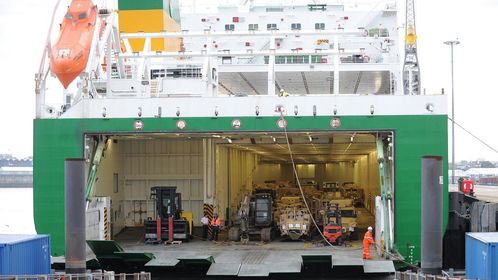
One area of massive concern ahead
of the Integrated Review is the UK’s amphibious capability. Despite the
attempts to put up smiles and talk of “exciting” times ahead for the “Future
Commando Force”, it is impossible not to notice the horrendous persistence of a
question mark on the fate of the amphibious ships that give the Royal Marines
their meaning. Worse still, there are some very, very goofy attempts constantly
going on at laying justifications for the loss of amphibious ships, mainly the LPDs
of the ALBION class, using wildly inaccurate comparisons with the “USMC giving
up its MBTs” or even statements as absurd as “the days of storming a beach are
over".
Let me be absolutely clear from
the very beginning: “the days of storming a beach are over" is another one
of those typical british nonsensical claims generated purely by fear that
budget cuts in an incoming SDSR are going to strip the capability to do so
away. It is simply not in any way true and it is ludicrous to see people
arguing otherwise.
It shouldn’t be necessary to say
this, but sadly it appears many need to hear it:
Nobody “storms the beach” because
it is a pleasant or easy thing to do. It is done because it is sometimes
beneficial and sometimes simply non discretionary to cross a significant body
of water to access strategically relevant territory.
Amphibious maneuver might simply
be indispensable to dislodge an enemy from a position; in order to access a
theatre of operations; in order to force the enemy to spread out its forces along
its coast, weakening its defences in other areas as a result; or even to turn
the flank of an enemy front too solid to be dealt purely with through “frontal”
assault on land.
Seas, islands and shores are not
going anywhere and so isn’t the need to be able to move significant force over
water, onto the shore and beyond. There will be occasions in which littoral
maneuver is simply non discretionary because geography, both physical and
political, dictates it.
And why beaches? Simple: because
the enemy is not stupid enough to directly give up a port. If getting directly
into a port is an option, obviously everyone is very happy to go for the port
as unloading ships in port is countless times faster and safer and easier. But
the enemy will make sure the ports are well guarded and / or timely sabotaged.
Having the ability to land substantial force over an undeveloped beach and
maneuver from there enormously complicates the enemy’s defensive needs and
plans.
There are legitimate concerns
about the ability to assault “defended beaches”, but first of all we should
better define what a "defended beach" is. Many seem to automatically
revert to images out of Omaha beach and imagine infantry charging in shallow
waters at Atlantic Wall bunkers.
But nobody today would be able to
defend in that way. Not even China has enough army to do that, and if you
forced them to do it, it would be a victory in itself with how many troops and
resources it ties down along countless kilometers of shore. Not to mention that
precision weaponry of today means that the fortifications of a new Atlantic
Wall would quickly turn into large graves.
A defended beach today is more
likely to be a stretch of coast which can only be approached from directions
which are covered by reconnaissance assets, perhaps with ground-launched
anti-ship missiles in range and with the threat of enemy air assets as well as
ground-based air defence such as long range Surface to Air Missiles. Enemy
ground forces over and in the immediate vicinity of the beach are unlikely to
be substantial, but mechanized units will be ready to move along the coast to
timely meet an invasion force. For example, Italy during the Cold War developed
the 8x8 tank-destroyer CENTAURO specifically to create wheeled, medium-weight
formations which could race along the coastal roads to contain a soviet
amphibious force landing (presumably) on the Adriatic coast. Now the TYPE 16
tank-destroyer being fielded by Japan is a continuation of that general idea.
These overlapping layers of
defence are commonly identified as Anti Access; Area Denial (A2AD) “bubbles”,
although this arguably tries to attribute to these threats a degree of novelty
which they do not really have. A major feature of war has always been the need
to prevent the enemy from accessing / taking over an area. What was a fort, a
coastal battery, is not A2AD of its time?
What is “new” to A2AD is that,
potentially, offensive weapons are currently seen as having better chances than
the defences. In the endless struggle between “sword” and “shield”, we
currently feel that the “sword” has the advantage. In other words, in the West,
we no longer trust our warships to be able to cope with enemy missile and air
attacks. We fear that modern technology has made it so much easier to detect,
track and attack ships out at sea that getting past the “coastal batteries”
might no longer be possible.
As I’ve written already while
talking of the other commonly heard trope that “aircraft carriers are
obsolete”, it is not the carrier that has grown more vulnerable than it was in
the past, but it is our escort ships and embarked air wing that we no longer
trust. If we feel we can’t operate the carrier / amphibious ships safely, the actual
implication is that we do not expect the escort ships and embarked fighter jets
to be able to defend them.
The answer to this fear cannot be
“let’s do without carriers and amphibs”, because that would weaken the fleet
even further (no air wing to fight the air battle with) and remove much of the purpose
of the whole fleet. If the carrier cannot be defended, what can we defend? If
warships cannot defend each other in a group, they won’t be able to prevent the
enemy from cutting off the sea lanes either.
Basically it would mean we have lost
not just control of the sea, but the ability to make any use of it, tactically
and strategically. If we believe this, very urgent action is required to
improve the “shield”.
But in truth, much of the
argument against carriers and amphibs is born more out of interservice rivalry
over insufficient budgets than by actual strategic and tactical thinking. If
the latter was driving the policy, we would be talking of how to improve escort
ships and their missiles as well as the capabilities of the embarked air wing.
To be fair, it must be noted that some in the US are actually calling for an
Air Wing rethink, but unfortunately they are an exception in a discourse which
is otherwise a completely partisan battle for the budget, not for the sea.
But the USMC…
In this sad debate, largely devoid
of actual technical content, many will happily mention the USMC reforms and
their offer of their MBTs in sacrifice to free up funds for other capabilities
as a sign that “storming the beach” is a thing of the past.
Some claim that the future is
“raiding” to be conducted with small boats, stealthy infiltrations of small
groups of Marines and helicopters for the rest, with little to no space for
surface maneuver. They want this to be the future of the Royal Marines and they
even claim this is what the USMC is doing.
Thing is, the USMC is definitely
not giving up on surface maneuver. The moment an amphibious force does that, it
ceases to exist, or at least it ceases to matter.
Using raids, stealthy infiltration
of small and agile combat elements and carrying out “Commando” work, sabotage,
reconnaissance and target acquisition in favor of the fleet is of course
important and it is right to pour more effort into improving tactics and
equipment for achieving greater effect. It is also rational to reduce the
vulnerability of the force by coming in smaller groups from multiple directions
at once: dispersion is an effective way to reduce vulnerability to the mass of
long range fires some enemies are able to deploy.
Ultimately, however, raids and
long range insertions of small bodies of troops to push the enemy back from the
shore are pre-landing force work. The multiple pinpricks they directly deliver,
and the much greater damage they can cause by calling upon and coordinating
Joint Fires are meant to weaken the enemy defences and ideally drive them back
from the shore to allow the fleet more freedom of movement, eventually all the
way up to the landing of a mechanized force. All these activities (call them
Commando work, if you must) are not new, and while we might evolve them and
make them deadlier, they cannot, in isolation, in any way be the future of amphibious
capability.
If you can raid but not land, you
are essentially arguing to become a master of foreplay but with no actual
capability to continue with the main act.
The USMC is definitely not giving
up on its ability to go ashore with a significant force. It is not giving up on
beaches and it is not aiming for “helicopters and boats”. If you actually read
the papers about the USMC restructuring you will see that they actually intend
to sacrifice several helicopter and even some tilt-rotor squadrons in order to
free up funds. Specifically, Heavy Lift helicopter squadrons are due to drop
from 8 to 5; attack helicopter squadrons from 7 to 5 or less; Tilt Rotor
squadrons from 17 to 14.
Some of the funds will go towards
one of the greatest priorities so far identified, which is the purchase of 30
more amphibious ships. Much smaller, simpler and “attritable” than current
large amphibs, but, interestingly, actually able to beach themselves like the
LSTs of old, and thus able to disgorge a significant load of vehicles or
stores, all the way up to MBT size.
Why would they want that?
Because their new concept of
operation definitely still requires the landing over the beach of significant
amounts of heavy equipment. While they recognize they must put the enemy in
front of a much greater number of individually less attractive targets (30
ships means almost doubling the current amphibious fleet) to begin to change
the dynamics, they know they can’t do that by turning amphibious capability
into 8 or 12 Marines in an Offshore Raiding Craft with little or nothing behind
them.
 |
| While the exact shape of the new amphibious ships for the USMC's future concepts has yet to be decided, the concepts make clear that landing heavy stuff on a beach is far from a dead requirement. |
The USMC wants to create multiple
dispersed forward operating bases ashore, some of which equipped as forward
arming and refueling points for aircraft up to F-35B or even F-35C (the latter
is more complex, for obvious reasons, but the USMC has the capability to lay
longer AM-2 strips and install deployable arresting wire sets). The Forward
Bases will effectively become their own A2AD bubbles, armed with long range
rockets and missiles, including anti-ship weapons. Indeed, the USMC plans to
greatly reduce its holding of howitzers (from 21 to 5 batteries) but to treble
the number of HIMARS rocket launchers and missile batteries equipped with even
smaller launchers (from 7 to 21). Notably, the USMC is investing in an unmanned
vehicle, the ROGUE, which is a JLTV without crew and topped by a launcher for
GMLRS rockets or other munitions, including the Naval Strike Missile anti-ship
weapon. The ROGUE is smaller and more easily deployable than even HIMARS and,
obviously, is more remorselessly sacrificed. The USMC has also requested in the
2021 budget a first purchase of 48 TOMAHAWK missiles for launch from the
ground, with the expectation that they will go for the new TLAM MK 5A Maritime
Strike variant, aka the one fitted with an active seeker for use against
warships at sea as well as moving targets on land. While it might be feasible
to move ROGUE by helicopter (the USMC will have the massive CH-53K King
Stallion heavy lift machines, after all), it is clear that in order to actually
beef up and sustain the forward bases there will be an enduring need for
surface manoeuvre. Only landing craft, or the new beaching amphibious vessel,
will be able to deliver the quantity of stores, ammunition and combat vehicles
required.
 |
| Test firings of a NSM anti-ship missile from a ROGUE prototype are expected soon. This new launcher has the firepower of a HIMARS in a smaller, attritable package. |
The new USMC Marine Littoral
Regiment is still experimenting to find its final shape, but it is centered on
a slightly smaller but “more powerful” infantry battalion mixed with long-range
Fires, including anti-ship missiles. The Regiment obviously has its own
dedicated logistic battalion. And, very significantly, there is a Littoral
Anti-Air Battalion, which will be absolutely central to the success of the
plan. Let the full implication sink in: a battalion of infantry, a battalion of
air defence assets. That’s one special ratio of infantry to air defences.
For now there has been very
little discussion about what exactly a Littoral Anti-Air Battalion will end up
looking like, but personally I expect the USMC will move to field ground based
anti-air capabilities with ranges and lethality going far beyond the remit of
the current Low-Altitude Air Defense (LAAD) Battalions. Investment currently is
focused on providing a modernized SHORAD and Counter-UAV capability with
weapons and sensors on JLTV vehicle bases, but it is reasonable to expect that
much longer ranged SAMs will follow. It is only logical: the USMC “A2AD”
bubbles will need to not only threaten ships but to help the fleet at sea in
the fight against enemy long range missile and air attacks. The USMC is already
working to ensure its ground-based radars can seamlessly share tracking and
targeting data with the Navy’s and with the Army’s own air defence networks,
but they will need to be able to put ashore their own long range SAMs, so I
fully expect substantial investment in this direction.
The USMC forward bases, some of
which will be decoys and some of which will be used rotationally, with frequent
moves from one to another, are clearly meant to be “sponges” for enemy long
range fires. Imagine forward airfields that can enhance the striking range of
F-35Bs as well as fire Naval Strike Missiles, TOMAHAWK and other long range
guided weapons: they constitute a threat that no enemy can ignore. Dispersion,
movement in and out of bases and use of small and expendable weapon systems
such as ROGUE, with a great number of small, cheap vessels shuttling the force
around mean that suddenly, the target is much harder to eradicate and it starts
absorbing more and more long range fires and more missiles. Especially so if it
comes with its own anti-missile defences and can shoot down some of the
incoming weapons, as well as “taking the others on the chin” without becoming
combat-ineffective.
Imagine a few of these deployable
A2AD bubbles forming a loose chain around a stretch of shore. Suddenly, the
defender is the one struggling to get troops into the area to hold it against a
force coming ashore.
You can see how the new USMC
approach starts to change the picture.
The USMC having no MBTs of its
own is more detail than substance when you realize that they will have the same,
or indeed a much greater ability to put MBTs ashore if they so need. The USMC
commander, General David Berger, has been very clear about what his thinking
actually is: “We need an Army with lots of tanks. We don't need a
Marine Corps with tanks.”
That phrase, alone, is enough to
shoot down any wildly inaccurate claim that the USMC thinks the tank is
obsolete, or that “storming the beach” is no longer a thing. It makes sense for
the USMC to accept some sacrifices and a greater dependence on the Army’s own
formations, if it can lead to a better overall result by enabling investment
elsewhere. Not to mention that this is the United States of America that we are
talking about: Congress might still decide to provide additional money and
prevent some of the proposed cuts from even happening.
Even if all cuts do take place, please
note that the USMC will no longer have tanks but it will have a very
significant number of 8x8 vehicles, both for reconnaissance and screening (a
LAV-25 replacement is in prototype phase) and for the infantry fighting.
The new Amphibious Combat Vehicle
(ACV) destined to replace the AAV-7 will have far better on-land combat value
than its predecessor, and the USMC is acquiring not just the APC variant but an
IFV / Combat variant with turret and 30 mm cannon. This is an enormous
capability uplift from the .50 HMG plus 40 mm Grenade Launcher in the tiny
turret of the gigantic and vulnerable AAV-7.

While it is notionally planned
that the number of Amphibious Assault Companies will drop from 6 to 4, this
still means the USMC will have the ability to move 4 full battalions of
infantry on 8x8s (note: each Amphibian Company of AAV-7s, and in the future of ACVs, is able to lift a whole battalion of Marines. The Amphibian companies are grouped in 2 battalions), maybe more considering that the individual battalion strength
is expected to go down around 200 elements from the current 850. Overall, the
number of infantry battalions itself is expected to go down from 24 to 21, so the reduction in vehicles is proportional to the overall force restructuring.
The Reconnaissance Companies
(currently mounted on the lightweight LAV-25 8x8) are at the moment penciled
for an increase from 9 to 12, meaning that significant “cavalry” support will
also be available.
In short: the USMC is certainly
not giving up its ability to land a substantial force and maneuver aggressively
inland. They will sacrifice their remaining 7 companies of MBTs, yes, but they
will gain more capability elsewhere and will still be more than able to put
ashore tanks. They will be army tanks, but that is secondary.
The Royal Marines have given up way too early on trying to secure an amphibious 8x8 future for themselves. The UK could use that kind of capability in many ways and scenarios, including on the continent. The complete absence of any amphibious armour in the UK's inventory (beyond the modest VIKING) is twice as surprising considering how much experience the British Army has collected in the Second World War on the usefulness of amphibious armour in getting acrosss rivers, littorals and flooded areas.
The Future Commando Force
It is very worrying instead to
observe the Future Commando Force work through a series of botched interviews
and news releases and endless rumors which all reinforce the unpleasant feeling
that we are staring at nothing more than a capability cut.
It is widely speculated that the
ALBION-class LPDs will be lost at the Review table, and probably without any
kind of replacement.
Not even the infamous Littoral
Strike Ships.
In the last article on the
Telegraph, the Littoral Strike Groups (one in the North Atlantic / Arctic area
and one East of Suez) are described as nothing more than a Company-group held
afloat on a single BAY-class LSD each. The possibility of the LPDs going and
the LSS never happening is spelled out without much hesitation, and yet the annoyingly
false pretense of “evolution” is pushed forth in what would be, with those
premises, nothing but an insult to any thinking brain.
Single company groups deployments
on lone BAY class LSDs, but also on the LPD at times, have been happening for
years under the heading “Special Purpose Task Group”. A SPTG based on HMS
Albion operated into the Pacific in 2018, for example, while one on Lyme Bay
operated in the Mediterranean. Eventually, the groups reconnected for an
operation at more meaningful scale during SAIF SAREEA 3 in Oman.
Reorganize the Company-group all
you like, add some UAVs and cameras on the helmets and a new uniform and C8
rifles in exchange for L85A3s, but what are you actually going to achieve?
Not much, frankly. It will still
be an SPTG, in the end. With the same limitations due to operating from the
very same ship it has been using for years.

What would be new if the loss of the LPDs was confirmed would be the inability to do anything more than SPTGs. No ability anymore to do something at battlegroup scale. No ability to put ashore a mechanized force of any relevance.
That is not an “exciting future
force”. That is a disastrous death for the UK’s amphibious capability.
“Dealing with new threats” has
clearly nothing to do with the structure of such a force. A BAY is in no way
more survivable than the LPD. In fact it is built to more relaxed standards,
which make it even less of a hit-taker, in pure survivability terms.
It is not any better armed than
the LPD. It does not come with new generation ship to shore connectors that
enable the Royal Marines to get ashore faster, from further away, or just more
stealthily. A forward deployed, one-ship Littoral Strike Group, or Littoral
Response Group, depending on who you listen to, is in no way more useable or
useful, than what could be done with the current amphibious ships.
I can trust the Royal Marines’
judgement on what they are trying to do with tactics for 12-man groups
operating more dispersed, more “Special Forces-like” once ashore. But,
dramatically, I see little to no attention paid to how to put troops ashore in
the first place. Going back to what I wrote at the beginning of the article, it
feels like we are debating all sorts of details about pre-landing force work,
but completely ignoring the landing bit.
What we really need to see is
ships, ship to shore connectors and vehicles talk. It’s impossible to take
seriously the hype about “future force” without the actual fundamentals being secured.
Until there is such a huge question mark over the fate of the ships and craft
needed to lift and insert and sustain the force, everything else is secondary
at best.
In all seriousness, if an
amphibious force isn't even sure it will be able to hang on to its defining
capability for lack of shipping, throwing money at new uniforms and C8 rifles
is more infuriating than exciting. Is this expenditure truly necessary,
considering that the amphibious capability as a whole is hanging by a weak
thread…?
What if the LPDs go but Littoral
Strike Ships come in?
Much would depend on what
capability the Littoral Strike Ships would come with. However, for what we have
seen and heard so far, the LSS was definitely heading into MV Ocean Trader
territory. That is, pretty much, a POINT-class RoRo with a flight deck and
hangar bolted on top, as well as an enlarged accommodation block added to the
superstructure.
If this is the LSS, losing the
LPDs to purchase them would be madness.
Let us be clear on one thing,
once and for all: the LSS concept was born as a (very) poor man's LPH replacement
because the current amphibious fleet's greatest weakness is the lack of
aviation facilities.
The combination of ALBION and BAY
classes was originally conceived with the expectation that there would be 2 LPH
covering the aviation side. Of course, 2 LPH quickly became 1 (HMS Ocean) and
then 0 today.
In absence of the QE-class carrier
at readiness, the LSS was (is?) going to provide a forward deployed group with
some hangar space, a big flight deck and extra lift to compensate, again, the
loss of the substantial capacity that Ocean ensured.
You might remember that the
Commando Helicopter Force was thinking in terms of “Units of Action”, aka
modular sub-squadron groupings of helicopters, indicatively described as 4
MERLIN plus some WILDCAT for the reconnaissance, escort and light attack roles.
An air group similar to the one we can observe on RFA Argus right now in the
Caribbean.

 |
| The PREVAIL concept is the best visualization we have been given of what an LSS could be. It would be a fantastic low cost floating base for forward presence, but makes very little sense as LPD replacement. |
A Littoral Strike Group of “2-3
ships”, centered on an LSS and comprising a BAY and eventually an LPD, would
have been a significant forward-deployed force, especially with an helicopter
“unit of action” on the LSS.
When the idea was proposed in
these terms, it all made sense.
But if you start to picture the
LSS as an LPD replacement, you are much better served by doing nothing and
keeping the LPDs you have.
The LSS as imagined so far has nothing
particularly magic about it and while it might carry several boats / Offshore Raiding
Crafts it is highly unlikely to have any real ability to land heavy stores and
vehicles unless she can use a port or go real close to shore to make do with
Mexeflotes. It is no better than a normal POINT sealift vessel, in this
particular regard.
Which means that, whatever kind
of fantastic insertion concept you want to imagine with RHIBs, "boats and
helicopters", the only thing the LSS has that other ships in the
amphibious flotilla don’t, is the hangar for maintenance on the helicopters.
Even if there was anything truly smart to "using boats and helicopters only” and withdrawing the LCU MK10 from service losing your heavy lift capability in the process, and there is not, you could do that extremely well from the existing LPD. You can fit plenty of boats in the well dock and vehicle deck; the davits have already been tested with CB90 combat boats in place of LCVPs, the flight deck can operate 2 CHINOOKs at once.
Which also means, again, that the
LPD can do better than the BAYs as well. Whatever you can imagine doing from a
BAY with "boats and helicopters", you can do better from the LPD.
More boats and more helicopters, literally.
Capability-wise there is exactly
ZERO reasons to lose those ships early, whatever concept of operation you want
to fantasize about.
If the LSS is to be a replacement
and not an addition, again there is ZERO reason to bother.
Beyond small boats, what defines amphibious capability is the possibility of inserting ashore a mechanized force with meaningful combat power. A force almost as agile as an airborne one in terms of deployability at range, but at the same time one which comes with armor, with mobility, firepower and sustainability that air insertion cannot give you.
Beyond small boats, what defines amphibious capability is the possibility of inserting ashore a mechanized force with meaningful combat power. A force almost as agile as an airborne one in terms of deployability at range, but at the same time one which comes with armor, with mobility, firepower and sustainability that air insertion cannot give you.
For this fantastic, unique
attribute to be true, however, you need LIFT. You need the right ships to carry
that force, and the right Ship to Shore connectors to send that force ashore. Lose
the LPDs and you've lost much of the LIFT (especially so if you get nothing at
all in exchange, obviously) and the very vast majority of ship to shore
capability. A single LPD operates 4 LCU MK10 and 4 LCVPs. The smaller well dock
on a BAY can handle a single LCU MK10. The whole fleet of 3 BAYs combined is
still one LCU short of what a single LPD gives you.
It's really simple math.
It's really simple math.
And since the carries thankfully
exist, i'd rather take the lack of aviation facilities in the forward deployed
element, knowing the carrier can at least be used when really needed, than go
for the lack of ship to shore, which nothing else in the fleet gives you.
Talk money, if you have to. But
whoever thinks the LPDs are a problem capability-wise is clearly not in touch
with reality. Don't even try to spin it in capability terms, it destroys your credibility.
Whoever thinks that using the
BAYs alone has anything to do with “new scenarios” and “A2AD making it impossible
to storm the beach like before” is equally living in fantasy.
What is the aim, at the end of
the day?
What is the actual aim of the Future Commando Force work carried out by the Royal Marines? What is the desired end state, the actual thinking for the future?
What is the actual aim of the Future Commando Force work carried out by the Royal Marines? What is the desired end state, the actual thinking for the future?
Obviously the Royal Marines are
not in the financial position for pursuing their own anti-air formations and
follow the USMC lead, but what is being done, or at least thought of, to
improve the capability at least a bit?
What does all the talk about “working
more closely with the Navy” actually entail? For what we are reading right now,
not much. Beyond the role change of 42 Commando, which has already happened, I don’t
see much. The forward presence through BAY ships is more of a Navy realignment
with the Royal Marines than the opposite, simply because the BAY class has been
increasingly called away from the amphibious role in order to cover all sorts
of other requirements, from disaster relief in the Caribbean to the enduring
requirement for a mothership in support of the MCM force in the Gulf.
With 3 BAY ships in total, one of
which tied down in support of the MCM force, keeping up a constant routine of
forward deployments in the High North and East of Suez would exhaust the entire
fleet. It is a concept of operations which will entail unavoidable presence
gaps for lack of shipping whenever a BAY hits refit time.
The loss of amphibious shipping
will also mutilate the role of 3 Commando Brigade in Norway and the High North,
just after the UK has committed itself to a 10 year plan of support to its
ally. Without the ships to lift a sizeable force and insert and move it with
agility along the Norwegian coast, 3 Commando brigade is just another Light
Infantry brigade with a problem of how to get to Norway in the first place and
how to move quickly around the country once there. Its actual usefulness in the
area drops down to minimum terms.
I hope there is a bit more to
this Future Commando Force than cosmetics, but so far it looks like shuffling
of chairs on the deck of a sinking ship. None of the work we’ve heard about is
tackling any real requirement connected to actual amphibious work. The last
time there was an attempt at something genuinely helpful was almost 10 years
ago when the PACSCAT fast landing craft and the CB90 combat boats were extensively
tested. Those could have been engines of change. Adding this or that UAV is
helpful, and changing uniform might make a lot of difference to the individual soldier's comfort, but none of these small bits does a future force make.
Ultimately, is there is going to
be no actual amphibious lift and capability left, the logical consequence must
be the immediate disbandment of 3 Commando brigade, with the transfer of 29 Royal
Artillery, 24 Royal Engineers and the Logistic Regiment and the VIKINGs to an
army brigade in 1st Division, so that at least one brigade can be rescued from
the current state of insignificance. If there is no capability to insert it
from the sea, there is no reason for it continuing and being a drain on the
Navy’s budget. Thanks to the VIKINGs, an Army brigade can take up the mountain
/ arctic role (if at least that is to be retained in some form, at this point
there is no telling what the UK is even trying to do anymore), while 40 and 45
Commando should just be disbanded. They would be reduced to the status of
infantry as expensive as Special Forces but not equally free of political
caveats on their employment.
42 Cdo would remain to cover the “actual”
maritime roles, as it already does; 43 Cdo will stay as long as the nuclear
deterrent stays, in order to ensure its security; and 47 Cdo might still become
something useful if, out of the massacre, they can at least buy actual combat
boats for littoral / riverine support to the Navy.
Imagine what an actual maritime
force multiplier a battalion more similar to the Swedish amphibious force, or
the US Navy riverine squadrons, could be: if 47 Commando was equipped with well
armed combat boats with decent range, something like CB90 or larger, it could
actually complement other warships.
Imagine a BAY used as mothership
for a substantial number of combat boats, deployed to somewhere like the Gulf,
in a scenario of protection to commercial shipping, like we saw very recently.
Fast, highly mobile combat boats cannot beat back a major Iranian offensive on
their own, but they can virtually “multiply” HMS Montrose. In the vast majority
of realistic scenarios, the presence of a suitable Royal Marines combat boat
would be enough to dissuade attempts to seize the merchant vessel, even if the
nearest frigate was a long distance away.
An expensive hollow force without
a clear role is not needed: the British Army already maintains a whole Division
of loosely put together infantry without supports, always on the lookout for a
reason to continue existing. 3 Commando brigade should not join the count of
the “fake” brigades.
But if it does because the
disastrous decision to cut the amphibious ships is made, then I’m left to hope
that there is the dignity and courage to at least be honest about the implications
and follow through with reductions which can at least generate some actual
savings in terms of manpower and money to devote to other priorities.
The worst
possible outcome is to mutilate amphibious capability to save the few dozen
millions spent yearly for the LPDs, but continue sinking money on a brigade no
longer able to carry out its mission.
If you really need to save money,
at least do that decently. If you kill a capability to save pennies and gain no
real personnel / budget headroom to do anything else anyway, you are shafting
yourself twice.
Ultimately, the UK needs to
decide what it wants to be. This is the one decision that constantly gets
skirted around.
If the worst case scenario for
the Integrated Review, which has been leaked to the Times today, ever comes to
pass, the UK must be honest with itself and spell out the consequence: it is
finished as a military power of any relevance. Not global, not even regional. It will be a small player with some absurdly good capabilities still in the arsenal merely because they are the ruins of what existed before. The whole structure, however, is losing so much coherence and stability that the comparison with other countries is increasingly humiliating.
What we absolutely not need is
the UK pretending to still be relevant and capable while mutilating itself.
Exactly like we don’t need the
Royal Marines pretending to be an amphibious force for the future while
amphibious capability actually vanishes.
Sort out what you want to be, with honesty.