Showing posts with label Royal Air Force. Show all posts

Sunday, October 6, 2024

An entry ahead of the new SDSR

For the first post in literally years, I'm sharing the submission I've filed in the public consultation for the SDSR. The format of the consultation involved a long list of fixed questions that could be answered with up to 500 words each. 

This has, of course, determined the format of my entries. 


Describe the strategic context for UK Defence


Strategic context begins with geography. Always remember that the world actually looks like this, and the UK's front in any Russia scenario is to the North. 


While the Russian invasion of Ukraine is the main factor polarizing attention, the threats to UK interests go well beyond Russia. It is in the Red Sea and Middle East that UK assets have actually needed to open fire to protect allied installations and critical shipping routes, and it is towards Asia that the economic and political center of the world is shifting. While Russia represents the most obvious threat, it is not in a position to start a direct land conflict against NATO and it would be a mistake to allow Russia to tether UK foreign and Defence policy to a narrow European focus.

The priority for UK defence remains maintaining a capable, useful mix of capabilities measured against high end, state on state warfare scenarios, that can be projected where needed, across Europe and beyond.

Geography dictate that any threat against the UK originates quite some distance away, and that any operation mounted by UK forces will be expeditionary by nature and will imply thousands of kilometres of distance to be negotiated. UK forces must be able to project over those distances and be credible once in theatre. While the UK won’t be able to achieve Mass on its own, it should maintain armed forces which are as much as possible capable of “independent” action within an alliance framework. In other words, the UK force should be able to deploy with its own means (SEA-lift, AIR-lift, LAND mobility) and, as much as possible, able to take responsibility for a section of a front / part of an operation without Allies having to fill critical capability gaps. The UK contingent should come with adequate Enablers and be able to serve as core for Allies to attach to (for example in a Joint Expeditionary Force context).This would enable the UK to retain a leading role in any scenario and in any theatre. UK forces could act as an aggregator that smaller partners can join forces with, helping to generate mass, enabled by UK strategic capabilities they might otherwise not have access to. When working with greater partners with more mass and resources, UK forces should still be able to provide a complete, reliable military component that can look as autonomously as possible over a sector of the front / portion of the operation.

There can be little doubt that UK forces which best compare on the world stage with that of other nations are Navy and Air Force.The Army does not compare as well, nor is likely to be able to catch up anytime soon. While the Army conditions must be improved, this must not come to the detriment of the other Services, especially since, even in a “narrow” European scenario, the front of most immediate interest to the UK is the Scandinavian peninsula – North and Arctic Sea and Iceland area (in Cold War parlance, the GIUK gap). This is the only front where Russia and UK are virtually in direct contact, through Sea and Air.

In general, UK is fortunate in that forces which are well attuned to their NATO role will generally be valid elsewhere too.


Propose, in order of priority, the roles UK Defence must be capable of fulfilling 2024-2040.

If the UK will maintain its ability to secure the North Sea / High North by forward deploying in NATO context a powerful Air Force component while also putting to sea a capable fleet centered on SSNs and the Carrier Strike Group, plus the Littoral Response Groups, it will meet its vital, direct defence interest.


On Land, the UK should maintain its High North commitment through the Littoral Response Group North and, ideally, a greater Army component aligned to the task (at least initially it would come from within 1st Division) while working to deliver the full promise to NATO of a Strategic Reserve Corps of "2 Divisions with 6 brigades" under the ARRC. Obviously it will be a relatively small Corps, made of relatively small brigades, but there is no reason why it shouldn't be capable.

The need to be rapidly deployable wherever SACEUR needs them across Europe will in turn ensure the British Divisions maintain capabilities and logistical readiness that will ensure the British Army can be relevant outside of Europe too when necessary.

To achieve this result, the British Army structures will need to evolve and, in absence of a net growth to the overall manpower ceiling, some infantry battalions will need to go, not because they are unneeded, but because forming the necessary Artillery, Air Defence, Drone, Logistics and Engineering units will be far more critical. The current structure is dramatically short of these key enablers and this will need fixing.


The wider context of a major NATO clash with Russia has not changed much. 


In Europe, the UK's priority is dictated by geography and will always come down to reinforcing the Northern flank of NATO, working in close cooperation with the Joint Expeditionary Force partners and bringing naval and air elements"up threat"in Iceland, Scandinavia and at Sea to contain Russian navaland air elements which are a direct threat to the UK mainland. Through the JEF, and the Littoral Response Group (North), which also hinges on the long standing cooperation with the Netherlands' own Marines, the UK is also committed to reinforcing the Allies ashore.

The UK is also committed to putting a British Corps (ARRC) of eventually 2Divisions at the call of SACEUR as a strategic reserve that can be rapidly deployed "along the entire NATO front in Europe".

This will require a well stocked, well trained force that can move quickly and that has the necessary strategic lift in place to get where SACEUR needs it.

UK reach and commitments to the Northern NATO flank require amphibious capability to be sustained and ideally enhanced.

The need to protect key infrastructure at sea and the Deterrent requite dedicate Deep Sea Data Gathering and thus put urgency on the need to procure the planned and very much necessary purpose-designed vessel for this (planned as the second Multi-Role Ocean Surveillance hull).

The Reserve should be reorganized to provide a more realistic seedcorn for expansion in time of crisis. Probably the Army Reserve would benefit from being organized in a couple of "shadow brigades", one dedicate to supporting the Heavy armour (and thus 3rd Division) and one (or more) dedicate to lighter,more easily regenerated light role / light mechanized capability in support of 1st Division.


Describe how existing UK Defence capability and the current 10-year programme match the demands of the roles and capabilities identified for 2024-2040, highlighting and prioritising critical gaps.

Existing equipment plans are mostly coherent with UK tasks in Europe and beyond. Some areas that require additional attention include:

Suppression of Enemy Air Defence: the introduction of SPEAR 3, SPEAR EW and ECRS2 radar with jamming capability (this on Typhoon Tranche 3) are helpful, but the absence of an anti-radar missile since the withdrawal of ALARM in 2013 is a concern. Adoption of the AARGM ER missile for both F-35 and Typhoon (Germany and Italy are already planning to adopt and integrate it) would greatly increase capability. Retrofitting the ECR Mk2 radar to Typhoon Tranche 2 should also be a priority.

Air to Air refuelling: the "nordic air force" (Sweden, Norway, Finland, Denmark) is THE obvious and critical partner for the RAF in an European fight, while US and Australia are other obvious main partners the UK will collaborate with. All these partners, and others (Germany, Italy, Netherlands, Japan etc) will use F-35As that can only be refuelled through the Boom method. The VOYAGER tankers of the RAF at present are not fitted with boom and cannot contribute in any way (and can also NOT refuel the RAF's own C-17, P-8, E-7 and Rivet Joint fleets). Fitting Boom to at least a portion of the fleet would enable the RAF to offer invaluable support to Nordic partners in Europe, and to Allies everywhere.

Ground based air defence must be enhanced at a brisker pace and with greater ambition. Existing SKY SABRE batteries can be quickly enhanced adopting the Extended Range variant of the CAMM missile, while development of the even longer ranged CAMM MR with Poland should be properly supported.

Additional SKY SABRE batteries are needed, and the Army's air defence regiments should probably be reorganized into hybrid regiments that, a bit like the PILICA+ batteries in Poland, combine CAMM with SHORAD. Adding a gun in anti-drone function should be a priority, with the PALADIN system having already been tested providing a good, UK-made candidate for rapid adoption. Directed energy weapons such as laser and RF (projects DRAGONFIRE, SWINTON, EALING) promise great capability which however might not be fully reliable for quite some time, making a gun-based solution a precious complement and stopgap.

Additional SHORAD Batteries should become an organic part of manoeuvre brigades: in other countries, a SHORAD battery is commonly found within the Brigade's artillery regiment, for example.

BOXER vehicles fitted with SKYRANGER gun turrets and missiles represent a good, readily available solution to succeed to STORMER and bring(thanks to the 30/35mmgun) increased anti-drone capability.

The Navy's Type45s should be equipped with new-production ASTER 30 Block1 NT missiles as soon as practicable. Low-volume production of these new and improved missiles would help realize the much needed "always on" model for key weapons production in the UK.

Logistic lift is known to be insufficient. The number of MAN SV EPLS trucks capable of carrying containers, for example, even if recently uplifted, remains more than 700 short of the endorsed Land requirement. This should be addressed, including by standing up new regiments to fill known gaps (for the support of 1 DRS BCT and 4 Light BCT, for example).


Propose how UK Defence's contribution to NATO should be enhanced as a driving requirement of capability and activity, including through prioritising defence export potential.

The UK contribution to NATO should be centred on the two Key roles:


-              The protection of the Northern Flank, with a focus on Carrier Strike Group operations, ASW, maritime urveillance, air defence and amphibious reinforcement of Scandinavia (Littoral Response Group North, in cooperation with the Netherlands's own amphibious force)

-              The provision of a credible British Corps to SACEUR for the Strategic Reserve role.


It might seem counter-intuitive and politically unpalatable, but to improve its contribution to NATO the British Army needs to offload the commitment to Estonia to other partners. The British Army is simply not large enough to deliver, at the same time, an armour-centric Battlegroup in the Forward Land Force (with commitment to uplift to a full brigade in time of crisis) and the Strategic Reserve role.

This is not debatable but rather fact: 3rd Division is the only heavy division the UK has, and only comprises 2 armoured brigades. If one of them is committed to Estonia, it cannot at the same time be available as a strategic reserve for SACEUR. Double-hatting is not serious and is not workable.

Partners should be approached in a mature way and the Forward Land Force role in Estonia should fall on another Army within the new NATO Force Model. Other countries are due to take Regional defence roles, and this should include replacing the british element in Estonia so the British Army can, in turn, ensure SACEUR's critical reserve is truly available and ready to deploy when and where needed.

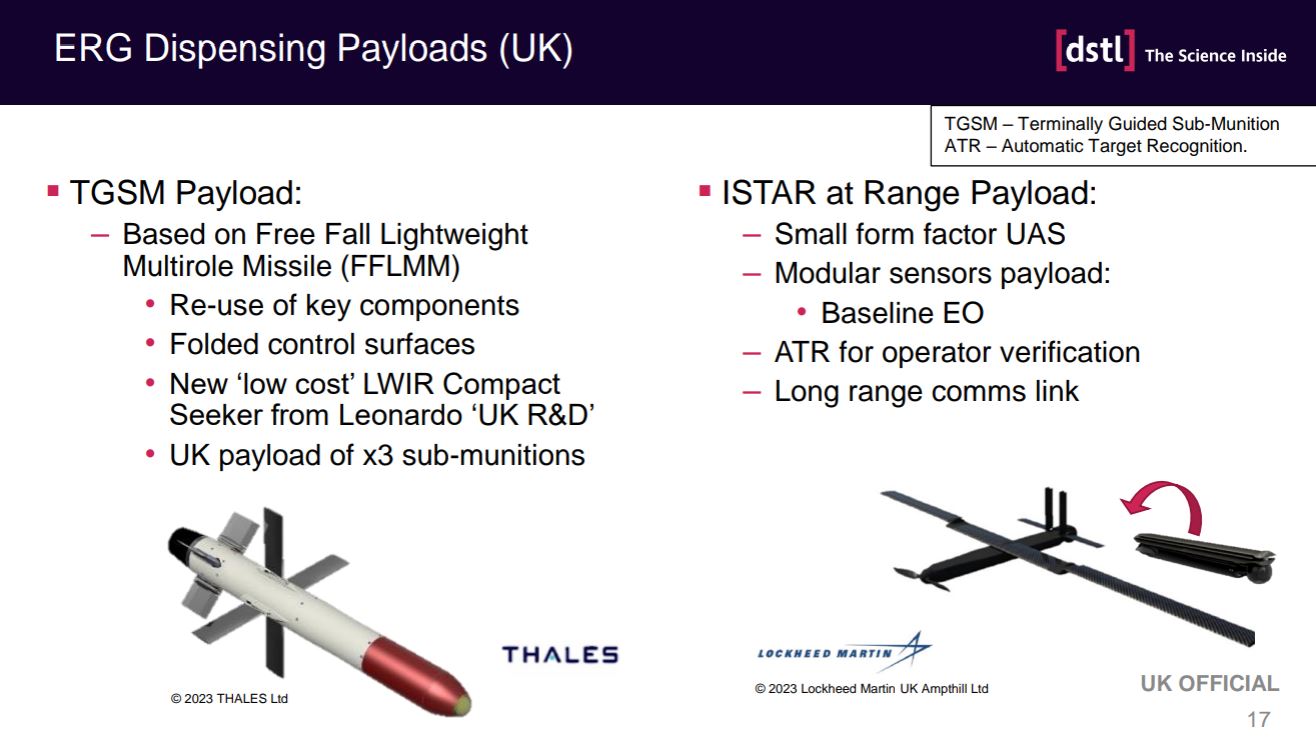
2 Army programs in particular stand out for export potential in a NATO context and possibly beyond: the Technology Demonstrator 5 project to integrated advanced lethal and ISR payloads into GMLRS rockets and PrSM missiles would result in a massive capability growth and most likely in substantial export orders.


The other project with great potential is the Mounted Close Combat Overwatch project centered on ground-launched Brimstone for long-range anti-armour capability. This has in some ways already obtained an export win of sorts with Poland having selected Brimstone for its own long range ATGW need.

There is obvious potential in several of the UK's drone projects as well: uncrewed adjunct aircraft, the HYDRA armed drone, one-way strike solutions and the PROTEUS uncrewed helicopter for the Navy could all prove successful in securing export deals.

DSTL’s work on an uncrewed, highly mobile ultra-lightweight 127mm gun on the LAMP mobility platform should also continue as it would answer the need of Marine, Para/Airmobile and Mountain troops in particular and could secure interest in multiple countries.


Describe how the current support to Ukraine is integrated into UK Defence programmes and activities and propose measures in priority order to sustain and enhance this support to at least 2027.

The UK could provide aid to Ukraine while improving its own defences in multiple ways, as the decision to restart manufacture of large calibre barrels in the UK proves.

With GMLRS rockets being a key asset for the British Army as well as one of the most successful weapons employed by Ukraine, the UK should look at establishing production at home. Lockheed Martin reportedly was willing to bring GMLRS work to Ampthill and this should be a priority.

Again on GMLRS, the already mentioned Techical Demonstrator 5 could be a game changer: Ukraine could probably benefit from early access to some prototype systems, which in turn would support spiral development for the UK's own needs.

There is great scope for even more cooperation on drones, lethal and not, and on electronic warfare, including C-UAS jammers.

Ukraine is also continuously in need of anti-air missiles. France and Italy have supplied SAMP-T batteries firing Aster 30 B1 missiles, and MBDA UK will soon be remanufacturing existing Aster 30 missiles of the Royal Navy into B1s. There might be potential to increase production capability in the UK and help keep Ukraine's batteries armed.

Similarly, CAMM/CAMM ER, much needed to increase the British Army's GBAD capability, could be key to help meet Ukraine's needs as well.

The recent work to increase the ability to produce ammunition in the UK and manufacture artillery barrels is welcome, but one critical weakness remains unaddressed: the production within the UK of energetics and propellants. A core capability in country would be fundamental for resilience in times of crisis when supply from abroad might dry up.


Describe and recommend how the UK Defence homebase is made secure and resilient in confrontation, crisis and conflict, including in enabling full mobilisation and campaign endurance when needed.

Ther esilience of the UK realistically depends on factors other than military. Increased capacity to produce energy domestically, reduced reliance on imports would be the most decisive factors.

The military specifically, and the UK’s ability to mobilise for a major war are afflicted by excessive centralisation as a result of decades of efficiencies. A successful long-range missile strike that managed to hit a few critical installations (for example Lossiemouth, critical to QRA, maritime patrol aircraft and AEW), Waddington, Ashchurch (most of the Army’s vehicle fleet is to be found stored there), Donnington (general stores) and Kineton (ammunition) would be enough to have an absolutely crippling effect on the ability to properly mobilise in the first place.

Strengthening Ground based air defence can help, but there are not enough resources to attempt a complete coverage. For sure, a resident SKY SABRE battery at least in Lossiemouth and other key locations on the eastern coast would not be a bad investment. Longer range air defences would help, but would require massive investment.

Project LEWIS for a new anti-ballistic radar would provide early warning to the UK and to the benefit of the whole of NATO, assuming the Government remains committed to it.


Project LEWIS has seen the UK secure US authorization for the procurement a Long Range Discrimination Radar (LRDR) (for construction on the island that gives the project its name...?), but it is one of those background programs no one ever talks much about. It's also a promise to NATO formulated years ago. 

The best defence against such an attack, which at present can come only from Russia, will always be to deploy the Armed Forces, particularly the Navy and Air Force, “up threat” to intercept Russian ships, submarines and long range aviation over Scandinavia and the North Sea. Forward deployment of the carrier strike group and of RAF jets to Iceland and Norway would no doubt be an early measure taken at the first sign of serious crisis.

In general, the worst threats to the UK will manifest not so much directly against the UK mainland but abroad. The Red Sea shipping crisis is an eloquent example. Even in a “Russia” scenario, the UK will be defended first of all at range up in the High North, not so much directly from its shores. Geography dictates this.

As a consequence, it is non-discretionary to maintain military force that is expeditionary and has the logistic “legs” to deploy where needed.


Propose measures in priority order that establish how UK Defence transitions to the optimum balance of regular, reserve, civil servant, and industry people across all standing tasks and commitments and on mobilisation. Recommend the recruitment, education, training and retention measures required to achieve this.

The topic of Reserves for the UK is complex, again because of the geo-political truth that dictates that state threats to the UK will manifest away from the homeland. The frequent mention of Finland’s reserves, or Poland’s territorial units is of limited relevance to the UK: light infantry formations for local defence have little to no relevance for the UK, unlike for those countries who would be fighting on and for the very home turf. Units equal to Poland’s territorials could be formed, but in any war scenario they would have to be lifted across Europe to the point of need, unlike Poland’s own.

The old Territorial Army used to have a demonstrable ability to deploy to the Continent in support of regulars during the Cold War, but it’s undoubtedly harder to do that now, and it is proving difficult to deploy formed bodies of Reservists during “peacetime”. There are a few cases, but all pretty small scale and relatively sparse over the years.

The matter of Reserves is tricky and not easily solved. It’s true reserve infantry battalions cost a lot less than regular ones, but that is of little relevance if their output is not only much smaller but also relatively unpredictable due to uncertain availability of people. Any expansion of their combat role, in addition, would require equipment and vehicle fleets that at the moment simply do not exist.

A serious assessment is needed to determine what the Reserve can actually do in “peacetime”(it would be fairer to say in times of competition/confrontation short of all out war) and what they can be expected to do during major mobilisation.

If all-out war ever happened, there is every reason to believe the Reserve would show up in decent force, but at present it is at best questionable whether it could be equipped and actually employed as anything other than individual / small sub-units replacements and some degree of augmentation. There is an obvious shortage of combat vehicle fleets, for example. Formed reserve units would only be of the lightest kind.

There will probably need to be a more neatly “separated” plan for those Reserve individuals and units which are available, willing and indeed needed in “peacetime” and those formed bodies which would only realistically come together for occasional major exercise and ultimately in case of a real major crisis.

The latter formations, which should probably be organized as coherent brigades for best effect, would need to have a well defined, realistic role attuned with what equipment will be actually available in the depots or in a realistic emergency procurement/production plan to outfit them.

It would probably be beneficial to organize a “shadow” heavy brigade of Reservists, recognizing however that as things stand the armour to make them deployable as a formed unit simply does not exist in the inventory. They would deploy essentially as augmentees / casualty replacements.

Light brigades could be organized to be “deployable” in a specific format which will not be equal to that of regular formations and should thus develop its own Concepts, much like Poland’s territorial formations but with the difference, again, that UK Reserves would be deployed to fight far away from home.

It might yet prove to be the case that a larger Reserve is not in fact the right answer if larger doesn’t work out to more available/capable. More capable will require dedicate vehicle fleets and equipment holdings which will rapidly make the Reserve far less financially attractive overall.

Roles and expectations must be defined first.


Propose how the maritime (including littoral) domain is developed to contribute to an Integrated Force, recommending measures that accelerate modernisation and transformation and identifying existing capabilities and programmes that do not support this.

The development of uncrewed assets such as PROTEUS (rotary wing), VIXEN (fixed wing) and SEA PROTECTOR (MQ-9B modified with the wing-king for short take off and landing on the carriers) would massively enhance the carrier strike group's ability to deploy and fight up-threat. SEA PROTECTOR could be ready within a few years and, equipped with suitable podded radars and sonobuoy launchers, could bring extremely long endurance airborne early warning cover against missile attacks and long range, persistent anti-submarine patrol.

PROTEUS will help make up for the insufficient numbers of manned MERLIN helicopters.

Carrierborne F-35B (the expansion of the fleet to atleast 74 jets in 3– ideally at least4 – Squadrons should remain an absolute priority) and drones ensure the UK can confidently deploy far from home with the indispensable air cover.


The Littoral Response Groups give the UK a persistent forward deployed force around which larger operations can take shape. In a NATO context, the Littoral Response Group North represent the continuation of cooperation with the Netherlands and assistance for the Nordic Allies. The future Multi Role Support Ship will need to be more survivable than current amphibious ships while preserving the ability to lift and send ashore even the heaviest Army vehicles. The new vessels will need to combine both aviation capability and heavy surface lift capability, with a well dock sized for LCUs and mexeflotes operations. Room for containers, including on the weather deck, will give flexibility to embark modular weapons (a modular CAMM missile system should be a priority) and capabilities (Role 2+ and 3 medical facilities) for deployment.


Frigates, destroyers and submarines with land strike weapons will contribute to the suppression of enemy air defence and will strike high value targets. They have a great deterrent value as well. General purpose frigates and pureOPVs are no longer particularly useful in a new context of state on state warfare risks: the new generation vessels should have space and services reserved for embarking drones and modular mission payloads / containerized weapon systems that make them more useful combat platforms by expanding their base fit.


The MCM component is currently based on small ships which are not very deployable nor very useful beyond their specialized role, but the transition is already underway. Drone-based systems for MCM are more capable and more flexible but the necessary motherships to project those drones at range have not yet been built. If they were, the transition could be accelerated further. Swift procurement of a first mothership would allow the return of the currently employed BAY-class vessel in the Gulf to the amphibious role.

Modular capability, such as CAMM missiles in containers (NavyPODs) and portable lasers can help ensure the new Multi Role Support Ships and MCM motherships can deploy with the necessary defences on board, while saving on build costs. Such modular capability could also follow the Marines ashore, delivering further effect very efficiently.

The Littoral Response Group will need long range strike weapons that can be inserted from the sea and then used from land, against the land and against the sea. GMLRS and PrSM missiles, common with the Army, would achieve this but would ideally require a lighter, more deployable launcher like the defunct LIMAWS(R) on Supacat platform, or the uncrewed ROGUE of the US Marines.

If the Marines can go ashore with GMLRS and CAMM, they can create safe havens for the fleet and prove a real strategic concern to the enemy.


Propose how the land domain is developed to contribute to an Integrated Force, recommending measures that accelerate modernisation and transformation and identifying existing capabilities and programmes that do not support this.

Land will contribute through growt of Long Range Fires, primarily through the Land Deep Fires programme to grow the number of M270 launchers and their ammunition.

-              GMLRS ER, which should include Alternative Warhead to restore area-attack capability, 150 km reach

-              PrSM missile 500+ km

-              Land Precision Strike will deliver extended overwatch

-              Technology Demonstrator 5, a UK effort, to integrate advanced payloads into GMLRS and perhaps PrSM, including reconnaissance drones and intelligent sub-munitions, mines, ISR sensors, EW devices and jammers. If realized, these capabilities would be transformational and are sure to gain export orders.

Further long range strike options will come through drones. Lethal drones are needed at all tactical levels:

small ones such as D40 would restore infantry’s ability to deliver HE on indirect trajectory.

Fires have to make up for lack of mass. The PHALANX model for Platoons and Companies, which pushes JAVELIN and 81 mm mortar down to Coy level, should be adopted.

At battlegroup level, adoption of 120 mm mortars and Mounted Close Combat Overwatch is key.


A battery of M270 should become organic to each Heavy brigade, alongside RCH155, primarily for Land Precision Strike overwatch. This seems the correct tactical level where to employ this new capability.


GMLRS ER and PrSM would primarily be used by the GMLRS Regiments held within Deep Recce Strike BCT if not even aligned directly to Corps level.

Another GMLRS regiment should be added, equipped with a lightweight launcher (like USMC’s ROGUE or resurrected LIMAWS-R) to ensure 16 Air Assault and 3 Commando Brigades have access to this strategic system and can more easily move it (including under slung by CHINOOK).

GBAD will need to grow. CAMM ER should be added to SKY SABRE urgently; more batteries should be formed.

Each Brigade should grow an organic, mobile SHORAD battery, on BOXER Skyranger in the Heavy formations. 30 / 35 mm gun adds cost-effective counter-drone capability.

Directed energy weapons work should continue towards a useable capability to be fielded as soon as practicable.

12 and 16 RA regiments probably need to evolve mixing SKY SABRE with SHORAD, both for their own survivability and for improved effect. Guns (such as PALADIN from British company MSI, which has already been tested) would add resilience against drones.

In order to deliver the “British Corps”, 4 Brigade will need to be rebuilt, with Combat Support and Combat Service Support regiments it currently lacks.

4 and 7 Brigades should both be made medium mechanized with FOXHOUND and a circa-20 tons Troop Carrier as planned within the Land Mobility Programme.

Ideally, 1st Division should have its own lightweight Deep Recce Strike formation. Resources are highly unlikely to be sufficient, so 16 Air Assault Brigade could be adapted to deliver this role where applicable while preserving its more unique deployability aspects.

3rd Division’s armoured brigades would benefit from putting a remotely operated turret on ARES and adapting the internal fit of these new vehicles to restore a degree of IFV capability.

BOXER would then deliver supporting roles by adapting the current plan for Mission Modules. A 120 mm turreted mortar and SHORAD should be priorities.

Ideally, 12 and 20 brigades should be “square” and composed of Combined Arms Regiments of CR3 and ARES. At an absolute minimum, the current 3 regular MBT regiments should be preserved by cancelling plans to convert King’s Royal Hussars from MBT to Armoured Recce.

Security Force Assistance Brigade should be sacrificed to free resources. In general, rebuilding needed CS and CSS formations is priority and in absence of manpower growth, accessory missions should be scaled back to recoup posts for more urgent priorities.


Propose how the air and space domains are developed to contribute to an Integrated Force, recommending measures that accelerate modernisation and transformation and identifying existing capabilities and programmes that do not support this.

The Air Force contribution to the Integrated Force is fundamental, but its ability to intervene in the face of powerful enemy anti-air defences must be increased if this is to continue to be the case even in high intensity warfare. EW, uncrewed aircraft companion for crewed jets, SPEAR 3 and SPEAR EW are going to be fundamental, and it would be extremely important to retrofit the ECR Mk2 radar with jamming capability on the Tranche 2 Typhoons too, since they make up most of the RAF’s numbers.

The procurement of AARGM ER anti-radar missiles, as already pursued by allies, should be the next step.


MQ-9B PROTECTOR’s potential overland is threatened by its vulnerability to enemy action. As it stands, PROTECTOR is virtually helpless against any enemy attack: procurement of a Self Defence pod should be a priority.

PROTECTOR should then be developed with suitable radar and podded sonobuoy dispensers to become an adjunct maritime patrol solution supporting P-8 Poseidon, especially in the High North.

PROTECTOR should also be equipped with the Short Take Off and Landing wing-kit to enable it to deploy directly on the aircraft carriers. The addition of suitable radars in pods would enable SEA PROTECTOR to deliver high altitude, long endurance Airborne Early Warning; in Maritime Patrol configuration it would deliver long duration anti-submarine patrols. In both cases, this would ease the burden on the insufficient number of MERLIN HM2 helicopters, which could then go back to focusing on ASW. In AEW, PROTECTOR would deliver greater capability than CROWSNEST and could in part supplement the insufficient number of E-7 WEDGETAIL too.


It would be highly beneficial to pursue a capability similar to the USAF’s RAPID DRAGON: pallets that can be air-dropped from cargo aircraft to launch multiple cruise missiles. A single A400 could be made to launch as many Storm Shadows as 4 or perhaps even 8 Typhoon, at far greater ranges from the UK, with next to no need for air to air refuelling. For a modest investment, this would bring quasi-strategic bomber capability back to the RAF’s roster.


Probably the most transformational capability that can be pursued, however, is the ISTARI multi-ISR constellation of Low Earth Orbit satellites. The OBERON-type satellites, with their radar sensor, will be particularly important to gather intelligence and targeting in all weathers. The use of laser to securely transmit huge amounts of data (TITANIA demonstrator) could also be game-changing.

In general, while LEO satellites are small and individually less capable than larger satellites so far favoured by most nations, they present advantages:

-          The UK industry is one of the main LEO small satellites producers worldwide

-          The use of multiple small satellites makes the constellation more survivable

-          It is conceivable that additional LEO sats could be “rapidly” deployed into orbit in time of need

-          The maturation of launch options directly from UK soil open up an opportunity to have UK satellites, launched from the UK, delivering sovereign intelligence capability


It would be highly beneficial to procure a number of air to air refuelling pods for A400M, to open up the ability to refuel MERLIN HC4 (Littoral Response Group) and CHINOOK (Army, Special Forces) in flight as well as have extra AAR capability for jets in times of need.

As mentioned elsewhere, adding Boom to at least some VOYAGER tankers would be a massive force multiplier by opening up options to extend E-7, P-8, RIVET JOINT and even C-17 in Flight, as well as making the RAF capable of supporting its main partners, including the F-35A of the “Nordic Air Force” in Scandinavia.


Propose how UK Special Forces are developed as part of an Integrated Force and in support of UK National Security and resilience.

In a high intensity warfare context, the role of Special Forces is likely to primarily revolve around deep reconnaissance and target acquisition in favour of the integrated force. The Army Special Operations Brigade, in particular, should have this as a key role for its Rangers, which should thus be organized and equipped with the necessary mobility, sensors and communications to scout deep beyond the Forward Edge of Battle Area.

Special Forces will of course retain their shock action and direct assault capability as well.


Propose how to improve financial management and administration across Defence, meeting HMG standards of accountability and identifying how more rapid adoption of digital technology will modernise culture, organisation and ways of working.

The one reform that would have the greatest effect on the handling of Defence budget would be one that favoured flexibility over rigid annuality parameters and that created a planning mechanism more akin to the Defence Planning Law in France. Government and Opposition alike need to have more visibility and more say on how long-term defence plans are set out and should vote regularly on those plans to ensure neither side can offer big promises while in Opposition only to deliver the opposite if Elected.


A more credible, long-term commitment to capabilities, programs and structures would give the Services and Industry the confidence needed to approach programs in annual increments. Currently, UK defence spends years and years trying to plan every financial detail of enormous, decade-long programs, generating famine periods followed by gigantic monolithic contracts which later invariably encounter problems due to inflation, unforeseen events, changed requirements and the delays that end up regularly being inflicted upon programmes to fit within annuality requirements. Enormous amounts of equipment are purchased in big contracts because Industry doesn't trust the government to come back if a project is split in tranches, and the Services are terrified of losing their chance (and budget) is they don't commit it. This needs to change. Industry and Services alike must be put in a situation in which they are more comfortable ordering 100 or so vehicles a year within a framework, rather than order 523 BOXERs in one go, to make an example. This would make it easier to control expenditure year on year on big projects without the need for shock cancellations.


Requirements must be set, endorsed, voted upon by both sides of the House, and then delivered incrementally year on year with industry and armed forces reasonably confident that the entire thing won't collapse the moment there is a new General Election and yet another SDSR looking for cuts.


Propose how UK Defence can build relationships with allies, partners and alliances as a strategic strength for the UK

AUKUS is the most impressive example of mutually beneficial relationship, and GCAP will do much in turn to keep Japan and Italy close to the UK.


There is obvious scope for more cooperation. BOXER with Germany, Australia and the Netherlands, for example. With Germany, synergies have been found in the TRITON program to jointly procure a replacement for the M3 rig; in the joint development of ammunition for Challenger 3; in the RCH155 artillery program, in FOST naval training, and hopefully in the future this can continue through the UK procuring the Skyranger turret for BOXER, like Germany already is doing, to enhance anti-air and anti-drone defence.


Type 26, if selected by Norway, could represent a formidable area of cooperation in the context of ASW on the Northern flank of NATO. There is potential for cooperation over P-8 POSEIDON too, and on MQ-9B PROTECTOR, particularly once it is fitted to also deliver maritime patrol / ASW. Norway has a known interest. Both countries employ the Sting Ray torpedo and this might continue in the future should Norway decide to follow the Mod 2 development now started in the UK.


Poland ties are strong thanks to CAMM / SKY SABRE and the joint development of the new CAMM MR munition. Poland has also acquired BRIMSTONE. Further synergies can be built upon these capabilities. Poland is about to become the second user of APACHE helicopters worldwide and the British Army Air Corps could do much to assist them along the way. The two nations would benefit from joint armament purchases for the APACHE fleets and from joint development of conceps and capabilities relating to the AH-64E.

Poland has also acquired AW-149s which the UK is considering as New Medium Helicopter solution.

I again stress the importance of TD5 and the advanced payloads for GMLRS rockets: this project could be a real winner in the field and on the market, and more GMLRS users should be involved as soon as possible to help build momentum.


These are some of the main examples. Those equipment points of contact bring mutual advantages, ease interoperability and create a wider user community to share the costs of modernisation with, while deepening mutual understanding and favouring common solutions.


The UK should consider more direct purchases from partners in return for defence sales. For example, cooperation with Norway on the VANGUARD concept for large motherships would deliver a good solution for the Royal Navy requirement while probably representing a welcome return for Norway's eventual selection of the Type 26 as its new frigate.

Thursday, April 2, 2020

The British Combat Aviation Brigade


It has been in the works for quite some time, and will be a building site for several years still, but the UK is finally standing up its own Combat Aviation Brigade to bring some order in the convoluted and overlapping command arrangements of its helicopter forces.
I’ve known about this plan for many months, but couldn’t really talk about it before some sort of official announcement was released. This finally happened yesterday, even if, primarily because of the pandemic, it was an extremely low-key news.

I’ve been and I remain extremely critical of much of what the Army is doing and saying about its future, but for all it’s worth I can certainly say I am a big supporter of this one move. It is arguably long, long overdue and the brigading of the units involved in fielding aviation groups in support of british land forces has long featured in my recommendations for the future structures of the Army. 


The Wings of what once was 24 Air Mobile Brigade have been chosen as the TRF for the new 1 star command, 1st Aviation Brigade (1st Avn Bde). Fun fact: in my proposals for the future, as far back as 2013, I had seen this coming. It has to be admitted, however, that it was a relatively easy guess: the other likely candidate was the Striking Eagle badge that used to be 16 Air Assault Brigade’s symbol until the return of Pegasus In 2018 and which has stuck around since as badge of the Attack Helicopter Force.

Back to serious matters, 1st Aviation Brigade is the main component of a wider restructuring of Army aviation (known as Project COLINDALE) which has been very, very slowly progressing ever since 2015.
Primary drivers for change are the need to generate efficiencies; the need to build a C2 construct capable to brigade aviation elements in support of a Divisional deployment, rather than penny-packet groups only suited to brigade or sub-brigade deployments; and the ongoing review of the infrastructure footprint of the Army Air Corps.

Notoriously, all three Services have had to craft a plan to divest a lot of bases, barracks and land in an effort to achieve savings and enable the modernization of the remaining infrastructure. Army Aviation is supposed to do its bit in this project, but decisions on the future footprint remain elusive. Essentially, the biggest dilemma is whether to close down Middle Wallop or Wattisham, since Yeovilton is going nowhere and there isn’t a real alternative to keeping Aldergrove for operations in Northern Ireland.


Operations in Arctic conditions have been intense between 2019 and 2020, with the debut of british Apaches in Norway and their first arctic use of Hellfire missiles. This is part of the as yet unpublished "UK Defence in the High North" strategy in which the UK committs to a much increased role on the Norway flank of NATO for the next decade. 

From what can be observed from the outside, the closure of Wattisham with the migration soutwards of the Apache squadrons is the desired outcome, but clearly the complexity and cost of the move are very much preventing the sealing of a definitive plan. It is clear that the time for such a move is now, if not yesterday, since the transition between the current AH1 standard and the new Block III standard is soon to begin on the flightline, with the first remanufactured helicopters arriving this year. The Army would like to co-locate all Apache training phases, currently split between Conversion To Type carried out by 673 AAC at Middle Wallop and Conversion To Role  done by 653 AAC, Wattisham, with the ultimate objective of also merging the 2 squadrons into a single one (653 AAC).
3 and 4 Regiments will remain otherwise relatively unchanged, each with its two frontline squadrons and with an uplift to manpower in the ground element to sustain an higher operational tempo for high intensity operations.

In terms of Command and Control, aviation groups have so far deployed under the control of HQs pieced together from disparate Joint Helicopter Command resources, assigned to the commander of one of the constituent forces. The Commander of the Attack Helicopter Force has been the core for one such “makeshift” Aviation Task Force (ATF-1); Commando Helicopter Force provides another (ATF-2) and Support Helicopter Force (RAF Chinook and Puma 2 squadrons) provide the basis for a third.


The use of Force Commanders and augmentees from JHC is no longer judged sufficient as it lacks the command capacity and battle staff power needed to plan, refine and execute multiple tasks at the necessary speed, concurrency and endurance.
The formation of a permanent 1-star command with associated staff also offers the benefit of providing a “plug-in point” that better enables integration with international forces and, primarily, with the US Army’s own Combat Aviation Brigades. Most countries the UK will be working with, have long had a 1-star Aviation HQ directing employment of Aviation Battlegroups, and others, like France, have in recent times gone in the same direction.

1st Aviation Brigade, based in Middle Wallop, will be born out of the progressive merging of the current Attack Helicopter Force (AHF) command element (the overarching command sitting above 3 and 4 Regiments AAC) with the Aviation Reconnaissance Force (ARF, essentially the overarching command element overseeing 1 and 5 Regiments AAC) and later of the Watchkeeper Force (WKF) as well.
Instead of having separate AHF and ARF forces, the Avn Bde will instead be a deputy commader in chief for the ATTACK and one for the FIND functions.

In preparation for the more ambitious role of Aviation in future Divisional operations, several large scale operations have seen whole AAC Apache squadrons flying long range strikes across the UK and even deep into France. The teaming of Wildcat and Apache, including the use of the first to laser-mark targets in favor of the Hellfire missiles of the latter, has also been tested and validated 

Watchkeeper will continue to be operated by 47 Regiment Royal Artillery, which continues to work on equipping and training 4 equipment batteries. The change of command won’t be particularly dramatic since 47 RA has been under Joint Helicopter Command control already since 31 august 2016, when it resubordinated from 1st ISR Brigade as part of efforts to overcome the problems that have tormented this UAV capability in its work up to full service readiness.
Under the 31 (HQ) Bty, 10 (Assaye) Bty and 43 (Lloyd’s Company) Bty were the first subunits to become operational with Watchkeeper, and have since been joined by 74 (The battleaxe Company) Bty and finally by 57 (Bhurtpore) Bty, which resubordinated from 32 RA during 2019.

From 2019, Watchkeeper is finally cleared to fly from Boscombe Down. Intense operations are ongoing also from Akrotiri, Cyprus.

1 Regiment AAC has had to abandon all ambitions of eventually re-activating 669 AAC and 672 AAC squadrons on AW-159 WILDCAT, as had once been planned. These ex Lynx units have now disbanded, leaving the Regiment composed of 661 and 659 Squadrons, plus 652 as training unit delivering both Conversion to Type and to Role. The regiment will have the ability to force generate as an Aviation Battlegroup for deployment.

4 Regiment AAC has under command 656 and 664 Squadrons on Apaches. The first is the specialist in Apache shipboard operations and the primary supplier of Attack Helicopter support to 3 Commando Brigade. 664 is primarily aligned to 16 Air Assault Brigade. The regiment will increasingly contributed to the max output required by Division scale operations, however. It should eventually take responsibility also for the combined CTT and CTR training unit, 653 Sqn.

3 Regiment AAC has the Apache squadrons 662 and 663. Both Attack Helicopter regiments will have the ability to force generate as Aviation Battlegroups for deployment.

5 Regiment AAC will oversee internal security operations (essentially, Northern Ireland and Special Forces support) and will also oversee aviation support to training overseas (7 Flight in Brunei and 29 Flight in BATUS). The regiment is otherwise made up by 2 squadrons; 665 AAC operates Gazelle helicopters from Aldergrove, while 651 AAC operates fixed wing ISLANDER and DEFENDER aircraft from the same base. Since 1 April 2019, however, 651 Sqn has been transferred to the RAF and once the new arrangements eventually reach Full Operational Capability, 651 will be removed from the Army’s order of battle. 665 AAC is instead intended to re-equip with a new helicopter replacing Gazelle. The expectation is that a small number of H-145 helicopters will be acquired for the role. Some could also replace the Gazelles of 29 Flight in BATUS, Canada.
658 Squadron, which operates in support of the SAS with Dauphin helicopters, will sit under the regiment but clearly its actual line of command is somewhere else.

The Brigade also commands 6 Regiment AAC with its 4 squadrons of reservists (675. 677, 678 and 679) who backfill ground support roles positions and provide war establishment uplift to the manpower of regular squadrons.

The training regiments (2, 7 and 9) of the Army Air Corps will not be included in the brigade. With WILDCAT training delivered directly by 1 Regiment AAC via 652 Sqn and with the same approach eventually planned for adoption by 3 and 4 Regiments with 653 AAC taking over all phases of APACHE training, it is expected that 7 Regiment AAC will fold its remaining functions into 5 Regiment AAC (training for the successor to Gazelle and oversight of overseas flights) and then disband. There are no firm official dates yet for this to happen; the main obstacle being the enduring inability to agree on whether to vacate Wattisham.

2 Regiment will carry on delivering the early phases of AAC personnel training in 668 and 676 Squadrons.

9 Regiment has been recently stood up at RAF Shawbury as part of the Defence Helicopter Flying School and has taken under command 670 AAC and 60 RAF Squadrons. It works alongside 2 Maritime Air Wing which delivers training through 660 AAC and 705 NAS squadrons. This arrangement will carry on.  

The aviation brigade will deploy under 3(UK) Division for major divisional operations and will deploy scalable C2 elements and associated Aviation Battlegroups or Units of Action for smaller scale contingencies. The Brigade will be resourced to operate with “at least” 4 Avg BGs and will be able to take under command non-british formations.

In particular, it is assumed than in any “max effort” scenario requiring 3(UK) Division to be fielded, 1st Aviation Brigade would have to deploy the vast majority of all frontline helicopter fleets, as it is expected than the Littoral Manoeuvre helicopter force (the Commando Helicopter Force with the MERLINs of 845 and 846 NAS plus the WILDCATs of 847 NAS, reinforced by 656 AAC with APACHEs and some CHINOOKs for heavy lift) would be required to operate as the same time as the main ground-based force.
Air mobility up to Company level is also assumed as requirement for Rear Area security: during a Divisional deployment, a Light Brigade formed out of units from 1st (UK) Division would deploy with Rear Area security roles.

It is assumed that 2 Squadrons of CHINOOKs, for up to 26 helicopters in total, would be deployed for such a large scale operation. If massed together for a primary operation, these helicopters could easily airlift a whole air assault battalion in one wave. If realized, this ambition would mean deploying more Chinooks than are found normally in American CABs.
24 Apache would also be the target, same number as are found in an attack battalion within an American CAB.


The main weakness of british aviation is naturally Medium Lift. Wildcat has extremely limited lift capability, while the small number of Puma HC2s is expected to be, for the most part, busy with Special Forces requests. The Americans, conversely, employ large numbers of Black Hawks, including several permanently tasked with CASEVAC / MEDEVAC role. French, Italians, Germans and others count on large numbers of NH-90 for the medium lift, but, with the sole exception of Germany, are in turn much weaker in terms of heavy lift.


Apart from the new and enhanced capabilities of command and execution of multiple concurrent operations, the Brigade will benefit from a substantial restructuring of 7 Battalion REME, which also includes 132 Squadron, Royal Logistic Corps, combining Equipment Support and repair with logistic sustainment of the deployed force.
Regimental REME workshops within 1, 3 and 4 Regiments will be restructured and strengthened with their own Equipment Support platoons and vehicle platoon for sustaining increased tempo of operations in the field.

The 3 british Chinooks deployed in Mali give much needed Heavy Lift support to the french forces in the region. In their first year of deployment they flew for 1192 hours, lifting 7,052 soldiers and 475 tonnes of freight 

On top of those organic resources, 7 REME will provide a 2nd line of Aviation Close Support in the field, with two Aviation Companies (71 and 72) and a Field Company specializing in Recovery (70 Fd Coy). 73 Aviation Coy relocated to Yeovilton in the last few years and will merge with 1 AAC regiment’s workshop elements to provide organic support.

1st Aviation Brigade is very much inspired by the US Army’s own CABs, but, for the moment at least, will continue to suffer of some of the typically british over-convoluted and overlapping layers of command and inter-service arrangements. 
Somewhat counter-intuitively, for example, the brigade does not seem destined to include 244 Signal Squadron, the designate aviation support comms units, which remains more loosely at JHC level, despite the unquestioned need for Communication and Information Support. I fully expect experience in the field to eventually lead to the resubordination of said squadron into the brigade, regardless of what the assumptions are right now.

More significantly, while 1st Avn Bde will have very significant organic FIND and ATTACK capabilities thanks to WILDCAT, WATCHKEEPER and APACHE, it won’t have direct day to day control over Manoeuvre helicopters as the CHINOOK and PUMA Squadrons are part of the RAF.
Connection with these crucial elements will be maintained through the higher level of command (Joint Helicopter Command), and deployed support helicopters will fall under 1st Avn Bde control during operations. Even then, it is acknowledged that “support helicopter squadrons have less organic life support than attack and recce formations and are not expected to manoeuvre in the same way”.
Similarly, the brigade won’t have direct control of the Tactical Supply Wing and Joint Helicopter Support Squadron.

This once again brings into focus the unhelpful awkwardness of having the troop carrying helicopters, quite frankly, sitting under the “wrong” Service. I don’t intend to denigrate the RAF’s commitment to the Support Helicopter Force, much as I will be inexorably accused of doing exactly that. I believe I’m simply stating a fact of life.
I will also immediately acknowledge that it is, at the moment and in the foreseeable future at the very least, almost unthinkable to prospect a transfer of CHINOOK and PUMA in Army hands. The effects on manpower could admittedly be disastrous if a well established RAF “family” was broken up, dramatically changing the career prospects of those who serve into it. Moreover, the Army is the Service that is most severely struggling with recruitment and retention, as well as grappling with decades of accumulated obsolescence across its structures and vehicle fleets, leading to a budget which is already broken as it is. As a consequence, I am NOT recommending a transfer at this time, although I will forever remark that it should be an objective for the future, perhaps to be incrementally implemented alongside the purchase of new build CHINOOKs to replace the oldest airframes in the coming years (assuming that the ongoing CHINOOK Capability Sustainment Programme does survive the new Integrated Review, of course). 
Transferring capabilities is difficult, but not impossible: the already mentioned case of 651 AAC is an example, and the transfer of MERLIN HC3 to the Navy is another.

What I am unashamedly urging is the immediate consideration of alternative joint solutions to bring the Support Helicopter Force into the Aviation Brigade and to restructure CHINOOK and PUMA 2 ground support / life support elements to deliver a more homogeneous capability for manoeuvre and flexible basing. As of now, APACHE and WILDCAT units are aiming for an increased ability to deploy forward and switch between Forward Operating Bases and multiple FARPs to operate in bitterly contested scenarios, while CHINOOK and PUMA 2 remain more decisively tied to availability of a better established Main Operating Base.

In addition, I believe that any honest appraisal of the resources available would conclude that creating a coherent Aviation Sustainment Battalion by combining Tactical Supply Wing, JHSS and 132 RLC Sqn is the sound thing to do. 7 REME could then focus entirely on Equipment Support.

Finally, proper planning should go into an integrated plan for adjusting / expanding the warfighting establishment as required, with Reserve support coming both from 6 AAC Regiment and from Royal Auxiliary Air Force formations. 1st Aviation Brigade will indeed include 6 AAC Regiment in its structure exactly for that purpose, and RauxAF elements connected to the Support Helicopter Force will, in a way or another, end up involved in any case.

Better to properly develop the arrangements in peacetime than scramble later when deployment time comes.

Wednesday, December 18, 2019

Towards the SDSR 2020


5 years ago, I ran a series of articles ahead of the SDSR 2015 in which I highlighted what, in my opinion, were the priorities to be tackled in the review. Admittedly, it was perhaps easier back then, because some major requirements were well evident and it didn’t take much imagination to call for the plugging of those holes. But my predictions proved remarkably accurate, and so I want to write a short piece ahead of the incoming SDSR 2020 as well, pointing my finger at what I see as main issues to be tackled.

First of all, I will expose myself and say that I am, for now at least, somewhat at peace with the idea of the incoming review. I’m relatively confident that it won’t bring big cuts: I’m expecting the targets of the SDSR 2015 to overall hold steady. The Conservatives have committed to the 2% of GDP base figure, and extended the 0.5% annual growth above inflation for the duration of the new Parliament, which is progress, however modest, since that commitment was otherwise going to expire by 2022.

This gives the MOD a degree of certainty about the budget that will be available, and means that the uncertainty mainly stems from the exact entity of the rumored “black hole” in the future years programme. That “black hole” is not really easy to actually define, as its effective magnitude depends on a huge variety of factors that go from Foreign Exchange variations to cost growth in ongoing programmes, to variations in GDP etcetera. In the 2018 estimates of the Black Hole, it is possible, and actually pretty likely, that the 0.5% growth above inflation was not factored in beyond 2022, and that will have contributed to the “worst case scenario” figure. Estimates supplied in 2018, in fact, had a pretty dramatic range, going from a modest 2,8 billion to nearly 15 or more over the 10 years of the programme. Clearly, 15 billion would be a big problem. 3, not so much.

The MOD secured a much needed injection of cash recently, as we know, and that helped overcome the short term problems and avoided the old and highly ineffective solution of delaying expenditure, which inexorably results in an even higher cost further down the line.

The budget pressure is indeed mostly, if not exclusively, concentrated on the next few years since a multitude of programmes are supposed to start and, at the same time, several others are already under contract at the same time. What is already under contract cannot, obviously, be easily tampered with, leaving limited flexibility to deal with money shortages.
In future years the problem is less dramatic simply because much of the expenditure is planned, but not contracted, and can be simply be pushed to the right. Of course, this has an impact on capability as kit is not procured, but on the other hand does not require the frantic cutting of what is already there, which is what happened in 2010.

Much, if not everything, will depend on the real width of the “black hole” and on the flexibility available to deal with it. Obviously, the most vulnerable programmes are the ones which haven’t yet started: Multi Role Vehicle Protected, for example, could very easily slip further to the right despite decisions on both Group 1 and Group 2 being currently expected in 2020. WCSP production, Challenger 2 LEP, but also purchases of F-35s after 2025, the Future Fleet Solid Support ships for the Royal Navy and the procurement of Typhoon upgrades (AESA, Litening 5…) and the purchase of new build Chinook Block 2 are all exposed to delays and variations and potentially even cancellation. Contracts which have not been signed yet are, obviously, the easiest ones to remove from the 10 year programme, and they make for cuts which are quite “stealthy” and do not expose politicians to as much criticism.
In other words, despite the noise on some newspapers about Dominic Cummings’ previous comments about the carriers, it is not the Queen Elizabeth class which is exposed. Both ships are now in service and the acquisition programme is nearly entirely complete, so (thankfully) any further political meddling (like the delay imposed by Gordon Brown which resulted in a cost growth of over 1 billion, or the 2011 mess) is out of question.

The carriers can of course still be hurt indirectly by, for example, stopping the Fleet Solid Support project, but this is relatively unlikely given how unusually high a profile shipbuilding has played in the Election. Labour had promised to amend the shipbuilding strategy to  ensure RFA vessels are built in the UK, and while the Conservative manifesto does not contain such a promise, the Prime Minister has promised more shipbuilding work. While I don’t expect the optional 3rd Solid Support Ship to ever be contracted, I’m optimistic that 2 will eventually come and I think building them in the UK is almost a certainty at this point.

Some other programmes are much more secure despite the lack of a contract. An easy example: apart from the capability rationale, Type 26 Batch 2 would be political dynamite to tamper with, due to the tensions with Scotland. SKYNET 6 satellites are also unlikely to suffer much, simply because they really are the kind of equipment which just HAS to be procured.

Space is expected to be a winner, in general. The Manifesto promises a Space Command, which might or might not grow into or from 11 Group, Royal Air Force, which is currently in charge for space activities, along with 23 Sqn, resurrected to be the first “space squadron”.
News coming out on some newspapers ahead of the Election suggest there will soon be announcements about a national Global Positioning System, aligned with the 5 Eyes organization (Australia, in particular, is expected to be involved in the project), which will give the UK a sovereign alternative to GPS and Galileo. If confirmed, this would be an exciting development, even if, with the pricetag being given at around 5 billions, I’m not sure should have been granted such a great priority. Much will depend on exactly how alternative it is to the existing GPS and “clones”. To be truly worth it, it should come with different technical approaches, hopefully obviating to some of the known vulnerabilities of the existing systems. With the UK’s (but Airbus-owned) Surrey having build the navigation system payload of the Galileo satellites themselves, know-how definitely exists.  

What I truly hope to see is a bold and meaningful commitment to projects ARTEMIS and OBERON, in connection with the spaceports in Scotland and Cornwall. Both programmes have received some initial funding but are currently experimental: I hope there will be a solid commitment towards growing up both constellations to give the UK a sovereign space-based imagery intelligence capability (ARTEMIS) and a sovereign Radar and Electronic Surveillance capability (OBERON), so to drastically reduce what is currently pretty much a 100% dependency on Allies (mostly the US) in both areas.

ARTEMIS and OBERON are bold because they want to pack high definition imagery and Inverted SAR radar capability in small satellites. Since Britain is among the biggest producers of small satellites in the world, this makes sense in more ways than one. And since the UK will soon have two spaceports able to put small satellites into space from UK soil, this is even more exciting. ARTEMIS, in particular, includes provisions to demonstrate the ability to put satellites into space with short notice, exploiting the air-launched rocket and the modified Boeing 747 “Cosmic Girl” taking off from Newquay in Cornwall.

The UK-developed "origami antenna" which should allow OBERON small satellites to have a powerful Inverted SAR radar sensor, with a resolution normally associated to much larger and heavier satellites 


This is extremely promising and potentially very, very significant, because (relatively) cheap ARTEMIS satellites could be launched at short notice to improve coverage in the future and, crucially, timely replace space-based sensors destroyed or denied by enemy action, kinetic or otherwise.
Britain-made, Britain-owned satellites, launched from UK soil, potentially with the Orbex’s british made rocket. That would be a great capability to have, and it would go quite some way towards healing the disastrous decisions of the past which put UK space on a dramatic capability holiday just after the UK had become one of the few nations in the world to put a sovereign satellite into space with a sovereign rocket (PROSPERO satellite and BLACK ARROW rocket, in 1971).
The RAF putting one first pilot into Virgin’s space programme is also a welcome step going in this very direction.

UK built satellites, launched from the UK, potentially with a RAF pilot at the controls. As early as 2021

Obviously, further support for the SABRE engine is to be auspicated. The recent RAF contract for studies into the potential benefits coming from integrating the pre-cooling technology of SABRE into the EuroJet engine of the Typhoon is a very welcome development and hopefully it’ll be just the first of many applications. SABRE is a true potential revolution in the making, so I’d like to see support to this exciting project being front and centre.

In general, Space should be a winner in the coming review and beyond. Space investment is in no way a Defence exclusive, and the UK has already confirmed a substantial uplift of investment into ESA projects, in exchange securing lead roles in a number of key initiatives. Further investment into space tech for the military sector is likely to be guided in large part by the Space Strategy document which was announced back when Gavin Williamson was still Secretary of State for Defence. The document has not been published yet, but we can expect much of its content to migrate into the new SDSR.

Much the same can most likely be said for the Arctic Strategy as well, which saw the UK committing to a 10 year programme of support, primarily to and in Norway, which will become very apparent with the large scale 3rd Commando Winter Deployment 2020 (WD2020) which is in preparation. The Northern Flank of NATO should, for obvious reasons, be confirmed as an absolute priority engagement area for the UK. The North Sea is the UK’s exposed flank in any Russia scenario, and this is enough of a reason to ensure appropriate attention is pinned on this sector and on key capabilities such as Anti Submarine Warfare.

A welcome step was the revitalization, back in November, of the NATO Channel Committee to oversee plans for the protection of vital shipping routes across the North Sea and the English Channel. A document was signed on November 7 between the Navies of UK, Germany, France, Belgium and Netherlands to breathe new life into the NATO Advisory Body - Channel Committee (CHANCOM), and it is in the UK’s best interest, for reasons I hope are obvious to everyone, to play a key role in this organization.

With the Type 31 under contract and the Type 26 being a top priority as well as politically red-hot things no one will want to mess with, I’m expecting the Royal Navy to fare well in the review, despite whatever grievance Dominic Cummings might have against the carriers.

The First Sea Lord will go to the SDSR table with the Future Commando Force as one of its top priorities this time, and hopefully that will help the amphibious flotilla and the Royal Marines survive another round of political meddling. This remains, however, the most exposed area for the Senior Service, so it is where the hardest battles will be fought.

I’m relatively optimistic about the Littoral Strike Ships eventually materializing since I expect that this requirement will be put in close relationship to well known ambitions for “disaster relief / hospital ships” which will be at least partially funded with Foreign Aid money. According to the latest reports, Boris Johnson is much more open towards the idea of using Foreign Aid to fund programmes which more directly benefit UK interests. The Department for International Aid is said to be heading for incorporation within the Foreign Office, in fact, and in general I expect that Defence will be aided with some of this very budget, where possible.

Littoral Strike Ships will hopefully still happen. Their flexibility will be key, in particular when it comes to their large flight deck and hangar. With the loss of HMS Ocean, UK amphibious capabilities suffer badly from a shortage of helicopter capability, unless a carrier is deployed. 

According to the Press, Ben Wallace might soon lose his role of Secretary for Defence, but until then we have to take due consideration of the priorities he has given in debates ahead of the Election. For the Royal Navy, the absolute priority is making better use of what is already available, and it’s impossible not to agree.
Ships that have been tied up in harbor should be returned to full operational status as soon as possible, and every effort should be made to put a brake on the delays to refits and maintenance periods which are keeping too high a proportion of the existing fleet tied up. The gains will take time, however, and not everything can be affected at all: Type 23 Life Extension refits are demanding and time consuming, and the Type 45s are going to have to circle one by one through Birkenhead to have their Diesel gensets replaced under Project NAPIER. Every effort should be made to ensure that the refits stick to the schedule, however, and even more effort should go into ensuring that all ships in the fleet are used as much as possible. This, of course, means also putting further effort (and money, if necessary) into filling up the manpower deficit.

If sacrifices cannot be avoided, I feel that the first “victims” should be the WAVE and FORT classes. Fort Austin and Fort Rosalie have a dismal record for sea days in the last several years, and 6 tankers are probably too many for the fleet that remains in Royal Navy service. At any one time, several RFA vessels are actually tied up into Birkenhead, inactive and effectively mothballed, and the cause of this should be finally identified and cured. If the RFA cannot actually crew and use the WAVEs, I think they should be sold while they have still value. As for the two oldest FORTs, they have not received the modifications given to Fort Victoria to make them compatible with the new aircraft carriers and thus their usefulness is limited. If there is no way to put them back at sea quickly, it might be better to just sacrifice them. It would not save much money at all, but neither it would hurt the Service that much, since they are mostly only ever parked up in port anyway.

Going back to the Future Commando Force, instead, one priority I’d set if it depended on me would be to bring back into full service the mothballed LPD.
It would be a major win for the Navy and it would reflect the priority of using to the max everything that the Navy already has. Moreover, it would greatly help in achieving one of the key targets of the Future Commando Force, which is to have more Marines forward deployed at sea.

Forward basing in general is likely to be a key theme for the Navy in the new Review. Two 1st Sea Lords in a row have, correctly in my opinion, identified it as the only option to increase presence abroad without an increase in the number of ships. HMS Montrose in the Gulf for 3 years is the first of, hopefully, a few more long-term forward basing arrangements, with the Royal Navy looking in particular at the Caribbean and at South East Asia. The 1st Sea Lord would like to “initially” put a couple of OPVs in Asia, and while this might seem low key, it would be a very significant first step, which Type 31 might in future make more meaty.

It will be important, however, to secure a further extension to the operational life of the 3 River Batch 1 ships to cover home water needs and let the more capable Batch 2s free to show the flag abroad and complement actual frigates.

It would be easy to ask for more frigates, but I won’t even waste the time it would take me to write about it, because there are no real chances of it happening any time soon, I’m afraid. Apart from increasing the readiness rate of the existing fleet and expanding its footprint with Forward Basing and Littoral Strike Ships and accompanying groups, my priorities for the naval sector would be:

-          Unmanned vehicles. Some good experimentation is ongoing thanks to 700X NAS and the Royal Marines respectively, but every effort should be made to finally move beyond the experimentation phase. The Royal Navy and Marines both need UAVs to increase their ISTAR collection capability. I’d like to see more work going towards unmanned surface and sub-surface vehicles configured for ASW tasks as well.
Among known projects, the Royal Navy is seeking a few PAC-24 RHIBS converted into USVs, and project MINERVA is working on a large quad-copter which will be able to locate a man at sea and drop a SAR raft and smoke markings to aid rescue efforts. MINERVA, if successful, could greatly reduce the need to tie up an helicopter as plane guard during every launch and recovery evolution on the aircraft carriers, for example, resulting in significant efficiencies in the use of precious and finite assets. The PAC-24 USV could be a precursor to more ambitious surface combat assets for inspection and force protection and, eventually, for ASW.
Another option immediately available is insisting with either ARCIMS or Halcyon from the unmanned MCM solutions: those are already able to tow sonars, and could complement the scarce frigates.
It’s also time to look again at plans for a rotary wing tactical UAS, which would also be very important for the future of the Yeovil factory. Leonardo was given 8 millions for studies back in 2017, but only ominous silence has followed.

-          Force Protection / Combat Boats. These would be essential not just for the Future Commando Force’s needs, but for the wider Navy. Well armed, enclosed, all weather combat boats with a good operational range could truly open up raiding opportunities along great lengths of enemy coast and even up rivers. Moreover, said boats, deployed from a Bay, a LPD or a Littoral Strike Ship or even a Type 26 or 31 could extend the influence radius of those units by hundreds of miles. Imagine, for example, well armed force protection crafts supporting the few frigates in the Gulf in the challenging task of escorting merchant shipping in and out.

Combat Boats such as the Mark VI, or the swedish CB90, would hugely boast the capabilities of the Navy and Royal Marines in the littoral 

-          Ship to Shore Connectors. Much as “raiding” seems to be the sexy word of the week, the future of the Royal Marines still lies with their ability to put an enemy coast at serious risk, forcing enemy units to mount guard along hundreds or thousands of miles of littoral. Moreover, the amphibious capability of the Royal Navy is only truly valid until it is dimensioned in such a way to enable the landing of heavy, mechanized force elements. New Ship to Shore Connectors, much faster and thus more survivable, are a key component of the future Commando Force, which means that resurrecting the LCU Mk 10 replacement programme as soon as possible should be high up on the list of priorities.

-          Investment in helicopters. Data links for WILDCAT and the addition of LMM missiles and radar on the Army variant of the AW-159.
The Commando Helicopter Force would also like to more heavily arm the Merlin HC4 (miniguns fit) and introduce the ability to refuel in flight.
Finally, in an ideal world the number of Merlin helicopters would be increased by repairing and updating as many of the remaining, stored HM1s as possible. This would be expensive, but everybody knows that 30 Merlin HM2 doing ASW and AEW at once are too few. The pressure on the fleet is very intense. 

For the Air Force, with the deliveries of Typhoon now completed, the only combat aircraft still being acquired is the F-35, and this review will have to look at what happens after the first 48 jets have all been acquired. With the Block Buy contract for lots 12 to 14 having been signed, focus now shifts to reaching a deal for Block Buy II, covering lots 15 to 17. These lots will complete the purchase of the first 48 jets and include an unknown number beyond those.

The questions still without answer are many. We don’t know over how many years the MOD proposes to acquire the famous 138 jets. We also do not know whether the RAF can, and if yes how, absorb that many jets and form additional squadrons from the manpower it has. Officially, the Typhoon Tranche 1 is now going to stay all the way to 2035, but that continues to sound pretty suspect to me, and I wouldn’t be surprised to see those 2 squadrons eventually becoming F-35 units with the very limited Tranche 1 heading out of service. By 2023 there should be 7 Typhoon and 2 F-35B Squadrons, and this is about as many fast jet units as the RAF has had in recent times. Where is the manpower margin to form additional units?


How many F-35 will the UK be able to purchase, year on year? The largest yearly order currently planned is for 8 jets in Lot 14; if the UK purchased 8 aircraft per year after 2023 it would still take more than eleven years to procure the other 90 jets, meaning that the last british F-35 could be delivered in 2035.
In that same year, rather optimistically, Project TEMPEST should deliver the first jets to RAF service. 

I believe the UK will never acquire 138 F-35. The actual number will be lower than that, because expenditure on Project TEMPEST will have to ramp up over the same years and something will have to give.  
This is not necessarily a “bad” thing, however, simply because there does not seem to be the manpower to form additional squadrons anyway. With today’s manpower figures, I don’t think the RAF can actually use 160 Typhoons and 138 F-35s.

Another question yet to be answered is, of course, the make up of the F-35 fleet. The RAF would love to switch the purchase to the A model, but if that happened immediately after the first 48 jets, it would make it impossible to ever fill up even just one of the two aircraft carriers. Moreover, it would make it very challenging to embark, with any sort of regularity, the objective airwing of 24 jets. It would mean embarking 100% of the frontline fleet, and that is unlikely to be feasible for obvious reasons.
The Review should determine how many fast jet squadrons can realistically be formed, manned and supported. Until recently, the target was to eventually field 4 F-35 squadrons. If this number is confirmed, splitting them 50/50, B model and A model, would be pretty horribly ineffective, leaving two small fleets, none of which truly able to meet all needs, which will inexorably be at each other’s throats all the time over finite budgets for updates, maintenance and support.
The last time the RAF had a 2-squadrons fast jet type, it ended up cutting the whole fleet because it was “not efficient”, remember? I would very much like to avoid going there again.
While the A does have some kinetic and range advantages over the B, I would very much recommend going for 4 squadrons of a single type rather than 2+2.
The reasons, I’ve already explained in detail in other occasions in the past.

To complete the Combat Air section of the review, I would of course like to see continued support for capability insertions into Typhoon. The adoption of STRIKER 2 helmets, LITENING 5 pods (with some reconnaissance capability making up at least in part the loss of RAPTOR) and SPEAR would definitely add a lot of capability to the fleet and I hope to see all of those confirmed.

The other and biggest capability enhancement is the AESA radar, with the UK busy developing a “R2 variant” which is expected to have a significantly greater EW capability than the R1 and R1+ chosen by Germany, Spain and Qatar. The timeline for the retrofit is still a question mark and, while Germany has now officialized its intention to retrofit all its Tranche 2s as well as the Tranche 3s, the UK’s plan remains obscure. Extending the Retrofit to the Tranche 2s is incredibly important, longer term, since that is the standard of most of the aircraft in the fleet. There are just 40 Tranche 3s.

Beyond Combat Air, one question which needs answering is what happens in 2021 to the wide area radar ground surveillance capability. A further extension to the Sentinel R1’s service life? A capability gap with their withdrawal going ahead? Or a replacement through the purchase of AAS radar pods for the P-8 Poseidon fleet, ideally along with a few extra airframes?
My favorite option would be withdrawing Sentinel but adding to the P-8 numbers and adopting the air to surface radar gondola.

For the unmanned portion of the ISTAR fleet, the Review will have to consider how many PROTECTOR to purchase. 16 are currently on order, with the stated aim of going beyond 20 with follow-on orders. Will those be confirmed?
Apart from purely financial considerations, manpower margins will play a part in the decision. It should also be noted that the recent spate of UAVs shot down (over Libya and Yemen, but also the Global Hawk shot down by Iran over the Gulf) has reminded everyone that these systems are currently completely (or in some case almost completely) defenceless. Even against enemies which are in no way peers, such as the militias in Libya, the UAVs are quite vulnerable.

I think a pause in the orders would definitely not be a tragedy. Indeed, it might be better to put some money into defences for the PROTECTORs already on order. In particular, I wonder if the defensive pods that came off Tornado GR4 and which saw considerable investment right up to the end of their service life, couldn’t be adapted for PROTECTOR.

Eventually, I would also like to see investment in the proposed ASW capability for PROTECTOR, with SEASPRAY radars and sonobuoys pods eventually becoming part of the fleet’s equipment to give the type a maritime role in support of the precious few P-8 Poseidons.


One expensive programme which has made very little noise so far but which will undoubtedly be reviewed is the Chinook Capability Sustainment Programme. The UK basically intends to procure new build Chinooks, ideally at the latest Block II standard, to progressively replace the oldest airframes. It has already secured in 2017 the authorization to purchase up to 16 such machines and according to Boeing a contract for 14 could come soon. Review permitting, obviously. This would be an expensive endeavour and it might well be postponed in a hurry to ease the pressure on the budget.  

If it does instead proceed, the authorization document suggests the UK has requested helicopters at the MH-47G standard, so the full-optional Special Forces one, with just one very evident item missing: the air refueling probe. In the meanwhile, however, the US have offered the probe for export to Israel and Germany both, so the UK should have no problem obtaining them.
Ideally, it should.

Putting probes on Merlin HC4 and Chinook, however, is only half the job. The UK would then have to procure either C-130J tanker kits, or A400M pods. The A400M is basically “tanker-ready” and recent tests with the reworked pods, carried out in France, suggest that the capability will indeed become available, so procuring a few pods should not be overly complex or expensive.
The C-130 tanker kit is an alternative, but the KC-130s are all short fuselage models, and the RAF is retaining only one short C-130. Converting just one aircraft wouldn’t be great. Had more short fuselage been retained, the ideal solution would have been to procure some HARVEST HAWK kits from the USMC, adding not just air refueling capability, but weaponry.

This would have fit into the spirit of the “VENOM” project announced by Gavin Williamson but never detailed. Assuming VENOM is not quietly cancelled, this should see the integration of a non better specified “kinetic strike” capability on some of the RAF ISTAR / support aircraft. HARVEST HAWK kits would be the absolute best fit among what is already out on the market, and the Special Forces would no doubt appreciate.
This whole initiative, however, is one of the easiest to cancel and will undoubtedly quietly vanish away if saving money fast is imperative.

My list of priorities for the RAF would include:

-          Expanding 216 Squadron activities and capabilities (the unit is standing up to work with Swarming UAVs)

-          Investing in the LANCA “loyal wingman” development, including the requirement for “runway independence” to ensure they can readily be embarked in support to the F-35Bs of the carriers as well. Maturation of the LANCA capability should be pursued with decision, because this is probably the only truly feasible way to expand the number of aircraft in service


-          A plan to get to a total of 4 F-35B squadrons. Avoid a fleet split, especially if no more than 4 Sqns can be expected to stand up in total. A reduction in total number of airframes is not only acceptable, but borders on the advisable, in order to free up funding for Project TEMPEST

-          Project TEMPEST should be supported and nurtured and every effort should be made to try and involve more countries, beginning with Japan in particular. Speaking of Japan, continued support to joint development of the Joint New Air to Air Missile (evolved Meteor with AESA seeker) should be a priority.

-          AESA retrofit extended to cover Tranche 2 Typhoons as well; STRIKER 2, SPEAR and Litening 5 to be adopted as soon as practicable 

-          Investigate adding some self-defences on PROTECTOR; ASW capability if financially possible.
 
-          Acquiring 2 to 4 sets of AAR pods for the A400M fleet once they have been proven workable
i      
       Ideally, go ahead with the Chinook CSP, including AAR capability for at least a portion of the fleet

If money could be secured, I would recommend investing further in capability aiming at the suppression and destruction of enemy air defences. In particular, an anti-radar missile derived from Meteor (MBDA has already proposed such a development) and eventual adoption of Escort Jammer pods for use on Typhoon would be my favored investments. An anti-radar weapon derived from Meteor would come with the key advantage of being compatible with internal carry into the F-35, while escort jammers would give better chances to the Typhoons to stay relevant well into the future.

Finally, the Army.
While for the other Services I auspicate a continuation of current programmes and approaches, I would recommend a wide ranging rethink of the Army plans. As I’ve written many times, in multiple articles, the Army plans for the future are by far the messiest and less convincing.

To this day, few seem to have awakened to the fact that more than half of the Army’s infantry battalions are “parked” within 4 “brigades” which have no artillery, no signals, no logistic, no engineering units of their own. The whole 1st Division is a container for “spare” infantry and some Light Cavalry. For me, this is an unacceptable waste of finite resources. I can accept some “spare” battalions (the UK needs a few just to cover rotating, standing tasks including Public Duty, Brunei and Cyprus), but maintaining a ghost division and parking in it around two thirds of the available Infantry is in no way acceptable.

Fixing 1st Division, and indeed the wider imbalance within the Army, should be priority number one perhaps of the entire Review. The plans that Carter left behind himself are in large part unworkable and should definitely be rewritten.

Re-balancing the Army will require the courage to tackle head on the one and only true Sacred Cow in Defence: the british fetish for the infantry battalions and their capbadges. Courage will be needed to merge and / or disband a few more battalions in favor of beefing up what remains and in favor of standing up more supporting units, to ensure that the brigades that remain are actually able to deploy into the field with their own communications, logistic, engineering and artillery support.

In particular, I would recommend adopting an army structure similar to the one adopted by France with the recent “Au Contact” restructuring. In practice, instead of having all deployable brigades in 3rd Division and “everything that’s left” into 1st Division, I’d encourage the formation of two more equally resourced Divisions, each one comprising an Armoured Infantry brigade, a Medium brigade (STRIKE, if you truly must insist with that rather empty title) and a Light brigade. In the past I had attempted a detailed look at such a possibility, and while today I’d go a slightly different way about it, that article remains interesting to see, in detail, what would be needed and what is instead already available.

One of said Light Brigades might have to be 16 Air Assault. This would cut down to a minimum the need to raise new Artillery, Logistic, Engineer and Medical formations, since 16AA already has these formations (albeit with just a couple of sub-units each).   
On the other hand, ideally I’d want 16 Air Assault and 3rd Commando and the Specialized Infantry Group (which could well be given a Brigade identity, since it is a 1-star command anyway) sitting together under a Joint Divisional Command specializing in unconventional warfare and theatre opening. The reasoning behind such a grouping is simple: Specialised Infantry is meant to be constantly deployed abroad, building security but also local knowledge of various reasons which might one day be theatres of action. 16 AA and 3rd Commando are early entry forces and, in particular with 3rd Commando, a raiding / unconventional warfare force which could be used to create the conditions for a subsequent deployment of a larger Army force.  

I’d alter the (too) ambitious Carter target of being able to deploy a Division of 2 Armoured and 1 Strike brigade, which does not appear realistic, in favor of being able to deploy either one of the two “identical” divisions instead. They would be individually lighter, but they could rotate in and out of operations and ensure the Army is not just a single use silver bullet which, if ever expended, is then out of the picture nearly completely for years.

On the equipment front, I’m recommending that the MoD does not proceed with a production contract for the Warrior Capability Sustainment Programme. If the decision was in my hands, that budget would be immediately moved across to the MIV programme to purchase further BOXERs, which would then be equipped with the WCSP turret (the only part of the program which is already under contract). The turreted BOXERs would then be mixed with the APC variants to form 8 battalions: 2 for each Armoured and Medium brigade. There are many reasons for me to formulate this recommendation, but they all more or less stem from the following main considerations: the Warrior hull is old and tired and the CSP does not quite solve that, nor does replace the old powerpack; an all MIV fleet helps standardization; having the infantry on wheels helps the Army be more self-deployable and means the precious few Heavy and Light Equipment Transports (89 and 77 respectively) are free to focus on moving the MBTs and other tracked platforms, such as AJAX and TERRIER; having at least a portion of the BOXERs well armed with a 40mm gun means that, apart from being able to get to the fight, they will also be able to fight. The current MIV, armed like a SAXON, can get there but can’t get into a fight, only drop its infantry a safe distance back. 
Finally, plans for a new tracked support vehicle to replace FV432 seem to have died entirely, and it would border on ridiculous to field a 28 tons tracked Warrior supported by wheeled 8x8s weighting close to 40. Boxer is a modern and well protected hull, and if the Army cannot afford a proper split of tracks and wheels, on balance of merits and defects, wheels should probably take precedence. This is what France has done, by the way, with the VBCI replacing the last tracked IFVs of the Armee de Terre. 


Again, a priority for me would also be to re-evaluate the variants of MIV to be procured, reducing to the bare minimum the number of ambulances and command posts in favor of pursuing instead a 120mm mortar and an ATGW variants as well as, potentially, more APCs / IFVs to increase, if at all possible, the number of mechanized battalions in the Army. With over 500 vehicles already on order, it should be feasible. I’ve written about this in greater detail in a previous article.  

The Ambulance role and, wherever possible, the C2 role would be instead “offloaded” onto much cheaper Multi Role Vehicle Protected variants. Regarding MRV-P, I’d personally urge the Army to finally proceed with the programme with the aim of rationalizing the current dog’s breakfast of multiple “mini” fleets, getting rid progressively of Husky, Panther, DURO, Pinzgauer and part of the Land Rovers.
My favorite for Group 2 would be the Thales Bushmaster, to be assembled in their Glasgow plant as promised by the company and by the Australian government.

Unfortunately, the near totality of the Royal Artillery modernization attempts are not under contract yet and are thus exposed to silent cancellation. It would be a repeat of the “lost decade+” that saw the previous programme of evolution nearly entirely killed off by budget cuts. The Royal Artillery’s main priorities for the new decade are pretty much the same as the previous decade:

-          Land Precision Strike. Initially delivered by EXACTOR MK2, it is meant to evolve towards a weapon system with a much greater range (at least 60 km, eventually). EXACTOR has a provisional OSD of 2023, but might be the successor of itself through a Mid-Life Upgrade. The Land Precision Strike system should be mounted on a vehicle, and EXACTOR itself (currently launched from a small trailer) might end up retrofitted onto a vehicle base in the next few years if the MLU happens.


-          Deep Fires Rocket System. This modernization / eventual replacement of MLRS should expand the striking range and introduce a greater variety of ammunition and effects. The Royal Artillery hopes to procure the GMLRS Extended Range rockets being developed, which would double the current range (to above 150 km) and it should also pursue the Alternative Warhead developed by the US as replacement to the old submunitions to restore an area suppression capability. Procurement of the new Land Precision Strike missile developed in the US or of a national alternative would enable strikes to 500 km or potentially beyond, reducing the gap against Russian systems, primarily ISKANDER.

-          SERPENS. This key programme is about procuring replacements for the handful (literally) of MAMBA artillery locating radars and the sound ranging equipment. High priority should be attached to this programme and to the Army’s Surveillance and Target Acquisition capability in general. Ideally, “basic” STA should be pushed down into the Close Support Artillery regiments, while 5 Royal Artillery Regiment should focus on Theatre-wide / Divisional level STA. More and better radars are a key upgrade the Army cannot do without if it has to be taken seriously in a peer scenario.

-          Mobile Fires Platform. The replacement for AS90 and for the L118 Light Gun in the “STRIKE” regiments. Around 98 systems for equipping 4 regiments, with initial capability expected in 2026. This programme is also very vulnerable to stealth cancellation, but it should be accorded high priority because the British Army’s artillery is truly in bad shape. In this very early phase of the programme, the Army has essentially looked at autocannons (CAESAR and ARCHER above all) but I’d recommend a more careful evaluation of the options. The US are about to move on to a 58 caliber 155mm gun system, while in Germany Rheinmetall is now working on a 60 caliber retrofit option. It would be very unwise for the Army to procure (with so great delay) a 52 caliber system only to still lag well behind both Allies and Enemies in terms of range.

-          Precision / Near precision 155 mm ammunition and, ideally, a smart shell with top-attack capability for use against enemy armour on the move. The Army had selected SMART shells for this requirement but the procurement was just one of the many programmes to be cancelled in the lost decade.

Other priorities, Army-wide, include finally pressing home the reorganization of the Army Air Corps and Joint Helicopter Command. Plans have been ongoing since at least 2015, including a seemingly endless review into the possibility / opportunity of moving the Apache helicopters out of Wattisham to rationalize the AAC bases.
Plans were well advanced, but implementation has largely been put on hold. It is now likely that the plan will be brought into the SDSR 2020 and the formation of a Combat Aviation Brigade on the American model will be part of the final document. Next year, a UK combat aviation battlegroup will deploy in Europe together with a US CAB during the mega exercise DEFENDER EUROPE 2020, and this is likely to be a key test for the new structures and methods. The implementation of the Combat Aviation Brigade plan should be a priority and it should, obviously, involve the RAF Chinook and Puma squadrons.

Finally, I’d urge the Army to proceed with the Challenger 2 LEP, because the obsolescence of the type can no longer be denied. The new turret put forwards by Rheinmetall BAE Land Systems will cure the problems and turn Challenger into one of the very best tanks within NATO, ensuring its validity for the next couple of decades. Ideally, a powerpack change should also be funded, however, since the current engine has too little power for such a heavy machine, and is getting increasingly unreliable.
Rather than cutting the number of tank regiments from 3 to 2, I’d encourage the Army to set up 4 tank regiments, albeit individually smaller (Type 44 instead of Type 56, for example), to ensure that the two Armoured Infantry brigades can have a solid “square” base and assign a tank formation in support of each infantry battalion.
Ideally, in a more courageous Army, I’d urge the reorganization of the Tank and Armoured Infantry regiments / battalions into Combined Arms Battalions, similar to the American ones, permanently combining tank squadrons and IFV companies. With Armour now being all concentrated in the Salisbury Plain area, this should not prove overly complex.


In terms of Commands, I remain unconvinced by the restructuring last August which saw Force Troops Command dismembered and renamed. While I recognize that the “spare infantry” of 1st Division would be used to secure the rear in a Divisional deployment and would provide security to theatre opening activities, I still don’t think 104 Logistic Brigade, 2nd Medical Brigade and 8 Engineer Brigade belong there.

As I said, in my “ideal” army, a Joint Rapid Reaction divisional HQ would group together 16 AA, 3 Cdo and Specialised Infantry, while 1st and 3rd Division would be nearly identical in structure and would alternate into readiness (and deployment, when necessary).
Force Support units would probably sit under a command focusing on logistics. However close the liaison would have to be with the “fighting” divisions, I don’t think the current arrangement is a good idea.


Conclusion
This piece is a summary of my expectations and opinions ahead of the SDSR 2020. As such, it might well be proven wrong in multiple areas. Things might end up being a lot rougher. I would lie if I said I was relaxed and solely confident in the outcome of the review.

I am, however, moderately optimistic. I’m expecting something upbeat, more similar to 2015 than 2010. There will be less big programmes launched, compared with 2015, and much of the focus will be on Cyber (thus on area where progress is hard to visualize and even harder to measure, allowing loud and cheap claims) and on Space. In general, I think the 2015 targets will be maintained as much as possible, and I hope there will be room for a few welcome adjustements and boosts in key areas.

As I’ve made clear in the article, pain is likely to be felt mostly in the less glamorous programmes which are part of the 10 years plan but are not really known by the public and are not yet under contract. Stealth cuts are a constant at the MOD, and this review will not be an exception. I don’t think Boris Johnson will want to associate himself and his government with draconian cuts to what is left of the Forces, so I’m trying to focus on the positive. The one area in which I think a revolution is necessary is the Army. Unfortunately, it is the one area which is most resistant to change. There is often much talk about “sacred cows” in defence, but as often happens, what is talked about the most is the smokescreen, not the problem.

Sacred cows are not the Paras, or the Marines. The one Sacred Cow is the Army’s insistence in clinging on to its regiments and infantry battalions, even at the cost of maintaining a ghost Division with very low actual combat capability.
This is the one sacred cow I’d want to slay right at the start of the Review.