The ships
HMS
Queen Elizabeth will be in port for a few more weeks before heading out for
another round of trials. There is still plenty to do: the ship has not yet
received its weapons (Phalanx CIWS mounts and DS30M 30mm guns), for example.
While she is in port she is getting further elements of the deck visual aids
installed, and there will be no doubt further touch-ups on the list. Judging
from CGIs and from the metallic frame well visible, the forward island should
get a large display which is still missing. When she goes out to sea again,
she’ll be more complete.
 |
| Testing the Firefighting Foam Spray system |

 |
| Testing the pre-wetting system for CBRN washdown |
There
is still plenty to be tested, too. So far, Queen Elizabeth has not used her
Mission System. Only navigation radars have been in use, while Artisan and LRR
have been kept motionless. The next phase of trials will almost certainly focus
on this area, to get to the point when the Royal Navy can commission her. That
should happen by the end of the year or in early 2018. As of now, the Queen
Elizabeth is still contractor owned and does not fly the White Ensign.


A
further period of defect rectification and capability insertion is planned for
next year. That’s when the F-35 related kit, beginning with the ALIS computers
and ending, probably, with the planned complement of mission simulators to be
carried onboard at all times.
The
Instrument Carrier Landing System (ICLS) AN/SPN-41/41A, which provides all
weather instrument approach guidance from the ship to the aircraft, might also
only appear onboard during this period of works. Currently, the space reserved
for the AN/SPN-41 Azimuth aerial is still empty.
The
AN/SPN-41 is found on all American aircraft carriers, LHDs and LHA, as well as
on the Italian carrier Cavour. It has a large, flat antenna installed on the
stern of the carrier, for the provision of Azimuth data, and a second element,
for elevation, found normally on the back of the island.
The
particularly powerful and hot downwash of an F-35B coming in for a vertical
landing has however introduced the necessity for appropriate shielding of the Azimuth
component. The three vessels that the US Navy has so far refitted for F-35B
operations (USS Wasp, USS America and USS Essex) are a good example: their
stern area has been re-arranged, moving some equipment around (Phalanx CIWS
mounts, most notably) and building a protective box around other pieces,
including the 41’s antenna.
On
HMS Queen Elizabeth, the 41 Azimuth component is contained within a specially
designed sponson which was rapidly worked into the design and into the building
process after the MOD requested it in November 2013, when the F-35 had
completed two periods of Development Trials at sea on USS Wasp (DT-1 in October
2011 and DT-2 in august 2013.
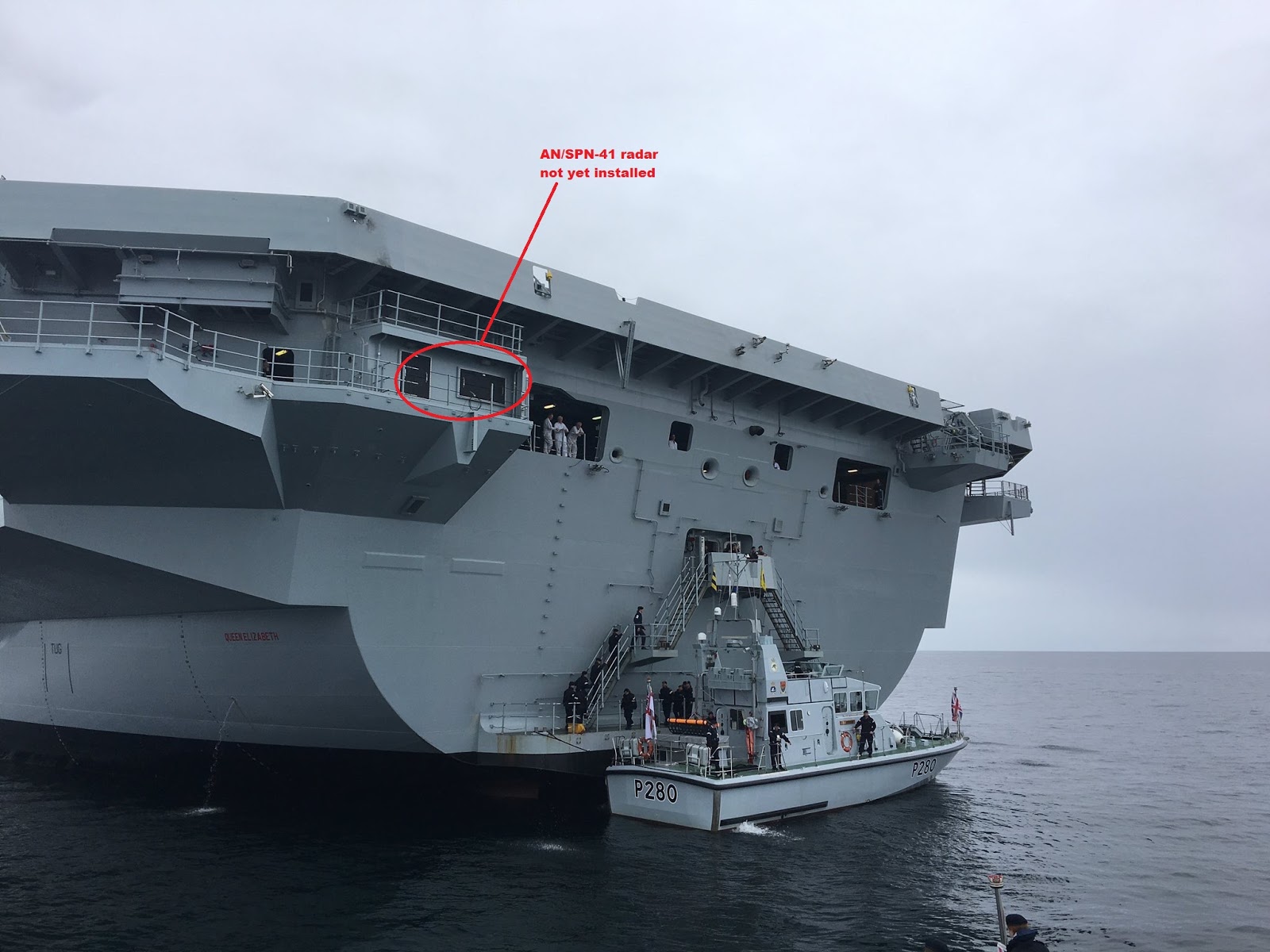 |
| The AN/SPN-41 is among the systems that still have to be installed |

Other equipment yet to be filled includes the Height Indicator Hover Aid Thermometer (HIHAT) which will appear on the forward island. A good view of the main Landing Aid lights and tools is available in the brochure by AGI, which produces them and is working right now on QE in Portsmouth.
Meanwhile,
on September 8, the second ship in class will be named with a ceremony in Rosyth
which will see the Royal Lancers, affiliated to the ship, proving a spear
Guard.

 |
| The USS America as commissioned (top) and following F-35B modifications applied in 2015 (bottom). The shielding of the AN/SPN-41 is evident. Phalanx has moved, with RAM replacing it. This might indicate that RAM is less vulnerable to hot downwash. |
Ship
boats for both carriers are in delivery or on order. Four purpose-built boats
have been ordered for Queen Elizabeth, and two (named Swordfish and Buccaneer)
have already been delivered.
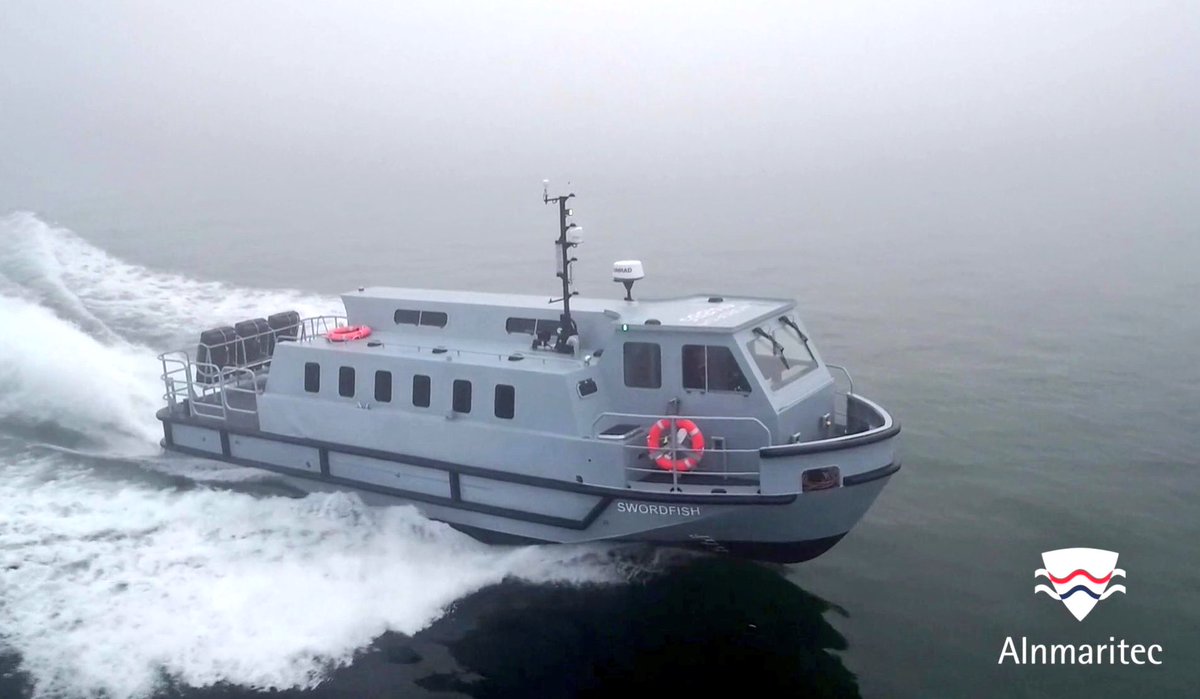 |
| Queen Elizabeth's boat |


 |
| Ship boats and RHIBs are carried in fully enclosed bays in the sponsons |
Prince
of Wales, instead, will receive three boats from the recent contract for “up to
38” workboats of the SEA class. The workboat contracts includes 33 firm orders
and 5 options. Included in the firm order are three boats for Prince of Wales,
while the options include 3 more boats of the same kind.
For
general interest, the SEA class will include 10 workboats (for delivery in Fiscal
Year 2018 (5), 2019 (3) and 2020 (2)), 3 passenger transfer boats plus 3
options, 7 Dive Support Boats (3 in 2019, 3 in 2020), 6 officer training boats
plus 2 options, for delivery in 2020 and 2021; 3 survey motor boats (Medium)
and 3 Survey motor boats (Small).

 |
| SEA class workboats are modular and come in 11, 13, 15 and 18 meters lenght. |
SafeHaven
Marine will deliver the largest boat, a 18-meter WILDCAT60 derivative which
will be delivered in May 2018 and will replace the current HMS Gleaner, which
is soon to leave service after carrying out key survey work to chart the course
out of Rosyth and into Portsmouth for the carriers.
 |
| At 18 meters, the replacement will be a big bigger than the current HMS Gleaner |
Capability build up
Things
will get more interesting next year. HMS Queen Elizabeth is expected to put to
sea between January and March 2018 for Rotary Wing trials and first embarkation
of a Special Purpose Task Group of Royal Marines. The aim is to land Merlin
HC4, Apache, Chinook and Wildcat on the ship and validate the employment of a
rotary wing air group and of an embarked component of Marines up to
Company-group size.
By
August 2018, HMS Queen Elizabeth should achieve IOC as LPH. It is the Royal
Navy’s intention to always embark a Royal Marines SPTG of anything between 50
and 300 marines supported by at least a “unit of action” of up to 4 Merlin HC4
from 845 NAS. The SPTG provides the carrier with a response force that can
quickly move ashore for raids, evacuations of british personnel and, crucially,
for recovery of downed pilots and recovery or destruction of valuable equipment
lost in enemy territory. The F-35 is highly valuable technology and cannot be
allowed to fall into enemy hands other than in very small pieces. Development of
a Joint Personnel Recovery Capability within 3 Commando Brigade is well
underway, and the RAF Regiment is working on JPR training of its own.
This
period of early LPH trials and experimentation will be followed by the already
mentioned period in port for technology insertion, which is meant to prepare
the ship for First of Class Flying Trials. Queen Elizabeth will set sail for
the US East Coast in the autumn. HMS Montrose is currently expected to escort
her there.
The
Royal Navy anticipates to send QE loaded with a Royal Marines force including a
composite rotary wing air component. This will move inland for exercises
alongside the US Marine Corps, while QE will embark 2 instrumented F-35Bs and 4
pilots for 8 weeks of tests and evaluation. Highlight of the trials will be the
experimentation of the Short Rolling Vertical Landing technique, which is of
routine use ashore but that, for the shipboard side, represents an innovation
and something that has so far been trialed only in simulation.
In
March 2018, 617 Squadron will formally stand up in Beaufort, in the US, in time
to celebrate the 75th anniversary of the Dambusters.
In
June 2018 the Sqn will begin its extraction from Beaufort, with a first group
of 4 aircraft flying to Marham, followed by other waves by August. By December,
617 Sqn should achieve Land IOC with 9 aircraft in Marham.
5
more aircraft and around 50 personnel will remain in Beaufort until the summer
of 2019 to repay the USMC of the collaboration and literally provide back
training flying hours. They’ll then move to RAF Marham in time for the stand-up
of 207 Sqn, the OCU for the Lightning fleet, in July 2019.
3
Instrumented aircraft (BK-1, BK-2 and BK-4) will remain in Edwards AFB with
17(R) Sqn for test, development and evaluation purpose.
By
the summer of 2019, work should be complete on the new Integrated Training
Centre being built in Marham. It will have 4 networked full mission simulators,
and the hope is to hook them up as soon as possible with Typhoon simulators in
Coningsby and Lossiemouth as well as with USAF F-35A simulators at Lakenheath
and elsewhere, to enable large-scale collaborative operations within the training
simulation.
By
then, Marham will also have 3 vertical landing pads; a hangar for deep
maintenance, a facility for maintenance and monitoring of the health of the
stealth coating and a new National Operating Centre hosting the UK ALIS
infrastructure as well as the Lightning Force HQ, offices and other key
supports. Drive-through sun shelters will be installed in the area destined to
617 and 207 Sqns operations, and existing Hardened Aircraft Shelters upgraded
for F-35 compatibility.
The
runways (one of 9500 and one of 6500 feet) will be resurfaced and the shorter
one will have an area specifically configured as STOVL strip.
 |
| The Hardened Aircraft Shelters for 617 Sqn, to the left, and the 207 Sqn OCU area, including the Integrated Training Centre, to the right |
 |
| The OCU facilities are entirely new builds, developed on brown land |
 |
| The ITC |
 |
| Maintenance facility, being built in place of the old No3 hangar. Another engineering facility replaces the old No1 as well. |
 |
| From the journal of RAF Marham, the progress in the build |

 |
| Project ANVIL is a massive infrastructure improvement |
In
the summer / autumn of 2019, the intention is to embark 617 Sqn and sail in UK
waters for squadron-level trials and certifications.
In
2020 this will be followed by a larger exercise combining 617 Sqn with the
other elements of the air wing (Merlin from 820 NAS; CROWSNEST from 849 NAS and
so along) and of the surface task group, in order to reach IOC Carrier.

Finally,
in 2021, Queen Elizabeth and her task group are expected to set sail for the
first major operational deployment away from home.
The
UK has received 11 F-35B so far, and by the end of the year they will be 14. 3
more aircraft will be delivered next year (BK-15, 16, 17), while BK-18 will
follow in 2019, alone, as the MOD ordered a single aircraft within LRIP 11.
3
will follow within LRIP 13, for delivery in 2020. 6 more in 2021, 8 in 2022 and
7 in 2023. By the end of 2023 the UK will have 42 F-35B, of which 24 will be in
frontline units as 809 NAS stands-up.
6
more aircraft will follow in 2024, so that by January 2025 the UK will have
taken delivery of 48 F-35B.
The
number of aircraft effectively embarked will depend on the Routine Operating
Model that will be written down.
The
profile of orders beyond Lot 16 (deliveries in 2024) is not yet known. The
latest Major Projects Report released by the MOD has the F-35 programme end
date as 31 March 2035. To receive all of the promised total of 138 aircraft by
then, the MOD should place the last order in 2033, as two years pass between
order and delivery.
Beginning
in 2023 and ending in 2033, the MOD would have to order 8 - 9 aircraft per
year. Not a particularly ambitious target, yet a non insignificant one for a
ministry in perennial budget crisis.
The
greatest threat for the future of embarked fixed wing aviation is the Split Buy
idea that continues to float around as very real threat. More on the split buy
danger here.
Within
the Joint Force, the manpower split is currently expected to hover at around 58
to 42% in favor of the RAF, but with the Squadron’s commanders alternating by
Service.
There
is every intention to have a permanent exchange programme in place with the
USMC, as used to happen with the Harrier, with one UK instructor in Beaufort
within the USMC OCU, and a USMC instructor in the UK within 207(R) Sqn.
For
expeditionary operations, the UK has the same kind of ambitions as the USMC.
AM-2 matting stocks are expected to be rebuilt, and Royal Engineers should
already be involved in USMC expeditionary airfield training at 29 Palms as this
is being written. Next year, a landing strip and pad should appear in Kinloss,
home of the Air Support engineers.
Training
of deck handlers is carried out at the School of Flight Deck Operations at
Culdrose, on the “HMS Siskin”, the dummy carrier deck modified for the new QEC
age. 4 training mock-ups of the F-35B have been procured, and thanks to water
tanks inside their structure they can replicate the various weights of
different load-outs. They are also equipped with cockpits suitable for training
of emergency extraction of injured pilots. Old Sea Harriers, which do not fly
but which have working engines, are used to prepare personnel to the noise and
hazards typical of flight deck operations. The School includes a special
simulator, an enclosed space where personnel can train safely for fire
emergencies.

 |
| 4 Ground Training Aids, Sea Harriers and real helicopters are used for deck training |
Since
late 2015 the School also includes a new Flight Deck Training Simulator which allows
flight deck crews to simulate every aspect of deck operations. Fire fighting
& engineering emergencies, aircraft refuelling, marshalling and multi-spot
landings can be simulated as well as changing sea states and day and night
conditions.
In
terms of capability of the F-35B, the UK is looking ahead to Block IV software
and hardware updates, for integration in four successive incremenets (4.1 to
4.4) between 2021 and 2025/26. The full list of upgrades and additions is still
being finalized by the Pentagon, but for the UK Block IV is defined by integration
of the latest mark of ASRAAM (New Build, or Block 6 if you prefer); of the
bunker-buster warhead variant for Paveway IV; of Meteor and SPEAR 3.
Block
IV should give the F-35 full video downlink capability as well as swap the
current EOTS targeting / FLIR assembly with the Advanced EOTS which offer a
greater resolution, a new TV camera, an IR pointer and a lead-in laser for
improved moving target engagement capability with laser-guided bombs.
A
new processor (Technology Refresh 3, TR3, as opposed to current in-production
aircraft which use the TR2, which supplanted the earlier TR1) a new cockpit
display by Elbit are expected in Block 4.2.
Significant
improvements to the engine, which would make it more powerful and reduce consumption
of fuel by a good 5%, have been proposed but it is not yet known if there will
be room to actually take such mods aboard in the Block IV programme, which is
already quite extensive especially due to the long list of weapons to be added.
The
IOC will be attained with Block 3F instead, which will begin to roll out in the
coming months, and which brings integration of 2 ASRAAM for external carriage
as well as up to 6 Paveway IV (2 internal, 4 external), plus of course 2
internal AMRAAM (or 4 if no bombs are carried internally).
The
UK chose to wait out on the gun pods and only bring them aboard with Block IV,
even though they will be cleared with 3F.
 |
| Phase 2 Ski Jump trials are underway at Patuxent River. Here a F-35B launches with a heavy ASRAAM and Paveway IV external load for the first time. Asymmetric loads and high wind launches are also being validated. |
On
the amphibious side of things, the Royal Navy is working to embody some
unspecified modifications and enhancements on Prince of Wales with the aim of
getting it to a “LPH FOC” status in 2023.
This
is a larger scale capability than the SPTG embarked on QE. Prince of Wales will
embark two company groups of Royal Marines with stores and some vehicles /
light guns as well as a large composite wing of helicopters for their insertion
and support. It will be the de-facto replacement of HMS Ocean (which bows out
early next year) and will be at the heart of the amphibious task group. With
Prince of Wales, 1 LPD and at least 2 of the Bay-class LSDs the Navy intends to
deliver the same 1800-strong Lead Commando Battlegroup envisaged today, with a
greater rotary wing support.
The
Lead Commando Battlegroup is meant to insert simultaneously a Company group by
air assault and a mechanized company group mounted on Viking vehicles by
landing craft from the LPD and LSDs.


The
other companies and supporting elements would follow in subsequent waves.
Prince
of Wales will be able to simultaneously launch 10 to 14 helicopters per wave
thanks to her vast deck.
The
modifications introduced on Prince of Wales should then be applied to Queen
Elizabeth during her first refit around 2026.
The
Navy intends to hold the aircraft carrier at Very High Readiness (5 days notice
to move) with the “LPH” at High Readiness (20 to 30 days notice to move). For
major deployments / operations, the two carriers would deploy together.
There
will be, however, periods in which only one ship is available as the other
enters refit. During those periods it will be more frequent to see mixed air
wings including a smaller number of F-35Bs and a greater number of Marines and
helicopters.
In conclusion
The
current plan is good. There is a lot of work to do, but the project looks solid
and it is particularly reassuring to see the planned development of the
amphibious capability, since the loss of HMS Ocean would otherwise have
catastrophic consequences for the UK’s capabilities in this area. Now we have
to hope that no new budget cuts come to knock pieces off this plan, and that
the split buy idea is killed off, at least until after 4 squadrons of F-35B
have been formed. 4 squadrons plus OCU are the current long-term plan and
already it represents arguably a bare minimum target for a capable, sustainable
fleet which must be able to generate a substantial deployable force. A split
buy would greatly harm the entire project and dramatically reduce the UK’s
ability to actually put jets on the deck.
An important element coming up is the MARS Solid Support Ship which must replace the old Fort Austin, Fort Rosalie and Fort Victoria around the middle of the 2020s.
Next month might provide some clues about this programme as well as Type 31 since the Shipbuilding strategy should (finally!) be released. The MOD plans to brief industry about Type 31 at DSEI, on September 7.
Contract award for MARS Solid Support is expected in 2020. These large ships, fitted with Heavy Replenishment At Sea rigs, will carry the stores, ammunition and spare parts needed to keep the carrier group going. Their role in support of amphibious operations will also be important, so details of their design and of the acquisition schedule are eagerly awaited.

