Babcock has now unveiled its offer
for the Type 31e programme, and in so doing has revealed the full extent and
effect of its alliance with the danish group Odense Maritime Technology (OMT).
The Arrowhead 140 is effectively a Iver Huitfeldt frigate hull with modified
top decks, pushed by an impressive alliance called Team 31 and comprising two Babcock yards, Ferguson Marine and Harland & Wolff.
The Iver Huitfeldt class, in service in the Royal Danish Navy, is an impressive family of ships which have cost surprisingly little for the huge capability they pack. The unitary cost per frigate was 325 million in FY 2010 US dollars, which is extremely competitive for a high end, 6600 tons warship equipped with good sensors and a big silos of 32 Strike Length MK41 cells flanked by MK56 launchers for 24 ESSM. Up to 16 Harpoon are also carried. Of course, that is in no small measure possible because OMT includes the commercial shipping colossus Maersk, but Denmark is confident that it can offer good deals for customers abroad as well, and OMT and Babcock apparently believe that they can build the Arrowhead 140 in british yards, staying within the infamous 250 million all-in price.
Arrowhead 140 Brochure by Liger30 on Scribd
The Iver Huitfeldt design makes limited but important use of the StanFlex concept in which modular “wells” are provided in the design for the easy slotting in of capability modules, for example the guns. The ships have been delivered with re-used Oto Melara 76mm guns in StanFlex modules, with the option of installing a 127mm later on. The total budget for three ships was 940 million USD plus 209 million USD in reused equipment. Spread on three hulls, it gives a total pricetag of 383 USD million per ship.

 |
| Shock Testing with explosive charges was carried out in late 2010 |
The ship is fit to receive a
variable depth sonar but was delivered fitted only with an hull mounted one.
The propulsion arrangement is CODAD with 4 MTU8000 diesels delivering 32800 KW
of power to two shafts. The ship’s max speed is given as 28 knots, although it
has demonstrated 29.3 knots, reaching them in under 120 seconds during trials. Range
at 18 knots is a flattering 9300 nautical miles.
Babcock’s Team 31 proposal would keep
the hull unchanged and focus on relatively minor modifications to the top
decks. Obviously, sensors and weapons fit would also change. This would cut
down design costs to the very minimum, and still give the UK a proven hull
which was put even through explosive shock testing. The Iver Huitfeldt achieved
their cost-effectiveness by making large reuse of design features from the
Absalon class, and the Arrowhead 140 seeks to pull through even more content
from the Huitfeldt themselves.
Compared to the Danish ships, the
Arrowhead 140 is expected to be lighter, at 5700 tons, with a reduced draft
and, one assumes, benefits to range and speed while maintaining very
significant margins for working weight back in with design variations for
export and/or capability insertions through life.
The design trades out the MK56
launchers in favor of two extra boat bays / mission spaces. The Arrowhead 140
is being marketed with the Thales TACTICOS open architecture combat system and
with Thales NS100 AESA radar enclosed within a conical mast
topped by IFF array, although some images of the “Royal Navy variant” seem to
carry an Artisan 3D on a different mast.
24 CAMM missiles in a “mushroom
farm” silos are seen in place of 32 MK41 cells amidships, although the design
maintains the capability to fit the strike length cells. The gun seems to be an
Oto Melara 76mm.
The Danish ships, which operate as
the principal AAW platform of the navy and which may one day soon serve in the
anti-ballistic role as well, operate with a crew of around 117. At one point
they hoped to make do with as few as 99, but that proved a step too far. Still,
it is a very impressive achievement and the Type 31e, given its simpler mission
and weapons fit, should be perfectly able to make do with fewer, while
retaining plenty of space for the at least 40 EMF spaces the RN hopes to have
on the vessel.
 |
| The impressive firepower of the Iver Huitfeldt class: 32 Strike lenght MK41 cells flanked by MK56 launchers for a total of 24 ESSM missiles. |
The proposal seems solid. There
probably isn’t another hull which is proven, cheap and capable as that of the
OMT design. BAE System’s Leander is based on the Khareef class corvette,
stretched longer, and does not compare all that well. It is also arguably
riskier, because while the Arrowhead 140 would literally take the hull and
propulsion “as is”, the Leander would require changes, albeit relatively minor.
Babcock’s offer is now truly
interesting, and there is even a possibility that the Arrowhead 140 might make
a surprise foray into the FFG(X) competition for the US Navy. Huntington
Ingalls Industries (HII)’s sudden silence about its proposal for what could
become an immensely important shipbuilding contract has got some people
thinking. Craig Hooper has recently raised the prospect of a Danish incursion
into the competition, and he correctly notes that the Iver Huitfeldt design is
not without its fans in the US. The Royal Danish Navy has been promoting its
ships for years and organized a successful tour in the US as far back as 2014.
He might or might not be on the right path with his analysis, but it is
certainly a fascinating prospect and one which is not without merits.
Danish Frigate Program brief_May 2014 by Liger30 on Scribd
Leander or Arrowhead 140?
At the moment, the Team Arrowhead and the Team Leander seem to be the leading contenders. Moreover, if the Arrowhead 140 truly can fit
the Type 31 budget, the Cammell Laird/BAE Systems ‘Team Leander’ design is now
in an uncomfortable spot. Babcock’s proposal now looks more convincing: much
larger and more adaptable, both through life and for export; considerably
greater speed (28+ knots against 25) and endurance (9000+ nautical miles at 18
knots compared to 8100 at 12); much greater space for weapons (easily
configurable for 32 MK41 Strike Length versus 12 small SAM cells up front and a
single 8-cell Strike Length amidship for Leander). Both ships claim the
possibility of fitting guns up to 127mm, but Arrowhead’s claim is more
immediately belieavable. The tightness of the Type 31e budget might mean that
this is not relevant for the Royal Navy as funding a 127mm gun might be out of
the question, but adaptability for the future, as well as for potential (albeit
unlikely) export orders is still key.


 |
| Navy Recognition obtained these BAE images at DIMDEX 2018 |
The Team Leander now claim that the flight deck of their ships will be rated for 16 tons helicopters, which would accommodate Merlin operations, while for the hangar they are reporting “up to Sea Hawk plus UAV”, but conspicuously not mentioning Merlin. The Arrowhead 140 would be fully Merlin compatible from day one, and this for me is a major factor, even though the Royal Navy will struggle to have many Merlin for frigates since their main focus will be the aircraft carrier group. With the merger of 829 NAS into 814 NAS there are now only 3 flights permanently focused on Small Ship Deployments (Tungsten, Kingfisher and Mohawk Flights) and their priority will be the Type 26, but this is still not a reason to be unable to operate with the most important machine in the Fleet Air Arm’s arsenal.
BAE Systems Type 31e Candidate Design by Liger30 on Scribd
A spacious hangar should always figure high up on the list of requirements: even with Wildcat being the most likely visitor, space is always precious, especially since the expectation is that UAVs will become a common feature in the next decade. The last thing the Royal Navy needs is a ship with handicapped aviation facilities causing headaches already a few years after entry in service.
The Arrowhead 140’s problems, in
turn, are its use of a new main radar and of a new Combat Management System at
a time when the Royal Navy has heavily invested in commonality and fleet-wide
fits. Artisan 3D, Common CMS and Sharpeye navigation and air direction radars
are now fleet-wide standards and departing from them would imply unnecessary
costs and complexities.

 |
| The CGI of the "british variant", the Arrowhead in Type 31 guise, clearly uses a different mast from the one seen in the video. The radar on top looks a bit small to be Artisan, but it probably represents it nonetheless. MK41 cells are replaced by (surprisingly few) Sea Ceptor "mushrooms". |
The Arrowhead 140 team includes Ferguson
Marine on the Clyde, Harland & Wolff in Belfast and the Babcock Appledore
facilities in Devon and in Roysth. Judging from the brochure, each shipyard
would build a “superblock” that would then be shipped out to Rosyth for final
assembly.
 |
| Note that the various partners seem to have already decided which superblock they will build. Rosyth is proposed as final assembly facility. |
This spreads the financial and
technical benefits of the programme across the wider shipbuilding industry, but
would cut out Cammell Laird at a time in which it is arguably the most
successful shipbuilder out there, picking up new orders for ferries; while building the impressive new Polar Research Vessel, the RRS Sir David Attenborough.
Pick a design and enlarge the consortium?
I’m not in a position to make
choices, obviously, but I come back to my original points about theShipbuilding Strategy to at least make my recommendations.
A Financial Times report recently
said that Babcock is very active on the Fleet Solid Support requirement as
well, and is talking to BAE and others to craft a joint, british bid for this
1-billion pound programme which will involve building two or three ships in the
40k tons range. In other words, a lot of precious work.
Building the FSS in blocks around
the country and assembly in Rosyth’s big dock, on the lines of what has been
done for the carriers, remains an attractive option.
The best possible outcome, in my
mind, would be to have the Fleet Solid Support work staying in the UK, with
assembly in Rosyth.
For the Type 31 the best possible
outcome would be selection of the Arrowhead 140 design, followed by enlargement
of the consortium to include the other team. The main reasons are that the Type
31 should be fitted with the BAE-developed Common CMS on shared infrastructure
as the rest of the fleet, in the interest of commonality. It should also be
fitted with the Artisan radar, again in the interest of fleet standardization,
especially considering that there will be up to 8 spare systems available as an
effect of 5 coming off the Type 23 GPs as they are withdrawn plus the 3 new
sets purchased to avoid shortage of components during the delicate transition.
For those who might have missed this
development, the Royal Navy has actually purchased 3 new sets of main equipment
pieces for the first three Type 26 ships, in order to avoid having to pull Type
23s out of service early to strip pieces off them, refurbish them and deliver
them to the shipyards.
Since then, however, it has become
clear that the Type 26 assembly will be a very slow affair: parliamentary under-secretary for defence Guto Bebb is on record saying that the first ship in the class, HMS Glasgow, is due to be accepted by the Royal Navy in summer 2025 and then, after trials and preparations, enter service in 2027. In theory, this is acceptable because the first Type 23 in ASW configuration, with 2087 towed sonar, would leave service in 2028 under the last known plans.
Despite the Royal Navy's careful approach with the ordering of three extra sets of equipment to avoid having to remove equipment from the Type 23s early on, it is also painfully evident that Type 23s might effectively go out of service early anyway. It must be remembered that at least one ship from the class in the last few years has been tied up in mothball, serving as harbor training vessel because of the enduring shortage in manpower. Even more ominously, the Fishery Protection Squadron is currently down to a single ship as OPVs leave service early to allow the crews to transition to the new ships, and even this has had to be aided by using some of the MCM crews, given "on loan" to the Squadron (Project JICARA). I'm sure the Navy hopes to solve the worst of the manpower crisis at some point, and the last few reports show that it is the only service with an inflow matching or exceeding outflow, but technical roles are difficult to form, and the percentage of fully trained manpower is the lowest in the three services, shy of 90%. At the moment it is hard to be optimistic, and even harder to imagine that the frigates transition can be any easier than the OPVs. If anything, it'll be much more complex.
Note: the OPV transition and project JICARA
The Royal Navy has up to 16 MCM crews, 8 in Scotland (MCM 1 Sqn, Faslane) and 8 in Portsmouth (MCM 2 Sqn). They rotate on and off the Sandown and Hunt class ships respectively.
Under JICARA:
Beginning from 1 April 2017, MCM2 Crew 6 moves from the minesweeper HMS Middleton onto HMS Tyne, allowing the crew of the latter OPV to transition to the new HMS Forth.
They were later relieved by the crew of the Hunt class minesweeper HMS Atherstone after this ship was suddenly decommissioned as part of emergency budget cuts in December 2017 while she was already in the shed for her refit and life extension.
HMS Forth commissioned on 13 April 2018, but remains alongside for defects rectification and final preparations. She is not yet ready for patrols, and anyway seems to be earmarked for replacing HMS Clyde down in the Falklands. HMS Clyde's out of service date is currently unclear.
HMS Tyne has decommissioned days ago, on 24 May 2018.
MCM2 Crew 7 moved from the MCM vessel HMS Ledbury onto HMS Mersey and will stay on the OPV until she decommissions (expected to happen this November). Mersey is currently the facto the only Fishery Protection Vessel actually patrolling UK waters.
Thanks to the MCM crew stepping in, personnel from Mersey can move on to the new HMS Trent.
The Royal Navy should this month accept the new HMS Medway, which is crewed by personnel from HMS Severn, the first River Batch 1 to be decommissioned, on 27 october 2017.
HMS Medway will then make ready to begin operational patrols early in 2019.
It seems likely that, with the number of MCM ships dropping, some of the crews will permanently become part of the OPV squadron to take in the additional River Batch 2s. The possible re-activation of the River Batch 1s parked in reserve waiting for a government decision is another factor.
- Ends
Type 23 OUT
OF SERVICE DATE (February 2016
assumption)
HMS
Argyll 2023
HMS
Lancaster 2024
HMS
Iron Duke 2025
HMS
Monmouth 2026
HMS
Montrose 2027
HMS
Westminster 2028 [ASW]
HMS
Northumberland 2029 [ASW]
HMS
Richmond 2030 [ASW]
HMS Somerset
2031 [ASW]
HMS
Sutherland 2032 [ASW]
HMS
Kent 2033 [ASW]
HMS
Portland 2034 [ASW]
HMS St Albans 2035 [ASW]
HMS St Albans 2035 [ASW]
Despite the Royal Navy's careful approach with the ordering of three extra sets of equipment to avoid having to remove equipment from the Type 23s early on, it is also painfully evident that Type 23s might effectively go out of service early anyway. It must be remembered that at least one ship from the class in the last few years has been tied up in mothball, serving as harbor training vessel because of the enduring shortage in manpower. Even more ominously, the Fishery Protection Squadron is currently down to a single ship as OPVs leave service early to allow the crews to transition to the new ships, and even this has had to be aided by using some of the MCM crews, given "on loan" to the Squadron (Project JICARA). I'm sure the Navy hopes to solve the worst of the manpower crisis at some point, and the last few reports show that it is the only service with an inflow matching or exceeding outflow, but technical roles are difficult to form, and the percentage of fully trained manpower is the lowest in the three services, shy of 90%. At the moment it is hard to be optimistic, and even harder to imagine that the frigates transition can be any easier than the OPVs. If anything, it'll be much more complex.
Note: the OPV transition and project JICARA
The Royal Navy has up to 16 MCM crews, 8 in Scotland (MCM 1 Sqn, Faslane) and 8 in Portsmouth (MCM 2 Sqn). They rotate on and off the Sandown and Hunt class ships respectively.
Under JICARA:
Beginning from 1 April 2017, MCM2 Crew 6 moves from the minesweeper HMS Middleton onto HMS Tyne, allowing the crew of the latter OPV to transition to the new HMS Forth.
They were later relieved by the crew of the Hunt class minesweeper HMS Atherstone after this ship was suddenly decommissioned as part of emergency budget cuts in December 2017 while she was already in the shed for her refit and life extension.
HMS Forth commissioned on 13 April 2018, but remains alongside for defects rectification and final preparations. She is not yet ready for patrols, and anyway seems to be earmarked for replacing HMS Clyde down in the Falklands. HMS Clyde's out of service date is currently unclear.
HMS Tyne has decommissioned days ago, on 24 May 2018.
MCM2 Crew 7 moved from the MCM vessel HMS Ledbury onto HMS Mersey and will stay on the OPV until she decommissions (expected to happen this November). Mersey is currently the facto the only Fishery Protection Vessel actually patrolling UK waters.
Thanks to the MCM crew stepping in, personnel from Mersey can move on to the new HMS Trent.
The Royal Navy should this month accept the new HMS Medway, which is crewed by personnel from HMS Severn, the first River Batch 1 to be decommissioned, on 27 october 2017.
HMS Medway will then make ready to begin operational patrols early in 2019.
It seems likely that, with the number of MCM ships dropping, some of the crews will permanently become part of the OPV squadron to take in the additional River Batch 2s. The possible re-activation of the River Batch 1s parked in reserve waiting for a government decision is another factor.
- Ends
With the Type 31e supposedly
entering service one per year from 2023, replacing the Type 23 GPs one by one,
it seems like the spare Artisan radars, Sea Ceptor launchers, etcetera will be
more useful on this class rather than on the 26s. For the 26s there should be time to employ equipment taken off from the 5 GP Type 23s as they decommission, at this point.
It is not entirely clear yet, but the Royal Navy appears to also have ordered 3 new 2087 towed sonars, that added to the 8 installed on Type 23s ASW give a total of 11.
Once the equipment from all Type 23s
is removed and refurbished, the UK will have reusable equipment for 16 ships,
including 11 Type 2087 sonar arrays.
One has to hope that, whichever design is chosen for Type 31e, this treasure is not squandered. Fitting the “extra” 2087s (if there truly are three full such sets: Thales has received a contract but has not specified exactly what is included) to three of the Type 31e would be immensely beneficial, even though Type 31e will never match the expensive acoustic stealth of the super-specialized Type 26. It would be a low cost expansion to ASW capabilities that would come as a logic consequence of the recognized increased threat coming from submarines lurking in the North Atlantic as Russia probes british waters. It would also make the Type 31 far more belieavable as Fleet Ready Escort, a role she is supposed to cover but that, without a proper sonar fit, would still require a Type 26 to be kept at readiness as on-call Towed Array Patrol Ship to respond to submarine incursions in home waters. Having at least 3 Type 31 with wider ASW usefulness would then truly begin to take some tasks off the Type 26s' shoulders, allowing the latter to focus on high end training, NATO groups and carrier task group.
One has to hope that, whichever design is chosen for Type 31e, this treasure is not squandered. Fitting the “extra” 2087s (if there truly are three full such sets: Thales has received a contract but has not specified exactly what is included) to three of the Type 31e would be immensely beneficial, even though Type 31e will never match the expensive acoustic stealth of the super-specialized Type 26. It would be a low cost expansion to ASW capabilities that would come as a logic consequence of the recognized increased threat coming from submarines lurking in the North Atlantic as Russia probes british waters. It would also make the Type 31 far more belieavable as Fleet Ready Escort, a role she is supposed to cover but that, without a proper sonar fit, would still require a Type 26 to be kept at readiness as on-call Towed Array Patrol Ship to respond to submarine incursions in home waters. Having at least 3 Type 31 with wider ASW usefulness would then truly begin to take some tasks off the Type 26s' shoulders, allowing the latter to focus on high end training, NATO groups and carrier task group.
So, of course, it probably won’t
happen.This is the british government and MOD we are talking about, after all. Rhetoric is never matched by facts.
The availability of radars, decoys,
missiles, light guns, even sonars and other sensors and components should be
seen as a blessing and incorporated into Type 31e whenever and wherever
possible.
Purchasing new radars while having
spare Artisans is something I certainly wouldn’t recommend.
Finally, I’d ideally want to see the
Type 31 assembled south of the Scottish border. Cammell Laird is my ideal
candidate for that. Aiding the revitalization of Birkenhead would be an
insurance policy against the SNP and a strong political message.
One of the (undoubtedly numerous)
difficulties with such an approach is the fact that the Type 31e and FSS
timelines do not align. The contract award procedures for the FSS are expected
in 2020, while Type 31e should clear that stage already next year. Without FSS
work for Rosyth and for the other shipyards it will hardly be possible to
negotiate such a change in plans.
This is the kind of conundrum that I
hoped the Shipbuilding Strategy would finally end, but the document did not go
far enough and did not commit the government to any specific path forwards for
shipbuilding capability. It is still down to the individual programmes to
determine the future of british yards, and without real multi-programme
coordination there will continue to be gaps.
Together, FSS and Type 31e could
truly be transformational for the british shipbuilding sector, but only if they
are considered as part of a truly joined-up strategy.
Speaking of Fleet Solid Support…
The MOD has published the call for
bids for the programme, and the three ships requirement has translated into two
firm and one option, a development that, given previous history, does not
inspire confidence.
Among the cuts and reductions caused
by Strategic Defence and Security Review (SDSR) in 2010 was the removal of the
requirement for concurrent, geographically displaced Carrier Strike and
Littoral Manoeuvre task groups. With Carrier Enabled Power Projection and the
final acceptance of a future without HMS Ocean came the necessary unification
of all the remaining resources in the single Response Force Task Group.
Among the other implications, the
once separated Fleet Solid Support Ship and Combat Support Ship Auxiliary requirements
were finally merged into a single FSS class of 3 hulls.
The Naval Design Partnership Team
was then asked to produce a series of designs to assess the technical
feasibility and cost implications of this requirement merge. The main result
was the famous image of a modern, large joint supply ship including provisions
for the carrying of a couple of LCVPs as well as a well deck in the stern. Both
additions obviously came from the Combat Support Ship Auxiliary requirement,
earlier still known as the Joint Sea Based Logistics requirement, which was to
provide afloat supply and support to forces ashore.

 |
| The design initially put forwards by the NDP. Fascinating, but probably never to become reality. Note the two Heavy Rigs on the port side, for QE class replenishment. |
That design has probably been deemed
too expensive, however, and the latest images coming out of the NDP through
DE&S suggest that the Fleet Solid Support vessel is losing all of the more
“amphibious” features in favor of a design very much in line with the American
T-AKE “Lewis and Clark” class.

 |
| A US Navy CVN aircraft carrier receiving stores through one of the aircraft lift openings. The same method is used by the QE class. |
In turn, the uncertain fate of the
amphibious capability as a whole might be part of the reason why the third ship
is now only an option. If the Modernising Defence Programme ends up destroying
the amphibious capability, the third vessel might simply not be needed anymore.
The T-AKE class is not incapable to
support an amphibious force ashore, but obviously is not optimized for the role
as the earlier NDP design would have been thanks to the well deck. The USNS
still keeps two T-AKE ships within the USMC Prepositioned groups, using the
vessels to carry the vast range of stores needed for an amphibious operation.
The new NDP design, which very closely follows the general ships arrangement,
would be similarly able to crane stores into landing crafts and sustain a force
ashore.
As a solid stores vessel, the T-AKE
is very rationally arranged, with all accommodations grouped in the single
citadel on the stern rather than split at the two ends like in the earlier NDP
design which was closer to the current Fort class in general shapes.
A single, full-width cargo
preparation deck runs from the bow to the flight deck on the stern, and
multiple heavy RAS rigs are provided. The british design has three rigs on the
port side and, apparently, a single rig on starboard. This is because the first
and third rig on the port side are specifically spaced out to “meet” the
aircraft lifts opening of the Queen Elizabeth class carriers, which are fitted
to receive the heavy stores. The two rigs remaining, one per side, would be
used to support the other ships.
The american T-AKE also carries and transfers fuel, while the british ship will not. The Royal Navy has chosen to keep the two roles well separated: Tide class for fuel, FSS for stores and ordnance.
The american T-AKE also carries and transfers fuel, while the british ship will not. The Royal Navy has chosen to keep the two roles well separated: Tide class for fuel, FSS for stores and ordnance.
 |
| The latest FSS CGI, as published on the latest DE&S annual department plan. |
 |
| A USNS Lewis and Clark T-AKE supply ship. |


Until the new FSS enter service, in
the second half of the 2020s, the QE class will be supported by RFA Fort
Victoria, which is currently in refit to prepare for
the “new” role. In
order to comply with today’s regulations she is being double-hulled since she
carries not only solid stores but also fuel and oils.

 |
| The Heavy RAS receiver on HMS Queen Elizabeth, deployed for use and folded away. The Queen Elizabeth class can receive fuel from two stations on the starboard side and simultaneously take on stores from the port side. Refueling station is available also on port side. |
She will not be refitted
with the new heavy RAS equipment, so she’ll only be able to transfer loads of 2
tonnes rather than the 5+ enabled by the new Rolls Royce kit already
demonstrated on land at HMS Raleigh.
Drop one FSS, convert two Points?
What if FSS followed the path of the
Type 26, which came out of the merge of what had originally been planned as two
separate frigate classes, and eventually was cut back with the appearance of
Type 31e?
Instead of building a third
expensive and not truly fit-for-role FSS to support the amphibious force, I
would suggest that, for a much smaller investment, the UK could re-acquire the
two Point class RoRos it dismissed in 2011 and convert them in a way similar to
what the US have done with the virtually identical MV Cragside, now MV Ocean
Trader.
The US conversion had the Special
Forces in mind and focused on adding a lot of spaces for planning, training,
accommodation for up to 207 embarked forces with endurance of 45 days. Multiple
davits for a variety of boats and assault craft are provided at the sides and a
jet skis launch and recovery system was also required. The requirements as
published included carrying 12 20 foot containerized equipment stowage module
and 22 11-feet lockers for weaponry. The flight deck can accommodate any
helicopter including the large Chinook, the MV-22 Osprey and the even larger
CH-53. The hangar has two bays, each large enough for a MH-60 class helicopter,
and spaces for aviation support and maintenance are provided. For aviation and
craft fuel, the requirements specified the possibility of using containerized
tanks but specified armor protection for them in that case. A single RAS
station is specified, to enable the reception at least of fuel. A vast boats
storage and maintenance area, conference and planning rooms, communications,
dedicated space for UAV detachment and lots of different storage solutions were
also required. The capability the ship can express is impressive, but in the American
case also very Special Forces specific.


 |
| The MV Cragside before and during conversion. The photo during the conversion makes it easy to identify the boat bays being opened in the sides, and the new blocks of superstructure: the double hangar and the big, white, windowless extension of the citadel towards the stern. |
But the space available is such that
organizing afloat workshops; transporting stores and vehicles and supporting
aviation through the construction of a flight deck and hangar like on the Ocean
Trader are real possibilities.
The Point class continues not to
have a well deck, but on the other hand has already demonstrated the
feasibility of opening the stern cargo ramp out at sea, weather permitting, to
enable the roll in and out of vehicles over mexeflote rafts.

 |
| These photos by David Kozdron, published by Tyler Rogoway on TheDrive.com. show the "MV Ocean Trader" as she is today. Note the hangar, the abundance of antennas, the stealth boats on the davits and the two hangar bays, plus what looks like Insitu catapult and recovery hook-wire system for UAVs like Scan Eagle and Integrator. |
Converted container ships of this
kind could provide the afloat support the amphibious forces needs. A ship could
also be relatively easily transformed into a RFA Argus replacement, embarking
hospital facilities.
Moreover, these ships could replace
the Bay class vessels tied down in the Caribbean and in the Gulf respectively
on Humanitarian Assistance & Disaster Relief (HADR) and MCM support. That
would make them twice as useful to the amphibious force.
 |
| Canada's Irving Shipbuilding put out its own proposal for a Point-like containership conversion, . |


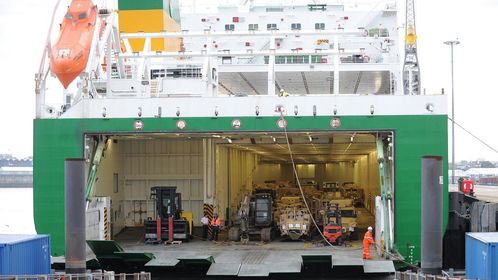 |
| Point Ro-Ro and Mexeflote operations. |
Point class Ro-Ro ships by GabrieleMolinelli on Scribd
Personally, I’d gladly trade out the third FSS for a number of converted civilian vessels like these, especially because the alternative is losing RFA Argus possibly as soon as 2024 almost certainly without replacement as well as continuing to struggle to put together an amphibious task group because the necessary ships are stuck in other long-term roles abroad.


