Saturday, May 4, 2013

My alternative proposal for Army 2020

I promised quite some time ago now that i would try and take a shot at a coherent, realistic, alternative Army 2020 plan, which would not move away from the 82.000 regulars and 30.000 phase 2-trained reservists numbers. No fantasy fleet, in other words, but a serious, disciplined attempt, because of course it remains an exercise of theory, to put together an alternative structure.


My planning has been done building on a number of firm points:

Army 2020 is not just about manpower. It is about training and basing infrastructure as well. If i suggest a whole different army structure, like the original plan for five multirole brigades each comprising heavy armor, i must plan for fewer battalions, because i'll need to move money out from the personnel budget to spend it on infrastructure to prepare other bases around the country for the arrival of heavy armor. New training areas will be needed, and this will imply big expenditure.

I'm sticking to the basing plan released by the MOD as much as possible. I think the basing of the army brigades and units is one of very few things that have been done with real wisdom in these three years. Mind you, there are still challenges, but it is a very good basing layout overall.
Moreover, it reprensent a financially realistic plan. I could suggest different choices, but i could not realistically cost them and say that they would be achievable with the same budget.

I'm not going back to the multi-role brigades because they imply some real challenge in terms of training areas and infrastructure. It is a wise thing, overall, to have the "peacetime" brigades divided by role and by geographic considerations. Salisbury Plain is the right place for the heavy armour. Complementary capabilities, lighter in nature, will come from other brigades.


The above points explain what i'm not changing. But there are other considerations that have made me take several choices different from the ones made by general Carter's team.

The UK's first line of defence is represented by the two high readiness brigades: 3rd Commando and 16 Air Assault. These two brigades are planned to sustain a very challenging rhythm, generating, constantly, battlegroups to keep at very high readiness: the 1800-strong Commando Lead Battlegroup and the 1300-strong Air Assault Lead Battlegroup. This is an Army 2020 / SDSR firm point, which has been, in my opinion, badly betrayed by the choices made in terms of force structure.

I'm fine with the removal of 1st RIFLES battalion from the Commando brigade, but i'm absolutely opposing the reduction of the brigade's engineer capability to the sole 59 Independent Squadron plus Reserve Squadron. It is an insufficient level of engineering support to enable the brigade to deploy whole without being reinforced by other elements scraped up from some other formation, and, worse, it is too little to ensure that the constant formation of serious battlegroups at high readiness can be formed.

A battlegroup should comprise one Commando battalion, one artillery battery, one Commando Logistic Task Group comprising the medical capability and surgical group, C4I capability from 30 Commando IX and one squadron of Engineers.
All elements can be sustained, in general, save for the Engineer component: how can a single squadron, even with a reserve capability available, sustain a constant state of high readiness? It just won't be able to do it.
And the Commando battlegroup will end up weak on combat engineer support, despite the Agile Army studies saying that combat engineering will be high in demand in future ops.

My first move is to keep 24 Commando Engineer Regiment, with HQ Sqn and three regular squadrons. 59 Independent Sqn currently holds most of the capabilities of an HQ Sqn, being alone in the role, so the manpower impact mostly comes from the need for two more field squadrons.

16 Air Assault brigade, has no combat engineer problem, but has its own issues too. First of all, the reduction to just two regular battalions plus 4 PARA (Reserve). Again, this just doesn't do the job in my opinion.
In my army structure, i resurrect an old plan, dating back several years, and assign the british-based Gurkha battalion to 16AA Brigade. The battlegroup at High Readiness will have to be a mixed battalion, formed by two Aviation Companies, good for helicopter assaults and for running out of a C130 following a tactical landing, plus a parachute-current company, capable to airdrop if and when necessary. The Gurkha battalion will be tasked to provide Aviation Companies, obviously. No parachute training, there's no money (and arguably no need for additional capability other than the enduring ability to airdrop a single Company group at any one time).

The Gurkha battalion is chosen because it is based in an acceptable position, and because it is not a formation that has problems recruiting and staying fully manned. 
This change is roughly manpower neutral.

I'm also proposing the formation of a new unit for the air assault brigade: an HQ Troops / Information Exploitation battalion on the model of 30 Commando IX.
This formation would be built up using the RMP element, the brigade HQ, 216 Signal Sqn and Pathfinder Platoon, and it would continue to draw from other army formations for additional capabilities: an air defence troop with Starstreak LML taken out of 12 Royal Artillery, EW teams from 14 Royal Signal regiment and so along.
The manpower increase would come from the re-formation of the 1st Airborne Reconnaissance and Surveillance Squadron (which would build on the history of the WWII airborne reconnaissance sqn), which would include in its strenght the current Pathfinder platoon but would add a standing Brigade Recce Force dedicated to the particular needs of 16 AA Brigade. The Squadron would have Jackals as main vehicle.

Note that there is a possibility that this move would actually be manpower neutral: so far, the Household Cavalry regiment has had an additional squadron in its establishment in order to provide recce support to 16AA. It is not clear if this will continue, under the current planning.

These changes are meant to better and more realistically enable the High Readiness brigades to cover the roles they have been given.


Flexibility must be real, not a catchword. The current Army 2020 plan abuses, in my opinion, of virtual "centralisation" of support units under specialised brigade HQs. I think this arrangement adds no flexibility at all, especially when we consider that the regiments are configured very differently depending on wheter they are Reaction Force-oriented or Adaptable-oriented.
The basing plan has also made good, rational efforts to base regiments in the best possible locations depending on their configuration.
Why have the three Reaction Force's artillery regiments in Larkhill, near the manoeuvre brigades they are meant to support, only to subordinate them to an "Artillery Brigade" based in Tidworth which is also supposed to control regiments located as far away as Newcastle?
It just makes no sense to me. It adds nothing good to the army's capabilities. It possibly hinders them, in fact.
I can't think of another major NATO power even considering the same idea. Not the US, not France, not Germany, not Italy.

My opinion is that intimate combat support elements must remain an integral part of the manoeuvre brigade, especially when the basing plan makes it possible.
So:

1) Disband 1st Artillery Brigade, re-subordinate artillery regiments to the relevant brigades.
2) Move Close Support Engineer regiments out of 8 Engineer Brigade back to the brigades.
3) Move Medical regiments back to the brigades' control.
4) Directly assign to the brigades their Close Support REME battalions.

The same could perhaps done to Logistic (RLC) regiments as well, but in their case it might make more sense to have them in two Logistic Brigades, assigned each to one of the two main deployable brigades.
The Logistic Brigades will include the Force Support REME battalions as well.

The Adaptable Force as currently envisaged in my opinion kind of forgets one of the main points of Carter's own assumptions: an Army is for warfighting, first and foremost. The structure of the Adaptable Brigades as of now is unnecessarily complicated and confused. There are, in the plan, three "main" Adaptable Brigades, but in the facts they are paper tigers, weakened by having their establishments hindered by the need to sustain Cyprus and Woolwish (Public Role) deployments.
Since it is possible to make sure that these brigades are properly configured at all times, with 3 manoeuvre battalions in force, i can't see why we shouldn't do that.

These three "main" brigades will be, as now, the Cottersmore-centered 7th, the Catterick-centered 4th and the Edinburgh-centered 51st.
Some Infantry battalions will need to be subordinated differently from what is now planned. The three mechanised battalions for the Reaction Force will now be the ones based in Aldershot. The change basically means removing from the role 4 SCOTS, which is based as far away as Catterick.
4 SCOTS will now be part of 4th Brigade instead, alongside with 2nd LANCS, which currently would respond to 42nd Brigade.
7th Brigade will assume command of the Guards battalion posted to Pirbright, while the battalion rotating into Public Role at Woolwich will fall, for the duration of its posting there, under the command of the Guards brigade.

In this way, it is possible to keep the strenght of the manoeuvre brigades up, even as battalions rotate in and out of Cyprus and Public Duty.

In an additional effort to make these brigades genuinely deployable, i'm giving them the combat support elements as well. The current Army 2020 plan includes two regular engineer and artillery regiments for the Adaptable brigades, because it privileged the achievement of the minimum number of five enabler formation per each role, so to support the capability for enduring brigade-sized deployments in the future.

I'd like to go a little bit further, and give all three brigades an artillery and engineer capability, so that the three main Adaptable Brigades can do their own 36-month readiness cycle complete of their enablers and thus ready to tackle deployments abroad in operations of some complexity. To do so, i'd backtrack from the plan to disband 40 Regiment Royal Artillery and 28 Regiment Royal Engineer, and use integration of regulars and reserves to keep these two formations at full strenght with minimal change to regular manpower figures.
From the current plan, which calls for 2 regular and 2 reserve Light Gun artillery regiments, i'd move to a plan with three mixed regiments, each with two regular and two reserve batteries.

My assumption (and the Army's one as well, it would appear) is that, to "equal" a regular sub-unit availability with a reserve sub-unit, you need to have two reserve sub-units. This is due both to manpower and training worries regarding the reserves, both to the fact that reservists can only deploy for a 6-month tour once in a 5 years period, while the regulars would do two tours in the same timeframe.
Having two reserve sub-units is meant to make it realistic to expect that the regiment could deploy with a mixed regular/reserve manpower delivering a full three batteries / squadrons /companies without exceding harmony guidelines.

Guidelines for the employment of Reserves

In the engineer field, it would appear that the plan already is for two integrated regiments, with 2 regular and 2 reserve squadrons each.
I would add a third regiment equally configured, at the expense of one of 3 currently planned Force Support engineer regiments (Reserve).
For the regulars, this means one additional RHQ and two additional engineer squadrons. 

Two regular medical regiments are already planned. A third regiment could be provided via an adequately reinforced reserve regiment.

The REME situation is the same: 2 close support regular regiments can be completed by a reserve REME battalion, taken away from a currently planned 4 Force Support battalions for the Adaptable Force.

On the Logistics front, there are two regular Force Logistic regiments planned for the Adaptable Force. The Force Logistic regiment is described as a hybrid unit comprising Supply and Transport/Fuel capability.
While the Reaction Force brigades, logistically heavier, are each supported by a Close Support Logistic and a Thetre Logistic regiments, the lighter Adaptable Brigade are supported by a single hybrid formation.
The equivalent of a third Force Logistic regiment is already planned, under the shape of two Transport and two Supply regiments of reservists.

The above changes are roughly manpower neutral: the number of squadrons and batteries remains the same. The number of Regimental HQs reduces.
However, the barracks in Ripon, which are now home to an engineer regiment but are currently planned to close as the regiment moves to Catterick, in my plan would remain. The third reg/res engineer regiment would be housed in Ripon, in fact.

To balance the changes in manpower and basing that i've described, my alternative Army 2020 reduces the infantry by a further battalion. Difficult choice to make, but the only one possible in my opinion. My proposal would imply the disbandment of 2nd MERCIAN and the closure of barracks in Chester, instead of Ripon.


Agile Warrior studies have concluded that future deployments should see the brigade HQ helped by a Division HQ. The brigade staff must be able to focus on the tactical aspects of the operation, while the 2-star HQ covers the strategy and the theatre-wide issues including theatre logistics. Despite this, Army 2020 proposes a rather confused future of the Divions of the british army.

My plan would see the downgrading of the LONDON DISTRICT, a two-star post not really necessary, in exchange for a more readily deployable capability within 1st UK Division HQ. The division would command the three "main" Adaptable Brigades.

The currently planned 2-star HQ UK Support Command would also revert to being a more traditional Division HQ, not immediately deployable but nonetheless more outward looking.
This Division would command the remaining Adaptable Brigades plus the Guards brigade (result of the downgrading of LONDIST).

The Guards brigade, non-deployable, would act as a container for the units based in the London area for their public duty period. Nonetheless, the Falklands Roulement Companies will come out of the battalions of this brigade. For what i understand, this already happens, but not all the time. In future, i'd want it to be the rule, because the army is stretched and can't afford to lose so many resources to ceremonial roles.

Then there would be three Reserve brigades directly paired to the three "main" Adaptable Brigades.
11 Brigade, the South HQ, would be paired to 7th Brigade. 11th Brigade, for geographic reasons, would also control the reserve elements supporting the Reaction Force, namely the 100 RA regiment, which i propose as possible new GMLRS reserve formation (since the regular GMLRS are moving south, from Newcastle to the Salisbury Plain area) and the Royal Wessex Yeomanry which will continue to provide reinforcement/replacement crews for Challenger 2 MBT formations.
42 Brigade, the HQ North West, would be paired to 4th Brigade.
52 Brigade, which would be re-established, would be paired to 51st Brigade.
These brigades, as much as possible, mirror the regular formation they support and integrate, so there is a TA infantry battalion for each regular one, and a TA Cavalry regiment for each Regular one.

The shifting and re-subordination of squadrons from the Royal Mercian and Lancastrian Yeomanry regiment to reform a Scottish Yeomanry regimen is apparently already on the cards.  

Lastly, there would be two mixed regular/reserve brigades, 38th and 160th, which would be the first choice for upstream defence engagement abroad.

The Force Troops element would be much the same as currently planned. Since Agile Warrior has confirmed the absolute, capital importance of Maneouvre, it is absolutely fundamental to preserve a number of specialised capabilities that make maneouvre possible. I'm speaking of the TALISMAN route clearance capability, and of the M3 rigs for rapid river crossing. These two capabilities would be preserved each into a Squadron of the Land Support regiment, 36 Engineer.


Summary of changes:

Regular 2-star HQs: -1 (LONDIST)
Regular 1-star HQs: -1 (Artillery Brigade)
Reserve brigade HQs: +2 (52 Bde, Guards Bde)

Regular regimental HQs: +3 (24 Commando Engineer, 28 Engineer, 40 Royal Artillery) NOTE: 24 Commando RHQ virtually manpower neutral change, due to HQ capabilities otherwise being part of the Independent Commando Sqn
Reserve regimental HQs: -3 (2 Light Gun artillery regiments, one Force Support Engineer regiment)

Regular Artillery Batteries: +1 TacGroup Bty (number of gun batteries unchanged, but spread over three regiments each with 2 gun batteries instead of 2 regiments of three batteries)
Reserve Artillery Batteries: Same (spread over three regiments instead of grouped up in two)

Regular Close Support Engineer Squadrons: +4 (?) (it depends on wheter the two currently planned Adaptable engineer regiments have 2 or three squadrons each, not yet clear) (2 Commando Engineer squadrons, 2 Adaptable Sqns)
Reserve Close Support Engineer Squadrons: +2
Reserve Force Support Engineer Squadrons: -2

Reserve Force Support REME battalions: -1
Hybrid Regular/Reserve Close Support REME battalion: +1

Regular Infantry Battalions: -1 (2nd Mercian)
Reserve Infantry Battalions: Same

Base closures: Ripon to stay, Chester to close


I believe my Army 2020 proposal delivers an army which is both more flexible and more realistically aligned to the Defence Planning Assumptions set by the SDSR. In addition, it makes efforts to try and adhere to the findings of the Agile Warrior studies.

In a way, my proposal returns to a concept of business that the Army has already experienced in the past, when three Armored and three Mechanised Brigades were meant to have their own 36 months cycle of force generation.
At any one time, in this way, one Armoured Infantry (Reaction Force) and one Light/Mechanised (Adaptable Force) brigades would be trained and ready for operations. The Adaptable brigade could be deployed on simpler interventions, or provide elements to be combined with regiments coming from the Reaction force to form a Multi Role Brigade with the correct mix of capabilities.

How it used to be

One problem, highlighted by Agile Warrior but harder to fix without a proper budget, is the fact that the British Army remains filled with Light Infantry, and is arguably the less mechanised army within the major forces in Europe. There is a very evident gap between Warrior and Foxhound, which FRES UV, currently planned for just 3 infantry battalions, is not going to close.
To improve the situation in this field, a complete rethink of FRES UV is in order, i think. One option would be to take a step back from the expensive, top class 8x8 AFV, and re-assess the possible "good enough" solutions. France is planning to buy hundreds (a thousand, possibly) of 6x6 VBMR vehicles for its medium weight, multirole brigades. Their requirements for the new vehicle are rather ambitious, and include excellent protection for a section of up to 9 soldiers, at a cost as little as 1 million euro per vehicle. My suggestion is to follow this interesting procurement effort with attention: it might be advantageous to go along with the french for once, with the hope to Mechanise at least a further three battalions, one for each "main" adaptable brigade.
It would be a step in the right direction, compliant with the Agile Warrior recommendation to re-mechanise the army.


Monday, April 29, 2013

France's Defence White Paper


France has finally published its long awaited document of strategic and budgetary guidance for the next decade (2014 to 2025), setting a total budget of 364 billion Euro, with 179 of those committed over the years 2014 - 2019. 

34.000 posts within the armed forces will be lost by 2019. Of these, 10.000 posts already were earmarked for suppression since 2008. The document says that the reductions will mainly affect administration and support manpower, but reading the Defence Planning Assumptions does rise more than one doubt about this claim.

Reading the document, it is obvious that cuts and reductions in national ambition are on the way. As widely anticipated, the Navy is, overall, perhaps the service getting the best deal, but, even before we learn the details, it is clear that some sacrifices will be made: there won't be an order for a second aircraft carrier (PA2 has looked more and more unlikely in the last few years anyway, so it is not a real surprise) and there won't be a fourth Mistral-class LHD either, with the Dixmunde, third ship in the class, being the last vessel the french navy will get. 

The Fleet is set to have: 

1x Aircraft Carrier (Charles de Gaulle)
3x LHD (Mistral, Tonnere, Dixmunde) 

4x SSBNs 
6x SSNs 

15x "First Rank" frigates. This suggests that there will be an increase in the number of high-end escort ships as part of the new strategy.
The documents released do not really detail this figure, but it comprises the 2 Horizon-class air defence frigates (the french navy insists to call "frigates" these units which are destroyers by any other name) and the planned 11 FREMM frigates. This, though, gives a total of 13 hulls, which is the same number of high-end frigates currently available to the french navy. While the White Paper fails to detail this voice, perhaps the FREMM order will be incremented to 13. (NOTE: originally, the french navy was due to receive 17 FREMM ships, but the order was later reduced to 11).
The FREMM program is currently intended to deliver 9 ASW/Land Attack frigates and two FREDA air-defence configured vessels. The FREDA are needed to keep up the number of air defence ships in the fleet: originally, four Horizon units were envisaged, but costs were too high and the order was halved. The FREDA is seen as a lower-cost alternative.  

However, the "Dossier Thematiquè" suggests that the reality could be less pleasant: it says that the 15 tier-one ships include "less powerful combat units, notably the frigates type La Fayette upgraded with sonar". If all five La Fayette are similarly upgraded and counted in the total of 15 high-end warships, it would entail a reduction from 11 to just 8.


15x Offshore Patrol vessels. Again, not easy to exactly understand what this entails. Judging from a look at the current french fleet and previous plans, these 15 vessels should include the five La Fayette-class frigates, the 9 A69-class avisos and the patrol vessel L'Adroit which is, however, currently only available for french navy use for a period of three years, as a DCNS move to try and put its new OPV design in the spotlight, with the hope of gaining firm orders. The language of the White Paper is "ambiguous" enough that the number of patrol vessels could probably be dropped to 14 at the end of this three-year concession, but the Navy might also decide to buy the ship by then.   

The uncertainty on the future collocation of the La Fayette adds confusion to the whole picture. Anyway, there is plan, known as BATSIMAR (bâtiment de surveillance et d’intervention maritime), which will deliver replacements for the aging patrol vessels.

6x Surveillance Frigates. The current Floréal ships, we have to assume.   

The White Paper provides no information on the plans for the smaller coastal patrol vessels and does not give an indication of the planned future of the support vessels. The french navy has a requirement for 4 new tanker/supply ships. The relevant program is known as FLOTLOG (flotte logistique).
There is also no update on the plans for the future of the minesweepers flottilla. There will be one, and the SLAMF (Système de Lutte Anti-Mines navales Futur) program goes ahead to develop the future solution for the MCM requirement.  Drones, deployed by a new kind of mothership, are the envisaged solution.

Anyway, it does show that MOD personnel collaborated with the french for this White Paper...! 

The Fleet Air Arm will keep its nuclear role, with nuclear-tipped missiles carried on Charles De Gaulle for launch from the embarked Rafale M airplanes. The number of naval aircrafts, helicopters and maritime patrol aircrafts are not disclosed, for the moment. 
Programs ongoing include the upgrade of the Atlantique 2 maritime patrol aircrafts and the acquisition of 27 NH90 NFH helicopters.
With the total number of Air Force and Fleet Air Arm fighter jets now capped at 225, i would not be surprised to the see the french air force becoming more aggressive in a bid to get an as big share of them as possible: we'll have to see if the french navy fights its corner better than the Royal Navy did when faced with the same problem... 


This leads us straight to the Air Force.
As i just said, France now aims to a force of 225 fighter jets in total, comprising Air Force and Navy airplanes. With the imminent withdrawal from service of the navy's Super Etendard and of the Air Force's Mirage F1 CR, the fleet will be composed only by Rafale and Mirage (several variants). 
In the future, a monotype fleet of sole Rafale is in sight, but for many more years the Mirage will continue to be a precious workhorse. 
In recent times, the plan had been to procure 234 Rafale for the Air Force and 60 Rafale M for the navy, with the air force hoping to have, on its own, 225 aircraft by 2022. The drop in expected numbers is obviously very relevant, and the Air Force / Navy proportions might have to change as a consequence. 
The Navy wants 60 Rafale M because it aims to have three embarkable squadrons, each having (on paper) 18 airplanes. The squadrons are the 12F, 11F and 17F, the latter being the last unit to fly with the Super Etendard.  

The announced purchase of 200 Meteor missiles and the integration of the weapon on Rafale (by 2018) seem to still be planned.

The new White Paper will undoubtedly cause a lot of big and small changes and plan rethinks in the coming months and years, but it is worth remembering that in recent times France had been planning to: 

- Retire the Mirage F1CR. The withdrawal of this reconnaissance aircraft is to be balanced by the integration of the RECO NG Aeros pod on the Rafale. 12 such pods are planned for the Air Force and 6 for the Navy, along with 3 ground control stations. 

- Mirage 2000N: to remain in service until 2018, it is compatible with the RECO NG pod but its main role is as nuclear strike aircraft, armed with the ASMPA cruise missile. 

- Mirage 2000D: the intention is to upgrade these strike fighters so they can employ the ASTAC (Analyseur de Signaleux TACTiques) pod to provide ELINT reconnaissance. Data Link 16 and ROVER image downlink also planned. The 2000D was seen likely to be in service until 2021 or even 2025. 
A new generation laser designation pod remains planned. 

- Mirage 2000-5 and 2000C: these air defence aircraft should retire by 2018. 

The White Paper signals a reduction in the number of new tanker aircrafts to purchase, from 14 to 12. The program will be launched next year, with the A330 MRRT aircraft as the choice. Differently from the RAF, which ordered the passenger variant of the A330, the french will purchase the fully multi-mission cargo/passanger variant. In exchange for this great capability, the air force will lose the 5 A310 and A340 aircrafts currently used as strategic cargo aircrafts.  
It would appear that the full order for 50 A400M tactical cargo aircrafts is confirmed without reductions, but there is some controversity still. The A400 order could still be reduced, with the air force keeping its small fleet of C130s or some of its C160s for Special Forces use instead. 

The small transport aircrafts of the CN-235 type are not mentioned in the White Paper, but they are believed not to be part of the figure of 50 tactical cargo aircrafts. They should be (relatively) safe.

Studies for a future UCAV will go ahead, so to build up options for a future program of acquisition of a novel unmanned air combat platform in the 2020s.  

In the missiles section, the document gives a welcome promise that the FASGW(H) / ANL will get the go ahead, along with the MMP missile destined to replace the MILAN. 
An upgrade program for the SCALP / Storm Shadow is also confirmed, which will keep the missile relevant out to 2030. These confirmations mean good news for RAF and Royal Navy.  
The White Paper also promises to go ahead with the ASTER 30 modernisation (Block 1 NT) which will also expand anti-ballistic capability. Italy is interested in this development, while it is not clear if the UK will join. 
A new missile to succeed to the MICA is promised. Can't quite understand if this successor to MICA is the Meteor, or if they are talking about a new missile (presumably short-range, to complement the Meteor).

The document also promises 7 aircraft for "air detection and surveillance". I immediately thought of the E3 Sentry AWACS, but France only has four of those. It is not specified in the document, but i'm assuming the total of 7 comes from adding in the 3 E2C Hawkeye owned by the Navy. 
Not better specified manned light reconnaissance and surveillance aircrafts are mentioned, along with a planned 12-strong fleet of "drones for theatre surveillance", which should be Medium Altitude, Long Endurance (MALE) machines: it has been widely reported that France is seriously considering ordering the US Reaper for this role. 
Officially, the Reaper would be "an interim solution", but in these times of extreme budget tightness, i can't see France being much willing to committ to TELEMOS after acquiring the Reaper. TELEMOS is the joint BAE-Dassault program for the development of an european MALE, which is hoped could meet both the british SCAVENGER requirement and the french needs. 
In the end, the MQ-9 Reaper might win the day in both countries. 

Lastly, the White Paper says the Air Force will have 8 batteries of medium-range air defence missiles. This means that the SAMP-T order, which was expected to deliver 10 batteries, will be cut short. 
 

As had been reported in the last while, the Army is going to be the service hit hardest by the reductions. The White Paper says that the Army will restructure on 7 brigades, two of which will be Heavy, 3 will be Medium/Multi-Role and 2 will be light. 
Studying the current structure of the french army, and the distribution of recently purchased, critical equipment such as the VBCI, it is possible to formulate an educated guess regarding the identity of the brigades to remain in the force: 

2° and 7° Armoured brigades as the two Heavy formations 

1°, 3° Mechanised brigades plus the 9° Amphibious brigade as the Medium / Multi Role formations 

11° Parachute brigade and 27° Mountain Infantry Brigade as the two light formations. 

The above is, at the state, only my guess. The White Paper seem to suggest that the brigade to be cut will be one between the 1st, 3rd and 6th Mechanised brigades, assuming that the two heavy brigades will remain the same and expecting that the amphibious, parachute and mountain capabilities will be protected.

The new army will have a core of around 66.000 deployable personnel comprising the Special Forces, the seven combined arms brigades mentioned above, Combat Support and Combat Service Support units, "prepositioned units" and the garrisons located in overseas territories.

In terms of equipment, the White Paper announces a reduction in main battle tanks (from 254 Leclerc in active service to a planned 200). There will also be around 250 "medium tanks". Quite what vehicle is indicated by this definition is not really clear, by i think it could be the AMX 10 RC rénové. This wheeled tank, armed with a 105mm gun, is the only vehicle in the french arsenal which i'd dare calling medium tank. 256 such vehicles been upgraded ("rénové", in fact) by 2010, and their out of service date is set into the 2020s, so i think this is it. 

Continuing with the generic, never detailed trend, the White Paper promises a fleet of 2700 armoured vehicles, with no real indication of what it comprises. The fate of the SCORPION modernisation and digitalisation programme for the army, as a consequence, couldn't be more confused.  
The french army hopes to replace the ERC90 Sagaie reconnaissance vehicle and the AMX 10 RC as well, with the EBCR (Engine Blinde de Reconnaissance et de Combat).
There is also a requirement for the replacement of the aging VAB (Véhicule de l'Avant Blindé) with a new vehicle known as VBMR. How the White Paper impacts all these programs, and what is counted in the "2700" figure is impossible for me to say at the moment. Among the armoured vehicles currently available and on order we can count 191 Vikings on order, well over 3000 VABs in all variants, 700 VBCI, 1610 light armored cars Véhicule Blindé Léger (VBL) and 1500 small protected vehicles Petit Véhicule Protégé and small numbers of Buffalo, Aravis and Sherpa vehicles, ordered for use in Afghanistan.
Assuming that the Vikings and VBCI orders won't be touched, even expecting the old VBL to be retired from service in the near future, it is clear that there will be reductions and changes and the hoped-for 2326 VBMR and 292 EBCR could end up coming in much lower numbers.
EBCR might become the new "medium tank", so that would mean 250 vehicles according to current plans. The VBMR, the VBCI and the lighter vehicles including Viking should make up the 2700 figure. 

The Army will have 30 "tactical" UAVs. The french are currently trialing the british Watchkeeper, which, if selected, would fullfill this requirement. 

The Army will have 140 attack and reconnaissance helicopters, which should include the full planned 80 Tiger helicopters on order. Of these, 40 are in the HAP variant (armed only with gun, rockets and Mistral air to air missiles) while the remaining 40 are in the much improved HAD variant, which can also armed with Hellfire II missiles.
115 utility helicopters will also be available. Of these, a significant proportion should be made up by NH90 TTH helicopters (known as Caïman in the french army), but as of this month France is hesitating in placing an expected order for 34 such machines. The publication of the White Paper should be a step forwards in the right direction.
34 machines are already on order and an initial capability for the type was reached in February this year. The NH90 is mainly meant to replace over 90 PUMA helicopters used by the ALAT, the french army aviation.


Revised downwards are also the Defence Planning assumptions. France is planning to be able to deploy abroad significantly smaller force packages.
A package of 5000 men will be kept at High Readiness, in order to enable the constant availability of 
a very high readiness Joint Reaction Force numbering 2300 men. This force will be able to deploy "up to 3000 km away from the homeland" within 7 days and will comprise a 1500-strong battlegroup, Special Forces contributions, helicopters, 10 fighter jets and other supports. It will be able to deploy with the support of a small naval task group centered on one LHD. 

There is an assumption that the Army will be required to carry out multiple (up to two or three simultaneously) "crisis management operations", comparable to the british army "non-enduring operations".
To make this possible, the armed forces will be able to draw from a combined force of 6000 to 7000 army soldiers and SF operators with armored vehicles up to the mysterious "medium tank" and helicopter support. The Navy will be able to provide a frigate, and/or an LHD task group, eventually with the presence of an SSN "depending on the circumstances".
The air force would provide "a dozen fighters spread on the different theatres", and the wider forces of Air force and Navy could provide long range strikes with cruise missiles (SCALP and SCALP Navale).   

Like the british armed forces, the French are also keeping their options open for the delivery, with suitable warning (6 months notice, according to the Paper) of a non enduring "divisional effort", while retaining "some of the responsibilities already assumed in other open fronts".
This "best effort", to say it with the words that the british SDSR used, would mean deploying a Division HQ (if needed) to lead the force (which would be multinational, it is specified). The combat power would come from two brigades, representing a force of roughly 15.000 men.
These would get the support of up to 45 fighter jets (provided by Navy and Air Force together) and of a naval task group comprising the aircraft carrier, escorts, two LHDs, one SSN and support including maritime patrol aircraft. The White Paper document goes as far to suggest that it will only be possible to sustain such a level of naval support only if the british collaborate and bring to the party their own assets, as decided with the Lancaster House Agreement.
Following such "best effort", the french armed forces would be able to provide a smaller force to participate in post-war stabilisation operations.

There is also a capacity to provide up to 10.000 men in support of internal security.


Regarding the nuclear deterrence, the White Paper confirms an arsenal of "less than 300 nuclear warheads". The ASMPA air-launched cruise missile will receive a mid-life upgrade and the submarine-based ballistic deterrent will be fully supported, with work continuing on the M51 missile, which will replace the older M45 on the first three SSBNs (the fourth already had the M51 at its entry in service).  


Finally, there are relevant Satellite plans ahead.
The MUSIS Earth Observation constellation is confirmed, with France planning to put into orbit two optical satellites.
The CERES programme is also confirmed: it will deliver a space-based ELINT capability. 
There is also a New Generation COMSAT programme that will have to deliver, from 2020, a successor satellite communications system to replace the current SYRACUSE. UK-France collaboration on this requirement is a possibility, as the UK will need to think about the future of SKYNET roughly in the same period.


I'm sure we will talking again about this document and its consequences in the coming months. There are some really important developments, and some promising, much awaited news.
It is, however, rather worrisome to see that, after the UK, France is following in significantly reducing its arsenal and military capability.
Surprisingly, France is reducing its conventional force even more than the UK (in certain areas): the difference is not so much in the 200 main battle tanks against 227, obviously, but in the maximum effort that France is capable to make: 2 brigades and 15.000 men, against 3 brigades and 30.000 men.

The numbers, which are the most relevant for Europe, are starting to get truly worrisome. Capability is reducing dramatically. The numbers are truly low.

Observing the french effort, i will just add, once more, two considerations that i've made many times already:

The Royal Navy is damaged by the total absence of a "second line" of warships. The direct comparison between RN and Marine Nationale makes it very evident: while the RN leads, by quality and quantity, in terms of SSNs and high-end escorts (assuming that all 13 planned Type 26 are effectively put into service), the RN, while having just as many far and dispersed standing tasks all over the world as the french navy, totally lacks a second-tier flottilla of light frigates and large patrol ships.
The french have 21 such vessels, of various classes. The RN desperately needs to find a solution to this problem: it needs its own flottilla of "standing task" ships.

The second point i want to rise, once more, is that the UK is, in my opinion, not doing enough to exploit Space. Access to US satellites is fantastic, but are we really sure that the lack of a national capability for earth observation and space-based intelligence is a good thing?

I think it is not.


Friday, April 19, 2013

Royal Navy surface fleet: the coming years


In a break from the Army 2020 saga which has for quite some time now been the main focus, i've wanted to work on some interesting new documents i've found, to put some order in the current plans of the Royal Navy surface fleet for the future, starting from the Type 26 design, which is maturing quickly. 


Type 26 frigate

“There will be no more destroyers or frigates. There will be combat ships.”

The quote is from Cmdr. Ken Houlberg, Royal Navy who, until August 2012 , was the Capability Manager for Above Water Surface Combatants at the MOD. As such, he was the man in charge of the ongoing plans to design and build the new Type 26 Global Combat Ship  and, equally important, the developing plans for the Type 23 Capability Sustainment Programme.

We have to keep in mind, after all, that the last Type 23 is only expected to bow out of service in 2036: for many more years, the 23s will continue to be a fundamental part of the fleet, and for well over a decade they’ll serve alongside their successors. 

Another point he made is also absolutely worth highlighting: “These ships will be the spine of the Royal Navy. But they will be expendable. The day we make our escorts so expensive that they become strategic assets is the day I suggest we got it wrong.”

The Royal Navy is fully aware that the costs of the Type 26 frigate program must be kept on a tight leash: there must be no escalation. Either they are affordable, or the fleet will be in deep trouble.

The Royal Navy is trying to be considerably careful about what it asks for. It has been very openly admitted that, if 80% of the Type 45 destroyer was about innovation and revolution for the fleet, the Type 26 will be 80% about careful evolution of capabilities already available. The expectation is that several important elements of the ship’s equipment will cross-deck from Type 23 frigates decommissioning, in fact.

There have been doubts and disappointments voiced over this approach, and the validity of the whole Type 26 has been contested by some commentators, but personally I believe this is actually a completely valid approach. Besides, the emerging Type 26 frigate promises to deliver major improvements and great capability despite the relative “conservative” design philosophy.

Commander Houlberg, speaking in October 2012, shared some details on the MOD-endorsed Type 26 design: no shocking revelation, but several welcome confirmations of data you’ve already had the chance to read on this blog.

First of all, the Mission Deck, which originally was to be located in the stern but actually moved upwards, to Deck 1, adjacent to the helicopter hangar. Despite the move, Houlberg confirms that it remains a large reconfigurable space, with an available volume for 11.5 TEU containers and/or boats (up to four 11.5 meter boats) and unmanned surface and sub-surface vehicles. This confirms data which is also reported on the BAE Global Combat Ship website, but which appeared doubtful and possibly outdated. Now we know that it is not the case: the Mission Bay remains as part of the design, and continues to offer considerable amounts of useful space for the embarkation of mission modules of all kinds, such as a containerized field hospital or accommodation modules for an additional 84 troops, or command and control facilities. Crucially, this space will be available to carry air, surface and underwater unmanned vehicles which, in a future not too far, could be an absolutely crucial component of the ship’s combat system. 


The above image, courtesy of http://navy-matters.beedall.com/, shows a now old Thales concept of reconfigurable hangar and Mission Space, which was proposed for the Future Surface Combatant, now Type 26 Global Combat Ship. The image is still relevant, as it helps giving an idea of what the current hangar + mission bay arrangement could be like. 
 

We do not yet have a map or graphic representation of the current Mission Bay layout. I’ve made a guess already some time ago, but I hope we will be given some official indication in the future.

The move from stern to Deck 1 is reportedly due to several factors: the need for a wide, spacious mission bay conflicted with other requirements that the Royal Navy prioritized. Above all, acoustic quietness of the hull design, which has been the most pressing requirement all along. In addition, the free head available in the stern area was going to be very limited, and the low freeboard needed for boat operations via stern ramp was in conflict with stringent damage control requirements.

Last, but not least, the stern boat ramp and mission space conflicted with the installation of the towed torpedo decoy and of the 2087 towed sonar, introducing some serious challenges.

The move to Deck 1, on the other hand, implies boat operations will be more complex than they would have been with a ramp available in the stern. The decision was nonetheless made to go ahead with the move, meeting the challenges of boat launch and recovery with two motion-stabilized davits, port and starboard.

Houlberg is confident that the Type 26, also thanks to such free, mission-reconfigurable space, will be future-proof, and able to eventual employ railguns and direct energy weapons such as lasers. In the shorter term, the ships are expected to have 48 CAMM missiles in bespoke vertical launch cells, plus up to 24 large missiles including potentially a mix of anti-submarine, anti-ship and land attack weapons. These will be carried in 24 “Strike Length” cells, readily available for use with the Tomahawk and with a future Harpoon replacement. There will be two Magazine Torpedo Launcher Systems, as on the Type 23s, and the ship is planned to do away with the MK8 Mod 1 medium gun, to take aboard a modern, powerful 127 mm gun instead, which will also have the advantage of commonality with most allied navies, from US to Italy. The ship will have the capacity to embark a couple of CIWS systems for self defence, and it will also carry a couple of light guns for surface defence, plus a couple of miniguns and four GPMGs. 


This NavyRecognition photo shows the BAE Systems Type 26 model as showcased at Euronaval last year. I've evidenced the main features of the weapon system.


The type of VLS system is not yet decided, by BAE confirmed last January that the Type 26 is designed to be fitted with either the MK41 Strike Length or with the equivalent Sylver A70 cells.

The “RN Type 26 design” exploits the Cold Launch feature of the CAMM missile to locate 24 missile cells in the funnel mast, but this arrangement is not available for use with conventional, Hot Launch missiles due to risks and problems connected to heat and exhausts. Customers, however, which were to buy the Type 26 but require a different air defence weapon, could be given other options, such as different, large array of cells on the bow, or perhaps even a second missile silo in the space that the british variant uses for the Mission Bay.

BAE Systems is offering potential customers a variety of solutions, including a different, integrated mast with AEGIS-type radar aerials. Discussions on Type 26 collaboration have been started with a variety of possible customers including Canada and Turkey, but the most interested are Brazil and Australia. BAE has recently confirmed that a number of Brazilian engineers are involved in the over 300-strong team working on refining and finalizing the Type 26 design, while the UK and Australia have signed defence collaboration deals which include quite a focus on the possibility of walking together down the Global Combat Ship route.

The main gun is set to be either the BAE/United Defense 127/62 MK45 Mod 4 or the Oto Melara 127/64 Lightweight. The first gun has the backing of BAE Systems and is the latest variant of the standard US Navy gun, while the second is possibly the most advanced medium gun in the world and is in use or has been selected for future use by Italy, Germany and others. France is also interested in eventually acquiring the 127/64 LW for at least some of its FREMM frigates, after the experience in Libya in 2011 suggested that the 76mm gun is not really sufficient for what is going to be the main surface combatant in the future fleet.
Oto Melara is bullish on the possibility of achieving an historic win in the UK with the 127/64, and they have chosen an important british partner to work with: Babcock.

Routinely, the ships will embark either a Merlin or a Wildcat helicopter, plus, it is expected, at least one unmanned aerial vehicle, probably rotary wing. It is quite likely that the hangar, like that of the Type 45, will have actually have room for a couple of Wildcats.

The crew will number just 118, thanks to greater automation, but there will be accommodation for 190, leaving space for 72 more personnel. These will be “Capability Teams” of specialists operating in the most diverse roles: it could include anything from Royal Marines to Helicopter Flights to operators of unmanned vehicles and other capability modules.

The ship in addition will have an unprecedented logistic autonomy of 60 days, giving her roughly twice the endurance of a the Type 23’s.   

The Type 26 for the Royal Navy will be built with a CODLOG propulsion arrangement, expected to combine a single gas turbine and four high speed diesel electric engines connected to two electric motors. Rolls Royce confirms It has been contacted, and will make its bid: it is widely expected that its latest “lightweight” MT30 gas turbine will be selected for the Type 26.

Wärtsilä is the favorite for the contract for the supply of the diesels, but the main factor in the choice is to be, again, the ability to run quietly, as the Type 26 will do its ASW work on diesel propulsion. Converteam is  very likely to provide the electric motors.

The Type 26 aims to have the capability to cruise at up to 18 knots with diesel-electric propulsion, and there is a requirement to sprint to speeds above 28 knots using the gas turbine in direct drive.

It remains intended that 13 Type 26 ships will be built, with 8 configured for ASW missions and 5 as “General Purpose” vessels. The hulls will be the same, but the GP won’t be fitted with the towed sonar 2087 and other expensive ASW kit.

This already happens with the Type 23 fleet, with only 8 ships having been fitted with the advanced 2087 towed sonar.

The first Type 26 should enter service in 2021, and afterwards the building rhythm would be of one ship per year, until all Type 23s are replaced. By the end of this year, the team working on the Type 26 design is expected to grow beyond 400, active in Portsmouth, Filton and Scotstoun.


Surface Fleet programs in the Core Budget

An October 2012 presentation from DE&S contains very important information about the Surface Fleet programs featured in the Core budget. As we know, the document released to Parliament about the 10 Years Equipment Programme was extremely poor of details and basically named no programs other than the big ones already contracted for. Practically nothing was said about the large number of smaller programs that sit both in the Committed and in the Uncommitted Core Budget.

It must be remembered, in fact, that only a part of the Core Budget is already contractually committed. Around one half of the Core Budget is currently “uncommitted”: planned to be used for programs that still haven’t reached the point of contract signature. In the early years, up to 80% of the core budget is already contractually bound, but the balance changes rapidly: by 2015, it is roughly a 50:50 balance between committed and uncommitted, and towards the 2020s the balance is 20:80. This excludes the famous 8 billion “headroom”, planned to be available mostly after 2016/17. 
The 10 year Equipment Budget
 

For the Surface Fleet, the core budget for the next 10 years is as follows: 
 

10 year Core Uncommitted budget for warships


KIC stands for Key Industrial Capability. These KIC points are agreed levels of national shipbuilding capability that have to be preserved under the terms of the Terms of Business Agreement (TOBA) signed by the MOD with industry. The contract workings are complex to explain, but there are agreed levels of work that the MOD must ensure for the restructured national shipbuilding industry, otherwise a KIC threshold is broken and the MOD is forced to pay to preserve capability. 

RT997 is the new Type 997 radar, more commonly known as Artisan 3D. It is due to become the new standard 3D radar for the fleet, and it will be present on the Queen Elizabeth-class carriers as well as on Type 23, LPDs, HMS Ocean and Type 26. 

Do not be scared by the absence of CAMM/Sea Ceptor from the list, as its costs are part of another budget voice, the "Complex Weapons" one. 

The list of programs relative to warships includes:


Future Inshore Patrol Capability: this program, which from the graphic seems to benefit from a quite large budget (although exact values aren’t disclosed), is connected to the P2000 patrol boats. It might be a replacement for them, or, perhaps more likely, a program of improvements to their capability.

The fitting of armor, better weapon mounts and other improvements to HMS Tracker and HMS Raider, which have been removed from University taskings and assigned to Force Protection duties might have more than a little something to do with this budget voice. 


HMS Raider and HMS Tracker have been removed from University duties and upgraded to better serve in the Force Protection role.


 It is not clear if there is any link between this program and the Royal Marines’s requirement for a new, deployable Force Protection Craft.

Surface Combatant Common Core Combat System (SC4S): a Royal Navy effort to evolve combat systems in service across the fleet to build around a common core. Commonality will drive costs down and simplify adoption of fleet-wide improvements and additional capability modules. HMS Ocean, in her currently ongoing refit, will be the first vessel in the fleet to receive a Shared Computing and Network Infrastructure which will be progressively rolled out on the other vessels as well, with the LPDs to follow, before the escorts.

Naval Mode S Interrogators: continued roll out of the Successor IFF technology, with passage from the MK XII (first rolled out in 2003) to the latest MK XIIA Mode 5.

New Navigation Radar (NASAR: NAvigation and Situational Awareness Radar): this program is about the replacement of the aging Type 1007 navigation radar. A competition for the NASAR requirement was started as far back as 2009, with the aim of putting the new radar in service from 2012. Delays followed, and in a 2011 debate in the House of Commons it was disclosed that the ISD is now indicated in 2016.

NASAR’s objective is to select a Type 1007 replacement to be used across the whole RN and RFA fleets.

The contenders are the Kelvin Hugher SharpEye and the Ultra SCANTER 6000. The SharpEye has been selected for use on the new MARS Fleet Tankers, with each ship set consisting of three such radars. This suggests that the Royal Navy has chosen. Unless they have abandoned the proposition of using a single type of navigation radar for the whole fleet, we should be seeing more orders placed in the coming years, starting with ship sets for the new aircraft carriers.

Future Maritime Radar Electronic Surveillance (FMRES): fleet-wide adoption of the latest fully digital Thales Radar Electronic Support Measures (RESM) already being fitted to the Type 45 destroyers.

There is a series of research and development programs for improved Force Protection of warships against ASW and ASUW threats, from swimmers to fast attack crafts.

Maritime Integrated Defensive Aids Suite (MIDAS): this most interesting, complex programme includes multiple activities and objectives. A variety of new RF and IR decoys is to be developed, and there is also a requirement for protection against laser guided weapons.

The current fixed, six-barrel decoy launchers would also be replaced with a new generation launcher. This specific requirement should be known as DAS-SS. The contenders include the Rheinmetall Multi Ammunition Softkill System (MASS) and the Chemring CENTURION trainable launcher. The CENTURION appears in the slide, but the image does not automatically mean a selection has been made already. For sure, the Royal Navy is genuinely interested, and officers will be present at trials of the system planned for later this year. Chemring also firmly believes that the Royal Navy will eventually buy in: the CENTURION’s website is full of images of Type 45s and RN vessels.

The CENTURION is a stealthy, fully trainable turret launcher with 12 independently aimed launcher tubes capable to fire all existing 130mm decoy rounds, and larger ones as well. It can be loaded with multiple different types of decoy at the same time, and its main advantage is its ability to deliver accurate payload placement to maximise decoy effectiveness, regardless of the ship’s position.

Recently Chemring has signed a deal with Raytheon to work on a weaponized variant of Centurion, which will be able to fire not just decoys, but missiles for the defence of the platform, mainly from Fast Inshore Attack Crafts (FIACs). Missiles proposed include the Javelin, the Griffin and even the TOW. 

Almost certainly part of, or directly related to MIDAS is also the ACCOLADE technology demonstration programme, a joint UK/France effort for the development of a new, active Radar Frequency decoy. The contract dates back to February 2011 and has a value of 14,4 million pounds. Field and sea trials should happen in the coming months, before the demonstration concludes, by May 2014.

Other programs and researches connected to MIDAS aren’t publicized. Some high level research is obviously classified, as the Royal Navy places huge faith and importance in the Soft Kill technology, mindful of the fact that, as of December 2012, from 1967 there have been 241 anti-ship missile attacks in the world. Of these, 128 have been defeated by the ships’ defences, with 127 ASMs tricked by decoys and Soft Kill technology and only one stopped by interception (the Silkworm missile shot down by HMS Gloucester in 1991 during operations in Iraq).

One such research has been revealed recently, unfortunately because the MOD has been unable to continue funding it and has authorized Thales UK to seek new partners willing the fund the next phase among a list of allied countries.

The self-defence system that was to come out of this development program sounds very capable and very promising, but it also sounds like it realistically requires quite a lot of funding to reach maturity and be completed.

The system is described as a meter-high laser turret capable to employ up to four or five lasers in different wavebands. The lasers can be used to dazzle or destroy the electro-optic seeker on incoming anti-ship missiles; engage sensors on the enemy platforms firing the missiles, and even act as a non-lethal defence in asymmetric scenarios, dazzling people with an eye-safe laser.    

The DefenseNews article seem to suggest that MIDAS has been shelved as a whole, but I doubt this is correct. Although new cuts have been announced for the MOD in the budget 2013, they are not expected to bite into the core equipment programme. So, at least for now, it is more likely that MIDAS has entered a new phase (perhaps changing name to another impossible acronym, since the MOD loves doing that) and has selected just a few developments to fund, being unable to ensure money for those at a lower maturity level, such as this laser countermeasure. Hopefully, Thales UK will be able to bring other partners on board, to continue development of this very interesting system, which has, in my opinion, great potential. The MOD would then be able to buy the finished product later on, saving money.

The Automatic Identification System (Warship Automatic Identification System W-AIS) is a situational awareness tool which is being installed on all ships of the Royal Navy. It overlay AIS contact data onto Warship Electronic Chart Display Information System (WECDIS). WEDCIS is introducing advanced digital navigation on Royal Navy vessels, including submarines.

Future Maritime Fires System: this program’s main result is the choice to adopt a new Medium Gun starting with the Type 26 frigate. A 127mm standard NATO gun will replace the MK8 Mod 1.

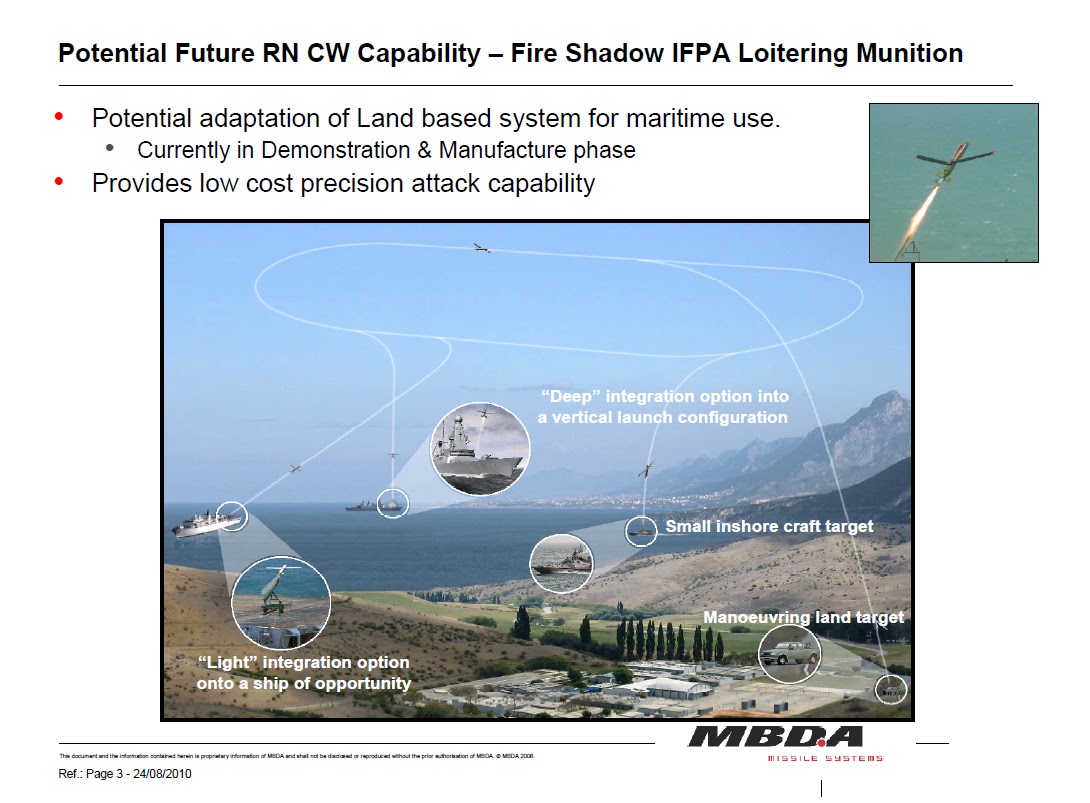
Other offensive weapon capabilities have been studied and are considered, including “deep” integration of the Fire Shadow loitering ammunition for launch from the Vertical Cells of Type 45 and, in future, of the Type 26. 


Fire Shadow at sea


FIAC Target (also FIAC RT, Fast Inshore Attack Craft Realistic Target): purchase of training solutions meant to prepare for defence against swarm attacks carried out by small, fast boats, including suicide crafts. This includes purchase of unmanned target boats.

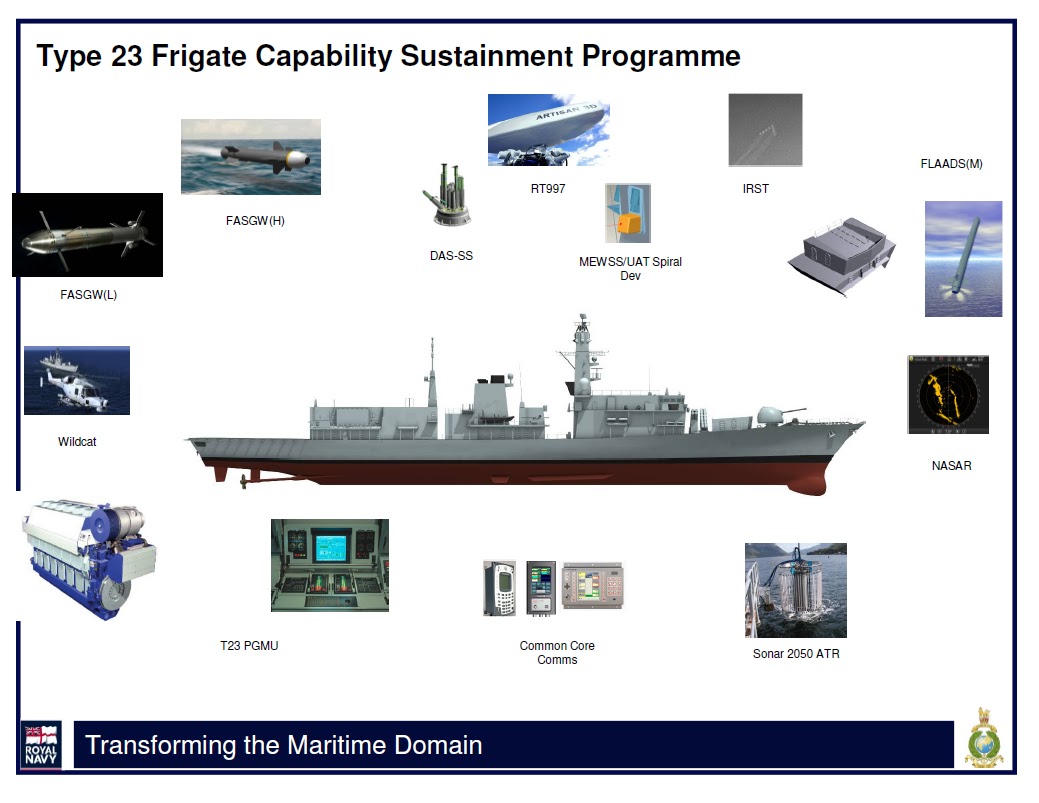
Type 23 Capability Sustainment Programme: covered further down in this article, it is a program of upgrades meant to keep the Type 23 relevant all the way to exit from active service, in the 2030s.

Maritime Composite Training System: the MCTS is expected to become a more and more important and effective way to train crews on land, using advanced simulations to save money.

GWS60 Harpoon Sustainment Programme: the graphic shows that a lot of money is expected to go into sustaining the Harpoon missile to its OSD. It will be interesting to see what choices are made in this area, and what missile will eventually replace the old Harpoon. The Type 26 is, in fact, expected to employ a Vertical Launch weapon: among candidates that have the RN’s eye there is also the Tomahawk IV “MultiMission Tomahawk MMT”, a US-backed development of the cruise missile to make it capable to engage ships in complex scenarios, including in the littoral.

There is also a joint study with France going on for a future cruise and anti-ship missile, with the MBDA Perseus concept being a first indication of what the general thinking is.

Maritime Engineering Development Programme (MEDP): research and development activities covering all aspects of marine engineering technology, including advancements in All Electric Warship configurations, integrated waste management, upper deck systems, fire-fighting devices, roll stabilization etcetera. 

Minewarfare and Hydrographic Patrol Capability: a bit budget is reserved for activities relating to the development of unmanned vehicles for hydrographic and MCM tasks, which will initially be employed on current minesweepers and survey vessels.

Eventually, the MHPC will also deliver a new, multi-purpose ship design to replace the minesweepers and, in time, survey ships Echo and Enterprise. Current indications are for a 2-3000 tons patrol vessel with global range, light armament and the capability to carry the unmanned vehicles needed for stand-off mine clearance and hydrographic survey.

UK Cooperative Engagement Capability (UKCEC): in early 2012 the Royal Navy had hoped to get the go ahead to fit CEC to the Type 45 destroyers, but the request was turned down. There was no money available for the program in the Planning Round, and the news was widely spread over the internet.

However, the graphic, which dates October 2012, confirms that CEC isn’t gone. It is planned to get greater funding from the fourth of the 10 years of the Equipment plan. This sudden increase might indicate fitting of the system to the Type 45s, and the level of spending, which remains high all the way to 2022 (the 10th year), hopefully means that CEC will find its way on the Type 26 as well.     

Small Boats: the money allocated to RHIBs and other boats in service with the Navy (and Marines?)


Type 23 Capability Sustainment Programme

As we have started to see, quite a lot of capabilities of the Type 26 will come from the modernized Type 23s, which will, in this way, also act as testing beds to refine systems and concepts for their successor.

It is expected that the Type 26 will inherit:


·         The Stingray anti-submarine torpedoes, and very possibly the tubes and launcher systems whole

·         The ARTISAN 3D radar (Type 997 for the Royal Navy), with the first having been fit on HMS Iron Duke during her latest refit.

·         The FLAADS(M) Sea Ceptor system with its CAMM missiles. FLAADS stands for Future Local Area Air Defence System (Maritime). It is planned to start replacing the old Sea Wolf on the Type 23s from 2016. 

·         The towed sonar 2087, with the eight set having been installed recently on the 8th Type 23 (HMS Portland, Westminster, Northumberland, Richmond, Somerset, Sutherland, Kent, St Albans)

·         Possibly the 30mm guns


In addition, the Royal Navy is working to develop a Common Combat System, with applications across the whole fleet. This evolutionary approach will eventually lead all the way up to the Type 26’s own system.


CAAM missiles will represent a dramatic improvement from the current Sea Wolf system. Fully fire and forget, faster and more agile, the CAAM has a greater useful range (in excess of 25 km, approaching that of the much more expensive Aster 15) and promises to have an anti-surface attack capability as well, with the capability to engage even Fast Attack Crafts.

MBDA shows on its website a video explaining the future refit that will be carried out on the Type 23 warships to move from Sea Wolf to the new system. The current 32 Sea Wolf tubes will be removed and replaced by just 12 cells, arranged in two rows of six, on the Port side of the existing silo. Each of the six cells will contain a quad-pack of CAMM missiles, giving a total of up to 48 weapons embarked. The cells are not Sylver VLS systems, but a much simpler installation enabled by the Cold Launch feature of the new missile.

The starboard half of the current missile silo will become available for other uses, freeing up invaluable space in a ship type that is inexorably approaching the end of its growth margin. The CAMM installation also enables the removal of the two Sea Wolf radar illuminators and of their bulky under-deck equipment, replacing them with much smaller secure Data Link antennas. The all-weather canisters used by the CAMM missile on the frigates are the same that will be used for use on the truck-mounted launcher intended to replace Rapier in the Army, maximizing commonality.

It is a real bargain: more missiles, more capable, AND precious free space suddenly available for other uses. Without the large mass of the Type 911 Sea Wolf radars, it will even be possible to fit Phalanx CIWS systems on top of the bridge superstructure, and/or on top of the hangar. It won’t necessarily happen, but there will be finally space to make it possible. 

But there is even more. Much of what will appear in the coming years on the Type 23s will then be part of the equipment with which the Type 26 begin their service life. The T23 CSP is part of the Royal Navy Core Budget, funded as part of the 10 year plan. However, most of the T23 CSP components currently sit in the Uncommitted portion of the core budget, as contracts haven’t yet been physically signed.

So, what further improvements are planned for the Type 23s?

 
In the red circle, one of the two Type 911 Sea Wolf radar directors. Their removal will free up valuable space. In the blue circle, the GSA.8 sensor turret, that the Navy hopes to replace soon.
The ULTRA Series 2500 EO/IR turret is the likely preferred option, having already been selected for the Type 45s.


The GSA.8 was also used on the Type 22 B3 (two turrets on each ship). The Type 45s entered service with the much more modern and capable ULTRA Series 2500 Naval EO turret. Two turrets are installed, and they are very easily spotted looking at a photo of the destroyer. A single Series 2500 turret could be fitted to the Type 23s to replace the GSA.8, but so far there has not been a contract award.

DAS-SS: the Type 23 is expected to get the new decoy launcher and, of course, the decoys that will emerge from the various MIDAS-related work streams.

The Type 23s can also expect communications improvements, including Data Link 22, which will in the coming years progressively replace the Data Link 11, introducing Beyond Line of Sight capability that DL11 does not offer.

MEWSS/UAT spiral development will roll in progressive improvements to the Electronic Warfare Support Systems, and under Future Maritime Radar Electronic Surveillance (FMRES) the ships will be fitted with the latest fully digital Radar Electronic Support Measures (RESM) already being fitted to the Type 45 destroyers.

And, of course, the Type 23 will indirectly benefit from improvements to the helicopter fleet: the Merlin HM2 with its vastly greater capabilities, the new Wildcat, and, in good time, the new weaponry, from the M3M heavy machine gun to the Future Anti Surface Guided Weapon (FASGW), both Heavy (Sea Skua replacement) and Light (Thales LMM missile, introducing a new capability, particularly effective against small surface targets). 

As we know there is also a Maritime UAV requirement, to be met via UOR, that should, in the coming months, deliver a contractor-owned, contractor-operated unmanned aircraft system. A first Task Line is wanted for a “RFA vessel” which is undoubtedly the Bay-class LSD based in the Gulf, but a second Task Line is wanted for the Type 23 frigates.

Already in 2006, the Royal Navy trialed Scan Eagle aboard, and demonstrated full level 5 control of the UAV from the ship.  


Don’t write the Type 23s off yet, their best days are yet to come.