Friday, January 20, 2012

F35 updates 2.0


The last few days have been filled with announcements about the F35, possibly a reaction of Lochkeed Martin to the by now well known report that throwing the current problems of the plane to the crowd easily managed to rise moans and calls for cancellation and other bemoaning. While it is far from pleasant to see the F35 still having all these issues, it is not at all surprising for a new generation airframe which is roughly 1/5 into its test phase and which is pushing the boundaries of what is possible a good deal ahead of where they are now.

First of all, the F35 report on year 2011 from the US DoD was released, and it confirmed that the situation is bittersweet.
"Overall the [F-35 programme] has demonstrated very little missions system capability thus far in flight-tests. In fact the programme has not delivered some of its intended initial training capability, such as effective and consistent radar performance," the report written by Michael Gilmore, the Pentagon's director of operational test and evaluation, notes.

The report, though, notes that the F35 programme exceeded the 812 in-year test flights for 2011 by 105, and flew 56 more sorties for the testing of mission systems than the 133 planned. The problem is that the most specific test flying, the sorties designed to demonstrate specific systems such as targeting and navigation, are behind schedule by 11% for the F35A and 9% for the B.
Good news for the UK, the F35C is 32% ahead of schedule.

More worrisome, but expected, is the fact that the 63 production-model airplanes delivered under the first four low-rate initial production contracts will require, later on, “significant numbers of structural modifications and upgrades”. It is a problem, for now, for the US: the UK is getting 2 F35B (BK-1 and BK-2) from LRIP5, both due for delivery this May if the schedule is met, with the first F35C (CK-1) arriving next year. All three are more advanced than the previous airplanes built and already incorporate many of the changes. Still, they will need upgrades and fixes, but being airplanes destined to live an intense but relatively short life (especially the first 2) it is not granted that they will be upgraded.
What the UK wants, is for its production lots of F35C to come as ready and complete as possible, at most, if possible, coming out with the software Block 2 while the final Block 3 is refined. Expensive structural upgrades will hopefully be avoided: the Typhoon gave (and gives) the armed forces more than enough in-year expense as it is to gain the many capabilities it still does not have. (from Paveway IV, which should arrive this year, to AESA radars hopefully around 2015, to Brimstone and Storm Shadow planned for around 2014, but also the last ten or so Tranche 1 to go through the R2 retrofit to be brought to Block 8 standard [from F2 toFRG4 in-service designation for the RAF] )
The F35 test fleet is now starting to fly at night as well, it has been announced, further expanding the scope of the test flights. An Interim Helmet Mounted Display (a version of the Striker from BAE system, as used on the Typhoon) will be soon made available and used for the tests, with the pilots wearing NVGs while Rockwell Collins tries to fix the latency problems with its HMD, which for the moment remains the long term planned F35 fit.
It would not surprise if BAE further developed the Striker to try and get the contract, though. Whoever can deliver the needed performance on time and budget is more than welcome!

Again of great relevance to the UK, the tailhook issue that caused the press to write a thousand articles about carrier planes that can’t land on carriers was already know by LM, and a revised tailhook design is being prepared for trials on Lakehurst Air Base, N.J in the second quarter of this year. While risks remain, the at-sea trials campaign on US Navy carriers remains planned for summer 2013, with LM confident that the revised tailhook will catch the wire.
Basically, the problem is that, in order to conceal the tailhook when not in use to preserve stealthness, a small bay had to be built in the fuselage to accommodate it, and this forced engineers to have the hook much closer to the landing gear than in other carrierborne airplanes. Distance on the F35C is just above 7 feet, while even the X47B drone has over 10 feet, and the F18 much more than that.
This means that when the jet passes above the wire and causes it to move, the hook arrives early, before the hook movement stops, making it more complex to catch it. The revised tailhook takes this and other considerations in hand, and hopefully will deliver a working solution. LM is bullish on the matter, and dismissed claims that the F35C won’t land on aircraft carriers as “patently not true”.
Again of importance, modifications and fixes are financed by the US. The money spent by the UK in test and development won’t rise above already agreed figures (over 2 billion).

A less pleasant news, (see why I say bittersweet?) is that transonic acceleration targets might not be met, with the F35 accelerating slower than planned due to its large front section. This is hardly an issue of great concern, considering that the acceleration target was (very ambitiously) written for the F35 based on acceleration of the F16 and F18 in “clean” (no external loads) configuration.
The clean configuration of F16 and F18 means no weaponry, the clean configuration of the F35 means 2 AMRAAM and 2x 2000 pounds bombs in the weapon bays, a relevant difference.
Besides, most of the life of the fighter jets, including in combat, still happens at high subsonic speed. And for the UK, the F35 will still be a huge leap ahead in performance compared to Harrier and also to Tornado GR4.

Another of the issues highlighted by the recent damning report was that of the fuel dump valve, which (again due to the needs of stealth) had the defect of not releasing fuel clear of the fuselage. Particularly bad for the F35B, on which fuel can go dangerously close to the roll-post ducts in the wings, part of the short-takeoff-and-vertical-landing system, and potentially ignite. A revised fuel dump design is incoming already that will fix the problem. A first temporary change will be available on the test fleet soon, while in the second quarter of the year the definitive solution will be rolled out and tested on the fleet for enabling its use on the next airplanes to be produced.

As a news of purely UK interest, the MOD process for selection of the Joint Combat Aircraft Main (and only) base is ongoing. Unsurprisingly, Marham is on the shortlist. It is not specified which bases complete said list: Lossiemouth could still be on it, since it used to be the preferred MOB until last year, when it was decided to close Leuchars and move the Typhoons into Lossie. It is expected that Lossiemouth will now be busy with its 3 Typhoon squadrons and QRA North role, so the F35 is very likely to be based elsewhere.
Marham is, in my opinion, the most serious (and possibly the only) alternative. Also because Marham’s destiny depends purely on the Tornado GR4 of which it is home. There is only one destiny for Marham is the F35 goes somewhere else (where? I don’t really see realistic alternatives): closure.
We will see what happens, but I firmly believe that, perhaps already later this year, Marham will be announced as MOB for the JCA fleet.

Speaking of announcements, the new British Army structure is expected to be explained on April 12. So, updating the “Big Dates” calendar:

January 26, BAE conference on Type 26 GCS
April 12, announcement on new Army Structure

Tuesday, January 17, 2012

Redundancies Tranche 2; F35 update

I'd dare saying that it is not at all as bad as it promised to be according to press reports. Still nasty, but it could have been worse by far.

The Army is looking to discharge up to 2900 men, of which 400 are to come from the Gurkha brigade. 8 Brigadier posts will disappear, along with up to 60 Lieutnant Colonels.

The RAF seeks up to 900 redundancies, including 15 Air Commodores and 30 Group Captains.

The RN seeks up to 300 redundancies, inclusive of 5 Commodores, 17 Captains and some 19 RM officers, with Royal Marines losses in other ranks.

RN and RAF are confident that they won't need a Tranche 3 of redundancies to meet their downsizing target, which will be reached slowing down recruitment. The Army, instead, has a lot more pain ahead of itself.
This second Tranche follows the first reduction, in September 2011, which saw 1020 RN posts disappear, along with 920 RAF and 920 Army. 62% of the personel who quit had applied for leaving. This time around the volunteers are expected to be much fewer, making it all more painful. 


The first two UK F35, of the B variant, will be delivered in May. Training of UK personnel for the F35 for the next years will happen at Englin Air Base (Florida) in the "F35 university" of the US forces. The UK F35s will fly their test and evaluation sorties from Edwards Air Base (California).

The first F35C for the UK is the CF-17, a USMC F35C which will be exchanged for the british BK-3 F35B.
The F35C assigned to the UK is expected to change name and become CK-1.

Royal Marines test campaigns: PACSCAT and CB90


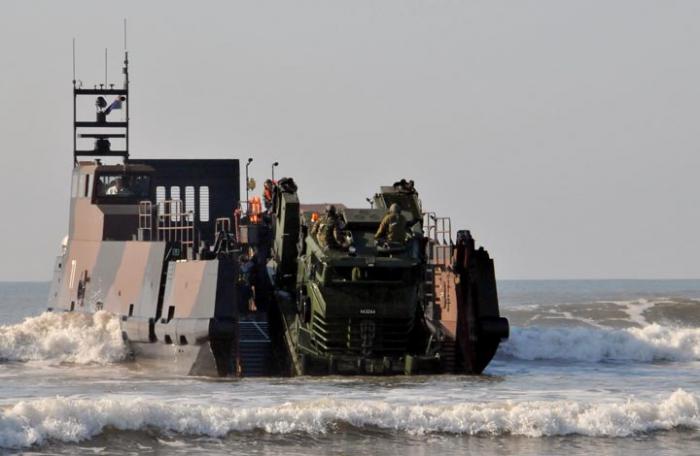
Navy News has published a reportage on the CB90 testing by the Royal Marines for its number of January 2012, a very interesting article about the subject, from which it would appear that the Royal Marines and the Navy consider the future Force Protection Craft more urgent a need than the new Fast Landing Craft (to be LCU MK11) For the Landing Craft requirement, in fact, there was no indication of timeline for acquisition, unfortunately, meaning that, more than other items of the Navy programme, it will be subject to delays until funding for it can't be squeezed between other, higher-priority items. In addition, Navy News reports that a few defects in the PACSCAT prototype were identified. Unfortunately (but unsurprisingly) nothing is specified about the issues emerged. The testing remains precious anyway, as it was still largely succesful: the PACSCAT delivered all kind of cargos (Hippo BARV, a packet of 5 Vikings, a Challenger II MBT, 4 HX60 4x4 trucks) at very high speed, registering a record speed of 19 knots while carrying a Challenger II and almost 40 knots unladen. Hopefully, the Fast Landing Craft process will not be stopped by budgetary issues, and soon enough we’ll hear more about what should become the LCU MK11. 

The HIPPO BARV comes ashore from the PACSCAT during trials


For the Force Protection Craft, the plan is to have it first arriving at Instow in 2015 with front-line assault squadrons getting their hands on it from around 2017. The requirement is for a fleet of 12, and the new boat will replace at least part of the fleet of 21 LCVP MK5 landing crafts acquired in 2001. 
The Royal Marines at RM Instow in North Devon have been loaned four Swedish Combat Boat 90s, in exchange for british Offshore Raiding Crafts, that the swedish marines will be trying. The Royal Marines will use the CB90s to gain experience and learn lessons that will help shape the final specifications and requirements when the MOD looks for firms to build the Force Protection Craft, which might well be a modified CB90, since it seems that the sturdy, proven sweden boat is gaining many smiles and approvation. 

The Force Protection Craft is meant to be need fast, capable to provide accurate and effective firepower to protect ships and landing craft, and must be able put a small raiding/reconnaissance party of commandos ashore well in advance of the main force – and a long way from the mother ship. Its role will likely cover Riverine combat and patrol operations, such as those carried out for years in Iraq since 2003, an experience which already shaped the Ofshore Raiding Craft. Interestingly, the US Navy RIVRON riverine squadrons, the "brown waters navy" have adopted the CB90 as their main heavy hitter, in fact. 
Protecting ports and acting as patrol ships in anti-piracy operations could also be roles for the Force Protection Craft. Again, the new boat could be deployed forward to protect operating bases of the RN abroad: mainly, the bases in Oman and Barhain from which the minesweepers of Operation Kipion work in the gulf, or the bay where the "East of Suez" SSNs of the Royal Navy find refuge during their months-long operations. RFA DIligence has long been forward based there, too, to provide forward submarine support, and both of these locations are secured by boats and teams of US Navy sea-control force protection teams. 

The Royal Marines want their new boat to be compatible with LCVP MK5 spaces and davits, and the CB90 has already been launched and recovered succesfully from the davits of HMS Albion. 

Trials with 11 Assault Group Royal Marines (Training) will continue for the most part of the new year, though. So far the boats have had their basic handling tested, they operated with other landing and assault craft (a prerequisite for any future boat), worked out of the loading dock of HMS Bulwark, put troops ashore and carried a stretcher aboard safely, but much more remains to be trialed, inclusive of launch and recovery by davits in rough sea, weaponry and fire support roles, and operations from a RFA ship of the Bay type. 

The CB90 will be tested armed with at least one remotely operated Overhead Weapon Station. 
The CB90 is available with armour for operations in "hot" zones, and can seat a landing party of 18 fully equipped Royal Marines, more than meeting the basic requirement for the Force Protection Craft, which is for no less than 8.  

Capable of 45 knots in calm sea, the CB90 handles excellently, and is a reliable and sturdy boat, something that the RM appreciate, along with the proven capacity to work out in open sea, comfortably even in Sea State 4. The american RIVRON squadrons have already proven that the CB90 can easily be carried on trailers for transfer by roads, and a boat on its trailer can easily be carried within a C17. Cost for a CB90 H, with armour protection, would be around 500.000 US dollars, but cost goes up depending on the kit that one wants. In a US RIVRON, the C90H acts as Riverine Command Boat, is outfitted with the latest in C4ISR equipment with have the ability to communicate with other vessels, aircraft and land based assets. It comes with a SeaFLIR III IR system and Furuno Navigation package allowing for night operations, long range tracking and integration of the navigational equipment. The weaponry of the RCB includes provisions for four individual .50 caliber mounts and a centrally located mount for a stabilized remote control weapons station (ROSAM) with a 360 degree arc of fire. The RCB also has the ability carry and deploy mines and has already been tested and certified to increase fire up to, but not limited to, Hellfire missiles and a gyro-stabilized twin-barrel 12-cm AMOS mortar turret. It costs well over 800.000 dollars. 

Again, Navy News reports that the Royal Marines have found some defects along the many good points: the bow ramp is smart and works, but ideally should be enlarged, because a RM with Bergen fatigues to squeeze through. More importantly, there are no heads as the CB90 is only intended to work for 24 hours, while the Royal Marines would like their Force Protection Craft to be able to work autonomously for a longer time. Again, there is no hot water at all, nor the chance to heat rations, and the boat tends to ingest a lot of muck in sandy beaches, being, as it is, designed to deal with Baltic’s rocky beaches. Perhaps the worst find, though, is the unsatisfactory performance of the CB90 as firing base, but trials in this sense are far from over, and the RWS, which is stabilized on two axis, should remedy to the problem.
All these factors, however, will have to be considered carefully when the requirements for the Force Protection Craft are written out. 

Landing on a beach with the CB90


The Royal Marines want their “fighty boat” of the future to be fast, work autonomously for quite a long time, handle well the open sea, and be able to get ashore to insert small beach recce parties. The LCVP MK5 can carry, at relatively good speed, some 35 soldiers or a light utility vehicle, but these capabilities are now regarded as secondary. The CB90 seats 18 Marines and takes their kit (and one of her good points is that said 18 Marines were able to all but sleep while riding out in Sea State 4, while people in a LCVP MK5 in the same sea conditions would throw up) but the RM requirement is for as few as 8, which means that some of the troops space on the CB90 in the Force Protection Craft will be likely “sacrificed” for fitting a few commodities and kit to enable longer unsupported sorties.
The CB90 has a crew of four: a Corporal acts as commander, a Marine or Lance Corporal acts as helmsman and two Marines man the weapons and the ropes.

The Force Protection Craft is a very interesting programme, and it is relieving to see it alive. I find that the new boat could find many roles, and prove useful in many ways. It will also be very interesting to see what final design comes out of the trials and studies and who will build it in the end. CB90 as it is probably won’t do, but it is likely to be a starting point, and a good bit of its design will probably be maintained, to exploit its proven and excellent speed and seakeeping.

Monday, January 16, 2012

A closer look at the Foxhound


Developed in the UK by Force Protection Europe (recently acquired in a 300 million dollars deal by General Dynamics) and by engineering firm Ricardo, with Thales, Qinetiq, Formaplex, DSG and Sula collaboration, is a wholly new design. The vehicle has been drawn on a clean sheet to increase current available levels of protection, mobility and modularity/mission configurability compared to vehicles already on the market.

The result of the design process is the by now relatively well-known “Skateboard” chassis type. Most, if not all readers interested in the British military have probably already read the name. This chassis, basically, is a V-shaped armoured element that acts as spine for the vehicle, like a keel in a ship. It sustains and protects the engine, the two fuel tanks (one main and one secondary tanks), the batteries, the electric generator and all elements of mechanical transmission. The only elements left outside of the armored shield are the torsion bar suspensions, but this is not to be considered a disadvantage: in most cases, as proven by the tests, a mine will blow off a wheel, but leave the Foxhound able to move on on the remaining three, and reach a safer area on its own. 

Foxhound on trials: note the absence of side door


Atop the skateboard pod sit the various mission-specific pods. For now, there’s a 2+4 seats Protected Patrol module, a Fire Support open-top Weapon Mounted Installation Kit WMIK pod and an Utility pick-up pod for protected logistics role, but more could be developed, and in particular an ambulance pod should be available soon. Each pod, regardless of its specific role, has sharply tilted inferior sides, which sitting atop the skateboard complete an ample V-shape perfect to reduce underbelly blast effects, venting the force of the explosion outwards.

The advantages of the Skateboard are: 

-          A low centre of gravity as all the heavy items are placed under the skateboard, improving mobility and stability  

-          The absence of any mechanical part inside the crew pod, ensuring maximum safety and leaving more exploitable space available inside the mission pods. 

The pods in this way could be built entirely in composite materials, giving it a good compromise in terms of weight and protection levels. The base protection level of each pod is STANAG 4569 Level 2+, with add-on armor kits available to overcome Level 3 and offer protection against RPGs and Explosively Formed Projectiles EFPs. I expect the UK Foxhounds on order for Afghanistan to be fitted with this additional layer of protection, but for now there is no evidence of it.
I also must say that I’m a bit disappointed: Level 2+ protection, or even Level 3, is far from revolutionary, even if, to be fair, the Foxhound is intended for a gross weight of 7.5 tons, which limits the amount of armor that one can put upon it. The French Aravis 4x4 vehicle offers Level 4 protection, but it weights over 12 tons. Blast and mine protection levels are not disclosed, but are certainly at least meeting STANAG Level 2a/2b, and hopefully exceed these significantly. 

A batch of Foxhound vehicles: again, no side doors.

The pods are installed with a fast linking system that allows the replacement of mission pods directly in the field. To replace a pod it is enough to remove the electric connectors, detach the steering system and open the hinges on both sides of the hull. At that point the module is detached and can be lifted off and replaced, in just 30 minutes of work. For normal maintenance, the operation is the same, but the hinges of the pod are opened only on one side, and the pod is gently pushed to tilt to the side with the help of, for example, another vehicle.
Very simple is also the replacement of the engine block, which has to be possible in any FOB, without sending the vehicle back to the main base.    

The Patrol Protected Vehicle module has two front seats (Driver and Commander), with the seats, provided with five-points harness, hang from the roof for improved blast-mitigation effect. Two bulkheads behind the seats separate the front compartment from the rear one, where four dismounts sit in seats attached to the walls, shoulders to the wall, sitting face to face. Further bulkheads separate this compartment from the last one to the back, which houses the radio and the electronics, on the two sides of the large double door at the back. 

Inside the Foxhound LPPV: note the empty space in the back, over the wheels. Here is housed the radio and other electronics, while the seats for the Dismounts sit in the middle.

Access to the vehicle is possible from this large door or from a large “Commander’s Door” in the side of the vehicle. This door is optional, however, since the absence of side openings is advantageous in terms of protection. Since the Mastiff 3 re-introduced side doors, it is probable that Foxhound vehicles will also have it, despite the detrimental effect on overall resistance of the safety cell. On the roof two large openings are provided: one hatch above the Commander’s seat, on the left, and a larger one in the middle of the roof, over the Dismounts compartment. This second opening is large enough for two men to stand and fire out of it at once with their personal weapons. In alternative, a ballistic-protected shielded turret for a machine gun can be fitted. Remotely-operated turrets should however be the preferred long-term solution, as they tend to offer the maximum performance and protection while generally impacting less the weight margin and centre of gravity.

The Protected Logistics variant sits only driver and “commander”, has a single top hatch over the commander’s seat and side doors, with the back made up  by the pick-up loadbed. The WMIK variant sits four men in an open-top pod with thick rollbars from which the blast-mitigating seats hang. Several weapon mounts are available, two more than on a Land Rover or Jackal: in addition to the top ring mount and the Commander’s swing mount, to the side of the driver, there’s a heavy machine gun mount in the back, aiming to the rear, and a further swing mount for a medium machine gun can take place on the passenger’s side.   

The Foxhound Protected Logistics variant: ideally, this vehicle will appear in the British Army and be a long term replacement for many Utility Vehicles, including the UOR procured Husky, which is inferior in protection (blast protection in particular) and payload (around 1300 kg).
Foxhound with WMIK module
  
The Foxhound is 5.4 meters long, 2.1 meters wide and 2.34 meters tall, with a gross weight of 7.5 tons, with a payload of nearly 2000 kg. In the Patrol Protected Variant this means that there is payload margin for 6 soldiers (for design purposes a soldier is a load of around 158 kg) and over 900 kg of further load, which could include a RWS turret (on the market there are models from 70 to 280+ kg. The Selex Galileo Enforcer, widely used by the British Army on the Panther, on the Bulldog and on some Challenger II vehicles, weights around 156 kg without ammunitions and weapon) or a shielded, manned turret ring (can weight well over 300 kg), additional armor and other kit.

At 7.5 tons, the Foxhound can be under slung on a Chinook helicopter and airlifted easily by C130, A400 and, of course, C17 and above. The Foxhound has a Steyr-Daimler Puch 3.2l engine. It is a six-cylinder, four-stroke diesel engine with turbocharger with a power of over 250 HP. The vehicle is also fitted with a ZS six speed auto-transmission and independent, lockable differential axles from AxelTech. The four-wheel steering provides it with a turning circle of just 12m. The Foxhound can reach a maximum speed of 110 km/h and accelerates from 0 to 80 km/h in 19.7 seconds on road. Cross country it can overcome a 60% maximum gradient and negotiate side-slopes of 30%, promising very good mobility on the field.
With the around 200 liters of fuel in the tanks, the Foxhound has a range of around 600 km.

Last, but not least, it is worth remembering that the Foxhound will be the first vehicle adopted by the British Army that meets the Generic Vehicle Architecture (GVA) requirement. Objective of the GVA is to affirm as unique vehicle standard for all electric and electronic parts, the DefStan 23-09. In practice, the wish is to have all new vehicles fitted with a common, open electronic architecture, so that any equipment developed for a vehicle is compatible with all the others as well.
To make this possible, it was necessary to rapidly select a stable base over which develop the system  and write the requirements in terms of hardware (which tension should the component use, which shape factors it needs to follow, etc). Key to this is the “Middleware”, the common software interface that allows components from different firms to work together and dialog without problems. As Middleware, the MOD selected the DDS (Data Distribution Service), and consequently made available to its suppliers a specific development software suite, called Land Data Module. A supplier that tomorrow will be asked by the MOD to design and provide a new component for a GVA vehicle will use the Land Data Module development suite to write software fully compatible with the DefStan 23-09.
In the case of the Foxhound vehicles on order, responsibility for design of the DefStan 23-09 components falls on Thales.

The Foxhound should soon make its appearance in Afghanistan, mainly as Land Rover Snatch replacement. Initially procured as UOR in the first order, placed in 2010 (180 million pounds for 200 vehicles and initial spares package) they have been brought into Core budget and are part of the long term Army plan for the future. A second order for around 100 more is being negotiated and has already been announced. It is expected that the actual contract will be signed soon. This news is however made a bit less happy and good by the awareness that, originally, it was expected that the second batch order would be for another 200 vehicles. It has effectively been halved.

Further orders are expected, but they will depend on the availability of budget for it – no more UOR money for Foxhound, most likely -, on its effective performances in Afghanistan, on its cost hopefully dropping (now it is still way too high) and on the decisions that will be taken on its long term roles within the new army structure. In particular, its future is likely to be closely connected to that of the ex-Operational Utility Vehicle System, now Protected Vehicle Multirole. Of course, the Foxhound/Ocelot aims to export orders as well, even though its first big occasion (a 1300 vehicles order from Australia) has been lost, with Australia deciding to locally develop and pursue the Hawkei vehicle.