Previous posts in this series
Battalion Strength
First of all, an update to the
analysis on Battalion strength that i provided in the Introductive Post: on ARRSE, serving soldiers are reporting being briefed by their commanding
officers that the Adaptable Force’s battalions (Light and Light Protected
Mobility battalions, for a total of possibly 20 formations out of 31, depending
on whether one or two battalions stay in 16 Air Assault Brigade together with
the two Para units or not. It is also not clear if the Gurkha battalions will
be similarly affected.) will be downsized by removing a rifle platoon from each
Rifle Company. There is also a rumor that the Machine Gun Platoon might have to
go as well, but on this second point I’d be careful as there are big doubts.
The plan is that the Territorial
Army will supply the missing platoons and bring the battalion up to strength
for deployment. It is worth remembering that the Army 2020 restructuring plan
for the Territorial Army has not yet been completed, and it is not expected to
be released before around year’s end, but the Army 2020 plan says that
Adaptable Force’s battalions will be paired with TA battalions. It is not yet
clear how this will be achieved in practice, but in numerical terms, 14 regular
Light Role battalions planned face a TA force of exactly 14 battalions. The
British Army document on Army 2020 shows also the Foxhound-mounted battalions
as paired with a TA battalion, but I think it is more than premature to say
that the TA will get additional formations.
A way to achieve the result would be
to have smaller TA “battalions”, but more numerous (20, so the Foxhound-mounted
Regulars get their own Reserve counterpart) very closely connected to their
Regular counterpart (and thus ideally based as close as possible, in the same
area) and very much structured to provide a minimum of a Company worth of
manpower.
The regular battalions can be
expected to deploy for 6 months in a 3 years period, while the Reserve personnel
will be asked to face a 6 months tour in a 5 years period, so the TA battalion
must be large enough to be able to field 2 companies, made of different
personnel, in a 5 years period to provide adequate support to the paired
regulars.
Now, a consideration. The British
Army works daily to the assumption that there must be 3 maneuver units into a
formation if this is to fight successfully. At Company level, this means having
a Platoon that Assaults, one that Supports and one acting as Reserve.
This is for the routine: for
deployment on combat operations, the Army’s doctrine calls for 4 maneuver
units, (Assault, Support, Reserve, Echelon) and
for years the stated role of the Territorial Army has been to provide to
deployed battalions an additional company plus supporting mortar and anti-tank
section. Something that never actually happened, as far as I’m aware, with the
TA employed most frequently to provide individuals, not formed subunits.
In future, achieving the optimal
number of 4 maneuver formations will be even harder, and indeed even deploying
multiple Adaptable Force battalions at full 3-companies strength risks proving
challenging: if the Territorial Army fails to deliver the planned output,
elements of regular battalions will have to be assigned to the deployed force
just to bring it up to the minimum “full” establishment, further reducing the
number of battalions/battlegroups that the UK will effectively be able to
deploy and sustain.
Using the reserves to achieve a
4-coy structure for deployment will likely only be possible once in a 5 years
period, in alternative to providing a coy two times.
Albeit non optimal (someone has
already called it an Army “fitted for, but not with” soldiers) an approach, it
is perhaps the only real way to integrate the TA. It is clear, however, that
with these new planning assumptions it becomes even more important to get the
Territorial Army reform right.
It is formally correct to note that
British Army battalions will almost never fight in their peacetime structure
and establishment, both because they will make modifications to adapt to the
situation at hand and both because they will almost certainly be formed into
battlegroups, but the reality is that the constant reduction in the manpower
and firepower of infantry battalions is going to damage the Army’s capability
significantly.
A Battlegroup ideally should be
formed by taking an Infantry Battalion and attaching to it one or more Tank
troops or Tank Squadrons, for example, plus an Engineer Squadron and perhaps an
artillery battalion. The deployed battalion would of course receive other
specialist reinforcements relevant to the contingent situation (ECM Force
Protection teams, additional Signallers, a Fire Support Team of Royal Artillery
observers and JTACs, UAV detachments, HUMINT teams, military working dog
teams…).
But there is a big difference
between the above process for forming a battlegroup and one process in which a
battalion ends up needing to draft in companies from another, taking two just
to form a battalion-sized battlegroup.
And this is what the Army fears will
happen, when it talks of future enduring operations not stretching beyond 3
years or so: in theory, Army 2020 has what it takes to go on and on past the 3
years mark, but if to make a regular battalions you need 2, of course the whole
story changes…
Unsurprisingly, the Army would have
preferred to keep fewer but full-strength battalions, but Army 2020 was very
much a political problem before a military one, and the loss of capbadges was
unacceptable. The Army had effectively no alternative.
Moving on to the topic of this post,
I will now look in as much detail as possible at the current and future “Lethality”
of the British Infantry, by exploring the weapons and sights employed and
planned.
Section Weapons: UORs and beyond
The main weapon of the British Army,
the SA80 assault rifle, has been significantly enhanced and modified for use in
Afghanistan. In its current incarnation, the rifle is known as SA80A2 TES, even
though SA80A3 is incorrectly frequently used.
The SA80 TES has had the handguard
replaced with a Picatinny Quad-rail assembly developed and produced by Daniel
Defense, it has been fitted with the vertical foregrip with extendable bipod
(Grip Pod), it has had an interim weapon sight adapter system and it received
the Vortex flash eliminator.
In 2011, the Magpul Industries
polymer-made EMAG magazine was introduced to replace the previous, heavier
steel one, achieving a considerable weight saving (from 249 grams to 130), with
a million magazines on order over a 4-year period. On a typical load of 12
magazines, a soldier ends up carrying 1.56 kg less than before: definitely not
bad.
For a while, the SA80 had the SUSAT
sight replaced with the ACOG 4x, while now it is getting the ELCAN Specter 4x,
selected as part of the Future Integrated Soldier Technology – Surveillance and
Target Acquisition (FIST - STA)
 |
| L85A2 TES fitted with Grip Pod, new handguard with rails, ACOG 4x on interim adapter, Vortex flash eliminator and Light Laser Marker (LLM) installed under the barrel. |
These are important improvements,
and also come with the added bonus of a significant reduction in the weight of
the rifle, down to 5290 grams, a reduction of over 1 kg from a baseline SA80A2
with optic.
The SA80A3 was (and should still be)
envisaged as the weapon for FIST, at least in its initial years. Modifications
would include a full-length top rail for easy fitting of optics and accessories
(replacing the interim adapter) and further weight savings.
Powered rails are a future target,
as part of improvements to the power distribution infrastructure in the soldier
system. Powered rails would make it possible to fit lighter accessories, which
would not need the huge amount of AA batteries currently used.
The power would come from the
centralized energy solution of the soldier, but of this aspect I’ll talk in a
future post in this series.
 |
| Above, the new Handguard for the SA80, with integrated rails; and the E-Mag lightweight magazine UOR |
Further weight reduction is a
target, and the Cranfield University has been working for the MOD on this,
producing two SA80 prototypes incorporating many changes and mods.
Stellite-made barrels were trialed, and validated: the greater resistance to
heat provided by Stellite makes it possible to fire more rounds without
carrying replacement barrels, or to remove material from the barrel to make it
lighter but with the same useful life.
Parts of the SA80 were replaced with
others made in plastics and carbon fibre, following a study into the stress
suffered by the rifle during usage: where this is low enough, excess material
(and weight) were eliminated.
The two recoil rods of the rifle,
made of steel, were replaced with others made of titanium, saving 90g per rod.
Another prototype was used to
lighten the Grenadier’s gun by providing a new, lightweight mount and assembly
for the L123A3 (H&K AG36) underslung grenade launcher.
Delivered from January 2011, the
prototype P1, completed with picatinny rails at the front, grip pod and ELCAN
weights just 4829g, a reduction of 461g in weight.
The P1A prototype for the Grenadier
with the AG36 launcher, without sights, weights 4629g, down from the current
5501g, again without sights. An impressive 872g difference.
I will cover the Cranfield
University’s work more completely in a future post of this series, as they have
also been working to develop lighter ammunition and further weight-saving, but
I thought it was worth to put the SA80 work here, because lightening the rifle
represents a possibly attractive option for the future, not just for
Afghanistan.
As of 2011, it is anticipated that
Initial Gate for a SA80 replacement programme will be in 2014 for delivery in
the 2020s, but a SA80 ‘A3’ modification centered on significant weight
reduction could be a cost-effective alternative.
In terms of sidearms, under a UOR, a
new pistol has been procured to be issued in place of the Browning 9mm High
Power. This gun is the SIG Sauer P226, known as L105 by the Army. The L105A1 is
the standard pistol, the L105A2 is the P226R, which adds a rail for easy
application of accessories, ahead of the trigger guard, and the L106A1 is a
further improved variant with corrosion resistant finish.
A smaller compact variant, the P229,
is in service as L117A2, since the earlier compact P228 was already in use with
the SAS as L117A1.
A requirement for replacement of the
Browning continues to exist in the Army plans, and apparently the Sauer,
despite having performed well in Afghanistan, is not the definitive solution
envisaged by the Army, which wants something else.
Under another UOR, the Army procured
200 12 gauge shotguns, produced by Italy’s Benelli. The M4 Super 90, which is
also in service in the US, is known in the british army as L128A1. It weights
nearly 4 kg, and carries 8 rounds in the extended tubular magazine, with
different types of ammunition available. It has a 130 meters range with a solid
shot, and 40 meters with buckshot. It is carried by the Point Man on patrol. The
rifle in British Army service comes with foregrip, picatinny rails and EOTech
holographic sight.
 |
| L128A1 with rails and Eotech sight |
Possibly the most important and most
appreciated UOR weapon, the L129A1 Designed Marksman Rifle is already a
mainstay of the future army, which has been very impressed by the impact it has
had in the field. Produced by Lewis Machine & Tool, the “Sharpshooter” has
a 16 inches barrel, a lightweight polymer magazine for 20 rounds, an Harris
bipod and fires 7.62 x 51 mm NATO rounds with high accuracy easily out to 800
meters. In Afghanistan it is issued at least on the basis of one per Section.
The initial order, placed in August
2009, was for 440 guns for 1.5 million pounds, but several sources indicate
that consistent follow on orders might have already been placed. It would appear that the Army, as of August 2012, has been handed some 1500 L129A1s.
 |
| Royal Marine Sharpshooter in action |
Apparently, the L129A1 has also been
selected for another UOR, far less publicized, which is the “Sniper No. 2
system” or "sniper support weapon" for the renewal of the personal armament and kit used by the spotter in
a sniper pair (the sniper using the L115A3). A very small hint of this was already provided back at the time of the initial order: "The Sharpshooter's capabilities are also complementary to the current Sniper System."
The main difference between the
Sharpshooter and Sniper No.2 is made up by the sights: the Sharpshooter is
fitted with a Trijicon ACOG 6X sight, compensated for bullet drop out to 1200
meters and fitted with a secondary Close Quarter Combat CQB sight on top, the
Trijicon Ruggerized Miniature Reflex RMR. The Sniper No. 2 is used with a more
powerful scope sight Schmidt & Bender (possibly migrated from the L96/L118 rifles being progressively retired) for day engagement and with OSTI MUNS
night sight for nocturnal use. The MUNS (Magnum Universal Night Sight) is an image intensifying night sight that is installed ahead of the day scope and allows engagements out to 700 or more meters at night. The MUNS would appear to be used as night-sight solution for the rifles in Sharpshooter role as well. It can be seen mounted on a L129A1 at minute 4:03 of this Army video.
The L129A1 is issued with 20-rounds
P-mag polymer lightweight magazines. The L129A1 is used in Sharpshooter role
with the 16 inches barrel, but a 12 inches and a 20 inches barrel are
available, and it is not absurd to assume that in the Sniper No. 2
configuration the longer barrel might be used.
Issued one per Section, (27 or more
per battalion) the L129A1 is an excellent weapon, and around 1000 are the long
term requirement for Sharpshooter role. While there are indications of
additional orders having been placed past the initial 440, I’ve no details
available.
The L129A1 has also been seen used
by RAF heli-snipers on Puma helicopters deployed for the protection of the
Olympic games, another demonstration that the well liked weapon is finding new
roles in the force.
A number of G3A4 rifles and an unknown amount of H&K 417 are in service, used for for a variety of
missions: the 417 is in use with the Special Forces which needed a sharpshooter
quickly and could not wait for the Army to make trials and take decisions. The
H&K 417 has reportedly some defects and issues, and was beaten by the
L129A1 during british army acceptation trials. The G3 is seen quite frequently
in the hands of Royal Marines on ships.
A long-term rationalization on
L129A1 might be attractive.
 |
| Overwatch on HMS Cumberland alongside in Libya for the 2011 Evacuation effort: the soldier is armed with the G3A4 |
The L110A2 Minimi (the british Army
and Royal Marines adopted the Minimi PARA, with short 14’’ barrel and sliding
buttstock) has not been left out either. Modifications to the machine gun were
part of the soldier system improvements for Afghanistan, and a reconfigured
Minimi was shown during the presentation of the FIST STA sights package. I’m
not entirely sure on the timeline of introduction of these modifications, but
selected improvements include Grip Pod downgrip, Picatinny tri-rail handguard and top cover, retractable Savit
buttstock, and a prong-style flash “eliminator”. The improvements comport a
weight reduction of .29 kg, down to 6.91 kg (15.24 pound).
 |
| The MINIMI seen during the presentation of FISTA STA equipment, showing rails, new buttstock and Grip Pod. In foreground the MOSKITO binocular can be seen, and nearby is the Light Infantry Periscope, unfolded and ready for use. Near the machine gun, on the table, is a MaxiKite 2 (MK2) |
In the longer term, beyond
Afghanistan, the Army intends to “reconfigure” the LMG. This is likely to
involve additional changes over those explained above, and very possibly
include a longer barrel: the short one used in the Minimi has been widely criticized,
and it is said that it reduces the useful range of the Minimi to 200 meters,
and in any case less than the range of the SA80, which uses the same round but
from a 20 inches barrel.
 |
| Grip Pod (above) and the new butt stock (M4 style) for the Minimi |
As widely known, taliban often fire
from 500 or more meters away, and the British Army has had to reintroduce the
GPMG Light Role (L7A2 with bipod and provision for 50rounds belt) into the
Sections/Patrols, after removing it years ago.
Probably to provide a lighter and
less bulky alternative to the “gimpy” in foot patrols, the MOD eventually
placed a UOR order for the acquisition of 176 “Major
Minimi”, the Minimi 7.62x51. The first 176 had to be delivered by the end of
2011, and the contract includes options for a further annual order of 250 machine guns in 2012, 2013 and
2014.
The Minimi 7.62 offers 70% commonality to the 5.56 Minimi, and is more than 30% lighter than the GPMG. Of course, it does not deliver quite the same firepower at range as the General, but the Minimi 7.62 represents a good compromise.
Rockets
The British Army in Afghanistan has
been using the M72 LASM (Light Anti Structure Munition), also known as M72A9,
procured as UOR in 2007 as an interim solution on the way to the intended Anti
Structure Munition.
The 66mm LASM rocket is produced by Norwey's NAMMO
Talley, and comes within an extendable, disposable (single-shot) tube which
is less than 80cm long when folded for transport. Weight of the system is 4.3
kg, a lot more than the original M72 Light Antitank Weapon (LAW), mainly due to
the larger warhead employed in the LASM in its new role. The LASM is used
against fixed positions, bunkers and other buildings, and it uses it's kenetic
energy to penetrate the outer walls of a structure before the high explosive
warhead detonates inside.
 |
| The LASM rocket and tube (extended, ready to fire) |
The Anti Structure Munition was selected
with a 7 million pounds assessment phase which saw Dynamit Nobel and Saab
Bofors Dynamics compete for the contract. Dynamit Nobel eventually won,
offering a rocket launcher derived from the Rafael Matador.
The contract, signed in 2006,
covered an unspecified number of systems plus training and five years of
support, for 40 million pounds. In-service date was 2009, then slipped to 2010,
and the rockets possibly did not reach Afghanistan until 2011, with the LASM
reportedly still being used, even alongside the ASM.
The LASM should finally retire this
year, as the ASM enters full service and the FIST UGL Control System arrives in
theatre.
The L2A1 ASM’s problem is that it weights
close to 10 kg, a feature that is highly unlikely to be appreciated by the
soldiers out in the field. Its advanced design, however, offers increased
safety as it is compliant to Insensitive Munition regulations and the tandem
warhead can be used to destroy light-armoured vehicles or mouse-hole walls
(even in triple-brick walls), or it can be programmed to smash inside a building
and explode inside with devastating effect. It has a minimum range of 10 meters
and an useful range of up to 400 or 500 meters.
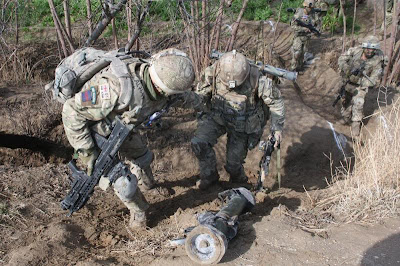 |
| This photo shows the elusive ASM, laying on the ground in foreground in the picture. The man climbing up appears to carry a LASM over his backpack. |
In the Anti-Tank role, the British
Army has been using the LAW80
for years (at entry in service it replaced the L14A1 Carl Gustav recoilless rifle and M72 LAW rocket
which then made a return as LASM), this 94mm rocket being the baseline weapon,
with spaces for the stowage of 8 being reserved into the Warrior IFV, for
example.
Of course, the LAW80 has been aging,
and it eventually became obsolete before a replacement was ready: perhaps the
most relevant defect being the impossibility to fire the rocket from enclosed
spaces, so this brought to an UOR, met by purchasing the AT4CS rocket launcher
as ILAW (Interim Light Antitank Weapon).
In 2002, the Saab Bofors Dynamics
MBT LAW was selected to become the Army’s Next-Generation LAW (NLAW), offering a fire and forget Predicted
Line Of Sight guided rocket with a minimum range of 20 meters and a maximum
range of 600+ meters, capable to defeat Main Battle Tanks. The rocket can be
fired safely from enclosed spaces. It uses top-attack mode against tanks, but also offers Direct fire option against light armor and bunkers or buildings.
The launcher is reloadable, and the
system is compliant to Insensitive Munition regulation. Around 14.000 rockets
have been ordered/acquired, with entry in service from 2009 and an expected
service life of some 20 years.
The system weights 12.5 kg, however,
so it is not that light to carry around. In the contract, an In-Door Training aid and an Outdoor training round were included.
 |
| NLAW training |
When the transition will be
completed, the British Army section will have access to the ASM and NLAW systems,
both top of their classes, as the other interim and obsolete systems are
retired. The weight issue, however, is serious.
In support
The L7A1 (FN MAG 60.20 T3) and L7A2
(FN MAG 60.20 T6) GPMG were
originally manufactured on license by the Royal Small Arms Factory at Enfield
Lock in Greater London. When that closed, UK production of GPMGs and spare parts
moved to Manroy Engineering Ltd of Beckley, East Sussex, better known for being
the UK’s provider of .50 Heavy MG. In 2008, following problems with Manroy who
lost the rights to produce the GPMG, the UK’s L7A2 machine guns are produced by
H&K in Oberndorf, Germany.
The GPMG is used in Sustained Fire
and Light Role modes. In SF mode, it is mounted on the L4A1 stable light
mounting developed by the Royal Small Arms Factory. This tripod mounting incorporates
a recoil buffer unit, permits all-round traverse and has a quick-release
mechanism allowing free traverse, elevation and depression. In Light Role, it
has a folding bipod and can take 50 rounds belts. The GPMG is a popular weapon
in the army, but the weight is its obvious defect, and a reason for its disappearance
from the Section when the SA80 era started.
The loss of firepower and the
reduction in the ability to suppress the enemy, particularly at range, was
badly felt, however, and the British Army eventually adopted, for some years
(until around 2008, indicatively), the US model of adding a Maneuver Support
Section (MSS) to the platoon, containing 2 GPMGs, at the cost of adding 4 men
and 1 NCO.
Eventually, in the early 2000s, the
Minimi LMG was procured as a replacement for the L86 LSW, and the under slung
grenade launcher was introduced to the Section. The cost was the loss of the
Platoon’s 51mm mortar and of the recently introduced MSS, removed for saving manpower. Both choices did
not prove happy ones, as we’ll see.
In Afghanistan, the GPMG ended up
being heavily used, and it returned to the Section, with each patrol going out
having one. At least.
However, weight issues remain, and
weight reduction for the General is a recognized objective, even after the
‘Major Minimi” UOR. Cranfield University has been working on it, with ambitious
long-term aims: as of 2010, the target is a weapon mass reduction of 3.6 kg and
a further 6 kg saving in the weight of 800 rounds and belt links.
Other studies have been made on
light medium machine guns around the world, and H&K proposes its own
solutions, from the H&K-121 (a new machine gun design) to the
Lightweight L7A2 GPMG revealed in June, sporting a welcome 1.8 kg reduction in
weight thanks to modifications that include a fluted barrel, picatinny rail for
sights on top cover, folding butt, “dark earth” colored body matching the Multi
Terrain Pattern camouflage and an improved feed tray with ‘pawls’ to stop the
ammo belts from slipping around. This gun does not include titanium-made body,
which has been mooted for a long time and is possibly still being trialed. It
might not have been judged mature enough yet, or it might be a money problem.
In any case, it remains desirable and under study at Cranfield: it is estimated
that it might imply a saving of up to 3 kg.
For the future, beyond Afghanistan, a Lightweight GPMG remains a stated
army priority.
 |
| Lightweight L7A2 by H&K |
The underslung grenade launcher (H&K AG36, adopted by the Army as
L17A1 for use on the L119A1 carbine and as L123A1, A2, A3 for use on SA80) only
reaches half of the distance covered by the 51m mortar, at most, and is not as
lethal, so that the Army made it clear that a requirement exists for procuring,
at some point, a capable Medium Velocity 40mm (40x46) grenade offering range of
800 meters or more. The UGL currently employs Low Velocity 40mm grenades. The
High Velocity grenades (40x53) are used by the GMG, and are unsuitable for the
UGL, but several types of Medium Velocity rounds (in 40x46 or 40x51 mm
calibers) are available and/or in development.
These add quite a lot of recoil
force the Grenadier has to deal with, but carry more explosive and double the
range out to 800 meters or more.
Differently from the US M203 grenade
launcher, the UK-adopted, H&K AG36 UGL is readily capable to take the
longer 40x51 mm grenade, eventually, as its breech does not slide forwards for
reload, but swings open to the left.
In the meanwhile, this year the FIST
UGL control unit will entry in service, and by reducing the CEP at 300 meters
range to just 5 meters it will dramatically enhance the effectiveness of the
weapon.
 |
| H&K AG36 UGL open for reloading |
However, as of now, there is no
Medium Velocity grenade in service, and anyway it has been recognized that,
even when there will be one, it won’t fully replace the effect provided by the
Platoon’s hand-held light mortar.
And in fact, a UOR was launched and
procurement of a complete 60mm Light
Mortar capability went ahead, possibly procuring a total of 630 mortars
which will stay in the Army in the long term, and not just for Afghanistan.
Two variants of 60mm mortar have been procured,
both from Hirtenberger: the M6-640 is used at Platoon
level, and is an Hand-Held (HH) ‘Commando’ weapon. In Commando mode it weights
around 4.6 kg and is 726 mm long with a 1921 meters maximum range at Charge 3.
The M6-895, with longer barrel ( 984
mm, 5.5 kg ) and bipod, is used as a Light capability added to the Mortar
Platoon at battalion level. Mounted with baseplate and bipod, it has a maximum
range of 3610 meters, is 977mm long and weights 19,5 kg. The M6-895 can also be
used in Hand-Held mode after undergoing a simple 2-minutes conversion. In
Hand-Held mode it can be used to maximum Charge 3, with a range of 2100 meters.
The 60mm ammunition is the same, and
there is a huge assortment of rounds available: the 1.4 kg HE bomb generates
590 splinters, and there is a Practice round, a Smoke-White Phosphorous with a
90 seconds burnt time, a 90-seconds Red Smoke round, an IR illuminating round
capable to provide 35 seconds of illumination over a 1200 meters radius area,
and others.
The M6-640 can be fitted,
eventually, with the same bipod and plate as the M6-895. For both mortars, the
maximum rate of fire is 30 rounds per minute.
The L134A1 Grenade Machine Gun was first introduced as a UOR, with an
order for 40 systems from H&K placed in November 2006. A second, much more
relevant 18 million order was placed in February 2008, to fulfill the
requirement for the infantry Fire Support Weapon. This order also included a
complete suite of weapons optics including telescopic day sight, image
intensifying and thermal night sights, and a laser rangefinder. A simulated
training system, allowing to train realistically without firing a single
grenade, was also procured.
The Fire Support Weapon focus was on providing weapons and
tripods specifically for the use of the GMG in the fire support elements of
Light, Mechanized and Airmobile infantry. Armoured infantry, having the
Warrior’s gun in support, can do without.
The GMG anyway remains fully
vehicle-compatible, with integration tackled by procuring the ISTEC Universal Gun Mount, which provides a single, common
assembly for mounting GPMG (single or twin), HMG or GMG. It has been reported that by 2010-11 the
holdings of GMGs had increased to around 400.
 |
| Training with the L111A1 |
Finally, the L111A1,
the immortal Browning .50 Heavy Machine Gun. Prior to the Iraq and Afghanistan
conflicts, the Army had left its holdings of .50 HMG wither down to just 156
guns, but successive orders, according to some sources, have brought the number
up to around 1100 by 2011!
The L111 is produced by Manroy, which also introduced
a ‘Soft Mount’ reducing recoil and improving accuracy, and a Quick Change Barrel
system.
In the long-range Anti Tank role, over the 2500 meters
distance, there is the well known Javelin,
in service since 2005. The missile has been widely used to hit compounds and
other targets at range, leading to a few consistent orders to replenish the
stocks of rounds. The Aiming unit of the Javelin provides a valuable ISTAR kit
by enabling long range observation. The UK continues to use the L16 mortar, in 81mm caliber, as its
heaviest support weapon in infantry formations, pretty much an exception to the
rule since the allies have long moved to the 120mm mortar at battalion level
(US, Italy, France, Germany…) and nations such as Russia and China have long
embraced the advantages offered by 120mm Mortar-cannons capable to fire in
direct as well as indirect mode.
 |
| L16 in action |
This, however, will be material for a future post in
the series.
Sniper System Improvement Program
The L115 designation in British Service indicates the
Accuracy International AWSM (Arctic Warfare Suprt Magnum) rifle in .338 Lapua
Magnum caliber. The first rifles purchased were known as L115A1 LRR (Long Range
Rifle) and saw extended usage in Afghanistan and Iraq in 2001 and 2003, fitted
with a Schmidt & Bender 3-12x50 PM II optics.
The L115A2 followed, and introduced several
improvements, such as Tan colored body, Harris bipod, fluted barrel and
suppressor. It was effectively a prototype for the further enhanced L115A3.
L115A2 rifles are similar enough to the final A3
configuration that they were converted to A3 standard, but the legacy L115A1 LRR (Long Range Rifle) was not
modified.
In 2007, finally, the Sniper System Improvement
Program kicked in, and in November 2007 the MOD announced the selection of a
new standard sniper rifle for Army, Royal Marines and RAF Regiment, with the
placement of a 11 million pounds order
in March 2008 to Accuracy International for 580 of the new, improved AWSM
variant, the L115A3.
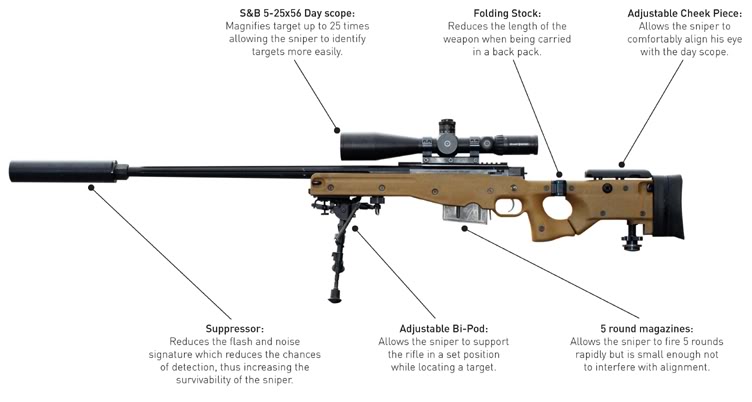
The new rifle came with a more powerful optic (with
twice the magnification, at x25 against x12), the Schmidt & Bender 5-25x56
PM II. Other improvements include a suppressor to reduce the flash and noise
signature, a folding stocks for improved ease of carriage, an adjustable cheek
pieces assembly for more comfort and better eye alignment with the telescopic
sight, a Butt spike or ‘monopod’ to enable the shooter to observe the target
area for extended periods with minimal fatigue, a new adjustable bipod and 5
round box magazine.
The L115A3 would finally entirely replace the L96
family (L96A1, L96A2, L118A1) in 7.62x51 mm, increasing range and lethality
with the adoption of the more powerful Lapua Magnum round.
 |
| L115A3 |
This purchase was followed by the Sniper Thermal
Imaging Capability program, for the purchase of suitable night sights. Two
products of Qioptiq were selected: the SVIPIR2+ as Thermal Sniper Sight, which
is mounted ahead of the scope. The VIPIR2S+ is issues as night sight for the
Spotter (also known as No.2) and can be handheld or mounted on tripod.
The SVIPIR2+ is designed to operate in total darkness,
being a Thermal camera and not an Intensifier sight (which needs at least a
little external light source) and enables engagements out to 1200 meters at
night and/or in foul weather, fog or dust cover. It is also fairly light and
small compared to other comparable systems, but with the defect that it needs 4
AA batteries at a time, and empty them in as little as 6 hours.
In Iraq, the
KN203 Night Sight Simrad was widely used. This is a II system that clamps onto the day sight scope, and might still be used as complementary to the new thermal sights. In presence of some form of light, (star, moon light or other), the II sight is very useful for identifying the target. The thermal imager does not need external light sources, on the other hand, but identifying the soldier you are looking at is very difficult.
The sniper teams will also use the
Kestrel 3000 pocket weather reader to determine a variety of factors crucial to the shot's accuracy, from winds to humidity levels.
The spotter might also be carrying the
LEICA Vector laser range finder and the
Leupold x40 spotting scope.
SSIP also covers other elements of the sniper’s
equipment, from special tripods to other bits of kit: one is the Vectronix PLRF
15C Pocket Laser Range Finders, ordered in 2007. PLRF15C can lase a
target out to around 5 km, and it includes a DMC Digital Magnetic Compass
feature. This small addition provides a wealth of additional data: azimuth or
bearing, inclination or elevation; horizontal distance and height difference –
not only between the observer and an object, but also between two remote
objects A and B.
 |
| A sharpshooter accompanied by a soldier pictured here looking at the enemy with a PLRF15C |
A number of rifles in .50 caliber are used by British
Forces, from SF to the Royal Marines, which use the Barrett as L82A1 Infantry
Support Weapon. The Accuracy International AW50F .50 with folding stock was
also procured, and put in service as L121A1. It used by Royal Marines in counter-smuggling, as it can
disable a boat with a shot well placed, but it is also use to shot at IEDs from the
distance.
The second major requirement in terms of weapon system
within Sniper System Improvement Program was an Anti-Material capability
provided by a semi-automatic 12.7 mm rifle to complement or replace the
existing arsenal. In 2009, this requirement was estimated in around 50 rifles.
Deliveries had to be made in 2010, and the selection was down to two
competitors: the Accuracy International AS50 and a modified M82A1 Barrett variant. The requirement was specifically for a .50,
semi-automatic, accurate enough to enable the sniper to engage sequentially 5
targets in 10 seconds. The rifle would have to immobilise a vehicle engine and
penetrate laminate and toughened glass by day, out to a minimum requested range
of 1800m, with a desired range of 2000m.
AS50 and M82A1 were selected for
final trials, with 8 rifles of each type requested for appropriate evaluation.
Unfortunately, I’ve been unable to find further information, and I don’t know
if this branch of the Sniper System Improvement has progressed, or if it fell
victim to budget cuts.
A wider adoption of Anti-Structure
Precision Rifles is worth considering, as such heavy caliber weapons have
gained a lot of recognition during operations. The US Army and Marines
identified the .50 sniper rifle as one of the most important capabilities they
had available in Iraq, where the sniper war was incredibly complex and
ferocious.
.50 Sniper rifles are used by
Canada, US, Italy and many others. The US case is particularly interesting. In
the US BCTs, the Infantry company is given a Sniper Team made up by 3 men: one
is armed with the XM107 Barrett .50, one has the M24 in 7.62mm caliber and one
man is in the close protection role, armed with an assault rifle, complete with
under slung grenade launcher, which provides a chance to break free of
engagements.
In the Italian “medium-weight”
brigades, the Infantry Company is given a sniper team of two men. The plan is to
give the “sniper” a .50 Barrett, while the “spotter” gets a SAKO TRG 42 in the
same .338 Lapua Magnum caliber of the L115A3.
The british sniper team, conversely,
uses the .338 caliber weapon as main sniper rifle, with the scoped L129A1
apparently selected as weapon for the spotter/No. 2. On paper at least, the
intended force is a Sniper Platoon of 16 men in 8 teams per each infantry
battalion, even if the aim is to give each platoon a sniper (pair, ideally).
The combination L115A3/L129A1 makes
a good sniper team, but in my mind using .50 sniper rifles only for Special
Forces, stand-off counter-IED and niche roles, as purely anti-material
(anti-boat most of the time!) weapons is depriving the wider Army of a very
useful capability. As part of the Sniper enhancement programme, in my opinion a
reassessment of the .50 precision weapon is necessary.
Improved bullets?
In June 2010, the MOD and BAE
announced that a
first batch of a million 5.56x45 mm rounds would be produced for
experimentation, with Qinetiq to evaluate the effective eventual improvements.
Officially, this had nothing to do
with Afghanistan, but unofficially, improved range and lethality quickly
available for use in Afghanistan were desired.
The current L2A2 round (SS109 NATO)
uses a steel–tipped, lead core bullet, while the new, improved SS109 was
intended to have a full-steel core, removing lead entirely from the equation
(and so doing also removing the concerns of lead poisoning, making greenpeace
happy). Nicknamed the “Dirty
Harry” round, its current status is unclear. Just this week, the Guardian
wrote that the Army has no lead-free bullets, and no plans to adopt them.
Either the Guardian is wrong, or Dirty Harry did not progress.
If successful, the new type of
bullet would be adopted for 7.62 mm rounds as well.
The US Army has long been trying to
improve the 5.56 round’s lethality. Their M885A1 round, development of the baseline M885, encases a steel core in a
thin copper jacket which fragmentates in high speed impacts. The UK refuses to
adopt this solution due to strict interpretation of the Hague convention, which
would appear to make this unlawful.
The US have also used the MK 262
open tip match bullet, but even this solution is considered banned.
Efforts to improve the bullets,
making them much lighter, if not more effective, continue.
Sights and Night Vision
Following a variety of UORs which brought into service
a wide range of day and night sights, from the ACOGs to the MaxiKite, the Synergistic Individual Surveillance Target & Acquisition (SISTA) UOR brought into service a number of VIPIR2+ night thermal weapon sights, which had already been preceeded by 300 hand-held VIPIR-S surveillance sights ordered in March 2006 and by a further 450 ordered in January 2007.
 |
| VIPIR2+ sights installed on a GPMG and SA80. Now that FIST STA solved the problem of providing night sights to the dismounts, it is likely that the VIPIR2s will more and more frequently be seen on support weapons, from GPMG to HMG and GMG |
The Army
was finally able to move onwards with FIST STA in 2009, and place a coherent
order for the complete re-equipping of pretty much the whole army.
In fact, the initial order, signed in September 2009 was for delivery and in-service support of 95
Infantry Company ‘packs’, but in December 2010 a follow-on order of 51 further packs brought the total to 146 Companies, enough for
whole (or almost) of RAF Regiment, Royal Marines and British Army. The first 95
Company Packs will all be delivered by 2014, with the rest to follow.
FIST STA includes:
Lightweight
Day Sight ELCAN Specter OS4X each man in
the Section gets one. It is the intended replacement for the SUSAT, with the
(still evolving) plan predicting a gradual retirement of the SUSAT, to be
complete by 2025. The ELCAN is a 4x sight, and is fitted as backup for close
range engagement with the Shield-produced Mini Sight Reflex Red-Dot, said to be the smallest and most compact
red-dot sight in the world.
The introduction in service of the
L129A1 rises an interesting question, as the sharpshooter in the Section
envisaged by FIST was to employ the L86A2 LSW, with the 4x sight. As we have
said, the L129A1 is using a 6x ACOG sight, and it would be a retrograde step to
reduce the magnification available to the marksmen. As I write, it is currently
unclear what the long term solution will be. Perhaps bringing into FIST the
ACOG 6x, or adding a dedicate procurement of the ELCAN 6x…?
Fist Thermal Sight (FTS) a high performance un-cooled Thermal Weapon Sight that
provides the User with 24hr target detection, acquisition & engagement
capabilities out to extended ranges, in every weather conditions and even in
total absence of any external light source. The FTS is equipped with a 640x480
format un-cooled thermal core, and is powered from AA batteries.
The FTS has an integrated Infra Red Laser
Aimer (IRLA) for enhanced target identification, along with the integrated
fall-back Close Quarter Battlesight (CQB) red dot sight from Shield, as we said
earlier.
The FTS also has the ability to be controlled remotely
via the weapon hand guard, again demonstrating an enhancement in the wider
integration context.
In each 4-man Fire Team, the FTS is assigned to the
Leader and to the LMG Gunner.
Common Weapon
Sight the Pilkington
Kite night sight is a Generation III Image Intensification (II) night sight capable
to use starlight or moonlight to provide night vision. In the Army is known as
Common Weapon Sight, and has been around for some time. Under FIST STA, the
sight is upgraded and fitted with the Shield red dot, and then re-issued. It is
used by the Grenadier and provides 4x magnification. It weights 990g excluding the 2 batteries and offers night detection of a standing man out to 500 meters with sole starlight available.
MaxiKite 2 is the big brother of the CWS, and
just as CWS it was already in service prior to FIST STA contract. Like the CWS,
it gets upgraded and fitted with the red-dot before being re-issued. The Maxikite offers 6x magnification and
allows targeting at night over long range (a standing man will be seen at 750 meters) and will be issued
to the Sharpshooter. It weights 1.36 kg and can operate for 70 hours with a couple of batteries.
Grenadier UGL Fire Control System the SA80A2 with UGL
is fitted with a UGL sight provided as a UOR by Istec Services of Hertfordshire, coupled with
the FIST-specific Rapid Acquisition Aiming Module fire control system jointly
developed by Vectronix of Switzerland and Wilcox Industries. RAAM instantly
calculates the distance, angle of declination or inclination, and adjusts the
point of aim accordingly.
The combined solution is valid day
and night, and reduces the Circular Error Probable to 5 meters over a 300
meters range.
MOSKITO Commander’s Target Locator a binocular day/night target
acquisition system,
weighting less than 1.2 kg and offering 5x daylight and 3x night magnification
with a 24 hours of night vision observation duration with a set of batteries. MOSKITO
measures range, azimuth and vertical angle, locating NATO standard targets up
to 4 km away.
Ruggerized
Digital Camera a sturdy, highly
resistant digital camera to take photos or short videos valuable for
intelligence examination. Issued one per Section. This commercial off-the-shelf camera produced
by Olympus was specified for FIST due to its ability to transmit and receive
images from patrols. Weighing only 200 grams (6.4 oz.), it is designed for
harsh conditions. The camera reportedly operates even after being immersed in
10 meters (33 ft.) of water or dropped 2 meters.
Lightweight
Infantry Periscope produced by
Uniscope, Israel, this foldable periscope is issued one per Section and enables
soldier to look past a corner without exposing themselves. It is seen as an
interim solution: cameras integrated in the rifle sight relaying imagery to a
head mounted display were trialed, but judged not yet mature enough. Besides,
with the freezing of the “C4I” elements of FIST, there is currently no data
architecture and no selected display to use in such a system, which features,
instead, in Soldier Systems such as Italy’s Soldato Futuro, France’s FELIN, the
various US projects and so along. This architecture makes it possible to fire
accurately exposing only the weapon past the cover, something that with the LIP
is not possible.
The LIP offers a 12-deg. field of view and 3X magnification.
 |
| Overview of the FIST STA items, and how they fit into a 4-man fireteam as of 2011. Note that on operations, the L129A1 is used in the Sharpshooter role, one per Section. Since a Section has 2 fireteams, in the future one of the two Sharpshooters might continue to use the LSW. The LIP (Lightweight Infantry Periscope) is issued one per Section, as is the Ruggerized Digital Camera (RDC). The MOSKITO Commander's Target Locating System (CTLS) is issued to each fireteam leader, so 2 per Section. Everyone gets the Light Laser Marker and the HMNVS night vision. |
While not procured under FIST STA,
the Light Laser Marker (LLM) is an
important component of the Lethality package. Issued in measure of one per
soldier, the LLM-01,
a design by Oerlikon Contraves, is a small unit mounted on the personal weapon
and combining Visible Red Laser Beam Marker; Invisible IR laser marker for use
with night vision equipment; IR illuminator, again for facilitating use of
Night Vision equipment and II weapon sights and a Lamp Head (Visible Light
torch) or Laser Head available in Marker and Illuminating variants.
 |
| LLM unit: (1) Visible Red Light Laser (2) Invisible IR laser (3) IR illuminator provides invisible light for use with NVG (4) Visible Lamp Light or IR Invisible Lamp Light |
In the same role, the Special Forces
favor the AN/PEQ-2,
which is standard issue of the US forces.
 |
| This well known photo of a squad from the Special Forces Support Group (1 PARA) shows an H&K 417 sharpshooter rifle (second man knelling from the left) and SA80 rifles all very evidently fitted with the AN/PEQ-2 |
Also not directly a FIST STA component,
the Head-Mounted Night Vision System
(HMNVS) AN/PVS-14 is fundamental. This monocular
sight, used extensively by the US forces as well, is now the standard night
sight for the british armed forces, with 32.000 units in inventory as of 2011
and some 10.000 more planned, enough to give night vision to all deployed
soldiers, in each section. An additional order (for all of the 10.000 planned?)
has been placed in early april this year, with deliveries to be completed by
2016.
 |
| AN/PVS-14 can also be used hand-held or rifle mounted |
The British Armed Forces also use
the LUCIE sight, and will use it at least out to 2023 according to current
plans. LUCIE is an image intensified (II) night vision
goggle.
In this area,
in 10 years, the British Army made huge leaps, as this historic
figure from a 2003 Written Answer show: back then, Night Vision was pretty much
stuff for special forces, with available numbers of sights for the PBI (Poor
Bloody Infantryman) low or extremely low.
In the
future, FIST envisages a Head Mounted Sight (a function of a multirole Head
Mounted Display, I believe, like in other Soldier Modernization programmes) and
a new kind of “all-doing” weapon sight combining optical, Image Intensifier and
Thermal Imaging modes to provide a day/night all-weather system.
Research and
development should start in 2014/15, and proceed towards a FIST 2 capability
which will start delivering from 2018. FIST 1 is the current FIST package in
delivery: it had to comprise Increment 1A (the weapon sights as listed above)
and a Situational Awareness/C4I package under Increment 1B.
Increment 1B
was cancelled, and FIST restructured in “epochs” (1, 2 and 3). Epoch 2 will be
particularly important as it is a bridge, comprising the many UORs moving into
Core post-Afghanistan, towards the targets of the full FIST platform for the
2030.
Another Surveillance and Target
Acquisition instrument available to the Army at Team level and above is the Thales Surveillance System And Range
Finder (SSARF), 707
of which have been procured with deliveries completed in 2011. The SSARF is similar in concept to
the MOSKITO, but features an un-cooled thermal sight element, and is used by
Fire Support Teams to detect targets for subsequent mortar, artillery or air
attack.
 |
| Observing with SSARF |
Again, the British Army ordered in
March 2012 a significant number of Sagem (Safran group) JIM LR (Long Range) multifunction infrared binoculars
for the “Long Range Thermal Imager” requirement. The JIM LR offers day/night
(infrared) vision, rangefinding, laser pointer, North seeker, GPS and data
transmission. The British Army variant also provides Image Fusion between the
infrared and visible channels, to penetrate camouflage during the day, and to
provide true all-weather vision (through smoke, etc.). It will also be able to
record imagery on USB supports.
VIPIR-S, SSARF and JIM LR should more than
make up for the soon to come retirement of the old LION short range and SOPHIE
Medium Range thermal imagers, by providing greatly increased Short, Medium and Long range thermal imaging and surveillance capability.
Moving ahead
The Army has a list of programs and
priorities for the next few years, and in the “Lethality” sector, we can
summarize them in the following list:
-
Reduce weight
as an absolute priority as part of the long term aim of achieving a maximum 40
kg load per soldier by 2020 and a 30 kg load by 2025, with a 25 kg load
considered ideal.
-
L129A1
expected to live on “well past 2015”, being brought into core
-
NLAW
and ASM fully in service
-
60mm
Mortars to stay
-
SA80
replacement initial gate in 2014, with fielding in the early 2020s. A SA80A3
upgrade remains a possibility.
-
The
polymer-made lightweight magazines procured as UOR are intended as an interim
solution, with a Lightweight Magazine Long-term replacement planned.
-
A
Lightweight Bayonet is planned
-
A
Lightweight GPMG is planned
-
The
LMG Minimi will be “reconfigured”, likely to reduce weight and install a longer
barrel
-
Weapon
Paint Rounds systems for training
-
Powered
rails on the personal weapon, connected to the Soldier’s power system for easy
attachment of accessories and reduction in the number and weight of batteries
to be carried
-
Round
counting
-
Rationalization
of Hand Held Thermal Imaging equipment
-
Lightweight
binoculars and monoculars
-
Development
of an Universal Helmet Mounting system
Personally, I’m adding to the list the already
mentioned .50 sniper rifle reassessment, plus considerations for adoption of
the 120mm mortar-cannon. In future posts I’ll also explain my opinion on the
need for re-establishing the Platoon-level Maneuver Support Section and the
need for a powerful Fire Support Group at Company Level.
Finally, a note to this and other posts of this
series: the argument I’m treating is immense, and very complex. A huge numbers
of UORs and years of delays, changes and rethinks on a variety of programs have
made this subject very complex to treat in full detail.
Despite my best efforts, I might be missing something
here and there, or even making some mistakes. Believe me when I say, however,
that I’ve tried to cross-cue as much as possible, using as many, as reliable
and as up to date sources as possible. I will welcome any useful contribution you
can make to improve this and other posts.