The Seat
of Purpose is on the Land. For
British maritime power, the real focus of maritime strategy is on what you do
once you have control of the sea; ‘the
essence of maritime power is the ability to influence events on land’.
This means that while sea control is essential, only the minimum level of
effort, commensurate with the acceptable level of risk, should be employed in
it. The rest of our resources should be used to influence events on land, both
at, and from, the sea. This also requires sea control, of course, which enables
the holder to use maritime power and, if required, denies an opponent that same
ability. At sea, the military, diplomatic and economic impact will depend upon
the opponent’s dependence upon the maritime
environment
for its security and resilience; for many states sea dependency is growing. On
land, the military, diplomatic and economic impact will depend upon the holder’s
ability to influence its opponent from the sea; this influence could take a
variety of forms from a low-level focused maritime blockade
(such as
one focused on components for weapons of mass destruction), to an invasion of
the opponent’s territory.
MOD Joint Concept Note 1-12 (JCN 1-12), dated May 2012
The promised second part of my reasoning on the future "Lighter Frigate" for the Royal Navy, apparently to be known as Type 31. My question, detailed in Part 1, is whether traditional escort designs can still do their intended job. Several developments suggest that they can't, or that at least they will not be able to do it in the near future.
So the question becomes: what should Type 31 be?
The answer, as we saw in Part 1, is "a ship meant to deploy a number of air, surface and sub-surface systems meant to expand its capabilities and allow her to survive, to protect other ships and to contribute to the widest possible range of missions.
Part 2 looks at some ship designs from around the world and details my proposal.
The two extremes
A growing number of designs, either
built, planned or simply offered, are meant to embark and employ modular
mission payloads. The list would includes vessels such as the American LCS, the
Italian PPA, the Damen Crossover, the Black Swan concept, up to the Danish
Absalon class.
The first observation to be made is
that the importance of the modular payload varies from design to design: the
capability of some ships depends almost entirely from the embarked payloads,
while other vessels have a wide range of equipment which is only complemented
and expanded by embarking payloads.
At the two extremes, we find Black
Swan (entirely shaped by payloads) and the Absalom (a fully fledged and well
armed warship which also offers a large cargo space).
The Black Swan concept, which caused lengthy debates online when it was
revealed a few years ago, was a deliberately provocative proposal which brought
reliance on external payloads to the extreme. The briefing paper argues for the
construction of “sloops-of-war” costing no more than 65 million pounds apiece;
2000 to 4000 tons in terms of size; built to commercial standards albeit
capable of operations in marginal ice; armed extremely lightly, basically like
a current River OPVs perhaps with the addition of a CIWS based on laser (once
mature); crew as small as 8, with room for up to 60 more; low, extremely modest
speed requirements to reduce costs and complexity; diesel-electric propulsion.
The Black Swan sloop is described as
a mothership vessel which operates at stand off distances by sending unmanned
systems in the contested, denied area. Its capabilities are entirely driven by
the payload embarked and the ship is not meant to operate in isolation but in
small groups (assumption is that 4 Black Swan plus mission payloads would be
built for the cost of a traditional large escort vessel).
The Black Swan has a very basic
sensors fit, and it is even described as having a rather basic communications
fit, which feels contradictory and dubious since, depending on the force of the
group and having to stay in constant two-way contact with multiple unmanned
vehicles, the ship can be expected to have serious ICS and bandwidth
needs.
The notional design provided at the
end of the briefing paper shows a 95 meters ship, a bit over the 3000 tons,
with a core crew of 8 and space for 32 mission specialists, which would all
live in SSN standard accommodations (HMS Astute being the benchmark). The
payload would reach 400 tons and the requirement is for a volume equal to at
least 20 containers. A large hangar (Merlin + rotary wing UAV) and a
Chinook-capable flight deck complete the design.
The design comes with a 600 square
meters mission bay and a 370 square meters hangar bay. Each of the 20
containers on the mission deck is individually accessible and can be connected
to ship services. A stern ramp for boats is provided aft, flanked by two
container positions for modules that require direct access to the water, such
as towed array modules.
The Black Swan is an extreme
concept, which tries to ensure a large number of ships can be built, and that,
however cheap, each is flexible and precious even in a high end warfighting
scenario. However, the reliance on external systems is pushed to the extreme,
and is arguably excessive. It will be very challenging (both technically and
financially) to ensure that the Black Swan can constantly keep UAVs in the air
to have sensors coverage and firepower at the ready. Costs will merely shift
from the mothership to the vast array of UAVs and USVs and UUVs needed,
especially since the authors seem to envisage particularly capable unmanned
systems, able to strike enemy targets deep into contested space in a high end
warfighting scenario.
Other evident bottlenecks are:
-
Power
generation and supply. It is one thing to trade speed off to lower costs, but
the mothership will have to provide power to its modular payloads, and this
might require substantial amounts of electricity. It might be impossible to cut
down the power generation.
-
Space.
The tyranny of space imposes the choice of submarine-like accommodations for
the crew, and reduces the space available for the specialist teams accompanying
the unmanned systems. While they have no men in the cockpit, unmanned systems
to this day remain far from “unmanned”, requiring a substantial crew back at
the base for maintenance and mission control. We can assume that the systems
will become more and more autonomous, but betting that 32 men will be enough
for everything and specifying an 8 men core crew is very likely to lead to
trouble. It will also put greater pressure on the unmanned systems, which will
need to be much more autonomous and much more reliable, making their
development riskier, more demanding and, inexorably, more expensive.
Of
course, part of the Mission Deck could be used to add accommodation modules for
extra personnel, but then the space for the systems is reduced, and finding the
good balance might rapidly become challenging.
The Black Swan, in my opinion,
chooses the wrong hull. I’d rather have fewer but larger motherships,
individually more capable, than groups of small sloops. This because the
availability of great space and weight margins greatly eases integration of new
systems and evolution through life.
The LCS is just one step above the Black Swan, since it has relatively
little capability unless it is carrying a specific mission package.
Much has been said of the LCS, a
program which has repeatedly encountered serious difficulties and has thus
gained a vast armada of haters which have by now poisoned the whole debate
about their merits and shortcomings.
The critique I move to the LCS is that
they are trying to be two things that do not mix too well: nimble, ultra-fast
littoral “street fighters” and, at the same time, motherships.
The LCS ended up absorbing features
of the “Street Fighter” ship envisaged in the 90s by Vice Adm. Art Cebrowski,
head of the Naval War College. The “Street Fighter” was going to a cheap, small
(less than 1000 tons), extremely fast and nimble, disposable ship meant to go
in the littoral and fight off FACs and other anti-access threats in the
challenging brown waters were, it was felt, the big Burkes would struggle
badly.
In the early 2000s, under the tenure
of Donald Rumsfeld at the Pentagon, small ships and “transformational”
approaches to warfare gained traction. The LCS was born, and the navy began to
work on a mission and on a design for them. The LCS grew quickly as a result,
to over 3000 tons, and the requirements piled on it included replacing
minesweepers and Perry frigates as well as fighting back FACs in the littoral
by means of speed and maneuver. It is not what the original Street Fighter was
meant to be, yet it insists on extremely high speed (even if a lot lower than
what was wanted from Street Fighter). The compromises that have had to be built
into the design as a consequence are the root cause of most of the trouble and
of the skepticism that surrounds the ships.
They have large mission bays, but
the mission package must weight no more than 105 tons, which is proving
difficult. Growth margins are almost inexistent. Accommodations have had to be
expanded as more men are required to accomplish the missions. Autonomy is not
very good, as the ships are thirsty race horses. And their armament, EW and
sensors fit limits their warfighting capability.
 |
| The LCS ASW module. Ship-mounted torpedo tubes are not included. Even the Type 26 might not have ship-mounted torpedo tubes, but there is no definitive confirmation. |
Somewhat predictably, the US Navy is
now working to make some of the modular payloads permanent components of the
ships, particularly in the “Fast Frigate” evolution of the LCS which will
represent the last batch of ships to be built. Anti-ship missiles will be
added, as will a proper EW outfit. The Fast Frigate will also permanently sport
light guns and a towed array, instead of having to add them as modules.
The US Navy so far is refusing to
accept the evidence that, if the LCS is to become more fighting capable, it
needs a capable lightweight anti-air missile fit. They are putting considerable
effort into adapting a vertically-launched Hellfire missile variant as an
anti-FAC weapon instead, but if the Pentagon was a bit more open to adopting
foreign products they could just buy into Sea Ceptor and use it to give the LCS
both decent local area air defence and anti-surface strike capability. The
impossibility to mount bulky MK41 launchers would not be a problem with Sea
Ceptor…
 |
| From LCS to "Fast Frigate", several bits cease to be add-ons and become permanent features. |
The rest of the problems with LCS
are due to the immaturity of the modular payloads. The development of the
payloads started after that of the ship, and in a period in which unmanned
vehicles were still somewhat primitive. But developments in the unmanned world
are becoming faster and I’m convinced that the mission bay will allow the LCS
to stay relevant in all missions.
The lack of weight margin, though,
is a problem. It goes to reinforce my belief that if you are going to build a
carrier, you must make sure it is actually built to carry stuff.
The Italian PPA (Pattugliatore Polivalente d’Altura, which could be translated
as Multimission Oceanic Patrol) is a completely new design produced by the
Italian Navy’s own projects office in collaboration with Fincantieri, that will
build them. The PPA is an innovative ship, introducing new systems and new
concepts and it is meant to replace several classes within the Italian navy,
from the 2 Durand de la Penne destroyers (due to be de-classed to frigates due
to the removal from service of their old air area defence weaponry, still using
the Standard SM-1) to the Minerva class corvettes, the Soldati-class “patrol
frigates”, the Minerva-class corvettes and the OPVs of the classes
Costellazioni and Comandanti.
The ship is required to carry out a
wide range of tasks which go from disaster relief to warfighting, and will be
procured in multiple configurations. Curiously the expectation is that there
will be 3 levels of fitting-out: Light, Light+ and Full. The Full will,
obviously, be fitted at build with all sensors and weapons, while the Light+ will
have an intermediate fit and predispositions to accept the missing systems as
required. The Light will have no missiles and will come fitted-for-but-not-with
only in some areas.
The PPA will be a large vessel with
an empty weight just short of 5000 tons, 143 meters in length, but slender due
to a beam of “just” 16.5. They are also required to be pretty fast: a maximum
sustained speed of 35 knots was originally envisaged, although it seems the
requirement has been relaxed to 32.
The PPA is equipped with a complex
propulsion system, in an “evolved” CODLAG arrangement: at slow speed, two
electric motors will give a silent, fully electric propulsion up to 10 knots;
the use of one Diesel will allow cruising up to 18 knots, while adding the
second Diesel is meant to give a speed of 25 knots. Engaging the gas turbine
allows to keep speeds higher than 31 knots. General Electric MV300 drives will
be installed on the ships, allowing them to generate and send ashore 2 MW of
power when stationary in port, converting the frequency from 50 to 60 hertz to
allow smooth shore connections whatever the location. The capability to
generate electricity and potable water are part of the requirements for
Disaster Relief: it is intended that one PPA will be able to cater for the
immediate needs of a disaster-struck town of 6000 people.
The autonomy figure seen so far merely
says that 5000 nm is the minimum required, but the information available is
still incomplete and sometimes uncertain as the design is still being
finalized.
 |
| PPA Full, profile. Copyright team Forum Difesa (http://difesa.forumfree.it) |
In terms of sensors, the PPA is
intended to carry a newly-developed Dual Band AESA radar by Selex, employing
two sets of 4 fixed faces: one set, in C band, works as the long range volume
search radar while the other set, X-band, tracks surface and air targets for
engagement. At the moment it is expected that only the Full variant will have
both installed.
A new IFF with a fixed, circular
array for 360° coverage is part of the design as well as a 360° IRST.
The ships will be armed with a new
variant of the 76/62 mm gun, the “Sovraponte”, a non-deck penetrating CIWS
turret containing its own ammunition. It will fire the DAVIDE / Strales guided
shells for anti-missile, anti-aircraft and anti-surface self defence. The main
gun will instead be a 127/64 with a fully automated magazine and Vulcano
guided, long-range ammunition.
Two 25mm light guns are provided for
close range engagements.
The ship comes with two Sylver A50
modules giving 16 cells for Aster 15 and 30 missiles. The Full variant should
come with space reservation for 16 more cells and the possibility of installing
the A70 launchers in place of the A50, enabling the use of cruise missiles.
The missiles will be carried by the
Full and Light+, while the Light will be fitted for but not with.
All ships will be able to accept 8
Teseo anti-ship missiles, although they are not expected to be installed at
build, not even on the Full.
 |
| The schemes as shown on television by the italian navy. The scheme suggests that 16 A50 cells and 16 A70 cells could be installed at the same time. |
The PPA will have two mission
spaces: one is located in the stern, under the flight deck, and includes one
launch ramp for a boat, flanked by two spaces for container-sized payloads. On
the Full, these two spaces will be used for a towed array sonar and for two 533mm
Heavy Torpedo Tubes facing aft.
There is space for 5 containers or
mission modules and two side openings are also part of the design: these doors
will add flexibility to the procedure to deploy unmanned vehicles and will also
serve as Rescue Zones for taking aboard shipwrecked migrants, a task which
unfortunately is a daily occurrence for the Italian navy these days.
Another modular space is located
amidship, on the weather deck, and can take another 8 containers and/or RHIBs
and boats up to 15 meters. A powerful crane is provided to handle the boats and
containers.
The crew varies from 90 in Light
configuration to 171 for a Full with complete crew and embarked force element.
The PPA will have an innovative
cockpit, similar to that found on aircraft. Sitting two men side by side, and
using augmented reality in the glass windows, it is meant to ensure unparallel
control over the platform, enabling the ship to be fought by as few as 4 men on
bridge.
The large hangar can take one AW-101
or two NH-90 helicopters.
 |
| Towed array module and Heavyweight torpedo tubes plus RHIBs and potentially unmanned ASW vehicles give the PPA Full a powerful array of anti-submarine capability. Heavyweight 533mm torpedoes are increasingly common in industry offers (see also the DAMEN CrossOver): looks like an admission of the fact that ship-launched 324mm light torpedoes are not a credible ASW weapon anymore. |
The Italian navy has signed a
contract for the construction of 7 PPA, with another 3 options to be exercised
within 2021. The 8 ships on order are expected to be Light, Light, Light+,
Full, Light+, Light+, Full. The options are for a Full, a Light, a Light+.
The Italian Navy has expressed a
requirement for 16 PPA in total, which in addition to the 10 FREMM frigates
would make for an impressive fleet. Whether so many will ever be effectively
procured is far from certain. The PPA is not exactly cheap, although the first
7 vessels are expected to cost no more than 4 billion euro, including a 10-year
logistic support contract. They come as part of a massive 5.4 billion “Navy
Law” which the current chief of Navy staff, admiral De Giorgi, has been able to
obtain by campaigning tirelessly for new ships to replace the aging equipment
of the navy. Intended as merely the first step in the renewal programme, the
Navy Law funds 7 PPA, 1 LHD (costing over one billion) and 1 Logistic Support
Ship (around 400 million), plus two small, fast special forces support boats.
 |
| The Augmented Reality cockpit with HUD functions |
The PPA clearly leans more towards a
traditional frigate, putting a lot of focus on the ship’s own sensors and
weapons rather than on modular payloads. This is to be expected, since the
Italian navy still hasn’t put much work into those. Cost is contained by
realizing variants with a simplified combat system.
The approach of multiple
sub-variants is not what the Royal Navy needs, but the ship remains a very
interesting product in its own way.
The Absalon is the hybrid of a frigate and an LPD, so much so that the
danes gave her a L rather than F or D pennant. It was not really thought out
for operating with modular ASW systems, but rather to transport troops and
vehicles, or modular hospitals or headquarters. The vast space available could
be exploited with future systems of unmanned vehicles if a suitable launch and
recovery system can be installed in the stern. The current gauntry crane for boats is just a beginning. It has an excellent fit of sensors and weapons but commercial standards and CODAD propulsion have allowed the danes to keep the costs down.
 |
| The large door has a ramp which can take even the weight of MBTs like Leopard 2. The smaller door allows a gauntry crane to launch and recover large boats. |
The Damen Crossover is a proposed design that mates frigate and LPD, offering
more flexibility than the Absalon in terms of embarking and deploying offboard
equipment, thanks to a stern ramp and side doors.
It could be an excellent starting
point for the Royal Navy’s requirement, although the flexibility of the stern
area does not appear to be quite matched by the flexibility of weapon options
up front. The number of missile cells seems to stay low in all configurations
and the largest gun offered is the 76mm.
Moreover, the fear is that, since it
is really impossible politically to build the “Type 31” anywhere else other
than on the Clyde, going with a Damen design would not enable cost control.
Probably its cost would end up swelling a lot when construction is done in
Govan and Scotstoun.
I also want to mention the proposed BMD ship based on the LPD-17 hull. This
monster is definitely not cheap and not something the Royal Navy could or
should pursue. But it is an impressive example of how missions traditionally
associated with destroyers and cruisers can be transferred, with serious
capability gains, on top of the most flexible of all naval assets: the
amphibious ship. The Ballistic Missile Defence ship is armed with a rail gun on
the bow, meant to engage even ballistic targets. An enormous 4-face radar, far
larger than the one that can be installed on DDGs or even current cruisers,
offers increased search, detect and track at longer ranges. The ship carries an
amazing 288 missile cells in a multitude of MK41 modules arranged along the
sides, in peripheral way. The well dock is enclosed and has been turned into a
below-deck hangar, with aircraft lift sized for MV-22 Osprey.
 |
| The impressive BMD ship is a derivative of the LPD-17 design. Of course, it is not cheap. |
Adapting an LPD to a more generic,
loosely defined escort mission against surface, air and sub-surface threats
would actually be a very good solution. The problem, of course, is cost, as
LPDs are not cheap.
Or are they?
Algeria has procured from Italy a "command vessel" which is "just" an evolution of the "Santi" (Saints) class of mini-LPDs the Italian Navy has been using for many years.
This derivative built for Algeria keeps all of the amphibious capabilities of the LPD, but adds a FREMM-like mast with EMPAR radar; a 76mm gun and a battery of Aster 15 missiles for local area air defence. 2 light guns and a comprehensive fit of decoys and sensors complete the vessel, creating a sort of hybrid between a frigate and a LPD.
While not quite as cheap as we'd need Type 31 to be, it was still delivered for around 450 million euro, initial crew training included. That is an LPD costing less than a frigate.
Being so small, the ship is somewhat limited. There is no separate hangar deck: the helicopters and the vehicles end up parked on the same deck, which ends with the well dock at the stern.
 |
| This profile by Ennr shows an italian San Giorgio LPD. The algerian ship is a derivative. |
At 143 meters long and some 8000 tons, this ship is directly comparable to a Type 26 (actually, it is even shorter!) dimensions-wise. The crew is pretty large, suggesting a low reliance on automation (150 men are the given figure) and Algeria will be embarking up to 440 soldiers on them.
Two helicopter spots, a sizeable cargo deck and a well dock make it a very flexible asset, and an interesting solution worth being mentioned.
How much modularity?
Systems
Not Platforms. Much as
torpedoes, submarines and aircraft changed the face of maritime warfare in the
last century, unmanned systems will do the same in the 21st Century. In the
future, unmanned systems could help to provide a solution to maintaining a
balanced fleet by matching the required capability to future threats, available
resources and mandated tasks.
This
future concept would concentrate investment in systems, rather than the ship,
and a change in emphasis to one that does not see the ship as the fighting
platform.
MOD Joint Concept Note 1-12 (JCN 1-12), dated May 2012
The Danish STANFLEX approach sought
to make even weapons modular and rapidly swappable. However, its success has
been somewhat limited: there is no real reason, nor any real gain to be
obtained, by swapping weaponry modules on a mission by mission basis,
especially since each weapon requires personnel trained and current on its
employment. The STANFLEX modules continue to be employed, but their benefit has
reduced to ease of installation. The ships are normally fitted with their gun
and missile modules, and only lose them at the end of their service life or
when a new, improved system can be added. The change can be expected to
typically happen during a refit and then last for a long time. The benefit is
thus mostly felt in building the warship and in recovering precious sub-systems
from it at the end of its life, to move them rapidly across to another hull.
The truth is that any warship has a
minimum set of capabilities that are basic requirements and never really go
away. There is no real point in seeking modularity at all costs.
It seems wise to give the
mothership, at a minimum:
-
Its
own air defence missile battery, with the appropriate suite of sensors and EW
that goes hand in hand with it and that ensures the ship can protect itself and
other units in the area. For the moment there does not seem to be any advantage
to be gained by trying to offload the anti-air missiles upon the “parasite”
platforms deployed by the mothership.
-
A
main gun, for naval gunfire support. A mission that has never gone away and
that seems set for an actual rebirth in a few years time if the rail gun will
keep its promises.
-
Light
guns for close range self defence
The mothership ideally would also
carry land-attack missiles (a fundamental part of “influencing events ashore”)
and at least an hull mounted sonar for obstacle and mine avoidance at a
minimum. Adding anti-ship missiles, while not strictly indispensable, would
complete it.
These are the mission bits that are
pretty much always needed and that are most difficult to transfer onto offboard
solutions.
The Black Swan and, to a degree, the
LCS chose to simply ignore these requirements, leading to units that have
serious survivability and capability gaps.
The Absalom and the PPA, and the
CrossOver to a degree, come with the necessary “fixed” bits of capability
installed on the mothership. Their approach is to be preferred: there is
nothing in sight that suggests that unmanned vehicles will be able to provide
distributed air defence in the near future, nor is it clear if it would be
actually advantageous to try and do so. Years ago, the Skunk Works created the
stealth ship, a Small Water Area Twin Hull vessel with a low RCS, great
stability and good speed. The idea they put forwards was to lead it with 64
Patriot missiles and use it as an alternative or at least a complement to Aegis
cruisers and destroyers. Exploiting stealth, the ship would sail hundreds of
miles up threat, ahead of a carrier air group, and shoot down incoming air
targets.
The prototype, the Sea Shadow, was a
560 tons vessel, 70 feet wide, and had no weapons aboard. The idea was
fascinating, but it eventually did not materialize. The Sea Shadow was used for
trials and tests and for RCS studies at sea, and ended up scrapped in 2012.
 |
| The Sea Shadow at sea. In his memories, Ben R. Rich, then director of the Skunk Works, explains that the concept for an operational Sea Shadow derivative was to carry 64 Patriot SAMs and sail up-threat to form a stealthy SAM screen ahead of a carrier battlegroup. The stealthness of the vessel was meant to allow it to target the launching aircraft (especially the russian bombers, given that we were in the late 70s and early 80s), rather than the anti-ship missiles, like Aegis. According to Rich, during tests the problem was that the Sea Shadow ended up being too stealthy, and looked like a suspicious black hole in the background radar noise caused by the waves. The problem was eventually solved, but the Sea Shadow never progressed into the air defence ship that the Skunk Works office had imagined. |
Much as aircraft allow an aircraft carrier to remain at range from an engagement,
so will unmanned systems for the future warship. This means that the investment
needs to be in the weapon systems, manned or unmanned, rather than the ship.
While crew survivability is important, money should not be wasted on the ship.
Instead it should be designed along cheaper commercial lines.
MOD Joint Concept Note 1-12 (JCN 1-12), dated May 2012
Distributing air defence on “small”
stealthy offboard “systems” (boats / mini-ships) would have merits and seems to
be what the authors of the Black Swan study bet on for the future. However, missiles
are large and require a big platform. One big enough that it would have to
deploy directly from the port, rather than be carried by a mothership (unless
it is a big, dedicate Float On, Float Off transport!). Is it doable? Is it
financially feasible? Isn’t it a needless complication? Won’t it end up
requiring many small crews, which summed up will amount to even more manpower
than needed for large “traditional” warships? What impact would it have on
naval base infrastructures? The placement of adequate sensors on such a
launching platform would also be challenging. So, for the “visible” future at
least, I think evolution, rather than revolution, is to be preferred. While
unmanned, distributed MCM and ASW are rapidly becoming a reality, air defence
and anti-surface don’t yet show signs of major change, and pressing on with
revolutions at all costs will immediately kill any hope of keeping the costs of
the programme down.
The mothership should as a
consequence come with the basic bits installed; yet with vast space available
for “offboard systems”, intended in the widest possible sense, to include
manned helicopters and boats and embarked troops.
At the same time, cost must be kept
low. Impossible?
Maybe. But what about working with
container ships?
Return of the escort carrier?
The
future sloop-of-war will be more akin to an aircraft carrier, or an amphibious
ship (albeit on a much smaller and less sophisticated scale), providing
command, hotel services, maintenance facilities and a taxi service for a range
of unmanned and manned systems. These systems would be deployed in the form of
a range of capability packages that can be added to the ship to meet its
required tasks.
MOD Joint Concept Note 1-12 (JCN 1-12), dated May 2012
A US Navy project gives us the
latest visualization of the kind of capability that can be squeezed out of a
containership if it is modified in the right way. The ship in question happens
to be almost a twin sister of the Point class RoRo ships the MOD already uses,
making it a particularly interesting example. The MV Cragside is being transformed in a “maritime support vessel”
able to support an embarked force of 207 in addition to the crew, with an
endurance of at least 45 days, a range of at least 8000 miles and the
capability to keep a 20 knots transit speed for at least 5 days and transit at
least 3000 nm in Sea State 5. The ship is being given the equipment to
simultaneously launch and recovery 4 large boats (12.5 meters); a flight deck
with 2 MH-60 spots and clearance to handle single spot CH-53, MV-22 and Chinook
operations. A two-bay hangar is being added, sized to take MH-60 helicopters of
the special forces (folding rotor, but no folding tail boom and refueling probe
adding some to the length). Aircraft maintenance spaces, storage spaces, a
workout area and mission planning rooms thought for the need of special forces
(including secrecy requirements) are being added to the ship. Receiving
stations for fuel and stores delivered via RAS and VERTREP are being provided,
and the ship will be used to refuel the boats it deploys.
8 large boats plus 4 jet skis, 4
Zodiacs and one 10 meter craft are required to be carried, next to the launch
and recovery davits.
The ship is required to have 4
separate fueling stations for aviation and another four for embarked crafts and
vehicles, to be provided eventually employing containerized systems and
filtering tanks protected by steel armor. The requirement includes carrying
150.000 gallons of JP-5.
Obviously, ample space for stores
and spare parts is specified.
A medical space with 10 beds and 2
surgical tables and supports is also part of the project.
So is a full facility for the need
of divers.
Built in 2011, the MV Cragside is
owned by Maersk, and the US Sealift Command is buying her services on an annual
basis. A first contract, worth 73 million USD, was placed to acquire her and
have her modified for the new role.
The only photo I’ve found showing MV
Cragside being re-built for the new role shows the massive enlargement of the
original superstructure, the addition of the flight deck above what was the
original top cargo deck and the construction of the large two-bay hangar. Large
openings have been cut in the side walls of the top cargo deck, suggesting that
the boats will be carried and deployed mostly from there.
The extent of the modifications is
impressive, and so is the array of capabilities that the MSV will offer.
 |
| Photos by The ferry site. The MV Cragside is extremely similar to the Point ships. The base design is exactly the same. |
 |
| The MV Cragside being rebuilt for her new role. Note the huge block of extra superstructure aft; the two-bay hangar forward, the flight deck added on top and the large openings in the now otherwise fully enclosed upper deck. |
What if the “lighter frigate” was
replaced by modern day escort carriers, built upon the Point class RoRo basic
design?
There is a lot of space available,
which would enable installation of a rail gun on the bow even if several
containers of below-deck power storage equipment were required. A Flight deck
would be added like on the Cragside, but instead of the two-bay hangar I would
recommend a lift leading down to the Main Deck, which would become the main
mission space of the ship. Its aft half would be mainly devoted to unmanned
surface and sub-surface vehicles, while the first half could serve as the
hangar. This deck is 6.8 meters high, the tallest on the ship, and would enable
comfortable storage of any helicopter.
The lift should be large (say, 22
meters long, for full compatibility even with folded MV-22 Ospreys), but if
installed perpendicularly, it would still leave a 60 meters flight deck, only
marginally shorter than that of HMS Albion and HMS Bulwark, which means that
simultaneous operations of even two Chinooks should be possible.
Like on the Cragside, the enclosed
deck obtained beneath the flight deck could take the RAS rigs, the davits and
the ship’s manned boats plus the spaces for their maintenance.
MK41 launcher modules could be
fitted along the sides, in a peripheral arrangement, like on the proposed BMD
ship or DDG-1000 destroyers. This should help maximize survivability. The depth
is not a problem, as even the strike-length modules would have plenty of room. Sea
Ceptor canisters would be even easier to integrate, if, as it is very likely,
that turned out being the most the MOD would fund. Ideally, as we saw in the
first part of this discourse, a longer range and heavier surface to air missile
would be required to make the ship a true escort. Sea Ceptor is good mostly for
self-defence and even in that role the short range missiles like it are
probably going to become less and less effective as faster and faster
sea-skimming anti-ship missiles appear.
An integrated sensor mast would be
added to provide the necessary sensors, and an EW and decoy fit would also have
to be factored in.
The Point class has a service speed
of around 22 knots, which is not bad, and can travel 10.000 miles. It has also
some capability in marginal ice and comes with enhanced stability and VERTREP
clearances. Having been built with the MOD service in mind, they were given
some extras right at build.
More power might be required, not
for additional speed but for feeding all the new systems and the embarked
modules.
Finally, a large and flexible launch
and recovery system would have to be built in the stern. Using a wet dock is
out of the question: it would require a costly redesign and would be a constant
source of maintenance requirements. What is needed is a ramp leading to a “dry
dock” system able to push-out and pull-in boats and unmanned vehicles also of
important dimensions, as might be the future ASW drones that will give this
novel “escort carrier” its wide-area anti-submarine capability.
 |
| The Point class can carry a lot of stuff. It has vast, empty, strong decks which can take a lot of weight. There is much that can be done with a Point as the starting base. |
The possibilities of such a vessel
would be great and would cover requirements going from disaster relief to
convoy escort, passing even by strategic sealift. It should be possible to keep
the costs within acceptable values, and survivability would not necessarily be
bad, even with the built happening at commercial standards: size has a
survivability value in itself, and once adapted for her new role the ship would
be separated in areas and compartments, rather than being made of completely
open decks from bow to stern.
The MOD intends to soon award the
contracts for the first prototype unmanned MCM system, jointly with France.
What everyone is hoping is that the modular, unmanned systems for hunting,
sweeping and clearing minefields will make it possible to migrate the MCM role
to larger, steel-hulled ships. The US Navy is already going that way with LCS,
while the Royal Navy has been forced to push the OSD of current minesweepers
well to the right, and no new ship is expected before 2028.
If the MCM system of systems will
keep its promises, the family of unmanned systems could well find its seabase
on the “escort carrier”, removing the need for a separate, smaller class of
motherships.
The “merchant escort carrier” could
also be fitted out as a perfect replacement for RFA Argus, in both the
auxiliary aviation and joint casualty receiving roles. This would reduce the
number of separate programmes to be launched, and would release more funding
for building a few more “escort carriers”, helicopters, unmanned systems and for resurrecting
the Force Protection Craft effort of the Royal Marines. Imagine an Escort
Carrier stationing just outside the brown waters, with its long-range missiles
and its embarked helicopters, deploying and covering from behind a squadron of
Royal Marines with their Force Protection Craft. It is a better way to control
the Littorals then sending a “light frigate” or an LCS and engage in evolutions with smaller, faster FIACs which could still prove to be a problem. It influences a much greater
area, too.
 |
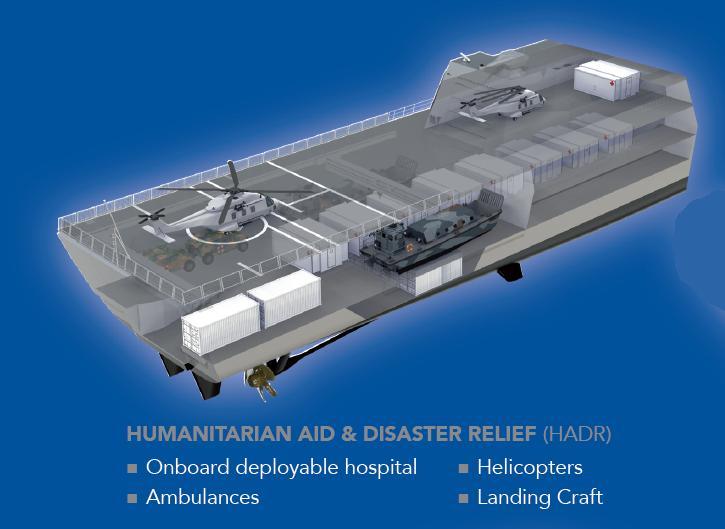
| I'm clearly not a naval engineer, but images are the best way to quickly explain an idea. This little graphic shows the general idea behind the Point Escort Carrier. |
MHPC was initially going to deliver “OPV-like”
motherships with some utility in constabulary tasks in addition to their main
role of seabase for MCM and hydrographic unmanned vehicles.
Clearing a minefield in a contested
area from a platform of that kind would be little better than doing it from a
current minesweeper: intimate protection should be provided by well armed
warships.
The Escort Carrier could have what
it takes to protect itself while its drones accomplish the mission at stand-off
distance.
The flexibility of the “Escort
Carrier” is, in my mind, the real manifestation of the escort, and of the “general
purpose” warship. You can find a good use for it in pretty much any scenario,
from disaster relief to ASW hunting (provided, of course, that ASW unmanned
boats and underwater vehicles receive investment over time) all the way to
amphibious operations.