During DSEI, Navy Recognition had
the chance to speak with Geoff Searle, program director for the Type 26 Global
Combat Ship, and one factor emerged: apparently, there is not a clear plan, at
the stage, for arming the Type 26 with a surface to surface missile. At least,
there is not a plan that BAE knows: it is always possible that, within the MOD
and Royal Navy, thinking is actually at a much more advanced phase, since there
is a long running program for the definition of Future Maritime Fires
capability.
At the moment, however, what can be
observed is that the Royal Navy does want at least 16 Strike Length VLS cells
fitted to the new frigates at build. There just isn’t a precise plan (at least
not out in the open) for fitting a specific weapon system in these cells.
More precisely, a definitive choice
hasn’t even been made yet about which cells should be fitted: the europen
Sylver A70, or the American MK41 system? A choice could be made next year, or
later still.
At the same time, the Royal Navy is
preparing to fit the Type 45s with the electronics and wiring needed to support
the Harpoon Block 1C missile, with four of the destroyers effectively fitted
with launchers and missiles taken from the prematurely withdrawn Type 22 Batch
3 frigates.
In addition, a 2012 graphic in a
Royal Navy presentation which provided some insight into what programs are
included in the famous 10-year Budget Plan, includes an important voice of
expenditure detailed as “GWS60 Harpoon sustainment program”, meaning an upgrade
and life-extension for the missile currently in service. There is no detail
(yet) about the extent of the upgrade, nor an indication of the extent of the
life-extension the missile is going to get, but I believe it is fair to assume
that the aim of the Sustainment Program would be to delay the OSD for Harpoon
all the way to 20230 – 2036.
The 2036 date is not casual: on the
current planning assumptions, 2036 is the year in which the last of the Type 23
frigates, armed with Harpoon, leaves active service.
The graphic, which is the only information
we have at the moment, does not provide precise numbers on the amount of money
that will be devoted to the various programs, but provides a visual indication
of when the most of the expenditure is planned, and that is between the 5th
and 9th year of the 10-year budget. Since the budget covers the
period 2011/2012 to 2021/2022, the Harpoon sustainment program should be in
full swing in the second half of the current decade.
NOTE: for an in-depth analysis of the workings of the 10-year budget and of the above graphic, see my earlier article.
 |
| This graphic shows the plans the Royal Navy has made for the allocation of its portion of the Core Budget in the 10 years plan. This expenditure is "uncommitted", as there are not yet contracts signed about these programs, but the work is ongoing and the money is allocated. The expenditure for Type 45, CVF and Type 26 is not shown in this graphic as they all are part of the Committed core budget. |
NOTE: for an in-depth analysis of the workings of the 10-year budget and of the above graphic, see my earlier article.
The graphic also shows the Future
Maritime Fires System expenditure, roughly starting from the fourth year of the
Budget. The main item of FMFS is the new medium gun to be fitted to the Type 26
frigates, and in fact, in compliance with the general indication coming from
the graphic, the selection of the new 127 mm gun (either the Oto Melara/Babcock
127/64 Lightweight or the MK45 Mod 4 127/62 from BAE/United Defense) is
expected next year. There is no telling, at the moment, if FMFS also includes
the purchase of new missiles: while missiles (and even the Fire Shadow
loitering ammunition) are all part of the study, there is no evidence
suggesting that they are part of the funded program in addition to the new main
gun. The relatively small amount of money suggested by the graphic makes me
think that, for the moment, the budget just covers the guns.
It is anyway in the FMFS voice that
the long-running requirement for a Future Surface to Surface Guided Weapon has
been likely folded into. The british requirement is indicated under the very
generic acronym SSGW (surface to Surface Guided Weapon) and has been around, in
a shape or another, from the early 90s. An SSGW system was part of the Type 45
planned mission fit, but was notoriously written off from the list of
requirements for the AAW destroyers for the time being. The detailed
requirements are not known, but according to some sources, the ambition
included developing a rocket boosted-weapon for long range anti-submarine
attack as well as providing an anti-ship and land-strike missile. The
anti-submarine rocket would restore a capability the Royal Navy has missed for
decades, ever since the old IKARA system was retired from service without a
replacement. Comparable weapons of this kind in the world include the American
ASROC and the Italian MILAS: these rocket-propelled torpedoes enable a frigate
to immediately attack a submarine contact at ranges of over 30 kilometers, even
if the helicopter is unavailable. They are a good solution for the need to hit
time-critical targets at range without having to send the helicopter in the air
all the time, and they are good at filling the many gaps in helicopter coverage
that come up in a rolling 24 hours period. The Type 23 and 26, which will relay
on the big Merlin helicopter for ASW work, and that carry a single such
machine, would appear to badly need such a gap-filler, since a single helo
can’t be in the air all the time, and obviously can’t be expected to be always
in the right place at the right moment. Despite this consideration, it is fair
to assume that it will be really tough for the royal navy to develop or even
just adopt this kind of very single-role, highly-specialized weapon.
Certain is, instead, the requirement
for a genuinely multi-role missile capable to hit enemy warships but also able
to strike targets well inland. The new missile will be vertically launched, and
it is behind the selection of Strike Length cells on the Type 26.
The idea seem to be that the old MK8 Mod 1 gun and the old Harpoon missile will be around as long as the Type 23 is in service, which under current plans means 2036. At that point (or by that point) the new Medium Gun can be expected to be retrofitted to the Type 45 to standardize the fleet back on a single main gun type, and the 45s could finally receive their own Strike Lenght cells, losing Harpoon in exchange for new capability.
There is also the chance that MK41 cells make their debut on Type 45 much earlier than 2030, if the ongoing assessment of the T45s as anti-ballistic missile platforms evolves into a program for the acquisition of kinetic ABM capability.
The idea seem to be that the old MK8 Mod 1 gun and the old Harpoon missile will be around as long as the Type 23 is in service, which under current plans means 2036. At that point (or by that point) the new Medium Gun can be expected to be retrofitted to the Type 45 to standardize the fleet back on a single main gun type, and the 45s could finally receive their own Strike Lenght cells, losing Harpoon in exchange for new capability.
There is also the chance that MK41 cells make their debut on Type 45 much earlier than 2030, if the ongoing assessment of the T45s as anti-ballistic missile platforms evolves into a program for the acquisition of kinetic ABM capability.
With the RAF and with France
The only new anti-ship missile there
is currently talk of, is the UK-France Future Cruise and Anti-Ship Weapon (FC
ASW). And to say the truth, it is not like there is much talking going on about
it in the open. This new weapon was conceived under the framework of the
UK/French joint Declaration on Defence and Security Co-operation agreed at
Lancaster House in November 2010, but only came to the light in early 2012,
when the governments of France and United Kingdom disclosed its existence and
announced that a two-year seed contract had been awarded to MBDA in December
2011. The contract was signed by the French Direction générale de l'armement
(DGA) with MBDA UK and MBDA France, on behalf of both countries.
Currently, we are at a very early
stage: the contract covers initial studies over the concepts, technologies and
system options that could be employed to bring to life the new weapon, or
family of weapons, which is destined to replace cruise land attack and
anti-ship missiles currently in service.
In practice, Storm Shadow, Harpoon
and Exocet would all be replaced with the weapon(s) that come out of this joint
development. Perhaps even Tomahawk would be replaced by this new missile.
In the first quarter of this year, a
first selection was made between the concepts emerged so far, with around six
being brought forwards for further study and development. The approaches being
considered to make this new weapon survivable and lethal against ever improving
air defence systems (mostly of Russian design) essentially come down to
stealthness and to very high speeds, with Mach 3 having been mentioned more
than once in recent MBDA concept works, such as PERSEUS
and, more recently HOPLITE.
The aim of the joint project is to
prepare the new weapon (or family of weapons) in service sometime between 2030
and 2035.
Among the requirements that this new
weapon will have to satisfy, there’s clearly the capability to be launched from
vertical cells on warships, from airplanes and almost certainly from
submarine’s torpedo tubes as well.
Being intended also as a Storm Shadow
replacement, the FC ASW project is part of the Selective Precision Effect At
Range programme of the RAF, as Capability 5.
SPEAR Capability 4 is about the
mid-life upgrade and life extension of Storm Shadow. This project, which once
again is jointly sustained with France, should start soon enough and aims to
keep the missile relevant and effective out to the 2030s. France confirmed in
its own White Paper, released earlier this year, that the joint work on Storm
Shadow (Scalp, in French service) will be funded.
Together with the Harpoon
sustainment programme, this seem to be intended to “hold the ground” before the
new system developed under the Capability 5 headline does arrive.
Sylver or MK41?
I first of all invite you to give a look at the following presentation about MK41, which will give you a much better idea of what a VLS system is and how it works: presentation by Mark Zimmerman.
With the Type 26 frigate, we are
back to a debate which never really ended ever since it was opened by the
attempts of the Royal Navy to get MK41 VLS systems for the Type 45, attempts
that were frustrated by European political considerations and by the worries
connected to the possible costs and technical challenges of integrating the
European Aster missile in a VLS cell made in America.
The problem is now back on the table
for the Type 26, and a decision has not yet been taken.
It is clear that, if the Royal Navy
has no real hopes to get a missile into the Strike Length cells before SPEAR
Capability 5 comes of age, going Sylver A70 might make sense: since the FC ASW missile
is developed jointly with France, compatibility with the Sylver VLS system will
be a requirement from the very first moment. The French have adopted the Sylver
A70 on their new FREMM frigates, and the same launcher will be expected, in the
future, to welcome the new missile. It is to be seen, though, if this is enough
of a justification for going again with the Sylver line of VLS systems.
In the short term, in fact, Sylver
A70’s only weapon is the Scalp Navale cruise missile, ordered in 250 pieces by
the French armed forces. This “European Tomahawk” seems not as capable as the
Tomahawk itself, especially the most recent TLAM Block IV, while it is much
more expensive, as is to be expected for a new weapon, which has not been (and
perhaps never will be) produced in the same huge numbers as the Tomahawk.
France is planning to purchase some 250 missiles in four separate orders. 50
missiles will be encapsulated for torpedo firing from the new nuclear attack
submarines of the French fleet, with entry in service in 2017, while the rest
will be for vertical launch from the A70 VLS cells on the FREMM frigates. The
expected cost is 910 million euro, and done the math, the Tomahawk is a much,
much cheaper option for the Royal Navy.
Of course, the A70 cells can also be
used to embark Aster missiles, but it is a bit of a waste since these only need
five meters deep cells (the A50 module) and not the full seven meters of the
A70 VLS module.
Until SPEAR 5 eventually happens,
the only use of A70 cells eventually fitted to Type 26 would be as launchers
for the Scalp Naval: but there is no reason at all to justify the purchase of a
more expensive, less capable “clone” of Tomahawk, establishing two separate
logistic lines.
Adopting the MK41 Strike Lenght VLS used by the US
Navy, instead, opens the door to the possible integration in the Type 26 combat
system of a huge variety of weapons, including the full range of surface to air
missiles employed by the Americans, plus Tomahawk, ASROC and, in a not distant
future, the new LRASM anti-ship and strike missile.
Adopting the MK41 would, in my
opinion, offer the greatest insurances for the future. As it is destined to
remain the launcher of choice of the US Navy for many more decades, the MK41
won’t be short of support and will be the launcher for which the greatest
number of weapon systems will be certified. The sole fact of being fully ready
to employ the Tomahawk Block IV is an important consideration, as the TLAM has
effectively become the weapon of choice in all military operations. The Royal
Navy tried to secure funding for the addition of MK41 cells and vertical launch
Tomahawks on the Type 45s already in the early 2000s: the attempt was
unsuccessful back then, but there are good chances that it would be successful
in a new try.
Gaining the capability to fire
Tomahawks from surface ships as well as from submarines would mean having more
platforms fully capable to influence events ashore, well inland. It would
simplify planning, as it would be much easier to bring a launcher platform in
the area of a crisis, and it would not tie a precious nuclear submarine into a
“launch box”, a small area of sea where the SSN stations and waits for the
order of launching a missile against targets ashore. In the future, the small,
precious fleet of SSNs could be needed to cover many other tasks, so avoiding
the limbo of the “launch box” would help meeting the other commitments.
There is also an important financial
factor at play: an SSN is an expensive launch platform, which is not always
necessary. Against an enemy with capabilities as limited as Libya’s, there was
no real need to covertly deliver strike missiles from an undetectable
submarine: a cheaper surface ship could have done the job almost as safely.
Again, the Tomahawk capsule for
torpedo tube firing adds several hundred thousand dollars to the price of every
single missile, compared to the Vertical launch variant used on ships from MK41
cells.
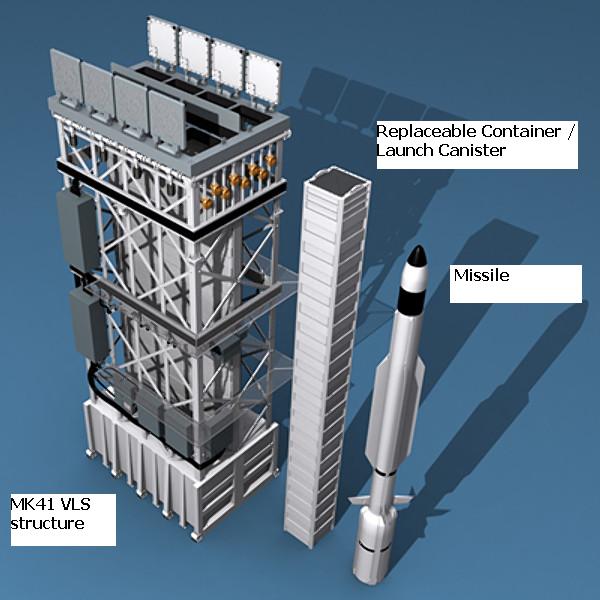 |
| Strike Lenght cells aren't an easy fit: they go down into the ship for 7 to 9 meters, so they can't be fitted everywhere. |
 |
| Lockheed Martin has introduced the very smart idea of the ExLS insert, which is an "adaptor" which can be slid into MK41 cells, with the electronics and canisters made for missiles not initially thought for MK41. An ExLS with quadpack is being validated for use with CAMM. The ExLS can also be used, in some cases, as a stand-along launching system. An ExLS Standalone with three CAMM cells is being jointly developed by LM and MBDA. |
 |
| The first test ejection of a CAMM missile from a MK41 cell fitted with ExLS module. |
Ultimately, Tomahawk has proven to
be a highly useful, highly requested and highly useable conventional strike
weapon. When TLAM was first purchased, specifically for use on submarines, the
british armed forces didn’t think they would end up using it so much, so often.
TLAM was almost conceived as a conventional arm of the policy of
submarine-based deterrence, but operational experience has proven that it is
far more than just that, as Dr. Lee Willett wrote in his essay “TLAM and british strategic thought”. The introduction of the Tactical
Tomahawk, the Block IV, has only made the TLAM even more useable, and further
improvements are being jointly developed by the US and the UK, including the Joint Multi-Effect Warhead System, which couples fragmentation effect
with enhanced bunker-busting capability, making the missile capable to engage
pretty much any kind of target. Importantly, TLAM is evolving to be able to
engage even relocatable and moving targets, with Third Party In-Flight
Retargeting capability already demonstrated, also during HMS Astute’s TLAM
firing trials in the US.
There is every reason to consider an
expansion in the number of Tomahawks available to the MOD (thought to remain at
a total of around 60 to 65 rounds) and, critically, in the number of launch
platforms.
 |
| A Tomahawk is launched from a MK41 cell on a US Navy warship. Notice the blast of the rocket venting upwards and wooshing out of the opening in the middle of the launch module. CAMM removes this complexity by adopting the ingenious Cold Launch feature: a piston powered by compressed air ejects the missile and shoots it around 100 feet into the air before the Sea Ceptor's rocket ignites. CAMM, however, is an exception, not the rule: the other missiles need a VLS system, complete with the exhaust system. |
The adoption of MK41 cells on Type
26 would be the solution. It would also be a reliable parachute for the Royal
Navy, was something to happen with the development or procurement of SPEAR
Capability 5: with the weapon potentially more than two decades away from
entering service, I don’t think the RN can shape the new ships to be only
focused on the hope of getting this particular European product. Was the
program to die in future budget cuts, and the Royal Navy had fitted Sylver
cells, the alternatives would be very few: the Navy would most likely end up
having to fork out new money to try and adapt an American missile to the Sylver
system.
Since MBDA and Lochkeed Martin are
now collaborating to integrate European weapons in the MK41 launcher, starting
with the Sea Ceptor missile, also known as CAMM, I believe there is every
reason to go with the proven MK41. After signing an agreement last May, the two
companies have very rapidly made tangible progress, and demonstrated in early
September a first ejection sequence from an ExLS quadpack inserted in a MK41
cell.
Considering that the Type 26 design
is still to be completed, and keeping in mind that SPEAR Cap 5 is many years
away, there is all the time to make sure that the missile can fit into the MK41
cells when the day comes. This would ensure the best capability for the new
frigate, both in the near term and in the long term.
Anti-ship capability: timeframes do not match
Tomahawk is a ready-to-go solution
available to give the Type 26 a punch against land targets, from day one at
entry in service, if the MOD will want and find the money for it. There is also
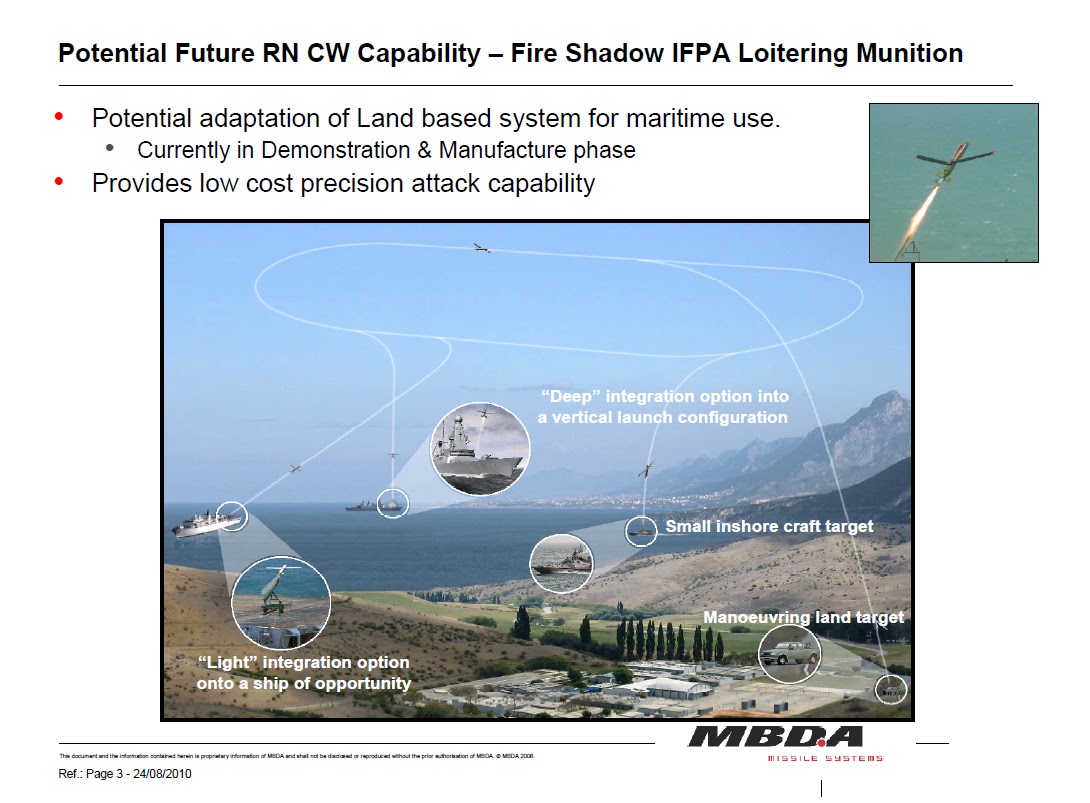
the option of adapting the Fire Shadow loitering munition for vertical launch,
MBDA says. Fire Shadow only has a range of some 150 km, but it can loiter over
a target area for six to ten hours, sending imagery intelligence back to the
ship and denying an area to the enemy by being ready to strike as soon as one
shows up. It would be a great capability to have, although completely different
in nature from the long-range reach offered by the cruise missile.
What about anti-ship capability in
the fleet, though?
A new vertical-launch missile,
especially if large enough to require strike length cells (which means tubes
with a depth under deck that ranges between 7 and 9 meters, meaning some three
deck levels) could never be fitted to the Type 23 frigates, which just do not
have the space for such a VLS system.
If the missile is longer than around
5 meters, it won’t fit the Sylver A50 cells employed on the Type 45 destroyers,
either, but the Type 45’s VLS silo has been built to a design and size values
that make it possible to add a further 16 cells to the current 48, and all the
cells (newly-fitted and existing ones) could be Strike Length if the need was
identified.
The Harpoon currently in use is not
a Vertical Launch missile. It can only be fired by the well known stacks of
tube launchers employed on the Type 23s. The Royal Navy uses quadruple
launchers, but the canister-launchers can also be stacked in couples, or even
used singularly. The Type 45 destroyer has been built with space and fittings
arrangements for mounting a couple of quadruple Harpoon launchers behind the
Aster missile silos, and four of the six vessels will receive their fit of
Harpoons in the next future, the MOD has confirmed.
Observation of the current Type 26
design, however, suggests that it is not possible to install the conventional
stacks of canister launchers (used not just by Harpoon, but by the likes of
Exocet, Otomat TESEO, PRBS-15 and Naval Strike Missile). Observing the images
and the models showcased so far, there does not seem to be any adequate
allocation of space for the installation of the launchers. On the Type 26, the
typical locations in which such an installation normally happens (amidship
between radar mast and funnel, or, in british style, behind the main gun/ VL
missile silo) do not appear to be properly dimensioned and kept clear of
obstacles. In particular, the space between the sensors mast and funnel does
appear to be really too restricted. And effectively, the conventional launcher
for anti-ship missiles was last seen in the very first concept pictures for
Type 26: as the design progressed, they vanished.
 |
| The twin quadruple launchers commonly used by current-generation western anti-ship missiles were clearly shown on the very first Type 26 design. Soon, they vanished. |
 |
| Today's Type 26 has changed a lot, and improved a lot. |

 |
| The current arrangements of the ship's spaces and armament suggest that the Royal Navy wants to make the big step with the new frigate, moving entirely to vertical launch weaponry. |
While the decision to move fully to
vertical launch makes perfect sense, the Royal Navy is going to find itself in
trouble because of timeframes that do not match.
The Type 26 frigate will, under
current plans, begin to entry into service from around 2021, and will then
replace, one for one, the Type 23s at a rhythm of roughly one per year all the
way out to 2036.
With the Harpoon apparently
incapable to move from the Type 23 retiring to the Type 26 entering in service
in replacement, the number of royal navy ships fitted with an anti-surface
capability will shrink dramatically from the third T23 onwards (assuming that
the Harpoons removed from the first two Type 23s would move on to the last two
Type 45 destroyers).
With the risk of having to wait
until 2030 or 2035/36 before a new missile is inducted, the Type 26 could be
without an anti-surface weapon for over a decade, and the Royal Navy could go
down to as few as six or seven vessels fitted with such a capability, before a
replacement comes with SPEAR Cap 5.
Alternatives?
In theory, there are alternatives to
a Type 26 without anti-ship capability for a decade. Going MK41 with the VLS
cells would keep the door open for adoption of the LRASM, for example, which the US Navy is developing
and trialing right now as a solution to its own Harpoon problem. The US Navy
is, in many ways, are already in trouble for an acute shortage of anti-ship
capability on its surface vessels. The old Harpoon is seen as increasingly outdated
and ineffective against modern decoys and missile defences, and the number of
ships fitted with it in the American fleet is much lower than one would think:
attempts to develop a vertical launch Harpoon never went ahead, and the DDG-51
Arleigh Burke destroyers have not been fitted with Harpoon launchers ever since
the Flight IIA production lot started.
The US Navy is, in many ways, in the
situation that the Royal Navy seems doomed to experience in the 2020s, and is
trying to take swift action with LRASM to remove this dangerous gap in
capability.
The alarming fact is that the US
Navy at least still has submarine-launched and air-launched Harpoon. The Royal
Navy lost the first capability in 2003, and the second in 2009/10, when the
Nimrod, last british air platform with a heavy anti-ship missile, was withdrawn
from service.
Unfortunately, even the adoption of
MK41 cells does not automatically remove the anti-ship missile problem: it is
hard to imagine the Royal Navy having the money for a substantial investment in
an interim anti-ship missile, while simultaneously having to keep spending on
Harpoon and on the development of SPEAR Cap 5.
A large ship-launched anti-ship
missile is an important capability, but a bit of a niche one, which hasn’t seen
much use in the operations the RN has been a part of. Seeing how complex it is
to get funding even for an expanded Tomahawk arsenal, despite it being used all
the time, arguing for more investment for the anti-ship niche is likely to be a
desperate, hopeless struggle.
One solution could come, once more,
via Tomahawk. The solution could be the Maritime Interdiction Multimission
capability proposal, also known as Multi Mission Tomahawk. The MMT would
introduce a moving-target seeker and an upgraded data link to the Tomahawk
Block IV, turning it into an hunter-killer weapon capable to locate and pursue
moving targets including warships out at sea.
The MMT idea has been around since
2009, and has been briefly brought back in the spotlight in August 2012, when
the US Navy and Raytheon were reported as “close” to going ahead with the
development of an anti-ship capability package for the TLAM Block IV.
Early data for the “Maritime Interdiction” missile, released by the US Navy,
assumed that the modified Block IV would be able to search for targets in an
area of 30 square nautical miles, accounting for possible errors in the
position of the target supplied by third-party directors and, of course, for
the movement of the target at speeds of up to 30 knots. The range of the
missile for such a complex anti-ship engagement would be around 500 nautical
miles. The navigation system, the data link and seeker would have to be
reinforced to ensure the missile can find its target even through jamming and
decoys.
The Multi-Mission Tomahawk was
intended to be US Navy Interim Offensive Anti-Surface Warfare solution, but as
of April 2013 the US Navy seems to have abandoned the Tomahawk Block IV
conversion, while DARPA-funded work on the Lockheed Martin LRASM A (a weapon
derived from the JASSM cruise missile) is ongoing, with a successful test on August
27 that involved launch from a B-1 bomber against a barge loaded with empty
containers acting as target. The missile hit the containers as expected. Preliminary
work to demonstrate launch from MK41 vertical cells was completed
on September 4, and next year, LRASM should be fired twice from MK41 VLS
cells, demonstrating its ship-launch capability. A submarine-launch variant
could follow.
For the Royal Navy, a Tomahawk
solution would have been easier to acquire, because it wouldn’t have been a
total departure from established logistics and knowledge basis, and it would
have fitted in the idea of expanding TLAM attack capability, as the missile
retains full utility as a long range land strike weapon, indeed adding greater
capabilities against complex, mobile targets.
The Tomahawk solution could still
happen, though: the US Navy is still working on choosing its next
move. LRASM could
be chosen without a competition, but Raytheon and Boeing are ready with their
own proposals if the pentagon decides to give a chance to other systems.
Sea Ceptor for everyone?
If the anti-ship segment of the RN
capability is close to extinction, there is at least some relief in the
Anti-Air missile arena. With an order placed for the production of CAMM Sea
Ceptor missiles, the Royal Navy can now work to get it on all relevant
platforms.
In March this year, a study should
have been concluded, on the costs connected with eventual installation of Sea
Ceptor on the new Queen Elizabeth-class carriers. There is no open-source
evidence of the results of the study, nor can we realistically expect to see an
investment made any time soon to fit the missile system, but it remains an
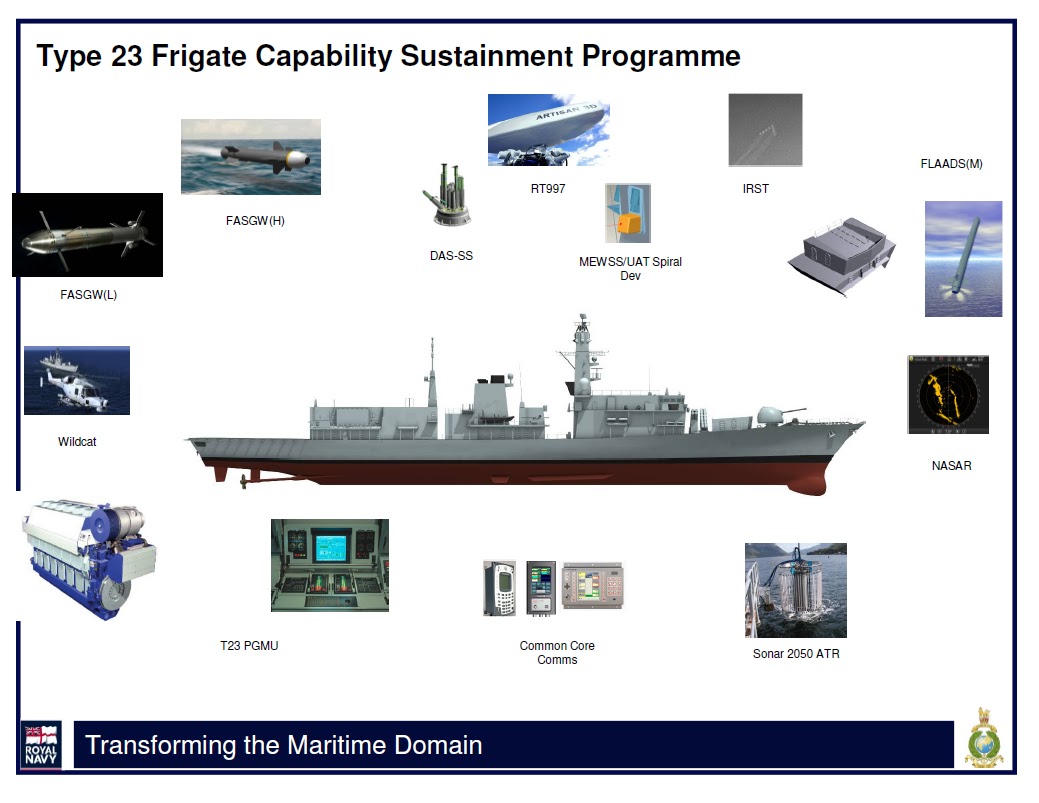
option. The carriers are fitted with the Long Range Radar and with the Artisan
3D radar (Type 997 in RN service), both of which could feed targeting
information to the missiles, which are, differently from Sea Wolf, fire-and-forget
and would pursue their targets autonomously after being launched, with the aid
of information relayed from the ship via secure Data Link.
The first platform that will get the
Sea Ceptor in current planning is the Type 23 frigate. The first vessel should
swap Sea Wolf for the new CAMM during a refit in 2016. The ship has not yet
been identified. The work to be carried out will involve the removal of some
five tons of Sea Wolf cabinets and old electronics, plus the two guidance
radars, in exchange for a far more modern, smaller and lighter data link
system.
The missile silo on the bow will
be modified with the removal of the 32 Sea Wolf tubes and the installation
of CAMM electronics. The Sea Ceptor missiles will be fitted in quadpacks into 12
sealed wells to protect the canisters from the sea water washing over the deck.
The number of missiles carried will be boosted to a maximum of 48.
On Type 23, the CAMM will be feed
data on the targets by the Type 997 radar, which is due to replace the earlier
Type 996 over the coming years, with HMS Iron Duke having received the
first-of-class fit already.
The Sea Ceptor fit will then be
physically moved out of the Type 23s as they are withdrawn from service, and
installed on the new Type 26. The images and models shown so far about the new
frigate show that the 48 air-defence missiles will be distributed in rows of 6
canister-launchers each, with four such rows arranged in the bow missile silo
and a further four rows aft of the funnel mast.
The canister-launchers are
weather-proof as they have been developed to be used (from around 2020) by the
Army as replacement for the elderly Rapier, so they do not appear to have
additional protection: on the Type 26, they are installed high enough in the
superstructure to be protected by the sea spray without having to be sealed
into enclosed wells like on the Type 23.
The Type 997 radar will also move on
from T23 to T26.
Around 2016 there will also be the
chance to transform a potential problem in an opportunity. The Royal Navy has
decided that it will withdraw from service the Goalkeeper CIWS system, to standardize
instead on the Phalanx (36 mounts + 5 new on order). This is due to the fact
that the number of Goalkeeper mounts in the fleet by then will have fallen
dramatically in number, due to HMS Illustrious bowing out in 2014 with her
three mounts, leaving the sole Albion and Bulwark with a total of four mounts
(although Albion’s ones have already been removed as she was put into reserve
and mothballed).
In 2016 it is planned that the two
LPDs will trade places in the fleet, with HMS Albion being refitted and
regenerated to return into active service, while HMS Bulwark enters her own
period of mothball (unless the SDSR, as I personally hope, allocates the 20 or
so million a year needed to operate the second LPD as well).
The LPDs should both receive their
Type 997 radar during the next refits, and they can be expected to be fitted
with a couple of Phalanx CIWS in replacement of Goalkeeper.
The opportunity I see, however, is
that of fitting the bow CIWS on top of the deckhouse, instead of on top of the
small superstructure used by Goalkeeper. There might be some problem since the
two manned GAM-BO1 20mm light guns for surface close defence are located up there
as well, but it should not be an insurmountable issue. The GAM-BO1 are arguably
well in need of being replaced by the DS30M remotely operated 30mm gun mounts
being adopted throughout the fleet, as well.
Phalanx has no under-deck
penetration, while the much larger Goalkeeper turret takes one deck of space.
By removing Goalkeeper and relocating the frontal CIWS, the LPDs would have a
little bit of precious free space on the bow for the fitting of CAMM missile
cells.
This would of course have a cost,
but it would massively increase the survivability of the LPDs against all kind
of threats: the Royal Navy is fully aware of how vulnerable these large ships
can be, especially when docked down for landing craft operations. Air attacks,
swarm attacks with FIACs and missiles are all very serious threats, and CAMM
would counter them all (the missile has a secondary anti-surface attack
capability, good against fast and suicide attack boats).
 |
| The LPD problem that could be an opportunity: replacing Goalkeeper |
 |
| The small superstructure on the bow, currently occupied by Goalkeeper's under deck segment, offers precious space that could be used to fit CAMM cells. |
 |
| Moving Phalanx on top of the deckhouse could be a problem because of the old GAM-BO1 gun mounts. Imagine doing this with a Phalanx mounts a few meters away, buzzing and taking aim and perhaps opening fire. The GAM-BO1 could and should really be replaced by the unmanned 30mm mounts as on the rest of the fleet |
On the export front, there is some
initial sign of interest from Italy. The Italian army will need to replace its
Skyguard batteries in the near future, and CAMM is seen as an attractive
option. MBDA Italy and MBDA UK could end up collaborating on the land variant
of CAMM, with MBDA Italy looking at the command and targeting system, introducing
elements of the SPADA 2000 air defence batteries. For sure, CAMM is a very
interesting missile system, with a great potential and very good chances of
gaining international success.