As I’ve made hopefully clear on Twitter in several different occasions, I am convinced the Integrated Review was very good. The Defence Command Paper had a lot of good things about it too, although it is clear that some things would need more funding to truly get moving according to stated ambitions.
Future Soldier is the one document that is not just disappointing but flat out concerning. It is to be hoped that a “Refine” will come swiftly, because the plan feels like it was written by "2 guys" wanting fundamentally different things. Brigade Combat Teams and combined arms integration at lower levels on one side; preservation of increasingly artificial barriers and tribalism between Corps and Regiments and specialties on the other. The end result is an awkward compromise that fails to deliver “conventional”, solid brigades and equally fails in progressing new ways of operating.
The Army is “lucky” in that the events in Ukraine represent a perfect chance to save face and justify the changes without admitting that the problems were all there from the get go.
Future Soldier fails to articulate a new concept for how to structure, field and employ force in the field.
The Army’s “Conceptual Force 2035”,
which up to at least 2017 was looked at very seriously, imagined an army completely
reconfigured to deliver 3 smaller but capable divisions made of lighter,
faster, more deployable, largely independent battlegroups, with dispersion
being the norm. Conceptual Force 2035 specified that the disaggregated fighting
requires Combined Arms capabilities to be organic at lower level, to ensure the
dispersed Battlegroups do not have to wait for a superior echelon to make
supports available. This includes having more organic Indirect Fire capability
and employing it alongside greater ATGW capability to offset the capability
currently delivered by MBTs through “lighter” vehicles.
Apparently, Conceptual Force 2035 has since lost traction, and that actually saddens me, because at this point the army is in such miserable shape that it was arguably the one model it could follow to try and regain some effectiveness. On the other hand, 2035 was always way too close in time for many of the things imagined to actually happen. Robotic and Autonomous Systems, for example, are nowhere near as mature as needed for the full vision to take shape, and without pervasive use of ground combat uncrewed vehicles it’s easy to imagine that the main difficulties experienced in the simulations will have been infantry shortages and resupply problems.
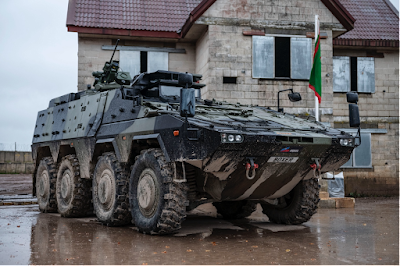
Whatever vision takes shape next is anyway unlikely to stray too far away from Conceptual Force 2035 ideas, because rebuilding a large “conventional” force would require manpower and money that simply isn’t going to be there. While I am not expecting new IFVs to come into service anytime soon, the Fires "ingredients" that would be indispensable for CF35-like combat groups are in the plan, and there are promising signals that the number of BOXERs will continue to grow.
Ultimately, the Integrated Operating Concept 2025 has set out the following list of
attributes for the future force:
Have
smaller and faster capabilities to avoid detection
Trade
reduced physical protection for increased mobility
Rely more
heavily on low-observable and stealth technologies
Depend
increasingly on electronic warfare and passive deception measures to gain and
maintain information advantage
Include a
mix of crewed, uncrewed and autonomous platforms
Be
integrated into ever more sophisticated networks of systems through a combat
cloud that makes best use of data
Have an
open systems architecture that enables the rapid incorporation of new
capability
Be markedly
less dependent on fossil fuels
Employ
non-line-of-sight fires to exploit the advantages we gain from information
advantage
Emphasize
the non-lethal disabling of enemy capabilities, thereby increasing the range of
political and strategic options
Unless these attributes are quite drastically revised, the new concepts will necessarily have a lot in common with CF2035. I think the army need to accept this, because “mass” will never be there.
What we see in Ukraine is that not even the Russians are achieving the kind of mass needed to create a “traditional” continuous front. The British Army, with far less troops and material, won’t be able to create a front either, unless it’s ridiculously narrow.
Dispersion these days is unavoidable, not only to reduce vulnerability against enemy Fires, but also simply to cover ground.
 |
STRIKE was way too optimistic in imagining huge tactical advantages to be secured by a force which was going to have no particular mobility advantage on comparable formations and certainly no firepower advantage whatsoever. It imagined an enemy paralyzed by dispersed STRIKE elements advancing on multiple directions simultaneously, completely failing to appreciate that dispersed elements can very easily and quickly become isolated and very difficult to resupply. For years, STRIKE literally assumed that there would be no need for it to conduct bridging operations in the direct fire zone, which was one of the wildest, most absurd assumptions ever.
Ultimately, too much about STRIKE was just not credible, but dispersion is something we will have to deal with, by necessity if not by choice.
The challenge is defining a workable British Army organization that maximizes the survivability, lethality and usefulness of its small force.
Some starting assumptions:
- Long range Fires are arguably the only way to “close the gaps” between dispersed force elements and ensure that small deployed contingents have disproportionate effect.
- The ability of Fires to truly “close the gaps” depends on their responsiveness and on the ability to provide targeting from a multitude of sources all across the manoeuvre force.
- For the foreseeable future at least, the tank remains a fundamental capability. Its survivability, combined with the high number of “stored kills” can hardly be replaced by volleys of missiles. It is reasonable to assume that in the future tanks might shed weight as piling up passive protection simply becomes counter-productive and we might see Robotic / Autonomous vehicles taking up more of the MBT role, but until technology matures we have to make good use of what is available and works.
- Air defence must be much more widely distributed, otherwise all sorts of threats will have an easy time targeting troops in the field.
- Recce by stealth is increasingly unlikely to be feasible. Land manoeuvre can be observed by a multitude of drones, space, air and ground based sensors, and the widespread availability of all sorts of communication systems make it pretty much impossible to imagine small armoured vehicles sneaking unobserved on the enemy.
That recce by stealth is no longer feasible is something the British Army, just like other armies worldwide, has de facto accepted quite some time ago. Recently, the Royal Dragoon Guards have provided some welcome clarity on how the Cavalry regiments are attempting to confront the combination of the AJAX disaster, the CRV(T) imminent retirement and further manpower reductions. The latter has the inexorable consequence of leading from a 4 Sabre Squadrons structure down to 3.
SCIMITAR is going to be replaced by WARRIOR, which has already seen some use with the cavalry since at least 2018 as an AJAX surrogate. But of course, since there are nowhere near enough working WARRIORs, they are concentrated in just ONE Sabre squadron, albeit enlarged to 5 Troops. Interestingly, WARRIOR cavalry will, in field, mix with CHALLENGER, with the RDG forging a close relationship with the Queen’s Royal Hussars.
This is the only logical consequence of accepting recce by stealth is (mostly) dead, and follows examples from other parts of the world. Notably, the US Army has re-introduced a company of M1 tanks into its cavalry squadrons, and also grouped the Styker MGS and ATGW into the reconnaissance squadron of the Stryker BCTs, until it decided to remove the MGS from service.
In Italy, to give another example, CENTAURO/CENTAURO 2 support FRECCIA in the Cavalry regiments doing reconnaissance for the brigades.
In truth, there’s no need to wander the world at all: the UK’s original FRES SV plan notoriously included a true medium armour variant with 120 mm smoothbore cannon, which would have accompanied the SCOUT.
There really is nothing new in all of this: it is just another sad and self-destructive circle that the British Army has walked.
It really is sobering that, after 30 years and billions of expenditure, the Army’s future is a team of CHALLENGER and WARRIOR. When one looks back at WARRIOR demonstrators for the recce cavalry role, and at high-tech experiments such as VERDI, and thinks about all that followed, it’s impossible not to get emotional.
The Guided Weapons/Javelin Troop is enlarged into Sabre Sqn mounted in "variety of armoured vehicles", which presumably means anything from JACKAL to Mastiff to have some mobility. The Squadron will de facto fight dismounted and in close liaison with the infantry (in the case of the RDG, specifically alongside 5 RIFLES), employing JAVELIN, NLAW and LASM / ASM.
There has been no increased allocation of JAVELIN. Of course, one bitterly adds.
The final Sabre Squadron groups the Sniper troop, Surveillance Tp, Assault (pioneer) Tp and C2 Tp. This seems to build upon work Household Cavalry’s B Squadron has been doing for the last several years, ahead of what was supposed to be the first conversion in the Army from CRV(T) to AJAX, and the assumption of their role within STRIKE.
Adding snipers is, apparently, a major revolution that took a long time. In 2020 B Sqn HCR formed an Anti-Tank Troop and had worked for a while to “try” and form a Mortar Troop as well. Sadly, this seems to have been way too ambitious a revolution, and there is no sign of mortars in the new cavalry structure.
In general, the new Cavalry organisation is all about forming combined arms groups in the field, but without adopting it in the barracks. And once again I ask: why? Why can’t the British Army make that final step and try to give itself a structure which is more in line to how it actually expects to fight?
The main reason not to do it, the logistic complication of having regiments home-based far from each other, is gone, with the heavy forces all centered upon Bulford, Tidworth and Warminster.
Structures must change because the current ones are simply not fit for purpose and they unnecessarily complicate future planning, training and operations by maintaining artificial separations in roles and capabilities.
An organisation for dispersed, heavy hitting forces
The Reconnaissance Strike Group imagined and championed by retired US Army Colonel Douglas Macgregor remains, in my opinion, the most promising force structure to face the current challenges of land warfare.

It is,
obviously, presented at “American scale”, so with numbers that the British Army
could never match, but conceptually it
is a valid framework that is centered on manoevre forces capable of dispersed,
mobile, operations across a wide area
in presence of capable enemy forces. It is meant to survive and fight in the
modern battle space where ISR and EW are pervasive and Fires are a constant
threat.
-
This new battle space demands self-contained independent battle groups;
formations that operate on land the way the Navy’s ships operate at sea: within
the range of their organic ISR and STRIKE capabilities.
-
RSG suppresses or destroys enemy air defense and missile assets-RSG is
effective when immediate responsiveness is required, in complex terrain or in
poor visibility.
There is no separation between Manoeuvre and Reconnaissance forces in
the RSG. The entire force is about recce and manoeuvre. It uses 4 battalion
battlegroups to jointly Find, Target and Manoeuvre, and has a Fires battalion
at its core.
As the expectation is to operate dispersed, the RSG is deliberately
conceptualized as a sort of mobile fortress in which the battalions surround
and protect the Fires element, feeding it targets to destroy.

The Integrated Operating Concept 2025 guidance, the Conceptual Force
2035 assumptions and the equipment programmes underway are all very attuned to
an RSG-inspired force structure for the main combat formations.
The new USMC Littoral Regiment has its own lesson to give, in how it
produces a self-contained manoeuvre formation with its own “Anti-Air Battalion”
(which is actually a more multi-role unit than the name suggests, delivering
also air control and Forward Arming and Refueling Points for the supporting
aviation element) and Sustainment Battalion.
 |
| The RSG as imagined for american use is a huge formation which contains a number of armoured vehicles an UK formation wouldn't possibly match, just like the US Armored Cavalry Regiment of the 1990s was comparable to an entire british Division, but the concepts are what matter |
Imagine the British Brigade Combat Team as a formation of 4 Combined
Arms Regiments arranged around a Fires formation. Each Regiment would have a
Manoeuvre Battalion with Infantry mounted in BOXERs and, in the “Heavy”
variant, cavalry squadrons with CHALLENGER 3.
One of the roles of the Manoeuvre battalion would be to Find targets
and direct Fires. The current Tactical Group Batteries of the Royal Artillery,
and indeed Surveillance and Target Acquisition sensors, including SERPENS
counter-battery radars and the new portable battlefield surveillance radar,
would be pushed directly into these units.
AJAX is really a thorn. Obviously, if it survives and enters service it
will have to be used, both alongside Challenger in mixed Recce-Strike Squadrons
within the manoeuvre battalion (heavy) and without tank in (medium)
configuration. But in truth, if I could have one wish granted, it would be to
make AJAX vanish and get back the money to fund the upgrade of more CHALLENGERs
and the procurement of more and better armed BOXERs.
A possible template for the Cavalry squadron could come from the old US
Armored Cavalry Regiment, in which troops combined Scout platoons on BRADLEY
with tank Troops with M1. Each Troop had 8+1 ABRAMS and 12+1 BRADLEY, and this
could be a possible mix to practice with WARRIOR and then with AJAX if it
really comes.
Alongside the Manoeuvre formation there would a Combat Support
Battalion delivering Pioneer and engineer capabilities as well as organic
Fires. The kind of reach imagined by Conceptual Force 2035 could easily be
achieved by adopting 120 mm mortars carried in BOXERs, and BRIMSTONE-based MountedClose Combat Overwatch (MCCO).
There would also need to be a SHORAD troop, initially equipped of
course with STARSTREAK/LMM, on STORMER self-propelled launchers wherever
possible.
There would then be a Sustainment Battalion combining REME and Logistic
elements.
The Fires Battalion at the center of the Brigade would ideally revert
to the mixed format of Artillery regiments in Army 2020, so with a GMLRS
Battery in addition to the AS90 (and then Mobile Fires Platforms) batteries.
This would give the BCT the ability to strike out to at least 150 km with GMLRS
ER. The Precision Strike Missile would ideally be held at Division level in
another GMLRS regiment, able to strike out to well over 500 km, with strategic
relevance that will increase in the coming years as spiral development of the
missile delivers a seeker for striking mobile targets, from Air Defence units
to warships at sea, to ranges of 700 km and beyond.
To hopefully reduce costs, the Division’s GMLRS regiment would use a
truck base, with the M270 launchers given to the Brigades. In the US, work has
started on a Palletized Field Artillery System which is a 2-pod GMLRS launcher
that can be used stand-alone or carried on a EPLS-type truck, or even on the
deck of a ship. Germany hopes to soon add a truck-based, GMLRS compatible,
2-pod launcher, so there are options for the UK to procure more rocket
launchers, with wheeled mobility and beyond, without going anywhere near HIMARS
that comes with a single pod due to C-130 volume and weight constraint
considerations.
 |
| The proposed "early entry" vanguard element of a RSG is arguably not that far away, Robotic and Autonomous Systems aside, from what the Conceptual Force 2035's Future Combat Team aspired to be. |
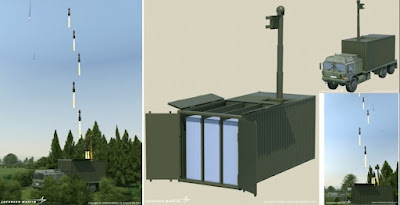
At brigade level would also sit an Air Defence battery with SKY SABRE,
with CAMM ER missiles planned to be available from 2026.
A Division of 4 BCTs in this “Heavy” configuration would be a good
start. Hopefully a second Division could then follow, in a “medium”
configuration without the CR3s.
At Division level, remaining Light forces, either air mobile or mounted in vehicles (if you expect to operate dispersed and over a wide area, moving on foot just won't give you the tempo you need) would be chiefly tasked with ensuring supplies to get to the BCTs across theatre. Ensuring the safety of the supply flow is going to be an absolutely key task, and Ukraine only goes to prove this.
The "operational reserve" that Future Soldier is supposed to create should have this as its primary mission: each Division should have a Reserve brigade which, while undoubtedly light for lack of enough vehicles and heavy gear, will have to possess credible protected mobility to literally plug holes in the flexible, shapeless front and ensure supplies get through.
The Vanguard Light Brigade in Army 2020 Refine, and arguably the whole of what remained of 1st Division, had a rear area security role in a major operation, in which they would operate to secure the rear of 3rd Division. This requirement is also recognized by the new WAYPOINT 2028 organisation of the US Army, most evidently in the presence of the Force Protection brigade in the Penetration Division.
The British Army will have to ensure this key role is adequately covered. Expanding the fighting role of the Royal Military Police, in a way similar to what the US Army does with its own MPs is possibly part of the answer. The Reserve should be part of the Answer, too.
Forget about even trying to procure a new tracked IFV, focusing instead
on BOXER coming with the appropriate variants and firepower, so for example the
already mentioned 120 mm mortar.
In early May, Rheinmetall published a periodical accounting report
outlining potential deals that must legally be communicated, and it notably
includes a 3rd Lot BOXER order for the UK, numbering c 400 vehicles.
If this does indeed happen, it would push the UK purchase above the 1,000
threshold (523 in the 1st Lot ordered in late 2019; 2nd Lot
of 100 added in April), and there’s a lot of good things that can be done with
a thousand high end vehicles if you are laser-focused on maximizing combat
capability.

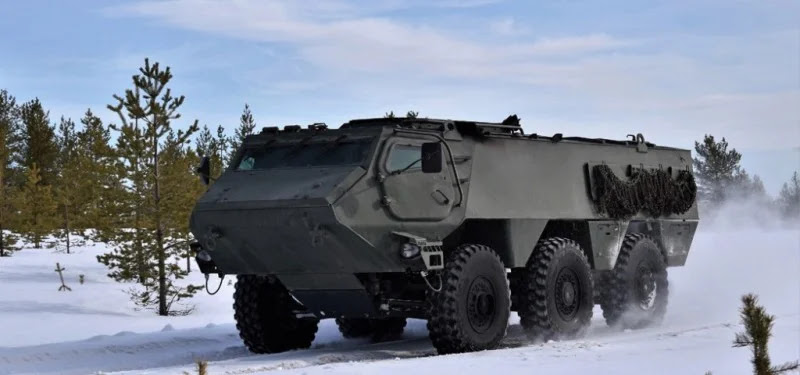 |
| The Patria 6x6 is being adopted by Finland, Latvia, Estonia and Sweden as Common Armoured Vehicle System. It is an example of a good, cheap candidate to be the perfect supporting vehicle to BOXER in a multitude of roles. |
Ideally, I repeat, I would also forget about AJAX, if there really is
the chance to claw back the money, and the Treasury is willing to let the MOD
invest in advance. There is no overstating how helpful it would be to get more
than 5 billion pounds to invest on programmes that are actually in step with
the Army’s conditions.