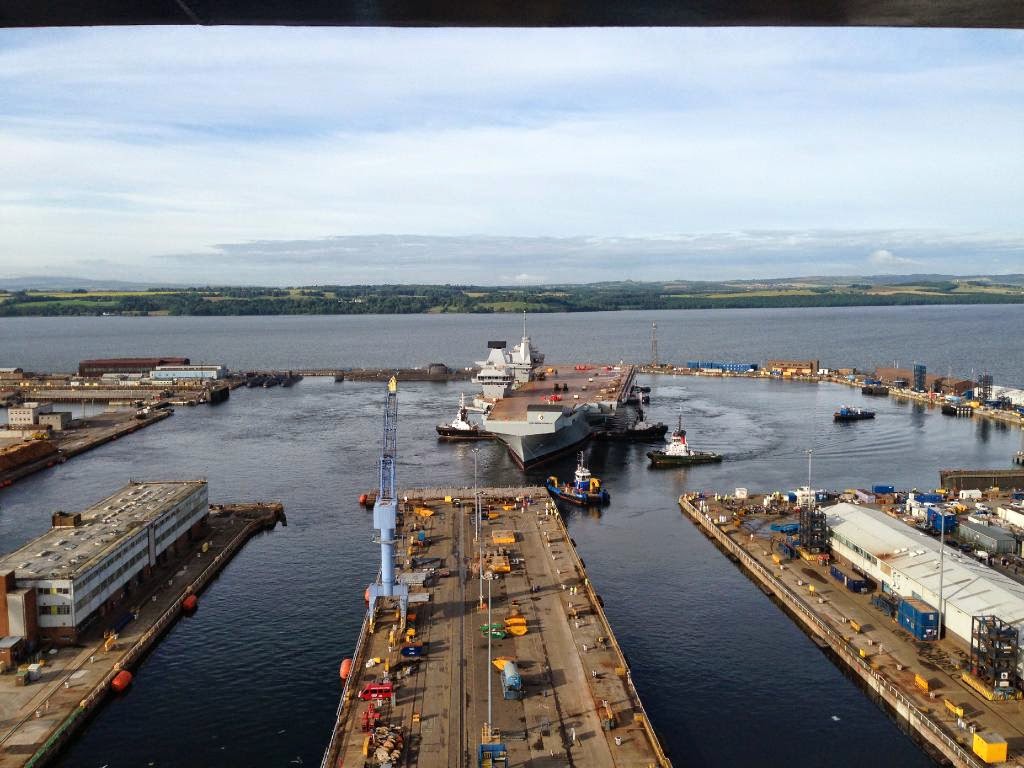
HMS Queen Elizabeth undocked
After being named, the aircraft
carrier has now been carefully eased out of No 1 Dock in Rosyth, to be berthed
in the shipyard’s basin, where the ship will be completed. The dock will not
stay empty for long: the LB03 superblock for HMS Prince of Wales has already
been loaded onto a barge for the travel to Rosyth, planned for next week. LB01
(the bow) is already in Rosyth, ready to be craned down into the dock. CB02 has
been loaded on another barge itself.
Progress on Prince of Wales will be
rapid: it is expected that the assembly phase of the second carrier will take
12 months less thanks to a more efficient process and to the experience made
with the first-in-class.
 |
| Moving the carrier out of the dock required a flottilla of tugs. One of them had to be lifted whole via Goliath crane, to be then lowered in the dock, ahead of QE's bow! |


F-35 visit to the UK is cancelled even as flight resumes
The June 23 fire on the USAF F-35A
AF-27 in Eglin has ultimately, as was to be feared, proven to be a big enough
issue to prevent the planned international debut of the F-35. The investigation
that followed the incident has located the problem in the F-135 engine,
specifically identifying excessive friction between the third-stage integrally
bladed rotor and an abradable strip lining the engine casing as the cause for
the engine failure, which cut a fuel line and sparked the fire. A general
inspection, fleet-wide, has been made on all the engines in the fleet, and it
seems that the problem is an isolated anomaly. However, the F-35 fleet has for
now only been allowed to flight within strict restrictions which include
mandatory engine inspections. The investigation, in fact, is not yet complete
and it has so far not been possible to isolate the root cause, a fundamental
passage to clear in order to safely determine if other engines are at risk or
not.
The restrictions put an end to the
hope of seeing the F-35 cross the Atlantic to debut abroad for the first time.
It must be noted however that F-35Bs of the USMC have actually flown
long-endurance flights across the USA twice after the June 23 fire, as three
aircraft were flown from Yuma to Patuxent River on July 27, and they yesterday
flew back to Yuma, trailed by tankers.
Other F-35 news include the signing
of the contract between AIM Norway and Pratt & Whitney for the standing up
of an F-135 engine Maintenance, Repair and Overhaul (MRO) centre in Norway.
This is the first such centre selected, and is of special relevance to the UK
as well, since cooperation agreements between Britain and Norway have all
included the plan to eventually have british F-135 engines maintained by AIM
Norway.
Two more engine MRO centres are
expected to stand up in Europe on the back of other Pratt & Whitney
agreements: one MRO line is expected to open in the Netherlands, at the Fokker Woensdrecht
centre. This facility, yet to be contractualized, is a key component of wider
multinational F-35 agreements, as the Netherlands expect to maintain Italian F-135
engines in exchange for the assembly of their F-35 jets in Italy’s FACO in
Cameri.
Finally, Pratt & Whitney has signed
a LOI on May 22, 2014, to help Turkey stand up not just a MRO centre but a true
engine-FACO which will also be able to assemble engines in support of the F-35
program. However, while Norway and the Netherlands already have a clear path to
achieve at least one major client outside of their own airforces, Turkey has
yet to find its place in the enterprise.
Meanwhile, the first third
generation Helmed Mounted Display systems for the F-35 program have been
delivered for testing. They have been trialed in flight to the satisfaction of
test pilots, but so far only on substitutive flying-lab aircrafts. Trials will
now be made using F-35A AF-3, a test aircraft fitted with Block 3I software and
TR2 processors (both appearing starting with LRIP 6 aircraft). It is expected
that the third generation helmet will be delivered as part of the LRIP 7.
Later this year, it is expected that
negotiations will be concluded and a contract signed for LRIP 8 production,
expected to include 4 F-35B for the United Kingdom.
The United Kingdom is preparing to move
personnel and aircraft out of Eglin towards the next destinations: 13
engineers and one pilot will follow the USMC training squadron 501 as it moves
from Eglin to its intended permanent base in Beaufort. The USMC move is
underway, with the first aircraft having transferred yesterday, following the
early move of part of the personnel. The first training courses in Beaufort are
expected to begin in the fall (October most likely), with the full transfer
completed in 2015. Beaufort is where 617 Sqn RAF will stand up, train and grow
before moving to Marham in the UK in the summer (july/august) 2018. By December
2018, land IOC is expected to be declared. The same year, HMS Queen Elizabeth
is expected to sail across the Atlantic to have her first aviation trials
embarking F-35Bs in the US East Coast area.
The rest of the current british
F-35B personnel (3 pilots and 16 to 20 engineers) will move to Edwards AFB,
where they will, later this year, stand up 17(R) Sqn as the OEU unit.
Lockheed Martin, Northrop Grumman
and BAE Systems are due to invest 140 million dollars between 2014 and 2016 to
fund affordability and cost reduction approaches in order to reduce
the Unit Recurring Fly-away Cost to “4th Generation levels”.
Another measure being studied to
achieve affordability is the project
for a “block buy” which would see international partners committing firmly
to substantial number of aircraft in the next few years, in exchange for a “discount
price”. This is meant to encourage partners to help the US ramp up yearly
production numbers ahead of the passage to full rate production and Multi-Year
Procurement, so to achieve the cost reduction that everyone is hoping for.
On the testing front, there are good
news. Structure durability testing has concluded
in Brough, UK, on the horizontal tail surfaces for all three F-35 variants.
They have survived the 24.000 hours of simulated flying, equivalent to three
design lives (the F-35 has a design life of 8000 hours, against the 6000 of
aircraft such as Typhoon).
Next year, the same kind of testing
should be completed on the vertical surfaces as well. Brough is also doing the
durability testing on the F-35A fuselage, and by next year it will clear the
second of the three lives in testing.

The F-35B remains on track to
achieve the intended USMC IOC. The final version of the Block 2B software is
flying, and testing is progressing, including on complex features such as
four-aircraft situational awareness sharing via MADL secure link.
In October and out to early November,
2 F-35C will embark on USS Nimitz for the first sea trials of the type.
Block 3I software testing in flight
is also on the way. This is important because Block 3I is needed for acceptance
of the LRIP 6 jets.
Block 3I is the Block 2B software
hosted on new, more powerful TR-2 processors introduced on the aircraft from
LRIP 6 onwards. TR-2 processors are needed to eventually receive the complete
Block 3F software, and will be retrofitted to early production aircraft going
ahead.
HMS Illustrious close to retirement
HMS Illustrious will soon
decommission. On July 22 she will make her last entry into Portsmouth. Just
days ago speculation had made the rounds about her Out of Service Date being
pushed back by the delay of 3 months suffered by HMS Ocean’s big refit. It was
suggested that Illustrious might have to deploy once more, as part of the
Response Force Task Group for Ex Cougar 14, due to HMS Ocean not being ready.
It won’t be the case. HMS Ocean is
now busy in post-refit sea trials, and is starting aviation trials: it looks
like the trials will be speeded up to allow her to take her place at the centre
of the task group, as originally planned.
 |
| HMS Illustrious seen during her last big adventure, ex Deep Blue, with a full ASW team of 9 Merlin HM2 |
CBRN reactivation goes ahead
A further step has been moved to
restore CBRN wide area recce capability, putting out a tender notice for the regeneration of the Fuchs
armored vehicles. The tender covers 9 vehicles, down from 11, but is a key
advancement in the story. The regeneration will include spares, logistic
support and support for future updates. 3 years of support, plus two 1-year
extension options are envisaged. The cost range is between 7 and 11 million
pounds.
Sentinel, Shadow and Reaper to stay
Despite providing little actual
detail along with the announcement, David Cameron’s much publicized address at
Farnborough confirmed the unlocking of funding meant to keep Sentinel and
Shadow serving at least out to 2018, reversing the decisions outlined in the
2010 SDSR.
Reaper was not mentioned in the
announcement, but it is understood that it will be brought into core and funded
for at least five years. A formal confirmation of the plan to retain the RPASs
has not yet come as the Royal Air Force is still firming up a decision on where
to base the aircraft when it comes back from Afghanistan. It must also be noted
that, as of now, personnel from 39 RAF Sqn remains based in Creech AFB, USA, with one Ground Control
Station, to maintain the direct ties with the USAF’s own RPAS force. A british pilot
is embedded in the 556th Test and Evaluation Squadron, which stood up in march
2008 as the first UAV operational test squadron in the USAF.
39 Sqn had been originally planned
to move into Waddington, alongside XIII Sqn which stood up there in 2012 when
the other two british Ground Control Stations were transported from Creech to
the british base. The two GCS have been housed inside one of Waddington’s hangars to ensure maximum security.
Meanwhile, the last five british
Reapers have begun to operate in Afghanistan, after several months of delay due
to the challenge of validating the changes and upgrades present in these more
recent RPASs.

The Sentinel R1 will not just be
retained, but it will actually receive significant upgrades over which the RAF
and Raytheon are already working. It is likely that one of the five aircraft
will be devoted to a program of assessment of the upgrade program in the next
months: the development paths being considered involve
introducing a maritime search mode for the radar; adding long-range EO/IR
optics, probably derived from the sensor employed by the DB-110 RAPTOR
reconnaissance pod, primarily for high definition, visual validation of radar
tracks; and a SIGINT sensor fit.
A maritime radar mode won’t be an
MPA replacement, but it will help to fill the gap somewhat, by restoring a wide
area surface surveillance capability.
Tornado GR4’s last upgrades
Despite being planned to leave
service in March 2019, the Tornado GR4 is still receiving upgrades. 59 aircraft
will receive the full package of upgrades (once planned for 96 aircraft) by the
end of March 2016, in order to stay relevant until their very last day of
service. The remaining Tornado aircraft will be used as a source for spare
parts for the forward fleet.
The upgrades include the Tactical Integrated
Exchange Capability (TIEC) Data Link 16 and Improved Data Modem capability,
which fills a gap which was badly felt in 2011 over Libya. The TIEC program had
been in the works from well before operation Ellamy, however (dating back
easily to 2004), and had been working to introduce Data Link 16 on the Harrier
GR9 first.
The upgrade program includes secure communications
fit by Cassidian, and full integration of the Paveway IV guided bomb.
Tornado has received substantial improvements in recent times. For
operations in Afghanistan, it was fitted under UOR with the Advanced IR Counter
Measures (AIRCM) pod (a customised version of Terma's Modular Countermeasures
Pod/MCP) and a CAGNET multi-band transceiver (based on a Rohde & Schwarz MR6000L
software radio) which embodies the Have Quick II waveform used for air-ground
communications with JTACs.
CAGNET was a stop-gap measure on the way to SCOT (Secure Communications
On Tornado), a program started in 2005 and rolled out from 2010 that uses the
same transceiver but opens up additional waveforms including SATURN for
satcoms.
Tornado also received an Helmet
Mounted Display fit for target cueing purpose. At least twelve HMD sets
have been procured, and the fleet has been progressively fitted for but not
with, so that deploying aircraft can bring the system to bear.
A Honeywell TCAS II anti-collision system has been fitted to two
aircraft for development and demonstration, and trialed on a third. It will be
rolled onto the whole fleet later this year, in a much delayed answer to the
risk of in-flight collisions: 3 RAF crewmen from Lossiemouth died in a
collision between two Tornado in 2012, and further collisions had happened in
the past, including a tragic impact with a Cessna which caused 4
deaths in 1999.
The AIRCM gave the Tornado GR4 increased protection against IR missiles,
and a new contract is due to completely
renew the Skyshield 2 pod, carried on the other wing, to massively enhance
protection against enemy radars.
Selex ES will take the existing Skyshield 2 pods and rework their
internal structure completely, replacing the entire receiver chain, introducing
a digital control unit and a digital techniques generator as well as updating
to the TWT transmitters. Two Towed Radar Decoys (TRDs) identical to those
currently in service with the Eurofighter Typhoon will be incorporated into the
rear of the pod. Flight trials are expected by the end of the year, with IOC in
late 2015.
 |
| Skyshield 2 pods have not quite kept up with enemy radar developments. In Afghanistan, the lack of radar-guided threats has lead to Tornado often flying with a BOZ simulacre (with the only purpose of keeping the aircraft balanced) instead of a Skyshield pod (unlike the Tornado in this picture, which has it under the left wing) |
 |
| This Tornado carrying RAPTOR is equipped with an AIRCM (to the right, in the picture) and a simulacre (on the left). No Skyshield 2 |
 |
| The TERMA AIRCM was introduced as UOR to protect Tornado against possible IR-guided threats. The AIRCM combines missile warning sensors and flare dispensers, slaved to an Electronic Warfare Management System, AN/ALQ-213(V) which automatically reacts to a threat by deploying the adequate countermeasure while giving the pilot video and audio warnings as suitable. |
Selex ES has received a final support contract for Tornado, which will
carry it towards OSD.
Typhoon AESA and Storm Shadow
The E-Scan Radar Development
Programme for Typhoon is currently still within the Assessment Phase, prior to
its main investment decision. In fact, despite the fanfare at Farnborough, a
go-ahead contract has yet to be signed. United Kingdom and Italy appear to be
ready to sign, but Germany is known to still have to secure parliamentary
approval, and until the contract is signed, we are still stuck at the hopes
level, like it has already happened many times in the past years. The Typhoon
AESA story has been a long and so far disappointing tale.
The contract, once it will be
signed, is expected to be worth a billion pounds, spread on the partner
nations, but there are no confirmations. The signing of the deal is expected
before year’s end.
At Farnborough, as announced by
David Cameron, a british-only £72 million Extended Assessment Phase contract
has been awarded to BAE Systems, to de-risk UK specific requirements as part of
the pre-main investment decision work. It has long been known that the RAF has
set ambitious and extensive requirements for the Typhoon’s AESA, to include
electronic war functions. This is not the first work that is authorized into
developing those additional features, with the most well known earlier project
known as Bright Adder.
The RAF hopes to install the AESA radar
on its Tranche 3 aircraft, and have the system operational in the early 2020s.
A final contract has instead been
signed for the integration of Storm Shadow on Typhoon. Earlier, the first
study contract for integration of Brimstone 2 had been announced. The RAF wants
to have both weapons integrated on Tranche 2 and 3 Typhoons by 2018, in order
to be ready when Tornado GR4 is withdrawn in March 2019.

Ongoing work is evaluating how to
add a collision avoidance system to RAF Typhoons, as well.
The RAF is also probably in talks
with BAE regarding their Striker II Helmet system. The Typhoon currently
employs the Striker I, but BAE has already developed a follow-on thanks to the
work made into the F-35 program to provide an alternative HMD.
Striker II is a fully digitally
integrated helmet display which removes the need for the pilot to wear Night
Vision goggles at night as it comes with an integrated ISIE-11 sensor camera.
The night vision is then projected binocularly onto the visor.
Striker II will
be flown on a Typhoon already later this year. BAE won’t disclose who it is
talking to, but it reasonable to assume that the RAF will be interested.
The RAF is also considering its
options regarding recce capabilities beyond Tornado GR4 and RAPTOR pod. Rafael
is said to be offering the new TopLite MHD (Multi-High Definition) for Typhoon
integration: the pod offers visual, near infrared, medium-wave infrared,
short-wave infrared and laser units integrated in the same stabilized package.
It can also cover the targeting role currently performed by the Litening III,
also by Rafael.
Brimstone
On the complex weapons front, MBDA
has announced that Brimstone 2 series production
has now started at Henlow, and the missile will be operational on Tornado
GR4 next year. Typhoon will hopefully follow by 2018. Brimstone 2 is the
solution for the SPEAR Capability 2 Block 1 program. Future evolutions of the
missile are expected, which could see it being adopted on British Army Apache
helicopters from around 2021 as a replacement for the Hellfire as it goes out
of service. Successful firing trials on a Reaper have been concluded, and
integration could follow pretty soon.
Paveway IV
Raytheon provided an update
regarding the development of new capabilities for Paveway IV under the SPEAR
Capability 1 program.
SPEAR Capability 1 is, as always,
further broken down in blocks. Block 1 is about the development of a
low-collateral damage warhead option. Tests on the ground have already been
carried out.
Block 2 is about developing a
capable bunker-buster warhead. The challenge is achieving good penetration and
lethality while maintaining the external shape and the current 500 lbs mass of
the warhead, to avoid costly trials and integration procedures. The
bunker-buster warhead has an external shroud which makes it look like a base
warhead, but the shroud is shredded on impact as the special, hardened core
penetrates deep into the target. The objective is developing a suitable
replacement for the much larger 2000 lbs Paveway III BLU-109, which is not
expected to be integrated on Typhoon and F-35B and thus looks set to end its
career together with Tornado.
On its own, outside of SPEAR,
Raytheon is developing a new digital seeker with high off-boresight field of view
and proportional navigation to enhance the capability to hit moving targets running
at up to 70 mph.
Raytheon is also working to offer
enhanced, active anti-jamming GPS guidance. All capabilities should be
available by 2018.
Improvements have been rolled out
onto the Paveway IV already several times: the over 4000 bombs produced for the
UK MOD have in fact actually been delivered in at least three marks (MK 0, MK 1
and MK 2).
In the next few years, it can be
anticipated that Paveway IV, with its various new warhead options, will replace
all other, earlier Paveway iterations in the british arsenal, with obvious
logistic advantages.
SPEAR 3
Development of SPEAR 3 continues,
and at Farnborough a mock-up gives us a first vision of the Common Weapon
Launcher option that MBDA has been asked to come up with to ease SPEAR 3
integration on Typhoon. The Common Weapon Launcher has the same general shape
and mass of the current triple rail Brimstone launcher, so that the two
different weapons can capitalize on the same flight trials, with the savings
that this enables. It is worth remembering that SPEAR 3 actually sees light
with a SDB-like quadruple rack especially meant to maximize internal carry
capability on the F-35.
 |
| SPEAR 3 on the Common Launcher, with Brimstone in background, to the right. Note the folded wings and the air intake on SPEAR. |
SPEAR 3 has many points of contact
with the American Small Diameter Bomb II by Raytheon, and indeed Angus Batey
writes from Farnborough about the drive of Raytheon to try and sway the MOD
away from the MBDA product.
Despite all the points of contact,
however, it must be noted that SPEAR 3 is a powered weapon, while SDB II only
glides. SPEAR 3 has two small side intakes for its Hamilton Sundstrand TJ-150
turbojet, and the engine opens up a whole range of unique capabilities for a
weapon so small. This 80 kg mini-cruise missile can be launched even when not
facing the target (differently from SDB) and with more freedom regardless of
launch height and weather conditions that affect gliding. The weapon is to be
able to engage fixed and mobile targets alike, with a data link enabling
post-launch control and retargeting. The propulsion is also fundamental in
order to achieve the range of at least 100 km that the MOD wants. SDB is a 45
nautical miles glide weapon, while MOD and MBDA believe they can achieve north
of 62 nautical miles for SPEAR.
 |
| SPEAR 3 comes with a quadruple rack, but for ease of integration, the triple launcher could be used on Typhoon. |
 |
| The proposed VL SPEAR in quadpack |
MBDA is also
offering a vertical launch SPEAR 3 development for future use ashore and on
warships. Four SPEAR 3 rounds could be fitted inside a single MK41 cell, for
example on Type 26 frigates.
FASGW
After many delays, FASGW is finally
on the move, with all contracts signed. 48 million pounds are going to Thales
to complete development and validation of LMM and of the five-round launcher,
the FASGW(H) contract has been signed time ago with France, and at Farnborough
a 90
million deal has been signed with AgustaWestland to integrate both weapons
on Wildcat.
 |
| Sea Venom integration contract is signed |
The FASGW(H) has also a name,
finally: according to Jane’s, the MOD has chosen the name Sea Venom.
Thales has also showcased for the first time one LMM derivative that was known to be in development: the Free Fall mini munition, primarily meant to arm UAVs. The FFLMM is a gliding mini-bomb obtained by removing the LMM rocket motor and adding redesigned wings. The weapon is 70 cm long, 7.6 cm in diameter and weights just 6 kg while retaining the LMM's dual-effect
shaped charge and pre-fragmented blast warhead.
Thales has added INS and GPS navigation as well
as a semi-active laser guidance that replaces the beam-riding system currently used on
the LMM. An airburst fuze is a possible development for the near future. The weapon will glide 4 kilometers if dropped from 10.000 feet, and 3 munitions can be carried on an Hellfire rail.

The british MOD so far has not committed to this variant, but has been involved in its development. Development launches were made from a Lynx AH7, for example.
FCAS and Storm Shadow MLU
Two Memorandum of Understanding
documents have been signed with France at the Farnborough airshow: one sets out
the course
of the next phase of joint studies for the Future Combat Air System (FCAS),
the UCAV to be jointly developed for the 2030s.
The other MOU covers the next phase
of joint activities aimed at the incoming Mid Life Upgrade for the Storm Shadow
missile.
More Merlin HM2 might still be within reach
After the successful exercise Deep
Blue, which saw Illustrious deploying in the Atlantic with 9 Merlin HM2 and two
Type 23 frigate escorts to stage a full-size ASW war against four between
british and French nuclear submarines and dutch diesel-electrics, the RN has
achieved IOC with the first 15 Merlin helicopters upgraded to HM2 status.
Flight trials of the two systems in
the race for CROWSNEST will soon be ongoing, beginning with the Lockheed Martin
VIGILANCE podded solution “in the coming weeks”. The THALES solution based on
the current, well known Searchwater “bag” will follow.
The key development emerged at
Farnborough is that the Royal Navy has obtained a re-evaluation of the case for
upgrading some more helicopters. The original HM2 plan was for 30 helicopters
and 8 options, but at one point the option was dropped and it seemed to become
more or less official that the 8 HM1 remaining would be shelved.
The Royal Navy is now trying to
flesh out a plan for the upgrade of some
more helicopters, up to 8 of them, in recognition of how high in demand the
Merlin is and is going to be. The current assumption is that the 30 Merlin HM2
will have to deliver a forward fleet of 25, 14 of which would be committed to
the aircraft carrier when it deploys at sea. The 14 helicopters would cover the
requirement for an ASW force of 9 (to ensure 24 hours coverage) and an AEW
group of 4 to 5 helicopter swith CROWSNEST kit.
Add to this training needs, the
unexpected and the need for frigate small ship flights, and it becomes evident
how hard worked the fleet would be.
Obtaining more HM2s would be a
massive boost.
UAVs at sea
The Scan Eagle contract for the Royal
Navy has been extended out to June 30, 2017. The earlier contract would have
ended in April 2015.
Meanwhile, AgustaWestland is
continuing to develop the optionally manned SW-4 SOLO helicopter. It has
showcased it in unmanned flight to the Italian ministry of defence, the company
announced, and later this year or early in 2015 the system will be used for the
Royal Navy’s RWUAS demonstration campaign which is expected to include
operations at sea on a Type 23 frigate.
RAF A400M deliveries to be accelerated by 3 years
The A400M has received around 80
tons of fuel in air to air refueling trials which used the Voyager tanker that
the RAF is providing for the Atlas program in Getafe. Parachute launch trials
have also been cleared, and will continue with expansion of airdrop capability
to include low-level, high-weight load extractions.
Program-wise, the RAF now expects to
receive its full fleet of 22 aircraft by March 2018. Until last year, the 22nd
unit would have not been delivered before 2021.
The deliveries have been
reprogrammed thanks to a swap of production slots with France. This year,
starting with MSN 15 in September, the RAF will receive four aircraft. Six more
will follow by the end of next year, with the balance spread over 2016, 2017
and early 2018.

