I will start this article by making
it clear that I deem extremely unlikely (unfortunately) the scenario that sees
the UK buying the V22 Osprey, fascinating and militarily attractive as this
solution arguably is. I don’t think the MOD has the money, the will and perhaps
not even an impelling enough necessity for doing it. It is a lot more
believable, instead, to talk about the US Navy exercising its option for the
buy of 48 Ospreys, to use mainly for Carrier On-board Delivery (COD) and,
eventually, Search and Rescue (SAR) and Air to Air Refuelling (AAR). And,
perhaps, at some point the US Marines will want an Aerial Early Warning
platform capable to operate from the flat-deck amphibious vessels, who knows.
With the return to the F35B and, as
a consequence, to a STOVL-configured CVF, rumors have been prone to come up
every few minutes about the UK possibly buying a number of Ospreys for AEW and
COD and AAR roles. Not without a reason, since the V22 AEW was a contender in MASC
(Maritime Airborne Surveillance and Control) for the replacement of the Sea
King ASaC Mk7 AEW, with some interesting collaboration going on between the UK and the US
Marines, who showed quite a bit of interest in fitting the british Cerberus AEW suite to the Osprey. In addition, the
Royal Navy was pretty eager to demonstrate that it would be able to operate
with an airplane as large and complex as the V22, even on a deck as “small” as
that of an Invincible-class carrier.
A lot of things have changed,
however, and not for the best. MASC has become Crowsnest, and it is now pretty
much certain that the new AEW solution will be Merlin HM2-based, with the
helicopter being fitted with the Cerberus system, migrating from the Sea Kings,
or with the new Lockheed Martin Vigilance podded radar system. A marked
backwards step from the earlier Navy hopes of procuring around 10 dedicate AEW
platforms: under the new scenario, the already hard-worked fleet of Merlin
helicopters, while going down from 42 (4 in storage) to 30, would be loaded
with yet another role, in addition to ASW and Maritime Security in the Gulf.
Even worse, there is a very real
risk of having to face and AEW gap of several years, with the Sea King Mk7
bowing out in 2016, with the replacement only available possibly as far away as
2021 or 2022.
From this scenario to a buy of V22s
for specific navy use… well, I think it is evident why I find it real hard to
consider the Osprey option anything other than a nice dream. However, it is a
subject worth treating, and, who knows, perhaps I’ll be proven wrong.
I’d love it.
AEW, AAR, COD
The core role that needs to be met,
urgently and categorically, is the Airborne Early Warning one. The Falklands
have well shown what happens when the surface ships are left on their own,
trying to react timely to airstrikes that their mast-mounted radars can only
detect at short distances. Highly deployable airborne radars capable to provide
the commanders with a complete picture of what’s happening in the air and on
the surface have proven relevant and indispensable in many, many more
occasions: name a recent conflict the UK has been a part of, and the Sea King
MK7 was there.
It was there in 2003 to provide 3rd
Commando Brigade with the necessary airborne surveillance capability. It was
there in Libya, it was there to protect the Olympic games and it is used to
great effect in Afghanistan.
Crucial to the Sea King MK7’s
success is the Cerberus system, with the Searchwater 2000 radar. This system,
delivered from 2002, turned the Sea King MK2 (a pure AEW platform) into a
multimission surveillance and control system: the Searchwater 2000 is a very
capable radar that can track targets on the surface and in the air, processing
three radar modes at once.
The two observers flying into the
Sea King MK7 can share the battlefield picture obtained thanks to the radar
with the commanders on ships / on the ground, via Data Link 16 and an extensive
Secure Communications equipment.
In any moment, the Observers can be
asked to re-task, and look over a particular area. For the almost totality of a
typical 3.5 hours sortie, the Sea King MK7 is an all-seeing eye over the
battlefield.
There is no exaggerating the impact
of this kind of capability.
The radar, multimission by nature,
makes the Sea King better, under certain aspects, than an immensely more
expensive, much bigger E3D Sentry: the AWACS has very little use as a
ground-target tracking platform.
In addition, the small sizes of the
Sea King, and its ability to take off vertically have been important, making
its deployment a lot easier when compared to the use of huge E3D Sentry and/or
Sentinel R1.
On the other hand, the Sea King’s
typical sortie lasts a fraction of that of a Sentry or Sentinel, and the
helicopter can only fly at a much, much lower altitude. And there’s a price to
pay for this: the radar has to be placed as high as possible, as altitude means
increased range, and increased range means detecting the enemy earlier, and
having more time to react. And time is never enough in certain situations.
Every additional second counts.
Delivering 24 hours coverage with
the Sea King is not easy. The MK7 will often fly two missions a day, but even
so, you need no less than 4 airframes to ensure constant coverage. And there is
no remedy to the altitude issue.
These two being the reasons that
make the V22 attractive.
The V22 is fully compatible to a
STOVL carrier, and is almost as deployable as Sea King: it does not need big
runways to operate. On the other hand, it is much, much larger than Sea King,
so deployment on small ships such as frigates and destroyers is a no.
On the other hand, the V22 offers greater
mission endurance and flies at a much higher altitude, with a service ceiling
of 24700 feet. A Merlin-based solution would fly at 15.000 feet at most.
The MV22 is also much faster, at
between 250 and 262 knots maximum sustainable cruising speed against Merlin’s
cruise speed at 150 knots. Even in “economic” cruise speed, the MV22 would
undoubtedly lead by a great margin.
The MV22 has at least 4 hours
endurance with a load of 24 combat-ready troops, but its mission normally is
not described much in terms of endurance, but in terms of range and speed: it
can carry the 24 Marines out to 325 naval miles and return to the ship in
record time.
The Special Forces CV22 has
additional fuel tanks, and its mission is to carry a 18-man team out to 500
naval miles.
In March
2008 Boeing was already proposing a V22 ASaC solution which would incorporate
the CV22 additional fuel tanks, improved power connectors, secure
communications and a Link 16 antenna. A rigid radome would contain the
Searchwater 2000 radar. As of 2012, the proposed V22-Cerberus is still mooted,
as Totally Organic Sensor System (TOSS).
The US V22 plan calls for the acquisition of 458 V22s, of
which 360 for the Marines (MV22 variant), 50 for the US Special Forces Command,
via USAF (CV22) and 48 for the US Navy (HV22). As of 2010, 216 Osprey aircrafts
had been procured, 185 for USMC and 31 for USAF. The 48 Navy Ospreys haven’t
yet been ordered.
Recent buys have been conducted
under the terms of a 10.4 USD billion contract signed on March 28, 2008, valid
out to FY2012 and covering procurement of 141 MV22 and 26 CV22, giving an
average cost per unit of roughly 62,3 million dollars for the multiyear
contract. When the over 10 billion dollars of Development costs are added, the
unitary cost is 109 million each over the planned 458-strong fleet.
In terms of capabilities offered, a MV22 AEW would mean a big leap
forwards, thanks to greater speed, altitude and endurance. Besides, the Osprey
can refuel in flight, and while the Merlin (the HC3 variant, at least) can also
be air refueled, the UK currently is unable / unwilling to exploit this
particular characteristic.
The TOSS envisaged 3 workstations on
board, adding one compared to Sea King MK7, and better accommodating teamwork
with UAVs, that the UK has been experimenting as part of MASC since 2005.
Namely, the Sea King MK7 was back then trialed working in team with the Scan Eagle drone, which the future AEW
platform could send ahead to visually observe a target acquired on the radar,
for example.
This year the Scan Eagle will again
be trialed by the Royal Navy from a Type 23 frigate, but this time it’ll be an
operational trial, since the drone will be used in the Gulf, during a routine
deployment.
An April 2012 image of a possible
V22 ASaC shows two workstations, but probably there is quite a lot of
flexibility in how the AEW equipment can be arranged on board.
The AEW Osprey is shown equipped
with a palletized Cerberus, rather similar to what was proposed in 2010 by
Thales and AgustaWestland for adoption on the Merlin HC3. The radome containing
the Searchwater radar is lowered out from the rear ramp, while a pallet fitted
with the electronics and workstations
As a Carrier On-board Delivery platform, the V22 offers respectable
performances: it has an internal cargo bay volume of 739 cubic feet, and can
carry a 20.000 pounds load, with the floor rated for a pressure of 300 pounds
per square foot.
The length of cargo space available
is 20.8 feet, which means a load of, for example, four 48x48 Warehouse pallets, or
two 463L pallets. The cargo space can take containers as large as 68 inches
wide, 66.23 inches high, and 250 inches long as long as they can achieve the
necessary restraint criteria.
For external loads, there are two
cargo hooks, either of which can support a 4358 kg load (10.000 lbs).
Alternatively, both hooks can be used together, to stably lift a 15.000 lbs
load.
There is also a rescue hoist on a
removable boom. Good for SAR work, it is rated for 600 pounds. Fastrope equipment can be fitted under the tail, allowing men to rope down from the rear ramp with the Osprey hovering.
As an Air to Air Refueler, the V22
is fitted with a palletized 660 lbs kit with a single drogue unit, deployed
centrally from the rear ramp. Two auxiliary fuel tanks are installed in the
cargo bay, each for 430 gallons, for a combined 5590 lbs of weight.
The installation of this kit takes
around 1 and a half hours. Max speed is 230 knots in this configuration, enough
to safely refuel fixed-wing jets, F35 included. The central position of the
drogue keeps the plane that is being refueled safe from the vortexes of the two
massive rotors of the V22.
Internally, the MV22 carries 1720
gallons (117000 lbs), with the CV22 carrying 2040 gallons, so that, with the
auxiliary tanks installed, there’s at least 17290 lbs of fuel on board, much of
which is transferable.
It is not much, when you consider
that a F35B carries more than 13.000 lbs of internal fuel, but for sure it is
enough to provide an helpful top-up to several F35s in a single sortie,
extending their range and endurance considerably.
 |
| The ISR-C2 variant shown seems to be equipped with the TOSS system based on the Cerberus and Searchwater radar. The trademark "bag" of the radar is well visible. |
The deck footprint of a V22 is quite
huge: 84,6 feet in width and 57,3 feet in length. When folded for storage,
however, the width reduces to just 18,11 feet [5.8 meters], while the length increases
to 63 feet. The V22 can be brought down into the CVF’s hangar without being
folded, as the lift and hangars are big enough to take the airplane. The hangar
is also high enough, at least for part of its length, to take the unfolded V22,
which is 6,7 meters high, reducing to 5,5 meters when folded down.
If the UK ever got around to buying
the Osprey, there would also be an opportunity for collaboration and joint
maintenance in the UK, as the US are deploying a squadron of CV22 Special Ops
Ospreys to the airbase in Mildenhall.
There is no doubt that the V22 would
make available some very interesting capabilities to the Royal Navy, but at a
quite high cost. I don’t think the Navy will ever be able to justify said
costs. To the scrutiny of the MOD and Treasury, the Merlin helicopter is
probably going to result perfectly adequate for the AEW role, and COD and AAR
roles are not immediate requirements, much as they would of course add a lot to
a carrier task force’s capability.
Data from:
http://www.scribd.com/doc/89698817/v22-brief#download - thanks to SNAFU - Solomon for putting this online
http://www.marines.mil/unit/mcbjapan/Pages/Around/MV22GB.pdf
Arnie Easterly (January 2004) "Navy V22 Concept of Employment, US Naval War College"
Crowsnest: the Merlin AEW
Indeed, as said also in the Royal
Navy 2012 handbook, the Crowsnest is by now set on using the Merlin HM2 platform
as base for the AEW role.
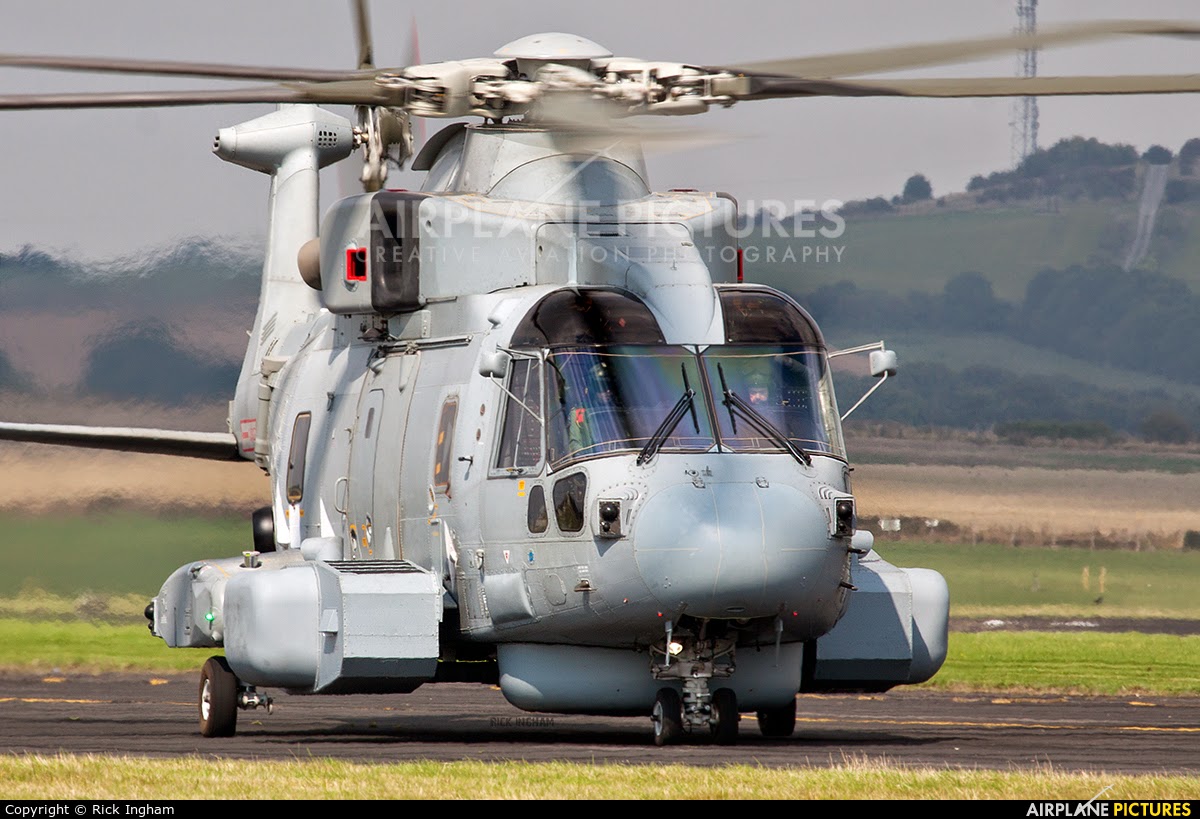
The HM2 is the soon to be in service
upgraded variant of the Merlin HM1 sub-hunting helicopter. Originally, 44
Merlin HM1 were purchased, but in the years 2 have been lost to accidents and 4
have been mothballed. Of the remaining 38, 30 are being updated, while an
option for modernizing the other 8 seem set not to be exercised.
The Merlin HM2 fleet will routinely
be asked to provide 6 or 8 Small Ship Flights for the Type 23 and then 26
frigates, with more potentially earmarked for Type 45. A requirement also
exists for providing larger (4 to 6 helicopters) flights to big ships such as
RFA Argus (it has become a common solution for Somalia anti-piracy deployments)
or the Fort class replenishers, and of course to the Aircraft Carrier in
future. Then there are additional security tasks, training needs and other
requirements to be met.
If we consider that all ship flights ideally should be triple (one training,
one deployed, one recovering after deployment), we can immediately appreciate
the full dimensions of the problem, and of the work that the already stretched
Merlin family does. Meet all calls from a fleet of 30 aircrafts will be a real
problem.
As I said, I deem it highly unlikely that we get an Osprey solution. My
greatest hope is to see Crowsnest adjusted to involve the upgrade and use of
the 8 – 12 HM1 airframes not currently part of the HM2 upgrade. This upgrade could
do away with everything relating to the dipping sonar and sonobuoys, and focus
on delivering the core software and hardware modifications of the HM2, to
remove obsolescence and make the fleet logistically common to the main one.
This way, the two AEW Squadrons could be retained as a separate force, like
now, and the requirements could better be met.
If we were to obtain this, it would
already be something worth cheering for.
There are two different industrial
teams putting forwards two modular AEW solutions for adoption on the Merlin HM2.
One team is composed by AgustaWestland and Thales, and includes a palletized
Cerberus solution, “migrated” from the Sea Kings.
Lockheed Martin and Northrop Grumman
are putting forwards their Vigilance podded radar/ESM solution, developed
specifically on the HM2 software and systems, which are a Lockheed product to
start with.
In some more detail:
Thales and AgustaWestland proposal
The initial proposal by Thales and
Westland was made in the summer of 2010, and aimed at HC3 type Merlins equipped
with a rear ramp. The choice of airframe was rather weird, as there is no
overabundance of Utility helicopters, quite the opposite!
The possibility of modifying the
surplus HM1 airframes to cut a ramp opening into their back was, as far as I’m
aware, never confirmed, and anyway such an approach would require quite a lot
of work and expense. Westland at the time was planning on the hope that the MOD
would acquire around 10 new helicopters specifically to meet AEW needs.
 |
| The original Thales - AgustaWestland proposal, targeted at the Merlin HC3 (or better still at new build "HC3+" with folding rotors and navalization) |
In this first proposal, a pallets
with two workstations and the electronic equipment would be rolled into the
fuselage, followed by another pallet mounted on the edge of the ramp, holding
up the Searchwater 2000 radome, which would be lowered once in flight to have
unobstructed 360° coverage.
In 2011 the Thales/Westland proposal
evolved as it became clear that HM2 airframes would likely to be mandated for
the job. The new proposal removes the need for a rear ramp and for pallets, by
utilizing modified HM2 workstations (2 of them, no additions) and by fitting a
modified Searchwater radome over rails fitted to the side of the fuselage.
The radar pod would slide up and
down the rails: up to clear the way for landing, and down to obtain
unobstructed view once in the air.
 |
| The revised Thales proposal, with rail-mounted radome. The "bag" slids upwards prior to landing. |
This new proposal involves minimum
modifications to the base helicopter, and would enable quick re-roling of the
Merlin if most or all of the HM2 fleet was fitted with the rails and software
mods.
Lockheed Martin and Northrop Grumman proposal
The Lochkeed Martin/Northropp Grumman Vigilance
AEW radarpod is a 280 to 300 kg pod, entirely self-contained, which
houses a powerful Northrop Grumman AESA radar, said to be related to the
AN/APG80 and AN/APG81 radars of the same company. The AN/APG81, in
particular, is the “super radar” of the F35.
Said AESA radar is said to offer quite
unbeatable performances, with SAR and ground targeting capability, and powerful
air to air AEW mode.
The Vigilance pod also contains the
processor and power system, an IFF interrogator, GPS/INS, ESM sensors and its
own cooling system. Two of these pods, mounted on the torpedo hardpoints of the
Merlin HM2, can give 360° degrees of AEW and land surveillance capability. They
only need a single power source connection, and can work with the software and
tactical workstations (2) of the Merlin HM2, even if two more stations could be
added for improved performance in the various roles made possible by the
multimission nature of the radar.
 |
| The Vigilance radar pod fitted to a Merlin HM2 for tests |
 |
| The Vigilance pod contains IFF, AESA radar and integrated cooling system |
Again, this solution requires minimum
modifications to the helicopter (very possibly even less than required by the
Thales solution) and would be quickly adoptable on potentially all of the HM2s.
The Vigilance pods could almost certainly
be fitted to the V22 as well, leaving more space in the cargo bay to install
auxiliary fuel tanks and expand endurance. The pods are indeed offered for
adoption on a huge variety of rotary and fixed wing platforms. Validated on the
Merlin HM2, the Vigilance is offered for platforms all the way up to the C130.
The odd and fascinating
one
The Bedfordshire-based Hybrid Air Vehicles is
producing its HAV304 airship platform for the Northrop Grumman’s Long Endurance
Multi-Intelligence Vehicle (LEMV), an airship
that will offer the US Army a 21 days loiter time at 20.000 feet (plus possibly
the equivalent of 2 days loiter in range of deployment), with a wide range of
sensors and cameras installed as part of a 1800 lbs payload.
With a crew of men
onboard, loiter time reduces to 5 days at 16.000 feet.
The hybrid airship
can loiter at 30 knots speed and cruise at a max speed of 80 knots.
The LEMV has made its
first flight in the last few days, some 16 months behind schedule: it had to be
in Afghanistan by the end of 2011, and it won’t be there before 2013.
The Royal Navy
interest was apparently for the HAV314 variant, however, a larger heavy lift
airship with a payload of 50 tons. Now known as AIRLANDER 50, this
hybrid airship can land on water or on any reasonably flat ground surface. It
does not need a runway, but it does require around 4 times its length in open
space to safely land and take off.
Range is 2600
nautical miles (at full payload of 50 tons?), and the body of the airship is
fitted with a cockpit for a 2-man crew. The cargo area is separated in two
zones: the first area, just behind the cockpit, has a raised floor and offers
2.8 meters (9 feet) in height and 10 meters (33 feet) in length, with a minimum
width of 5,64 meters. The second cargo section offers 3.93 meters (13 feet) in
height and 20 meters (66 feet) in length and can take 6 standard containers in
two rows of 3. In the rear, a vertical crane assembly is provided, which can lift
20 tons, and pull up or lower a container on a truck or on the ground.
Landing and take off
speed is 40 knots, and cruise speed is around 80 knots or higher.
With 200 passengers,
it can cross the Atlantic in around 36 hours. According to the Telegraph
report, the Royal Navy was even considering the Airship as an assault vessel,
carrying up to 150 Royal Marines and a number of RHIBs that could be lowered
into the water via crane, or deployed after landing the airship on the water.
Fascinating, even if I wonder what the range and endurance would be, what kind
of accommodations the Royal Marines would have on board and what exactly would
be the mission of such platform.
As an AEW/ISTAR platform,
an airship is both attractive and problematic: how would it deploy? Self-Deploying
at range over a naval task force in open sea might be a real issue, and the
airship definitely can’t land on the carrier’s deck, even less on a smaller
vessel.
Would it be possible
to refill, maintain, refuel and support the airship by landing it on the water,
or would an airship-support vessel be required?
With an airship
costing 60 million pounds, reportedly, the solution is already far from cheap,
at least in initial procurement (the savings come over the service life of the
platform, which requires a lot less support and a lot less fuel than
helicopters and airplanes), without needing to buy a (huge) support vessel
capable to embark at least a couple of airships, the number needed to ensure
continuous coverage.
Even assuming that a
Cerberus-like payload can be integrated, and then operated remotely from on
board the carrier to maximize the time the airship can spend in the air, and at
maximum altitude, the problem of deploying the airship over the task force and
keep it flying needs a solution.
As air-tanker, the
Airship has no chances, as it is way too slow to enable fast jets to refuel
from it.
As a COD platform,
with a 20 ton crane capable to lower standard TEU containers on the deck of
CVF, and with the capability to carry 50 tons or 200 passengers, the airship is
quite unmatched.
But the only way I can
see an airship used in the Royal Navy is as an additional capability, not as a
Crowsnest solution. A small number of airships, fitted with a payload of
sensors and surveillance cameras and with a remaining significant payload
margin for transport and COD missions would certainly be useful.
But would they be
useful enough to justify their cost in a crowded and always tight budget?
The airship might not be the right
solution for the present.
It might, however, be the solution for the
future, paradoxically. Enter the Lockheed Martin’s
ISIS (Integrated
Sensor Is Structure) airship, a gigantic high altitude platform meant to fly at
70.000 feet for up to 10 years per
sortie, while carrying a massive integral air search radar capable to
detect air targets at a range of 373 naval miles in all directions, while
simultaneously carrying a monstrous ground surveillance radar system capable to
track multiple static and moving surface targets out to 186 naval miles. The
airship would be able to relocate globally in a 10 days time thanks to a
sustained speed of at least 60 knots and sprints to 100 knots, and operate
without in-theatre support. The control element would be CONUS-based
(CONtinental United States).
This capability would
replace at once the E3D Sentry AWACS, the Sentinel R1 and the carrier-borne AEW
platforms, offering much increased performances over all of them. The US has
been working on the ISIS for years, with the LM contract awarded in 2009. A
demonstrator might fly next
year.
This airship
program, if successful, would no doubt represent a true revolution.