I've put together a map visualizing the laydown of the major Headquarters as announced:

For the engineers, the approach is roughly the same, with the Reaction formations at Perham Down and the Adaptable regiments in Catterick.
I was proven right on the disappearing regional brigades, with only one surprise: the South-East is now assigned to 11 Infantry Brigade, a new HQ identity coming from the "merge" of 145 and 2 Regional Brigades.
In my graphic i had shown 20 Brigade going to the Cottersmore area (HQ in Chilwell, to be precise) and the Desert Rats going to Salisbury. It was a 50/50 chance to be right, but i was wrong: rather surprisingly, in my opinion, the Army chose to remove the heavy armor from the 7th Brigade, despite it being worldwide-known for its historical armored role and exploits.
I'm sure the army has reasons for this choice, but it did surprise me, it saddens me, and it allowed the press to make a lot of noise ever since the announcement came out. Inevitable, really: the Desert Rats losing their heavy metal was inexorably going to be a loud thing.
So, the new ORBAT as announced includes the following Divisions and Brigades:

3rd (UK) Division, Bulford

1st Armoured Brigade, Tidworth

12th Armoured Brigade, Bulford

20th Armoured Brigade, Bulford

16th Air Assault Brigade, Colchester
The Adaptable Force should all come under the command of 1st Division HQ:

1st (UK) Division, York

7th Infantry brigade, Chilwell

4th Infantry Brigade, Catterick

11th Infantry Brigade, Aldershot

160th Infantry Brigade, Brecon

42th Infantry Brigade, Preston

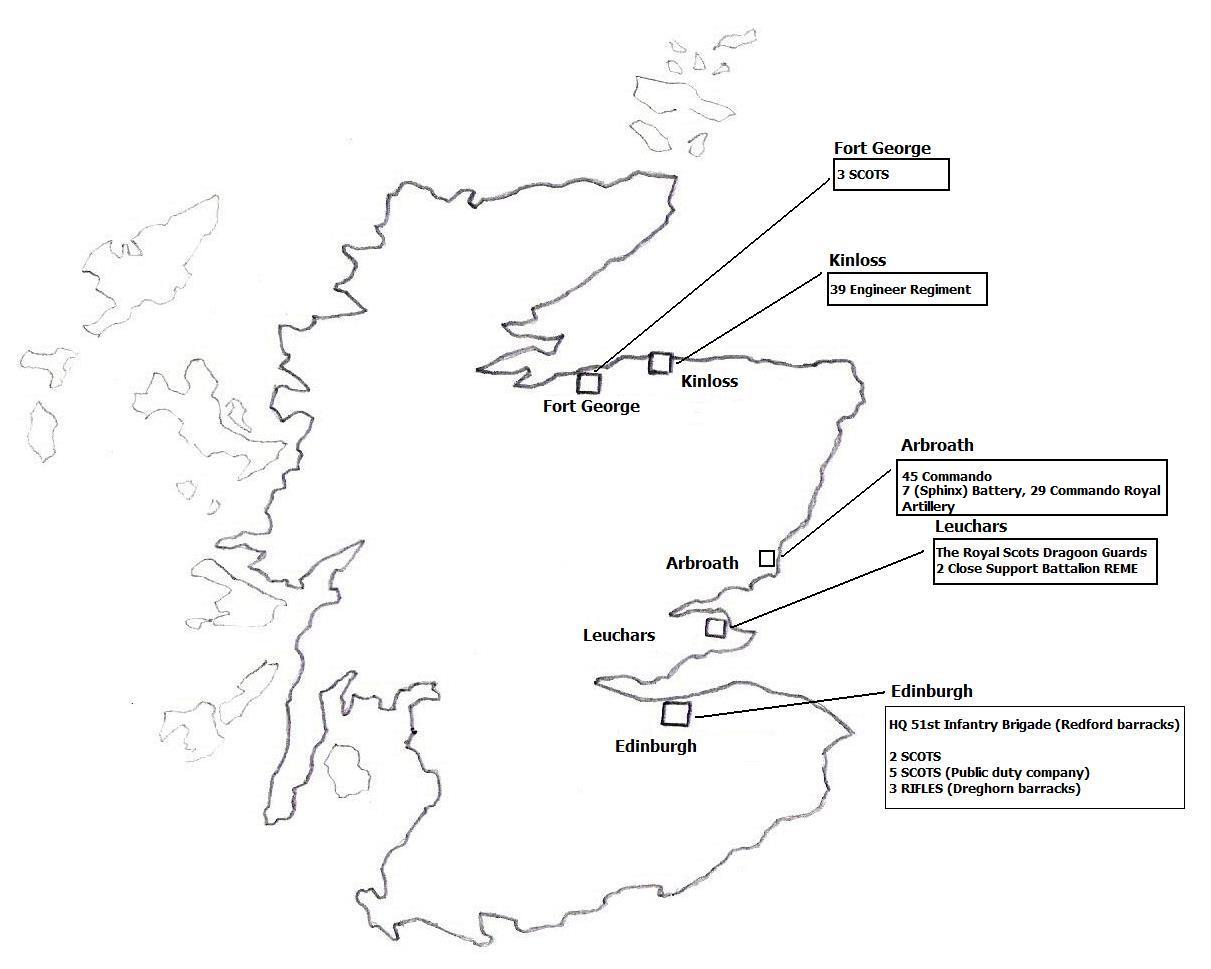
51th Infantry Brigade, Edinburgh

38th Infantry Brigade, Lisburn
There are two other Division-level headquarters of not very clear usefulness:

HQ UK Support Command (2-star), Aldershot

London District (2-star), London
And then the Force Troops element:

HQ Force Troops (2-star), Upavon

101th Logistic Brigade, Aldershot

102th Logistic Brigade, Grantham

104th Logistic Brigade, South Cerney

11th Signal Brigade, Donnington

1st Signal Brigade, Innsworth

1st Artillery Brigade, Tidworth
Badge not yet known - 1st Intelligence and Surveillance Brigade, Upavon
Badge not yet known - 1st Military Police Brigade, Andover

8th Engineer Brigade, Minley

2nd Medical Brigade, Strensall
Below is a map of the Salisbury Plain area, with the Army 2020 units listed out for location.

Here is a map of the East region, controlled by 7th Infantry Brigade, with HQ in Chilwell.

North East, responsibility of 4th Infantry Brigade, in Catterick.

The Home Counties include the Aldershot super garrison.

Aldershot is the base for some elements of the Reaction Force, such as 4th Armoured Medical Regiment. Although for now it is unconfirmed, i suspect the 3 infantry battalions to be based in Aldershot (4 RIFLES and a couple of Guards battalions on rotation) will be the ones roled as Mechanised Infantry in the Reaction Force.
Windsor remains the home of the Household Cavalry Regiment, expected to be mounted on FRES Scout to serve as a reconnaissance regiment in the Reaction Force.
Guards battalions will also rotate into the barracks at Pirbright and Windsor.
In Andover, the Army is standing up the HQ of the newly-created 1st Military Police Brigade, which will assume control over all RMP elements. These will comprise:
three identically structured RMP Regiments (1st, 3rd and 4th Regiments) fully integrated to maximise the utility of the Provost Reserves with fewer, but larger and more capable Regular and Reserve Provost Companies and larger Regimental Headquarters;
an integrated RMP Special Investigation Branch Regiment with a small RMP SIB Reserve element and with a new deployable capability to meet the requirement of contingency;
a new RMP Specialist Operations Unit, which groups existing, but disparate, specialised capabilities (the Service Police Crime Bureau (SPCB), the Close Protection Unit (CPU) and the Operational Support Unit (OSU)), and allows for the appropriate depth of command so that the delivery of scarce and highly skilled niche specialist capabilities, such as Cyber-Crime and covert policing, can be better managed while also interacting in the national policing landscape at home.
The military provost staff (MPS) will see its Regular capability growing to number 191 personnel (up from 106 personnel) and will have an enduring Reserve component.
In future Tier-1 Service Custody Facilities (SCF) in Garrisons will be manned by MPS, along with the Tier-2 The Military Corrective Training Centre (MCTC). The aim is to professionalise and optimise Firm Base custody thereby increasing surety.
The enlarged MPS will be better able to meet future contingency capability by drawing across the whole MPS structure to deploy personnel to man Tier-3 Operational Facilities.
The Military Provost Guard Service (MPGS) of the future will have its structure changed somewhat as it'll need to adapt to the changing disposition of the army, as a number of Military sites are closed, security levels are reviewed and other bases are expanded.
I've also prepared a map of the South-West and Cornwall. Included on the map are the bases of the Royal Marines and the two defence colleges at Lyneham and Worthy Down.

The space freed at HMS Raleigh was at one point expected to be used to allow the relocation of 45 Commando battalion from Arbroath, but, as of Army 2020 plan, the idea of moving the commandos south has been abandoned. Honestly, i expect the idea to resurrect in the future, though.
Lyneham will be the tri-service technical training centre, while Bovington is a fundamental training ground for vehicle fleets. The Royal Marines are getting a purpose-built facility in Bovington to support their training with the Viking armored vehicles of the Armoured Support Group, which is based in Yeovilton.
Bicester, Abingdon and Hullavington host the logistic support units for two of the 3 armoured infantry brigades. Each Reaction Brigade will in fact be supported by a Close Support Regiment RLC and a Theatre Support Regiment RLC. The third logistic element is based in Aldershot. The pairings would appear to be:
Aldershot
3 Close Support Regiment RLC
10 Queen's Own Gurkha Logistic Regiment [will be configured as Theatre Support Regiment]
Abingdon
4 Close Support Regiment RLC
27 Theatre Support Regiment RLC
Bicester - Hullavington
1 Close Support Regiment RLC
9 Theatre Support Regiment RLC
There is no certainty at the moment on how these pairs will be assigned and managed. They could either be assigned directly to the reaction brigades or be assigned to the centralised control of 101 Logistic Brigade.
The two Force Support RLC regiments will be assigned one to each logistic brigade, with (possibly) 7 Regt in 101 Brigade and 6 Regt in 102 Brigade, considering that the 7th, being based in Cottersmore, is much closer to the reaction force than the 6th, to be based in Dishforth on return from Germany. The Force Support regiments are described as "a fusion of Supply and Transportation from point of entry to foxhole for the entire force".
The Reaction Force is also expected to be supported by three Transport Regiments of the RLC Reserve component, one per each brigade, but we'll have to wait for the Reserves plan in order to get the details.
Bicester is also the home and training centre for the newly created Defence EOD, Munitions and Search (DEMS) Training Regiment. It is part of the DEMS School (DEMSS) which also includes the RLC training school for ammunition technicians, based just 30 km away, at Kineton.
The DEMS Training Regiment brings together EOD and Search expertise from all three services, and centralizes the DEMSS infrastructure around Bicester and Kineton, allowing the closure of older facilities at Lodge Hill.
In the map you can also see that 539 Assault Squadron Royal Marines is based in Devonport, along with 10 Landing Craft Training Squadron. This is because i'm accounting for their planned move from Poole to the newbuilt facility on Weston Mill Lake.
London will continue to have its own 2-star HQ, the London District.
The units based within London are those on Public Duty: at any one time, two battalions of Guards and one battalion of line infantry are busy in the role. The two Guards battalions on public duty are stationed one in Windsor and one in Hounslow, while the line infantry battalion moves into Woolwich.

Wellington Barracks is the permanent home of the three Guards incremental companies, while Woolwich also hosts The King's Troop Royal Horse Artillery.
The Basing Plan published by the MOD, contains two paragraphs that are incomplete. A lot of text is missing, and this means we do not know the details of the army unit moves rotations.
The Guards will move regularly between Aldershot (Mons and Keogh barracks), Pirbright, Windsor and Hounslow, but it is not clear how many years will pass between a move and another. As a consequence, currently it is unclear who will fullfil the role of Mechanised Infantry for the three reaction brigades: Aldershot is arguably the best location in which to base them, since there is no space on the Salisbury Plain. And according to the basing plan, there are exactly 3 battalions home-based in Aldershot. One is 4 Rifles, which was indicated time ago for the Mechanised role, but the other two battalions are Guards. Could they serve in the Mechanised Role between a Public Duty tour and another? It might be, if the turnation gives them a full three years to spend assigned to a deployable brigade, enabling them to fit into the Operational Readiness Mechanism, which is based on a 36 months cycle. In this way they could train with the Reaction Brigade and then serve in its ORBAT for its year at readiness, before moving on to Public Duty.
Unit Moves will be the norm for the King's and Queen's divisions, too. Once more, the paragraph on the official document is incomplete (a mistake that i expected would quickly be spotted and corrected, but that instead seems not to concern anyone...). For the Queen's Division, the battalions to rotate will be 2nd PWRR, 1st and 2nd Royal Anglian.
For the King's Division, i'm assuming (the relevant text was lost...) that the rotating battalions will be 2nd Yorks, 1st and 2nd LANCS.
These battalions will rotate into Cyprus (2 battalions, every 3 years) and Woolwich (1 battalion, every 2 or 3? years).
Lastly, the two Gurkha battalions will rotate between Shorncliffe and Brunei every 3 years.


In the West, the "home of the Signals" is taking shape, with full steam ahead for Project BORONA, the relocation of a further two Signal Regiments to Stafford, where 22 Signal Regiment is already based. The 143rd Regional Brigade, which used to control this region, will vanish, replaced by a Regional Point of Contact (West) in the HQ of 11th Signal Brigade, in Donnington. The ARRC and its support elements remain in Innsworth.


The North-West remains under the control of 42nd Infantry Brigade, with HQ in Preston, while Northern Ireland is under the command of 38th Infantry Brigade, in Lisburn. 5th Regiment Army Air Corps will continue to fly from Aldergrove, with its HQ located in Belfast.