The reckoning
We are
weeks away from the publication of the long awaited, much anticipated and very
much feared Integrated Review and, in particular, of the Defence White Paper
which should provide “details”. I think that previous experiences have made us
all wary about what the MOD considers “details” and one of my greatest fears is
that we will, in fact, be given vague promises that will keep us all wondering
for the next few years.
Most of the
other fears have, as was always predicted, the British Army at their centre. My
increasingly exasperated battles in the last 5 years over the shocking
self-harm that the Army was committing in pursuing the half-formed STRIKE at
the expense of everything else are, sadly, looking likely to be vindicated. The
questions that I’ve been formulating for 5 years are still without an answer,
and the Army is reportedly about to pay dearly for its failure. If the leaks to
the press are accurate, the British Army will disband at least 4 infantry
battalions and will progressively settle downwards to a trained strength target
of around 72.000, rather than 82.000.
And if that
seems a painful price to pay, be wary that there will potentially be far more
pain caused by the other reported cut: the loss of the whole WARRIOR fleet,
mitigated apparently by a wish to “accelerate” the procurement of BOXER.
 |
| I made this scheme in November 2015. The ink on the SDSR's pages was virtually not dry yet, but already there were questions and risks evident in the just announced Force Structure. The following years have not provided answers; just evidenced further problems. |
There are
key things we still don’t know, so estimating the full magnitude of what will
happen is not yet possible. Chiefly, we do not know if there will be additional
purchases to expand the BOXER fleet. This becomes the absolutely key question,
followed by the determination of which roles BOXER will go on to cover. Will a
turreted variant be added? Will a mortar variant appear?
The MBT –
IFV combo is the heart of any modern army. CHALLENGER 2 LEP+ appears to be
going ahead, according to the latest reports, and this is a great relief.
Apparently, around 150 tanks will receive the new turret with the smoothbore
120mm cannon and all the new sensors and electronics. This is a remarkably
small number but not truly surprising: the British Army has been planning for
just 2 regular tank regiments for the best part of 5 years now. As the Army
pursued its STRIKE dream, it instructed the 3rd MBT regiment, the King’s Royal
Hussars, that it would eventually convert to AJAX.
 |
| A more recent scheme i produced to try and help people realize just how far the ripples travel through the armour if you cut CHALLENGER 2, WARRIOR, or both. They are the heart of everything the Army is, and you can't expect to rip the heart out without causing consequences. |
The British
Army has recently reverted to its traditional Type 58 structure for MBT
regiments, so the regular fleet will number 116 tanks, with a small reserve
fleet on top. Too small, in fact, to even contemplate the possibility of
rebuilding a third frontline regiment from the single Reserve MBT formation,
the Royal Wessex Yeomanry.
A very
questionable approach to that “regeneration” capability that the Army only ever
pays lip service to, but this is how things stand. After the LEP+ upgrade, at
least, the CHALLENGER 2 will finally live up to the otherwise largely
undeserved hype that surrounds it.
Losing the
IFVs is however going to create massive headaches and a ripple of problems that
will travel far and wide.
The above
graphic, which I first made back in august 2020, hopefully helps in visualizing
the ramifications of such a cut.
Just how
bad it will get, we will only know once we are told if new BOXERs are
happening, or not. The British Army will be keenly hoping for permission to
commit money towards additional BOXER purchases and more variants.
They have
always hoped that this would eventually happen: the MIV programme tender
documents specify that arrangements have been made to keep the door open for
the purchase of more vehicles. There are enough options for getting to a fleet
of some 1500 vehicles in total, with specific mention that more variants could
be added, and indeed developed in the UK.
All the way
back in 2018, when those documents were published, I wrote a post about it, noting that it very much
suggested a serious appetite within the Army to “go wheeled”, the way the French
did with VBCI and then with GRIFFON/JAGUAR/SERVAL.
Back then I
noted:
The notice specifies that additional variants
and requirements could follow, and it specifically mentions the adoption of a
“medium gun”, basically implying an IFV variant.
Moreover, the notice specifies that the MOD is
asking for the option of ordering up to 900 more vehicles, for a total of 1500.
1500 does not appear to be a casual number: the
Army has been planning for 380 upgraded Warriors; declares on its website 409
FV432 still in use; and fields / stores a fleet of 305 Mastiff Troop Carrier
Vehicles plus 127 specialistic variants (Enhanced Communications Variant,
Interim ECM, Interim EOD [possibly 23], ambulance, Protected Eyes / Praetorian)
plus 118 Ridgback Troop Carrier Vehicles and 51 specialistic variants (Command,
Ambulance), supported by 125 Wolfhound (Utility and at least 44 between Military
Working Dog and EOD).
The total is 1515. Coincidence? Probably no.
It seems more and more likely that the troubled
Warrior CSP will, in the end, be cancelled. This MIV notice seems to prepare
for a WCSP cancellation scenario by making provision for the numbers and the
addition of a medium gun.
In 2018,
the increasingly dire situation of the Army’s plans was already pretty
painfully evident and I urged the then Modernizing Defence Program to take a
good, hard look at the whole mix of Army capabilities and choose a direction of
travel. If tracks and wheels can’t be properly funded at the same time, and it was absolutely clear that they could
not be, it only takes rationality to know that you have to pick one.
The French
consciously picked the wheels side and have put all of their resources in
building up a powerful wheeled force around their MBT fleet, which is pretty
much the last tracked element in the Armee de Terre simply because it remains
unreplaceable, regardless of the usual takes on how MBTs are supposedly
obsolete.
The British
Army could well have taken a similar decision.
But, and
again I quote from my 2018 post, because the reality of facts is unchanged:
The replacement of WCSP with more MIV would put
the British Army on the same path chosen by France with the VBCI, which
entirely replaced their own tracked IFVs. Moreover, the replacement of FV432
with MIV variants would represent a rather dramatic shift in favor of wheels,
completely changing the scenario that currently exists within the British
Army.
Such a change of heart would do wonders for
commonality and obsolescence removal from what is an aging fleet of fleets, but
it would also sideline Ajax even
further, leading to further questions about where the tracked heir to FRES
should sit.
Ever since the SDSR
2015 was published, Ajax has looked more and more lost, ultimately resulting in
its “re-branding” into a “medium armour” capability which has, it is fair to
say, convinced very few people.
AJAX, not
WARRIOR, is the problem the British Army has created for itself.
To
understand Army's pain in trying to shape its own vision for the Integrated Review,
consider this: its absolute most expensive program is for a tracked family of vehicles,
the AJAX gang, which delivers only a few roles, and is no Infantry Fighting
Vehicle. In itself, it solves "nothing”, because you need WARRIOR,
carrying the infantry, to give true meaning to the whole force.
The second most
expensive program is for a wheeled APC which, by itself, also solves
"nothing" because out of 523 BOXER, 15 are training vehicles and the
508 frontline ones are split between APCs, APCs with different internal
arrangement for carrying engineers, artillery fire directors, JTACs and other
“specialists” with related equipment, ambulances and command posts.
Once you
put AJAX and BOXER together, you have burned over 10 billion pounds of budget
room, but are left with a dysfunctional mix. There are a ton of tracked roles
left uncovered, beginning with the absolutely key IFV but expanding to mortar
carriers and supporting roles currently covered by FV432 in the hundreds.
And a ton
of wheeled roles remain just as uncovered .
And the
money is not enough to do both.
What is now
happening in the Review was entirely predictable. As i've been writing for 5
years, the problem of how to mix AJAX and BOXER in a force structure that makes
some kind of sense while also preserving at least the CHALLENGER MBTs is
demanding an urgent answer. And poor WARRIOR is the designated victim at this
point, because unlike BOXER and AJAX it is not yet under production contract.
It is
merely the simplest one to cancel.
But make no
mistake: WARRIOR is not the problem. AJAX is. Or BOXER, depending on whether
you side with the track or with the wheel.
The truth
is that the Army had the money and "ingredients" to outfit at least 3
excellent tracked, heavy brigades. In September 2014 it put AJAX under
contract, and 2-3 more billions would have seen enough WARRIOR and CHALLENGER
2s upgraded to complete the renewal of 3rd Division as had been
imagined in the original Army 2020 plan (published 2011).
Alternatively,
the Army could have chosen to “go French” and bet big on wheels, beginning a
wholesale restructuring by going for a huge BOXER purchase to effectively drive
WARRIOR, FV432 and CRV(T) out of the door over N years.
But the
Army did not want to pick just one side. The Army wanted to have both, and
while I can see why they would want that, I cannot forgive them for ignoring
the evidence and putting themselves into this mess.
In
September 2014 they committed the biggest chunk by far of their future budget
on AJAX.
In November
2015 they made wheels their absolute priority, and ever since, STRIKE had
dominated the Army’s vision, all the way up to the signing of the BOXER
contract at the end of 2019. Just in time to arrive at the Integrated Review
with CHALLENGER 2 LEP+ and WCSP still uncommitted and thus extremely
vulnerable.
In the
middle there was the whole saga of the “delayed Review” and the Review to stop
the Review, also known as “Modernizing Defence Program”. What that saga did was
signal, without any possible doubt, that the money was not there to pursue
both tracks and wheels at once.
The Army
made its choice in late 2019, putting all the money on BOXER. Considering the
situation, this was a suicidal choice. With AJAX in place, the Army needed WCSP
and CR2, not BOXER. Splitting an already insufficient budget inexorably
condemns the Army to a sub-optimal mixture of tracks and wheels which will drag
on for decades into the future.
The time
for a big change of heart was before the AJAX contract was signed.
The moment AJAX was put under contract it should have become a fact of life that the time
for adding an 8x8 fleet could only ever come after WCSP and CR2 LEP had been secured.
And the
British Army itself used to know this basic reality: up to 2015, the MOD Major Projects Spreadsheet contained a single title that
summarized the whole modernization of the Army’s armour fleets. The Mounted
Close Combat Capability Change super-program was started March 16, 2010 with a
Project End Date set for December 21, 2033. The budget over that timeframe was
given as 17.251,81 million pounds.
In April
2014 that colossus was split into its different components: Armoured Cavalry
2025 (AJAX), Armour MBT 2025, Armoured Infantry 2026 (WCSP and ABSV) and
Mechanised Infantry 2029.
A telling
indication, which the SDSR 2015 and the STRIKE obsession eventually turned on
its head, trying to get MIV into service from 2023, with operational capability
for the new brigades in 2025. This change of heart is now having its entirely
predictable consequences.
Now we are
in the worst possible limbo, with a force that doesn’t have the tracked
vehicles it needs for holding on to Armoured Brigades and at the same time
doesn’t have the wheeled vehicles needed for a true Medium, wheeled force.
Where do we go from here?
A look at the budget figures
The annual
major projects spreadsheet from the MOD helps us track what the situation is.
The Armour MBT 2025 program started in 2014
and currently has a Project End date set for July 31, 2028.
This
represents a 791 days extension on the
previous target of June 2026 and is due to the fact that in Financial Year 2019
the Army turned the original CHALLENGER Life Extension Program in LEP+.
Specifically,
the latest Major Project spreadsheet, released in July 2020 and current
to September 2019, reports on the sudden realization within the army that just
upgrading the thermal sights was not going to do much.
The scheduled baseline project end date at Q2 1920 (30th September 2019)
is 31/07/28, has lengthened by 791 days since last year's Q2 1819 date of
01/06/26, due primarily to the following factors;
In this period the programme's scope was expanded from obsolescence only
to include enhancements to its lethality and survivability. The expanded scope
has also lengthened the time to complete the work and increased cost over the
assessment, demonstration and manufacture phases. These dates are
currently subject to negotiation and will be confirmed when the full business
case has been approved.
The baseline Whole Life Cost at Q2 1920 (30th September 2019) is
£1,304.19 m, due primarily to the following factors;
This reflects the financial
position following the capability uplift endorsed by HMT. This sees a
capability uplift and extension to the Main Battle Tank out to 2035.
The above restructuring of the
program was confirmed in an utterly shambolic intervention of the Chief of the
Defence Staff, previous Chief General Staff and mastermind of Army 2020 and
Army 2020 Refine, General Sir Nick Carter, in front of the Defence
Committee. From his words, it appears the Army was essentially unaware
of the lethality issues of the multi-piece ammunition of the current cannon
until 2019. This is, of course, completely false, considering that the Army was,
in fact, looking for solutions already in the early 2000s, when the Challenger
Lethality Improvement Programme was tentatively launched. It was in 2006 that a
CHALLENGER 2 was first retrofitted with a 120mm smoothbore gun, in fact.
Swapping the gun was never an issue: the issue was in the complete redesign
needed to fix ammunition storage spaces and make room for the much longer
single-piece rounds. This is the main issue to this day, and the chief reason
for swapping out the entire turret.
Have they forgotten everything about
that phase? Was Carter being overly kind to his political masters, to the point
of having the Army shouldering more blame that necessary? He was not shy
earlier in the same hearing saying that some decisions depend on money: why,
then, say something as hopelessly stupid as this about CR2 lethality problems
suddenly "dawning" on an oblivious Army...?
It’s one of the many mysteries of
the last few years of Army decisions.
Armoured Cavalry 2025, also launched in 2014, is supposed
to end on April 30, 2025 although this seems optimistic considering the current
delays in acceptance for the turreted AJAX variant and the fact that only
handfuls of ARES, APOLLO and ATLAS have been delivered. Fair to assume that the
end date will change.
Budget over
the period is given as 6.288,95 million. As of 19, despite the deliveries
having barely started at all, the MOD had already paid 2,78 billion pounds,
which is part of the reason why AJAX is not being cancelled. In 2019/20, the
MOD paid 643 million, down from a planned 694, exactly because of the delays
with AJAX and with the consequent cancellation of expenditure connected with
getting training in BATUS up.
Armoured Infantry 2026, also started formally in 2014, is
due to end 31 December 2026. The last time we were given an indication about
the total budget for WCSP is in the Spreadsheet released in 2017. Back then,
the expectation was for 1612,72 million pounds.
Up to 2016
the budget had been 2176,45 million pounds. The difference was caused by the
decision, in 2016, to de-scope the Armoured Battlegroup Support Vehicle, which
remains an “aspirational” requirement. Essentially, the Army has no clue how it
will replace the ancient FV432.
From 2017
onwards, the numbers associated with the WCSP programme have been hidden for
commercial interest as negotiations have dragged on to try and get to a
contract.
As of
financial year 2019, at least 474 million pounds have already been expended on
WCSP. It is extremely likely that, if the program is indeed cancelled, the Army
will have wasted another half a billion in exchange for nothing.
Finally, Mechanized Infantry Vehicle, launched
in April 2018 and with a currently planned end date of 31 December 2032. Budget
over the period: 4663,31 million pounds.
It is
painfully evident that the money committed on MIV would have gotten WCSP and
ABSV going. There was room to go with the 2010 target of 6 WARRIOR battalion
sets, in fact, rather than the 4 that have been the reduced ambition since 2015
in order to accommodate STRIKE.
It also
seems that some of the money once associated to the Mounted Close Combat
Capability Change program is missing. The current budgets add up to 13,867
billion, rather than 17,251. This apparently vindicates the Army’s claims that
it has been robbed of money to pay for cost overruns in the other Service’s
programmes.
However,
the budgets listed above give us no visibility on how much money was expended
between 2010 and 2014 (admittedly unlikely to be very high as all programs were
in very early stages) and also leave out several years. The 17,251 billion were
to be expended out to 2033, while the current projects end dates (2028, 2026,
2025, 2032) all stop well short of that point. It is entirely reasonable to
assume that the missing 3,384 billion will be expended across the various
fleets in those missing years. Indeed, might even be more. We also do not know
where programs like Multi Role Vehicle – Protected have their budgets: it seems
reasonable to assume that this program in particular might have originally been
part of what used to be “Mechanized Infantry 2029”. This adds further
uncertainty.
Also,
there’s no way to tell if the Army received formal indications in 2015 that it
would get more money, and this eventually failed to happen soon afterwards.
We can’t
say for sure if the total out to 2033 has really shrunk, and if so by how much.
We can be sure that the Army has seen significant fluctuations in the amount of
money allocated to it year on year, which might well have complicated project
management and forced delays to the signing of contracts.
But I’m not
prepared, given the figures above, to side with those who claim the Army’s woes
are due to the other Services and to Government. I’m not sure they have had it
that much worse than the other Services, nor are we in a position to determine
if, and how much, the totals available out to 2033 have truly changed. The data
available to us outside of the MOD is, simply, insufficient for determining
that.
The data
that is available is incomplete, but suggests the Army bears enormous
responsibilities for its own troubles. AJAX is the most painful and undeniable
demonstration that the Army’s own inability to set priorities has been
destructive: the fact that, while deliveries have barely even started, the
vehicle already is basically a square peg in a world of round holes, is
damning.
Whatever is
done now, AJAX is here to stay. But in the Army that is taking shape with the
loss of WARRIOR, it looks like a orphan. Something that no longer has a truly
good collocation anywhere in the force. And this is an obscenity. Your biggest,
most expensive programme CANNOT be a problem. That it now is, is the measure of
your failure.
What next?
Decisions
should, as I already said, have been taken earlier. Now it is very difficult to
imagine a truly “good” outcome.
Things will
get spectacularly ugly if there are no further BOXER / AJAX purchases. Such a
scenario would truly mutilate the Army, which would see a net 50% cut in the
already insufficient number of infantry battalions it planned to mechanize.
The
original Army 2020 Refine, in 2010, was based on 6 armoured and 3 heavy
protected / mechanized battalions. In other words, 6 on WARRIOR and 3 on
MASTIFF, later to be replaced by an 8x8 around 2029. Each of the 3 armoured
infantry brigades would have 2 battalions on WARRIOR and a battalion riding on
wheels, not unlike what happens in the German army where a single JAGER
battalion (on BOXER APC) is integrated in heavy brigades.
But as we
know, in 2015 Carter decided that the future was all about STRIKE, even though
right from the start the cost of such a change was heavy: one tank regiment to
go; one AS90 regiment gone; one armoured engineer regiment also gone. The Army
2020 Refine plan now called for 4 brigades, albeit individually smaller. Of
these, two would be armoured and would have 2 battalions on WARRIOR each, and 2
would be STRIKE brigades, each with 2 BOXER battalions. Net result was a drop
to 8 mechanized battalions in total.
Now, as
Army 2020 Refine falls apart, if there are no new vehicle purchases, the Army
will have managed the spectacular feat of crashing all the way down from 9 to 4
mechanized battalions, and all of them on lightly armed APCs, thus with an even
more dramatic loss of firepower. And as we have seen in the Budget section of
the article, it won’t be for lack of spending, to add insult to injury. It will
have paid a sweet 10+ billion pounds to create this mess.
With just 4
mechanized battalions, it is likely the Army will collapse all the way down to
a force of just 2 brigades worth of their title. Brigades with 2 infantry units
are already sub-optimal; splitting 4 battalions across more than 2 brigades
appears pretty much impossible.
I can only
think of one way to do it in an acceptable fashion, and that is by adopting
Permanent Combined Arms Battlegroups: instead of forming 4 AJAX regiments, as
planned under Army 2020 Refine, some of the AJAX would instead be assigned
directly to the infantry battalions, to create “square” battlegroups with 2
AJAX Squadrons in support of 2 Infantry companies on BOXER APCs. This, in
theory, allows you to form 6 permanent BGs, which you can then spread across up
to 3 brigades.
But this
is, literally, the math of despair.
New
vehicles are desperately needed for the Army to remain functional.
The French way…?
The British
Army is likely to be headed the French way, since BOXER is all the rage these
days. This will however happen more by accident than by design, with AJAX
destined to remain pretty much an orphaned oddity in such a “new” army.
As I’ve
written multiple times, I think the “French model” is very much an acceptable
compromise. Not perfect, but good enough provided
that the Army buys many more BOXERs, and suitable wheeled vehicles (through a
revamped MRV-P) to support it, over the coming years. The last 30 years
have seen the Army change its mind constantly, with utterly disastrous results:
it has run around in a tortuous circle which has brought it back literally to
the starting block (the BOXER saga is absolutely terrifying), but with several
missing limbs and a scrawny body which has lost all muscle along the way.
If the Army
is to recover, it will need to stabilize its aims.
My readers
already know that I do not believe that wheels are key to adopting a more
dispersed kind of fighting, and certainly I will never side with the British
Army in pretending that having wheels is sufficient to change battle dynamics.
Fighting dispersed is complex, dangerous and demanding. It requires more capability, not less. It requires
capabilities currently relegated at higher command levels to be distributed far
more widely, at far lower level. One such example is air defence: dispersion
alone, in the age of the UAV and airpower in general, cannot possibly be a
solution to anything if the dispersed groups have little to no ability to
defend themselves from threats from the air.
Wheels,
however, do have unquestioned merits in making a ground force element more
readily capable to move independently over long distances without depending on
semi-trailers and trucks. Wheeled armour also tends to be less thirsty, which
means it can do with a smaller logistic train. For a small Army with a
(relatively) small budget, wheels can represent a serious advantage.
Moreover,
as we try and think of where the Army might go from here, we cannot ignore what
the minds of the Armed Forces have indicated, in the Integrated Operating Concept 2025, as the necessary attributes of the
future force:
Have smaller and faster
capabilities to avoid detection
Trade reduced physical
protection for increased mobility
Rely more heavily on
low-observable and stealth technologies
Depend increasingly on
electronic warfare and passive deception measures to gain and maintain
information advantage
Include a mix of crewed,
uncrewed and autonomous platforms
Be integrated into ever more
sophisticated networks of systems through a combat cloud that makes best
use of data
Have an open systems
architecture that enables the rapid incorporation of new capability
Be markedly less dependent on fossil
fuels
Employ non-line-of-sight fires
to exploit the advantages we gain from information advantage
Emphasize the non-lethal
disabling of enemy capabilities, thereby increasing the range of political
and strategic options
Arguably,
the above aims are not conceptually too far apart from the same drivers that
were being FRES and the US Future Command System. Even in more recent times, If
we take a look back at what FRES SV/AJAX was originally meant to eventually
grow into, we can easily identify a future in which all capabilities, potentially
including the MBT role, would have been delivered with FRES SV/AJAX variants.
Tracked, but still much lighter than current MBTs (although very much not
lighter than WARRIOR).
The AJAX family
was supposed to be just the first capability Block within a larger programme
that should have eventually included another two Blocks, introducing more
variants. One such variant in particular, the ambulance, had been close to
being purchased. It had already been named, even, as the ASCLEPIUS. But then
2015 happened, and any hope of further Blocks for the AJAX family has
evaporated.
 |
| Looking back at what the Specialist Vehicle (then AJAX) was meant to be is a painful exercise. Had the Army persevered in this direction, very capable tracked brigades would be taking shape right now. It is very hard not to get Future Combat System vibes from this scenario. |
It is
fascinating to think of what the British Army could have achieved by carrying
on with the original FRES SV/AJAX plan, indeed expanding it to replace WARRIOR
as well. Such an approach would very much replicate what the US Future Combat
System used to be like. As you might remember, FCS was all about medium-weight
tracked platforms.
While the IOC2025
directions do not openly favor wheels above tracks, however, the additional
logistic weight imposed by tracked vehicles the size of AJAX, and the
consequent financial penalty, very much suggest that, just like France, the UK
would not be wrong in settling for wheels instead.
If we
accept the design drivers identified by IOC2025, BOXER is probably the correct
vehicle for the future. It is not “light” in a literal sense (the UK’s BOXER,
built to the latest A3 configuration, can reach 38.5 tons) but it does come
with greater, “faster” ability to move to and across the battlefield, while
also being “lighter” in logistical terms. A battle force made up of BOXERs
would certainly be easier to deploy and sustain than a tracked one, even one
built entirely on AJAX as base.
This is
especially true if we also consider the Army’s “Conceptual Force 2035”, which
very much doubles down on the same kind of design drivers. This study imagines
an army of 3 smaller but capable divisions made of lighter, faster, more
deployable, largely independent battlegroups, with dispersion being the norm.
Conceptual Force 2035 specifies that the disaggregated fighting requires
Combined Arms capabilities to be organic at lower level, to ensure the
dispersed Battlegroups do not have to wait for a superior echelon to make
supports available. This includes having more organic Indirect Fire capability
and employing it alongside greater ATGW capability to offset the capability
currently delivered by MBTs through “lighter” vehicles.
 |
| Conceptual Force 2035 described in the British Army Review, issue 177, Winter/Spring 2020 |
The BGs
will be expected to carry out, and I quote, deeper, more risky and aggressive manoeuvre. Robotic, sacrificial
systems will be used to press on reconnaissance, and I quote again, to the
point of destruction, in order to enable the BG to use frenetic op-tempo to
make up for the lack of mass.
The
resulting BGs would be around 500-strong but are supposed to match the current mission
set of a 1250-strong armoured BG though the use of robotics and higher
op-tempo. The Conceptual Force imagines that, from around 82.000 regulars, the
British Army would be able to form some 48 such Combined Arms battlegroups. The
organization would work to the Rule of 4, with an Assault Force, Covering
Force, Echelon Force and Reserve Force. These BGs would be grouped in Brigades
with enough CS and CSS elements to fight, again, largely independently from the
Division level.
The key
attributes described above, for me, are the key to the whole concept: if you
want to fight dispersed and be lighter but still capable, you must pack a serious punch and have far
more capability pushed down the levels of command. This is something that in
STRIKE we are just not seeing in any
meaningful way. Firepower has been dead last in the list of priorities so far,
and that makes the whole thing not credible.
In fact, what
is most striking about the Conceptual Force 2035 is that it is so entirely alien to what the British Army actually looks like
today, in structure, “culture” and programmes. For example, Permanent
Combined Arms Battlegroups are anathema in today’s British Army and among the
purists of capbadges and specialty separations. CS and CSS are a scarce
resource completely out of balance with the number of infantry battalions. Indirect
Fires and ATGWs are weaknesses, not strengths. The Rule of 4 is nowhere to be
seen, and indeed resources in multiple areas are spread so thin than even the
Rule of 3 is dubious.
 |
| A LM proposal for a vertical launch missile module for BOXER, complete with mast-mounted radar and EO/IR. |
One key
question ahead of the publication of the White Paper is whether the shock of
this Review finally gets the Army to move from its current indefensible
obsessions, or if the new manpower reduction results in just “more of the same”,
through the loss of yet another “brigade-set” of CS and CSS. As I said, the
sheer scarcity of combat vehicles to mechanize the infantry with suggest a
reduction to as few as 2 brigades. Currently the British Army has Combat
Support and Combat Service Support resources sufficient to aim for 4 brigades. My
worst fear is that, consequently, the Army will go for the “easy” solution of
removing up to 2 Engineer, Artillery and perhaps Signals and Logistic units,
rather than go for a wholesale rebalancing and reorganization. This would only
exacerbate the inbalance, rather than address it, and would inexorably prepare
the stage for a further manpower reduction a few years on, when politicians
will (rightly) observe that an output of some 2 brigades does not
require 72.000 personnel.
The Army
needs to decide, quickly, if it believes in the findings and directions of its
own studies for the future, and start acting accordingly, reorganizing its
structures and reassigning manpower to the capabilities that need to be
expanded.
As a first
step in a transition process to something resembling the Conceptual Force 2035,
the Army should work to increase its ability to field combined arms brigades.
The Corps of 3 Divisions and 48 battlegroups imagined by the Conceptual Force
2035 is very hard to imagine, as manpower is just one ingredient and the other
expensive ones are all missing; but the British Army should be more than
capable to put together 6 brigades, spread under 2 divisional HQs, mirroring,
again, the French model. Each Division would have a Heavy, a Medium and a
Light/Air Mobile brigade, one a revamped 16 Air Assault Bde, the other built by
restructuring resources already available but tied down in the current 1st
Division. Such lighter brigades would seek to fight dispersed primarily by exploiting Light Cavalry support, Foxhound and, even more so, the RAF's very precious and very significant fleet of 60 CHINOOK. Obviously, they would be limited in what they could achieve in the highest intensity scenarios, but they could find plenty of use across a multitude of cases.
A third Division would continue to group up the rest of the force: the battalions busy on garrison / forward presence roles; the Specialised Infantry Group. Ideally, said Division should also serve as a Regular core force which a restructured Army Reserve should "regenerate" for action in times of need. But this is a complex topic better left for future discussions.
The
resulting division would be lighter than the 3rd Division as envisioned by Army
2020 Refine, but it is more realistically sustainable and having 2 of them make
it possible to sustain an effort over time, rather than fire a silver bullet
once and have nothing else left.
In order to achieve this, more vehicles will
be a non-negotiable requirement. Most likely, all efforts will go towards new
BOXERs, although this is not necessarily the only option on the table.
Obviously there will be no new tracked IFV purchased anytime soon (if ever
again) if WARRIOR is cut.
Even so,
one could envisage an effort to maintain tracked, heavy formations by ordering
more vehicles of the AJAX family. If AJAX was an IFV, it could replace Warrior.
But AJAX has no room to carry infantry and there is no real way to change this
fact. The structure of the vehicle and the vast turret ring (specified in part
because there once was to also be a Medium Armour variant with 120mm smoothbore
gun) prevent any conversion to an IFV. It is also probably next to impossible
to pursue a “rewriting” of the contract that de-scopes some of the AJAX to make
room for a new IFV variant, which General Dynamics is ready to offer and has
tried (and failed) to sell to Australia.
However,
the ARES APC already on order could easily be delivered with internal
arrangements for carrying 7-8 dismounts. If more ARES were ordered and
configured accordingly, it would be possible to create Combined Arms
Battlegroups by mixing AJAX and ARES.
I don’t
think, sadly that this is likely to happen. But it is a possibility worth
considering. Permanent Combined Arms Battlegroups of AJAX and ARES carrying
infantry could become a prototype for the Future Combat Team of 2035, adopting
the Rule of 4 and beginning to develop true “Find, Fix and Strike” mechanisms
by adding in organic Indirect Fires.
If more
ARES could be squeezed in to make this happen, it would be possible to hang on
to the superior all-terrain mobility of tracks and ensure that the remaining
CHALLENGER 2s have appropriate intimate support. The two Heavy brigades could
thus consist each of a single tank regiment and 2/3 AJAX/ARES BGs.
Otherwise,
said BGs will inexorably have to be mixed, with AJAX supported by BOXERs.
On the
BOXER front, an absolutely priority should be the acquisition of a turreted,
well armed variant.
Ideally, the
40mm guns already procured and paid for WCSP should be used to create this new
variant. The WCSP turret is, as we speak, close to completing extensive
reliability trials. There’s no way to know how the turret behaved, but if it is
doing well it would be wise to migrate the whole turret towards a suitable
module to be developed for BOXER.
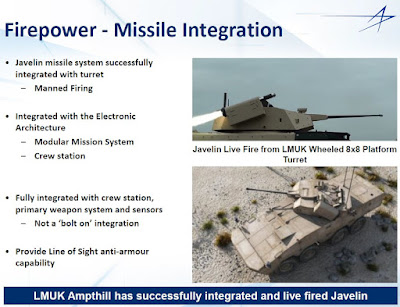 |
| LM's work in 2015 to demonstrate that a turret derivated from the WCSP's one could indeed work on BOXER. |
Such an
enterprise would require some time, but should not be overly complex. Lockheed
Martin fit one of its turrets onto a BOXER and carried out some early trials,
including weapon firings, already as far back as 2015. While these industry-led
demonstrations involve integrations that are far less mature than one might
think, there should be no reason for the turret not fitting on a troop-carrying
module.
Acquisition
of such a turreted BOXER would enable AJAX, with its mobility penalty, to be
taken out of the “STRIKE” / Medium brigades without a loss of firepower. The
Medium force could then enjoy all of the advantages of being a purely wheeled
formation, with the same level of mobility across all of its components.
The
turreted BOXERs would have to be mixed with the APCs already on order with the
aim of forming the highest possible number of Combined Arms Battlegroups.
Not
“cavalry”, not “infantry”. Permanent, combined arms BGs that will have to
deliver that mix of “Find, Fix and Strike” capability by progressively
integrating more indirect fire options, and the ability to target them from, if
not any soldier, certainly from pretty much any squad and combat vehicle.
These BGs
will have to progressively evolve towards those “Future Combat Teams” envisaged
by the Conceptual Force 2035. A key capability to bring in as quickly as
possible to enable that evolution is the Land Precision Fires system, which is
meant to succeed EXACTOR MK2 and eventually expand striking range towards the
60 km mark. Land Precision Strike is an Artillery program, but this should not
be allowed to stovepipe it away from the combined arms BGs. Land Precision
Strike must become an Army-wide effort to give battlegroups a new and enhanced lethality.
The Army
has lost mass and has lost many tanks as well; lethality cannot continue to be
an afterthought. It is time to seriously approach the problem of how to
increase it to compensate the other weaknesses. It is no good to only ever talk
about compensating loss of armour with Indirect Fires while doing absolutely
nothing to make it a reality. The Army needs to demonstrate that it is doable
and that it is committed to a dramatic increase of firepower at lower command
levels.
In order to
ensure that as much money as possible goes towards the new capabilities,
vehicle variants and additional vehicle purchases needed, the Army will have to
get better at setting its priorities.
It remains
foolish, in my opinion, that the British Army has prioritized ambulance and
command post variants for the BOXER over more “fighty” frontline roles. I’ve
already asked this question in the past, but I will formulate it again: does
the ambulance vehicle really need to
be a BOXER…? I fully understand it is desirable,
but I don’t think it is necessary.
Again, a
priority for me would also be to re-evaluate the variants of MIV to be
procured, reducing to the bare minimum the number of ambulances and command
posts in favor of instead pursuing, with maximum urgency, a 120mm mortar and an
ATGW variants. With a wiser choice of priority on the variants to include in
the order, the 508 BOXERs already on order could equip more than just a paltry
4 battalions. I’ve written about this in greater detail in a previous article.
The
Ambulance role and, wherever possible, the C2 role should be “offloaded” onto
much cheaper Multi Role Vehicle Protected (MRV-P) variants.
 |
| The Iveco ORSO (Bear), on the left, is pretty much the italian equivalent to what Multi Role Vehicle - Protected Group 2 hopes to be. |
I
understand the allure of having everything on the same vehicle base, and I
realize that there is no safe rear echelon when fighting dispersed and dealing
with enemies who can contest, if not win control of the air and dominate the
Fires battle. But I still don’t see “BOXER-for-everything” being in any way a
solution.
Moreover, it
is painfully obvious that the money is not and will never be enough for such an
approach. Surely it makes sense to be
very selective when it comes to what should ride in an extremely expensive
BOXER and what can make do with something else. In fact, this is exactly what
already happens in other countries: France definitely does not have an
ambulance variant for VBCI, but rather for the less expensive GRIFFON. Italy,
similarly, has limited its FRECCIA 8x8 almost exclusively to combat, frontline
roles, using the Iveco ORSO for the supporting roles.
BOXER and
Multi Role Vehicle – Protected should, similarly, ensure they work together to
cover all bases, so that the BOXER purchase can be laser-focused on the combat
roles, maximizing the mechanization of the army while keeping costs as low as
practicable.
In the
previous article, already mentioned and linked, I offer a more detailed
discussion of what France and Italy are doing, so I won’t repeat the same
things here. I will note that, finally, the British Army has last year tested
the Elbit RHINO armoured shelter / container kitted out as command post. I’d
like to see a lot more effort going in this direction, rather than in hundreds
of super-expensive BOXER and ATHENA vehicles.
 |
| The Elbit RHINO is built inside a protected shelter that can be moved by trucks like a normal container. The Italian Army, as well as others including recently the US Army, has been putting quite some work into HQs-in-shelters. |
What practical
problem is solved by putting the command post into a BOXER, at the end of the
day? The main enemies of the command post in a high intensity scenario are
Fires and Air attacks, and BOXER is not really going to give you a relevant
survivability boost against those.
Being able
to command and communicate on the move by ensuring the new data-radio systems
have the relevant capabilities is going to make much more of a difference than
BOXER’s armour does.
If the Army
truly believes in innovation, it must be ready to truly revolutionize the
command post, exploiting modern comms on the move and the possibility to reach
back for support. Last year, the Royal Marines had their experimental exercise
in Cyprus and their command and control on the ground was both slimmed down and
revolutionized, and enabled by reach-back all the way not just to the ships,
but to the homeland. The 1st Sea Lord himself was able to connect
directly from his own station.
There are
increasingly effective ways to ensure that the command function can be
disaggregated, dispersed, handled faster and on the move, and with the support
of staff physically located far enough from the battlefield to be safe.
Naturally, this opens up new vulnerabilities in broadband, communications, risk
of jamming and cyber attacks, but the Army itself is saying they prefer to
wrestle in this domain rather than in the physical one. They did so in the
moment they wrote down their guidance for the future by claiming that
disaggregate operations and indirect fires are to counter the lack of heavy
armour. That approach will inexorably mean the ability to communicate and share
data and targeting third-part weapons becomes even more crucial than it already
is.
Like
everything else in life, it’s a compromise, but perfect solutions don’t exist.
There are just good and bad compromises.