After years of hesitations,
rethinking, changing of minds, messing of requirements, wasting of money,
starts and stops, FRES SV is finally “the thing” after the signing of a
production contract worth 3.5 billion pounds and covering the delivery of 589
vehicles in various configurations.
The history of FRES and of the
programs that came before is a messy, sorry novel which has cost hundreds of
millions and delivered nothing for it, but I want to focus on the good side of
the news for this once. FRES SV has undergone the last major changes (to date) behind
the scenes following the release of the SDSR 2010 (October 2010) and, moreover,
with the three-months additional cutting exercise of 2011, which shredded
several pages of the SDSR and generated the Army cuts known as Army 2020.
Prior to the Army cuts, FRES SV was
a program meant to develop across three “RECCE” production Blocks plus a “Medium
Armour” and “Manoeuvre Support” blocks totaling up to a maximum of 1238
vehicles, 10.000 jobs and with production in the UK. After the cuts of summer
2011, FRES SV has shrunk massively: the Medium Armour and Manoeuvre Support
blocks were lost practically right away, and the Block 2 and Block 3 have
looked increasingly unlikely, up to the point of being effectively reabsorbed
into the sole Block 1. And production in the UK is, at best, highly unlikely, as the reduced quantities to be purchased mean General Dynamics will almost certainly want to keep work in its plants in Spain, or ask for quite a lot of additional money to step up an assembly line in the UK. Jobs realistically sustained in the UK will be no more than 1300 unless an assembly line is indeed started up.
 |
| FRES SV as once envisaged. Quantities and number of variants were much higher. |
The good news is that in the last
few years the program has remained stable and has worked to reabsorb the main
army needs into the sole Block 1, and the result, as it stands today, is
reassuring in the sense that the numbers outlined appear perfect for Army 2020,
with its three armoured infantry brigades. The variants announced also cover
most of the needs, even if a few questions remain, in particular regarding what
can be done to replace the Samaritan CVR(T) and the FV430 ambulances.
In fact, the contract calls for the
production of:
245 “turreted” vehicles, with the
CTA40 mm gun. 245 gun turrets were reportedly ordered months before the
contract.
Of these:
-
198
Cavalry vehicles Scout
-
23
Joint Fires Control variant
-
24
Ground Based Surveillance variant
A further 256 vehicles are variants
of the turretless Protected Mobility base vehicle, of which:
-
112
Command and Control C2
-
59
Protected Mobility Reconnaissance Support troop carriers
-
34
Formation Reconnaissance Overwatch vehicles
-
51
Engineer Reconnaissance vehicles
The final 88 vehicles are for recovery
and repair, specifically:
-
38
Recovery
-
50
Repair
Most of these variants haven’t been
properly demonstrated yet, as the Block 1 production run was once expected to
include 589 vehicles, yet, but coming only in Cavalry Scout, Protected Mobility
Reconnaissance Support, Repair and Recovery variants. The other variants have
all been pulled forwards from later production blocks, and there have been only
some basic feasibility demonstrations done over the course of 2013 to ensure
that the Common Base Vehicle Hull could be adapted for the various roles.
Such demonstrations have been made
for the ambulance variant as well, but an ambulance variant has not been
included in the contract.
 |
| The Scout in the latest CGI |
There is consequently serious
enduring uncertainty about how these variants will be configured. Very early
graphics and information dating up to 2011 suggested, for example, that the
Ground Based Surveillance and Joint Fires Control variants would be based on
the turretless hull, but this has now changed entirely. I’m particularly
impressed by the change of heart regarding the Joint Fires Control variant,
since up to at least 2011 the Royal Artillery was planning to have this vehicle
able not just to designate targets for artillery and air attacks from under
armour, but also to carry a full 6-man dismountable Joint Fires Support Team.
The use of the turreted variant appears to me to suggest that this second
requirement has been dropped, because for what has been seen so far, despite
deriving from an IFV, the Scout vehicle won’t be able to carry that many, if
any, dismounts (early prototypes showcased only had a couple of seats in the
back).
 |
| The work done by the Royal Artillery to shape a way forwards for the FV514 variant of the Warrior will no doubt feed into the design of the FRES Joint Fires Control variant. One question waiting for an answer is also how many FV514s will be upgraded for Joint Fires Control for use in Armoured Infantry Formations. Will these vehicles also be permanently attached to AS90 artillery regiments, like once happened? And when will the RA be able to launch a formal upgrade program for the FV514? The Warrior CSP will only deliver mechanical, electric and protection upgrades to these Warriors, but the complex mission equipment will have to be selected and fitted separately under RA responsibility. Originally, FRES Joint Fires would come from the Block 2 production lot and would replace all Spartan vehicles used for Fire Control tasks: current situation is unclear. |
The Ground Surveillance vehicle was
also shown as a turretless vehicle variant with a very evident mast-mounted
radar and, possibly and desirably, an electro-optic sight head as well.
Currently, the news releases say that the GBS variant will have a “man-portable
radar”. One would hope that, like it was for the Warrior artillery observation
post with the MSTAR radar, this vehicle will offer the possibility to rise the
radar antenna on a mast for use from stationary vehicle, with the possibility
to dismount the radar and a number of operators. Again, the relatively small
space available observed in the Scout prototype showcased so far suggests that
in no way more than four, and more likely just two, dismounts can fit in the
back, even without thinking of how to possibly store a man-portable radar set
inside the vehicle.
The prototype seen in earlier shows,
while not fully representative of the final Scout, is likely indicative of what
kind of space is available, and it only had two blast-protected seats on the
left side, with the right side occupied by a white box presumably containing
some of the electronics.
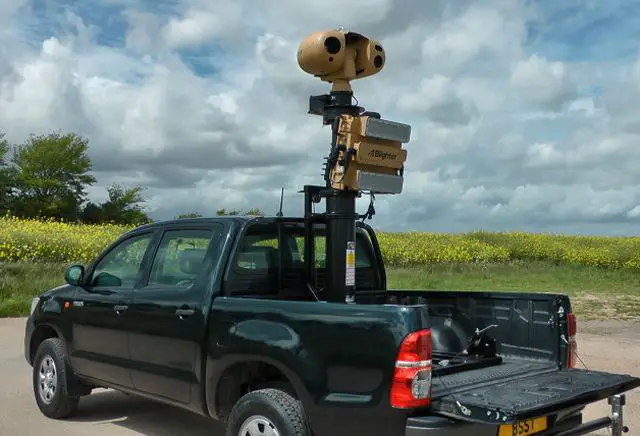 |
| Mast-mounted sensor heads combining radar and EO/IR are becoming increasingly common. One would hope that the future primary ISTAR platform of the British Army, at least in its Ground Surveillance variant, will be equipped with something resembling this combination offered by Blighter |
Another variant which can only
attract curiosity is the Overwatch variant for the Guided Weapon Troops within
Armoured Cavalry regiments. Heirs of the GW Troops armed with the Striker
vehicle, CVR(T) family, armed with Swingfire anti-tank missiles capable of 4000
meters engagements, the Guided Weapon Troops (3 in each Army 2020 Armoured
Cavalry Regiment) are now making do with Javelin teams capable of 2500 meters
engagements, moving around on simple APCs.
It will be very interesting to see
if the Overwatch FRES SV variant is just a Protected Mobility vehicle with
Javelin racks and slightly different seats arrangement, or if it finally
restore a longer-range, vehicle-launch precision strike capability. In years
past, particularly with the TRACER program, which came before FRES but was
ultimately cancelled, the Overwatch variant had to have a turret with .machine
gun and boxes of ready-to-fire Brimstone missiles (at least 4), giving it quite
a formidable reach and punch. In more recent times, the MOD funded a 2-year
study and demonstration for a lightweight multipurpose missile turret capable
to employ both anti-tank and anti-air missiles, the Multi
Mission System Technical Demonstrator Programme (MMS TDP), which might come
handy for the Overwatch variant. Some experience in dual-role missile turrets
comes through the 2011 capability sustainment programme of the Stormer HVM
vehicles, which received integration of the LMM missile as well as the latest
variant of Starstreak, and a sensors and thermal imaging upgrade to enable
surveillance and engagement of ground targets as well as of airborne targets.
The LMM, while not a main battle
tank killing missile, could have lots of uses against lighter armored vehicles
and other targets. The anti-tank capability proper could come from Brimstone
(but it is perhaps unlikely due to cost) or from Javelin, which has been
demonstrated as a vehicle launched weapon and also proved to an extended
range of 4700 meters.
 |
| MBDA's Multi Purpose Combat Vehicle turret could be indicative of a possible solution for a vehicle-mounted launcher for the Overwatch variant. Here in "french" sauce, the MPCV is shown being used with MMP anti-tank missiles or with Mistral surface to air rounds. |
Worth of mention is also the high
number of C2 vehicles to be acquired. 112 is a big number, and seem to confirm
my expectation that, due to the high complexity of wiring the electronic and
comms of a modern command post, new-build FRES SV platforms have been preferred
over the rebuilding of Warriors or other as yet unspecified solutions within
Armoured Battlegroup Support Vehicle programme, which should take a step
forwards over the end of this year and early in 2015. Thanks to its greater
capacity, the FRES Command vehicle should do more than just replace Sultan,
also considering that some Sultan roles have actually already been taken up by
Panther. The FRES Command post variant will be seen well beyond the confines of
the Cavalry regiments: it can be expected to feature in tank, armoured infantry
and armoured engineer formations as well, and perhaps in armoured REME units
too, replacing Sultan and also, I would guess, at least a part of the FV432s
and 436.
 |
| The most recent CGI of the C2 variant. |
Conversely, the absence of a FRES
Ambulance variant suggest that there might be greater confidence in turning out
a suitable vehicle from the ABSV programme, most likely by rebuilding surplus
Warriors into new variants. The MOD, however, retains the option of purchasing
a second block of FRES SV vehicles if it was to become necessary, and
ambulances might enter the frame in this (very unlikely) case.
It will also be interesting to see
how Engineer formations will reorganize if the Engineer Recce vehicle variant
really carries no dismounts. I’m quite surprised by this, honestly, since the
recce troop has always had dismounted teams moving around in Spartan or other
armoured vehicles. I don’t see why the Engineer Recce would be unable to carry
dismounts, being a derivative of the APC hull. What is the “specialist
equipment” to be carried? At the moment, I honestly have no idea.
I’m left to wonder if the deletion
of the counter mobility variant carrying Remote Delivery Mine System for the
replacement of Shielder (which was silently withdrawn from service without
replacement as part of SDSR cuts) has something to do with it. If not, it would
be nice to understand if and how the army plans to recover a counter-mobility
capability, which seems to me to be very important.
 |
| Engineer reconnaissance variant. Reportedly, it will not carry any dismount: what will be carried in their place? |
There is also an enduring need for
medium-weight bridgelayers to support the independent manoeuvre of the new
recce cavalry regiments. The british army is set to retain the 10 to 12 sets of
truck-mounted Rapidly Emplaced Bridge Systems (REBS) purchased as UOR for
Afghanistan, but this solution seems no more than a stopgap, besides with some
serious limitations.
It is licit to wonder if the
proposed Warrior Bridgelayer vehicle could find a place in the ABSV budget, and
come to the rescue.
Warrior CSP and ABSV
As I’ve written several times in the
past, with the way the armour programs of the british army have evolved, FRES
SV can’t be considered in isolation from ABSV, as this second programme is
needed to hopefully complete the replacement of FV430 in addition to CVR(T).
Controversial reports have emerged in the public domain about the number of
vehicles to be upgraded, and further confusion is generated by the recent
decision to formally separate Warrior CSP and ABSV.
The NAO Major Projects report 2013
reported that the affordable fleet of Warrior vehicles numbers 565 machines,
with 445 planned to undergo CSP, including 65 to be upgraded to ABSV. This was
prior to the division of the two programs, and anyway always made little sense:
65 ABSV are far too few to respond to the ABSV requirement.
Press reports in more recent times
have suggested that the MOD is looking at upgrading a minimum of 381 vehicles,
of which 250 would be IFVs, with the turret and 40 mm gun.
Again, the numbers don’t quite add
up, in my opinion: 131 recovery, repair and artillery observation post (the
FV514 variant has the turret, but the gun is a dummy) appear too many, and yet
too few to assume ABSV variants are counted in.
Originally, 788 Warrior vehicles
entered service. An Armoured Infantry Battalion of the old ORBAT needed some 63
Warrior vehicles of which 7 between recovery and repair variants and 56 “turreted”
ones, with gun. Even assuming a reduced allocation of vehicles to the Anti-Tank
platoon, it is fair to assume that over 50 turreted Warriors are still needed
for each battalion, and this makes it instantly clear that 250 such vehicles
would totally insufficient for the 6 armoured infantry battalions that are
supposed to be the hard core of Army 2020. At 56 turreted vehicles for
battalion, and excluding reserve and training fleet needs, 336 turreted
Warriors are required.
Compare the numbers with FRES Scout,
where the 198 Cavalry vehicles slot in quite nicely with the requirement (estimate
requirement 3 squadrons of 12 in each Cavalry regiment, plus one recce troop of
8 in each Tank and armoured infantry battalion = 180 versus 198 ordered, not
including Radar and Joint Fires subvariants).
I would not want to invest in having
all the recce vehicles I need, if then the main core of my brigades is
insufficient and I can only scrub together 4 out of 6 battalions at maximum
effort. I would expect the Warrior CSP
to deliver numbers more closely matching the requirement.

Note that 380 + 65 gives 445: I’ve
long suspected that the NAO and the press have been reporting their numbers and
types the wrong way. 380 turreted Warriors and 65 between recovery and repair
vehicles would much more closely match the requirement, and would still leave
some 120 surplus Warriors available for conversion under ABSV. More,
potentially, since the fleet is supposed to still include at least 643
vehicles, the original number planned for CSP upgrades.
120 vehicles could potentially
suffice (albeit barely) to replace the around 20 FV430 vehicles in ambulance,
APC, mortar carrier and command variants found in each armoured infantry
battalion. The new ABSV programme is expected to generate an invitation to
tender before this year ends, with Initial Gate hopefully to come next year,
and entry in service desired starting in 2019 to keep the pace with Warrior CSP.
An APC, C2, Ambulance and Mortar variant are envisaged, with the Army keeping
open the door for the option of a vehicle-mounted anti-tank guided weapon
system. If an ATGW vehicle was included in ABSV, the number of Warrior IFVs to
be upgraded with the new turret and gun could decrease due to the vanishing
need to provide a battle wagon for the Javelin teams.
Another way to reduce the number of
turreted Warrior vehicles to be acquired would be to build sections including
turretless APC vehicles coming out of ABSV: this could have some merit due to
the fact that the number of dismounts on Warrior is to drop from 7 to 6 as part
of the CSP upgrade. Replacing one or two of the four IFV in the Platoon with a
simpler APC would restore the dismounted strength of the platoon, while potentially
also saving money. It might be an option with enough merit to be considered.
The clear implication is that the
requirements are closely connected, and a change in one area can have impacts
elsewhere.
Now that there is a signed FRES SV
contract, it is fundamental to arrive to a final decision on the number of
Warrior to be upgraded, and on the way forwards for ABSV: the use of surplus
Warrior hulls is no longer described as the automatic way forward for the
programme, but I continue to believe that it remains the most likely and most
promising option.

 |
| The Warrior Mortar Carrier demonstrator was shown with L16 81mm mortar, ENFORCER lightweight RWS and full suite of 360° situational awareness cameras |
BAE systems seem to think the same,
as it showed a notional Warrior mortar carrier variant at DVD earlier this
year.
Considerations on FRES SV
There has been criticism in some
areas about the weight and size of the FRES SV, which supposedly make it a
vehicle unsuited for its role. I personally disagree. FRES Scout is a big
vehicle, but this is only fair in view of its role, which is scouting for
armoured brigades made of Challenger 2s, Warriors, Mastiff and heavy trucks and
artillery. While there is some merit to equipping the reconnaissance unit with
a small, nimble vehicle which can move on very soft ground and in very tight
places, it must also be noted that this kind of mobility is not excessively
beneficial in broad terms. The current Scimitar is an excellent, agile and
easily deployable light scout which can move on bridges and routes that heavier
vehicles won’t be able to use. But the question is: how much of a gain actually
comes from this? The Scimitar is scouting ahead of a brigade made of Warriors
and Challenger 2s, and these are the vehicles that determine where the brigade
can and cannot go, in the end.
It is their weight and size that
dictates how long the brigade takes to deploy, and how it moves on the
battlefield. The Scimitars might get some benefit from being able to use
alternative routes and gain positions precluded to heavier vehicles, but the
benefit will be limited, as in the end the action will need Challenger 2
routes.
The FRES SV comes with excellent
soft ground mobility thanks to large tracks and to the additional road wheel,
giving it a ground pressure not distant from that of the latest Scimitar MK2:
this despite being 38 tons in combat weight, versus 12. Tactical mobility will
still be pretty good, even if tight routes and bridges that would be perfectly
good for Scimitar won’t be acceptable for the Scout.
On the other hand, the Scout comes
with much greater protection, much better sensors and communications, much
improved armament and with a whole different level of comfort for the crew. All
these are crucial factors in modern operations, as the Scimitar MK2, with its
rebuilt hull, testimonies.
Despite the upgrades they received,
the CVR(T) are well past their time as primary armour reconnaissance platforms
of the british army. It is definitely time to see them replaced: an APC for
four dismounts which struggles to actually fit two with how much kit soldiers
carry today, and a recce vehicle at the end of its evolutionary path are not
going to meet the long term army requirements.
There would be, however, still use
for an armoured, tracked vehicle with excellent tactical mobility and the
incredible ease of deployment of CVR(T). Something that can be loaded on a
cargo plane with a full load of weapons and consumables, and roll out on the
runway during Air Landing assaults. Something that can be airlifted by
helicopters and that can go over almost any terrain. There would very much
still be uses for it, even if the gun is the old RARDEN with all its limits. I
do see this usefulness more as a niche role, however: an option to keep alive
on a small scale, as a complement to heavier capabilities and as a support to
air manoeuvre and special forces operations.
%2BMk2%2Broll%2Bover%2Bprotection.jpg) |
| The Scimitar MK2 offers increased protection and more decent spaces for the crew thanks to the use of remanufactured Spartan APC hulls mated to Scimitar turrets. Weight grows to over 12 tons from the original 8, though. |
Under Army 2020, the Household
Cavalry saw its connection to 16 Air Assault Brigade severed. The brigade no
longer has a direct affiliation to a squadron of light armour, and despite the
entrance into the brigade of other kind of capabilities as replacement (namely
one STA battery from 5 Regiment RA, and one UAV battery from 47 Regiment RA)
the truth is that some armour protection capable to go in from the air would
very much still be needed.
 |
| Air Landing assault: an A400 can carry a combat ready Scimitar, a WMIK with trailer and 60 troops onto a tactical landing zone. The Scout appears likely to only be A400 capable if in air transport configuration, requiring filling up for combat after landing. |
That’s where CVR(T) could and should
still have a role. In an ideal world, 16 Air Assault brigade would have a
reconnaissance squadron riding the CVR(T) Mk 2 vehicles coming back from
Afghanistan, and ideally, in the future, a more modern platform with similar
perks.

