3: Helicopters
The International Military
Helicopter conference has started this morning, and the top officers of the
british Joint Helicopter Command have delivered speeches in which they shared
some interesting news on the helicopters situation in the armed forces.
First of all, the theme is
unsurprisingly about reductions. They confirmed that the Apache fleet is
definitely going to shrink, and provided a vision of the frontline strength
that the JHC will be able to offer as the current programmed numbers in the various
fleets are reached. Specifically, the magic number is 148 airframes in
frontline fleet.
The break down is reportedly as
follows:
19 Puma HC2 (out of 24 in the total
fleet)
46 Chinook (out of the around 60 in
total that will be available when the HC6s are all delivered)
24 Wildcat AH1 (out of 34)
20 Merlin HC4 / 4A (HC3 / 3A until
navalisation and life extension work will take place) (out of 25 in total)
This would leave some 39 aircraft
out of the count, and this would be the Apache fleet, suggesting an expected
total no higher than around 50.
Regarding Apache, the position of
the army is clear: the future they want is the Apache Block III, now known in
the US as AH-64E Apache Guardian. According to Brigadier Neil Sexton, deputy
commander Joint Helicopter Command, the army expects to finalize the plan to
transition to the Block III “in the next two years” and sign a contract for the new
helicopters shortly afterwards, with the aim to get the helicopters before the
end of the decade.
As anticipated already some time
ago, the favored option appears to be using new-build airframes, transferring
all the kit that is still valid from the current machines to the new ones. The
excess engines, targeting sensors and other valuable components will be kept as
spares.
The UK originally procured 67 Apache
AH-64D (Block I standard), but one has since been written off, leaving 66. The
fleet of 67 was used to provide 48 machines in six frontline squadrons, 8 in
one training squadron, 1 for development and trials, 1 for the Empire Test
Pilot School and 9 for the Sustainment Fleet.
The buy of 67 aircraft was in itself
a cut from an hoped 91 helicopters in 9 squadrons, one of which would have been
the Royal Marines’s 847 NAS.
It is widely anticipated that the
fleet will shrink to 4 frontline squadrons, perhaps with a fifth acting as a
support formation for advanced conversion to role training, such as for ship operations,
giving a frontline strength varying between 32 and 40. The Block III will
compensate the reduction somewhat thanks to improved capabilities, including
manned – unmanned teaming, which will allow the Apache to work closely together
with the Watchkeeper UAV of the Royal Artillery, and other systems.
The JHC is also determined to
acquire a new fleet of training helicopters which can act as surrogates,
allowing crews to effectively train for their roles using less expensive
machines than the frontline ones. The idea currently sees six helicopters of
the new type, equipped with appropriate kit to simulate and replicate the
actual frontline machine, assigned to each operating base.
This would be a separate activity
from the training done at the Defence Helicopter Flying School at Shawbury.
The same new type of helicopter would
also ideally replace the Bell 212 used in support to training exercises, and could
be assigned to 5th Regiment AAC for security support in Northern
Ireland.
This suggests the possibility that
this new helicopter would effectively replace the last Gazelles (OSD 2018).
On the naval front, there are
confirmations that the Merlin HC3 navalisation and Life Extension program aims
to install the same HM2 cockpit already in use on the ASW variant of the
helicopter, so that the pilots will receive exactly the same training, with
obvious advantages.
This suggests that in good time
Merlin training for both fleets could be centralized on the Merlin Training
Facility in Culdrose. Currently, the Merlin HC3 crews are trained in RAF
Benson, while the Royal Navy’s HM2 crews are formed in Culdrose.
 |
| HM2 cockpit |
UPDATE: during the second day of the IMH event, some more info was released on the Merlin transition from RAF to Royal Navy. The current plan (still provisional in terms of exact date) sees 78 Sqn standing down in September, with 28 Sqn disbanding in mid-2015.
The Merlin force will transfer under Navy command this year, as soon as the manpower balance shifts in favor of the Fleet Air Arm.
The first two Merlin navalised and life-extended, to be known as MK4 / HC4, will be ready in September 2017, and it is expected that work on the first helicopter will begin soon after the announcement of the contract, expected this week.
With the last Sea Kings going out of service in 2016 and the last of 25 Merlins HC4 possibly not delivered before 2022, the amphibious force is looking ahead to years of extremely low availability of appropriate support helicopters. This can be considered, by all means, another capability gap in the long list.
The gap will be mitigated somewhat by modifying "several" Merlin HC3 with a folding rotor head (possibly coming from the stored and non-updated Royal Navy HM1 helicopters, so that would mean between 8 and 12 machines). These interim machines will likely be known as HC3I.
The IOC for the helicopters at HC4 standard is expected in early 2018, with 7 such machines available.
The navalisation will include the folding tail (in 2010, serious consideration was given to keeping a fixed tail boom as a way to save money), folding rotor head, HM2 cockpit, one additional fast rope point, plus modifications to the landing gear and lash down points. An emergency egress system will be optimized on both variants (HC3 and the 6 HC3A ex-danish air force)
The Merlin force will transfer under Navy command this year, as soon as the manpower balance shifts in favor of the Fleet Air Arm.
The first two Merlin navalised and life-extended, to be known as MK4 / HC4, will be ready in September 2017, and it is expected that work on the first helicopter will begin soon after the announcement of the contract, expected this week.
With the last Sea Kings going out of service in 2016 and the last of 25 Merlins HC4 possibly not delivered before 2022, the amphibious force is looking ahead to years of extremely low availability of appropriate support helicopters. This can be considered, by all means, another capability gap in the long list.
The gap will be mitigated somewhat by modifying "several" Merlin HC3 with a folding rotor head (possibly coming from the stored and non-updated Royal Navy HM1 helicopters, so that would mean between 8 and 12 machines). These interim machines will likely be known as HC3I.
The IOC for the helicopters at HC4 standard is expected in early 2018, with 7 such machines available.
The navalisation will include the folding tail (in 2010, serious consideration was given to keeping a fixed tail boom as a way to save money), folding rotor head, HM2 cockpit, one additional fast rope point, plus modifications to the landing gear and lash down points. An emergency egress system will be optimized on both variants (HC3 and the 6 HC3A ex-danish air force)
It is also planned to integrate the
Merlin HM2 and the Scan Eagle UAV, so that the mission crew on the helicopter
can receive data feed from the UAV, and control it, using it as a mobile,
long-range eye. This is not at all a new concept, however: it was validated as
far back as 2006, with the Sea King MK7 ASaC. The Royal Navy is merely trying
again to see if it can obtain what it already tried to get in 2007, when the
first embarked UAV urgent requirement was voiced, but ultimately turned down.
The Scan Eagle has finally been
procured last year, with two contractor owned and contractor operated systems
now in Royal Navy use. One system is embarked already from late last year on
RFA Cardigan Bay, in the Persian Gulf, and a second system is starting to operate
in these days from the Type 23 frigate HMS Somerset.
 |
| Scan Eagle was validated on HMS Sutherland... nearly seven years ago! |
Joint Helicopter Command is also
rethinking its CASEVAC approach. Currently, the Medical Emergency Response
Teams in Afghanistan employ Chinook helicopters, but JHC would like to stop
tying down such a precious machine for this role and use, when possible,
another platform.
As earlier reported, including on
this blog, last year the MOD was also curiously enquiring about light,
air-droppable 4x4 vehicles, capable to fit ready to go into a Chinook, for
Combat SAR role (and special forces work?). It is unlikely that the MOD will
find a way to actually fit such a requirement in the budget, the MOD would like
to launch a formal requirement in 2016 as part of the effort to constitute a
C-SAR (Joint Personnel Recovery) capability, to fill one of several macro-gaps
in capability evidenced by studies on Force 2020.
The end result, in the best case,
could be the development of a CASEVAC / Joint Personnel Recovery capability
which would see teams of personnel and medical equipment created and assigned
to the helicopter most suited to the need at hand. Puma HC2 could be a suitable
platform to use in the Land Domain when the size and downwash of a Chinook is
excessive (in Afghanistan, when Chinook is unsuitable to reach the casualty,
American H-60 platforms intervene instead), while the Merlin HC4, once
navalised, would be good to go in the littoral domain.
It
is early to say what will come out of these studies and ambitions, but we might
see a return, in some ways, to the plans already made in the past decade, which
are described in the excellent book “A moment in time.”, by Gordon Angus Mackinlay.
Combat Recovery The (RAF) Regiment provides the Ground Extraction Force (GEF) for RAF Combat Recovery. GEF’s mission is to recover Isolated Personnel (downed aircrew etc-PR Personnel recovery) and high-value assets, in all conditions and threat levels over extended periods, in any operational environment. Combat Recovery requires the small teams to insert primarily by helicopters to locate, authenticate and recover the IP(s) or asset(s). Operating in four man self sufficient teams, behind enemy lines, utilising RAF Regiment tactics and certain items of specialist equipment, until the IP or asset are recovered. The GEF is a part of E Flight, No 28 (AC) Squadron operating Merlin HC Mk3 helicopters at RAF Benson (role may go to No 78 Sqn to support the SF Flight), a further element is with the SFSG. Rescue of shot down aircrew is not just a single helo operation, combat search and rescue will involve a great deal of RAF/AAC resources, for command and control, airborne early warning, strike aircraft support, reserve helicopters, refuelling support.NOTE : Whilst it was accepted the the UK could not afford a dedicated CSAR force and PR was the intended way, in April 2003 it was intended to have a JPR-Joint Personnel Recovery doctrine. With a Initial Operating Capability (IOC) of three Sea King HC4 on five day 'notice to move' crewed by UK Search and Rescue (SAR) personnel, with three RM Commando GEF teams, and medical personnel from the Tactical Medical Wing. With a intended Full Operating Capability (FOC) for JPR of these plus, a flight of six Merlins (crewed from SAR force), with six RAF Regt GEF teams from No 28 Sqn. Due to operations this FOC has “quietly gone away”, although IOC remains.
Another such macro-gap has been
opened in December 2013 with the withdrawal from service, without replacement, of the ALARM
anti-radar missile. This kills off the RAF’s specialist SEAD capability. Of
course, one of the excuses given is that the UK will actually act as part of a
Coalition, which will be able to do SEAD work in place of the RAF.
The problem is that with the RAF
quitting this capability area, in the whole NATO there are just three countries
left with SEAD capability: the US, obviously, followed by Germany and Italy.
In practice, “coalition” as often
happens, actually reads as “we’ll ask the Americans”, since the availability of
Italian and german resources is not too trustable. Italy’s SEAD capability was
used over Libya in 2011, but Germany did not participate, and the end result was that most of the work was done by the US.
 |
| Radar-chasing no more. Another precious capability lost. |
Storm Shadow and Tomahawk are of course very good to demolish the fixed elements of an integrated air defence system, but an anti-radar missile remains a key capability to face nimbler, mobile air defence systems, and this certainly constitutes a dangerous gap, and one which brings real limitations.
It is impossible not to notice, with bitter irony, how the United Kingdom uses the coalition excuse to cuts its own capabilities, and then roars against any call for closer cooperation and integration of capabilities not just in Europe, but even in NATO (the UK, for example, did not join in on the joint maritime patrol aircraft initiative, despite having clear interests in doing otherwise). In other words: the conspirationists that see the reductions in national capability as a way to go towards unified european armed forces have got it wrong. It is actually worse: capabilities just vanish entirely, substituted by vague and inconsistent comments about working inside coalitions.
On the unmanned aviation front, the
British Army hopes to finally get an interim release to service for the Watchkeeper UAV. This
document will enable, hopefully within this spring, the army to fly the
Watchkeeper in temporarily closed air corridors from Boscombe Down test
airfield in Wiltshire to the Salisbury Plain training area, where the aircraft
will be able to support army training, staying in the segregated airspace. It
is taking a long time to satisfy the MAA authority and obtain the needed
certifications, and this has imposed vast delays to the program. It is a
process which will last for much longer, we can bet, before the restrictions
are all lifted.
The british army at least will be able
to move on with the testing of the system: on the to-do list there are
exercises to validate the deployment of Watchkeeper task lines via C-17, the
air-lifting, under-slung by Chinook, of the containerized elements of the
system and operations from semi-prepared runways and tented facilities, in
order to prepare for contingency deployments.
The Royal Air Force will keep its 10 Reapers, bringing them into core once
Afghanistan operations end. The RAF will work to develop the methods for
deploying and employing the Reaper in support to contingency and expeditionary
operations. Even as the RAF moves the Reaper to Waddington, it will maintain a
presence in Creech air force base, in the USA, to stay in close touch with the
USAF and continue to share methods and expertise about Remotely Piloted
Aircraft operations.
Finally, the French specialized
publication Air at Cosmos reports that France and UK are talking
about a possible change to the delivery schedule of the A400M cargo aircraft.
France would like to delay some of its purchases to save money in the short
term, and is talking with the MOD to see if the UK could and would swap
delivery slots, taking more aircraft in a shorter timeframe. There is no firm
plan as of now: the UK is not in a better position than France, so finding the
money to take over the aircraft earlier than planned might not be easy. The
negotiation is however described as serious, and it would also involve tighter
cooperation over the type, and a faster build up of the joint activities.
Currently, the UK expects to
receive:
3 aircraft in 2014
8 in 2015
6 in 2016
2 in 2017
2 in 2018
1 in 2021
This would complete the planned
fleet of 22. The Uk retains an option for 3 more aircraft, which were
originally scheduled to be delivered 2 in 2018 and 1 in 2019. The UK could
still decide to exercise the options and take up these additional aircraft, but
as of now it is unlikely due to budget problems. In the meanwhile, 6 RAF
personnel have entered the A400M MEST (Multinational Entry into Service Team),
including the first pilot.
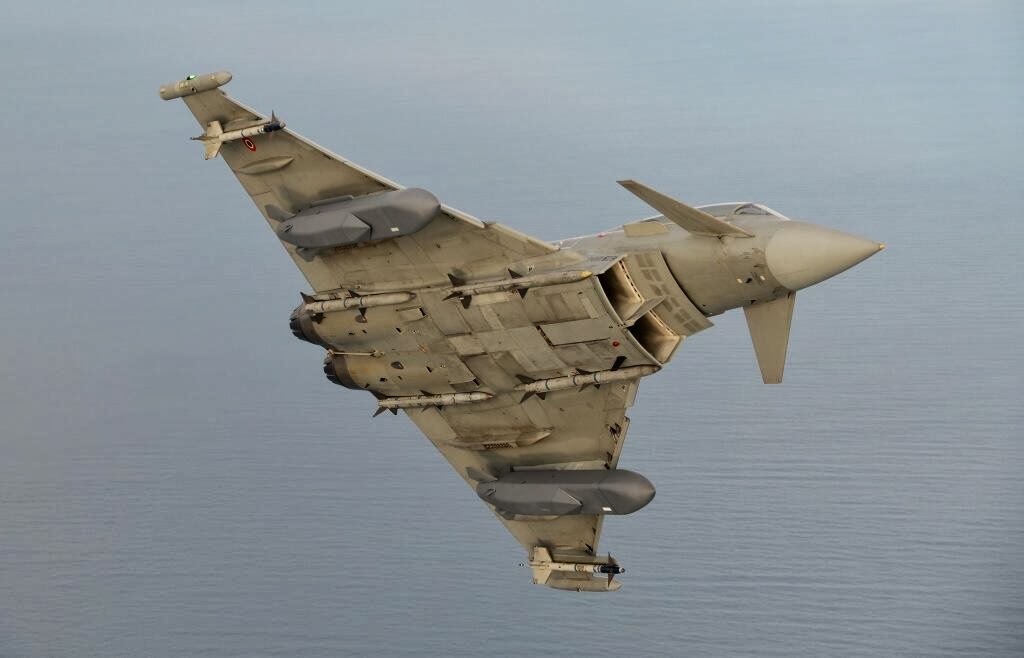 |
| Storm Shadow test flights finally began |
In the meanwhile, the Typhoon has
begun to fly carrying Storm Shadow and Taurus missiles, as the integration
process begins, and in the US the Block IV software and hardware upgrade,
destined to be rolled out for the F-35 around 2020, is starting to take shape.
Block IV is important as it is the first point in which the UK, like the other
partner countries, will be able to add further national requirements. The hope
is that UK and Italy manage to agree and fund a plan for the integration of the
Meteor missile in Block IV. Norway will be getting its JSM integrated, and
other capabilities will be added to the aircraft, Flightglobal
reports.
I recommend
you follow on Twitter Tony Osborne @Rotorfocus and Gareth Jennings @GarethJennings3 who
tweet live from this and other events, always supplying great information

