The Royal Navy and Royal Air Force exploited RIAT 2016 to deliver a couple of interesting about the F-35 and the fabled Carrier Enabled Power Projection (AKA: you are losing HMS Ocean without replacement, make do somehow).
Beginning with the F-35B, we get an update about the build-up plan. As is to be expected from the MOD, nothing really new is revealed and plans for LRIP 11 and beyond purchases are not detailed at all. Currently, the MOD has placed a long-lead items order for a single F-35B to be delivered as part of LRIP 11, the last of the famous 14 jets authorized to enable the formation of the first frontline squadron.
Following purchases are meant to be planned out as part of Main Gate 5, scheduled for the 2017 budget cycle, so we'll have to wait until next year to learn anything substantial about what follows BK-18.
The LRIP 11 production contract will be let by the Pentagon later during 2017, so the MOD has time to add a few more airframes to the currently lonely BK-18. Moreover, LRIP 12 should be the opening lot of the proposed "Block Buy", making next year's decision very important.
We have been told that 42 F-35B should be in british hands by the end of 2023, including 24 in two frontline squadrons, and to achieve that number, considering a two-year timeframe between order and delivery, the UK needs to purchase a further 24 F-35 over a maximum of five production lots (11 to 15; 2017 to 2021). That works out at around 5 aircraft per lot, which is far from ambitious yet not without challenges for the MOD's budget.
 |
617 Sqn will fly to RAF Marham during summer 2018. For a while, it will be understrength as aircraft move out to fill the OCU. Then it will, for a while, grow into a "super squadron" before splitting, by December 2023, into two as 809 NAS stands up.

Thankfully, integration of key british weapons is confirmed as a Block 4 event. Between 2020 and 2026, the british F-35B will receive the new build (Block 6) ASRAAM; the Paveway IV with bunker-buster warhead; SPEAR 3 and Meteor.
SPEAR 3 is, according to Jane's, a Block 4.2 candidate. This contradicts an earlier slide, released in february 2015 by LM, showing SPEAR 3 towards the final 4.4 software release. Development of SPEAR 3 is progressing well and MBDA believes it can offer a complete weapon, ready for integration, within the next two years or so.
Meteor in the slide was a 4.3 candidate and there are reasons to believe that it will be the last to be integrated, being the most complex.
The decision to retain the Typhoon Tranche 1 into service into the 2020s is probably connected to this timeframe, in the sense that it provides further reason to extend the AMRAAM into RAF service beyond 2020.
While there is no official confirmation that i know of, logic and facts suggest that the two Typhoon Tranche 1 squadrons will live on in british service just as long as AMRAAM does (otherwise they'll have very little to employ...), and AMRAAM is needed as long as Meteor isn't integrated on F-35. Moreover, the second pair of F-35B squadrons planned are the obvious replacement of the two Tranche 1 squadrons.
Typhoon T1 is merely a useful placeholder, that will be exploited to the best of the little it can offer, bridging the gap between Tornado and F-35, avoiding a ruinous fall in the number of squadrons which would have probably never been reversed.
In practice, we can assume that the RAF is thinking roughly on this line:
Now: 5 Typhoon + 3 Tornado GR4 squadrons
2019+: Tornado GR4 bows out, personnel sent in Typhoon stream to build up to 7 Typhoon Sqns and 1 F-35B
2023 and beyond: Typhoon Tranche 1 bows out, but two more squadrons of F-35B are built up. 7 + 2 become 5 + 4. Meteor finally completely replaces AMRAAM.
On the infrastructure front, RAF Marham will see a lot of work in the coming years.


Runway 01 will become a STOL strip, and 3 vertical landing pads have been funded. The main runway will be resurfaced by June 2024.
Hangar 3 has been demolished to make room for the Maintenance and Finish Hangar. Hangar No 1 will be demolished later this year to be replaced by another engineering facility.
The South HAS area will be refurbished to become 617 Sqn's home, and the offices for the OCU will be built nearby, close to the Integrated Training Centre which will host the simulators.
Work on the Lightning Force HQ and National Operating Centre has also started. The building is being built as a secure facility, because this is where the british ALIS main node will be located. Office space for 125 is planned.
On the ship side, things are moving too. Not always in the most encouraging of ways: for whatever reason, the Navy seems to be expecting a long capability gap between the loss of HMS Ocean and the maturity of plans for using Queen Elizabeth class as an assault ship.

CEPP IOC is given as September 2023, and this might have to do with the stated intention of modifying parts of HMS Prince of Wales to give her better Embarked Force spaces and amphibious bits, which have never been detailed so far.
In full "amphibious" configuration, the target for a Queen Elizabeth class carrier is given as two companies, which should mean something in the region of 500 men, plus a good 300 more in support of the embarked group of helicopters.
It is to be assumed and hoped that HMS Queen Elizabeth will get the "amphibious mods" applied during her first refit, considering that the ships will often operate alone, not as a couple, requiring, more than a pure carrier strike or pure amphibious loadouts, an hybrid "assault" configuration.

The USMC is now officially expected to be part of the air wing on the first operational deployment of HMS Queen Elizabeth, expected in 2021, as announced by secretary of state for defence Fallon. Their F-35Bs and MV-22 will complement the british elements of the air wing.
This is really not a surprise, and there had been very clear hints dropped in multiple occasions, all the way up to the USMC including the QE class between the platforms considered in its annual Aviation Strategy document.
Their MV-22 could end up being especially valuable if they came with the tanker kit for air refuelling. They will also provide a long-range, quick CSAR platform. Jane's is reporting that the Royal Marines are pushing for greater effort in this area, and that a Personnel Recovery cell has already been created within 3 Commando Brigade.
The MOD has been attempting to set up a proper Joint Personnel Recovery capability for a long time, and last year it had begun looking around for vehicles compatible with internal carriage on Chinook and with usefulness in scenarions including evacuation of downed personnel and recovery and/or destruction of classified equipment fallen in enemy territory.
It will be interesting to see if, how and when this project progresses. It would most likely be closely connected with the SDSR-sanctioned wish of the Special Forces director for longer-range air mobility.
The options on the table, essentially, are two: a V-22 Osprey purchase; or the procurement of air refueling probes for a number of Chinook helicopters, plus a couple of tanker kits for two of the retained C-130J.
In the case of the Chinook, the HC3 (soon to be HC5) machines are excellent candidates: they already come with longer legs thanks to their fat tanks; and they will exit from their ongoing JULIUS modification fitted also with the same digital flight controls introduced by the HC6, The addition of the probes would make them very capable.

The V-22 appears not once but twice in this slide, shown both as part of the embarked force and as an element of Maritime Intra-Theatre Lift (MITL). This doesn't necessarily mean anything, but it is still worth noting.
Regarding the Fleet Carrier / Carrier Strike end of the business, the Royal Navy is doing what it can to restore a proper air wing beginning with the helicopter side.
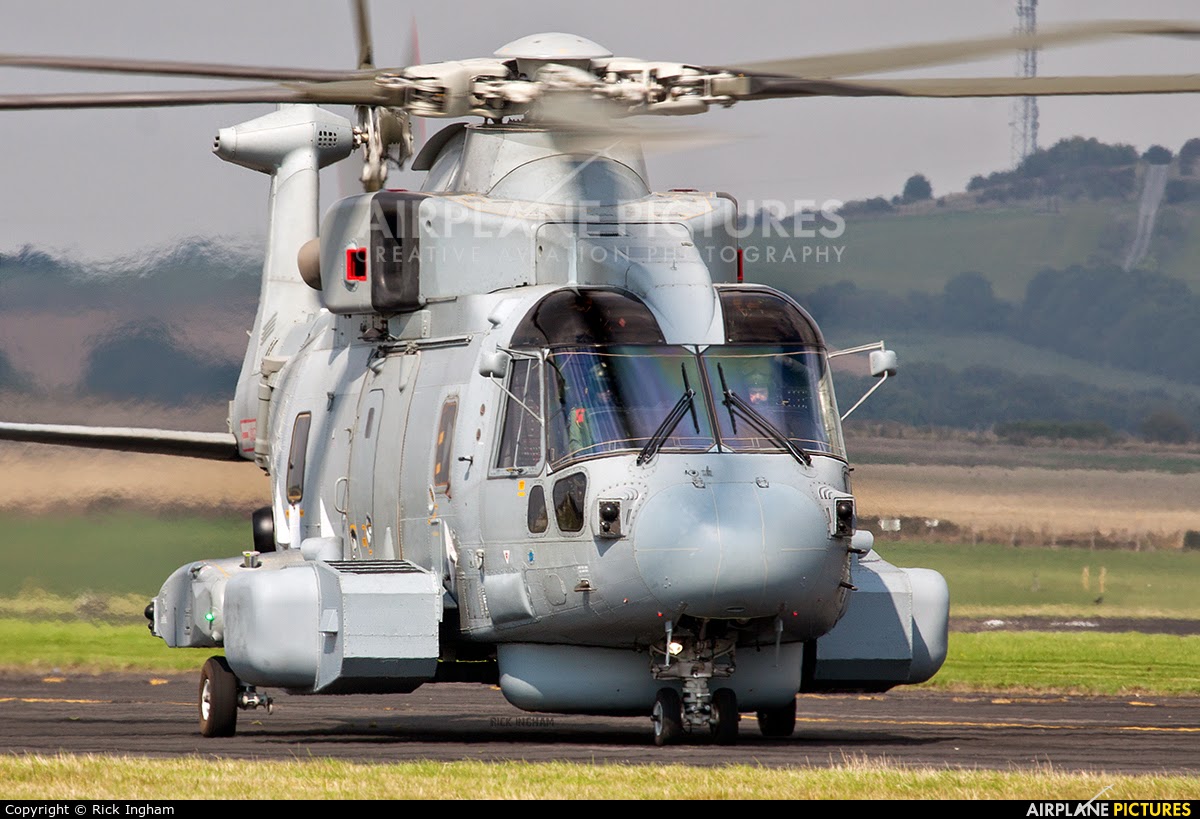
Last year's Deep Blue exercise saw, for the first time in years, a major carrier ASW deployment with a standard complement of 9 Merlin helicopters working to keep the task force safe from enemy submarine action.
This year's Deep Blue did not include quite as many Merlin HM2 but on the other hand it introduced the other key bit: AEW coverage and Anti-Air Warfare. Sea King ASaC Mk7 were embarked and employed to protect the task forces from the attacks of the Hawk jets of 736 NAS playing as aggressors.
The Royal Navy wants the carrier air wing to include a 9-helos ASW squadron and a 4/5 helos strong AEW force. To achieve that, it is planning to restructure the Merlin force over the next two years:
820 NAS will become a permanently carrier-roled ASW squadron.
814 NAS and 829 NAS will be merged together to provide Small Ship Flights for the Type 23 frigates; a flight at high readiness for the Fleet Ready Escort / Towed Array Patrol Ship and a few extra flights for reinforcement of the carriers.
849 NAS will continue being the AEW squadron, moving from Sea King ASaC Mk7 to Merlin HM2.
824 NAS will be the training unit.
The loss of one of the current squadrons in order to accommodate the indispensable AEW-roled unit might, unfortunately, signal the final surrender of the Royal Navy in the quest for getting the 8 remaining Merlin HM1 upgraded and kept in service.
It seems reasonable to assume that, had those helicopters been funded, 814 and 829 would not be merging.

The large number of helicopters will tipically mean fewer F-35B. A large air wing will tend to have 24, rather than 36, F-35B on board. This would mean embarking half the squadrons (2 out of 4 once the intended Lightning Force is fully built up), which is not unrealistic. More should be achievable, but not routinely.
Finally, the brief suggests that Type 45 and F-35 could work together very closely to take down air threats. This is absolutely doable and should be an objective for the future, but the reality is that, as of today, the Royal Navy does not have the kind of Cooperative Engagement Capability equipment in use in the US Navy.
While US F-35s will be trialed as nodes within a Naval Integrated Fire Control - Counter Air (NIFC-CA) network as soon as this month, british F-35Bs do not currently have a clear path to follow to reach the same capability. The Royal Navy had hoped to fit the US CEC system to the Type 45 destroyers, but funding never materialized.

It would be a major upgrade and a big step in the right direction to join the NIFC-CA project sometime in the future.
The two complete documents can be seen below:
RIAT 2016 briefing on QE class and CEPP plans by Liger30 on Scribd
F-35B UK Plans briefing from RIAT 2016 by Liger30 on Scribd