Showing posts with label Protector. Show all posts

Sunday, October 6, 2024

An entry ahead of the new SDSR

For the first post in literally years, I'm sharing the submission I've filed in the public consultation for the SDSR. The format of the consultation involved a long list of fixed questions that could be answered with up to 500 words each. 

This has, of course, determined the format of my entries. 


Describe the strategic context for UK Defence


Strategic context begins with geography. Always remember that the world actually looks like this, and the UK's front in any Russia scenario is to the North. 


While the Russian invasion of Ukraine is the main factor polarizing attention, the threats to UK interests go well beyond Russia. It is in the Red Sea and Middle East that UK assets have actually needed to open fire to protect allied installations and critical shipping routes, and it is towards Asia that the economic and political center of the world is shifting. While Russia represents the most obvious threat, it is not in a position to start a direct land conflict against NATO and it would be a mistake to allow Russia to tether UK foreign and Defence policy to a narrow European focus.

The priority for UK defence remains maintaining a capable, useful mix of capabilities measured against high end, state on state warfare scenarios, that can be projected where needed, across Europe and beyond.

Geography dictate that any threat against the UK originates quite some distance away, and that any operation mounted by UK forces will be expeditionary by nature and will imply thousands of kilometres of distance to be negotiated. UK forces must be able to project over those distances and be credible once in theatre. While the UK won’t be able to achieve Mass on its own, it should maintain armed forces which are as much as possible capable of “independent” action within an alliance framework. In other words, the UK force should be able to deploy with its own means (SEA-lift, AIR-lift, LAND mobility) and, as much as possible, able to take responsibility for a section of a front / part of an operation without Allies having to fill critical capability gaps. The UK contingent should come with adequate Enablers and be able to serve as core for Allies to attach to (for example in a Joint Expeditionary Force context).This would enable the UK to retain a leading role in any scenario and in any theatre. UK forces could act as an aggregator that smaller partners can join forces with, helping to generate mass, enabled by UK strategic capabilities they might otherwise not have access to. When working with greater partners with more mass and resources, UK forces should still be able to provide a complete, reliable military component that can look as autonomously as possible over a sector of the front / portion of the operation.

There can be little doubt that UK forces which best compare on the world stage with that of other nations are Navy and Air Force.The Army does not compare as well, nor is likely to be able to catch up anytime soon. While the Army conditions must be improved, this must not come to the detriment of the other Services, especially since, even in a “narrow” European scenario, the front of most immediate interest to the UK is the Scandinavian peninsula – North and Arctic Sea and Iceland area (in Cold War parlance, the GIUK gap). This is the only front where Russia and UK are virtually in direct contact, through Sea and Air.

In general, UK is fortunate in that forces which are well attuned to their NATO role will generally be valid elsewhere too.


Propose, in order of priority, the roles UK Defence must be capable of fulfilling 2024-2040.

If the UK will maintain its ability to secure the North Sea / High North by forward deploying in NATO context a powerful Air Force component while also putting to sea a capable fleet centered on SSNs and the Carrier Strike Group, plus the Littoral Response Groups, it will meet its vital, direct defence interest.


On Land, the UK should maintain its High North commitment through the Littoral Response Group North and, ideally, a greater Army component aligned to the task (at least initially it would come from within 1st Division) while working to deliver the full promise to NATO of a Strategic Reserve Corps of "2 Divisions with 6 brigades" under the ARRC. Obviously it will be a relatively small Corps, made of relatively small brigades, but there is no reason why it shouldn't be capable.

The need to be rapidly deployable wherever SACEUR needs them across Europe will in turn ensure the British Divisions maintain capabilities and logistical readiness that will ensure the British Army can be relevant outside of Europe too when necessary.

To achieve this result, the British Army structures will need to evolve and, in absence of a net growth to the overall manpower ceiling, some infantry battalions will need to go, not because they are unneeded, but because forming the necessary Artillery, Air Defence, Drone, Logistics and Engineering units will be far more critical. The current structure is dramatically short of these key enablers and this will need fixing.


The wider context of a major NATO clash with Russia has not changed much. 


In Europe, the UK's priority is dictated by geography and will always come down to reinforcing the Northern flank of NATO, working in close cooperation with the Joint Expeditionary Force partners and bringing naval and air elements"up threat"in Iceland, Scandinavia and at Sea to contain Russian navaland air elements which are a direct threat to the UK mainland. Through the JEF, and the Littoral Response Group (North), which also hinges on the long standing cooperation with the Netherlands' own Marines, the UK is also committed to reinforcing the Allies ashore.

The UK is also committed to putting a British Corps (ARRC) of eventually 2Divisions at the call of SACEUR as a strategic reserve that can be rapidly deployed "along the entire NATO front in Europe".

This will require a well stocked, well trained force that can move quickly and that has the necessary strategic lift in place to get where SACEUR needs it.

UK reach and commitments to the Northern NATO flank require amphibious capability to be sustained and ideally enhanced.

The need to protect key infrastructure at sea and the Deterrent requite dedicate Deep Sea Data Gathering and thus put urgency on the need to procure the planned and very much necessary purpose-designed vessel for this (planned as the second Multi-Role Ocean Surveillance hull).

The Reserve should be reorganized to provide a more realistic seedcorn for expansion in time of crisis. Probably the Army Reserve would benefit from being organized in a couple of "shadow brigades", one dedicate to supporting the Heavy armour (and thus 3rd Division) and one (or more) dedicate to lighter,more easily regenerated light role / light mechanized capability in support of 1st Division.


Describe how existing UK Defence capability and the current 10-year programme match the demands of the roles and capabilities identified for 2024-2040, highlighting and prioritising critical gaps.

Existing equipment plans are mostly coherent with UK tasks in Europe and beyond. Some areas that require additional attention include:

Suppression of Enemy Air Defence: the introduction of SPEAR 3, SPEAR EW and ECRS2 radar with jamming capability (this on Typhoon Tranche 3) are helpful, but the absence of an anti-radar missile since the withdrawal of ALARM in 2013 is a concern. Adoption of the AARGM ER missile for both F-35 and Typhoon (Germany and Italy are already planning to adopt and integrate it) would greatly increase capability. Retrofitting the ECR Mk2 radar to Typhoon Tranche 2 should also be a priority.

Air to Air refuelling: the "nordic air force" (Sweden, Norway, Finland, Denmark) is THE obvious and critical partner for the RAF in an European fight, while US and Australia are other obvious main partners the UK will collaborate with. All these partners, and others (Germany, Italy, Netherlands, Japan etc) will use F-35As that can only be refuelled through the Boom method. The VOYAGER tankers of the RAF at present are not fitted with boom and cannot contribute in any way (and can also NOT refuel the RAF's own C-17, P-8, E-7 and Rivet Joint fleets). Fitting Boom to at least a portion of the fleet would enable the RAF to offer invaluable support to Nordic partners in Europe, and to Allies everywhere.

Ground based air defence must be enhanced at a brisker pace and with greater ambition. Existing SKY SABRE batteries can be quickly enhanced adopting the Extended Range variant of the CAMM missile, while development of the even longer ranged CAMM MR with Poland should be properly supported.

Additional SKY SABRE batteries are needed, and the Army's air defence regiments should probably be reorganized into hybrid regiments that, a bit like the PILICA+ batteries in Poland, combine CAMM with SHORAD. Adding a gun in anti-drone function should be a priority, with the PALADIN system having already been tested providing a good, UK-made candidate for rapid adoption. Directed energy weapons such as laser and RF (projects DRAGONFIRE, SWINTON, EALING) promise great capability which however might not be fully reliable for quite some time, making a gun-based solution a precious complement and stopgap.

Additional SHORAD Batteries should become an organic part of manoeuvre brigades: in other countries, a SHORAD battery is commonly found within the Brigade's artillery regiment, for example.

BOXER vehicles fitted with SKYRANGER gun turrets and missiles represent a good, readily available solution to succeed to STORMER and bring(thanks to the 30/35mmgun) increased anti-drone capability.

The Navy's Type45s should be equipped with new-production ASTER 30 Block1 NT missiles as soon as practicable. Low-volume production of these new and improved missiles would help realize the much needed "always on" model for key weapons production in the UK.

Logistic lift is known to be insufficient. The number of MAN SV EPLS trucks capable of carrying containers, for example, even if recently uplifted, remains more than 700 short of the endorsed Land requirement. This should be addressed, including by standing up new regiments to fill known gaps (for the support of 1 DRS BCT and 4 Light BCT, for example).


Propose how UK Defence's contribution to NATO should be enhanced as a driving requirement of capability and activity, including through prioritising defence export potential.

The UK contribution to NATO should be centred on the two Key roles:


-              The protection of the Northern Flank, with a focus on Carrier Strike Group operations, ASW, maritime urveillance, air defence and amphibious reinforcement of Scandinavia (Littoral Response Group North, in cooperation with the Netherlands's own amphibious force)

-              The provision of a credible British Corps to SACEUR for the Strategic Reserve role.


It might seem counter-intuitive and politically unpalatable, but to improve its contribution to NATO the British Army needs to offload the commitment to Estonia to other partners. The British Army is simply not large enough to deliver, at the same time, an armour-centric Battlegroup in the Forward Land Force (with commitment to uplift to a full brigade in time of crisis) and the Strategic Reserve role.

This is not debatable but rather fact: 3rd Division is the only heavy division the UK has, and only comprises 2 armoured brigades. If one of them is committed to Estonia, it cannot at the same time be available as a strategic reserve for SACEUR. Double-hatting is not serious and is not workable.

Partners should be approached in a mature way and the Forward Land Force role in Estonia should fall on another Army within the new NATO Force Model. Other countries are due to take Regional defence roles, and this should include replacing the british element in Estonia so the British Army can, in turn, ensure SACEUR's critical reserve is truly available and ready to deploy when and where needed.

2 Army programs in particular stand out for export potential in a NATO context and possibly beyond: the Technology Demonstrator 5 project to integrated advanced lethal and ISR payloads into GMLRS rockets and PrSM missiles would result in a massive capability growth and most likely in substantial export orders.
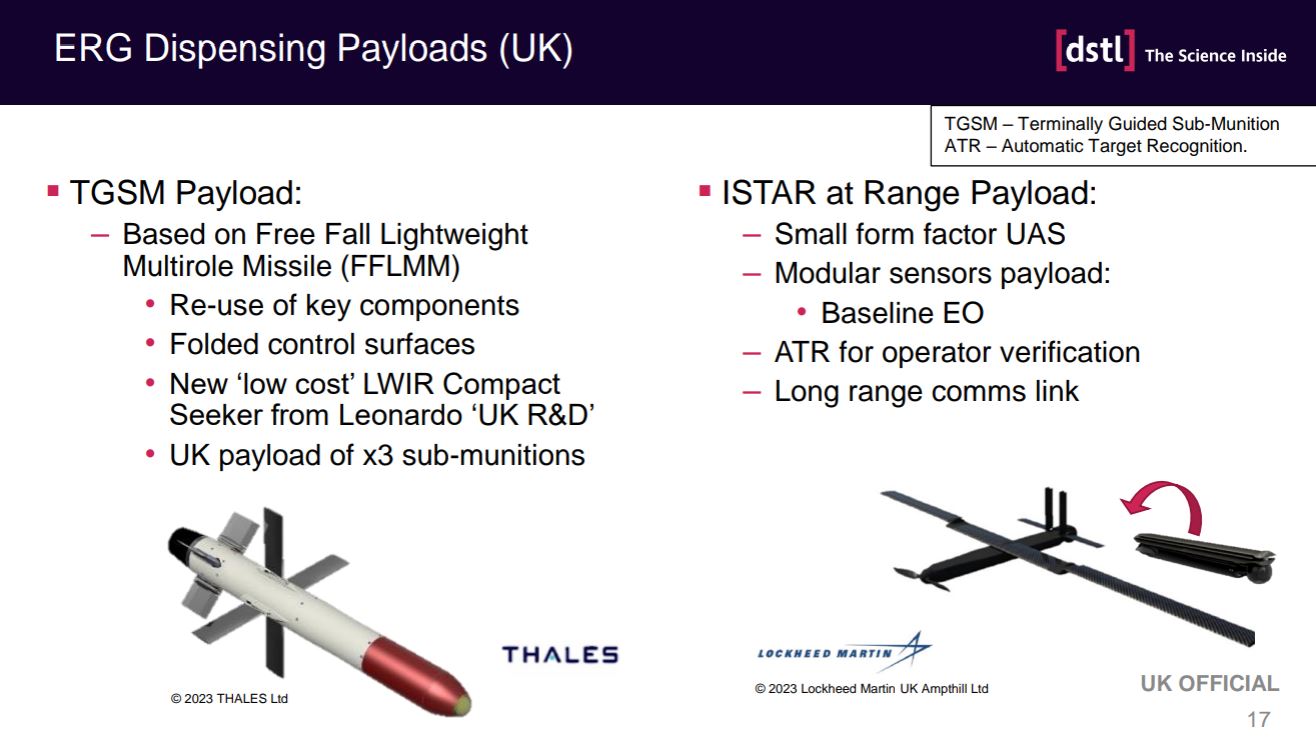


The other project with great potential is the Mounted Close Combat Overwatch project centered on ground-launched Brimstone for long-range anti-armour capability. This has in some ways already obtained an export win of sorts with Poland having selected Brimstone for its own long range ATGW need.

There is obvious potential in several of the UK's drone projects as well: uncrewed adjunct aircraft, the HYDRA armed drone, one-way strike solutions and the PROTEUS uncrewed helicopter for the Navy could all prove successful in securing export deals.

DSTL’s work on an uncrewed, highly mobile ultra-lightweight 127mm gun on the LAMP mobility platform should also continue as it would answer the need of Marine, Para/Airmobile and Mountain troops in particular and could secure interest in multiple countries.


Describe how the current support to Ukraine is integrated into UK Defence programmes and activities and propose measures in priority order to sustain and enhance this support to at least 2027.

The UK could provide aid to Ukraine while improving its own defences in multiple ways, as the decision to restart manufacture of large calibre barrels in the UK proves.

With GMLRS rockets being a key asset for the British Army as well as one of the most successful weapons employed by Ukraine, the UK should look at establishing production at home. Lockheed Martin reportedly was willing to bring GMLRS work to Ampthill and this should be a priority.

Again on GMLRS, the already mentioned Techical Demonstrator 5 could be a game changer: Ukraine could probably benefit from early access to some prototype systems, which in turn would support spiral development for the UK's own needs.

There is great scope for even more cooperation on drones, lethal and not, and on electronic warfare, including C-UAS jammers.

Ukraine is also continuously in need of anti-air missiles. France and Italy have supplied SAMP-T batteries firing Aster 30 B1 missiles, and MBDA UK will soon be remanufacturing existing Aster 30 missiles of the Royal Navy into B1s. There might be potential to increase production capability in the UK and help keep Ukraine's batteries armed.

Similarly, CAMM/CAMM ER, much needed to increase the British Army's GBAD capability, could be key to help meet Ukraine's needs as well.

The recent work to increase the ability to produce ammunition in the UK and manufacture artillery barrels is welcome, but one critical weakness remains unaddressed: the production within the UK of energetics and propellants. A core capability in country would be fundamental for resilience in times of crisis when supply from abroad might dry up.


Describe and recommend how the UK Defence homebase is made secure and resilient in confrontation, crisis and conflict, including in enabling full mobilisation and campaign endurance when needed.

Ther esilience of the UK realistically depends on factors other than military. Increased capacity to produce energy domestically, reduced reliance on imports would be the most decisive factors.

The military specifically, and the UK’s ability to mobilise for a major war are afflicted by excessive centralisation as a result of decades of efficiencies. A successful long-range missile strike that managed to hit a few critical installations (for example Lossiemouth, critical to QRA, maritime patrol aircraft and AEW), Waddington, Ashchurch (most of the Army’s vehicle fleet is to be found stored there), Donnington (general stores) and Kineton (ammunition) would be enough to have an absolutely crippling effect on the ability to properly mobilise in the first place.

Strengthening Ground based air defence can help, but there are not enough resources to attempt a complete coverage. For sure, a resident SKY SABRE battery at least in Lossiemouth and other key locations on the eastern coast would not be a bad investment. Longer range air defences would help, but would require massive investment.

Project LEWIS for a new anti-ballistic radar would provide early warning to the UK and to the benefit of the whole of NATO, assuming the Government remains committed to it.


Project LEWIS has seen the UK secure US authorization for the procurement a Long Range Discrimination Radar (LRDR) (for construction on the island that gives the project its name...?), but it is one of those background programs no one ever talks much about. It's also a promise to NATO formulated years ago. 

The best defence against such an attack, which at present can come only from Russia, will always be to deploy the Armed Forces, particularly the Navy and Air Force, “up threat” to intercept Russian ships, submarines and long range aviation over Scandinavia and the North Sea. Forward deployment of the carrier strike group and of RAF jets to Iceland and Norway would no doubt be an early measure taken at the first sign of serious crisis.

In general, the worst threats to the UK will manifest not so much directly against the UK mainland but abroad. The Red Sea shipping crisis is an eloquent example. Even in a “Russia” scenario, the UK will be defended first of all at range up in the High North, not so much directly from its shores. Geography dictates this.

As a consequence, it is non-discretionary to maintain military force that is expeditionary and has the logistic “legs” to deploy where needed.


Propose measures in priority order that establish how UK Defence transitions to the optimum balance of regular, reserve, civil servant, and industry people across all standing tasks and commitments and on mobilisation. Recommend the recruitment, education, training and retention measures required to achieve this.

The topic of Reserves for the UK is complex, again because of the geo-political truth that dictates that state threats to the UK will manifest away from the homeland. The frequent mention of Finland’s reserves, or Poland’s territorial units is of limited relevance to the UK: light infantry formations for local defence have little to no relevance for the UK, unlike for those countries who would be fighting on and for the very home turf. Units equal to Poland’s territorials could be formed, but in any war scenario they would have to be lifted across Europe to the point of need, unlike Poland’s own.

The old Territorial Army used to have a demonstrable ability to deploy to the Continent in support of regulars during the Cold War, but it’s undoubtedly harder to do that now, and it is proving difficult to deploy formed bodies of Reservists during “peacetime”. There are a few cases, but all pretty small scale and relatively sparse over the years.

The matter of Reserves is tricky and not easily solved. It’s true reserve infantry battalions cost a lot less than regular ones, but that is of little relevance if their output is not only much smaller but also relatively unpredictable due to uncertain availability of people. Any expansion of their combat role, in addition, would require equipment and vehicle fleets that at the moment simply do not exist.

A serious assessment is needed to determine what the Reserve can actually do in “peacetime”(it would be fairer to say in times of competition/confrontation short of all out war) and what they can be expected to do during major mobilisation.

If all-out war ever happened, there is every reason to believe the Reserve would show up in decent force, but at present it is at best questionable whether it could be equipped and actually employed as anything other than individual / small sub-units replacements and some degree of augmentation. There is an obvious shortage of combat vehicle fleets, for example. Formed reserve units would only be of the lightest kind.

There will probably need to be a more neatly “separated” plan for those Reserve individuals and units which are available, willing and indeed needed in “peacetime” and those formed bodies which would only realistically come together for occasional major exercise and ultimately in case of a real major crisis.

The latter formations, which should probably be organized as coherent brigades for best effect, would need to have a well defined, realistic role attuned with what equipment will be actually available in the depots or in a realistic emergency procurement/production plan to outfit them.

It would probably be beneficial to organize a “shadow” heavy brigade of Reservists, recognizing however that as things stand the armour to make them deployable as a formed unit simply does not exist in the inventory. They would deploy essentially as augmentees / casualty replacements.

Light brigades could be organized to be “deployable” in a specific format which will not be equal to that of regular formations and should thus develop its own Concepts, much like Poland’s territorial formations but with the difference, again, that UK Reserves would be deployed to fight far away from home.

It might yet prove to be the case that a larger Reserve is not in fact the right answer if larger doesn’t work out to more available/capable. More capable will require dedicate vehicle fleets and equipment holdings which will rapidly make the Reserve far less financially attractive overall.

Roles and expectations must be defined first.


Propose how the maritime (including littoral) domain is developed to contribute to an Integrated Force, recommending measures that accelerate modernisation and transformation and identifying existing capabilities and programmes that do not support this.

The development of uncrewed assets such as PROTEUS (rotary wing), VIXEN (fixed wing) and SEA PROTECTOR (MQ-9B modified with the wing-king for short take off and landing on the carriers) would massively enhance the carrier strike group's ability to deploy and fight up-threat. SEA PROTECTOR could be ready within a few years and, equipped with suitable podded radars and sonobuoy launchers, could bring extremely long endurance airborne early warning cover against missile attacks and long range, persistent anti-submarine patrol.

PROTEUS will help make up for the insufficient numbers of manned MERLIN helicopters.

Carrierborne F-35B (the expansion of the fleet to atleast 74 jets in 3– ideally at least4 – Squadrons should remain an absolute priority) and drones ensure the UK can confidently deploy far from home with the indispensable air cover.


The Littoral Response Groups give the UK a persistent forward deployed force around which larger operations can take shape. In a NATO context, the Littoral Response Group North represent the continuation of cooperation with the Netherlands and assistance for the Nordic Allies. The future Multi Role Support Ship will need to be more survivable than current amphibious ships while preserving the ability to lift and send ashore even the heaviest Army vehicles. The new vessels will need to combine both aviation capability and heavy surface lift capability, with a well dock sized for LCUs and mexeflotes operations. Room for containers, including on the weather deck, will give flexibility to embark modular weapons (a modular CAMM missile system should be a priority) and capabilities (Role 2+ and 3 medical facilities) for deployment.


Frigates, destroyers and submarines with land strike weapons will contribute to the suppression of enemy air defence and will strike high value targets. They have a great deterrent value as well. General purpose frigates and pureOPVs are no longer particularly useful in a new context of state on state warfare risks: the new generation vessels should have space and services reserved for embarking drones and modular mission payloads / containerized weapon systems that make them more useful combat platforms by expanding their base fit.


The MCM component is currently based on small ships which are not very deployable nor very useful beyond their specialized role, but the transition is already underway. Drone-based systems for MCM are more capable and more flexible but the necessary motherships to project those drones at range have not yet been built. If they were, the transition could be accelerated further. Swift procurement of a first mothership would allow the return of the currently employed BAY-class vessel in the Gulf to the amphibious role.

Modular capability, such as CAMM missiles in containers (NavyPODs) and portable lasers can help ensure the new Multi Role Support Ships and MCM motherships can deploy with the necessary defences on board, while saving on build costs. Such modular capability could also follow the Marines ashore, delivering further effect very efficiently.

The Littoral Response Group will need long range strike weapons that can be inserted from the sea and then used from land, against the land and against the sea. GMLRS and PrSM missiles, common with the Army, would achieve this but would ideally require a lighter, more deployable launcher like the defunct LIMAWS(R) on Supacat platform, or the uncrewed ROGUE of the US Marines.

If the Marines can go ashore with GMLRS and CAMM, they can create safe havens for the fleet and prove a real strategic concern to the enemy.


Propose how the land domain is developed to contribute to an Integrated Force, recommending measures that accelerate modernisation and transformation and identifying existing capabilities and programmes that do not support this.

Land will contribute through growt of Long Range Fires, primarily through the Land Deep Fires programme to grow the number of M270 launchers and their ammunition.

-              GMLRS ER, which should include Alternative Warhead to restore area-attack capability, 150 km reach

-              PrSM missile 500+ km

-              Land Precision Strike will deliver extended overwatch

-              Technology Demonstrator 5, a UK effort, to integrate advanced payloads into GMLRS and perhaps PrSM, including reconnaissance drones and intelligent sub-munitions, mines, ISR sensors, EW devices and jammers. If realized, these capabilities would be transformational and are sure to gain export orders.

Further long range strike options will come through drones. Lethal drones are needed at all tactical levels:

small ones such as D40 would restore infantry’s ability to deliver HE on indirect trajectory.

Fires have to make up for lack of mass. The PHALANX model for Platoons and Companies, which pushes JAVELIN and 81 mm mortar down to Coy level, should be adopted.

At battlegroup level, adoption of 120 mm mortars and Mounted Close Combat Overwatch is key.


A battery of M270 should become organic to each Heavy brigade, alongside RCH155, primarily for Land Precision Strike overwatch. This seems the correct tactical level where to employ this new capability.


GMLRS ER and PrSM would primarily be used by the GMLRS Regiments held within Deep Recce Strike BCT if not even aligned directly to Corps level.

Another GMLRS regiment should be added, equipped with a lightweight launcher (like USMC’s ROGUE or resurrected LIMAWS-R) to ensure 16 Air Assault and 3 Commando Brigades have access to this strategic system and can more easily move it (including under slung by CHINOOK).

GBAD will need to grow. CAMM ER should be added to SKY SABRE urgently; more batteries should be formed.

Each Brigade should grow an organic, mobile SHORAD battery, on BOXER Skyranger in the Heavy formations. 30 / 35 mm gun adds cost-effective counter-drone capability.

Directed energy weapons work should continue towards a useable capability to be fielded as soon as practicable.

12 and 16 RA regiments probably need to evolve mixing SKY SABRE with SHORAD, both for their own survivability and for improved effect. Guns (such as PALADIN from British company MSI, which has already been tested) would add resilience against drones.

In order to deliver the “British Corps”, 4 Brigade will need to be rebuilt, with Combat Support and Combat Service Support regiments it currently lacks.

4 and 7 Brigades should both be made medium mechanized with FOXHOUND and a circa-20 tons Troop Carrier as planned within the Land Mobility Programme.

Ideally, 1st Division should have its own lightweight Deep Recce Strike formation. Resources are highly unlikely to be sufficient, so 16 Air Assault Brigade could be adapted to deliver this role where applicable while preserving its more unique deployability aspects.

3rd Division’s armoured brigades would benefit from putting a remotely operated turret on ARES and adapting the internal fit of these new vehicles to restore a degree of IFV capability.

BOXER would then deliver supporting roles by adapting the current plan for Mission Modules. A 120 mm turreted mortar and SHORAD should be priorities.

Ideally, 12 and 20 brigades should be “square” and composed of Combined Arms Regiments of CR3 and ARES. At an absolute minimum, the current 3 regular MBT regiments should be preserved by cancelling plans to convert King’s Royal Hussars from MBT to Armoured Recce.

Security Force Assistance Brigade should be sacrificed to free resources. In general, rebuilding needed CS and CSS formations is priority and in absence of manpower growth, accessory missions should be scaled back to recoup posts for more urgent priorities.


Propose how the air and space domains are developed to contribute to an Integrated Force, recommending measures that accelerate modernisation and transformation and identifying existing capabilities and programmes that do not support this.

The Air Force contribution to the Integrated Force is fundamental, but its ability to intervene in the face of powerful enemy anti-air defences must be increased if this is to continue to be the case even in high intensity warfare. EW, uncrewed aircraft companion for crewed jets, SPEAR 3 and SPEAR EW are going to be fundamental, and it would be extremely important to retrofit the ECR Mk2 radar with jamming capability on the Tranche 2 Typhoons too, since they make up most of the RAF’s numbers.

The procurement of AARGM ER anti-radar missiles, as already pursued by allies, should be the next step.


MQ-9B PROTECTOR’s potential overland is threatened by its vulnerability to enemy action. As it stands, PROTECTOR is virtually helpless against any enemy attack: procurement of a Self Defence pod should be a priority.

PROTECTOR should then be developed with suitable radar and podded sonobuoy dispensers to become an adjunct maritime patrol solution supporting P-8 Poseidon, especially in the High North.

PROTECTOR should also be equipped with the Short Take Off and Landing wing-kit to enable it to deploy directly on the aircraft carriers. The addition of suitable radars in pods would enable SEA PROTECTOR to deliver high altitude, long endurance Airborne Early Warning; in Maritime Patrol configuration it would deliver long duration anti-submarine patrols. In both cases, this would ease the burden on the insufficient number of MERLIN HM2 helicopters, which could then go back to focusing on ASW. In AEW, PROTECTOR would deliver greater capability than CROWSNEST and could in part supplement the insufficient number of E-7 WEDGETAIL too.


It would be highly beneficial to pursue a capability similar to the USAF’s RAPID DRAGON: pallets that can be air-dropped from cargo aircraft to launch multiple cruise missiles. A single A400 could be made to launch as many Storm Shadows as 4 or perhaps even 8 Typhoon, at far greater ranges from the UK, with next to no need for air to air refuelling. For a modest investment, this would bring quasi-strategic bomber capability back to the RAF’s roster.


Probably the most transformational capability that can be pursued, however, is the ISTARI multi-ISR constellation of Low Earth Orbit satellites. The OBERON-type satellites, with their radar sensor, will be particularly important to gather intelligence and targeting in all weathers. The use of laser to securely transmit huge amounts of data (TITANIA demonstrator) could also be game-changing.

In general, while LEO satellites are small and individually less capable than larger satellites so far favoured by most nations, they present advantages:

-          The UK industry is one of the main LEO small satellites producers worldwide

-          The use of multiple small satellites makes the constellation more survivable

-          It is conceivable that additional LEO sats could be “rapidly” deployed into orbit in time of need

-          The maturation of launch options directly from UK soil open up an opportunity to have UK satellites, launched from the UK, delivering sovereign intelligence capability


It would be highly beneficial to procure a number of air to air refuelling pods for A400M, to open up the ability to refuel MERLIN HC4 (Littoral Response Group) and CHINOOK (Army, Special Forces) in flight as well as have extra AAR capability for jets in times of need.

As mentioned elsewhere, adding Boom to at least some VOYAGER tankers would be a massive force multiplier by opening up options to extend E-7, P-8, RIVET JOINT and even C-17 in Flight, as well as making the RAF capable of supporting its main partners, including the F-35A of the “Nordic Air Force” in Scandinavia.


Propose how UK Special Forces are developed as part of an Integrated Force and in support of UK National Security and resilience.

In a high intensity warfare context, the role of Special Forces is likely to primarily revolve around deep reconnaissance and target acquisition in favour of the integrated force. The Army Special Operations Brigade, in particular, should have this as a key role for its Rangers, which should thus be organized and equipped with the necessary mobility, sensors and communications to scout deep beyond the Forward Edge of Battle Area.

Special Forces will of course retain their shock action and direct assault capability as well.


Propose how to improve financial management and administration across Defence, meeting HMG standards of accountability and identifying how more rapid adoption of digital technology will modernise culture, organisation and ways of working.

The one reform that would have the greatest effect on the handling of Defence budget would be one that favoured flexibility over rigid annuality parameters and that created a planning mechanism more akin to the Defence Planning Law in France. Government and Opposition alike need to have more visibility and more say on how long-term defence plans are set out and should vote regularly on those plans to ensure neither side can offer big promises while in Opposition only to deliver the opposite if Elected.


A more credible, long-term commitment to capabilities, programs and structures would give the Services and Industry the confidence needed to approach programs in annual increments. Currently, UK defence spends years and years trying to plan every financial detail of enormous, decade-long programs, generating famine periods followed by gigantic monolithic contracts which later invariably encounter problems due to inflation, unforeseen events, changed requirements and the delays that end up regularly being inflicted upon programmes to fit within annuality requirements. Enormous amounts of equipment are purchased in big contracts because Industry doesn't trust the government to come back if a project is split in tranches, and the Services are terrified of losing their chance (and budget) is they don't commit it. This needs to change. Industry and Services alike must be put in a situation in which they are more comfortable ordering 100 or so vehicles a year within a framework, rather than order 523 BOXERs in one go, to make an example. This would make it easier to control expenditure year on year on big projects without the need for shock cancellations.


Requirements must be set, endorsed, voted upon by both sides of the House, and then delivered incrementally year on year with industry and armed forces reasonably confident that the entire thing won't collapse the moment there is a new General Election and yet another SDSR looking for cuts.


Propose how UK Defence can build relationships with allies, partners and alliances as a strategic strength for the UK

AUKUS is the most impressive example of mutually beneficial relationship, and GCAP will do much in turn to keep Japan and Italy close to the UK.


There is obvious scope for more cooperation. BOXER with Germany, Australia and the Netherlands, for example. With Germany, synergies have been found in the TRITON program to jointly procure a replacement for the M3 rig; in the joint development of ammunition for Challenger 3; in the RCH155 artillery program, in FOST naval training, and hopefully in the future this can continue through the UK procuring the Skyranger turret for BOXER, like Germany already is doing, to enhance anti-air and anti-drone defence.


Type 26, if selected by Norway, could represent a formidable area of cooperation in the context of ASW on the Northern flank of NATO. There is potential for cooperation over P-8 POSEIDON too, and on MQ-9B PROTECTOR, particularly once it is fitted to also deliver maritime patrol / ASW. Norway has a known interest. Both countries employ the Sting Ray torpedo and this might continue in the future should Norway decide to follow the Mod 2 development now started in the UK.


Poland ties are strong thanks to CAMM / SKY SABRE and the joint development of the new CAMM MR munition. Poland has also acquired BRIMSTONE. Further synergies can be built upon these capabilities. Poland is about to become the second user of APACHE helicopters worldwide and the British Army Air Corps could do much to assist them along the way. The two nations would benefit from joint armament purchases for the APACHE fleets and from joint development of conceps and capabilities relating to the AH-64E.

Poland has also acquired AW-149s which the UK is considering as New Medium Helicopter solution.

I again stress the importance of TD5 and the advanced payloads for GMLRS rockets: this project could be a real winner in the field and on the market, and more GMLRS users should be involved as soon as possible to help build momentum.


These are some of the main examples. Those equipment points of contact bring mutual advantages, ease interoperability and create a wider user community to share the costs of modernisation with, while deepening mutual understanding and favouring common solutions.


The UK should consider more direct purchases from partners in return for defence sales. For example, cooperation with Norway on the VANGUARD concept for large motherships would deliver a good solution for the Royal Navy requirement while probably representing a welcome return for Norway's eventual selection of the Type 26 as its new frigate.

Sunday, September 11, 2022

Does Ukraine salvage STRIKE?


The quick exploitation of the gap that the Ukrainians have punched in a lightly-held section of the Kharkiv front and in general the successful use of wheeled AFVs has caused some legit discussion about whether the Ukrainian experience supports the British Army’s STRIKE concept.

This is a discussion to be had, although I’m not sure we have all of the necessary information yet, and might not have it for quite some time still.

What i think must be said, already now, is that we should be very careful in mixing “rapid movement of wheeled AFVs” with “STRIKE”, because we were told in no uncertain terms that the two things were quite different and well separated.

I think no one has any real doubt about the viability and usefulness of wheeled mechanized formations, and their ability to move quickly along roads. Wheeled Mechanized Brigades have existed in multiple countries for decades, and in general in the history of warfare infantry has followed tanks in wheeled trucks (or in half-tracks) for most of the time mechanization has been a thing.

Remember that tracked AFVs to carry infantry into battle appeared only late in World War II, and essentially went into operation only in the British and Canadian armies with the KANGAROOs, after all. Later, the Soviet union has had a multitude of Motor Rifle Brigades combining MBTs and wheeled BTRs of various marks. The British Army used to have significant wheeled armoured components, and in the Cold War it has SAXON to work as a literal battle taxi to bring troops forwards to reinforce BAOR. 

In short: tanks (as in, actual MBTs) + Wheels is not new, is not revolutionary and is, ultimately, not STRIKE.

If you think Ukraine in any way vindicates British Army STRIKE brigade you have first to prove Ukraine formations actually bear any resemblance to STRIKE. Because if what we are talking about is actually a mechanized phalanx  exploiting a breakthrough, that is not new, and is not STRIKE. How many examples could we list, from the fall of France in 1940 to the breakout from Normandy and beyond...?


The British Army did not say it was building a mechanized brigade and it did not copy any of the medium, all-wheeled brigade that have proliferated in various Armies all around the world. The British Army said it had come up with a new concept, a new way of fighting that exploited dispersion to “penetrate an Anti-Access, Area Denial (A2AD) “bubble” and begin its disintegration”. This is how Chief General Staff Sir Nick Carter sold the concept from the onset, and how it was experimented and engineered, as explained years later by Brigadier James Martin, commander of 1st Armoured Infantry Brigade/STRIKE experimentation group between November 2018 and july 2020.

If i had to find a direct counterpart to the STRIKE brigade, i would probably point to the original CENTAURO-centric brigades imagined by the Italian army in the late Cold War. CENTAURO, having anti-tank capability, was supposed to "race" along roads to meet an enemy penetration, and more specifically an amphibious assault by the Soviet Mediterranean Squadron on Italy's long and exposed coast. It had to contain the russians, successfully grappling with an heavier force for long enough for heavier allied formations to also arrive. 

STRIKE was described as a quick reaction tool that would self-deploy "from Catterick to Tallin" to contain a russian assault, so there is some similarity. But in practice, that's also as far as that similarity goes, because STRIKE then diverges in both concepts and execution.  


STRIKE as a concept

Being the commander of the very brigade that was due to become the first STRIKE formation, Brigadier James Martin ought to be the voice we should be listening to when trying to understand what sets STRIKE apart from a conventional mechanized brigade.


Brigadier James Martin speaks from minute 28.45


Speaking at the RUSI Land Warfare Conference 2019, the brigadier was clear on Dispersion being the core of the whole project, and specifically said:

“fighting dispersed provides opportunity for decisive action that could otherwise be pretty difficult to come by. It allows for levels of infiltration, penetration and unpredictability that can decisively threaten a peer opponent Command & Control, his echelon forces and of course its logistic elements”.

There cannot be any doubt that what he summarizes as “dislocation at scale” is targeted at peer enemies and is supposed to allow the STRIKE sub-units to infiltrate the enemy front and threaten command posts, echelon and logistics in its rear.

In my rather less charitable way to describe it: the British Army expected STRIKE to go directly to Exploitation without having to achieve a Breakthrough.

He further specifies that experimentation has looked at brigade frontage of 82 to 100 km width, up to 100 km in depth

“beyond the traditional FEBA (forward edge of the battle area), if that concept still has relevance”

He then reaffirmed the bit about operational marches of 2.000 kms (the infamous “Catterick to Tallin” line that Carter had used all the way back in 2015) and tactical advances / investments along up to 12 different routes, with sub-unit dispersion “well beyond the confines of the kilometre grid square”

In other words, experimentation up to 2019 had supposedly proven the feasibility, and indeed the effectiveness of the idea as it was first conceived in 2015. How fortunate!

In more recent times there has been a sort of revisionism about STRIKE, led by a 2020 article from “STRIKE prophet” on uklandpower.com, written pretty literally to respond to my criticisms. According to this new current, STRIKE is a perfectly sensible “screening and exploitation force”, built on past operations and proven, clear concepts.

I find it instructive that Brigadier James Martin talks about covering and exploiting only once in his address about STRIKE. He does so when addressing lethality, and saying that STRIKE only needs to be “competitive with, not necessarily superior” to an enemy heavier force. He goes on to add that in experimentation this was achieved by “consistently privileging anti-armour capabilities across the brigade in the forms of organic, mounted and dismounted ATGW in every Platoon and Troop as well as some CSS elements”. This, he went on saying, enabled the STRIKE brigade to “survive, operate and win as both a covering and exploitation force”.

Ukraine does indeed prove how much damage can be caused by having ample availability of mounted and dismounted ATGW capabilities, but then again I don’t think there ever was  a doubt about this particular point.   

I don’t have any doubt about the viability of what is still, in the end, a mechanized brigade to provide a screening / covering and an exploitation function, but if this was the point, there would be no need to call it “STRIKE” and pretend it was a new and revolutionary thing.

The British Army intended STRIKE to do things differently and achieve some extraordinary effects, as Brigadier Martin so aptly explained.

If mechanized brigades do well in Ukraine, that has next to zero relevance to STRIKE. I don’t think there ever was a doubt on the usefulness of mechanized brigades and indeed on the mobility of wheeled AFVs. But since it was called STRIKE because it was going to be something different, something more, it can only be considered validated if we observe something on the battlefield that rhymes with what makes STRIKE unique.

The breakthrough in Kharkiv does not look like a single brigade exploiting by dispersion on a 100 x 100 km battle area, sorry. It just does not.

STRIKE bde didn't have MBTs but AJAX. Is any of Ukraine's mech battlegroups deliberately trying to fight without MBTs but using IFVs in medium armour fashion?

STRIKE bde was supposed to have a 100 Km front. Is it happening in Ukraine?

STRIKE talked of exploitation without breakthrough, purely by dispersion/infiltration. Any evidence of anything similar proving feasible on the ground?

If none of STRIKE’s defining characteristics are to be observed, we cannot possibly see a validation of them in the ongoing operations.


STRIKE as executed

I repeatedly made the point that a concept is ultimately only as good as its execution, so we have to also consider what the STRIKE brigade actually looked like and the context in which they appeared.

STRIKE prophet and others go on to claim that STRIKE is supposedly platform-agnostic, but the reality is that the Army considered the replacement of MASTIFF (used in some of the experimentation, by the way) as absolutely indispensable. The procurement of the Mechanized Infantry Vehicle (for which BOXER was eventually selected, as we know) was moved forwards from 2029 to 2023, and the STRIKE brigade IOC depended literally on BOXER becoming available.

As we know, each STRIKE brigade was going to have 2 Regiments of AJAX (removed from the armoured infantry brigades) and 2 infantry battalions mounted in BOXER APC. One of those AJAX regiments was going to be a “Medium Armour” formation tasked with providing tank-like support to the infantry, despite armament and protection being unchanged.


Future Soldier put an end to STRIKE brigades plans and with WARRIOR going out of service, BOXER is no longer heading to Catterick at all. WARRIOR's demise leaves plenty of empty garages around Bulford and Tidworth. 


All my doubts about STRIKE brigades stand, starting from the AJAX – BOXER mix, which would have had inexorable consequences for the ability of STRIKE brigades to conduct those long operational marches. 

It is telling that the British Army has converted 77 Oshkosh tanker tractors into “Medium Equipment Transporters” with trailers rated for 44 tons payloads. These would have been indispensable to carry AJAX (and at the same time not sufficient) during a STRIKE brigade operational march.

This is particularly ineffective because between AJAX and BOXER it is the former that has the sensors and the firepower that are meant to enable STRIKE to fight and be competitive with enemy heavy / heavier forces. It is AJAX that has the sensors to acquire targets and direct joint Fires.

In a workable STRIKE brigade, AJAX should have been wheeled and able to ride on into battle in the very vanguard. To return to my earlier comparison with the italian example from the 80s, AJAX was supposed to be STRIKE's very own CENTAURO. But while CENTAURO has MBT-like firepower with a  105 mm (and now 120 mm in CENTAURO 2) and is wheeled, AJAX has the firepower of a IFV and is tracked. 

AJAX was hammered into STRIKE for lack of alternatives, not because it was ever thought for anything resembling STRIKE's CONOPS. And allow to say me one thing: if you have to deal with METs, you might just as well deal with HETs (a bit bigger and with one extra axle, yes, but otherwise entirely comparable) and carry actual MBTs. Which, unsurprisingly, is what mechanized formations that include both tracks and wheels tend to do, all around the world, whether it’s a soviet / Russian Motor Rifle Brigade or a german armoured brigade or a French heavy brigade. 

Either you don't have tracks at all, to fully capitalize on the long range mobility of wheels, or those tracks tend to belong to MBTs. STRIKE's mix was very unique, and very sub-optimal. 


The operational debut of MET during IRON SURGE, the flash reinforcement of the battlegroup in Estonia following Russia's invasion of Ukraine. You can appreciate how little practical difference there is, at the end of the day, between HETs and METs. Investment in more HETs and METs, but to quickly carry MBTs and WARRIORs respectively, would have made more of a difference for the British Army's ability to quickly move towards battle than adding a wheeled APC does. 


It was also extremely dubious whether Brigadier Martin’s point about availability of mounted and dismounted ATGW at all level was ever going to be realized. The Overwatch variant of AJAX (more accurately, technically a sub-variant of the ARES) was cancelled years ago now, and while Battle Group Organic Anti-Armour is now its own program, hopefully to result in ground-launched BRIMSTONEs, it is not yet anywhere near being in service.

A recent US authorization for the Foreign Military Sales of 513 lightweight JAVELIN Command and Launch Units also includes an unspecified number of electronic assemblies to enable the fitting of a single JAVELIN tube on the RS4/PROTECTOR remote weapon station used on ARES and BOXER, but apart from this there is no real evidence of any big investment in new mounted ATGW capabilities.


Variants and sub-variants breakdown of the BOXER Batch 1 order. It is assumed the "Recce/Fire Support Vehicle" was eventually going to get JAVELIN integrated on the RS4 RWS, but there is no definitive confirmation available in the open. Readers and Twitter followers will know that i think the British Army is wasting way too much money on BOXERs for ambulance and command posts roles, while mounting a ridiculously small number of infantry battalions in the new vehicle and missing firepower and key variants such as a recovery vehicle. I'd rather use cheaper vehicle bases in Support roles and reserve BOXER for the fighting roles at the front. This is, by the way, what happens in Germany, where FUCHS is used, or Italy where ORSO and LINCE cover all of the ambulance requirements and the vast majority of mobile command post needs. 


There is a very bitter irony in the fact that Brigadier Martin’s power point slide when he talked about lethality showed a german PUMA IFV firing a SPIKE anti-tank missile. AJAX does not possess that capability, obviously, so...


MIV programme personnel from the British Army at a Kongsberg event in Norway last April, getting a demonstration of the RS6 RWS, a step up from the RS4, which can employ the M230LF 30x113 mm cannon and JAVELIN 


In other words: even the one bit of the concept that was pretty unquestionably wise still does not have, to this day, a clear path to becoming an operational reality. It has been widely suggested that, now that BOXER is de facto replacing WARRIOR, a firepower boost will have to come, somehow, but there's still, even to this day, no evidence of a firm plan being in place. 

And beyond the viability of this bizarre brigade construct in itself, we should never fail to consider the impact that the sudden STRIKE brigade obsession had on the wider Army.

 Army 2020 (the 2011 plan centered on 3 armoured infantry brigades) was a plan mainly concerned with sustaining enough brigades to maintain a “1 in 5” cycle for enduring deployments (6 months deployed, 24 to rest, regenerate, train), and inevitably so since operation HERRICK was still Defence’s main effort. Even so, Army 2020 very much had “contingency” (state on state warfare, that is) in mind. Its heavy core of 3 capable armoured brigades was meant to preserve the Army’s warfighting know how. Army 2020 planning guidelines did include a Divisional "best effort", with 3 brigades, 2 of which armoured and 1 of which would be made up by elements of 16 Air Assault brigade and 3 Cdo brigade.

In other words, Army 2020 was meant to protect the Army’s ability to field a force pretty much equivalent to that generated for Operation TELIC in 2003, but from a smaller overall army. Accordingly, it was acknowledged that a Divisional deployment would only be possible with adequate warning and preparations, because supports were insufficient.

When in 2015 Army was given direction to accelerate regeneration of a warfighting, deployable Division because focus by then was squarely back on being able to provide NATO with a sizeable land component, a rational mind would have sought to improve the readiness of the existing armoured brigades while rebuilding as many of the missing supports as possible.  

It was, without a doubt, doable.

But the Army instead decided that the overwhelming priority to be funded was procurement of BOXER, not just to replace MASTIFF in the single mechanized infantry battalion that had been part of each Armd Inf Bde of Army 2020, but to build a whole new kind of fighting formation.

Under 2015’s “Army 2020 Refine”, the Division would have again been composed of 2 armoured brigades, with the 3rd one being a STRIKE brigade, leaving 16AA, 3Cdo and a light brigade from 1st Division for Rear Area security on top.

In practice, a force much heavier than had been generated for the invasion of Iraq in 2003, coming out of a smaller army. An army that didn’t really enjoy any growth from Army 2020 plans.

Army 2020 Refine and STRIKE were the ultimate "do more with less" madness, calling for a super demanding force generation cycle and the ability to deploy 100% of the armoured brigades in the ORBAT. And it was supposed to solve the difficulties that Army 2020 had in deploying 2 armd bdes from 3.  

It was, in other words, a fairy tale that Land HQ at Andover told itself.

By 2019 it was painfully evident that the Defence budget was again running hot and that the Army was in particularly dire straits ahead of the incoming Integrated Review, but in December BOXER was ordered, reconfirming it as Andover’s number 1 priority.

From that point onwards, the Army’s ability to fund upgrades to CHALLENGER 2 and WARRIOR, and in general its chances of hanging on to its current sizes and programs were, to put it mildly, tied to the chances of rolling nothing but sixes at every throw of the dice.

Thankfully, the Army rolled several sixes. Boris Johnson’s government put many billion pounds of investment into Defence and Land HQ got most of the increase and the largest allocation over the 10 years. Those were 2 sixes rolled. Getting the CHALLENGER 3 programme funded was another.

WARRIOR ended up not rolling its six, and in general the Army’s mess at that point was so big that the money was never going to be enough for everything.

The STRIKE brigades as once imagined have disappeared, and the Army is getting smaller, with Future Soldier leaving it dramatically short of actually deployable and meaningful brigades.

In all of this, what Ukraine probably proves once again is that replacing MASTIFF with MIV was never what was urgent. Fires, air defence, MBTs themselves and even the IFVs are decisive. Shape of the wheeled APC is secondary. Ukrainian mechanized infantry is making do with an unlikely dog’s breakfast of platforms, including, funnily enough, MASTIFF itself.

In the end, Future Soldier itself admits that the picking of priorities was disastrous. It finally puts the money into CR2 upgrades, artillery and air defence (hoping that plans continue to progress).

Warrior did end up being the sacrificial lamb and BOXER is now de facto THE vehicle the British Army’s future depends upon, but that was unavoidable after the December 2019 contract and the building of two assembly lines in the UK.

The only ray of true hope at the moment is (apart from the promises of a further defence budget boost) the coming of a Chief General Staff who has pretty clearly said that there is much to fix, and that he is prepared to change Future Soldier structures to (hopefully) deliver real combined arms formations and not pure lip service.

I’ve seen hints that the so called Operation MOBILISE might result in a first refinement of Army plans to be announced by the end of the year. I’m wishing it the best of luck, and I’m hoping rationality has returned to Andover, because it’s badly needed.

Sunday, February 17, 2019

A look at the Equipment Programme and an ear for the Secretary of State's speech


Equipment Programme 2017: Category A and B projects

The MOD has published a FOI answer in which it details the names of the projects of category A (value exceeding 400 million pounds) and B (from 100 million to 400). The list does not provide any additional detail, but even so it is simply invaluable to better understand the 10 Years Equipment Programme.

The fact that the MOD is fine with revealing this list if specifically asked to do so, but does not include anything comparable in the EP document itself, is extremely irritating, and it proves once again that there is no security reason whatsoever for publishing such a vague EP document. As I’ve fully embraced the cause of greater accountability and transparence by the MOD in the handling of the defence budget, I will remark that in the future it should no longer be necessary to use FOIs to get this level of information. It would be very helpful to include it in the EP document itself.

Getting to the document, in addition to the really big programmes that are well known and expected to figure, the list does contain a number of voices worth touching upon. 


Complex Weapons

There are several voices here that are of enormous interest. One is the Category A project unimaginatively named “Battlefield Weapon”. It is hard to guess what this is, exactly. With the JAVELIN anti-tank missile having a notional OSD of 2025, the development of a new, more multi-role missile for the infantry might well be what’s hiding under this name. The British Army also has (or had?) a requirement for a “Reusable Multi-Role Medium Range Shoulder Launcher (MRSLs)” to introduce into the platoon to increase anti-structure and anti-infantry firepower and, effectively, replace the outgoing 60mm mortar. The expected date for contract award has however passed months ago without a selection being announced. The contenders were (are?) the Carl Gustav, which is enjoying a major renaissance being selected by both US Army and USMC as new Squad weapon; and the C90 Reusable.
MRSL might be hiding behind “Battlefield Weapon” as well, in theory, but it is not likely, also because even an Army-wide purchase of Carl Gustav would still not get anywhere near the 400 million mark.

There is also a “Tactical Guided Munition – Indirect”, which appears as a voice both under Procurement and under Support. This could hide the decade-old requirement for a guided 155mm shell solution for the Royal Artillery’s AS90 howitzers.

We also have, however, “Land Precision Strike”, which, if I had to guess, would be related to the GMLRS rockets. Again, there is no way to tell for sure. These are both Category A procurement programmes, so we are talking about sizeable projects for new capability. It would be hugely beneficial for the Army to procure the new GMLRS “Alternative Warhead” which restores area-effects lost with the demise of traditional sub-munitions, but I’m not sure an area-effect weapon would fit very well within the project name.

Finally, we have the “Deep Fire Rocket System”, again a Category A project. To comment on this one we have to note that for well over a decade the Royal Artillery has wanted a long range weapon, namely the ATACMS large rocket for the M270B1 launchers. 
We must also go back to the end of last year, when 16 RA Bty went into suspended animation, but with a most unusual promise of a relatively swift return to active service to operate a new Deep Fires capability. In the occasion it was said:
 “There is a plan in the middle of the 2020s around 2024 when we develop a new capability for the British Army and enhance some of our deep fire capabilities as part of a divisional fires regiment.”

While there is no way to confirm it, it seems very likely that the British Army intends to procure the new missile that the US Army is developing to replace ATACMS, the Long Range Precision Strike munition for GMLRS launchers. The standing up of a new battery for it, however, suggests that the launcher vehicle might also be new, and it is relatively easy to imagine that the army might be thinking of the wheeled HIMARS launcher, which would complement the tracked, heavier (but with more rockets ready for launch) M270. This solution would deliver wheeled GMLRS capability for the Strike Brigades and introduce a 500 km precision strike capability (or maybe even more than that if the INF treaty collapses for good. The LRPF is a prime candidate for quick range extension in that case).

HIMARS and LRPF for the Royal Artillery in the early 2020s? 

Curiously, the integration of Meteor on the F-35 also appears in the “Complex Weapons” budget rather than in the “Combat Air” one, as happens instead for weapons integration on the Typhoon. This might be due to the fact that the missile is to receive a new set of “clipped” wings as part of the integration. It might also have to do with its further development (GaN AESA radar seeker) under the name “Joint New Air to Air Missile”, a bi-national programme with Japan. JNAAM does not appear in the FOI: it is either part of “LII (Lightning II) Meteor integration” or is too small a budget to enter in category A and B.

There is a “Next Generation SPEAR” voice as well, which is not readily identified. Brimstone 2 Capability Sustainment Progamme (also known as Brimstone 3), SPEAR Cap 3 and Future Cruise and Anti-Ship Weapon are all listed separately, so this might revolve around the Paveway IV spiral development, or represent a whole new system.
In the Category B list it is worth noting two large purchases of Paveway IV bombs for arsenal replenishment: 1200 and 3500 bombs respectively.

There are also a “Javelin follow-on buy” voice, which might or might not include the purchase of the latest, multi-role Javelin F with improved blast-fragmentation effect for roles other than anti-tank.
The 4th Tranche of High Velocity Missiles (Starstreak) is also listed as Category B.
There is a Category A “Future Systems” which is as vague as it could be but no doubt covers all sort of studies.
The Storm Shadow Mid Life Refit is a Category A equipment support project. There is a “Future Ground Based Air Defence contingency” voice which is probably connected to FLAADS Land Ceptor (now Sky Sabre).
Complex Weapons budget includes also a “Medium Range Radar” voice which is probably ARTISAN. The inclusion of this and most of the Sea Ceptor costs in the Weapons budget explain why the Type 23 CSP appears so cheap.

Future Cruise and Anti-Ship Weapon is quoted as two programmes: FLRDFC is (probably) the replacement for Storm Shadow, but the exact meaning of the horrible acronym is uncertain. FC/ASW FOSUW should be the Future Offensive anti-Surface Weapon, the replacement for Harpoon on ships.

Brimstone 2 CSP is worth a mention as this programme should deliver a "Brimstone 3" round which is expected to replace Hellfire on the British Army's Apache Block III helicopters in the 2020s. By then the US Army will be transitioning to JAGM, and while Hellfire will remain a plenty big player for many more years, it will become progressively harder to support as the main customer moves on to the new system. Brimstone, on the british side, is the obvious solution. Brimstone 3 is also offered to France for the TIGER attack helicopter modernisation, but it is pretty easy to imagine that Paris will go with a MMP development or some other non-british solution, especially since a british purchase of VBCI has well and truly gone with the wind. 
It would be very interesting if Brimstone 3 added a launch mode that sees the missile dropped before the rocket ignites: this modification would enable integration of the 3 inside the F-35's bays. Currently, Brimstone is rail launched so is not compatible with confined spaces... 


LAND

In the Land Sector the big disappointment is the disappearance of the Armoured Battlefield Support Vehicle which brings the issue of replacing FV432 in armoured formations back to square one. It had been present up to the 2016 edition. Not for the first time I’m left wondering how the “Armoured Infantry 2026” overarching programme is supposed to ever deliver full operational capability if the Warrior CSP is not supported by a replacement for FV432. If they are looking at having MIV covering the role, I can only repeat my suggestion: bin WCSP and put the new turret on MIV. It would be absurd to have, say, the mortar team in support to a battalion of Warriors traveling on a wheeled AFV larger and heavier than the IFV itself… 

MITER and NAV-P are both present, however. MITER is a large Category A programme which aims to unify, in the 2020s, the provisions of the current C Fleet, Protected Plant fleet and Mechanical Handling Fleet.
The C Fleet comprises of engineering, construction and plant equipment to enable manoeuvre, construction, logistics, force protection engineering and life support. It is currently provided under a Private Finance Initiative contract which will end in 2021. The current small protected construction plant fleet is owned by the MOD and is mainly the result of UORs. It is now supported by industry under a contract also ending in 2021. The Defence Mechanical Handling Equipment is currently almost entirely provided under the DMHE contract, ending in 2020. The equipment fleet, composed of pure Commercial Off The Shelf kit, is owned by the contractor and provided to MOD on a period lease basis. Under MITER, the future contractor will manage and sustain the combined construction and mechanical handling equipment fleet in the United Kingdom, on deployed operations and overseas environments.

The Non Articulated Vehicle Programme is the replacement of DROPS. In July 2018 the MOD ordered the conversion of 382 of its MAN SV HX-77 trucks to be converted into Enhanced Pallized Load Systems EPLS, including 33 winterised/waterproofed for Royal Marines operations. 40 deliveries are planned early this year with final deliveries by the end of march 2021. Around 180 had been procured earlier on. NAVP will build on this interim solution to hopefully finally complete the DROPS replacement.

One notable absence, not easily explained, is the Multi Role Vehicle - Protected voice. The Foreign Military Sale authorization for up to 2,747 Joint Light Tactical Vehicles is dated 10 July 2017, so the programme was definitely ongoing already. But, up to that point it might, for internal accounting reasons, have been reported as a smaller-budget project? After all, no MRV-P candidate, not even the JLTV, is still fully and definitively selected. 
JLTV should cover the Group 1 requirement, while Bushmaster and Eagle 6x6 are still battling it out for the Group 2 requirement for a larger vehicle (selection might take place this year). Group 3 should cover the Light Recovery Vehicle. 
The absence of MRVP from the list is curious, but not necessarily concerning. However, MRVP does seem a remarkably vulnerable programme which might well be delayed once again in the near future as far too many priorities battle over a far too tight budget. 

Worth a mention is the Category B project TYRO for the upgrade or replacement of BR90 equipment, both Close Support (Titan-launched scissor bridges) and General Support (the ABLE system.
The latest variant of contract notice published for TYRO – Close Support adds a new vehicle requirement: a Wheeled Close Support Launch Vehicle that must be able to launch the same bridges as operated by Titan.
As of today, the Close Support bridge does not have anything like this: the supporting vehicle is a Unipower trucks that carries spare bridges but is not meant to launch them.
Up to 36 Wheeled Close Support Launch Vehicles are requested, and the inclusion of “Close Support” is significant because, keeping pace with army doctrine and definitions, it requires a vehicle that can operate in the Direct Fire zone. In other words, something offering a decent level of protection, because it is expected that there will be a fight going on while launching the bridge.


Not just Tank Bridge Transporters anymore. Under TYRO, a wheeled close support launch vehicle is now requested. The number of ABLE General Support bridges, on the other hand, shrinks to compensate. 

It is pretty evident that such a vehicle would deliver greatly enhanced bridging support to the Strike Brigades when compared to the Rapidly Emplaced Bridge System (REBS) which spans a smaller gap, is launched by a lightly protected MAN SV EPLS and has a Military Load Class limited to 50.
TYRO requests that all bridge elements are certified at least for MLC 100 (Tracked), which means that pretty much everything has to be able to cross.

There is no Project TRITON in sight yet, but it might just be because of timelines. The TRITON project for the procurement by 2027 of a replacement for the M3 rigs for Wide Wet Gap Crossing has been unveiled in late 2018 in the new Army’s newsletter. It probably hadn’t been firmed up yet in the 2017 plan.


ISTAR

ISTAR big projects are dominated by communications, and in particular Future Beyond Line of Sight, or SKYNET 6, the successor to the current constellation of comms satellites. As is know, a first “transitional” satellite, SKYNET 6A, has been ordered in summer 2017.

Many of the other voices are part of the Land Environment Tactical Communication Information Systems mega-programme for the renewal of comms at pretty much all levels. FALCON 2 EXPLOIT and EVOLVE both figure in the Category A programmes, and it is meant to expand on the capabilities of the current FALCON, which is the deployable High Bandwidth Backbone Network for the joint force, and primarily for the army.

Importantly, Dismounted Situational Awareness appears as a Cat A programme. It is part of the MORPHEUS communication system (data and voice radios and display for situational awareness) meant to progressively replace BOWMAN.

PICASSO also figures, and in this case we are talking of the national capability for strategic Imagery Intelligence (IMINT) and GEOInt, which provides commanders with information obtained from the analysis of date coming from national and multi-national collectors.

The Increment 1 and 2 of the Aliied Systems for GEOINT (AGS) are also included.


Combat Air

The elephant in the room, due to the current uncertainty surrounding it, is the UK-France Future Combat Air System, aka the UCAV for the 2030s. If we believe the press reports, France was ready to progress into a funded Demonstration phase and proceed with the building of prototypes, but the UK has refused to commit funding to that. Whether the programme survives, and in which form, is currently hard to say.

Then we have, of course, the national FCAS, better known in public as Project TEMPEST. Connected to it is also project PYRAMID, which is meant to develop the solutions for the MOD’s Mission System Reference Architecture for future Air Systems.

Worth of mention is Typhoon RADAR 1, a category A project meant to deliver a workable AESA radar for Typhoon Tranche 3 (and hopefully Tranche 2 too). The radar 1, or R1, is the baseline AESA in development for the consortium, but the UK’s intention is to eventually use a more ambitious R2 standard, with Electronic Warfare capability. R2 does not appear in the list, but this might simply be because the additional investment so far authorized over and above R1 funding does not yet qualify into Cat B. Some 60 millions were given to BAE Systems. A more recent version of the list might or might not display R2 since the Secretary of State for defence, speaking at RUSI on February 11, mentioned that the Transformation Fund includes another 60 million for the Typhoon radar. The 100 million mark, in other words, might now have been passed.

One notable Cat A project is the Watchkeeper Mid Life Update. Given the pricetag, it should include some serious improvements and additions. The Army has finally declared Full Operational Capability for Watchkeeper, but it is actually still struggling to secure the certifications needed to operate it from Boscombe Down as intended. Training on Salisbury Plain, in non-segregated air space, was the big promise of Watchkeeper and on this one point there isn't yet a happy ending. 


Air Support 

One surprising absence is ASDOT, which should more than qualify as Category A. It might, however, have been included into the rather incomprehensible “DCS+S - DOTC-A- Core System + Services”, which stands for Defence Operational Training Capability – Air. Its core component is the development of a Common Synthetic Environment that enables the connectivity between different simulators, in different locations, to enable articulate, large-scale simulations.

Another byzantine acronym is MSHATF PFI, but this is the well known 40-years Private Financing Initiative with CAE for the delivery of the Medium Support Helicopter Aircrew Training Facility in RAF Benson.

The Sentry CSP makes an appearance, but as we know the MOD’s preferred approach is not so much a Capability Sustainment Programme anymore, but rather replacement with new build E-7 Wedgetail.

Sentinel R1 capability and its “project team” are both Cat A programmes. Its mid-life update, with the addition of maritime radar mode and other upgrades, might be the explanation.


The Secretary of State for defence’s speech at RUSI

While it is clear that the uncertainty around the budget has not gone away, the Secretary’s speech should be welcomed as it signals that the armed forces have finally found a champion who truly has a vision for the UK’s role in the world.
For one, I was particularly pleased with it because it attempts to change a narrative of decline into a rather happier one in which the armed forces return to the center of the UK’s visibility in the world. I was of course particularly happy also because, in the last few months, defence policy has been heading in a direction which I had identified years ago and for which I’ve been campaigning as relentlessly as I could, while admittedly having a lot less time for blogging than in the past.

I was incredibly pleased to see the removal from service of the River Batch 1s being pushed to the right. My readers will known that ever since the River Batch 2s were ordered earlier than necessary, I’ve been saying that the only way to make them into a genuinely good story was to also keep in service the earlier ships. While at the moment it is a short-term promise only (a couple of years), the Royal Navy has confirmed that it will try to man them with the help of the Reserve, and if the scheme can be made to work successfully it will prove to be a massive force-multiplier. I believe that there are good chances that the three vessels will stay into service well beyond the next two years if the experiment is successful. In turn, this will allow some of the newer Batch 2 to be employed in constabulary tasks far away from home. You might have noticed that, following the experimental deployments of two River Batch 1s in the Caribbean in the last couple of years, the North Atlantic Patrol tasking is regularly quoted as part of the Batch 2’s missions. This is all the more likely to become routine if the Secretary’s “ambition” of restoring a more permanent and sizeable presence (or a “base”, even) in the Caribbean is realized.

The other massively welcome development, which I’ve also auspicated for a very long time, is the announcement of two “Littoral Strike Ships”. The image released on Twitter by the 1st Sea Lord is virtually identical to the American MV Ocean Trader, and so very, very similar to my proposal for aconverted Point-class RoRo vessel. However, at this stage the programme is still in concept phase and the exact look of the ship, as well as the decision for whether it will be newly built or perhaps converted from an existing vessel, is still up in the air.
While the announcement came a little “out of the blue” after months of gloomy reports of cuts, it was actually in the air from a while. Back in 2017, Jane’s reported that a concept study for a Multi Role Support Ship had been launched, to firm up options for a vessel with utility for amphibious, forward repair, and medical capability work.
More recently, during a hearing in front of the Defence Committee, the MOD’s deputy chief of staff for Military Capability, Lieutenant General Sir Mark William Poffley, said that a new programme for “support ships” was being considered for launch ahead of the Solid Support Ships, something i discussed in depth here.
Finally, reports emerged of two “hospital ships” to be jointly funded with DFID.
The Secretary’s speech, most evidently, is just the culmination of a quiet but determined campaign which has been progressing within the MOD for at least a couple of years.

It is pretty likely that these new vessels will cost the Navy the “optional” third Fleet Solid Support ship, but this is not a bad trade-off. Two supply vessels are enough to support the single large task group that the Royal Navy is able to generate, while these two new vessels will greatly help in a number of areas which would otherwise be very problematic. The loss of RFA Diligence without replacement, the lack of a realistic plan for replacing RFA Argus in 2024 and the fact that up to two thirds of the Landing Ship Dock hulls are actually unavailable for amphibious operations at any one time are 3 major concerns which I’ve been highlighting constantly over the years.

The Littoral Strike Ship's first concept art as posted by the 1st Sea Lord on Twitter. The MV Ocean Trader vibes are evident. 

 
All the way back in 2016 i made my very own "mad" suggestion for something similar to the MV Ocean Trader, but a bit more ambitious and even more flexible. If the Littoral Strike Ship was newly built rather than a conversion of an existing ship, it would not be impossible to incorporate all of these changes. 

The name “Littoral Strike Ships” is kind of misleading, as we are most likely looking at something which will be done on the cheap and will thus not be quite adequate for the more “fighty” operations that “strike” suggests. Multi Role Support Ship, while far less pyrotechnic, is probably still the best definition for these units.
The “new” Littoral Strike Groups announced by the Secretary, in fact, might not be based on the new ships, but rather on the existing Bay-class LSDs that these new hulls might end up releasing from the Caribbean and the Gulf respectively.
The Littoral Strike Groups will, realistically, be the continuation of the semi-experimental “Special Purpose Task Groups” that the Royal Marines have been sending out at sea in the last couple of years. These formations, normally of Company-group size and embarked on a single amphibious vessel, have been sent all the way to Pacific (HMS Albion’s tour of last year) and have repeatedly traveled in and out of Mediterranean and Indian Ocean (RFA Lyme Bay, most recently). The Littoral Strike Group should be a more capable evolution of the SPTG, hopefully enabled by the availability of extra supports, including escort vessels.
The new Littoral Strike Group will probably embark significant amounts of Marines and is likely to beat the Bay-class in aviation facilities (the MV Ocean Trader used as example has a two-bays hangar for medium helicopters and a two-spot flight deck that can take anything up to the gigantic CH-53), but is unlikely to have a dock in the stern. It will still be plenty useful, however, and if a RoRo / container ship hull is used, it will have enormous utility as additional strategic sealift.
With the right people and modular facilities on board it could also do decently as a Forward Repair and Support vessel, and it could be able to replace Argus in the medical role if able to embark a modular Role 3 hospital, for which the Navy could work alongside the Army for maximum efficiency.


The MV Ocean Trader, ex MV Cragside, after being modified for use by the US forces 

MV Cragside undergoing her transformation in Mobile, Alabama

The announcement of a RAF Squadron equipped with Swarming Drones is also a welcome development. The mention of this by the Secretary fueled a lot of comments, especially since he made it sound like the whole system would be ready by the end of the year. The MOD has subsequently clarified that it Is more a three years effort, and at the moment we can only speculate on the final form that this capability will take. The “end of 2019” mentioned by the Secretary might actually be for the formation of the squadron, which I figure could well start out as an experimental unit, much like the Fleet Air Arm’s own 700X NAS.
At the moment it is impossible to say if the LANCA (Lightweight Affordable Novel Combat Aircraft) low-cost UCAV, which was sought last year in a call for proposals to industry, is part of this effort or a parallel development.
The UK, however, was already experimenting with unmanned loyal wingmen back in 2008, when a modified Tornado took control, in flight, of a BAC 1-11 modified to serve as UAV; plus 3 other simulated unmanned aircraft. There clearly has been an interest in the capability for many years, and this fits into the wider campaign of experimentation ran by UK industry, which includes of course TARANIS, but also the very interesting BAE MAGMA which replaces flaps, ailerons and other moving surfaces with blown air taken from the engine. In other words, there are the capabilities to put together some good capability.
The result might be something like the Kratos XQ-58 Valkyrie intended to be used as part of the Low-Cost, Attritable Strike Unmanned Air System Demonstration for the USAF.
It will also be a step forwards on the way to unmanned companions for FCAS / TEMPEST. Replying to a House of Lords written question by Lord West on 14 february, Earl Howe wrote that “the combat air acquisition programme is looking at the replacement of Typhoon's capabilities and any new combat air system will need to be interoperable with the Carrier Enabled Power Projection (CEPP) programme. The concept phase of the acquisition programme will consider QEC basing for any unmanned force multipliers which may form part of the future combat air system.”
This reads as if the TEMPEST will not be carrier-capable (sadly, not a surprise and one of the reasons why the lack of catapults on the QE class remains regrettable) but the unmanned part of the future combat air system might be. This is very interesting, but it’s very early days and I’m somewhat skeptical still.


Williamson also mentioned a non-specified “VENOM kinetic strike capability” which is meant to give an attack capability to “ISTAR platforms”. UK Defence Journal says that, according to MOD sources, the platforms in question are the C-130J and the SHADOW R1 (soon to be R2 after the ongoing mid-life update programme).
The C-130J is not properly an ISTAR platform, but like the SHADOW R1 is commonly used in support to the Special Forces and there are several good options readily available for its armament.
It has now been confirmed that at least one C5 short-fuselage C-130 is being retained as part of the 14 that the RAF is going to keep in the long term. This is important because the tanking kit has only ever been installed on short-fuselage C-130s and might not be adaptable to the stretched ones. The HARVEST HAWK kit has been developed to equip short C-130s in tanker configuration (KC-130J). 

HARVEST HAWK originally swapped out one Air Refueling pod and replaced it with a quadruple launcher for Hellfire missiles. In addition, a palletized console is embarked into the cargo bay and a 10-cell launcher for GRIFFIN lightweight missiles was installed on the ramp. A TSS EO/IR turret is provided thanks to a modified external fuel tank. 


HARVEST HAWK evolution is continuing, however, and the USMC is replacing the TSS with a MX-20 EO/IR turret mounted under the nose, to restore the full fuel load. Moreover, with the Outer Wing Station 430 modification (OWS430), by 2020 they will have added two additional underwing pylons, doubling the capacity for externally-carried missiles while allowing the return of the Air Refueling pod. The new and improved HARVEST HAWK will restore 100% of its tanking potential while doubling its fire power at the same time. 
The missile launcher on the cargo ramp has been replaced by an enclosed launcher in a modified side door ("Derringer Door") which enables the launch of the missiles without requiring decompression and ramp opening. That also ensures that cargo capability is retained and requires less preparations before a mission. 
The USMC is also integrating the INTREPID TIGER II Electronic Warfare pod, while Hellfire will be replaced by JAGM. 

The RAF has only activated two pylons on its C-130J-30s so far, adding external fuel tanks to them in the last few years. 


In an ideal world, at least a second C5 should be retained and HARVEST HAWK kits, including AAR capability, should be procured for the pair. That would deliver a great firepower boost while also introducing in service a couple of tankers able to refuel helicopters. The Merlin HC4 is AAR capable and the Commando Helicopter Force wants to tap into that latent capability since extra range would obviously help a lot in all missions, including Joint Personnel Recovery.

Harvest Hawk in its original configuration. The 30mm gun pallet is on hold. 

The Special Forces are also known to want the capability, ideally on CHINOOK, and the SDSR 2015, in theory, promised them “longer range helicopters”.
Putting a couple of pylons and lightweight munitions such as MBDA’s VIPER-E on SHADOW R1 wouldn’t be difficult, either. But if I was in a position to make the choice, my priority would definitely be converting two C5 into KC-130Js and getting a pair of HARVEST HAWK kits for them at the same time.

PROTECTOR deserves a mention too, because we have recently been given the first official indication that maritime patrol capability could feature in the intended second batch (16 are on order, but there are 10 options as well and the stated intention remains to get to “at least 20”). Leonardo has showcased its SEASPRAY radar, which is ready for adoption on the centerline pylon (PROTECTOR will have 9 pylons overall, up from 5 on REAPER, or 7 counting the low-payload external ones, which in practice have never been used so far but would be good for, say, Sidewinder / ASRAAM). ULTRA is continuing work on its ASW sonobuoy-dispensing pods.
It is now contractually confirmed that PROTECTOR will be armed with Brimstone and Paveway IV and fitted with the Due Regard Radar, which was initially only going to be Fitted For But Not With. On the other hand, deliveries will happen later, and entry in service will arrive in 2023 rather than 2021, while the RAF is in the process of “decommissioning” one of its 10 Reapers. A curious development, might be because the UAV has suffered damage that is deemed not worthy to try and repair.

In his speech, Williamson briefly touched on the issue of Warrior upgrades, indirectly confirming that WCSP is going ahead. 2017 and 2018 have been tough and unpleasant years for the programme, which was called into serious question over the big delays accumulated (entry in service now to start in 2023 when it had once been 2018, then 2020…), but the ongoing trials at Bovington seem to have been positive enough that cancellation is no longer a possibility.  

A remotely operated, unmanned TERRIER was used to breach anti-tank obstacles during a demonstration ran by the US Army which also included unmanned M113s laying smoke to cover the action. The US Army is already seeking an Optionally Manned IFV for replacing Bradley. 

Also for the army, the Secretary remarked that he supports the fielding not just of unmanned logistic support vehicles, which have so far gotten most of the attention, but unmanned combat vehicles too.
At the latest AWE event, a WarriorIFV was converted into a remotely operated combat vehicle and I thinkt the demonstration opens up interesting possibilities. If I had to put my money on something in this area, it would be on surplus CRV(T) Scimitar to be converted in unmanned combat vehicles. Their insufficient protection would no longer be quite as concerning, while their awesome strategic and all-terrain mobility, as well as air mobility, would make them incredibly flexible in support of manned AFVs and infantry alike. The RARDEN is not a good weapon for an unmanned vehicle due to manual reloading and lack of stabilization, but there a few good options out there for replacing the turret and introduce an autocannon+missile combination that would be enormously capable.

Jordan's KADDB's proposal for upgunning CRV(T). Add remote control. The first British Army unmanned companion for much larger and less deployable manned AFVs? 

The Secretary also announced that funding will go towards equipping all infantry (including Royal Marines and RAF Regiment) with advanced night vision equipment which so far was reserved to Special Forces. This follows on similar decisions in the US and will go a long way in ensuring the Army can truly own the night. It could be argued that night vision is a major asymmetrical advantage over non-peer enemies, but that so far it hasn’t been exploited as much as it should have been. 


Some growth

In the coming months, 23 Amphibious Engineer Troop, in Germany, will be growing into a Squadron. Mothballed M3 rigs are being reactivated and the new ORBAT is being defined. With its M3 rigs, it will remain forward based in Germany, alongside its german counterpart and well positioned to continue training on the river Weser.

M3 rigs, british and german, in action during NATO exercises

This is also the year of the return of 28 Royal Engineer Regiment as a joint C-CBRN regiment is reformed after the idiotic SDSR 2010 cut. 28 RE Regt will take under command 77 Field Squadron, ex armoured squadron, which was part of 35 RE Regt until this converted into an EOD unit.
FALCON Sqn Royal Tank Regiment, with its FUCHS reconnaissance vehicles, will join the regiment in July.
27 Squadron RAF Regiment, the current CBRN specialist, will also join the new unit; 64 Headquarters & Support Squadron will form up this year and 42 Field Squadron will be re-established in 2020. There are also tentative plans for a reserve squadron to follow in 2022.

The Brigade of Gurkhas in particular is growing quickly to fill some gaps and help with the manpower deficit. This too is a U-turn on disastrous 2010 and 2011 choices. The Gurkhas now man Gurkha Company (Tavoleto) in its role of Training Support Company, part of the Specialist Weapons School at the Land Warfare Centre in Warminster.
Moreover, the Queen’s Own Gurkha Logistic Regiment is growing and two additional Gurkha sqns are appearing, one within 9 RLC Regt and one within 4 RLC Regt.
The Queen’s Gurkha Signals are growing by two squadrons as well, with 247 Sqn within 16 Signal Regt and 249 Sqn within 3 Divisional Signal Regiment.
The Queen’s Gurkha Engineers could also see growth in the near future. They have taken up significant roles within the ARRC support battalion, beginning in 2014 with the Close Support Troop and Engineer element.