Showing posts with label Falcon. Show all posts

Thursday, January 10, 2013

Gaps, gaps, gaps - part 1


Part 2 of this report: Gaps, gaps, gaps 


The financial management of complex military programs is improving, but military capability is being eroded at alarming rate. This is what the NAO Major Project report 2012 exposes. The thick of the cost escalation is due to inflation factors that sit outside the MOD’s possibilities of control. In fact, after five years in which this expenditure voice wasn’t updated, expected fuel costs for the Voyager air tanker’s service life have been revised, and they account for an expected cost growth of 336 million pounds. Fuel cost is not something the MOD can do much to control and dominate, as the NAO itself notes.

In total, there has a net total increase of 637 million pounds over a number of programs, most notably FSTA (Voyager) and the CVF aircraft carriers. Other programs are now under control and costs connected to them are falling, so that the increase in expected expenditure compared to last year is ultimately  worth 468 million.

The Voyager tankers are also incurring a 31 million pounds cost increase due to inflation, 2 million for the implementation of additional safety measures and 24 million due to France stepping out of the frame: it had been hoped that the French air force would buy Voyager services to remedy to the shortage in air to air refueling capability, but an agreement wasn’t found and ultimately France is planning to order this year the first few of its own planned 14 A330 MRTT.  
The FSTA program for Voyager tankers has also achieved savings in other areas, however, with a noticeable reduction of 98 million due to the refinancing of the PFI deal.
The final balance of savings and cost increases, however, puts the Voyager on top of the list of the naughty boys, with a net increase of 257 million.

CVF follows, reporting a 217 million cost increase, in no small part due to the switch from STOVL to CATOBAR. The NAO report covers the CVF situation prior to the switch back to STOVL and F35B, which will be covered in the 2013 NAO report. Until then, it will be difficult to say what the real impact on the program was in terms of potential delays and additional costs. Later this year the NAO will release a new report into the delivery of Carrier Strike, so we might obtain the up to date, valid information from it. There’s many questions still waiting to be answered regarding the CATOBAR saga.

The A400 Atlas C.1 cargo plane program reports a 163 million net increase in costs, mostly due to the Export Levy payment made by the UK as part of the multinational agreement to keep the program alive. The UK share of costs is 175 million.
In theory, EADS will hand the money back if export orders are won in the future, but we’ll see how it actually goes. The MOD has prudently decided to consider this money as a cost increase. If it'll return at some point in the future, all the better.

Importantly, the NAO also observes:


In recent years we have reported several times that the Department has had to slip projects or cut equipment numbers to bridge the gap between estimated funding and the forecast cost of the defence budget. These decisions were not value for money and meant that new capabilities were not available on time. There are no such instances recorded this year, though difficult decisions may still be necessary as part of the Department’s drive to keep the Equipment Plan in balance.

If financial management is showing improvements and discipline is starting to have a beneficial effect on accounts, the situation for military capability is however dire in several areas. Particularly worrisome are Air-Air-Refuelling, airlift, embarked AEW and Amphibious support helicopters.

At various points to 2017, there will be critical gaps in air transport and air-to-air refuelling capability. From 2022, there will be approximately a one-third shortfall in tactical transport aircraft against the stated requirement. On the ability to move passengers and cargo by helicopter, the Department has accepted that while there will be a shortfall against the full requirement, it believes that current plans will deliver a sufficient capability, and the risk will be reduced by using other defence capabilities.

Main contributors to the reduction of planned expenditure are Typhoon, Type 45 and Astute (boats 1 to 3) which have been able to hand back the major part of the 169 million pounds recapped in 2011/12 over the programs examined in the report.
This money was contingency funding that proved not necessary and could be put back in the central money pot.

The entry in service of several capabilities, however, has slipped to the right by a combined 139 months. An enormity, with the Brimstone 2 and Meteor missile programs being the biggest contributors, with twin 23 months delays to report.
CVF reports a 9 months slippage, but as we said, the "photograph" of the NAO has been in this case been made outdated by the switchback to STOVL: construction of the ships as of now seems to be going strong, several milestones have been hit earlier than planned on the assembly of Queen Elizabeth and i'm consequently willing to guess that the NAO report 2013 and/or Carrier Strike report will rectify this particular data. 

Anyway, delays and gaps. This is where the pain comes. Let's look at the military capability, and see what the situation is.

A400 Atlas C.1

Entry in service still expected in March 2015, no further delays on the horizon.

The plan is to hit IOC in 2015 with 70 Squadron RAF fielding the first 3 Atlas cargo planes.
Full Operating Capability will be hit over 2017/18 with 12 airplanes operational.

The first UK airplane, MSN16, is expected to be delivered in 2014. It will the 16th production A400 aircraft, but the UK took the conscious decision in previous planning rounds to be patient and wait a little, in order to receive all aircrafts at production standard and with software SOC 1.5: this standard means the aircraft is fully ready and cleared for all kind of airdrop operations and is ready for the Air Tanker role, although the RAF so far does not plan to procure AAR kit for the Atlas.

The early planes, delivered to France and others, come at standard SOC 1, which is very much an early release, with some limitations.

SOC 3, expected in 2018, will add the full capability for low-level tactical flying and Special Forces role.

It is also confirmed, as announced for the first time in 2008, that the madness of not having fuel-inerting system on the RAF A400 has been terminated: the MOD has paid some 6 millions to have fuel inerting pipes installed and has invested to add a Portable Removable On-Board Inert Gas Generation System. This greatly improves safety.

The installation of full Defensive Aids Sub-System (DASS) has also been brought forwards, and the full range of countermeasures, including Directed Infra Red Counter Measures (DIRCM) will already be on the first airplane delivered.
As of now, however, it would appear that DASS is funded for the first 9 airplanes only. Obviously, this is unacceptable, and it will have to be corrected as soon as possible in the next planning rounds. 

22 airplanes remain planned for entry in service by 2022, when the C130J is expected to retire. The NAO however reports that the Atlas alone are insufficient, with a one-third shortage in tactical airlift capability anticipated. Not a case that, prior to SDSR 2010, the C130J's OSD was 2030, and not 2022.

In the immediate future, the situation is just as complex, with measures urgently needed to improve availability of C130Js and a further delay having been imposed to the retirement of the last 8 C130K to October this year, at a cost of 16 million. The end of the old C130Ks has had to be delayed several times in a row now, and this of course has a cost.

The Urgent procurement of 2 BAE 146 Quick Change tactical cargo aircrafts cost 47 million pounds.


AIRSEEKER

The procurement of 3 Rivet Joint airplanes for COMINT and SIGINT tasks is on track, but reports a 4 million cost growth due to exchange rates variation.
At full operating capability, the Rivet Joint force will consist of 3 airplanes, 4 trained crews, 2 deployable ground stations for data processing, ground infrastructure for support (at the Main Base, RAF Waddington) and a ground intelligence analysis and exploitation facility (to be built at the Joint Services Signals Unit, RAF Digby base).


C17 number 8

Cost for the 8th C17 was 215 million.

There's no mention in the NAO report, but rumors are circling about the incoming purchase of UK9, a 9th C17 strategic cargo aircraft. A 10th serial number is also reserved for an eventual 10th aircraft.
The ambition to have 10 machines has been there for some time, and the lease or purchase of a further 2 C17s was reportedly on the table lately, also because the withdrawal from Afghanistan will require powerful air transport capability. The NAO believes that there will be Strategic Airlift capability in excess of requirement from 2016 onwards, but i do not quite agree: this is one of these capabilities that very rarely, if ever, can be in excess of requirements.


Future Strategic Tanker Aircraft - Voyager

The Voyager is currently operative as a transport and aeromedical evacuation platform only. It entered active service on April 4, 2012, and by December 2012 (when the third Voyager airplane arrived at Brize Norton) 16.000 personnel and other one million kgs had been airlifted in well over 1000 flying hours.

Of course, though, the main mission of Voyager is refuelling other airplanes in flight, and this is currently not yet validated due to leaks that were detected in various parts of the AAR flight envelope. Corrective measures have been agreed and are being implemented.

Air to Air refuelling IOC should be achieved within September this year, with one airplane fitted with both Wing pods and centerline fuselage station.
Air Tanker and the RAF, following problems in trials with the Cobham-designed High Speed-Variable Drag Drogue (HSVDD) fitted to the hoses of the Voyager have taken the decision to remove the HSVDD from the wing stations of Voyager tankers, reverting to the old Sergeant-Fletcher-designed drogue present on Tristar and VC10.

Aviation Week explains:

The HSVDD is designed to refuel aircraft at between 180 and 300 kt., a much wider speed range than previous drogue systems. However, a series of flight trials in 2011 found that the drogue or basket was venting and separately spinning, causing hose oscillation.

Although those oscillations were solved by mid-2012, results of trials with Tornado GR4 were still not satisfactory. The return to the Sergeant-Fletcher drogue has instead resulted in success with both Tornado and Typhoon.
The HSVDD will be maintained on the Centerline Fuselage Station, which is mostly intended for use in refueling of large aircrafts: trials have successfully been completed to validate AAR with C130J, and in 2014 the trials will be carried out with the E-3D Sentry AWACS.

FOC for FSTA is the provvision of a full fleet of 9 "core" tankers, 7 of which will be fitted for centerline refueling station and 5 fitted with it. The expected date for achievement of FOC is May 2014.
The centerline fuselage station is essential to provide Day and Night air refuelling to large aircrafts such as Sentry, C130 and, in future, A400 Atlas. The other 5 tankers, as known, are "on call" and might be released when not needed to serve as passenger airplanes on the civilian market. In reality, it has long dawned on the MOD that this is unlikely to happen, while it is more likely that european partners could buy Voyager AAR hours and services in the future. As mentioned earlier in this article, it had been planned that France would buy Voyager hours, but this plan did not go ahead.

To remedy to the potentially dramatic gap in AAR capability, the old Tristar tankers will serve beyond their planned OSD of July 2013, being in service until March 2014 at an extra cost of 7 millions.
The VC10 was expected to cease service in March 2013 but the RAF will try and operate them for at least a few months longer, out to September, but the closure of the maintenance line at St Athan will be the deciding factor: at one point, not far into the future, it'll be simply impossible to keep the VC10 flying any longer. 
 
The 3-point Voyager tankers (2 Wing stations plus centerline fuselage station) are known as Voyager KC3, the others as KC2. 
All aircrafts are fitted for a full DASS fit of electronic countermeasures and, following a 124 million measure in PR11 they are being fitted for platform protection (cockpit armor and other survivability features) for use in war theatres.


Astute-class submarines

The NAO report confirms that Astute has been trialing the installation and use of a "payload bay", which is actually the CHALFONT dry deck shelter for carriage of Special Boat Service operators and equipment, all the way up to the Swimmers Delivery Vehicles.

Planned expenditure for boats 1 to 3 reduced by 94 million pounds between April 2011 and March 2012.
Astute boat 4 and 5 had a significant cost growth connected to the slow-down of production connected to the delay of the Successor SSBN program to 2028. 

The NAO certifies that the delays imposed to the delivery of the 7 Astute submarines is preventing the Navy from achieving the planned availability of deployable SSNs.

The NAO reports that Astute boats 1 to 3 are forecast not to meet their Top Speed requirement, but all other requirements to be met. There is also an element of hope in the fact that the NAO notes that

initial trials in Boat 1 have been deliberately constrained but unrestricted trials will be conducted prior to Operational Handover.
so that HMS Astute could still demonstrate it can be as fast as the Navy hoped.

Boat 4 and 5 are expected to meet all requirements, but there are still risks, mainly due to some elements of planned capability not having been given the final go ahead and funding. In detail:

- Spearfish torpedo upgrade is now funded and on the way, with excellent progress to date
- An integrated communications and radar solution for Astute Boat 4 is now funded
- Naval Extremely/Super High Frequency Satcom Terminal approved by HM Treasury in December 2011 (not clear if the approval is for fitting at build only from boat 5 onwards, report is contraddictory as the same element is not funded in the Boat 4 table and funded in Boat 5 table)
- Astute Capability Sustainment Programme still awaiting HM Treasury approval

Despite the drama kicked up by the Guardian's articles, the Astute submarine program seems to be actually in good shape, and things appear to be improving.


Meteor BVRAAM

Technically, the missile is doing well, finally, in development and firing trials with a 3 months reduction in the trials period expected to be needed. However, the MOD was 11 months late in signing contracts and, worse, the Typhoon software development continues to be horrendously slow. The missile will be ready soon enough, but Typhoon won't get the software and the radar improvements necessary to properly employ Meteor in time. The FOC is described as full 6-missile fit, 2-way datalink and cockpit symbology and functionality, but the June 2017 ISD date could end up being valid for just the four missiles in semi-conformal positions under the fuselage.

The result is the slippage from an ISD of July 2015 to June 2017, with a consequent 50 million pounds cost to keep AMRAAM missiles stocks longer than planned. Worse, it might not be enough, and availability of AMRAAM missiles by 2017 risks being dangerously low.


JULIUS and Chinook New Buy 

The MK4 and 4A Chinooks upgraded are now entering in service and the first HC4 has even deployed to Afghanistan. However, the program accumulated several months of delay compared to earlier planned dates.

Delivery of the 14 new Chinooks (HC6) for service has also suffered delays and the MOD has prudently assumed that the IOC for the new Chinooks will take longer than hoped, now expecting it in November 2014, some 6 months later than earlier assumed.


Complex Weapons 

The NAO Report does not cover the Selective Precision Effect At Range (SPEAR) Capability 1 segment, unfortunately. This is relative to spiral development and evolution of the Paveway IV bomb, including the development and provvision of different kind of warheads, including a low-yeld, low collateral damage and a bunker-buster option. Improved capability against fast moving targets and longer glide ranges are also expected to be explored.

In July last year, Raytheon and Qinetiq completed ‘sled trials’ at the UK’s Pendine test range on the bunker-buster warhead, we know.

The Compact Penetrator warhead has the same outer mould-line and mass of the current Paveway™ IV enhanced Mk 82 warhead and has demonstrated a significantly increased penetration capability through the series of target engagement trials. Raytheon UK and QinetiQ have been working closely with Thales under the UK’s Weapon Technology Centre Compact Penetrator programme. The 25 month initiative will also undertake operational environment assessments, such as transportation, handling and air carriage.

Over the course of 2012, three orders for Paveway IV bombs were placed: a 60 million order in April to replenish stocks after operations in Libya, plus a 14 million in July and a further 25 million order in December.

The NAO does talk of SPEAR Capability 2, however: this is the development of the Brimstone missile.
Capability 2 Block 1, specifically, is the Brimstone 2 missile, a major improvement from the current UOR-derived Dual Mode Brimstone.
Brimstone 2 adds improved seeker and Insensitive Munition-compliant warhead and rocket motor, plus other improvements. It was to be introduced this year, but unfortunately trials imposed a 23 months delay as issues with both warhead and rocket motor emerged, the NAO reports. Warhead problems are fixed, lethality is confirmed and Critical Design Review passed, but the motor is still a problem. Seeker and electronics have been validated with 3 successful launches.
In 2013 there is going to be an IOC phase mating the improved seeker and electronics of Brimstone 2 to existing warheads and rocket motors, as an interim capability on the way to full release to service. A "minor concession" on performance has been agreed to enable MBDA to fix the rocket motor, presumably as a way to control costs, instead of wanting every tiny bit of capabilitity no matter what the cost. 

There was to be a SPEAR Capability 2 Block 2, but the decision was taken to delete this point of decision and just continue to spiral-develop the Brimstone 2. It is intended that in the early 2020s the Brimstone 2 or developments of it will replace the US-made Hellfire missile on the Apache attack helicopter. Hellfire OSD is 2021, and the NAO shows that Concept Phase has now begun on preparing Brimstone to act as replacement.
Brimstone 2 will be used on Tornado GR4 and Typhoon. F35 is not mentioned, at the moment. Integration on Typhoon is part of the Typhoon Future Capability Programme 2, for which we have no dates as of now. Almost certainly after 2015, unfortunately.
Tornado GR4 will be retired from service in March 2019, and by 2018 the RAF hopes to integrate Brimstone and Storm Shadow on the Typhoon.

A SPEAR Capability 2 Block 3 remains planned for the early 2020s (2022 or 2024). This could be a replacement missile in the same weight and mass class, or another development of the Brimstone.

SPEAR Capability 3 is a new 100-kg stand-off weapon (100 to 180 km range) specifically thought out for internal transport into the weapon bays of the F35, but we can expect to see it on Typhoon too, one day. The NAO provides a breakdown of the activity done so far, and the list is quite impressive, showing a great amount of progress:

Spear Capability 3
(i) Request for Quotations (RFQ) for seekers released - February 2011
(ii) Initial discussions about demonstration and manufacture/integration issues with Typhoon - May 2011
(iii) Assessment Phase subsystem downselect, Concept Design Review and Phase 2 Gate Review completed - July 2011
(iv) MBDA commenced launcher study because BRU-61 launcher found to be incompatible with chilled airframe design - August 2011
(v) Warhead supplier recommendation endorsed by Portfolio Management Board; Systems Design Review Complete; BAE Systems under contract for Phase 1 of Airframe and Propulsion Flight
Demonstration. Draft System Requirement Document issued - December 2011
(vi) Contract let with Hamilton Sunstrand for Turbojet Technical Assistance Agreement - January 2012

SPEAR 3 resembles the US Small Diameter Bomb and uses the same arrangement, with a launcher/pylon carrying four weapons. It is however a turbojet-powered missile and not a gliding bomb. Each F35B will carry a quadruple pylon in each weapon bay.

Another chapter is Fire Shadow, the loitering munition for the Royal Artillery, which saw the first 25 or more weapons delivered to the Army in March last year. Requirements have more or less been met, and development is continuing, but the MOD decided not to send Fire Shadow in Afghanistan for in-field experimentation and validation as had earlier been planned.
Fire Shadow is now "under review" within the Army, as is the whole of the unfortunate Indirect Fire Precision Attack program of which it is a part: the fear is that this "review" will ultimately be the final, lethal blow to IFPA, which has been so far a near complete failure:

- AS90 upgrade and 52 caliber barrel was cancelled
- Sensor fused 155 mm anti-tank shell was cancelled in 2010 after contract award in 2007
- LIMAWS(G) and (R) for lightweight self propelled gun and MLRS launcher were both cancelled
- Arming the Watchkeeper drone is an option on hold
- Fire Shadow seems to have an uncertain future at the moment
- Procurement of ATACMS (Large Long Range Rocket) for the british MLRS launchers was cancelled in Planning Round 11
- Procurement of a guided 155 mm shell is effectively on hold following deletion of funding in Planning Round 2011, but the intention is to deliver the precision artillery shell by 2018

The list is a graveyard, and makes it very evident that the effort of the Royal Artillery to modernize its kit has been frustrated again and again.

Much better news come from the Future Local Area Air Defence (FLAADS) which is the air defence missile system using CAMM as effector.
The NAO report suggests that not just the Maritime variant could be ready in November 2016, but the Land variant too (intended replacement for Rapier), although, as far as i'm aware, Rapier OSD is 2020.
Notable achievements include:

(i) Acheivement of Demonstration Phase Contract Award to deliver First of Class Platform - December 2011.
(ii) Successful completion of the System Preliminary Design Review - March 2012.
 
In 2016, FLAADS(M) will replace Sea Wolf on the first of the Type 23 frigates. It will also arm the Type 26 next generation frigates.

Finally, the Future Anti Surface Guided Weapon programme (FASGW) has hit a stumbling block. The Royal Navy and French Navy hope to join forces on FASGW(Heavy) to jointly develop the missile, but France is refusing to committ funding at this stage, and despite british pressure there has not yet been a decision on the way ahead.
The delay in launching the program is resulting in an expected delay of 19 months in entry in service of the new missile, which is needed to replace the old Sea Skua and arm the Wildcat HMA1 helicopter. This way, FASGW(H) will not be ready in 2015, and Sea Skua will have to be used for a longer period, with the very real risk that no money will be expended on integrating it on Wildcat, leaving the new helicopter clawless for the first part of its service life.

The definitive go-ahead has not been given to FASGW(L) either, but the Thales Light Multi-mission Missile is at a far higher technological readiness, and there is still time to order it in time for a 2015 entry in service on Wildcat.


The FALCON communications system finally entered service (Increment A for the Army and Increment C with the Royal Air Force signal unit), but it was several months late as well, and its UOR iteration for use in Afghanistan will not be ready in time either. The biggest plan change, however, is a March 2012 decision to distribute FALCON over the regiments of the Royal Signals (presumably the 5 Theatre Support Regiments) instead of concentrating it just in 30 and 22 Regiments.
This is presumably due to the conclusion that Brigade-level communications must be enhanced and FALCON is simply indispensable for all future deployments. This decision will have some impact on infrastructure expenditure in the next years, probably: under Project BORONA, 22 and 30 regiment (and a third regiment To Be Announced) are both due to be based in Beacon Barracks, Staffords, where infrastructure for storage and support of FALCON is to be built.
The NAO notes, in fact:

Whilst a lack of suitable garage space will not impact upon the capability, Army Headquarters is struggling to ensure that all intended locations have suitable secure storage for specialist items.

To enable the Urgent Operational Requirement, Falcon will utilise an Operational Training Equipment Pool and Operational Support Uplift Pool. This will be whole fleet management within 11 Signal Brigade. Not all receiving units will be able to garage Falcon but all units will have secure storage for access restricted items.

The NAO also notes that a series of improvements and interoperability mods to FALCON, developed for the UOR solution, are to be rolled out onto the whole fleet. Good news for once.
There is no mention of work on the next increment of FALCON, however, which is meant to introduce Network on the Move to maneuver forces. The Army's position is that improved communications are one of the most urgent improvements to be made, but at the same time financial realism means that the thick of the improvements will only go as low as to Battlegroup level, while the ambition was to bring network features all the way down to Company level.


The F35 and CVF sections are not of great interest this year as the NAO coverage does not reach the switch back to B and its implications.
It still lists, for example, a 31 million pounds saving from interuption of work on the Shipborne Rolling Vertical Landing technique for the F35B due to the switch to C variant, but it has been undisclosed in these days that, as part of the return to B, SRVL activities have restarted.
It has also been announced that this winter the Ski Jump for HMS Queen Elizabeth will be shipped to Rosyth, despite the fact that it has not even been ordered yet. It would be great to have informations on these changes, but they are outside the period covered by the 2012 report.

On CVF we learn that HMS Queen Elizabeth, in the plan that would have seen HMS Prince of Wales fitted with catapults and wires, would have served for just around 9 months for ship trials and validation activies before being mothballed.
It is hoped that the return to STOVL will mean both carriers are kept and put in service.


Regarding Wildcat helicopters, the NAO report confirms that the requirement, following PR11 options exercised, is for 66 helicopters:

30 Wildcat AH1 (Army Helicopter 1 - battlefield reconnaissance)
8 Wildcat LAH1 (Light Assault Helicopter 1 - 4 converted AH1 airframes and 4 additional, new airframes)
28 Wildcat HMA1 (Helicopter Maritime Attack 1 - naval variant)

The reason why we continually hear the ministers speak about 62 helicopters is that funding has currently been set aside in Core Budget for 34 AH1 and 28 HMA1 machines: negotiations and decision-making to include the LAH order in the Core Budget haven't yet concluded. The decision is expected this year.
The LAH is expected to be destined to replace the Lynx AH7 helicopters used by 657 Army Air Corps squadron, which flies in support of Special Forces.
The AAC expects to have four squadrons on the AH1 Wildcat. The squadrons will be all under 1st Regiment Army Air Corps, following the merge with 9 Regiment, as announced in Army 2020. The regiment will be based in Yeovilton, alongside the Navy's own Wildcats and the common training facility.
6 Regiment, the reserve element of the Army Air Corps, expects to stand up a new reserve squadron  to support the Wildcat force. 

There is not yet certainty about the exact composition of the naval order, either: for what i've heard, 4 of the 28 helicopters for the Royal Navy will actually be in AH1 configuration because destined to the Royal Marines of 847 NAS.
The remaining 24 machines, all HMA1, would be distributed 5 in 702 NAS for training and 19 in 815 NAS, to form 19 Small Ship Flights. The Merlin HM2 will, i believe, continue to provide 6 Small Ship Flights for frigates and two squadrons for "large deployments" (up to 6 helos at a time, on carriers or large RFA vessels), even after the reduction to just 30 airframes as part of the upgrade to HM2. 

The Wildcat AH1 risks being not fully capable because fitting of the Bowman Combat and Infrastructure Platform is not yet funded.
Similarly, the Wildcat HMA1 has not yet been given funding for the installation of the Data Link 22 (which in the next few years will replace Link 11, which works only in Line Of Sight), limiting the capability of the helicopter to share data Beyond Line of Sight.
The Royal Navy is prioritizing surface ships when it comes to funding of Data Link 22, but fitting it to Merlin and Wildcat will be a priority in the near future.

The Wildcat AH1 should be in service in August 2014: this represents a delay of 7 months, due to the training facility having been ordered only recently. The Full Mission Simulator won't be operative before december 2013, the Cockpit Procedures Trainer is only planned to go live in February 2014, the Aircraft Systems Trainer in November 2013 and Weapons & Avionics training solution in February 2014. This of course makes much harder to prepare personnel.
The HMA1 variant should still manage to enter service in January 2015.


Monday, July 16, 2012

Informing, or justifying Army 2020…?


The results of the 2012 edition of “Agile Warrior”, the future-informing series of exercises and studies that the Army is using for shaping its future structure and capabilities have been released via RUSI during the Lad Warfare conference in June. Agile Warrior 2012 is said to have significantly informed the Army 2020 restructuring.

Agile Warrior has been hailed as an “innovative” and open thinking exercise of thought, open to the general public scrutiny (at least in part), constituting an example of how the forces should try and see into the future to re-shape (read reduce) themselves.

Is there anything really that innovative or good about Agile Warrior? I’m far from convinced.

For example, until Agile Warrior 2011, the exercises had been centered on developing the Multi Role Brigade on which the Army has been working at least since 2008, when the hope was to have 8 such brigades. In 2010, this had reduced to 5 as we know, but the MRB concept was still the way, and Agile Warrior 2011, albeit showing some reserve on some factors, significantly hailed the MRB as the way to go.
Then, as we know, Army 2020 took a sharp turn to the side and broke away from the MRB concept altogether, and apparently moved away also from much of the sound concept of unit standardization and modularity that had been worked upon. As far as I’m aware, there has not been an Agile Warrior assessment of this complete change of direction. It just happened, and Agile Warrior 2012 is considerably less expansive of AW11, and just avoids expanding on any kind of brigade or force structure.
This, in my opinion, already undermines the credibility of the whole thing. Is AW actually influencing something in a meaningful way, or are the decisions made and then “justified” with a suitably general and vague document published later? It very much feels like it is the second option.

But let’s see what the major thinking exercise of the Army has brought forwards this year, also building on the experiences of Urban Warrior 3, the third major urban warfare simulation conducted:


• Recognise that it is more likely than not that the Army will be required to fight in a city within the next 10-15 years.

• Prepare and employ combined arms brigades, with expeditionary and mobile headquarters for manoeuvring to seize the tactical initiative.

• Invest in the divisional level, where operational art should be practiced using a comprehensive approach.

• Re-mechanise. Beyond 2020, ensure that the equipment programme includes a capable main battle tank, an armoured reconnaissance vehicle, an armoured artillery piece and armoured vehicles for armoured and
mechanised infantry; with command and support vehicles to match, in order to ensure the necessary levels of firepower, protection and mobility.

• Move from assured to confident targeting, based on judgements, the law and accountability, rather than mechanistic processes.

• Invest in specific preparations for operating in urban areas: inter alia, intelligence awareness of the terrain; a method for simplifying the common operating picture; communication that works in built up areas; psychological inoculation of personnel; and tactical training for fighting in buildings and underground.

• Re-invest in logistics, medical and equipment support pushed forward and integrated with the fighting echelon.

• Ensure that aviation can operate effectively in urban areas.


Perhaps I’m cynic, but I can’t see any innovative thinking or any great discovery here, while I continue to be amazed by just how vague and generalist these documents can be.
“Invest in the Divisional Level” can mean pretty much anything, but the hard fact is that we are getting a single Divisional HQ of which the Army has not yet decided the structure, plus another (presumably) deployable following augmentation, and another HQ with divisional rank for internal operations in the UK and daily management. Investing in the Divisional Level is certainly desirable, but what this “investment” is about, who knows. Obviously the Army won’t tell everything to the general public, but the sensation is that there aren’t many hopes of seeing anything particularly revolutionary. Ideally, the Division level should be able to provide a deployed brigade the theatre-level logistics, a strategic direction, “big picture” intelligence, and it should also provide a number of enablers such as, for example, an Air Assault Battlegroup (this is what happens in Afghanistan, where the Regional Battlegroup South is kept separated from Task Force Helmand and employed as an air assault formation for maneuver and for rapid reinforcement when necessary, with one Company held at 6 hours readiness to move, and the rest at 12 hours notice) and air support (via collaboration with the RAF) plus other elements as and when necessary.

A new structure for Brigade HQs with a renewed Mobile element is also highlighted as necessary, fortunately.

The re-machanization concept is overall sound and in line of principle we can all agree with it, I think. It is important to note that command and support vehicles adequate to support the new armour and mechanized force are highlighted (will we hear of a Mortar Carrier replacement for the ancient FV430 vehicles in this role, finally? This is a requirement that FRES SV seems to have forgotten entirely, this far…), and we will see if this assessment brings to any actual action in the future.

Re-investing in logistics, medical and equipment support pushed forwards, closer to the fighting echelon is also a concept to be welcomed, but what will we actually see done about this?
For example I can think of confirming the Royal Signals Infantry Support Team project as a long term element of the force, and not as an Afghan-timed measure. These less than 180 men organized in 5-man teams at battalion level have a hugely beneficial impact on the combat effectiveness of the formation, and this is amplified by the fact that this small team prepares up to 50 soldiers within the battalion for the role of Tactical Signallers, competent in the use of HF, VHF and Satcom radios and also trained as Combat Medics.
The stable integration of such a combat medic / Tac Sign at least at Platoon level is absolutely desirable, and more than worth the investment.

Strenghtening the Electronic Warfare and Electronic Counter Measure (Force Protection) capability to make it more available at Company or evel Platoon level is also very desirable. This might be done, as it seems that 14 (EW) Regiment is continuing to expand (even if Army 2020 strangely decided to cut a squadron from it, barely weeks after the additional squadron mandated few months earlier stood up…) and 10 Regiment, which contains the Army’s ECM(FP) Squadron is now described as an ECM regiment. A way to announce an expansion in this capability? I hope so.

Up to Agile Warrior 2011, the new Logistics element of the Army was described as having organic escort and force protection fighting element. This is not mentioned openly in AW12: should we be worried? We will perhaps know in the next months, as future unit ORBATs are revealed.
The Army also has a long-running requirement for a Platoon (or lower level) load carrier, ideally a drone, and we’ll keep an eye on this as well, to see if it brings to something or just vanishes. At Company level, vehicles such as Coyote and Husky are part of the Logistic picture, but we’ll have to see if these are brought into core when Afghanistan is over. At Battalion level, MAN SV trucks and Wolfhound vehicles are meant to deliver the logistic element. Again, Wolfhound’s future in the long term is far from certain.
The Multi-Role Vehicle (Protected) should replace Land Rovers, Pinzgauers, Panther and possibly Husky and other UOR platforms in this logistic and support role, but even in the best-case scenario, the MRV(P) is years away, so there is a lot of questions and not a whole lot of answers here.
Also, will the UK infantry company gain a CASEVAC section with a battlefield ambulance as part of the “move forward” of the support elements, like it happens in other nations, such as the US? 
It is too early to know the intended future ORBATs of the battalions, but the Army has determined that the Full Unit Establishment for the main type of infantry battalions will be as follows: 

Armoured Infantry (on Warrior vehicles, 6 battalions): 729 
Mechanized Infantry (on Mastiff, then on FRES UV, 3 battalions): 709 
Light Protected Mobility (on Foxhound, 6 battalions): 581 
Light Role Infantry (14 battalions): 561 

Again, the US Army has been observing the USMC in Afghanistan using the K-Max unmanned helicopter to sling heavy loads and carry them to remote FOBs without putting people in danger and without requiring convoys moving on IED-ridden paths. They are now planning for adding load-carrying helicopter drones to their logistic elements in future: this is innovation at play. I see no sign of it in the british army document.
Is lack of funding constraining even ambitions and free thinking? Being unable to finance it now should not mean not even considering it.

Ensure that aviation can better work in urban areas roughly means “acquiring and fitting improved electronic countermeasures”, one of those rare but welcome priorities that are actually being addressed. However, the hard question in this area is what can be done to protect low flying helicopters in the urban maze from the threats against which Chaff, Flares and even direct laser/IR missile blinding rays won’t do a thing: small arms fire and unguided RPGs fired in volleys. These latter two menaces have caused most of the helicopter losses in Iraq and Afghanistan, but the obsession seem to be always about portable SAMs. Other than a few efforts, mainly in the US and Israel, to develop small-arms fire locating warning devices, and an Israeli effort for developing an hard-kill anti-RPG countermeasure, there does not seem to be much of a solution in the works. The British Army should probably consider acting in this particular area, at the very least by following US and Israeli efforts, instead of focusing only on SAMs, ignoring even the operational experience. 

NOTE: just this afternoon, the MOD announced a 20+ million pounds order to Thales for developing and demonstrating a major 360° Infra Red situational awareness system for helicopters and aircrafts which will be capable to locate not just missile launches, but rockets and small arms fire. A step forwards in the right direction. This will ease evasive maneuvers. Hopefully, countermeasures will follow. 


Another important passage of the report is about the use of fire support, namely artillery, in future and specifically in urban warfare scenarios.

Offensive Support. The utility of indirect fires in urban operations was confirmed. Conventional fires to defeat or neutralise the enemy remain highly relevant although the balance between yield, precision and suppression demand a range of capabilities to be available. Non-explosive natures were also seen to have utility, e.g. marker and smoke. Further study is recommended to investigate how novel munitions could enable operations in the urban environment where avoiding collateral damage is a major factor.

Very generic.
Indirect Fire programs have been chopped savagely in the years, and the efforts of the Royal Artillery to modernize have been frustrated. I can think of many questions that could be made:

-          You were shown 81 mm mortar shells converted in precision guided bombs with a change of fuze. It seems the kind of technology that helps a lot in urban scenario: is it going somewhere?
-          Maneuver against enemies other than guerrilla fighters are openly expected, and we are keeping armored brigades indeed to face said threats. But the Royal Artillery no longer has an anti-tank shell, after the old bomblet carrier was retired and its replacement, the SMART 155 (a 155 mm shell containing two precision guided Anti Tank submunitions) was cancelled. Where are we going with this? Last time that thousands of bomblet shells were used was in Iraq in 2003, not a century ago.
-          MLRS was the anti-area, anti-mass weapon for excellence until 2007, when even the guided variant of the submunitions rocket was retired, just 2 years or so after being acquired. The unitary warhead GMLRS is very good for hitting point targets with great accuracy, but what about enemy maneuvering forces? The US are developing a new, Alternative warhead for area attack which removes the problem of unexploded ordnance common with submunitions: will the UK look into it?
-          The AS90 is ready already since 2010 for adoption of the GPS guided Excalibur shell. Course-Correction fuzes capable to turn current long-fuze ammo into 20 meters-CEP precious rounds are also available. Yet the RA is being forced to wait at least until 2018?
-          The focus on maneuver, including long-range, deep penetration air assault operations, is likely to require artillery with longer reach to keep the forces in the vanguard under the umbrella of heavy supporting fire. The Large, Long Range Rocket requirement (ATACMS) has been de-scoped, but this does not seem wise. Extended range ammunition and longer-range GMLRS (range of well over 100 km already demonstrated) will be re-considered? They were part of the Indirect Fire Precision Attack family of modernization efforts, but one by one they have been systematically killed.
-          What about Fire Shadow? Combining UAV and precision missile with low-collateral damage capability, it could be extremely useful in any scenario, urban one included, especially when, from October this year if times are respected, the full-motion video downlink via Strike Hawk device will be validated, allowing troops on the ground to see Fire Shadow imagery on ROVER portable displays.


Some “innovative thinking” in replying to hard questions such as these would be a more convincing exercise.   

But the area of the report that more than all others told me that Agile Warrior cannot and will not generate much of anything is the part about Command, Control and Information (C2I) needs. I find this part of the report as depressing as it can get and denotes a total lack of reaction to even obvious needs. What Agile Warrior tells me, is that the money available for investment on C2 and communications is tight or non-existent, and the Army is trying to say that it does not need certain improvements. This is not innovation: this is telling people that things are going fine while the ship is sinking. This is flattening the Army’s voice on what government says, even hiding the reality of the operational needs in order to say that, really, what we have is fine and beautiful.
This is a criminal way of acting. It is obvious that financial resources are a factor in what can and what cannot be done, but the process should be: Identify Needs and Challenges Ć  Develop a Strategy Ć  Identify priorities and fit into the finances available. Instead, the process seems to have turned into: This Is What You Get Ć  Tell Everyone That It Is Fine.
But let’s see what the problem is, reading what the document says:


The exponential growth in information technology has revolutionized operations. The demand for complex, rich information services in the current and future operating environments has outstripped delivery. Information and Communications Services (ICS), and their applications and data, need to be made available, securely, to a very large number of dispersed users and if necessary within a contested environment. These users will need access to information services through ‘points of presence’, interconnected by high bandwidth links, and will need to be able to reach across the deployed force, to allies and coalition partners, to the home base and to others in the country of deployment. While reversionary working needs developing and practice, there is, essentially, no going back. C2 elements, large and small need access to a ‘flat’, ubiquitous ICS network to allow them to achieve an operational advantage; all within the context of cyberspace - with its associated opportunities and threats.

Military communications specialist, supported by DE&S and contractors, will need to operate a common equipment platform, carrying common NATO services and applications, using a single Service Management regime. The scaling of Dii(S) and Dii(R) to deliver medium scale enduring operations, requires review. There is also a lack of an agile (smaller/lighter) solution. It will be essential that the ICS regiments use common infrastructure, networks and service management, and that there is a common set of user applications.
Without this common platform, the multi-role approach will be difficult to implement.

Delivering rich information services into the fast moving manoeuvre elements of a force is challenging and services at this level will be optimised for voice, situational awareness and battle planning and control, with some tailored access to richer services; fixed or static HQs, with relative stable power supplies, can expect the full range of ICS to be provided; BGs and Coys will rely on Tactical CIS. As there is a direct correlation between the quality and timeliness of information and decision making, manoeuvre force elements will need to readjust to making decisions with less information and thus reduced understanding, which will have a concomitant impact on the level of assurance, risk and tempo of operations.


In other words, the Army needs information on the move, and needs it down to lower echelons than Brigade level, but delivering information is “challenging”, and  the “innovative” solution the Army comes up with is asking the forces on the field to make do with the reduced, frammentary situational awareness they have got.
For a document that plans for the future, this is inacceptable. This should be a temporary (and indeed an as-short-as-possible) gap in capability, not an element reported in a document for the future of the Army. It is like being back in 1940, when German tanks had radios and French ones had not.

Before Agile Warrior 2012 came out, for a lucky case of destiny, I had chosen to make an article about FALCON, the new communication system entering service with the Army in these months, introducing this crucial problem into the discussion. It was very much the right inspiration, it seems. In the article, I also included an Australian Army assessment of the communications situation, which painted a picture definitely depressing for the British Army, which offers sorely insufficient comms support to lower echelons and has ridiculously low capability for sharing information on the move.
It was also noted in the article how, with contractors’ help, FALCON in Afghanistan has been adapted to exploit commercial technology to deliver information at 100 Mbps, against the limit of 32 Mbps the system is built with.
Now, in what I can only consider as a lie, Agile Warrior tells us that “Estimated broadband WAN bandwidth
requirements range from 10 Mbps at the smallest C2 nodes up to 32 Mbps at the larger nodes.” This is not a requirement honestly assessed, it is, casually, what is available with FALCON.

The only tiny bit of honesty comes with the headline:

Their is [error maintained from original document] an emerging imbalance between the demand for rich ICS and the ability for supply to keep pace.

The suspect is that the British Army is expecting not to be able to invest into the next element of FALCON, the “Future FALCON”, for several more years at best. So long, indeed, that they are hushing even their needs down, as they don’t know whether they’ll ever be able to solve the problem. This is very, very serious.
The lack of an effective Information and Communication system, deployable, ubiquitous, reaching all echelons and available on the move is the biggest blow to the Army’s efficiency.
This conflicts dramatically with the reality of operations and with all realistic expectations for the future, which will see the need for communications and data exchange grow, not shrink. Even instruments such as UAVs, from Watchkeeper to Scavenger, will deliver far less effect than they could and should, if the final users on the ground are unable to receive the data and imagery and full motion videos the UAVs collect. Ever since the dawn of war, information has been the key to victory, more than almost anything else.
It is crucial that investment in ICS materializes. 

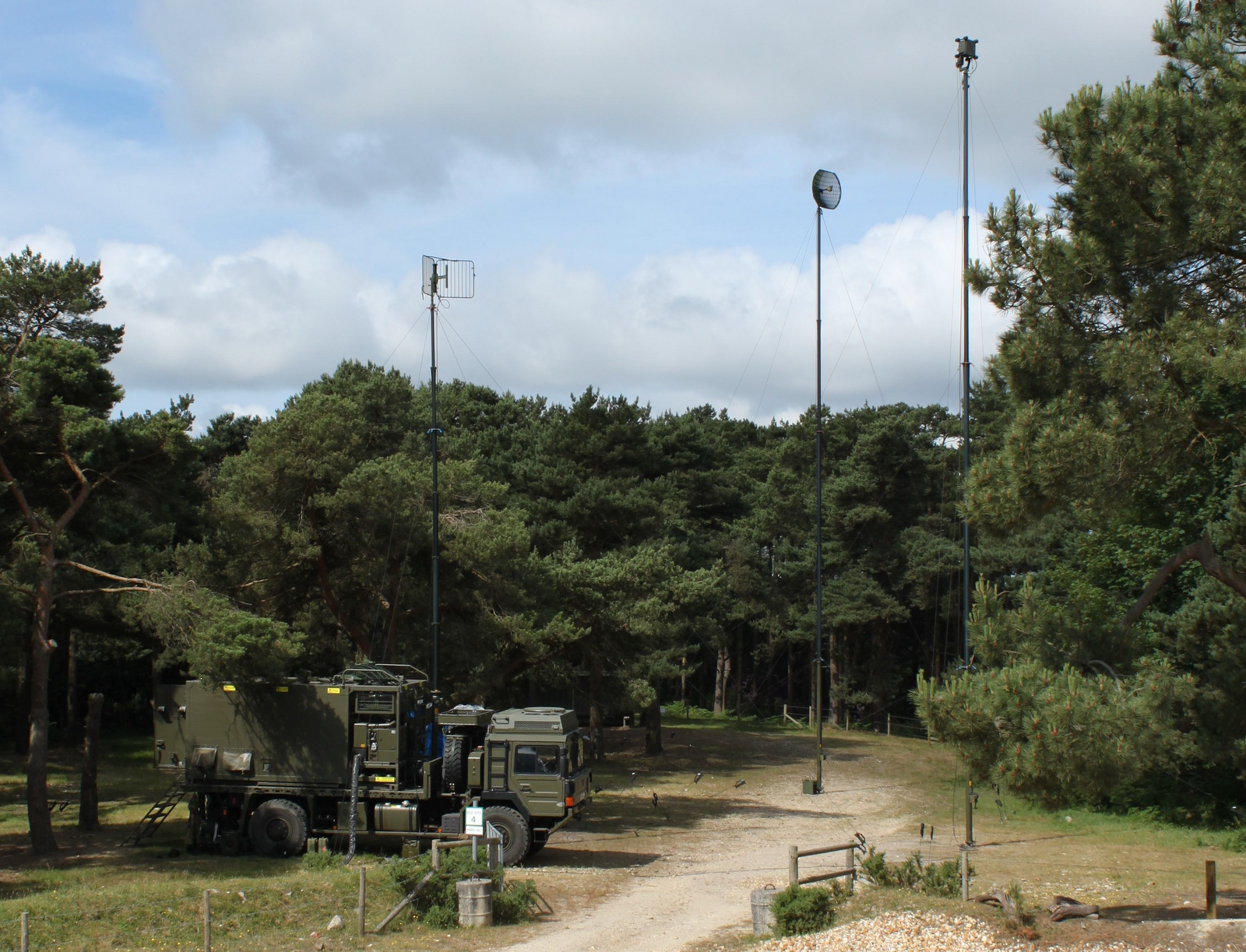
A FALCON WASP node deployed. Save for the mast deployed directly from the truck, the rest has to be assembled all times the node deploys. On the move, the node does not contribute to the network, and has very limited situational awareness via a Bowman tactical radio.
FALCON, as it works now, is roughly comparable to the US Army’s WIN-T (Warfighted InformationNetwork – Tactical) increment 1: it delivers a communication network using IP (Internet Protocol) infrastructure, with VoIP (Voice Over the Internet Protocol) capability, optimized for use in command posts down to battalion level, and with Networking-On-The-Halt capability: the command post arrives in the intended location, deploys, resets its systems and connects into the network.
On the move, communications services reduce to Bowman radios, which only ensure voice and basic data capability. When the command post transfers, most of its capability is lost until it deploys again. The FALCON network nodes themselves work only on the halt: on the move, they cease to be working elements in the network. 

On the move, FALCON stays silent.
The British Army seems set to be stuck at this point for undetermined time into the future, but the other allies in NATO are moving on from this limitations. Technology to overcome the problem is available. The US Army should start fielding in October the WIN-T increment 2, which introduces “On the Move (OTM)” capability all the way down to Company level. Crucial to this is the adoption of powerful Software-Defined Radios, capable to automatically switch channel (VHF, UHF, HF, satellite or military VoIP channel): with the SDR, the old separations in roles and capability vanish. If until now an operator had to be trained in the use of this or that channel and then issued with, say, a VHF radio that could talk only to other VHF radios, today an operator can talk to everyone, as the radios adapt automatically to the needs of the moment.
In addition, a radio which is moving on a vehicle, which is talking to another radio and loses the Line-Of-Sight contact, automatically switches, for example, to SATCOM to keep the communication going on.  
Testing is well underway, and by the end of next year, 8 BCTs might already be equipped with the system. 

The consequences of this improvement are immense, and far-reaching. The need for traditional headquarters which deploy and expand under canvas is reduced dramatically, as the commander can stay fully updated on the battle situation inside its vehicle on the move, be it a M1 Abrams, a Bradley or another.
Behind this capability, is the NetOps software, which dynamically assigns shares of bandwidth over the network to this or that unit, ensuring that no one can saturate the lines.
The physical infrastructure of the network inside a BCT is made up by 4 different kind of nodes:

TCN (Tactical Communications Node)
POP (Point of Presence)
SNE (Soldier Network Extension)
VWP (Vehicular Wireless Package)

The TCN node is the main hub of the system, and works as Satellite and Line of Sight node, with On The Move capability. In the US Army, the TCN is installed on FMTV (Family Medium  Tactical Vehicle) trucks. This is roughly comparable to the WASP node of FALCON, which is mounted on HX60 trucks. The FALCON node, however, has no OTM capability, as we said.  

US Army's TCN node, deployed along with other WIN-T elements, including a satellite dish. FALCON in the British Army will often work near a REACHER satellite node.


The echelon immediately lower inside the Network is supported by the POP network: the POP systems are installed on the tactical vehicles used by commanders and their staff, down to Battalion level.
Both TCN and POP use Highband Networking Radios (HNRs) for Line Of Sight communications, employing pulse directional antennas for directing a narrow signal (harder to intercept) over a greater distance. For Beyond Line of Sight (BLOS) communications, TCN and POP use satellite communication systems with antennas capable to electronically scan the signal and keep locked on to the satellite while the vehicle moves.

The capability to work On The Move being introduced in the WIN-T system is the start of a new era in military communications.


The SNE is the expansion of the Network down to the fighting Echelon at Company level. Installed on combat vehicles, the SNE node has a small satellite antenna and a VoIP modem that can reconfigure automatically to interface with all portable radios used by the soldiers, keeping the network working on the move, regardless of terrain and dispersion, by communicating with the main radio of a Platoon, which acts as node of connection to the personal radio of each soldier in the team. The US Army has selected as “Rifleman Radio” the AN/PRC-154 produced by a Thales/General Dynamics joint venture, of which a first lot of over 6000 was ordered in June 2011. The Rifleman Radio has been sent in Afghanistan for in-theatre experimentation with the 75° Ranger regiment last January, and reportedly met the favor of the soldiers for its low weight, its capability of talking regardless of obstacles in the way (crucial in rough terrain and, even more, in urban scenarios) and its 10 hours battery duration.

Finally, the VWP is a Local Area Network extension node, which keeps the command posts on the move linked in the LAN with the TCN nodes.

An US MRAP vehicle fitted with SNE node during trials of the WIN-T increment 2

Finally, the WIN-T Increment 3 to come in the near future will expand the network to aerial platforms, by fitting the Gray Eagle MQ-1C drone with a 150 lbs Highband Networking Waveform pod. This will act as a communications relay node working in Line of Sight (LOS) by dialoging with the vehicle-based nodes below, reducing the need for satellite use, a crucial factor since satellite bandwidth is, of course, finite. It is expected that 3 pods will be issued to each Gray Eagle company, so perhaps a single pod will go to each of the 3 platoons, each with 4 drones. The Americans have put a Gray Eagle company into each Combat Aviation Brigade, which is a divisional asset. Brigades have their own UAV element with the smaller, 6-hours endurance Shadow drone. For the British Army, the sole Watchkeeper works at brigade/division level.   
In Afghanistan, the US has been regularly using manned airplanes working as communication relay nodes as well. The installation of such pods on other high-flying, long endurance platforms is also envisioned and experimented. 
[NOTE: the above is a quick and simplified overview of what is a very ample and complex system of systems. A complete view of all components and structures of the WIN-T network is in this document, but don't be surprised if you don't quite get it all, it's quite complex!]

The British MOD itself tested a communications relay pod on the Qinetiq Zephyr solar-powered drone, holder of the world record for endurance in flight for a UAV (some 14 days at 21.500 meters of altitude), even if lately it has apparently vanished from the radars. The Zephyr aims (aimed?) to deliver a lightweight drone capable to stay over the battlefield for months, making it a good, low-cost alternative to satellites.
The Watchkeeper drone should also have some margin for additional payload (weapons are an option being studied, and the Hermes 450 from which it derives can be fitted with two fuel tanks for 50 liters each under the wings), so a comms-relay payload might be a possible fit for the future.
Again, British company ALLISOPP HELIKITE offers a variety of small kite-balloons (the smallest is only 3 feet long) that can be used to launch at altitude a radio antenna offering immediate, long range relay of signals.
The options are there to exploit, in other words.

The Future FALCON, which is meant to deliver communications support to the maneuver forces, including those on the move, is absolutely crucial for the Army’s future capability, I repeat once more, and I find it abysmal that Agile Warrior is not used to assess, measure and explain the full range of needs of the deployed forces on the field. Lack of money is not in itself a justification for even refusing to honestly face reality and find solutions. If the Army’s “innovative thinking” is just a way to hide the dust under the carpet, then they should save the money and effort of going on with these annual exercises and “studies”.


Moving on, to ISTAR.

Robust ISTAR structures at each level of command are essential to meet future contingent needs. Whilst forming a bespoke IX/ISTAR Group on operations (as seen on Op HERRICK) may be an option it should not necessarily be the default setting (1). What is needed is better alignment of collection assets and the process of collection management, with that of Information Requirements Management in order to better support a commander’s decision making with an analysed output (Intelligence). The key to success is the effective grouping of special-to-arm I, S, TA, R force elements in barracks, holding them at the appropriate readiness and force generating them at the right stage of the supported HQs Collective Training; CT5 and CT6 events must include the full suite of ISTAR capabilities.

Specialist support must be scalable and adaptable to the HQ structure; start small (lean) and get bigger as required. Following the ‘plug and socket’ philosophy, which is a key tenet of the A2020 proposition (2), there is a need for a combination of better educated generalists with appropriate training and experience to be core staff members in Battlegroup, Brigade and Divisional HQs, responsible for integrating ISTAR; and specialists (EW, UAS, HUMINT, GMR etc) that are task-organised when required to bring professional/SME advice and input to both collection (FIND) and exploitation.  

[…]

Each deployed brigade should have its own organic ground mounted recce, Intelligence, Communication, Geo and Battlespace Management elements. The division may require the development of a bespoke deployable reconnaissance / surveillance organization that manoeuvres to find but in direct support of
divisional information requirements.

A One-Star proponent (Capability Director Information) will reinforce the professionalisation of ISTAR as a discipline and bring coherence to its delivery. (3)

Consideration should be given to introducing a tactical intelligence career stream for infantry and armoured
Regiments.
  

(1)    This appears to be a direct contradiction of what the Army said in Agile Warrior 2011, where an Information Exchange/Exploitation group was assessed as needed at each brigade level, somewhat mirroring 3rd Commando Brigade with its 30 Commando IX group.
(2)    It would be nice to see some explanation given about this philosophy, which is mentioned only in passing, in such a casual way. Who follows my blog and has followed with me the Army 2020 sage knows that the new force structure suggests that deploying brigades will “pick” “this” artillery battery/regiment, “that” Theatre ICS Signals Regiment and “that” one Logistic element from the “container” brigades of the Force Troops command, but no official explanation of this has been released yet, nor do we know how this choice was made.
(3)    Possibly this will be the brigade HQ of the newborn Surveillance and Intelligence brigade, of which we still ignore the composition, even though I’ve long been saying that I expect it to reunite Royal Artillery UAV regiments and Military Intelligence battalions, plus perhaps even the STA regiment of the artillery.  


Another crucially important area is the retention of Afghanistan UORs to bring into the Core Budget.
About this, AW12 says:

Fires, Targeting and ISTAR.
• Retain the significant enhancement in collect capability
• Retain and nurture the significant enhancement in staff dissemination and processing skills.
Lethality.
• Review of training progression and the use of simulation.
• Maintain the competence levels among reserves and support forces across the wide spectrum of new weapon systems that they have used.
Counter-IED.
• Future training will need to balance between scenarios constrained by an IED environment with training for operations that demand speed of manoeuvre.
• UK must maintain its world class R&D and manufacturing capability.

[Note: in here, I hoped to find an indication about Talisman being retained. It would be endlessly stupid to once more throw away the route clearance capability. For 20 or more years, the British Army has been dealing with mines and then IEDs, across Serbia all the way to Iraq and Afghanistan. It sunk huge amounts of money on studies and development and acquisition of several clearance systems, then quickly junked them, only to restart again from scratch in the following mission abroad. PLEASE, don’t let Talisman be the next one system developed, used, junked and then soon afterwards missed.]

Vehicles
• Those vehicles used to provide Equipment Support must have mobility and protection matched to those
that they are supporting. [So? Husky, Coyote, Foxhound to stay…?]
• Future fleet requirements must enable units to train as they fight as opposed to wholesale conversion to type prior to deployment.
Dismounted Close Combat
• A coherent assessment of night operating capability is required.
ISTAR / Base ISTAR
• Need for an integrating hub for all ISTAR collect assets.
• Provision of robust Full Motion Video capable Information Support Service, separate from Base
ISTAR infrastructure should be investigated in order to support contingent operations.
There is an enduring requirement for a layered ISTAR mix ranging from heavy to light and including a capable aerostat. [Good news for Project Outpost, meant to preserve for the future some of the Cortez BASE-ISTAR system used to provide security for FOBs in Afghanistan. It includes 5 PGSS aerostats bought from the US]
• Provision of simulation in support of ISTAR training.
• ISTAR Specialists must be made available for Level 3 Collective Training activities, and above.
Aviation
• Enhanced Defensive Aid Suites are fundamental for the use of aviation, particularly as the future airspace is likely to be increasingly contested.
Training
• The investment in training in support of current operations, and its clear benefits, has been hard earned and must be retained
• Tactics Techniques and Procedures (TTPs) that have evolved during HERRICK (and which will have utility in
future operating environments) need to be hard wired into training and Tactical Doctrine.
Next Steps:
• Output has informed Army 2020 and will be used to inform MoD and Army capability balance of investment decisions.
• Study continues on this theme in 2012.


The Aerostat used by Cortez is the Persistent Ground Surveillance System (PGSS) (25,000 ft3) is an helium-filled tethered blimp that can raise a payload of up to 150 pounds to 1,200-2,000 feet and remain aloft for up to two weeks.  The mainstay PGSS payload is a (98 pound) L-3 Wescam MX-15 EO/IR sensor, but the turret can accommodate most any payload or payload combination of up to 150 pounds.  PGSS has carried various acoustic (shot/mortar identication) sensors and a SIGINT payload could be another option as well.

The coverage offered by the PGSS with the MX-15 EO/IR payload is as follows: it can detect a vehicle at 18km; identify a vehicle at 12km; detect a man at 12km; identify a man at 4km. It is filled with Helium in around one hour, and can stay in the air for a couple of weeks. While up in altitude, the aerostat resists to 60 knots winds, and can be launched with 20 knots. The mooring station of the aerostat weights some 16.000 lbs, but work has been made to try and make it helicopter-portable for easing future deployments.

These were procured from the US, but apparently the UK has been leading the way on a smaller, far more deployable kind of floating surveillance device, the HeliKite, which combines features of kites and aerostats and comes in a far smaller and easier to manage package that can be used to keep up in the air surveillance sensors or even communication relay systems. These HeliKites are produced in the UK, by the already mentioned company, ALLSOPP HELIKITES. Now this is more an example of what I call innovative thinking.


These are the highlights from Agile Warrior 2012. I find very, very little to hail as innovative, imaginative, or particularly reassuring, apart from the fact that Cortez kit should be safe, along with quite a lot of other UOR material.
Then again, judging from the IX group, last year mandated as priority and now described as an option at best (and one to avoid if possible, probably due to the manpower capping at 82.000 regulars), Agile Warrior 2013 could again cut back on ambitions.

I appreciate the effort the Army is making, and I recognize the challenges it is facing. But Agile Warrior so far has been absolutely unimpressive. And I have the feeling that it is not doing much to actually inform decisions.
It seems more like it justifies them once they are taken.